"A New York Treasure" --Village Voice

Daily Archives: August 11, 2008

Permanent Press

The pressure is on the Yankees and it shows.  Our boys are cracking.  They are flat, they are pressing.  Pick any cliche you like.  Most any one will fit.

Against Glen Perkins, a soft-tossing left-hander (okay, he can throw 92-93, still, he’s not throwing cheese), they were hacktastic, seemingly without an offensive game-plan.  As John Flaherty mentioned time and again on the YES broadcast, the Yankee hitters looked frustrated as they swung early and often, putting themselves in the hole, before Perkins put them away.  The Yankee hitters just missed a host of pitches–Nady, Sexson, Cano…Pudge Rodriguez had at least three good hacks at fat pitches that he couldn’t put in play.  Perkins threw eight shut out innings; while stuff is not overly impressive, he worked quickly and threw strikes.  Joe Nathan struck out the side in the ninth.

The Yankees had four cruddy hits as they lost 4-0.

The closest thing they had to a rally came in the second when Cano singled to start the inning and then advanced to third on a wild throw by Perkins.  Sexson walked but Pudge Rodriguez popped out and couldn’t bring the run home.  Melky Cabrera swung at the first pitch he saw and bounced into a 6-4-3 double play. 

The futile offensive showing stings even more when you consider that Sidney Ponson actually threw a nice game.  He gave up a two-out walk in the second and then a two-run homer to Adam Everett.  The Twins manufactored another run in the sixth (double, sacrifice bunt, sacrifice fly), and then hustled another one across the plate in the eighth.  Otherwise, Ponson worked quickly and efficiently.

Joe Girardi’s decision to sit Johnny Damon in favor of Justin Christian (0-4), a move that was openly questioned by the Yankee broadcast team of Flaherty and Michael Kay, will be fodder for blogs, tabloids and talk radio tomorrow.  "It’s getting hard to explain what’s going on," said Kay when it was all over.

Honestly, there is plenty to be vexed about if your team is the Yanks.

At least it was brisk.  The game took two hours and fourteen minutes to complete.  I can’t tell if that’s a good thing or just something else to be furious about.


Minnesota Twins III: Back Where We Started Edition

UntitledThree weeks ago, the Twins arrived in the Bronx holding a two-game lead over the Yankees for second place in the Wild Card race. The Yanks swept past Minnesota in that week’s three game series, but have since fallen back into the back. As a result, the Yankees head into Minneapolis tonight once again trailing the Twins by two games for second place in the Wild Card race.

While the Yankees have been struggling to remain relevant to the Wild Card picture, the Twins have had bigger fish to fry. Three days after leaving New York, the Twins hosted the AL Central-leading White Sox and took three of four games to close the gap atop the central to a half a game. Since then, the Twins have twice slipped past the Pale Hose, only to slip back behind them the next day. They enter tonight’s action trailing the Chisox by just a half game and the two teams have been within 1.5 games of one another for the past week.

The Twins have been hanging tight in the Central all year, and a week ago they finally brought rehabilitated lefty ace Francisco Liriano up to replace aged innings eater Livan Hernandez in the rotation. The Yankees are fortunate not to have to face Liriano (2-0, 2.31 since being recalled) this week, but given the Twins’ spectacular record at home (.650 winning percentage), and the fact that Minnesota actually has something to fight for, they’ve got their work cut out for them anyway.

The Yanks split a four-game series in the Homer Dome as May turned into June, and will kick this week’s three-game set off tonight by sending Sidney Ponson to the mound against Glen Perkins. Ponson has faced the Twins thrice already this year. He pitched 5 2/3 innings in the opening game of the Yankees’ July sweep and picked up a win thanks to 12 runs of support. His first start of the season saw him pitch 5 1/3 innings against the Twins in Texas, give up four unearned runs, and take a no-decision. His one start at the Metrodome, however, was one to dream on, a 110-pitch complete game in which Sir Sidney allowed just one run on six hits and a walk while the Rangers cruised to a 10-1 victory. Perkins, meanwhile, has faced the Yankees twice, once in each location, both times coughing up five runs, which is exactly what he did against the Mariners in his last start as well.

The lefty Perkins won’t have to deal with Jason Giambi or the hot-hitting Johnny Damon tonight, as Richie Sexson gets the start at first base and Justin Christian starts over Damon in left field with Xavier Nady DHing. Damon DHed in both weekend games after slamming his sore left shoulder into the wall on Friday night in pursuit of a rocket hit off Ian Kennedy, so it seems likely that Joe Girardi is simply using the opposting lefty as an excuse to give Damon a needed day off. Still, starting both Christian and Melky Cabrera over Damon hurts, as Damon has had two singles in each of the last five games, is hitting .370 over his active 11-game hitting streak, has hit .333/.413/.420 with five steals in as many tries since being activated from the DL after nursing that same sore shoulder back to relative health, and, if you hadn’t noticed, is actually leading the league in batting average. Similarly, while Sexson has quietly hit .292/.400/.458 as a part-timer since joining the Yankees, the clean-shaven Giambi is hitting .313/.500/.875 with three home runs on the current road trip.

(more…)

Card Corner–Ed Figueroa


Untitled

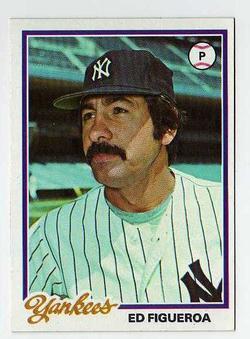
Perhaps we should call him "Forgotten Figueroa." For most Yankee fans, the 1978 season triggers memories of Ron Guidry’s Cy Young performance, Reggie Jackson’s stirring presence in the lineup and locker room, the mid-season transition from Billy Martin to Bob Lemon, and, of course, the looming specter of "The Boss." Yet, no one ever talks about Ed Figueroa’s contribution to the cause. Pitching in the thin but substantial shadow of Guidry, Figueroa (as seen here on his 1978 Topps card) quietly won 20 games, gobbled up 253 innings, and gave the Yankees a perfect right-handed complement to "Louisiana Lightning." Heck, on most teams, Figueroa would have qualified as a full-fledged ace, a natural to start a one-game playoff tiebreaker or the first game of a World Series. But on the ’78 Yankees, Figueroa was the proverbial second banana—the Vida Blue to the A’s Catfish Hunter, the Dave McNally to the Orioles’ Jim Palmer, the Frank Tanana to the Angels’ Nolan Ryan.

Aside from the obvious Guidry factor, why has Figueroa faded so much in our collective memories? Several factors may be conspiring against Figgy. First, he wasn’t overpowering, lacking the strikeout ability that both mainstream and Sabermetric types seem to favor. By the time that Figueroa traded in his Angels halo for Yankee pinstripes (as part of the Bobby Bonds for Mickey Rivers swap), he had become a four-pitch pitcher: fastball, slider, curve, and change-up. He threw mostly a sinking fastball, which he liked to mix and match with his breaking and off-speed pitches. That didn’t add up to a lot of strikeouts, just a lot of quiet effectiveness during his halcyon days from 1976 to ’78.

Then there was Figueroa’s lack of staying power. As good as he was during the Yankees’ mini-dynasty, topped off by his peak in 1978, he faded quickly from the scene. He threw a lot of innings in the mid-1970s. Over a four-year span, he averaged 248 innings per season, a substantial workload that became exacerbated by an awkward motion. In his wind-up, Figueroa tucked his left leg and left arm in toward his mid-section; by the time he put himself in position to deliver the pitch, he was throwing the ball across his body. It was a fun delivery to imitate (as I know well from hours of throwing a ball up against a boulder outside of my house), but it sure did appear to put extra stress on the arm and shoulder. Figueroa’s arm problems began in 1979; by 1981, he was fully cooked.

Finally, Figueroa’s personality may have soured any hopes of long-term appreciation. Figgy had his share of run-ins with Billy Martin (then again, who didn’t?) and the manager’s enforcment of his own strict set of policies regarding his pitchers and their approach against each batter. Portrayed as surly by some of the New York media (which may or may not be fair, given the treatment of Latino players by some writers), Figueroa came across as dour to a young fan like me. When I think of Figueroa, I envision the "Lieutenant Castillo" character that Edward James Olmos once portrayed on "Miami Vice." Yes, he was highly effective and very good at his job, but not exactly someone you’d send an invitation to amidst hope that he’d enliven the atmosphere at your local block party.

Given Figueroa’s mix of pitching style, longevity (or lack thereof), and personality, we are left with a retired pitcher who often attends Old-Timers’ Day at the Stadium but remains a figure wrapped in obscurity. With that in mind, here are a few things that you may or may not know about Ed Figueroa.

*A veteran of the Vietnam War, Figueroa saw the start of his major league career delayed by military service in 1969. He missed all of that minor league season while in the war, losing a valuable year of development. Figgy didn’t make the major leagues until 1974, when he was already 25 years of age. He probably would have arrived a year or two sooner, if not for Nam.

*By winning 20 games for the ’78 Yankees, Figueroa became the first Puerto Rican pitcher to achieve the milestone, ending a drought that began with Hiram Bithorn’s debut in 1942. Juan Pizarro, a 131-game winner for his career, never won 20. Neither did Ruben Gomez. Today’s winningest Puerto Rican pitcher, former Yankee Javier Vazquez, has never won more than 16 in a single season. Figueroa might have reached the milestone even sooner, had a late-season game in 1976 not been rained out. Figueroa settled for a 19-10 mark that year, emerging as a major factor in securing the Yankees’ first pennant in a dozen years.

*Because of arm troubles, Figueroa’s prime ended by his 28th birthday. After the 1978 season, he never pitched more than 104 innings and never had another winning season. By the time he was 32, Figueroa had thrown his final major league pitch as a member of the Oakland A’s.

Figueroa will never make the Hall of Fame, never receive the loudest cheers at Old-Timers’ Day, and never have his number retired by the Yankees. But he deserves to be remembered as an essential piece—the right-handed anchor—of the ’78 Yankees. Without him, there would have been no tiebreaker against the Red Sox, no playoff appearance against the Royals, and no World Series date with the Dodgers. It’s long overdue, but we just want to say thanks, Figgy.

Bruce Markusen, an avid fan of the ’78 Yankees, writes "Cooperstown Confidential" for MLBlogs at MLB.com.


Big Daddy

 Soul legend Isaac Hayes passed away on Sunday.  He was 65. 

Untitled 

Hayes is most famous for composing the title theme to "Shaft," but he did far more than that.  

Along with David Porter, Hayes was the major creative force behind Stax Records in the Sixties–their most enduring work is the classic, "Soul Man."  His vocal stylings paved the way for Barry White, and years later, Hayes, a Scientologist, had a successful cameo on "South Park."  

Dag, another meaningful loss.   

I love Hayes’ moody rendition of "Walk on By":

feed Share on Facebook Share on Twitter Share via email
"This ain't football. We do this every day."
--Earl Weaver
