"A New York Treasure" --Village Voice
Category: 1: Featured

Joe Blanton Would Be Proud

Pat Jordan’s latest for SB Nation Longform:

I had the stuff. I just didn’t have the heart. Or, more precisely, I always had the stuff, which was why I never had the heart. I didn’t need it. Then, in the arrogance of youth, with those early years of effortless success in Little League, American Legion, and high school, all the no-hitters and one-hitters and bushels of strikeouts, I felt indomitable. Eventually, however, when it all went south in my 20s, it dawned on me, dimly, that maybe my stuff wasn’t enough, that I lacked something.

I tried to find it, too late, without a clue as to what it was. I looked for something outside myself, a new pitch, a new motion, when I should have been looking elsewhere, inside myself for that “thing” beyond just “stuff” that every great pitcher has. Some not-so-great pitchers have it , too, the workmanlike plodders, the serviceable, fourth or fifth starters on a staff of superstars, the Joe Blantons grinding it out in the shadows of bigger names, Doc Halladay, Cliff Lee, Roy Oswalt and Cole Hamels, his teammates when he was with the Phillies.

Pitchers like Blanton are good enough to go six innings on their good days, give up maybe nine hits and three earned runs, just enough to keep their team in the game, with a chance to win it in the eighth or ninth inning. I always liked guys like that, with mediocre stuff at best, who persevered, and survived 12, or 14 years, with a record of something like 102-103, and an ERA of 4.59. They pitched into their late ‘30s, maybe made a lone All-Star appearance the year they had a good first half and finished 13-11, then retired with a few big contracts under their belt, perhaps enough to buy a small farm in the Piedmont of North Carolina.

Of course, I also admired great pitchers with the big stuff: Warren Spahn, Bob Feller, Sandy Koufax, Tom Seaver, and Justin Verlander. I admired, too, the very good pitchers with nice stuff: Vic Raschi, Bob Lemon, Robin Roberts, C.C. Sabathia, James Shields, and my old minor league teammate, Phil Niekro. But over the years, I have most learned to appreciate the Joe Blantons of baseball, the bricklayers of their craft like Livan Hernandez, Mark Buehrle, and Tony Cloninger, my minor league teammate. I had better stuff than all of them put together, except for Tony, yet I lasted only three years in the minors, while they all pitched successfully in the major leagues for years.

What did they have that I lacked? Fifty years after my failure, I’m still searching for the answer to that question.

[Photo Credit: Chris Daines]

The Unthinkable

Tough but well-written story about the aftermath of the Newtown shooting by Eli Saslow in the Washington Post:

They had promised to try everything, so Mark Barden went down into the basement to begin another project in memory of Daniel. The families of Sandy Hook Elementary were collaborating on a Mother’s Day card, which would be produced by a marketing firm and mailed to hundreds of politicians across the country. “A difference-maker,” the organizers had called it. Maybe if Mark could find the most arresting photo of his 7-year-old son, people would be compelled to act.

It hardly mattered that what Mark and his wife, Jackie, really wanted was to ignore Mother’s Day altogether, to stay in their pajamas with their two surviving children, turn off their phones and reward themselves for making it through another day with a glass of Irish whiskey neat.

“Our purpose now is to force people to remember,” Mark said, so down he went into his office to sift through 1,700 photos of the family they had been.

The Bardens had already tried to change America’s gun laws by studying the Second Amendment and meeting with President Obama in the Oval Office. They had spoken at tea party rallies, posed for People magazine and grieved on TV with Katie Couric. They had taken advice from a public relations firm, learning to say “magazine limits” and not “magazine bans,” to say “gun responsibility” and never “gun control.” When none of that worked, they had walked the halls of Congress with a bag of 200 glossy pictures and beseeched lawmakers to look at their son: his auburn hair curling at the ears, his front teeth sacrificed to a soccer collision, his arms wrapped around Ninja Cat, the stuffed animal that had traveled with him everywhere, including into the hearse and underground.

Almost six months now, and so little had gotten through. So maybe a Mother’s Day card. Maybe that.

Mark turned on his computer and began looking for the right picture. “Something lighthearted,” he said. “Something sweet.” He had been sitting in the same chair Dec. 14, when he received an automated call about a Code Red Alert, and much of the basement had been preserved in that moment. Nobody had touched the foosball table, because Daniel had been the last to play. His books and toy trains sat in their familiar piles, gathering dust. The basement had always been Daniel’s space, and some days Mark believed he could still smell him here, just in from playing outside, all grassy and muddy.

Now it was Daniel’s face staring back at him on the computer screen, alit in an orange glow as he blew out seven candles on a birthday cake in September.

[Photo Credit: Linda Davidson/The Washington Post]

The Boom Bip


Via Ego Trip, here’s a good, long interview with Q-Tip. Just when you thought Tip was an unbearable flake you watch something like this and understand what he’s about. Sure, there is some self-consciousness but he’s an artist, after all. Beyond that, he’s funny and smart and it’s a good interview. Oh, and skip ahead to the 50:30 mark to hear a snippet of Primo’s incredible demo version of Nas’ “Memory Lane.” Can’t get it out of my head, man.

Mr. Incognito

Photographs by Miroslav Tichy. 

BGS: The Passion of Dr. J

A treat from Mark Jacobson. Originally published in Esquire in 1984 and anthologized in Teenage Hipster in the Modern World, a stellar collection of Jacobson’s non-fiction. Reprinted here with the author’s permission.

Author’s note:

Michael Jordan is certainly the greatest basketball player of all time, but Julius Erving, the incomparable Doctor J, is my all-time favorite. No one ever gave me as much pleasure watching any kind of game. Since his retirement, Julius has been the subject of a number of distressing headlines, exactly the sort of stuff he sought to avoid during his career. He acknowledged the tennis player Alexandria Stevenson to be his out-of-wedlock daughter. Later, his son Cory drove his car into a lake in Florida and drowned. These are unfortunate, sad events, but even more so when connected to someone like Julius, who was once so effortlessly perfect. I’ve written numerous articles on sports figures, most of them basketball players, but Julius remains my number one. The fact that he used to pick me up at the Philadelphia train station in his Maserati, nearly unthinkable for a current-day player, is still one of highlights of my career. From Esquire, 1984.


I went for a ride through downtown Philadelphia with Julius Erving in his Maserati the other day, and with each passing block it became more apparent: Julius cannot drive very well. It wasn’t a question of reckless speed or ignored signals. Rather, he seemed unsure, tentative. His huge, famous hands clutched the steering wheel a bit too tightly, his large head craned uncomfortably toward the slope of the windshield. He accelerated with a lurch; there was no smooth rush of power. Obvious openings in the flow of traffic went unseen or untried. All in all, it reflected a total absence of feel.

This struck me as amusing—Julius Erving, the fabulous Doctor of the court, driving a Maserati with an automatic transmission.

Just an hour before, I’d compared the act of seeing Julius play basketball to Saint Francis watching birds in flight. It was my Ultimate Compliment. When a reporter with pretensions meets an Official Legend, especially a Sports Legend, it is mandatory to concoct the Ultimate Compliment, something beyond a plebeian “gee whiz.” Something along the lines of the august Mailer’s referring to Ali as a Prince of Heaven, whose very gaze caused men to look down. Or, perhaps, Liebling’s mentioning that Sugar Ray Robinson had “slumberland in either hand.” Saint Francis was what I’d come up with.

Viewing Doctor J move to the hoop inspired what I imagined to be an awe similar to what Saint Francis felt sitting in a field with the sparrows buzzing overhead, I told Julius. It was as if a curtain had been parted, affording a peek into the Realm of the Extraordinary, a marvelous communication that ennobled both the watcher and the watched equally. What wonders there are in the Kingdom of God! How glorious they are to behold!

“What you do affirms the supremacy of all beings,” I told Julius as we sat in the offices of the Erving Group, a holding company designed to spread around the wads of capital Julius has accumulated during his career as Doctor J. Large gold-leaf plaques calling Julius things like TASTEE CAKE PLAYER OF THE YEAR dot the walls. “Seeing you play basketball has enriched my life,” I finished.

“Thanks, thanks a lot,” Julius said politely. Then again, Julius is always polite. It was obvious, my Ultimate Compliment clearly did not knock his socks off. It was as if he were saying, “Funny thing, you’re the third guy who’s told me that today.”

Every serious hoop fan remembers the first time he saw Julius Erving play basketball. My grandfather, a great New York Giants baseball fan, probably had the same feeling the first time he ever saw Willie Mays go back on a fly ball. There was Julius, mad-haired and scowl-faced, doing what everyone else did, rebounding, scoring, passing, but doing it with the accents shifted from the accepted but now totally humdrum position to a new, infinitely more thrilling somewhere else. Who was this man with two Jewish names who came from parts unknown with powers far greater than the mortal Trailblazer?

Flat out, there was nothing like him. No one had ever taken off from the foul line as if on a dare, cradled the ball above his head, and not come down until he crashed it through the hoop. Not like that, anyway. Julius acknowledges a debt to Elgin Baylor, whom he calls “the biggest gazelle, the first of the gliders,” but, to the stunned observer, the Doctor seemed to arrive from outside the boundaries of the game itself. His body, streamlined like none before him, festooned by arms longer and hands bigger, soared with an athletic ferocity matched only by the mystical, unprecedented catapult of Bob Beamon down the Mexico City runway, or by the screaming flight of Bruce Lee.

Has any other individual in team sports radically altered the idea of how his particular game should be played to the degree Julius has? Jackie Robinson? Babe Ruth? Jim Brown? A more instructive comparison would be someone like Joe DiMaggio. DiMaggio was impeccable, the nonpareil. He was simply better. Yet there is something hermetic about Joe DiMaggio. He did what everyone else did, but with incomparable excellence. Joe’s exemplariness is to be admired, but it doesn’t offer a whole program of reform. His greatness is a dead end, specific to Joe and Joe alone. Julius, on the other hand, may not have invented the slam dunk, the finger roll, or the hanging rebound—the entire airborne game in general. But he certainly popularized it, and by doing so he announced that others could follow in his footsteps, even surpass him. Seeing Julius fly to the hoop spread the news: it can be done, so do it. Nine years ago Julius appeared alone in his ability to go pyrotechnic at any time. This past year, however, lined up against a gaggle of his poetic offspring, “human highlight film” youngbloods like Dominique Wilkins and Larry Nance, Julius was content to make his final attempt a running foul-line takeoff: the “classical” dunk, a bit of archaeology demonstrated by the father of the form.

Befitting the matter-of-factness of a legend discussing his craft, Julius is not falsely modest about his contributions to the game. In the clinical fashion he employs when delineating the x’sand o’s of his profession, he says, “I’d say I’ve had an effect in three main areas. First, I have taken a smaller man’s game, ball-handling, passing, and the like, and brought it to the front court. Second, I’ve taken the big man’s game, rebounding, shot-blocking, and been able to execute that even though I’m only six-foot-six. What I’ve tried to do is merge those two types of games, which were considered to be separate—for instance, Bill Russell does the rebounding, Cousy handles the ball—and combine them into the same player. This has more or less changed the definition of what’s called the small forward position, and it creates a lot more flexibility for the individual player, and, of course, creates a lot more opportunities for the whole team. The third thing I’ve tried to do, and this is the most important thing, is to make this kind of basketball a winning kind of basketball, taking into account a degree of showmanship that gets people excited. My overall goal is to give people the feeling they are being entertained by an artist—and to win.”

Then Julius laughs and says, “You know, the playground game … refined.”

In Roosevelt, New York, the lower-middle-class, largely black Long Island community where he grew up, there is a playground with a sign that says THIS IS WHERE JULIUS ERVING LEARNED THE GAME OF BASKETBALL. Herein lies Julius’s triumph. He successfully transmuted the black playground game and brought that cutthroat urban staple to its most sumptuous fruition. He, once and for all, no turning back, blackified pro basketball.

He did it by forcing the comparatively staid, grind-it-out, coach-dominated NBA to merge with the old ABA, a semi-outlaw league that played the run-till-you-drop “black” playground game with a garish red, white, and blue ball. Julius was in the ABA, and the older, more established NBA could not allow a phenomenon like Doctor J to exist outside its borders. Most observers feel the NBA absorbed the whole funky ABA, with its three-point shots and idiotic mascots, just to get Julius. Once they did, the entire product of pro basketball was refocused. Surprise! The ABA, comprising many performers from Podunk Junior College and some who never went to any college, had a lot more than Julius Erving. Many players long scorned by the NBA brass became stars, the incandescent “Ice,” George Gervin, and Moses Malone among them. And there was a lot more running. Before the merger there was only one consistent fast-break team in the NBA, the Celtics. Now, with the ABA people around, it seemed as if the whole league was running, playing the playground game, Julius’s game.

This is not to say Larry Bird isn’t great, no matter where the game is, on the back lawn of Buckingham Palace or up in Harlem, but blackification was inevitable. No one will really deny that the majority of black players jump higher and run faster than the majority of white players, and that’s what pro ball, as it’s currently constituted, is all about—running and jumping with finesse.

Many people have wondered if all this running is such a good thing. Since the merger and the takeover by the “black” game, the pro sport has suffered reversals. Attendance is uneven and TV ratings are down; rumors of widespread social evils among the players abound. It is difficult to have any in-depth conversation about the status of the league without coming up against the Problem. A league official says, “It’s race, pure and simple. No major sport comes up against it the way we do. It’s just difficult to get a lot of people to watch huge, intelligent, millionaire black people on television.”

When presented with the notion that by elevating his art he may have served to narrow its appeal, Julius says, “It’s unfortunate, but what can be done about what is?” Well, at least the onset of the playground game has exploded several pernicious myths. If there is one thing Julius and his followers (Magic Johnson comes to mind) have proved without a doubt, it’s that just because you play “flashy” doesn’t mean you’re not a team player. No longer is it assumed that the spectacular is really, at its root, just mindless showboating easily thwarted, in the crunch times, by the cunning of a small man chewing a cigar on the coaching lines. Julius’s teams have always won.

For the hoop fan, though, likely the most treasured item concerning Julius Erving remains in that first cataclysmic moment of discovery, that first peek into the Realm of the Extraordinary. This has to do with the nature of the fan, the hoop fan in particular. All team sports have their cognoscenti, gamblers poring over the injury lists, nine-year-old boys with batting averages memorized, but somehow the variety of fan attracted to pro basketball is in a slightly more obsessive class, sweatier, seedier perhaps, but absolutely committed. This type of hoop fan I’m talking about isn’t much different from the jazz buffs of the 1940s and 1950s, white people digging on an essentially black world.

How Julius, the Official Legend, comes into this is that he approached the beady consciousness as Rumor. He was a secret. He wasn’t a well-publicized high school star like Kareem; he went to the University of Massachusetts (a school with no basketball reputation) and then played two years at one of the ABA’s most remote outposts, the Virginia Squires. There was no hoopla surrounding him, no Brent Musburger hyping the size of his smile. The Doctor was something for the grapevine.

It cuts both ways. Probably, by somehow staying out of the limelight (that was easier in 1970) and by choosing not to go to a “big program” school where a crusty Adolph Rupp might have made it a principle to correct all that boy’s strange habits, Julius was left alone to create his wholly new thing. And by virtue of this anonymity, the hoop fan was able to come upon Julius as a wondrous found object.

Magic Johnson, Sugar Ray Leonard—no one is knocking their talents, but they arrived on the scene tied in a bow, sold to anyone within eyeshot of a TV. They will always carry that stigma. Julius, however, remains eternally cool. You had to work to see Julius, seek him out. There wasn’t any cable; maybe you could catch him on an independent station that had been hustled into picking up one of the numerous ABA All-Star games. Even after he came from the Squires to the Nets, then the ABA New York entry, the hoop fan had to ply the forlorn parkways to the Nassau Coliseum to sit with four thousand dour faces expressing regret that they weren’t viewing a hockey game. You had to go out of your way to see Julius. But it was worth it. When you saw that Rumor was Fact, and a far more remarkable Fact than imagined, then you felt like you had your little bond with Julius, that he was in your heart.

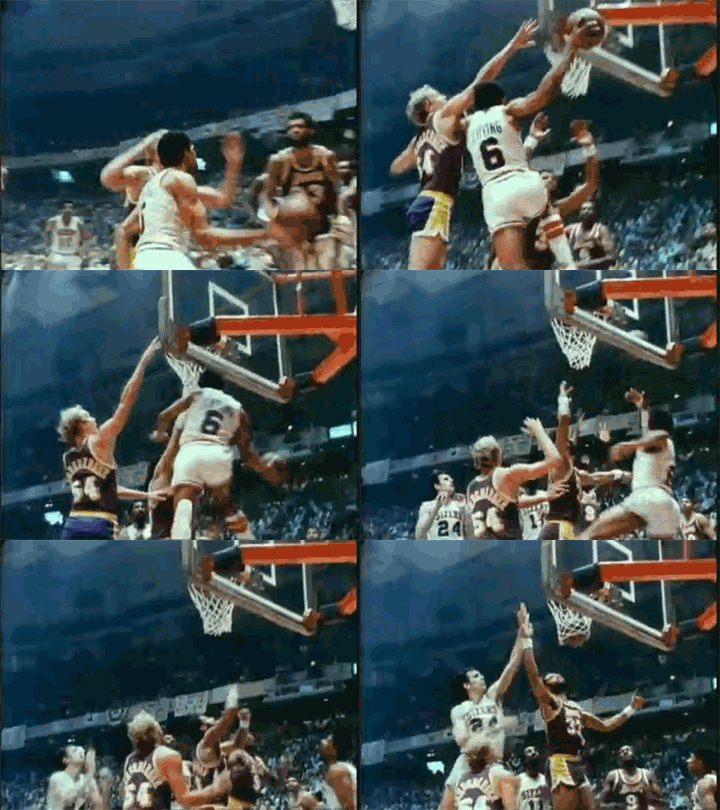
That Julius has maintained the quality of play this long is gravy. How do you measure the benefit one gets from seeing beautiful things happen? Sometimes I find myself idly replaying some of Julius’s more astounding moves inside my head. The one against the Lakers in the championship a few years back, the one where he goes behind the backboard and comes around for the reverse layup? Ones like that bring tears to my eyes. Really.

Of course, it can’t last. Last season Julius’s club, the Philadelphia 76ers, for whom he’s played since the league merger in 1976, were mangled by the bedraggled New Jersey Nets, transplanted to the Garden State from Uniondale, New York. It was an upset. The year before the Sixers won the title in a near walkover. Of the thirteen games they played in the championship rounds, they won twelve. The Sixers didn’t come close to repeating. Julius did not have a particularly good series. There were several reasons. For one, it had been a grueling season for the Doc. Numerous Sixer injuries forced him to play many more minutes than he might have wanted to at his age. He responded with perhaps his best year in the past three and had his backers for league MVP. By the playoffs, however, he was weary, worn out. In the last moments of the deciding game he made repeated turnovers and missed key shots. Had a b-ball cognoscenti arrived from Mars right then, dumb to the history of the past fifteen years, he could have watched Julius’s play and pronounced it “ordinary.”

So it goes. Athletes get old, and soon they’re too old to play. In the variety of pro basketball Julius helped create, it happens even quicker. There is no DH in the NBA, and right now Julius, at thirty-four, is among the fifteen oldest guys in the league. If he stays another couple of seasons, as he hints he might, he could be the oldest. His Afro, once wild as a Rorschach blot and seemingly a foot high, is now demurely trimmed and flecked with gray. So it goes: a million dudes with the hot hand down in the schoolyard waiting for the Doctor to roll over so they can get their shot. No tears over that. But it’s this driving that’s upsetting, the way Julius is driving this Maserati with the automatic transmission. It’s all so ordinary, how Julius is driving.

“Don’t ask me any questions or I’ll miss my turn,” Julius says, smiling, as if to comment on his competence.

Then he makes this flabby, too-wide turn off Broad Street. What a deal: soon enough Julius is going to retire from basketball, but likely he’ll be driving that Maserati with the automatic transmission for years to come.

“As it came it can go, as it came it most definitely will go,” he says cheerfully, unaffected by his companion’s gloom. “It won’t really be that big a change for me,” Julius says. “I’ve always thought of myself as a very ordinary guy.”

This is a little tough to swallow, the Doctor an ordinary guy. This is not to say Julius Erving is not a regular guy. Sports-page “class”—Julius is the embodiment of it. Probably no athlete still playing has signed more autographs. His marathon sessions are spoken of with awe. Talking about it, Julius gives a look that asks, “Weren’t you ever a kid?” and says, “Sometimes I ask myself, ‘Should I accommodate today, or go straight ahead?’ and I usually find myself accommodating.” There is a limit, however. Walking through the icebound streets of Milwaukee, a fat guy accosted Julius, screaming, “Doc! Doc! Where’s the other shoe?” Julius frowned. “I gave that guy one of my sneakers three years ago,” he says, “and now, every time we go there, he asks for the other one. Some people are never satisfied.”

As far as hoop reporters are concerned, Julius is the best. “There is no second place,” says a Philly writer. This means that when deadlines are approaching and sweat is popping out on foreheads, Julius can be counted on to produce the proper verbiage, a smooth rap that, without much time-consuming translation, can be plugged into hastily written stories as “game quotes.” It is something Julius works on, like any part of what he calls “my basketball function.” He knows what reporters need and tries to give it to them.

“A courtesy,” Julius says. Ask the right questions (nothing controversial, if you please!) and Julius will, in a voice that makes Frankie Crocker sound shrill, calmly assess the team’s mood for you. He’ll also say that Denver’s Calvin Natt is among the toughest for him to score against, and that it is difficult to play Dallas’s Mark Aguirre because “his butt is so big you can’t get close to him,” and that George Gervin is his favorite player, and that the Knicks’ Bernard King, considered by many the best forward in the league, “will never get up to the level of the real all-timers like, say, Kareem, or myself, because he looks like he’s working too hard. When you reach a level of greatness, there’s a certain added element that goes into making it look easy.”

Mainly, Julius keeps a low profile. He will often make inquiries about jazz—more out of educational desire than passion, for he prefers fusion. You could call him elegantly laid-back, stylish, though certainly you’d never confuse him with Walt Frazier. He is always the clean-living family man and, while sharp, displays little outward flash. He leaves the five-pound jewelry to the Darryl Dawkinses of the world, although he appears to cop no attitude toward the more flamboyant displays, sartorial or otherwise, of his fellows. He has, after all, been around, and not much raises the Doctor’s eyebrow.

In Milwaukee, however, one John Matuszak, late of the Oakland Raiders football team and the movie North Dallas Forty, came close. The Tooz, as he has been known to call himself, appeared unannounced in the Sixers’ locker room, and he was calling some attention to himself. Even in a world of large men, the Tooz stands out. He goes six-foot-eight, about three hundred pounds. In addition, he sports a mug that resembles the sort of hood ornament Screamin’ Jay Hawkins might have mounted on his ’55 DeSoto to ward off unfriendly spirits. This is not to mention his dress on this particular night, which included a black silk coat, tuxedo pants, patent leather shoes, and a white satin tie over a leopard skin print shirt. He was also affecting a manner that would put him right up there for the Bluto part, should a remake of Animal Housebe made anytime soon.

It was the Tooz’s sworn purpose to have both Julius and Moses Malone, the Sixers’ famously intimidating center, join him at one of Milwaukee’s more stylish wateringholes.

First he invited Moses. “Gonna win this year, Moses?” was Tooz’s opener. Moses, no midget himself, was sitting on a stool stark naked. “Yeah, we’re gonna win, ” said Moses, laying on his usual Sonny Liston-style bale.

Then, like a shot, the Tooz was down on one knee. He clasped his palms together and drove them like a hammer into Moses’ thigh. “Don’t say we’re gonna win. Say we gotta win, Moses!!” the Tooz shouted, startling the few stragglers in the locker room. “Come on, Moses,” the Tooz continued, “repeat after me: WE GOTTA WIN!” And, to the amazement of onlookers, Moses, who had not uttered a word in public since telling Philly reporters, “I’ll be making no further comment for the rest of the season,” repeated this after the Tooz. Moses, however, steadfastly refused to have a drink with the former lineman.

Thwarted, the Tooz went looking for Julius, who was in the midst of taking a shower. Unmindful of the water splashing everywhere, the Tooz confided to Julius how much he loved him. “I love you, Doctor!” the Tooz bellowed. Then he said, “Come on, Doctor. The Doctor and the Tooz must have a drink together. I got some friends, it’ll be a party!”

Julius, never rude, thanked the Tooz for his offer but expressed his regrets, citing a 5 a.m. wake-up call the next morning.

“If you’re worried about people hassling you, forget about it,” the Tooz said with understanding. “No one will mess with you if you’re with the Tooz!”

The football player had now stepped over the edge of the shower, his long hair dripping down over his drenched suit.

Backing into the stall, Julius, seemingly unrattled, said. “You’re getting wet, you know that?”

“A drink, that’s all I’m asking,” Tooz repeated, reaching out to wrap his arms around the Doctor. “People love you, man,” the Tooz said with sincerity, “people live to see you do your thing.” Then, clearly disappointed, the Tooz left.

Several moments of silence ensued, during which Julius began to dress and Moses picked tape off his leg. Then Moses looked at Julius sleepily and said, “See those shoes?”

“What about the tie?” Julius said back.

Later Julius smiled and said, sure, it seemed like the Tooz was something of a boor, but you really had to get to know him better before you could say that unequivocally. After all, The Doc is not what you would call judgmental.

Teammates speak of him with healthy degrees of awe and camaraderie. Marc Iavaroni, a marginal forward cut by a couple of lesser NBA clubs before catching on as a “role player” in the Sixers’ system, says, “Playing with the Doc? Don’t pinch me, please. He looks for me. On and off the court. Can you imagine that! Doctor J looking to pass off to Marc Iavaroni? Know how that makes me feel?”

Nearly everyone close enough to Julius to have personal dealings speaks of some small kindness, a birthday remembered, an appreciated pep talk, a good laugh. League officials, always aware of the “image problem” of the sport, tell you how many young players Julius has done right by, how his example is primarily responsible for the “rehabilitation” of Chicago’s troubled Quintin Dailey. Julius’s community awards appear endless. Last year he got the Father Flanagan Award for Service to Youth at Boys Town; previous recipients include Mother Teresa, Danny Thomas, and Spencer Tracy’s wife. The list of charities supported, youth groups spoken to (he read Peter and the Wolf at a special children’s show of the Youth Orchestra of Greater Philadelphia), and hospital wards visited goes on and on.

“All part of my ‘nice-guy image,”‘ Julius says with a wink. He is aware that all these good vibes add up under the economic heading of “Doctor J”: is proud that the Q ratings of his numerous commercial endorsements show him rating higher in “believability” than in “popularity.” “But really,” he says, “I just try to be decent. I try to do the decent thing in the circumstances. Right now I happen to be a well-known professional athlete, so I attempt to be decent within that context. Being nice is pretty normal, I think. If someone was drowning in the river, you’d assume most people would throw them a life preserver. You’d figure most people would do that, under those circumstances. That would be the normal thing to do. That’s what I like to believe I’d do, being a normal person.”

This led to Julius’s further insistence that, really, he was a very ordinary guy. An ordinary guy dealing with extraordinary circumstances, perhaps, but ordinary nevertheless.

“I’ve never felt particularly unique,” Julius says. “Even within the context of basketball, I honestly never imagined myself as anything special. I remember, back home, when I first started playing. At nine, ten, I had a two-hand shot. Then by twelve and a half, thirteen, I got a one-hand shot. Always went to the basket, that pattern was set by then. Actually, I don’t think I’ve changed much as a player since then. Back then, before I was physically able, I felt these different things within me, certain moves, ways to dunk. It sounds strange, being five feet tall, thinking about dunking in a clinical way, but that’s how I was. I realized all I had to do was be patient and they would come. So I wasn’t surprised when they did, they were part of me for so long. But I didn’t find anything particularly special about it. I assumed everyone could do these things if they tried.”

Julius claims the idea of being a professional basketball player didn’t occur to him until he was among the country’s leaders in both scoring and rebounding at UMass. He wanted to be a doctor. That’s the source of his unbeatable nickname. In grammar school when the kids got up to say what they wanted to be when they grew up, Julius said, “A doctor.” “Doctor!” the kids shouted, and it stuck. Later, when playing in the Rucker League, the deejay types “announcing” games were calling him the Claw, a moniker based on his large hands. Julius, always sharp to the distasteful, objected and, when asked for a substitute, said, “Oh, why don’t you just call me Doctor.” Doctors, after all, Julius felt, were white-haired men with soothing voices, who surrounded themselves with a great air of dignity. They also made a lot of money. These were Julius’s two main concerns at the time. His father had left his mother and brother early on and wound up being run down by a car when Julius was eleven.

“I never really had a father,” Julius says, “but then the possibility that I ever would was removed.”

After that, security, financial and otherwise, became obsessional with Julius. Even today, with a contract that pays him more than a million each year and other lucrative interests (he refers to basketball as “my main business application”), Julius is notoriously parsimonious. Do not expect him to pick up the check. It was this desire for himself and his family (there are four children now, three boys and a girl, living in a mansion on 2.8 acres on the Main Line) that made Julius think of playing ball for money.

“That’s when I started hearing all these people talking about how different I was supposed to be,” Julius recounts. “When a hundred people, then a thousand people tell you you’re different, you just say to yourself, ‘Okay, I’m different. … Don’t get me wrong, I liked it. I liked what it got me. I was a young player, I was doing what came easy to me, I was having a good time, so I accepted it as a fact of life.” It was only during the stresses caused by his leaving the Nets (in a protracted contract battle), the subsequent league merger, and his arrival in Philadelphia to less than knock-out notices when Julius began to ponder, “Why am I different? Why, with all these great players all around, guys who play as hard as I do, guys who want to win as badly as I do, why am I Doctor J?”

Quite a picture: the angst-ridden superstar, his piston legs rocketing from the pinewood floor into the glare of the houselights, his seemingly inexorable gaze transfixed on the orange ring, yet, in reality, his leap goes nowhere, for he is lost.

That’s the way Julius paints it. During his first years in Philly it became commonplace to downrate the Doc. In the ABA he’d scored 28.7 points a game and nabbed nearly a thousand rebounds each season; now he was getting 21, 22, and his ‘bounds were way down. Some nodded and said it was true what they said about the old league; it was a circus, after all. In 1978 an unnamed coach was quoted in Sports Illustrated as saying, “[Julius] has been on vacation for three years.”

For his part, Julius complained that his knees were killing him (he has had a tendinitis condition for some time) and that he’d purposely hidden away much of the spectacular side of the Doctor, so as to better mesh with then-teammate George McGinnis, another ABA scorer not noted for his passing skills. Yet, it wasn’t fun. None of it. He let it slip that more than likely he’d be retiring when his contract ran out in 1982. Now, though, Julius says his main problem was a spiritual, not a physical, one. “I felt totally hollow,” he says. “It was eating at me. I started off asking, ‘Who is Doctor J? How did I get to be him? What does being Doctor J mean?’ … then it came down to asking, ‘Who, really, am I?’ I became very frightened when I began to sense that I really had no idea.”

One can imagine the terror Julius felt. He seems a very methodical person, someone who likes everything in its place, not one to rush into things. Perhaps due to his longtime regimen as an athlete, where every day the practice is set for a certain amount of time and the bus leaves at such-and-such o’clock, he is given to compartmentalizing his life and talking of it in terms of small, constantly repeated activities. “I admit to liking the feel of things being in context,” Julius says, “the sense of the familiar waters.” This extends even to the court. Julius contends, “Out of one hundred moves I make in a game, I’ve made ninety-nine before, at one time or another. Sure, that one new one gives me a hit, but actually I get as much or more out of doing the other ninety-nine, because when I do something I’ve done before it means that I’ve compiled this information in my mind and selected the right action for the proper situation. That gives me a lot of pleasure.

“Back then, though,” Julius adds, “I felt completely alone at times. Often, after a game and a late dinner, in one of those cities, I’d be sitting up, three o’clock, four o’clock, after eating a big steak, just watching that TV, with all the phones turned off. I never felt like that before.

“It was finding my faith that pulled me through,” Julius says, leaning back from the desk in his Philadelphia office. In front of him is a rectangular paperweight you’d figure would be made of copper or brass and say, in embossed letters, something like JULIUS WINFIELD ERVING JR., PRESIDENT. But it is wooden and appears to have been made in a junior high school shop class. It says JESUS.

Julius’s conversion occurred during the summer of 1978, at a family get-together in South Carolina. The previous season had been his worst yet. Julius had played poorly, and he was suffering from numerous injuries. The flak was getting intense. “I was feeling a little sorry for myself,” Julius says, “but when I got down there and saw all those people, people I didn’t know, some of whom I didn’t even know existed, yet people who were connected to me in some way, it was really something. Because I was well known, everyone sort of used me as a lightning rod, a common denominator. They used me to get closer to each other. And I felt all that love passing through me. It was a very strange and wonderful feeling.”

At the meeting Julius encountered an uncle of his, Alfonso, a preacher. He told Julius about a blessing that had been laid on the family that, Alfonso said, was now being manifested through Julius. “After that,” Julius says, “things fell into place for me.”

When the subject of Julius-as-Christian comes up, a good portion of the cognoscenti express surprise (it is not well known) and then shake their heads. However, to the reporter with pretensions, it seemed a great boon, a fabulous opportunity. This isn’t to say Julius won’t go Jaycee on you at any moment; no doubt his “Dare to Be Great” speech ranks with the best. He is also given to saying things like “Did I want to open the doors to essential knowledge or did I want to remain on the merry-go-round of nondiscovery?” Primarily, though, here was an intelligent, observant man, who by the vehicle of a mysterious “blessing” had been thrust into the Realm of the Extraordinary. The hope was that he would have the presence of mind to keep his eyes and ears open while in this marvelous land, and that hope was rewarded. I mean, you could enter into a metaphysical dialogue with this man!

On a Milwaukee street we mulled over the notion of the Divine Call. On a bus in Detroit we beat around the dichotomy of true Needs and venal Wants. In a Madison Square Garden locker room we pierced the outskirts of the Spirit of Giving. But it wasn’t until our discussion in his office, during a laborious spiel of mine concerning the duty of the seeker to examine the varieties of religious experience, that Julius began to get pissed.

“I just can’t agree,” he said, “because even if you do manage to synthesize all these systems, what good is it going to do you? Even if you’re the smartest man on earth, even if you’re Albert Einstein, you’ll still only have a thimbleful of all the knowledge in the world. Where does that lead you? Digging and grinding on this unbelievable quest? Is there happiness in that? So it comes down to making concessions … down to knowing you’re not the wisest or the smartest, not the ultimate of anything, but knowing too that you have this powerful need to grasp something meaningful, something purposeful … you want a way, a way that makes sense for you, that you can embrace.”

It was clear what Julius was getting at. After all, he is a black guy in America, the son of a very religious church lady mother. He reached out to what was available to him, and it worked. He found himself capable of faith. But really, was there any other solution for the intelligent, humble man with the nice-guy image? Doctor J has not simply been a great player, he has been the epitome of a player, God’s own fantasy of a player. If Julius meant to “deal with logic, infused by faith,” as he says is his bent, was there any other conclusion but to accept the notion of the involved, controlling presence of a Higher Power? There seemed a profound sanity in Julius’s belief, and the reporter with pretension found it very satisfying.

Julius says he has no fear of life A.B. (After Basketball). “The thing that frightens me is what I heard about spiritual casualties. A spiritual casualty is someone … say a well-known athlete who takes a spiritual stand, and then the focus shifts from looking at that person as an athlete to something else. Suddenly there are all these people who want to put this athlete in the forefront because they assume he can be as significant spiritually as he was athletically. Then this famous athlete uses this forum to talk about what he feels about this new field he’s entered … and he doesn’t know what he’s talking about … like, say, someone might say, ‘Kareem, he’s a superstar ballplayer, so he should be a superstar Muslim.’ A spiritual casualty is someone who falls for that.”

Julius shivers at the mention of Eldridge Cleaver, who did much to make a mockery of himself in his post-Panther days, showing up on The Hour of Power one minute and modeling codpiece trousers the next. Julius is well aware of what went into the creation and maintenance of Doctor J, and he will do almost anything to keep that image from being defiled. “The last thing I want to be perceived as is a flake,” he says warily.

Some suggest that Julius might be a little less cautious. There have been intimations that by stressing his “Christian umbrella,” Julius has demonstrated a degree of naïveté concerning day-to-day life in lower-rent districts. This talk became increasingly intense after Julius’s no-profile stance in the recent Philly mayoral election, which pitted liberal black W. Wilson Goode against neo-Neanderthal Frank Rizzo. Hearing this, Julius gets as close as he does to bristling. “I’m very sensitive to this type of criticism,” he says, “but I’m not going to be pressured by it. My track record in the black community speaks for itself. You know, I’m not blind, I understand how things are. I remember what it was like growing up, and when we go to Boston and Chicago, there’s racism there. We hear what people shout, you know. I understand the danger of getting so far from a situation that you fool yourself and say it doesn’t exist, or get the illusion that because you’re a well-known ballplayer it doesn’t apply to me. I’m not living in a dream world, but I’ll tell you I’d be a fool not to use the advantages I’ve earned through playing in behalf of my family. But I’m not going to invite a potentially hostile situation into my life, into the lives of my wife and children, for just anyone’s idea of solidarity. If I can afford an extra layer of protection, I will exercise it.

“I’ve never been a political person. I’ve never backed a political candidate in my life. When I was with the Nets, a picture came out of me in the newspaper with a local candidate. It was just some function for the team, but this guy was there and he was running for some office, and then all these people were asking me why I was supporting the Republican candidate. I don’t want that to happen again. It would threaten my livelihood. If I backed the Democratic candidate, I’d run the risk of alienating half my public, and the other way around.

“But mostly it comes down to: I’ve played basketball for twenty-five years, almost every situation that can come up has come up. Therefore I’m qualified to sit here and talk to you about basketball. I don’t have those sort of memory cells concerning other areas.”

So, Julius says, he will enter the realm of the ordinary as a businessman. “An entrepreneur,” he says, professing to have always had “a deep yearning” to be such a person. Typically enough, most of his investments have reflected a stolid, blue-chippy side. He is a large stockholder in the Coca-Cola Bottling Company of New York. He makes earnest use of the products he endorses, which have included Coke, Converse, Spalding, and Chap Stick.

Don’t look for Julius dancing in the back row of a Bally’s Park Place Hotel Casino commercial, or any Doc’s Dunkshot Bar opening in the East Sixties. Julius does, however, keep some mad money around for what he calls “risk capital ventures.” One of these ventures was the now-defunct Doctor’s Shoe Salon, a chic fulfillment of one of Julius’s long-cherished fantasies. Throughout his life, especially since he got rich, Julius found it galling that he could not find high-fashion shoes to wrap around his size fifteens. The Doctor’s Shoe Salon assumed there were many others in the same boat and sought to fill that need by offering a wide selection for the hard-to-fit dog, mostly in the two-hundred-dollar range. The shop, poshly appointed and located on Philly’s South Second Street, was slated to be the prototype for a far-flung chain that would eventually take in all the NBA cities. It was not a success. “It caused me untold duress and aggravation,” Julius says sheepishly. “A lot of people expected, because my name was involved, that I’d be there all the time. When I wasn’t, they got mad. And when I was, I couldn’t concentrate on the business. I got bombarded with all kinds of questions, basketball stuff, A to Z. Plus we had a lot of trouble with kids who thought it was a sneaker store.” Kind of humorous—the great Doctor as the harried shoe salesman. But never let anyone say Doc doesn’t learn from experience. Currently his “risk” project is REACH, a camp for gifted and highly motivated children. Nowhere on the brochure will you find the name Julius Erving.

Basically, though, Julius says, his business goal is “to work four hours and rest twenty, as opposed to now, when I’ve got to work twenty hours to rest four.” Until he gets there he has other things to think about. The end of all those hotel rooms and 5 a.m. flights to the next city will mean a lot more time at home, a lot more time.

“One hundred and thirty to 140 more nights,” Julius relates, admitting some anxiety about this. Now, Julius, his wife Turquoise, and their four children (Cheo, Julius III, Jazmin, and Cory) are pretty much your all-American family, as was witnessed at last season’s dunk contest, during which the kids told Dad which shots to make. But 130, 140 nights. “A lot of nights,” Julius predicts, “they’re gonna be saying, ‘Him? Again?”‘ Then he laughs and says, “This is all first-generation problems for all of us, my wife and I, dealing with the circumstances we find ourselves in. There’s going to be a lot of trial and error, that’s for sure.” Then he says he’s thinking of calling up John Havlicek, Jerry West, “some old-timers, people on my level,” to get some pointers on the life ahead. Somehow, you figure, he’ll get over.

Mark Jacobson is a writer and journalist based in Brooklyn, New York. He is known for his explorations of the seamy side of urban life, both here and abroad, and for his offbeat and witty take on popular culture. His 2000 profile of Frank Lucas formed the basis for the Ridley Scott film American Gangster. He is the author of The Lampshade: A Holocaust Detective Story from Buchenwald to New Orleans; 12,000 Miles in the Nick of Time: A Semi-Dysfunctional Family Circumnavigates the Globe; and the novels Gojiro and Everyone and No One. He has been a contributing editor to Rolling StoneThe Village VoiceEsquire, and New York. You can find more at his website.

Word to God

Our man Mariano is Lisa Miller’s cover story this week in New York magazine:

Three months into his final season, Rivera’s hagiography is already being written. He has, for seventeen years, been the Yankees’ closer, the specialist who arrives in the ninth inning to protect a tight lead, and at this he is better than anyone else who has ever played the game. With 21 saves so far this season, he is pitching as well as he ever has, at an age when other ballplayers have long since withered, and after a long winter recovering from surgery for a torn ACL, an injury that cut short his 2012 season and has ruined many players much younger than he. His teammates speak of him as a giant, and they express gratitude for the privilege of merely being able to walk in the clubhouse where he has walked; atop the Yankees’ Olympus, populated by Ruth, DiMaggio, Gehrig, and Mantle, there’s already a name tag on Rivera’s throne. Sportswriters see him as a mystery, for while other closers have had brilliant seasons, even stretches of three or four, no one else has ever been as good for as long, not nearly. In trying to explain his unprecedented and ruthless two decades of dominance, they’ll cite Rivera’s natural athleticism and the simplicity of his mechanics and they’ll mention the advantages of having been tutored and coddled during his long career by the rich, paternalistic Yankees organization. Rivera acknowledges these things with gratitude—all true, he says. But in his view, his greatness has no earthly source.

“Everything I have and everything I became is because of the strength of the Lord, and through him I have accomplished everything,” he tells me as we sit shoulder to shoulder in the Yankees dugout on a temperate, breezy spring day last month. “Not because of my strength. Only by his love, his mercy, and his strength.” It is the first of several conversations about God I have with Rivera, over several weeks, and in each meeting I find myself struck by how eager he is to put baseball aside and speak openly, and at length, about his faith. Even as Rivera denies that his talent belongs to him, I steal a look at his magic right arm. “You don’t own your gifts like a pair of jeans,” he says.

By that reasoning, I venture, you might say that even the cutter doesn’t belong to you.

“It doesn’t,” he answers, nodding emphatically. “It doesn’t. He could give it to anyone he wants, but you know what? He put it in me. He put it in me, for me to use it. To bring glory, not to Mariano Rivera, but to the Lord.”

[Photo Credit: Martin Schoeller]

Getting Late Early

Questions: Taken literally, what’s incorrect in the final scene of Annie Hall (shot from inside O’Neal’s Balloon)?

After that it got pretty late, and, we both had to go, but it was great seeing Annie again. I realized what a terrific person she was and how much fun it was just knowing her, and I thought of that old joke. You know, this guy goes to his psychiatrist and says, “Doc, my brother’s crazy. He thinks he’s a chicken.” And the doctor says, “Well why don’t you turn him in?” The guy says, “I would, but I need the eggs.” Well, I guess that’s pretty much now how I feel about relationships– you know, they’re totally irrational and crazy and absurd, but, I guess we keep going through it because most of us need the eggs.

Answer: It wasn’t late at all. If you notice the light, it’s coming from the east, which means this scene was shot early in the morning.

Not that it makes any difference…unless you are an anal New Yorker.

“That’s a polite word for what you are.”

Made to Order

Member back when the Yanks used to play against Pedro in his prime and the idea would be to hang in there, keep the game close, drive his pitch count up and then win a squeaker? They took the same approach today against Felix Hernandez and it looked like they might be able to touch him early–loading the bases in the first, runners on the corners in the second–but they only got one run out of it.

And one run was all they’d get against the King (even though Brett Gardner had 4 hits in the game) so it felt like one of those days when, sooner or later, the Mariners would blow it open. But the Mariners can’t score runs and Dave Phelps held them to a single run himself. David Robertson worked out of a jam in the 8th striking out the last two men of the inning.

Cut to the top of the 9th, when Chris Stewart, El Scrubbini, singled home Ichiro with two out to give the Yanks a 2-1 lead. Never mind they stranded the bases loaded, never mind Mark Teixeira struck out four times, they had a lead and Mariano Rivera.

A familiar scene. Went something like this…

Kyle Seager:

Fastball, outside, line drive over short stop into left for a base hit. Seager singled on the first pitch he saw from Rivera yesterday, an inside cutter. It was as if he was waiting for Mo to change it up and he was ready.

Kendrys Morales:

Fastball, outside corner for a strike, 0-1. Cutter, in, and a ground ball to first. It bounces on a short hop to Tex, who snags the ball, steps on bag, and then throws over Seager’s head to Brignac who lays the glove down on the runner for the second out. Four strikeouts, yeah, but Teixeira turned the double play like he was falling out of bed.

Raul Ibanez:

Fastball, high and outside, 1-0. Fastball, inside, 2-0. Another fastball, high and inside, 3-0. Fastball, outside corner for a strike, 3-1. Fastball, inside again, misses, ball four. Second day in a row Rivera didn’t want any part of his old teammate.

Endy Chavez (pinch-hitting for Kelly Shoppach):

Stewart sets up outside, Mo misses the glove, 1-0. Fastball, a fat one, right over the plate for a strike, 1-1. Cutter, low, Chavez bends, Stewart freezes, so does Mo, but Rivera doesn’t get the ball, 2-1. Fastball right down the pike, Chavez swings and misses, 2-2. Another heater, plenty of plate, this one just up enough, Chavez fouls it back, still 2-2. Stewart sets up outside, Rivera misses, cutter darts inside and Chavez flares it into the seats foul. Fastball, high and fat, over the plate, and Chavez lines it to left for a single.

Michael Saunders:

Tall lefty. Sees one pitch, a cutter and swings. Ball popped up, harmless, easy, a nothing-to-it fly ball to Vernon Wells.

Game.

Final Score: Yanks 2, Mariners 1.

Now we can digest.

Destination Splitsville

What with King Felix going and all. Let’s hope the Yanks pull off an upset today.

Brett Gardner CF
Robinson Cano 2B
Mark Teixeira 1B
Travis Hafner DH
Vernon Wells LF
Ichiro Suzuki RF
Jayson Nix 3B
Reid Brignac SS
Chris Stewart C

Never mind the odds: Let’s Go Yank-ees!

[Photo Credit: Bryden McGrath]

Sundazed Soul

“Luck Of Lucien” A Tribe Called Quest

[Photograph by Matthew Gallaway]

All in the Family

Once again, it was Mariano Rivera closing out a Yankee win. He allowed a bloop base hit to start the 9th inning, walked Raul Ibanez with two men out, but he struck out three batters and earned his 22nd save of the year. It never gets old. We’ve only got a few more months left of him. More than ever, it’s about the now, appreciating the moment.

Which brings us to another oldie but goodie because Andy Pettitte was great today. The Yanks won, 3-1, thanks to a couple of RBI base hits by Jayson Nix and a fine outing by Pettitte. It’s a memorable day for Andy as this was his 250th career victory. Not only that but the Yanks drafted his kid, Josh.

Nice.

[Featured Image: AP; Silver Surfer by Moebius]

Matinee

It’s Andy, and with King Felix looming tomorrow, a crucial day for a “w” today.

Brett Gardner CF
Jayson Nix SS
Mark Teixeira DH
Robinson Cano 2B
Vernon Wells LF
Kevin Youkilis 1B
Ichiro Suzuki RF
David Adams 3B
Chris Stewart C

Never mind last night:

Let’s Go Yank-ees!

[Photo Credit: Mr. Freakz]

Saturdazed Soul

“Ralph’s New Blues”–MJQ

[Photo Via: Simple Tess]

Sorry, Charlie

I see Jeremy Bonderman on the mound taking his warm up pitches before the game started last night, listen to the story of his long journey back to the majors, and felt for the guy. Then the other part of me, the devil on my shoulder, reminded me that I’d just have to sacrifice my sympathy for the evening and root for Bonderman to get his ass handed to him.

When Brett Gardner hit a lead-off double and Robinson Cano walked it sure looked as if that’s the way things were headed but Bonderman got out of jams in each of the first two innings, allowing just one run, which is the only run the Yanks scored all damned night.

Meanwhile, our man Hiroki had one bad inning, where he gave up a series of walks and base hits with two men out and the Mariners scored four times. It was all the runs they’d need as Bonderman and his bullpen kept the Yanks in check.

Final Score: Mariners 4, Yanks 1.

Double Down

Tonight gives our man Hiroki:

Brett Gardner CF
Robinson Cano 2B
Mark Teixeira 1B
Travis Hafner DH
Kevin Youkilis 3B
Vernon Wells LF
Ichiro Suzuki RF
Reid Brignac SS
Chris Stewart C

Never mind the draft:

Let’s Go Yank-ees!

[Picture by Martin Stranka]

BGS: My Dinner with Ali


My Dinner With Ali


Adapted from the original, which was published in 1989 in the Louisville Courier-Journal Magazine. A postscript from Glenn Stout, editor of Houghton Mifflin’s Best American Sports Writing series, follows. The story is the basis for a new opera, Approaching Ali, which debuts this weekend at the Kennedy Center in Washington D.C.

1.

I’d been waiting for years. When it finally happened, it wasn’t what I’d expected. But he’s been fooling many of us for most of our lives.

For six months, several of his friends had been trying to connect me with him at his farm in Michigan. When I finally got to see him, it wasn’t in Michigan and I didn’t have an appointment. I simply drove past his mother’s house in Louisville.

It was mid-afternoon on March 31, three days before Resurrection Day. A block-long white Winnebago with Virginia plates was parked out front.* Though he hadn’t often been in town lately, I knew it was his vehicle.

I was sure it was him because I know his patterns and his style. Since 1962, when he has traveled unhurried in this country, he has preferred buses or recreational vehicles. And he owns a second farm in Virginia. The connections were obvious. Some people study faults in the earth’s crust or the habits of storms or of galaxies, hoping to make sense of the world and of their own lives. Others meditate on the life and work of one social movement or one man. Since I was 11 years old, I have been a Muhammad Ali scholar.

I parked my car behind his Winnebago and grabbed a few old magazines and a special stack of papers I’d been storing under the front seat, waiting for the meeting with Ali I’d been certain would come. Like everyone else, I wondered in what shape I’d find The Champ. I’d heard all about his Parkinson’s syndrome and had watched him stumble through the ropes when introduced at recent big fights. But when I thought of Ali, I remembered him as I’d seen him years before, when he was luminous.

I was in my early 20s, hoping to become a world champion kickboxer. And I was fortunate enough to get to spar with him. I later wrote a couple of stories about the experience and had copies of those with me today, hoping he’d sign them.

Yes, in those days he had shone. There was an aura of light and confidence around him. He had told the world of his importance: “I am the center of the universe,” he had said, and we almost believed him. But recent reports had Ali sounding like a turtle spilled onto his back, limbs thrashing air.*

It was his brother Rahaman who opened the door. He saw the stack of papers and magazines under my arm, smiled an understanding smile, and said, “He’s out in the Winnebago. Just knock on the door. He’ll be happy to sign those for you.”

Rahaman looked pretty much the way I’d remembered him: tall as his brother, mahogany skin, and a mustache that made him look a little like a cross between footballer Jim Brown and a black, aging Errol Flynn. There was no indication in his voice or on his face that I would find his brother less than healthy.

I crossed the yard, climbed the couple of steps on the side of the Winnebago, and prepared to knock. Ali opened the door before I got the chance. I’d forgotten how huge he is. His presence filled the doorway. He had to lean under the frame to see me.

I felt no nervousness. Ali’s face, in many ways, is as familiar to me as my father’s. His skin remained unmarked, his countenance had nearly perfect symmetry. Yet something was different: Ali was no longer the world’s prettiest man. This was only partly related to his illness; it was also because he was heavier than he needed to be. He remained handsome, but in the way of a youngish granddad who tells stories about how he could have been a movie star, if he’d wanted. His pulchritude used to challenge us; now he looked a bit more like us, and less like an avatar sent by Allah.*

“Come on in,” he said and waved me past. His voice had a gurgle to it, as if he needed to clear his throat. He offered a massive hand. He did not so much shake hands as he placed his in mine. His touch was as gentle as a girl’s. His palm was cool and uncalloused, his fingers were the long, tapered digits of a hypnotist, his fingernails look professionally manicured. His knuckles were large and slightly swollen, as if he’d recently been punching the heavy bag.

He was dressed in white, all white: new leather tennis shoes, over-the-calf cotton socks, custom-tailored linen slacks, thick short-sleeved safari-style shirt crisp with starch. I told him I thought white was a better color for him than the black he often wore those days.

He motioned for me to sit, but didn’t speak. His mouth was tense at the corners; it looked like a kid’s who has been forced by a parent or teacher to keep it closed. He slowly lowered himself into a chair beside the window. I took a seat across from him and laid my magazines on the table between us. He immediately picked them up, produced a pen, and began signing. He asked, “What’s your name?” and I told him.

He continued to write without looking up. His eyes were not glazed as I’d read, but they looked tired. A wet cough rattled in his throat. His left hand trembled almost continuously. In the silence around us, I felt a need to tell him some of the things I’d been wanting to say for years.

“Champ, you changed my life,” I said.* It’s true. “When I was a kid, I was messed up, couldn’t even talk to people. No kind of life at all.”

He raised his eyes from an old healthy image of himself on a magazine cover. “You made me believe I could do anything,” I said.

He was watching me while I talked, not judging, just watching. I picked up a magazine from the stack in front of him. “This is a story I wrote for Sports Illustrated when I was in college,” I said. “It’s about the ways you’ve influenced my life.”

“What’s your name?” he asked again, this time looking right at me. I told him. He nodded. “I’ll finish signing these in a while,” he said. He put his pen on the table. “Read me your story.”


“You have a good face,” he said when I was through. “I like your face.”

He’d listened seriously as I’d read, laughing at funny lines and when I’d tried to imitate his voice. He had not looked bored. It was a lot more than I could have expected.

“You ever seen any magic?” he asked. “You like magic?”

“Not in years,” I said.

He stood and walked to the back of his RV, moving mechanically. It was my great-grandfather’s walk. He motioned for me to follow. There was a sad yet lovely, noble and intimate quality to his movements.

He did about 10 tricks. The one that interested me the most required no props. It was a very simple deception. “Watch my feet,” he said, standing maybe eight feet away, his back to me and his arms perpendicular to his sides. Then, although he’d just had real trouble walking, he seemed to levitate about three inches off of the floor. He turned to me and in his thick, slow voice said, “I’m a baadd niggah,” and gave me the old easy Ali smile.

My Dinner With AliSEXPAND

I laughed and asked him to do it again; it was a good one. I thought I might like to try it myself, just as 15 years earlier I had stood in front of the mirror in my dad’s hallway for hours, pushing my worm of a left arm out at the reflection, wishing mightily that I could replicate Ali’s cobra jab. And I had found an old cotton laundry bag, filled it with socks and rags and hung it from a ceiling beam in the basement. I pulled on a pair of my dad’s old brown cotton work gloves and pushed my left hand into that 20-pound marshmallow 200, 300, 500 times a day: concentrating on speed: dazzling, crackling speed, in pursuit of godly speed, trying to whip out punches so fast they’d be invisible to opponents. I got to where I could shoot six to eight crisp shots a second—”Shoe shinin,” Ali called it—and I strove to make my fists move more quickly than thought (like Ali’s), as fast as ionized Minute Rice; and then I’d try to spring up on my toes, as I had watched Ali do: I would try to fly like Ali, bounding away from the bag and to my left.

After the levitation trick, Ali grabbed an empty plastic milk jug from beside a sink. He asked me to examine it. “What if I make this jug rise up from the sink this high and sit there? Will you believe?”

“I’m not much of a believer these days, Champ,” I said.

“Well, what if I make it rise, sit this high off the ground, then turn in a circle?”

“I’m a hard man to convince,” I said.

“Well, what if I make it rise, float over here to the other side of the room, then go back to the sink, and sit itself back down. Then will you become … one of my believers?”

I laughed and said, “Then I’ll believe.”

“Watch,” he said, pointing at the plastic container and taking four steps back. I was trying to see both the milk jug and Ali. He waved his hands a couple of times in front of his body, said, “Arise, ghost, arise,” in a foggy-sounding voice. The plastic container did not move from the counter.

“April Fools’,” said Ali. We both chuckled and he walked over and slipped his arm around my shoulders.


He autographed the stories and wrote a note on a page of my book-length manuscript I asked him to take a look at. “To Davis Miller, The Greatest Fan of All Times,” he wrote, “From Muhammad Ali, King of Boxing.”

I felt my stories were finally complete, now that he’d confirmed their existence. He handed me the magazines and asked me into his mother’s house. We left the Winnebago. I unlocked my car and leaned across the front seat, carefully placing the magazines and manuscript on the passenger’s side, not wanting to take a chance of damaging them or leaving them behind. Abruptly, there was a chirping, insect-sounding noise in my ear. I jumped back, swatted the air, turned around. It had been Ali’s hand. He was standing right behind me, still the practical joker.

“How’d you do that?” I wanted to know. It was a question I’d find myself asking several times that day.

He didn’t answer. He raised both fists to shoulder height and motioned me out into the yard. We walked about five paces, I put up my hands, and he tossed a slow jab at me. I blocked and countered with my own. Many fighters and ex-fighters throw punches at each other or at the air or at whatever happens to be around. It’s the way we play. Ali must still toss a hundred lefts a day. He and I had both thrown our shots a full half-foot away from the other, but my adrenal gland was pumping at high gear from being around Ali, and my jab had come out fast—it had made the air sing. He slid back a half-step and took a serious look at me. I figured I was going to get it now. A couple of kids were riding past on bicycles; they recognized Ali and stopped.

“He doesn’t understand I’m the greatest boxer of all times,” he yelled to the kids. He pulled his watch from his arm, stuck it in his pants pocket. I slipped mine off, too. He’d get down to business now. He got up on his skates, danced to his left a little, loosening his legs. A couple of minutes before, climbing down the steps of his RV, he’d moved so awkwardly he’d almost lost his balance. I’d wanted to give him a hand, but knew not to. I’d remembered seeing old Joe Louis being “escorted” in that fashion by lesser mortals, and I couldn’t do that to Muhammad Ali. But now that Ali was on his toes and boxing, he was moving fairly fluidly.

He flung another jab in my direction, a second, a third. He wasn’t one-fourth as fast as he had been in 1975, when I’d sparred with him, but his eyes were alert, shining like black electric marbles, and he saw everything and was real relaxed. That’s one reason old fighters keep making comebacks: We are more alive when boxing than at almost any other time. The grass around us was green and was getting high; it would soon need its first cutting. A blue-jay squawked from an oak to the left. Six robins roamed the yard. New leaves looked wet with the sun. I instinctively blocked and/or slid to the side of all three of Ali’s punches, then immediately felt guilty about it, like being 14 years old and knowing for the first time that you can beat your dad at ping-pong. I wished I could’ve stopped myself from slipping Ali’s jabs, but I couldn’t. Reflexive training runs faster and deeper than thought. I zipped a jab to his nose, one to his body, vaulted a straight right to his chin, and was dead certain all three would have scored—and scored clean. A couple of cars stopped in front of the house. His mom’s was on a corner lot. Three more were parked on the side.

“Check out the left,” a young-sounding voice said from somewhere. The owner of the voice was talking about my jab, not Ali’s.

“He’s in with the triple greatest of all times,” Ali was shouting. “Gowna let him tire himself out. He’ll get tired soon.”

I didn’t, but pretended to, anyway. “You’re right, Champ,” I told him, dropping my hands. “I’m 35. Can’t go like I used to.”

I held my right hand to my chest, acting out of breath. I looked at Ali; his hand was in the exact same position. We were both smiling, but he was sizing me up.

“He got scared,” Ali shouted, conclusively.

Onlookers laughed from their bicycles and car windows. Someone blew his horn and one yelled, “Hey, Champ.”

“Come on in the house,” Ali said softly in my ear.

We walked toward the door, Ali in the lead, moving woodenly through new grass, while all around us people rolled up car windows and started their engines.

2.

“Gowna move back to Loovul, just part-time.”

The deep Southern melody rolled sleepily in Ali’s voice. His words came scarcely louder than whisper and were followed by a short fit of coughing.

Back to Loovul. Back to hazy orange sunsets and ancestors’ unmarked graves; back to old, slow-walking family (real and acquired), empty sidewalks, nearly equatorial humidity, peach cobblers made by heavy, round-breasted aunts wearing flowered dresses; back to short, thin uncles with their straw hats, white open-collar shirts, black shiny pants, and spit-shined black Florsheims—back to a life that hadn’t been Ali’s since he was 18 years old.

We were standing in the “family room,” a space so dark I could not imagine the drapes ever having been drawn, a room furnished with dented, gold-painted furniture, filled with smells of cooking meat, and infused with a light not dissimilar to that of a fireplace fire.

Ali had introduced me to his mother, Mrs. Odessa Clay, and to Rahaman, then suddenly he was gone.

Ali’s family easily accepted me. They were not surprised to have a visitor and handled me with ritualistic charm and grace. Rahaman told me to make myself at home, offered a root beer, went to get it.

I took a seat on the sofa beside Ali’s mother. Mrs. Clay was in her early 70s, yet her face had few wrinkles. Short, her hair nearly as orange as those Louisville sunsets, she was freckled, fragile-looking, and pretty. Ali’s face is shaped much like his mother’s. While he was fighting she was quite heavy, but she had lost what looked to be about 75 pounds over the past 10 years.

Mrs. Clay was watching Oprah Winfrey on an old wooden floor-model TV. I was wondering where Ali had gone. Rahaman brought the drink, a paper napkin, and a coaster. Mrs. Clay patted me on the hand. “Don’t worry,” she said. “Ali hasn’t left you. I’m sure he’s just gone upstairs to say his prayers.”

I hadn’t realized that my anxiety was showing. But Ali’s mother had watched him bring home puppies many times during his 46 years. “He’s always been a restless man, like his daddy,” she said. “Can’t ever sit still.”

Mrs. Clay spoke carefully, with a mother’s sweet sadness about her. The dignified clip to her voice must once have been affected, but after cometing all over the globe with Ali, it now sounded authentically British and old-money Virginian in its inflections.

“Have you met Lonnie, Ali’s new wife?” she asked. “He’s known her since she was a baby. I’m so happy for him. She’s my best friend’s daughter. We used to all travel to his fights together. She’s a smart girl, has a master’s degree in business. She’s so good to him, doesn’t use him. He told me, ‘Mom, Lonnie’s better to me than all the other three put together.’ She treats him so good. He needs somebody to take care of him.”

Just then, Ali came back to the room, carrying himself high and with stately dignity, though his footing was unsteady. He fell deep into a chair on the other side of the room.

“You tired, baby?” Mrs. Clay asked.

“Tired, I’m always tired,” he said, rubbing his face a couple of times and closing his eyes.

He must have felt me watching or was simply conscious of someone other than family being in the room. His eyes weren’t closed 10 seconds before he shook himself awake, balled his hands into fists, and started making typical Ali faces and noises at me—sticking his teeth out over his lower lip, looking fake-mean, growling, other playful cartoon kid stuff. After a few seconds he asked, “Y-y-you okay?” He was so difficult to understand that I didn’t so much hear him as I conjectured what he must have been saying. “Y-y-you need anything? They takin care of you?” I assured him that I was fine.

He made a loud clucking noise by pressing his tongue across the roof of his mouth and popping it forward. Rahaman came quickly from the kitchen. Ali motioned him close and whispered in his ear. Rahaman went back to the kitchen. Ali turned to me. “Come sit beside me,” he said, patting a bar stool to his right. He waited for me to take my place then said, “You had any dinner? Sit and eat with me.”

“Can I use the phone? I need to call home and let my wife know.”

“You got kids?” he asked. I told him I had two. He asked how old. I told him the ages.

“They know me?” he asked.

“Even the 3-year-old. He throws punches at the TV whenever I play your fights.”

He nodded, satisfied. “Bring ’em over Sunday,” he said, matter-of-factly. “I’ll do my magic for ’em. Here’s my mother’s number. Be sure to phone first.”

I called Lyn and told her where I was and what I was doing. She didn’t seem surprised. She asked me to pick up a gallon of milk on the way home. I knew she was excited for me but we had a lot of history, some of it rough, and she wouldn’t show emotion in her voice simply because I was hanging out with my childhood idol. In September 1977, when Lyn and I were in college, we skipped class, took all of the money out of our bank accounts, drove from North Carolina all the way to New York, and attended the Ali-Earnie Shavers bout at Madison Square Garden.

As we were arriving in Manhattan the morning of the bout, we ran into Ali on the street in front of the Waldorf-Astoria. Traffic stopped in all directions. Thousands of us followed him as he walked to Madison Square Garden for the weigh-in. Although several people near Ali were taller and weighed more than he, he looked bigger than anyone I had seen in my life. There was a silence around him. As if his very skin were listening. There was pushing and shoving near the outside of the circle of people around Ali. Lyn and I stood on a concrete wall above and away from the clamor and looked down on him. There was a softness, a quietude, near the center of the circle; those closest to Ali were gentle and respectful.

That night in the Garden was the first time I’d seen 20,000 people move as one organism. The air was alive with smells of pretzels and hot dogs, beer and marijuana. It was Ali’s last good fight. He was regularly hurt by Shavers and would later say that Shavers had hit him harder than anyone ever. So resounding were the blows with which Shavers tagged Ali that Lyn and I heard them, the sound arriving what seemed a full second after we saw the punches connect, as we sat a quarter of a mile from the ring up in the cheap-seat stratosphere. In the 15th round, we were all standing and not realizing that we had stood. I was trembling and Lyn was holding my hand and thousands of us were chanting, “Ahh-lee, Ahh-lee,” his name our mantra, as his gloves melded into vermilion lines of tracers and the leering jack-o’-lantern opponent finally bowed before him.

We had spent all but $40 of our money on fight tickets. We could barely buy enough gas to make it back to North Carolina. For the rest of the year we had to live off of what little money I was able to make modeling for art classes at the university. Every weekend, to pay our electric bills, we filled a laundry bag (the same one I’d used as a boxing bag) with returnable soda bottles we picked up beside highways. But, all these years later, I think we’d both do it the same way to see Ali in one of his last fights.


Now Rahaman brought two large bowls of chili and two enormous slices of white bread from the kitchen. Ali and I sat at our chairs, took spoons in our hands. He put his face down close to the bowl and the food was gone. Three minutes tops. As I continued to eat, he spoke easily to me. “I remember what it was like to meet Joe Louis and Rocky Marciano for the first time,” he said. “They were my idols. I’d seen their fights and faces so many times I felt I knew them. Want to treat you right, don’t want to disappoint you.

“Do you know how many people in the world would like to have the opportunity you’re getting, how many would like to come into my house and spend the day with me?” he said. “Haven’t fought in seven years and still get over 400 letters a week.”

I asked how people got his address.

He looked puzzled. “I don’t know,” he answered, shaking his head. “Sometimes they come addressed ‘Muhammad Ali, Los Angeles, California, USA.’ Don’t have a house in L.A. no more, but the letters still get to me.

“I want to get me a place, a coffee shop, where I can give away free coffee and doughnuts and people can just sit around and talk, people of all races, and I can go and talk to people. Have some of my old robes and trunks and gloves around, show old fight films, call it ‘Ali’s Place.'”

“I’d call it ‘Ali’s,'” I said, not believing there would or ever could be such a place but enjoying sharing his dream with him. “Just ‘Ali’s,’ that’s enough.”

“‘Ali’s’?” he repeated, and his eyes focused inward, visualizing the dream. “People would know what it was,” I said.

I asked if he had videotapes of his fights. He shook his head no.

“Well, look,” I said, “why don’t I go to a video place and see if I can rent some and we can watch them tonight. Would you like that? You want to ride with me?”

“I’ll drive,” he said.


There was a rubber monster mask in the Winnebago and I wore it on my hand on the way to the video store, pressing it against the window at stoplights. A couple of times people in cars saw the mask, then recognized Ali. Ali wears glasses when he reads and when he drives. When he saw someone looking at him, he carefully removed his glasses, placed them in his lap, made his hands into fists, and put them up beside his head.

Ali was the worst driver I’d ever ridden with—other than my alcoholic grandfather near the end of his life. Ali careened from lane to lane, sometimes riding down the middle of the highway, and he regularly switched lanes without looking or giving turn signals. I balled my fists in my lap and pretended to be relaxed. A group of teenage boys became infuriated when he pulled in front of their old, beat-up Firebird and cut them off. Three of them leaned out the windows, shooting him the finger. Ali shot it back.

At the movie store, we rented an old Godzilla movie Ali wanted to see and a tape of his fights and interviews called Ali: Skill, Brains and Guts that was written and directed by Jimmy Jacobs, the international handball champion and fight historian. Jacobs had recently died of a degenerative illness. Ali hadn’t known of Jacobs’s death until I told him.

“He was a good man,” Ali said. His voice had that same quality that an older person’s takes on who daily reads obituaries. “Did you know Bundini died?” he asked, speaking in the same tone he’d use with a friend of many years. I felt honored by his intimacy and told him that I’ve heard.

In the Winnebago on the way back to his mom’s, he said, “You’re sincere. After 30 years, I can tell. I feel it rumblin’ up from inside people.”

“I know a lot of people have tried to use you,” I said.

“They have used me. But it don’t matter. I don’t let it change me.”

I stopped by my car again on the way into Mrs. Clay’s house. There was one more picture I hoped Ali would sign, but earlier I’d felt I might be imposing on him. It was a classic head-shot in a beautiful out-of-print biography by Wilfrid Sheed that featured hundreds of wonderfully reproduced color plates.* I grabbed the book from the car and followed Ali into the house.

When we were seated, I handed him the book and he signed the picture on the title page. “To Davis Miller, From Muhammad Ali, King of Boxing,” he wrote, “3-31-88.”

I was about to ask if he’d mind autographing the photo I especially wanted, but he turned to Page 2, signed that picture, then the next page and the next. He continued to sign for probably 45 minutes, writing comments about opponents (“Get up Chump,” he wrote beside a classic photo of the fallen Sonny Liston), parents, Elijah Muhammad (“The man who named me”), Howard Cosell, spouses (“She gave me Hell,” he scrawled across his first wife’s picture), then passed the book to his mother and brother to autograph a family portrait. He even signed “Cassius Clay” on several photos from the early ’60s. He flipped twice through the book, autographing nearly every photo, pointing out annotations as he wrote.*

“Never done this before,” he said. “Usually sign one or two pictures.”

As he turned from page to page, he studied, then chose not to autograph, a youthful picture of himself with the Louisville Sponsoring Group, the collective of rich white businessmen who owned his contract (and reportedly those of several race horses) until he became Muslim. He also hesitated over a famous posed shot taken for Life magazine in 1963, in a bank vault. In this photo a wide-eyed and beaming Cassius Clay sits atop one million one-dollar bills. Ali turned to me and said, “Money don’t mean nothin,” and leafed to a picture with Malcolm X, which he signed, then posed his pen above the signature, as if prepared to make another annotation. Suddenly, though, he closed the book, looked at me dead level, and held it out at arms’ length with both hands. “I’m giving you somethin’ very valuable,” he said, handing me the biography as if deeding me the book of life.

I stared at the book in my open palms and felt I should say something, should thank him in some way. I carefully placed it on a table, shook my head slightly, and cleared my throat, but found no words.

3.

I excused myself to the bathroom, locking the door behind me. A pair of Ali’s huge, shiny black dress shoes was beside the toilet. The toe of one had been crushed, the other shoe was lying on its side. When I unlocked the door to leave, it wouldn’t budge. I couldn’t even turn the handle. After trying several times, I tentatively knocked. There was laughter from the other room. I distinctly heard Mrs. Clay’s and Rahaman’s voices. I yanked fairly hard on the door a few times. Nothing. Just when I was beginning to think I was stuck in Odessa Clay’s bathroom for the millennium, the door easily opened. I caught a glimpse of Ali bounding into a side room to the right, laughing and high-stepping like some oversized, out-of-shape Nubian leprechaun.

My Dinner With Ali

I peeked around the corner. He was standing with his back flat against the wall. He saw me, jumped from the room, and tickled me, a guilty-little-kid smile splashed across his features. Next thing I knew, he had me on the floor, balled up in a fetal position, tears flowing down both sides of my face, laughing. Then he stopped tickling me and helped me to my feet. Everybody kept laughing. Mrs. Clay’s face was round and wide with laughter. She looked like the mom of a Celtic imp.

“What’d you think happened to the door?” Rahaman asked. I told him I’d figured it was Ali. “Then why you turnin red?” he wanted to know.

“It’s not every day,” I said, “that I go to Muhammad Ali’s, he locks me in the bathroom, then tickles me into submission.”

Everyone laughed again. “Ali, you crazy,” Rahaman said.

Suddenly I recognized the obvious, that I’d been acting like a teenage admirer again. And that Muhammad Ali had not lost perhaps his most significant talent—the ability to transport people past thoughts and words to a world of feeling and play. Being around Ali, or watching him perform on TV, has always made me feel genuinely childlike. I looked at his family: They were beaming: Ali still flipped their switches, too.

After helping me up, he trudged off to the bathroom. Rahaman crept over from his seat on the sofa and held the door, trying to keep Ali in. The brothers pushed and tugged on the door and, when Ali got out, laughed and wrestled around the room. Then Ali threw several feathery punches at Rahaman and a few at me.

We finally slipped the Ali tape into the VCR.* Rahaman brought everyone another root beer and we settled back to watch, he to my left, Ali beside me on the right, and Mrs. Clay beside Ali. The family’s reactions to the tape were not unlike those you or I would have looking at old home movies or high-school yearbooks. Everyone sighed and their mouths arced at tender angles. “Oh, look at Bundini,” Mrs. Clay said. “Hey, there’s Otis,” Rahaman offered.

When there was footage of Ali reciting verse, everyone recited with him. “Those were the days,” Rahaman said several times, to which Mrs. Clay responded, “Yes, yes, they were,” in a lamenting lilt.

After a half-hour or so, she left the room. Rahaman continued to watch the tape for a while, pointing out people and events, but then said he was going to bed. He brought a pen and piece of paper. “Give your name and number,” he said, smiling. “We’ll look you up.”

Then it was just Ali and me. On the TV, it was early 1964 and he was framed on the left by Jim Jacobs and on the right by Drew “Bundini” Brown. “They both dead now,” he said, an acute awareness of his own mortality in his tone.

For a time, he continued to stare at the old Ali on the screen, but eventually he lost interest in peering at distant mountains of his youth. “Did my mom go upstairs? Do you know?” he asked, his voice carrying no further than mine would if I had my hand over my mouth.

“Yeah, I think she’s probably asleep.”

He nodded, stood, and left the room, presumably to check on her. When he came back he was moving heavily. His shoulder hit the frame of the door to the kitchen. He went in and came out with two fistfuls of cookies, crumbs all over his mouth. He sat beside me on the sofa. Our knees were touching. Usually, when a man gets this close, I pull away. He offered a couple cookies, yawned a giant’s yawn, closed his eyes, and seemed to go dead asleep.

“Champ, you want me to leave?” I said. “Am I keeping you up?”

He slowly opened his eyes and was back to our side of The Great Mystery. The pores on his face looked huge, his features elongated, distorted, like someone’s in an El Greco. He rubbed his face the way I rub mine when I haven’t shaved in a week.

“No, stay,” he said. His tone was very gentle.

“You’d let me know if I was staying too late?”

He hesitated slightly before he answered. “I go to bed at 11,” he said.

With the volume turned this low on the TV, you could hear the videotape’s steady whir. “Can I ask a serious question?” I said. He nodded OK.

“You’re still a great man, Champ, I see that. But a lot of people think your mind is fried. Does that bother you?”

He didn’t hesitate before answering. “No, there are ignorant people everywhere,” he said. “Even educated people can be ignorant.”

“Does it bother you that you’re a great man not being allowed to be great?”

“Wh-wh-whatcha you mean, ‘not allowed to be great?'” he said, his voice hardly finding its way out of his body.

“I mean … let me think about what I mean … I mean the things you seem to care most about, the things you enjoy doing best, the things the rest of us think of as being Muhammad Ali, those are precisely the things that have been taken from you. It just doesn’t seem fair.”

“You don’t question God,” he said, his voice rattling in his throat.

“OK, I respect that, but … aw, man, I don’t have any business talking to you about this.”

“No, no, go on,” he said.

“It just bothers me,” I told him. I was thinking about the obvious ironies, thinking about Ali continuing to invent, and be invented by, his own mythology. About how he used to talk easier, maybe better, than anybody in the world (has anyone in history so enjoyed the sweet and spiky melodies of his own voice?); about how he sometimes still thought with speed and dazzle, but it took serious effort for him to communicate even with people close to him. About how he may have been the world’s best athlete—when walking, he used to move with the grace of a leopard turning a corner; now, at night, he stumbled around the house. About how it was his left hand, the same hand from which once slid that great Ali snake-lick of a jab—the most visible phenomenon of his boxing greatness—the very hand with which he won more than 150 sanctioned fights and countless sparring sessions, it’s his left hand, not his right, that shook almost continuously. And I was thinking how his major source of pride, his “prettiness,” remained more or less intact. If Ali lost 40 pounds, in the right kind of light he’d still look classically Greek. The seeming precision with which things have been excised from Ali’s life (as well as the gifts that have been left him) sort of spooked me.

“I know why this has happened,” Ali said. “God is showing me, and showing you“—he pointed his shaking index finger at me and widened his eyes—”that I’m just a man, just like everybody else.”

We sat a long, quiet time then, and watched his flickering image on the television screen. It was now 1971 and there was footage of him training for the first Frazier fight. Our Most Public Figure was then The World’s Most Beautiful Man and The Greatest Athlete of All Times, his copper skin glowing under the fluorescents, secret rhythms springing in loose firmness from his fingertips.

“Champ, I think it’s time for me to go,” I said again and made an effort to stand.

“No, stay. You my man,” he says, and pats my leg. He has always been this way, always wanted to be around people. I take his accolade as one of the greatest compliments of my life.

“I’ll tell you a secret,” he says, and leans close. “I’m gowna make a comeback.”

“What?” I say. I think he’s joking, hope he is, but something in his tone makes me uncertain. “You’re not serious?” I ask.

And suddenly there is power in his voice. “I’m gowna make a comeback,” he repeats louder, more firmly.

“Are you serious?”

“The timing is perfect. They’d think it was a miracle, wouldn’t they?” He’s speaking in a distinct, familiar tone; he’s easy to understand. It’s almost the voice I remember from when I met him in 1975, the one that seemed to come roiling up from down in his belly. In short, Ali sounds like Ali.

“Wouldn’t they?” he asks again.

“It would be a miracle,” I say.

“Nobody’ll take me serious at first. But then I’ll get my weight down to 215 and have an exhibition at Yankee Stadium or someplace, then they’ll believe. I’ll fight for the title. It’ll be bigger than the Resurrection.” He stands and walks to the center of the room.

“It’d be good to get your weight down,” I say.

“Watch this,” he says and dances to his left, studying himself in the mirror above the TV. His clean white shoes bound around the carpet; I marvel at how easily he moves. His white clothing accentuates his movements in the dark room; the white appears to make him glow. He starts throwing punches, not the kind he’d tossed at me earlier, but now really letting them go. I’d thought what he’d thrown in the yard was indicative of what he had left. But what he’d done was allow me to play; he’d wanted me to enjoy myself.

“Look at the TV. That’s 1971 and I’m just as fast now.” One second, two seconds, 12 punches flash in the night. This can’t be real. Yet it is. The old man can still do it: He can still make fire appear in the air. He looks faster standing in front of me than do the ghostlike Ali images on the screen. God, I wish I had a video camera to tape this. Nobody would believe me.

“And I’ll be even faster when I get my weight down,” he tells me.

“You know more now, too,” I find myself admitting. Jesus, what am I saying? And why am I saying this? This is a sick man.

“Do you believe?” he asks.

“Well …” I say. God, the Parkinson’s is affecting his sanity. Look at the gray shining in his hair. The guy can hardly walk, for Christ’s sake. Just because he was my boyhood idol doesn’t mean I’m blinded to what his life is now like.

And Ali throws another three dozen blows at the gods of mortality. He springs a triple hook off of a jab, each punch so quick it trails lines of light. He drops straight right leads faster than (most fighters’) jabs, erupts into a storm of uppercuts, and the air pops, and his fists and feet whir. This is his best work. His highest art. The very combinations no one has ever thrown quite like Muhammad Ali. When he was fighting, he typically held back some; this is the stuff he seldom had to use.

“Do you believe?” he asks, breathing hard.

“They wouldn’t let you, even if you could do it,” I say, thinking, There’s so much concern everywhere for your health. Everybody thinks they see old Mr. Thanatos waiting for you.

“Do you believe?” he asks again.

“I believe,” I hear myself say.

He stops dancing and points a magician’s finger at me. Then I get the look, the smile, the one that has closed 100,000 interviews.

“April Fools’,” he says, and sits down hard beside me again. His mouth is hanging open and his breath sounds raw. The smell of sweat comes from his skin.

We sit in silence for several minutes. I look at my watch. It’s 11:18. I hadn’t realized it was that late. I’d told Lyn I’d be in by 8.

“Champ, I better go home. I have a wife and kids waiting.”

“OK,” he says almost inaudibly, looking into the distance, not thinking about me anymore, yawning the kind of long uncovered yawn people usually do among family.

He’s bone-tired, I’m tired, too, but I want to leave by saying something that will mean something to him, something that will set me apart from the two billion other people he’s met, that will imprint me indelibly in his memory and make the kind of impact on his life he has made on mine. I want to say the words that will cure his Parkinson’s.

Instead I say, “See you Easter, Champ.”

He coughs and gives me his hand. “Be cool and look out for the ladies.” His words are so volumeless and full of fluid that I don’t realize what he’s said until I’m halfway out the door.

I don’t recall picking up the book he signed, but I must have: It’s beside my typewriter now. I can’t remember walking across his mom’s yard and don’t remember starting the Volvo. But I recall what was playing on the tape deck. It was “The Promise of Living” from the orchestral suite to Aaron Copland’s The Tender Land.


I don’t forget Lyn’s gallon of milk. Doors to the grocery store whoosh closed behind me. For this time of night, there are quite a few customers in the store. They seem to move more as floating shadows than as people.

An old feeling comes across me I almost immediately recognize. The sensation is much like going out into the day-to-day world after making love for the first time. It’s that same sense of having landed in a lesser reality. And of having a secret that the rest of the world can’t see. I’ll have to wake Lyn and share the memory of this feeling with her.

I reach to grab a milk jug and catch a reflection of myself in the chrome at the dairy counter. There’s a half-smile on my face and I hadn’t realized it


Postscript

Glenn Stout, author, series editor for the Best American Sports Writing, and contributing editor at SB Nation Longform: I first read Davis Miller’s “My Dinner with Ali” in Sport magazine, where it was published in 1989. I loved everything about it; guy drives by Ali’s mother’s house in Louisville, sees Ali’s RV in front of his house, stops in … and is transformed. From the first word, it came off as a very genuine, uncontrived piece. A couple years later, when I was approached to put together a sampler for a proposed new Best American title featuring writing about sports, I immediately recalled Miller’s story, and it was one of 12 or 15 stories I submitted as examples of the kind of story I would be looking for. Nearly a decade later, when Houghton Mifflin decided to do a Best American Sports Writing of the Century, I again remembered Miller’s story, sent it forward to guest editor David Halberstam, and he liked it as much as I did. Halberstam was a huge Ali fan, thought the writing about him was particularly important, and chose the story as one of six in the volume that focused on Ali (the others were by Murray Kempton, Dick Schaap, Norman Mailer, Mark Kram, and Jim Murray—pretty good company. Miller’s story is the last in the entire collection). It was then, while securing rights, that I got to know Miller a bit. I learned that the story first appeared in the Louisville Courier-Journal‘s Sunday magazine, and before landing at Sport it had also been re-printed in a number of other Sunday magazines. More remarkably, it was the author’s first published story. Miller, whose life was changed by his embrace of martial arts and boxing as a child, went on to write books about both Ali and Bruce Lee, deftly merging his personal stories with theirs. In our interactions he was as genuine and unassuming as the character who knocked on Ali’s door. Every year or two, I re-read it and still like it as much as the first time.


Davis Miller is the author of The Tao of Muhammad Ali, which has been developed into the opera Approaching Ali, premiering this weekend at the John F. Kennedy Center for the Performing Arts in Washington D.C. Miller is at work on two books, a memoir titled High Old Love Way and a collection titled Approaching Ali: The Muhammad Ali Stories.

[Color photo via Getty Premium; picture on the couch by Howard Bingham]

Curly Neal Would Be Proud

About Last Night…

The Sound of Silence

“I have learned over the years that there comes a rare and precious moment where there is absolutely nothing better than silence. Nothing better to be absolutely speechless to sum up a situation. And that was the moment. Holy mackerel.”–Vin Scully.

Here’s the video.

[Via Hardball Talk]

BGS: The Moving Finger Writes, Etc.

Red Smith is the most respected sports columnist we’ve ever had. In his prime, Jimmy Cannon, Smith’s friendly rival, was certainly as well-known. Cannon, the Voice of New York, was an emotional, colloquial writer whose reputation, unfortunately, has faded. But Smith endures. What is it about his writing that ages so well?

“It’s the same reason Shakespeare ages well,” Dave Anderson, the Pulitzer Prize-winning columnist told me recently. “He wrote beautifully, it’s as simple as that.”

The Library of America presents Smith’s finest work in the new collection, American Pastimes: The Very Best of Red Smith. It is available now and a must-read for all sports fans, young and old (and an ideal gift for Father’s Day). This week, with permission from Smith’s family, we’ll reprint a Red Smith column every day to offer you a sample of what he was all about. Today’s column is “The Moving Finger Writes, Etc.” which ran on October 19, 1977, the day after Reggie Jackson hit three home runs on three pitches in the deciding game of the World Series. 

So, enjoy, and for more on Smith, check out this oral history from Jerome Holtzman’s classic,No Cheering in the Press Box; this excerpt from Stanley Woodward’s memoir, Paper Tiger; anice tribute by his son, Terrance Smith; and this excerpt from Dan Okrent’s introduction toAmerican Pastimes. ‘Course it goes without saying that if you want to know from Red Smith you need to go find a copy of Ira Berkow’s excellent biography, Red.

It had to happen this way. It had been predestined since November 29, 1976, when Reginald Martinez Jackson sat down on a gilded chair in New York’s Americana Hotel and wrote his name on a Yankee contract. That day he became an instant millionaire, the big honcho on the best team money could buy, the richest, least inhibited, most glamorous exhibit in Billy Martin’s pin-striped zoo. That day the plot was written for last night—the bizarre scenario Reggie Jackson played out by hitting three home runs, clubbing the Los Angeles Dodgers into submission, and carrying his supporting players with him to the baseball championship of North America. His was the most lurid performance in seventy-four World Series, for although Babe Ruth hit three home runs in a game in 1926 and again in 1928, not even that demigod smashed three in a row.

Reggie’s first broke a tie and put the Yankees in front, 4–3. His second fattened the advantage to 7–3. His third completed arrangements for a final score of 8–4, wrapping up the championship in six games.

Yet that was merely the final act of an implausible one-man show. Jackson had made a home run last Saturday in Los Angeles and another on his last time at bat in that earthly paradise on Sunday. On his first appearance at the plate last night he walked, getting no official time at bat, so in his last four official turns he hit four home runs.

In his last nine times at bat, this Hamlet in double-knits scored seven runs, made six hits and five home runs, and batted in six runs for a batting average of .667 compiled by day and by night on two sea-coasts three thousand miles and three time zones apart. Shakespeare wouldn’t attempt a curtain scene like that if he was plastered.

This was a drama that consumed seven months, for ever since the Yankees went to training camp last March, Jackson had lived in the eye of the hurricane. All summer long as the spike-shod capitalists bickered and quarreled, contending with their manager, defying their owner, Reggie was the most controversial, the most articulate, the most flamboyant.

Part philosopher, part preacher and part outfielder, he carried this rancorous company with his bat in the season’s last fifty games, leading them to the East championship in the American League and into the World Series. He knocked in the winning run in the twelve-inning first game, drove in a run and scored two in the third, furnished the winning margin in the fourth, and delivered the final run in the fifth.

Thus the stage was set when he went to the plate in last night’s second inning with the Dodgers leading, 2–0. Sedately, he led off with a walk. Serenely, he circled the bases on a home run by Chris Chambliss. The score was tied.

Los Angeles had moved out front, 3–2, when the man reappeared in the fourth inning with Thurman Munson on base. He hit the first pitch on a line into the seats beyond right field. Circling the bases for the second time, he went into his home-run glide—head high, chest out. The Yankees led, 4–3. In the dugout, Yankees fell upon him. Billy Martin, the manager, who tried to slug him last June, patted his cheek lovingly. The dugout phone rang and Reggie accepted the call graciously.

His first home run knocked the Dodgers’ starting pitcher, Burt Hooton, out of the game. His second disposed of Elias Sosa, Hooton’s successor. Before Sosa’s first pitch in the fifth inning, Reggie had strolled the length of the dugout to pluck a bat from the rack, even though three men would precede him to the plate. He was confident he would get his turn. When he did, there was a runner on base again, and again he hit the first pitch. Again it reached the seats in right.

When the last jubilant playmate had been peeled off his neck, Reggie took a seat near the first-base end of the bench. The crowd was still bawling for him and comrades urged him to take a curtain call but he replied with a gesture that said, “Aw, fellows, cut it out!” He did unbend enough to hold up two fingers for photographers in a V-for-victory sign.

Jackson was the leadoff batter in the eighth. By that time, Martin would have replaced him in an ordinary game, sending Paul Blair to right field to help protect the Yankees’ lead. But did they ever bench Edwin Booth in the last act?

For the third time, Reggie hit the first pitch but this one didn’t take the shortest distance between two points. Straight out from the plate the ball streaked, not toward the neighborly stands in right but on a soaring arc toward the unoccupied bleachers in dead center, where the seats are blacked out to give batters a background. Up the white speck climbed, dwindling, diminishing, until it settled at last halfway up those empty stands, probably four hundred fifty feet away.

This time he could not disappoint his public. He stepped out of the dugout and faced the multitude, two fists and one cap uplifted. Not only the customers applauded.

“I must admit,” said Steve Garvey, the Dodgers’ first baseman, “when Reggie Jackson hit his third home run and I was sure nobody was listening, I applauded into my glove.”

Sweet Dreams

There is a slightly surreal quality to these west coast trips. Even if I catch a portion of the game–and last night I made it through five innings, lying in bed with The Wife, listening to John and Suzyn–I rarely stay awake for the whole thing. And so they unfold as if in a dream, comebacks and heartbreak alike, all the action waiting for me to read about in the morning but always just out of reach.

I heard Robbie Cano and Mark Teixeira go back-to-back and belly-to-belly, heard the Yanks stake Phil Hughes to 6-0 lead and when I passed out John and Suzyn were taking a break from the action to honor the passing of Esther Williams. That’s the last thing I remember.

Happy to see they hung on for the win–everyone but poor Austin Romine with at least one hit.

Final Score: Yanks 6, M’s 1.

feed Share on Facebook Share on Twitter Share via email
"This ain't football. We do this every day."
--Earl Weaver