Albert.

Thursday
July 16, 2026
Since 2002


Category: 1: Featured

The Banter Gold Standard: Furry’s Blues
“By now there must be in the world a million guitar virtuosos; but there are very few real blues players. The reason for this is that the blues–not the form but the blues–demands such dedication. This dedication lies beyond technique; it makes being a blues player something like being a priest. Virtuosity in playing blues licks is like virtuosity in celebrating the Mass, it is empty, it means nothing. Skill–competence–is a necessity, but a true blues player’s virtue lies in his acceptance of his life, a life for which he is only partly responsible.”–Stanley Booth, 1968
Another gem from Mr. Booth. Originally published in Playboy (1970) it appears here with the author’s permission.

“Furry’s Blues”
By Stanley Booth
When we cam into the alley, the children stopped playing. They stood poised, watching us. There were two-story brick buildings on both sides, with wooden stairways that shut out all but a thin blue strip of sky. Filthy rags and broken bottles lay on the concrete pavement. There were women sitting on the doorsteps, some of them together, talking, but most of them alone, sitting still, ignoring the heat and the buzzing flies.
“How are you?” Charley Brown spoke to one of them.
“I ain’t doin’ no good,” she said. She did not look up. The children’s gaze followed us as we walked on. The women talking would stop as we came near and then, as we went past, would start again.
Close by, a fat woman was holding a small brown-and-white dog to her bosom. “What you got there?” Charley asked her.
“Little spitz,” she said. “Look how dirty he is. He pretty when he clean.”
“Nice dog,” he said. ‘‘Is Furry home?”
“Dey up deah. Dey ain’t been long gone up.” We climbed the back stairs of the building on our left and went down a bare, dusty hall to a door with a metal number three over the cloth-patched screen. Charley started to knock, and then we heard the music and he waited. “ ‘Got a new way of spellin’,’ ” a quiet, musing voice sang, “ ‘Memphis, Tennessee.’ ” A run of guitar chords followed, skeptical, brief; “ ‘Double M, double E, great God, A Y Z.’ ” Then two closing chords, like a low shout of laughter, and Charley knocked.

The door swung open. There, sitting next to a double bed, holding a guitar, was Furry Lewis. During the hey day of Beale Street, when the great Negro blues artists played and sang in the crowded, evil blocks between Fourth and Main, Furry, a protégé of W. C. Handy, was one of the most highly respected musicians. He was also one of the most popular, not only in the saloons and gambling dives of Memphis but in the medicine shows and on the riverboats all along the Mississippi. In Chicago, at the old Vocalion studios on Wabash Avenue, he made the first of many recordings he was to make, both for Vocalion and for RCA Victor’s Bluebird label. But Beale Street’s great era ended at the close of the 1920s; since then, Furry has had only one album of his own—a 1959 Folkways LP.
Nor, since the Depression, has he performed regularly, even in his home town. He makes his living as a street sweeper. When he does play, it is usually at the Bitter Lemon, a coffeehouse that caters mainly to the affluent East Memphis teenaged set, but whose manager, Charley Brown, is a blues enthusiast and occasionally hires Furry between rock-’n’-roll groups.
Charley, a tall, blond young man, bent to shake hands with Furry. Furry did not stand. One leg of his green pajamas hung limp, empty below the knee.
The boy wearing gold-rimmed spectacles who had got up from a chair to let us in said, “I’m Jerry Finberg. Furry’s been giving me a little guitar lesson.” We shook his hand, then Charley introduced me to Furry and we all sat down. The room held a sizable amount of old, worn furniture: the bed, a studio couch, three stuffed chairs, a chifforobe and a dresser. Beside the bed, there was a table made from a small wooden crate.
“It’s good to see you, Furry,” Charley said.
“You, too,” said Furry. “You hadn’t been here in so long. I thought you had just about throwed me down.”
Charley said that he could never do that and asked Furry if he would come out to the coffeehouse for a couple of nights in the coming week. Furry picked up a pair of glasses from the bedside table, put them on, then took them off again. He would like to, he said, but his guitar was at Nathan’s. “This here one belongs to this boy, Jerry.” He put the glasses back on the table. It held aspirin, Sal Hepatica, cigarette papers and a Mason jar full of tobacco. Charley said not to worry, he’d get the guitar.
“Will you, sure ’nough?” Furry asked, looking at Charley with serious, businesslike gray eyes.
“I’ll get it tomorrow. What’s the ticket on it?”
“Sixteen dollars.”
“I’ll get it tomorrow.”
“All right,” Furry said, “and I’ll come play for you.” He reached out and shook hands solemnly with Charley.
“Could you play something now, or don’t you feel like it?” Charley asked.

Furry smiled. “I may be weak, but I’m willing,” he said. He took a small metal cylinder from his pajama pocket and picked up the guitar. “I believe I’ll take you to Brownsville.” He slipped the cylinder over the little finger of his left hand and started to play, his short leg crossed over the longer one, his bare narrow foot patting softly the plain brown boards as he sang. “ ‘Well, I’m goin’ to Brownsville, I’m goin’ take that right-hand road’ ” ; the cylinder slid, whining, over the treble strings.
“I was in Brownsville, Tennessee,” Furry said, “working on a doctor show, and I met a little girl I liked; but her parents wouldn’t let me come around to see her, ’cause I was showfolks, and they was respectable. So I wrote this: ‘And the woman I love’s got great long curly hair.’ ” The guitar repeated the line, added a delicate, punctuating bass figure, and then, as if it were another voice, sang the next line with Furry; staying just behind or slightly ahead of the beat: “ ‘But her mother and father do not allow me there.’ ”
As he played, I looked around the room. The brown-spotted wallpaper was covered with decorations: Over the bed were a few sprigs of artificial holly, an American flag, hanging with the stripes vertical and the stars at the bottom left, three brightly colored picture postcards and an ink sketch of Furry. On the wall behind the couch, there was a child’s crayon drawing in which Jesus, dressed in handsome red-and-blue robes, held out his arms to an enormous white rabbit. Furry’s right hand swooped and glided over the guitar, striking notes and chords in what looked but did not sound like complete random. At times, he slapped the guitar box with two fingers or the heel of his hand as, in the same motion, he brushed the strings. ‘‘Call that spank the baby,” he said. The guitar was both an echo of his voice and a source of complex and subtle accents. He sang, “ ‘Don’t you wish your woman was long and tall like mine?’ ” then repeated the line, leaving out, or letting the guitar speak, half the words. “ ‘Well, she ain’t good-lookin’, but I ’clare, she takes her time.’” The bass figure followed, then one amused final chord. Furry laid the guitar down.
“You play beautiful guitar,” Charley said.
“Yes, it is,” Furry said, holding up the instrument. ‘‘Believe I’ll be buried in this one.”
“Was that Spanish tuning?” asked Jerry, who had been leaning forward, elbows on his knees, listening intently.
“They some beer in the icebox,” Furry said.
Jerry sighed and stood up. “Come on,” he said to me. “Help bring the glasses.” We went into the kitchen. It was almost as large as the front room, with a stove, a refrigerator, a good-sized table and, in one corner, another double bed. A cabinet held gallon jars of flour, sugar, lima beans and an assortment of canned goods: Pride of Illinois white sweet corn, School Day June peas, Showboat pork and beans, Lyke’s beef tripe, Pride of Virginia herring, Bush’s Best black-eyed peas and turnip greens.
Jerry took a quart of Pfeiffer’s beer out of the refrigerator. I found four glasses on a newspaper-lined shelf, rinsed them at the square metal sink (“They clean,” Furry called, “but no tellin’ what’s been runnin’ over ’em”) and we went back into the other room. We had just finished pouring when there was a knock at the door.
“That’s my wife,” Furry said, sliding the latch open. “Come in, Versie.” She came in, a compact, handsome woman. I introduced myself and the others said hello. Versie, in a pleasantly hoarse voice, told us that only that morning, she had been asking Furry what he had done to make his boyfriends stay away so long.
“They all throwed me down,” Furry said, then laughed and told Versie he was going out to play at the Bitter Lemon. She smiled and asked if she could get us anything to eat. We all said no, thank you, and she sat down.
“My wife loves to see after folks,” Furry said. “Do anything in the world for people. Feed ’em, give ’em something to drink; if they get too drunk to go home, got a bed in there to put you to sleep on. And I’m the same way. But you know, there’s one old boy, I see him every day at work, and every time I see him, he bum a cigarette from me. Now, it ain’t much, but it come so regular. So the other day, I told him, ‘Boy, ain’t but one difference ’tween you and a blind man.’ And he said, ‘What’s that?’ And I told him, ‘Blind man beg from everybody he hear, you beg from everybody you see.’ ”
“Well,” Versie said, from her chair on the other side of the room, “it’s a pleasure to do things for people who are so nice to us. We tried and tried to find out Furry’s age, so he could get this Medicare, and Jerry went out to Furry’s old school and made them look through the records and find out when he was born. He spent several days, just to help us.”
“Found out I was born 1893,” Furry said. “March the sixth, in Greenwood, Mississippi. But I moved to Memphis, with my mother and two sisters, when I was six. My mother and father were sharecroppers and they separated before I was born. I never saw my father, never even knew what he looked like.” He took a drink of beer.
“Where did you live when you came here?” I asked.
“My mother had a sister lived on Brinkley Avenue,” he said. “Call it Decatur now. We stayed with her. They a housing project there now, but I could still show you the spot.” He took another drink, looked at the glass, then emptied it. “I was raised right there and walked a few blocks to the Carnes Avenue School. Went to the fifth and that’s as far as I got. Started going about, place to place, catching the freights. That’s how I lost my leg. Goin’ down a grade outside Du Quoin, Illinois, I caught my foot in a coupling. They took me to a hospital in Carbondale. I could look right out my window and see the ice-cream factory.”
He took a cigarette from a pack of Pall Malls on the bedside table. “That was 1916,” he said. “I had two or three hundred dollars in my pocket when that happened, too; I had just caught a freight ’cause I didn’t feel like spending the money for a ticket.” He struck a match, but the breeze from the window fan blew it out. Charley took the cigarette, lit it and handed it back. “Love you,” Furry said. “Goin’ put you in the Bible.”
He stuck the cigarette in the corner of his mouth, picked up the guitar and played a succession of slow, blues-drenched chords that seemed to fill the room. “I’m doing all right,” he said. “What you want to hear?”
“Do you remember Stagolee?” I asked.
“What song?”
“One you recorded a long time ago, called Stagolee.”
“Long time ago—I wasn’t born then, was I?” He quickly changed tunings and started to sing the song. He did one chorus, but it went off after the second, which began, “ ‘When you lose your money, learn to lose.’ ”
“What was the last?” Charley asked.
Furry repeated the line. “That means, don’t be no hard loser. That’s what this song is about.” He began again, but after a few bars, he lost the tune. He was tired.
Charley stood up. “We’ve got to go, Furry.”
“No,” Furry said. “You just got here.”
“Got to go to work. I’ll pick you up Tuesday night.”
“I’m so glad you came by,” Versie told Charley, in the hall. “Sometimes Furry thinks everybody has forgotten him.”
It had rained while we were inside and the air in the alley smelled almost fresh. The women were gone now and only a few of the children were still out. It was nearly dark. We walked back to the car and drove down Beale Street, past the faded blocks of pawnshops, liquor stores and poolrooms. The lights were coming on for the evening.

THE BEALE Street that Furry Lewis knew as a boy had its beginnings when, after the Battle of Memphis in 1862, the Federal Army made its headquarters in the area. The Negro population of the city consisted mainly of former slaves, who felt they had good reason to fear the local citizenry and, therefore, stayed as close to Federal headquarters as possible. After the War, many Negroes came in from the country, trying to find their families. There were only about 4000 Negroes in Memphis in 1860, but by 1870, there were 15,000. Beale Street drew them, it has been said, “like a lodestone.”
The music the country Negroes brought, with its thumping rhythms, unorthodox harmonies and earthy lyrics, combined with the city’s musicians’ more polished techniques and regular forms to produce, as all the world knows, the Beale Street blues. Furry cannot remember when he first heard the blues, nor is he certain when he started trying to play them.
“I was eight or nine, I believe,” he said, “when I got the idea I wanted to have me a guitar.” We were at the Bitter Lemon now, Furry, Versie, Charley and I, waiting for the crowd to arrive. The waitresses, pretty girls with long, straight hair, were lighting candles on the small, round tables. We sat in the shadows, drinking bourbon brought from the liquor store on the corner, listening to Furry talk about the old days.
He was coatless, wearing a white shirt with a dark-blue tie, and he was smoking a wood-tipped cigar. “I taken a cigar box, cut a hole in the top and nailed a piece of two-by-four on there for a neck. Then I got some screen wire for the strings and I tacked them to the box and twisted them around some bent nails on the end of the two-by-four. I could turn the nails and tune the strings like that, you see. I fooled around with it, got so I could make notes, but just on one string. Couldn’t make no chords. The first real guitar I had, Mr. Cham Fields, who owned a roadhouse, gambling house, and W. C. Handy gave it to me. They brought it out to my mother’s and I was so proud to get it, I cried for a week. Them days, children wasn’t like they are now.” His cigar had gone out; he relit it from the candle on our table, puffing great gray clouds of smoke. “It was a Martin and I kept it twenty years.”
“What happened to it?” Charley asked.
“It died.”
Furry put the candle down and leaned back in his chair. “When I was eighteen, nineteen years old,” he said, “I was good. And when I was twenty, I had my own band, and we could all play. Had a boy named Ham, played jug. Willie Polk played the fiddle and another boy, call him Shoefus, played the guitar, like I did. All of us North Memphis boys. We’d meet at my house and walk down Brinkley to Poplar and go up Poplar to Dunlap or maybe all the way down to Main. People would stop us on the street and say, ‘Do you know so-and-so?’ And we’d play it and they’d give us a little something. Sometimes we’d pick up fifteen or twenty dollars before we got to Beale. Wouldn’t take no streetcar. Long as you walked, you’s making money; but if you took the streetcar, you didn’t make nothing and you’d be out the nickel for the ride.”
“That was Furry’s wild days,” Versie said. “Drinking, staying out all night. He’d still do that way, if I let him.”
Furry smiled. “We used leave maybe noon Saturday and not get back home till Monday night. All the places we played—Pee Wee’s, Big Grundy’s, Cham Fields’s, B. B. Anderson’s—when they opened up, they took the keys and tied them to a rabbit’s neck, told him to run off to the woods, ’cause they never meant to close.”
I asked Furry whether he had done much traveling.
“A right smart,” he said. “But that was later on, when I was working with Gus Cannon, the banjo player, and Will Shade. Beale Street was commencing to change then. Had to go looking for work.” He rolled his cigar’s ash off against the side of an ashtray. “In the good times, though, you could find anything you could name on Beale. Gambling, girls; you could buy a pint of moonshine for a dime, store-bought whiskey for a quarter. We’d go from place to place, making music, and everywhere we’d go, they’d be glad to see us. We’d play awhile and then somebody would pass the hat. We didn’t make too much, but we didn’t need much back then. In them days, you could get two loaves of bread for a nickel. And some nights, when the people from down on the river came up, we’d make a batch of money. The roustabouts from the steamboats, the Kate Adams, the Idlewild, the Viney Swing—I’ve taken trips on all them boats, played up the river to St. Louis, down to New Orleans—white and colored, they’d all come to Beale. Got along fine, too, just like we doing now. ’Course, folks had they squabbles, like they will, you know. I saw two or three get killed.”
There were enough squabbles to make Memphis the murder capital of the country. In the first decade of the century, 556 homicides occurred, most of them involving Negroes. Appeals for reform were taken seriously only by those who made them. When E. H. Crump ran for mayor on a reform ticket, W. C. Handy recorded the Beale Streeters’ reaction: ‘‘We don’t care what Mr. Crump don’t allow, we goin’ barrel-house anyhow.”
But as the righteous Crump machine gained power, the street slowly began to change. Each year, the red-light district grew smaller; each year, there were fewer gambling houses, fewer saloons, fewer places for musicians to play.
Then came the Depression. Local newspapers carried accounts of starving Negroes swarming over garbage dumps, even eating the clay from the river bluffs. Many people left town, but Furry stayed. “Nothing else to do,” he said. “The Depression wasn’t just in Memphis, it was all over the country. A lot of my friends left, didn’t know what they was goin’ to. The boy we called Ham, from our band, he left, and nobody ever knew what became of him. I did have a little job with the city and I stuck with that. I had been working with them off and on, when there wasn’t anyplace to play. They didn’t even have no trucks at that time. Just had mules to pull the garbage carts. Didn’t have no incinerator; used to take the garbage down to the end of High Street, across the railroad tracks, and burn it.”
Before Beale Street could recover from the Depression, World War Two brought hundreds of boys in uniform into Memphis; and, for their protection, Boss Crump closed the last of the saloons and whorehouses. It was the final blow.
Furry sat staring at the end of his cigar. “Beale Street really went down,” he said after a moment. “You know, old folks say, it’s a long lane don’t have no end and a bad wind don’t never change. But one day, back when Hoover was President, I was driving my cart down Beale Street and I seen a rat, sitting on top of a garbage can, eating a onion, crying.”

FURRY HAS been working for the city of Memphis, sanitation department, since 1923. Shortly after two o ’clock each weekday morning, he gets out of bed, straps on his artificial leg, dresses and makes a fresh pot of coffee, which he drinks while reading the Memphis Press-Scimitar. The newspaper arrives in the afternoon, but Furry does not open it until morning. Versie is still asleep and the paper is company for him as he sits in the kitchen under the harsh light of the ceiling bulb, drinking the hot, sweet coffee. He does not eat breakfast; when the coffee is gone, he leaves for work.
The sky is black. The alley is quiet, the apartments dark. A morning-glory vine hanging from a guy wire stirs, like a heavy curtain, in the cool morning breeze. Cars in the cross alley are covered with a silver glaze of dew. A cat flashes between shadows.
Linden Avenue is bright and empty in the blue glare of the street lamps. Down the street, St. Patrick’s looms, a sign, 100 YEARS WITH CHRIST, over its wide red doors. Furry, turning right, walks past the faded, green-glowing bay windows of an apartment house to the corner. A moving van rolls past. There is no other traffic. When the light changes, Furry crosses, heading down Hernando. The clock at Carodine’s Fruit Stand and Auto Service reads 2:49.
The cafés, taverns, laundries, shoe-repair shops and liquor stores are all closed. The houses, under shading trees, seem drawn into themselves. At the Clayborn Temple African Methodist Episcopal Church, the stained-glass windows gleam, jewellike against the mass of blackened stone. A woman wearing a maid’s uniform passes on the other side of the street. Furry says good morning and she says good morning, their voices patiently weary. Beside the Scola Brothers Grocery is a sycamore, its brandies silhouetted against the white wall. Furry walks slowly, hunched forward, as if sleep were a weight on his shoulders. Hand printed posters at the Vance Avenue Market: CHICKEN BACKS, 12½¢ lb.; HOC MAWS, 15¢: RUMPS, 19¢.
Behind Bertha’s Beauty Nook, under a large, pale-leafed elm, there are 12 garbage cans and two carts. Furry lifts one of the cans onto a cart, rolls the cart out into the street and, taking the wide broom from its slot, begins to sweep the gutter. A large woman with her head tied in a kerchief, wearing a purple wrapper and gold house slippers, passes by on the sidewalk. Furry tells her good morning and she nods hello.
When he has swept back to Vance, Furry leaves the trash in a pile at the corner and pushes the cart, with its empty can, to Beale Street. The sky is gray. The stiff brass figure of W. C. Handy stands, one foot slightly forward, the bell of his horn pointing down, under the manicured trees of his deserted park. The gutter is thick with debris: empty wine bottles, torn racing forms from the West Memphis dog track, flattened cigarette packs, scraps of paper and one small die, white with black spots, which Furry puts into his pocket. An old bus, on the back of which is written, in yellow paint, LET NOT YOUR HEART BE TROUBLED, rumbles past: it is full of cotton choppers: Their dark, solemn faces peer out the grimy windows. The bottles clink at the end of Furry’s broom. In a room above the Club Handy, two men are standing at an open window, looking down at the street. One of them is smoking; the glowing end of his cigarette can be seen in the darkness. On the door to the club, there is a handbill: BLUES SPECTACULAR, CITY AUDITORIUM: JIMMY REED, JOHN LEE HOOKER, HOWLIN’ WOLF.
Furry pushes the garbage onto a flat scoop at the front of the cart, then goes to the rear and pulls a jointed metal handle, causing the scoop to rise and dump its contents into tire can. The scoop is heavy; when he lets it down, it sends a shock from his right arm through his body, raising his left leg, the artificial one, off the ground. Across the street, in a chinaberry tree, a gang of sparrows are making a racket. Furry sweeps past two night clubs and then a restaurant, where, through the front window, large brown rats can be seen scurrying across the kitchen floor. A dirty red dog stands at the corner of Beale and Hernando, sniffing the air. A soldier runs past, heading toward Main. The street lamps go off.
When Furry has cleaned the rest of the block, the garbage can is full and he goes back to Bertha’s for another. The other cart is gone and there is a black Buick parked at the curb. Furry wheels to the corner and picks up the mound of trash he left there. A city bus rolls past; the driver gives a greeting honk and Furry waves. He crosses the street and begins sweeping in front of the Sanitary Bedding Company. A woman’s high-heeled shoe is lying on the sidewalk. Furry throws it into the can. ‘‘First one-legged woman I see, I’ll give her that,” he says and, for the first time that day, he smiles.
At Butler, the next cross street, there is a row of large, old-fashioned houses, set behind picket fences and broad, thickly leafed trees. The sky is pale-blue now, with pink-edged clouds, and old men and women have come out to sit on the porches. Some speak to Furry, some do not. Cars are becoming more frequent along the street. Furry reaches out quickly with his broom to catch a windblown scrap of paper. When he gets to Calhoun, he swaps cans again and walks a block—past Tina’s Beauty Shop, a tavern called the Section Playhouse and another named Soul Heaven—to Fourth Street. He places his cart at the corner and starts pushing the trash toward it.
From a second-story window of a rooming house covered with red brick-patterned tarpaper comes the sound of a blues harmonica. Two old men are sitting on the steps in front of the open door. Furry tells them good morning. “When you goin’ make another record?” one of them asks.
“Record?” the other man, in a straw hat, says.
“That’s right,” says the first one. “He makes them big-time records. Used to.”
Furry dumps a load into the cart, then leans against it, wiping his face and the back of his neck with a blue bandanna handkerchief.
Down the stairs and through the door (the old men on the steps leaning out of his way, for he does not slow down) comes the harmonica player. He stands in the middle of the sidewalk, eyes closed, head tilted to one side, the harmonica cupped in his hands. A man wearing dark glasses and carrying a white cane before him like a divining rod turns the corner, aims at the music, says cheerfully, “Get out the way! Get off the sidewalk!” and bumps into the harmonica player, who spins away, like a good quarterback, and goes on playing.
Furry puts the bandanna in his pocket and moves on, walking behind the cart. Past Mrs. Kelly’s Homemade Hot Tamales stand, the air is filled with a strong odor. Over a shop door, a sign reads: FRESH FISH DAILY.
Now the sky is a hot, empty blue, and cars line the curb from Butler to Vance. Furry sweeps around them. Across the street, at the housing project, children are playing outside the great blocks of apartments. One little girl is lying face down on the grass, quite still. Furry watches her. She has not moved. Two dogs are barking nearby. One of them, a small black cocker spaniel, trots up to the little girl and sniffs at her head; she grabs its forelegs and together they roll over and over. Furry starts sweeping and does not stop or look up again until he has reached the corner. He piles the trash into the can and stands in the gutter, waiting for the light to change.
For the morning, his work is done. He rolls the cart down Fourth, across Pontotoc and Linden, to his own block, where he parks it at the curb, between two cars. Then he heads across the street toward Rothschild’s grocery, to try to get some beer on credit.

WHILE WE were talking, people were coming in, and now the tables were nearly filled. Charley looked at his watch, then at Furry. “Feel like playing?” he asked.
Furry nodded abruptly, the way Indians do in movies. “I always feel like playing,” he said. He drank the last of the bourbon in his glass. “Yes, sir. Always feel like that.”
“I’ll announce you,” Charley said. He carried a chair onto the stage, sat down and repeated the lecture he uses when ever he hires an old-time musician. It begins, “Without the tradition of American Negro music, there would be no rock music.” The lecture’s purpose is to inspire the rock generation with love and respect for the blues. However, this audience, none of whom looks older than 20, seems more interested in each other than in anything else.
When the speech ended, with “I am proud to present . . . ” Furry, carrying his battered Epiphone guitar, limped onto the stage. The applause was polite. Furry smiled and waved. “Ladies and gentlemen,” he began, “I’m very pleased to be here tonight to play for you all. I’ve been around Memphis, playing and singing for many years. My wife is with me tonight; we’ve been married many years. When we got married, I only had fifteen cents and she had a quarter.” I looked at Charley. He avoided my eyes.
“And then one day,” Furry went on, his tone altering slightly, “she upped and quit me, said I had married her for her money.”
Furry laughed, Versie laughed, the crowd laughed, and Charley and I looked at each other and laughed and laughed, shaking our heads. “I love him, the old bastard,” Charley said. “Sorry, Versie.”
But Versie, watching Furry proudly, had not heard.
He had begun to play a slow, sad blues, one that none of us had ever heard, a song without a name: “ ‘My mother’s dead,’ ” he sang, the guitar softly following, “ ‘my father just as well’s to be. Ain’t got nobody to say one kind word for me.’ ”
The room, which had been filled with noise, was now quiet. “ ‘People holler mercy,’ ” Furry sang, “ ‘don’t know what mercy mean. People . . . ‘ ”—and the guitar finished the line. “ ‘Well, if it mean any good, Lord, have mercy on me.’ ”
When, after nearly an hour, Furry left the stage, the applause was considerably more than polite. But I knew that it was only the third time Furry had heard public applause during the year and that in this year, as in most of the years of his life, his music would probably bring him less than $100. Soon, we would take him home and he would change clothes and go out to sweep the streets. I wondered, as Charley and Versie were congratulating him and pouring fresh drinks, how he had managed to last, to retain his skill.
Furry was sitting back in his chair, holding a drink in one hand and a new cigar in the other, smiling slightly, his eyes nearly closed. I asked him if he had ever been tempted to give up, to stop playing. “Give out but don’t give up,” he said. He tasted his drink and sat straighter in the chair. “No,” he said, “all these years, I kept working for the city, thinking things might change, Beale Street might go back like it was. But it never did.”
“But you went on playing.”
“Oh, yes, I played at home. Sometimes, nothing to do, no place to play, I’d hock the guitar and get me something to drink. And then I’d wish I had it, so I could play, even just for myself. I never quit playing, but I didn’t play out enough for people to know who I was. Sometimes I’d see a man, a beggar, you know, playing guitar on the sidewalk, and I’d drop something in his cup, and he wouldn’t even know who I was. He’d think I was just a street sweeper.”
[Painting by Kai Zomei]
Doin’ it to Death
The True Adventures of the Rolling Stones is Stanley Booth’s account of the Rolling Stones’ 1969 US tour. Keith Richards said, “Stanley Booth’s book is the only one I can read and say, ‘Yeah, that’s how it was.’ Stanley is a lovely guy–he’s got an eye. That book took longer to write than the Bible.”
We’ve got a Stanley Booth two-fer today, starting with this excerpt from The True Adventures. Here’s Booth on the Stones at Madison Square Garden.

I went down the hall to the Stones’ dressing room, where for a moment I was alone with the concrete block walls and hard benches. I heard voices and in came the Stones with Jimi Hendrix. They were followed by the Maysles brothers, tape and film rolling.
Jagger took off his shirt and walked around; Albert followed him, filming. Mick Taylor and I sat on a bench with Hendrix, who seemed subdued but pleasant. I told him about seeing Little Richard, and he said, smiling as if it cheered him up to think about it, that once when he was with Richard, he and the bass player bought ruffled shirts to wear onstage, and Richard made them change: “I am the beauty! Nobody spoze to wear ruffles but Richard!”
Mick Taylor handed his guitar to Hendrix and asked him to play. “Oh, I can’t,” he said. “I have to string it different.” Hendrix was left-handed, but he went ahead and played the guitar upside down, a wizard he was.
As Hendrix played I went into the bathroom, where Jagger was putting mascara on his lashes. Hendrix had tried to take Marianne Faithfull away from Mick, who wasn’t about to stand around and listen to him play, upside-down or sideways. I told him about my afternoon with Wexler. He seemed distracted, I figured because he was about to go onstage. I didn’t know that in the distance a black girl was telling him she was going to have his baby, and a blond girl (who two weeks ago had been threatening to join the tour) was telling him goodbye. Back at the Plaza in a few hours, Jo would write in her notebook, “Tried talk Mick imposs—concert fantastic—Mick better but must keep his mind on necessary things.” He listened politely, or appeared to, till I finished talking about Atlantic and the Magrittes; then, with the Stones changing into their stage drag, I went out to see the show.
In the hall I saw another of the next year’s ghosts, Janis Joplin, heading for the Stones’ dressing room. Because I’d heard that something I had written about her had made her angry, I avoided her. The next day, when I came into the Garden for the afternoon show, Bill Belmont told me that Janis, being stopped at the Stones’ door—because, as nobody got a chance to tell her, they were mostly naked—stuck her head in and gave the middle-finger salute to what must have been a surprised bunch of Rolling Stones. I think she was drunk, not an unusual state for her. Later tonight, when Jagger, onstage, sang “Don’t you want to live with me?” Janis would yell, “You don’t have the balls!”
It was cold in the Garden, under the high arches and giant mushroom spines. Terry Reid and B. B. King had already played and Tina Turner was onstage singing the Otis Redding song, “I’ve Been Loving You Too Long,” her sleek red beauty shimmering in a black dress, back arched, legs bowed, one arm thrust out, testifying as she had been for years to drunks in juke joints and cuttin’ parlors. Ike was standing back from the spotlight, small and black and nasty, eyeballs glowing under his shiny processed Beatie cut, chopping chords as if in anger. This afternoon Wexler, who often saw the Turners when they were in New York, said, “He’s really got the fear of God in her.” As you watched them, you couldn’t help wondering if Mother Nature were married to the Devil.
“Come Together”–Ike and Tina Turner
Tina sang “Respect” and “Come Together,” eyes bleached out in the spotlight, her pupils swimming white slits. When the band geared up for “Land of 1000 Dances,” Janis Joplin stepped onto the rear of the stage, stomping with delight, and Tina called her to the front.
“Land of 1000 Dances”–Ike and Tina Turner
Janis looked for once in her life completely happy; it was plain that she would love to nose around in Tina’s crotch all night long. “Roll over on your back—y’know I like it like that,” they sang together, Ike’s guitar whipping them, and Janis pulled off her little crocheted cap and threw it into the air.

After Tina and Janis finished there was a delay during which the audience had contact flashes from what they had seen and the recording equipment was prepared for the Stones. How can they follow this, I asked myself, as I did at almost every show. After watching Tina in Oakland, Mick had said that he wasn’t cocky anymore; but he was still following her. I went backstage, and Mick was wandering among the Coke bottles and folding chairs, looking rather lost and forlorn. The others kept their distance. He was about to be consumed, and there was a reverent silence between them. With his blue-beaded moccasins and black pants with silver leg buttons (only back here you can see they’re not silver, just shiny in the spotlight), little black jersey, his scarf dragging, hair hanging limp, chin slumped over gold-medallioned choker, Uncle Sam hat in hand, Mick seemed not bored but not comfortable, making little sounds under his breath as if to say, What a dumb thing this is, waiting.
As time passed and nothing happened, I went out front again into the smoky darkness. No one seemed to mind the wait. “Ain’t nothin’ any good without it has some grease on it,” Tina (the former Annie Mae Bullock, of Brownsville, Tennessee) had said, and she and Janis had left the audience greased and pleased. There were guards, but they weren’t wearing togas, and the few police didn’t seem intent on ruining a good time. The atmosphere was, if not relaxed, at least secure-perhaps because we were on an island in a giant tin can, concrete and metal shell, and no apparent threat to anybody.
Stu, walking across the stage to check a microphone, dressed in his pale-yellow tuxedo with shiny satin lapels, caused a ripple of applause, which he answered with a V-sign—very satirical, Stu. Then the stage was deserted and out of the stillness a disembodied cockney voice mused, “Everyone seems to be ready, are you ready?”
Yesss, the crowd answered in a snow-slide’s whisper-roar, Yesss.
“For the first time in three years,” Sam Cutler said, getting louder, “the greatest rock and roll band in the world, the Rolling Stones!”

The big yellow-blue-white spot bleached out Jagger as he came onstage, twirling overhead his Uncle Sam hat, not smiling, gaze fixed on fate. In a breathless rush of silence the Stones came out, Charlie settling onto the drums, the others, quick and businesslike, plugging their guitars into the amplifiers, twisting dials, setting levels, until Keith hit the opening chords of “Jumpin’ Jack Flash,” Mick started to howl about being born in a crossfire hurricane, and the kids all stood up and screamed. Glyn Johns stopped me in the corridor at the Plaza the next day to say that he had been backstage in a sound truck and the truck was jumping on its springs. “So I got out to see who was shaking it—I thought there might be some kids on top of it—but there was nobody there, the truck was just picking up the vibrations from the house, the whole bloody building was shaking.”
As “Jack Flash” ended, Mick, buttoning his trousers, said by way of greeting, “Think I busted a button on me trousers, hope they don’t fall down. You don’t want me trousers to fall down, now do ya?”
Yesss, the crowd answered, as Keith started “Carol,” standing beside Mick in the spotlight, surrounded by a glimmering halo of rhinestones on his Nudie shirt.
“We are making our own statement,” Brian had said in one of the interviews the publicity office arranged to keep him from feeling left out. “Others are making more intellectual ones.”

What message would you get if you were fifteen years old, standing in a cloud of marijuana smoke inside a crowded, cavernous hall, face reflecting the red and blue and yellow lights, watching Charlie hit the drums as hard as he was able, Bill slide his tiny hands over the skinny neck of his erect light-blue bass causing a sound like booming thunder, little Mick stare with wide eyes as if he were hearing an earthquake’s faint premonitory quiverings, Keith bend over his guitar like a bird of prey, Jagger swoop and glide like some faggot vampire banshee, all of them elevated and illuminated and larger and louder than life? A few years later, a New Yorker writer would observe, “The Stones present a theatrical-musical performance that has no equal in our culture. Thousands and thousands of people go into a room and focus energy on one point and something happens. The group’s musicianship is of a high order, but listening to Mick Jagger is not like listening to Jascha Heifetz. Mick Jagger is coming in on more circuits than Jascha Heifetz. He is dealing in total, undefined sensual experience of the most ecstatic sort.”
By the time that was written, Mick had sung “Midnight Rambler” in pink top hat and tails; after Altamont, the Stones would for reasons of self-preservation turn toward comedy. But in 1969, few people at Madison Square Garden on Thanksgiving Day thought that what the Stones were doing was a performance.

The Stones had first come to the United States in 1964, fewer than six years before. They had done five U.S. tours in three years, then were stopped for almost three years. Since then they had become world-famous idols, outlaws, legends, relics, and one was now a corpse. They had been more than lucky to find a guitarist who was docile and played, though not as Brian once had, excellent bottleneck. One problem they’d had preparing to tour was choosing songs that Keith and Mick Taylor could play. Hence “Carol” and “Little Queenie,” Keith’s Chuck Berry specialties, and hence the difficulty Jagger had mentioned of getting the old things together. The old things had featured, as Stu said, “two guitar players that were like somebody’s right and left hand.”
The people inside Madison Square Garden on this Thanksgiving had, most of them, lived through a time of cold war, hot war, race riots, student riots, police riots, assassinations, rapes, murders, trials, waking nightmares. But Keith, Mick, Charlie, Bill, and the new guitar player were impersonating the Rolling Stones, and the audience were impersonating their audience, both of them at the moment a great success. Dancing under the circumstances (“Oh, Carol! Don’t ever steal your heart away—I’m gonna learn to dance if it takes me all night and day!”) seemed to have a transcendent value. Many people thought then that dancing and music could have a major role in changing the structure of society. They may have been naive, but they were much more interesting than the sensible people who came along later. The Stones would tour the United States every three years for a long time to come, and the value of dancing would never be less than transcendent, but at Woodstock, only a few months before and a few miles away, music had seemed to create an actual community. There was—at this time, for many members of this generation—a sense of power, of possibility, that after Altamont would not return.

Here’s a nice piece on Booth by John Scanlan (which features a link to this excellent article on Booth’s career by James Calemine).
Books by Stanley Booth:
The True Adventures of the Rolling Stones (also available for the Kindle)
Keith: Standing in the Shadows (Kindle edition)
Rythm Oil: A Journey Through the Music of the American South

The author pictured with Keith Richards.
Dollars and Sense

This weekend’s Yankee rumors involved Vernon Wells and Michael Bourn. Meanwhile, the Jays are on the clock with R.A. Dickey.
If he winds up in Toronto the Blue Jays’ starting rotation looks nice.
[Photo Via: frOzenpizza]


Float On

The Angels stacked? How ’bout them Blue Jays, who are close to finalizing a trade for the likable R.A. Dickey.
[Photo Via: Left Field Cards]
Gainin’ on Ya
From our man Dayn Perry comes this gem:
And the Egraph Contest Winner Is…
Tough, really tough call but here goes the winners:

First place: monkeypants.
Second place: BronxToCT.
Monkeypants, you’ll get two egraphs; BronxToCT, you’ll get one. John Lippe at Egraphs will be in touch with you shortly.
Thanks again to everyone for the great stories.
[Photo Credit: Paul Katcher]
Under the Covers

Via Laughing Squid and Chicago Art Magazine check out the Sketchbook Project.
The Banter Gold Standard: The Boxing Gym
Let’s cap off Pete Dexter Boxing week with this beauty. It originally appeared in Esquire and can be found in Dexter’s stellar collection of non-fiction, Paper Trails, as well as the Library of America’s boxing anthology, At the Fights.
It appears here with the author’s permission.

The first day the fighter came into the gym he went two rounds with a weight lifter from New Jersey who was just learning to keep his hands up—and he tried to hurt him.
I didn’t know if it was something between them or if the fighter just had a mean streak. Some of them do. Whatever it was, the fighter went after him, turning his weight into his punches, missing some, but dropping enough right hands in so that at the end of the two rounds the whole left side of the weight lifter—without ever having been hit perfect—was blotted pink. It’s an honest gym, and what happened wasn’t particularly violent, but it was out of place.
I was sitting by the windows with Mickey Rosati at the time, and his son, little Mick.
The two of them are with each other all day. They work together in their garage downstairs, they run together, they box each other two or three times a week. The kid is a world-class amateur. They know each other inside out—moves and moods—and I’ve never heard a hard word between them. You get the feeling sometimes that they’re the same person, spaced about thirty years apart.
Up in the ring, the weight lifter was getting packed into the corner like one shirt too many in a hamper. “What’s that about?” I said.
Mickey shook his head. “They’re both from Jersey,” he said. “Maybe they got on each other’s nerves.”
The weight lifter had a brother named Dennis. He was fourteen year older—closing in on forty—and two or three times a week the two of them came over the bridge from New Jersey to work out.
The gym sits on a narrow street in South Philadelphia where people park on the sidewalks and sneakers hang from the telephone wires. Inside, it’s honest and clean; at least, for a gym it’s clean. We are not speaking here of Nautilus-center clean, but people have been known to hit the bucket when they spit, and when Mickey’s hawk—which is another story—used the ring for a bathroom one afternoon, the spot was scoured with Lysol before anybody fought again. That might not sound like much, but in most gyms, hawk shit will petrify before anybody cleans it up.
The weight lifter liked to box when he could; Dennis wasn’t as serious. He slapped at the heavy bags or shadow-boxed, and once in a while he mentioned that he ought to be getting paid for his entertainment value, which was probably true. If it came into his head, Dennis said it.
During the month or two Dennis and his brother had been coming up, Mickey had spent some time in the ring with the brother, getting him used to the feel of soft punches, showing him how to relax.
At the start, the brother had gone home depressed. Dennis reported it while Mickey was doing sit-ups on an elevated board, his teeth biting a cold cigar. “My brother’s got guys terrified of him in Jersey,” Dennis said. “He can’t believe somebody as old as you could do that to him. All weekend long he’s messed up.”
Mickey lay back on the board and closed his eyes. “Suddenly,” he said, the cigar moving in his teeth, “I don’t feel like doing sit-ups no more.”
As a step in the mending, Dennis and his brother decided Mickey probably wasn’t human; at least they had no idea he could be beaten or hurt. They called him the Punching Machine.
You could see how they might think that. Mickey Rosati is fifty-one years old and left-handed, and he can still fight. But he is fifty-one years old. His shoulders hurt him after he works out, he gets poison ivy just looking at the woods, and the speed he had when he won twenty-two straight fights back in the fifties isn’t there like it was. On brains and shape, he would still beat most of the four- and six-round fighters at his weight in the world, but he pays more to stay that way than anybody who isn’t around him could know.

The fighter from Jersey was back two weeks later. He came in with Dennis. Mickey was sitting in a chair, holding a cold cigar in his teeth, trying not to scratch his arms. He was just back from the Pocono Mountains, poison-ivyed half to death. He’d gone there for squirrels. Mickey has been hunting since he was seven years old—ever since he went after stray cats in the alleys of South Philadelphia with a baseball bat. As he gets older, though, he gets gentler, and cares less about the shooting and more about just being outside. This weekend, as a matter of fact, he’d left his gun in the cabin.
“This same path, I must’ve walked it a hundred times,” he said. “But this time, I was just walking along, and you know, there’s apples in all those trees. Millions of them. I been through there a hundred times, and I never saw the apples before . . .”
Dennis bent over him then. “Hey, Mick, 1 told this guy you’d give him two or three rounds,” he said.
Mickey looked at Dennis, then at the fighter, putting together what was doing. “All right,” he said. Mickey will always give you the benefit of the doubt; he will always give you his time.
The fighter dressed and wrapped his hands and then got laced into a pair of black gloves. He loosened up five or ten minutes, then fit his mouthpiece over his teeth and climbed into the ring.
Mickey slipped his unwrapped hands into an old pair of pull-on gloves and got in with him. He doesn’t use a mouthpiece or headgear. He was giving away twenty-five pounds, and twenty-five years. “Three rounds?” he said.
The fighter said, “I don’t know if I’m even in shape to finish one.” Mickey has been around gyms all his life and knew better than that.
The bell rang and the fighter came straight at him, throwing right hands and hooks, trying to hurt him. Little Mickey sat down a yard from the ropes and watched.
Mickey took the punches on his arms and gloves and shoulders, moving in and out, relaxed. A minute into the round, he threw a long, slow right hook at the fighter’s head, which the fighter blocked, and a short left under his ribs. Which he never saw.
The punch stopped the fighter cold. For two or three seconds he couldn’t breathe, he couldn’t move his hands. In those seconds, Mickey could have ended it and gone back to his chair and let him go. And when the fighter could breathe again, he began to find Mickey with some of the right hands.
The gym was quiet, except for the sounds of the ring itself. Mickey and the fighter seemed even for a round and a half, but somewhere in it the fighter got stronger. He used his elbows and shoulders; Mickey gave ground and landed some hooks to the side, but his punches didn’t have much on them.
Between rounds Mickey walked in circles, breathing through his teeth, looking at the Boor. I thought about being fifty-one years old, working all day pulling transmissions and engines, and then coming upstairs with bad shoulders and poison ivy and having to fight life and death with some kid who didn’t even know who you were.
The third round started, and the fighter, if anything, was throwing harder now. Mickey let the punches hit his arms and sides and glance off his head, moving in the direction they pushed him. One of them scraped some skin off his eyebrow.
The fighter followed him, forgetting what had happened to him in the first round, forgetting that Mickey hadn’t hurt him when he was helpless. And then I heard little Mickey say, “He’s got him now.” I looked down at him to see how he knew that, and by the time I looked back up, Mickey was hitting the fighter with twelve clean punches in a row.
For the last minute and a half of the fight, Mickey hit him with everything he threw. When the fighter tried to come back at him, it opened him up for something else.
At the end, he had stopped fighting and was leaning against the ropes covering up. Mickey patted the fighter on the head, climbed out of the ring, and worked two hard rounds on the heavy bag, jumped rope, and then put a cigar between his teeth and did sit-ups, looking happier all the time.
I said to his son, “He shouldn’t have to do that.”
Little Mickey said, “Yeah, but you know my father. He liked the challenge, having to do it…”
I looked around the gym—a clean, honest room with enough windows so you could feel the street—and as nice as it was, that’s what it was for. Having to do it. Not every day or every week, but if you’re going to box, then once in a while it’s going to happen.
And Mickey doesn’t own the place by accident. Now and then you’ve got to let the dog out of the house to run.
Driving home from the gym that night, I told him I wouldn’t have patted the fighter on the head, no matter how grateful I was that he tried to kill me.
Mickey said, “Yeah, I should have bit him.” His mood was getting better and better. He looked down at his arms, though, touched his neck where the poison ivy was. “Five days,” he said, “before it goes away. I lie in bed at night, thinking about scratching it or not.”
“That long?”
“The doctor said they got some kind of shot, it gives you the worse case you ever got, and then you don’t get it anymore. You can’t take the shot when you already got poison ivy, though. You got to be cured, and then they can give it to you, and then they can cure you. Probably.”
He shook his head. “There’s nothing you can do about poison ivy,” he said, “but stay out of the way.”
He dabbed at the scrape over his eye. “And what good is that?”

Million Dollar Movie

Starting next week, check out this cool 70mm film festival at Lincoln Center.
Chin Chin

It’s almost official but looks like the Yanks will have their Ichi for Christmas.
[Photo Via: New York Times]

Million Dollar Movie

From Cinephila & Beyond comes word of this interesting-looking book.
Obliged

A poster of The Wire, drawn by Dennis Culver.
Color By Numbers: Rivalry Reversals

Youk a Yank? Why not? (Photo: Getty Images)
Will there be a serenade of “Yoooouk” or a cascade of “boos” when Kevin Youkilis makes his Yankee Stadium debut in pinstripes? Judging by the initial response to the trade, the reaction might be somewhat mixed, especially with the Red Sox in town for Opening Day. Considering Youkilis’ infamous past as a Yankee killer, even those willing to welcome him into fold might still be susceptible to a flashback, particularly if they imbibed a little too much before the game.
In the 112 year history of both organization, 219 players have appeared in at least one game for both the Yankees and the Red Sox. However, Youkilis migration to the Bronx isn’t a run of the mill rivalry crossover. With a bWAR of 29.5 while in Boston, the former All Star ranks 20th on the Red Sox all-time list for hitters. So, when Youkilis steps into the box on Opening Day, many in the crowd will likely do a double take, and not just because the third baseman will be without his signature facial hair.
Red Sox Standouts Who Became Yankees
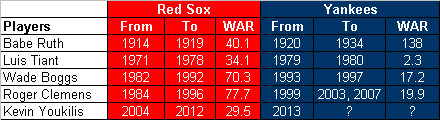
Just missed: Duffy Lewis, who compiled 19.8 WAR with the Red Sox from 1910 to 1917, played for the Yankees from 1919 to 1920. Bill Monbouquette, who compiled 19.8 WAR with the Red Sox from 1958 to 1965, played for the Yankees from 1967 to 1968.
Note: Includes players who compiled 20 WAR or more with the Red Sox before joining the Yankees. Babe Ruth’s WAR includes totals as a pitcher and position player.
Source: Baseball-reference.com
By joining the Yankees, Youkilis becomes only the fifth Red Sox player to don the pinstripes after compiling at least 20 WAR in Boston. Babe Ruth was the first person to crossover, and since the Bambino helped build the Yankees into the most successful franchise in sports, the flow of talent between the two teams has usually benefited the Bronx Bombers. Although it would be almost 60 years before another Red Sox legend made his way to the Bronx, the two recent transfers since Luis Tiant’s short stint with the Yankees in 1979-1980 also had a major impact.
Like Youkilis, Wade Boggs was a mid-30s third baseman when he joined the Yankees after having a down year. However, Boggs rejuvenated his career in pinstripes, batting over .300 in four of five seasons to go along with an OPS+ of 112. Soon after Boggs departed the Bronx, Roger Clemens joined the Yankees. After the 1996 season, the Red Sox had also given up on the Rocket, claiming he was in the twilight of his career, but instead Clemens responded with two Cy Young seasons in Toronto. Following his stint with the Blue Jays, Clemens spent five years in pinstripes tormenting his former team by not only winning two World Series rings, but adding another Cy Young while on the “downside”.
Yankees Standouts Who Became Red Sox
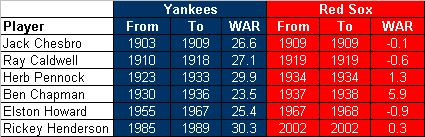
Just missed: David Cone, who compiled 19.1 WAR with the Yankees from 1995 t0 2000, played for the Red Sox in 2001.
Note: Includes players who compiled 20 WAR or more with the Yankees before joining the Red Sox.
Source: Baseball-reference.com
The Red Sox have actually had more 20-plus WAR Yankees join their ranks than vice versa, but the contributions of those players were relatively insignificant. On offense, Ben Chapman, Elston Howard, and Rickey Henderson were all former All Stars in pinstripes who wound up playing for the Red Sox, but neither made much of an impact in Boston. Among pitchers, Jack Chesbro made his Hall of Fame bones with the Yankees, but ended his career by pitching six innings for the Red Sox. Herb Pennock, who actually had an undistinguished start to his career with the Athletics and Red Sox, was another successful pinstriped hurler who pitched his last season in Boston. Finally, Ray Caldwell cobbled together a competent 12 years with the Yankees, but also found his way to Boston before retiring as a Cleveland Indian.
Even if Yankee fans don’t warm up to him at first, Youkilis can still win their affection by making a contribution in line with the other former Red Sox who wound up wearing the pinstripes. Of course, if he struggles in the Bronx, the denizens of Yankee Stadium won’t hesitate to voice their displeasure. In that regard, however, Youkilis does have one distinct advantage. Even if the crowd showers him with “boos”, he can always pretend their singing his last name.
The Banter Gold Standard: The Impression
On Monday, we ran Pete Dexter’s Inside Sports piece on Larry Holmes. Here is Dexter’s short article on the Holmes-Ali fight, reprinted here with the author’s permission.
“The Impression”
By Pete Dexter

When I heard Ali had agreed to fight Holmes, the first thought I had was that Ali would be killed. The punch was five years gone, his hand speed had been mediocre over his last half dozen fights, and he’d been getting hit by people like Leon Spinks.
I didn’t see that two years in the pasture could have helped any of that. What figured to be left to him, at almost 39 years old, was the chin. Enough to keep him up a long time after he should go down.
The second thought I had was that I didn’t want to see it happen, and even if there was enough grace in that night to make me wrong once, there was nothing in it to make me wrong twice. And if the talk afterwards’ about thyroid pills and a fight with Mike Weaver is more than talk, I won’t be there. Ali might take the chance again. I won’t.
I couldn’t watch it again. Ali without his talent, growing old in one long night, people everywhere without words, growing old with him. In the casino you see Ray Robinson posing in pictures with people who remember him—you can’t imagine Ali like that.

YOU WOULD not imagine Ali like this either: standing in front of Larry Holmes all night, eyes swollen, throwing no punches and once, after catching a terrible right hand, turning away in the ring.
Holmes had come into the fight in the best shape of his life—maybe he had believed the talk of a miracle a little bit, too. He began with energy and something close to hate, but after the second round he walked back to his comer wearing a different expression. “I knew what that look was,” Richie Giachetti would say later. Giachetti is Holmes’ trainer/manager. “We’d found out he didn’t have nothin’ left, and he was too old, and Larry was askin’ himself, ‘Do I really want this?’ All this time he was talkin’ himself into fightin’ Ali and now it’s here, he knows he’s got it won and the look on his face, it was just no expression at all. Usually he’d be happy or excited or somethin’, but the second round on. it was no nothin’ there.

AFTER THE fifth round, Angelo Dundee threatened to stop the fight. It is the eighth round, though, that keeps coming back. It was like a dream that wouldn’t move. Ali lost in ringside smoke, leaning deep into the ropes, moving his hands in slow motion. The rinse washing out of his hair, going gray in front of my eyes … it seemed to last half an hour. Ali without his speed or a punch or his legs, without his mirrors, clearly without his miracle. Nobody to tell him he was pretty; nobody left to believe it could happen.
Standing because he would not let himself go down.
When Dundee finally stopped it after the tenth, Holmes came across the ring crying and hugged Ali. “I love you,” he ‘said.
An hour later he went to Ali’s suite and found him lying face down on his exercise table. “Please promise me,” Holmes said. “Promise me you won’t fight no more.”
It ‘was quiet, then Ali spoke, “Holmmm-z,” he said, “I want Holmes.”
The next morning Dundee was sitting in his room, answering the phone, drinking coffee. “I didn’t do good business last night. It was a horrible night. I seen an Ali, couldn’t do nothing. He just wasn’t there.”
He shook his head. “I hope he don’t fight again, but you know I don’t tell him what to do. Nobody does.”
In the end you have to admire that. He had an extraordinary talent. He had a talent as rare, in a way, as Robert Frost’s or Picasso’s. And a talent like that, I think, is always ahead of the man who has it. It leads him, it takes him places other people can’t go. And even when he understands what it does, he doesn’t necessarily know what it is.
But he had the courage to use it, to follow it, and when it left him standing in the ring, alone with the best heavyweight fighter in the world, he had courage for that, too. And one way or another—unless you’re Robert Frost or Picasso—that happens, because growing old is losing talent.
For a long time, Larry Holmes didn’t want the fight. Giachetti never wanted it. Don King, who would pick Joe Louis out of his wheelchair and feed him to Roberto Duran if the money were right, talked Holmes into it.
King told Holmes that he had been living in Ali’s shadow too long. Giachetti told him the shadow was there, and as shadows go it wasn’t bad.
“Nobody who really knows Ali can say anything bad about him,” Giachetti said. “Nobody wants to see him hurt. We knock him out, they say he’s an old man. We don’t, Larry’s a bum. It’s a no-win situation.”
Holmes listened to King. And in the way you sometimes do when you’re unsure, Holmes denied the part of himself that said he cared about Ali. And as the fight got closer, he came to believe Ali had taken something from him. “I don’t care. if he gets hurt,” he said. “He been denyin’ me my just dues all this time. The man hypnotizes everybody, he don’t hypnotize me. I know him better than he knows himself. There’ll be no mercy in there for him. He either gets knocked out or he gets hurt.” And there was hate in that.

GIACHETTI FORGOT his reservations and got Holmes ready. “It’s comin’ down to a head job now,” he said. That was two weeks before the fight, and from then until the fight itself he kept Holmes away from Ali. “Nobody beats Ali at talkin’,” Giachetti said. “It’s his game. He says the same old things, but everybody still loves to hear it. It’s like ‘Moon River.'” So he brought Holmes to the weigh-in early. He refused to let his fighter pose with Ali for pictures. But Ali was always there.
After. his afternoon workouts, Holmes would take the microphone and ask the audience to believe he would beat him. “The old man has made a mistake. Porky gone crazy, fightin’ me. I could kick his ass back in 1974 when I was his sparring partner, and he never gave me my just dues….” It would go on too long, get awkward. Holmes being Ali, at the same time saying things from his heart.
“If I lose, I’ll retire. People will say I wasn’t ever nothin’ if this sucker beats me I’d have to go hide.”
On September 15, a kid named Gary Wells tried to jump over the water fountain at Caesars on his motorcycle, the same jump that almost killed Eve! Knievel.

AN HOUR before the jump, Ali was sitting in bed, watching the Holmes-Weaver fight on the Betamax. As it moved into the later rounds Ali walked into a closet. There was a tray there with 30 different kinds of pills—that and a scale. He sorted out eight or 10 to eat with breakfast. He said, “I will tell you something. I believe I am on a mission from God. I pray five times a day, it’s 60 per cent of my power. Holmes out drinkin’ wine, gamblin’, how can he beat me?”
I asked if he had liked Holmes when he was a sparring partner. Ali looked at me to see if I was serious.
“I like him now,” he said.
By the time Ali got out of the closet, Holmes had knocked Weaver out, and Truman Capote was bragging to Phil Donahue that he’d ruined Jack Kerouac’s career. Ali watched a few minutes. “This is a messed up world,” he said.
He stood up and looked out the window. The crowd was already waiting for the kid on the motorcycle. Ali had met him earlier. He had shook the kid’s hand and said, “You crazy.” The kid had liked that. A reporter asked if Ali would watch the jump.
“I don’t want to see nobody get his head ripped off,” he said. “They encourage him, but I know what people want to see when they watch somethin’ like that.”
He looked at himself in the mirror again and then laid down. On some unspoken signal, the old Cuban who rubs him down closed the curtains and the room was as dark as the night, and the reflection—the proof of the miracle—was gone with the sun. “As sure as you hear my voice,” Ali said, “you and l will both die.”
An hour later I was lying in my room when I heard the crowd and knew the kid hadn’t made it. The crowd, then the sirens. I thought of Ali, alone in his room.
What Becomes a Legend Most?

Rest in Peace, Ravi Shankar.



"This ain't football. We do this every day."
--Earl Weaver
--Earl Weaver