
I don’t feel much better this morning, you? Maybe some optimism will creep in as the day goes on–there’s CC to look forward to after all–but right now I’m cranky.
What you guys got?
[Picture by Bags]



I don’t feel much better this morning, you? Maybe some optimism will creep in as the day goes on–there’s CC to look forward to after all–but right now I’m cranky.
What you guys got?
[Picture by Bags]

When we talk about 1968 in baseball we think of Bob Gibson and all those low earned run averages and what is called “The Year of the Pitcher.” But when he wrote about it at the time, Roger Angell dubbed that season “the Year of the Infield Pop Up” which just goes to show how perception changes.
The Yankees and Orioles have been at each all year long, splitting the regular season series, 9-9. The O’s chased the Yanks down in the second half, tied them for first but couldn’t get passed them. They beat the Rangers in the Wildcard game and then split the first two games of the ALDS in Baltimore with the Yanks before getting hosed out of a win in Game 3. All the games have been close and apart from a mirage of scoring by the Yanks at the end of the first game, nobody has hit much.
So you could say that both offenses have been terrible—Alex Rodriguez has been hung in effigy in New York but he’s had company in futility, namely Robinson Cano, Curtis Granderon, and Nick Swisher. Baltimore has its own goats–Jones, Weiters, Thome. Or, you could say the pitching’s been sensational. Year of the pitcher or the infield pop-up? You decide.
More than anything we know the Yanks and O’s won’t let this thing go and so they played a game of reduction in Game 4, and brought horrible offense and stellar pitching into the 13th inning, tied at 1-1.
Despite some rocky moments from Phil Hughes and Joe Saunders, who looks like the barfly from Sex, Lies and Videotape…

…nobody scored. Oh, there were some horseshit pitches, and hard hit balls foul. Nick Swisher hit two balls off the end of his bat that otherwise would have been dingers, Jayson Nix hit a few balls well, and the Orioles left a ton of runners on base, but no, there were no runs.
Alex Rodriguez walked in his first at bat, singled in his second, and then continued to look like crap–old, slow, beaten. The most painful moment came when the Yankees had runners on first and second in the eighth and nobody out. Robinson Cano grounded out weakly to second moving the runners over. Rodriguez whiffed and Swisher popped out.
The bullpens were both terrific and score remained tied 1-1 until the O’s manufactured a run in the top of the 13th. J. J. Hardy drove in the go-ahead run with a double to left of Dave Phelps. This, after Joba Chamberlain left the game an inning early when he was hit in his pitching elbow with the a broken bat (x-rays were negative).
That brought on the closer Jim Johnson to face Mark Teixeira, Cano, and, of course, looming as the potential final out, Rodriguez. He quickly got ahead of Teixeira, then the count evened at 2-2, Teixeira fouled off an outside fastball, a high fastball, and looked at a curve ball for a called strike three. Shades of Carlos Beltran in 2006.
Cano lined the first pitch he saw to the left fielder and most Yankee fans were ready to throw in the towel. For a second straight night, Joe Girardi didn’t let Rodriguez hit against Johnson. This time, Eric Chavez took his place. Joe Girardi hoping–desperately–for some more magic. Chavez, looked a curve for strike, took a fastball high for a ball, fouled off a 95 mph heater, fouled off another fastball, took a curve outside, and lined a fastball to third base to end the game. No magic tonight.
What else could it have come down to for these two but Game 5? The season series is 11-11 and the winner will move on.
This is what it had to be.
Final Score: O’s 2, Yanks 1.
The Good News for Game 5? The Yanks have CC Sabathia on the hill. The bad news? Somebody in pinstripes is going to have to score some runs.
[Featured Image Via Stable]

It’s Phil Hughes vs. Joe Saunders. Someone is getting their tits lit tonight. Let’s hope it’s not Hughes. And if he falters early, Dave Phelps, and perhaps even Derek Lowe, could play big roles for the Yanks.
Derek Jeter DH
Ichiro Suzuki LF
Mark Teixeira 1B
Robinson Cano 2B
Alex Rodriguez 3B
Nick Swisher RF
Russell Martin C
Curtis Granderson CF
Jayson Nix SS
Never mind the emotion (the Win is the Thing): Let’s Go Yank-ees!
[Photo Credit: Staton Rabin/ National Geographic]

Joe Girardi’s father, Jerry, died today. He was 81. Giardi is expected to manage tonight.
Joel Sherman first reported the news on Twitter.
[Photo Credit: Bob Luckey / Greenwich Time]

(Source: Al Bello/Getty Images North America)
Raul Ibanez spent the regular season compiling big hits, but he saved his most spectacular heroics for October. Now, he stands among the Yankees’ legion of immortals as one of the most clutch performers in the franchise’s postseason history.
The Yankees have had no shortage of October heroes, but with two mighty blows, Ibanez thrust his name to the top of the list. By homering to tie the game in the ninth and then following up with a walk-off encore in the 12th inning, Ibanez racked up the highest cumulative Win Probability Added (WPA) in the team’s postseason history, surpassing Charlie Keller’s clutch hitting in game four of the 1941 World Series. In addition, Ibanez’ epic performance also cracked the top-five for all of baseball, and made the 40-year old slugger the first player to hit a homerun in both the ninth inning and extra innings of the same postseason game.
Top-10 Postseason WPA, Yankees and MLB
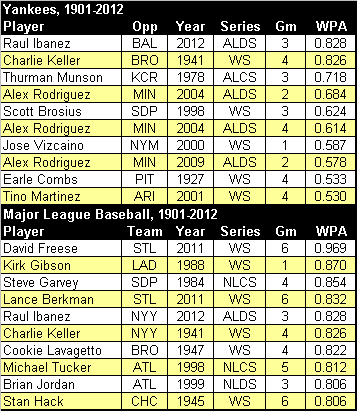
Source: Baseball-reference.com
In addition to rescuing the Yankees from a pivotal game-three defeat, Ibanez also saved Joe Girardi from having to face intense scrutiny for using him as a pinch hitter for Alex Rodriguez. In addition, Arod was able to spend the post game magnanimously applauding his teammate instead of having to answer unfair questions about his perceived inability to produce in the postseason. Of course, the irony is that if there was one man in the clubhouse who knew exactly how Ibanez felt, it was Rodriguez.
Before Ibanez’ game-tying homerun in the ninth inning, the last hitter to erase a postseason deficit in his team’s final turn was, you guessed it, Alex Rodriguez. In 2009, Arod actually accomplished the rare feat on two occasions: the first against Joe Nathan in game two of the ALDS and the second against Brian Fuentes in game two of the ALCS. Only 32 postseason home runs have helped a team tie or take the lead when trailing in the ninth inning or later, and Johnny Bench and Arod are the only players to do it twice.
Yankees’ Top-10 Postseason Hits, by WPA
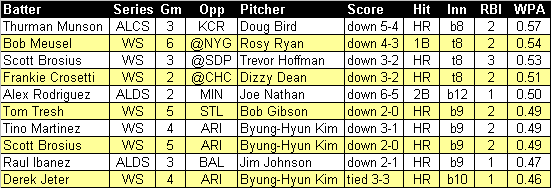
Source: Baseball-reference.com
It amusing to note that Rodriguez has compiled three of the top-10 WPA ratings in the Yankees long and illustrious postseason history (he also owns the highest WPA in the franchise’s regular season history). Although his struggles in the current ALDS are undeniable, the relentless characterization of Arod as an unclutch performer remains one of the great mysteries of irrational fandom. Fortunately, Joe Girardi isn’t as fickle as far too many Yankee fans. If he was, Raul Ibanez, who batted .057 in 60 plate appearances over a 24-game span at the end of the season, probably wouldn’t even be on the postseason roster. That’s something to think about the next time you feel the urge to overreact to a small sample.

Awesome Playoff Day Open Thread. Today, I’m rooting for the Reds, Nats, Yanks, and A’s.
Let’s Go Base-ball!
[Photo Via: It’s a Long Season]

With two swings of the bat, Raul Ibanez won Game 3 of the ALDS for the Yankees 3-2. Joe Girardi, in one of the ballsiest managerial moves in Yankee history, asked Ibanez to pinch hit for currently lost-in-the-woods Alex Rodriguez in the ninth inning. The Yankees trailed 2-1 at the time, there was one out, and the needle on the season was edging towards “disaster.”
Ibanez took a curve ball low and inside from Jim Johnson to start the at bat. The Oriole closer came back with his trademark sinker aiming low and away. The ball hung over the middle and Ibanez leaped on it. It was a lot like his homer to tie game 161 against the Red Sox, but struck even better than that.
There was a whole a lot of tense nothing after that until Ibanez led off the bottom of the twelfth against lefty Brian Matusz. Matusz had handled lefties Eric Chavez and Ichiro Suzuki with ease in the eleventh, giving them one decent pitch to hit early in the count and then driving them out of the strike zone. He tried the same trick on Ibanez, but Raul had target lock engaged and destroyed the 91 MPH fastball for the game-winner and possible season-saver.



Enough cannot be said of Ibanez, Girardi, Kuroda and Robertson. Ibanez will get, and deserves, every headline and accolade, but he wouldn’t have had a chance in the ninth if it wasn’t for Kuroda. Ditto the twelfth if it wasn’t for Robertson. And of course Joe Girardi, who never gets any credit and often takes a ton criticism, especially on the internet, chose the perfect time to pull the plug on his support for Alex Rodriguez. With Ibanez he gained the platoon advantage and the confidence advantage as the lefty slugger had just come through in a similar spot against a right-handed closer. If Girardi has lost Rodriguez for the rest of the series, so be it. I’d rather be up 2-1 without Arod than down 1-2 with him.
Going back to the pre-Ibanez portion of the game, Hiroki Kuroda was tremendous. A likable stalwart in a season full of uncertainty, he delivered a solid performance into the ninth inning. Kuroda cruised through his night on only 105 pitches and only allowed six base runners. Two solo homers to the bottom of the order were the only marks on his record. Yankee fans gave him the ovation he deserved as he left the game.
As good as Hiroki Kuroda was, Miguel Gonzalez was better. He went through the Yankees for seven innings with ease. He rung up eight Yanks, allowed almost no hard hit balls (were there any other than double and triple that plated the Yanks’ lone run?) and crucially walked no one. He was too tough.
Or maybe he was just pretty good and the Yankees met him halfway to awesome. I openly wonder if the Yankees would have had a more productive night if they just never swung the bat. For three straight games now, they’ve missed almost every cookie they’ve been served with foul balls and pop ups. And they’re so eager to do some damage that they’re expanding the zone in very counterproductive ways. Of the eleven times the Yanks struck out in this game, all were swinging whiffs, and the vast majority were on balls out of the strike zone. The Yankees were over aggressive, undisciplined and rendered utterly ineffective.
Derek Jeter picked up two more hits, though his RBI triple was a gift from Adam Jones. He’s one of the few Yankees who might get a hit at some point tomorrow night, so it’s bad news that he had to come out of the game with a leg injury. He smashed a foul ball off his toe and never looked comfortable after that. When he struck out in the eighth, he was barely able to gain his balance after each swing. Still put on a better at bat than anything Arod, Cano, Granderson or Teixeira could muster. Unless that foot has to be sawed off, Jeter’s playing tomorrow. If they amputate, downgrade him to probable.
But back to Raul Ibanez. He just hit a couple of the most important home runs in Yankee Postseason history. He’s on the list. From the color TV days, there’s Chambliss ’76, Dent ’78 (not Postseason but still), Jeter/Bernie ’96, Leyritz ’96, Justice ’00, Tino/Brosius/Jeter ’01, Boone ’03, Arod ’09. Probably missing some, but that’s a pretty good start (Reggie and Matsui of course, but maybe that’s a slightly different list, and heck, put Ibanez on that one too with his two bombs tonight).
The lack of hitting in the Postseason always confounds me. I always think, “Why can’t this be the year where they just get hot and blast their way to the Series?” But it never works that way and I need to stop being surprised that Jason Hammel, Wei-Yin Chen and Miguel Gonzalez turn into the 1963 Dodgers as soon as the calendar flips to October. The difference this time, hopefully, is that the Yankees have the starters to support the offensive outage.
All three Yankee starters have worked into the eighth and two of them were still on the hill in the ninth! A timely hit in Game 2 and the Yanks would have just swept this thing. Phil Hughes gets the baton and it doesn’t matter who he faces. It’s gonna be Koufax, Drysdale, Alexander, Gibson and Schilling all wrapped into some Oriole schlub and Hughes will need to be his best to keep them in the game. The Yankees probably won’t hit, but they just might win.
Top Photo by Bill Kostroun/AP via ESPN
Other Photos by Alex Trautwig and Al Bello / Getty Images via ESPN

Early for a game thread but what the hell?
There’s no lineup change for Alex Rodriguez and the Yanks but Eric Chavez is playing third and batting ninth.
Derek Jeter SS
Ichiro Suzuki LF
Alex Rodriguez DH
Robinson Cano 2B
Nick Swisher RF
Mark Teixeira 1B
Curtis Granderson CF
Russell Martin C
Eric Chavez 3B
RHP Hiroki Kuroda
Never mind those pesky boids: LET’S GO YANK-EES!
[Photo Credit: ari j. greenberg]

This afternoon we’ve got two NL games: Cards at Nats and then Giants at Cincy.
Enjoy.
[Photo Credit: Saint Anslem]

Here’s an extra beat of the day for you. A friend posted this on his Facebook page and said it made him feel like he was a Huxtable.

Chad Jennings with some Yankee notes. At ESPN/New York, Mark Simon looks at Baltimore’s Miguel Gonzalez.
And over at Deadspin, here’s Tom Scocca on Ichiro’s play at the plate last night.
Tonight gives a pair of Game 3’s: Giants vs. the Reds and later tonight, Tigers vs. the A’s.
Have at it.
Let’s Go Base-ball!
[Photo Via: Omynameistaken]

Over at SBN’s Longform, check out this fine piece story by William Browning:
Before the boy passed 10 his parents left the Mississippi Delta for the pine woods farther south, where his mother found a teaching job in the county. They were a young family, renting near the school, when his father left.
The boy felt lost in that new place. To better hide the hurt he whittled away his footprints through the years, turning his back on basketball, the drum line, a job bagging groceries and a place on the school honor roll. When he handed in his football jersey during his junior year there was nothing else to quit. He did it in spring, a few months after the ’96 season. A slow-footed receiver four notches down the depth chart, he thought he would not be missed. He was surprised when the coach sent a note to his English teacher asking to see him. Everyone called him, “Coach.” He was humorless and had a dry voice. He growled through one-sided conversations on the football field but off it he could be inarticulate.
The boy remembers walking the hallway toward his office, telling himself not to give in. He sat face-to-face with Coach, Bear Bryant’s picture hanging nearby on the office wall. Are you sure you want to spend your senior year in the bleachers? Coach said. Full of teenage arrogance, the boy said he wouldn’t be attending any games. He said he had watched from the sideline for two seasons and had his fill.
Coach, always slow to speak, leaned back in his chair and warned him. He warned him that not that season, but in a decade or so, he would come to regret his decision and that once made, it could not be undone.
The boy laughed. A grown man, said the boy, has no business thinking of games he did or did not play in high school. Coach said all right and the boy left. He never called him “Coach” again. Not because he walked away from football, but because that summer the coach married his mother.
And the boy hated him for that.
[Photo Credit: Colorado Springs Gazette ]

Pete Townshend’s “deeply felt but often ungainly” memoir, Who I Am, is reviewed by Michiko Kakutani in the Times:
What Mr. Townshend does manage to do here with insight, verve and sometimes grandiosity is describe how the Who and its music evolved: how the group “set out to articulate the joy and rage” of the generation that came of age in the “teenage wasteland” that was post-World War II Britain, under the shadow of the atomic bomb and deeply alienated from the established class system. This is why the Who’s early sound — with all the screaming feedback and distortion, the wrecked guitars and Moon’s frenetic drumming — was so aggressive and explosive.
“I wasn’t trying to play beautiful music,” Mr. Townshend explains. “I was confronting my audience with the awful, visceral sound of what we all knew was the single absolute of our frail existence — one day an aeroplane would carry the bomb that would destroy us all in a flash. It could happen at any time. The Cuban Crisis less than two years before had proved that.”
This is Mr. Townshend in his rock theorist mode — familiar to fans, who have read his music essays and reviews, or listened to his ruminative interviews. He speaks candidly in these pages about the influence that artists like the Kinks and Bob Dylan had on him, recalling that when he first sat down to try to write songs for the Who, he isolated himself in the kitchen of his Ealing flat, and listened to a few records over and over again: “The Freewheelin’ Bob Dylan”; Charles Mingus’s “Better Git It in Your Soul,” from “Mingus Ah Um”; John Lee Hooker’s “Devil’s Jump”; and “Green Onions” by Booker T. and the MGs.
He proves equally engaging as a sort of rock historian, describing the musical landscape in Britain in the early 1960s, when rock exploded on the scene. He describes how it upended the old order represented by the swing music that his father, a clarinetist and saxophonist, played in a band called the Squadronaires. And he charts how the Who came to push the boundaries of rock, creating one of the most acclaimed early concept albums (“The Who Sell Out,” 1967) and pioneering the form of the rock opera with “Tommy” in 1969.
As Mr. Townshend sees it, the Who’s ascendance would eventually be undermined by the rise of punk rock in the late ’70s. Though Who songs like “My Generation” and “Won’t Get Fooled Again” became “anthems for a particular time,” Mr. Townshend writes, by 1981 “a gulf had opened up between the Who and the new younger generation.
“I had to accept that we had reached our peak of popularity at Woodstock, and however famous and successful we still were as a band, our ability to reinvent ourselves was declining as we continued a long slow descent from that moment when Roger sang ‘See me, feel me, touch me, heal me,’ the sun rose up behind us, and my guitar screamed to 500,000 sleep-tousled people.”

Over at Grantland, here’s Bryan Curtis on Josh Hamilton:
By now, you and I could recite the outlines of The Story: Hamilton, baseball’s no. 1 overall draft pick in 1999, falls under the sway of crack and cocaine; abandons his wife and daughters; gets clean; gets acquainted with God; and in a semi-damaged, heavily tattooed state, leads Texas to the franchise’s first two World Series appearances.
While Texas fans still love Hamilton’s “story of redemption,” ESPN’s Jean-Jacques Taylor noted the other day, Hamilton “has abused that goodwill.” Not by having a bad season: Hamilton hit 43 homers, just one fewer than Miguel Cabrera, and posted a .930 OPS. No, Hamilton abused it by hitting into a first-pitch double-play ball against the Orioles and looking at just eight pitches in four at-bats and, with a frequency that seemed to accelerate when the Rangers needed it least, behaving like a flake.
Before we dive into how Texas fell out of love with Josh Hamilton, I want to be clear that I’m not making fun of Hamilton’s religion. I’m not questioning the events of The Story. What I’m suggesting is that Hamilton has become a prisoner of it.
…It’s not defending Josh Hamilton to say that he became despised this year for many of the things that, in the confines of a redemption narrative, once made him beloved. The Story swallowed the man. Hamilton seems like a reasonably friendly, occasionally defensive guy who is teetering on the edge of sobriety, who is prone to inconvenient bouts of detachment, and who gets hurt a lot. When he goes to his next team, I hope a new story will start there. But I have a sinking feeling that every time he loses a fly ball, Hamilton will again be a prisoner of redemption, trapped in a tale too flawless for any man.

This might pick you up. The Princess Bride is a clunky-looking movie but it retains much of the novel’s charm. Funny performances, a good, exceedingly quotable script, and really, who cares how cheesy it looks? That doesn’t take away from the movie’s pleasures. Movie is worth watching, book worth reading.

Before we even get started, let me tell you one thing. I’m not going to complain about the Yankees’ lack of hitting with runners in scoring position, mainly because that’s like complaining that the sun is rising in the East. Even without that issue, there’s plenty to discuss here, and several issues to chew on, so let’s get at it…
Things couldn’t have started out better. Derek Jeter quieted the raucous Baltimore crowd with a line drive single to right center off rookie Wei-Yin Chen to lead off the game, and the suddenly dynamic Ichiro followed by reaching on a questionable error to set the Yankees up with two men on, no one out, and the heart of the lineup due.
The papers will be awash this morning with doomsday headlines about Alex Rodríguez and damning statistics on the ineptitude of the offense, but A-Rod came to bat in the first inning and laced an absolute seed just a few feet to the right of second base. The infield defense was pulled around to the left as it usually is for A-Rod, but even positioned close to the bag, second baseman Robert Andino only had time for a quick step and a dive. He snared the line drive, then flipped to second to double off Jeter. Had that ball been just two or three inches to the left, a run would’ve been in and a rally would’ve been rolling with the hottest hitter on the planet due up next.
As it was, there were suddenly two outs and a man on first, A-Rod was still a dog, and the Yankees still couldn’t hit when it counted. It’s a game of inches, you know. But then Robinson Canó dug in and ripped a laser of his own off the base of the wall in right field. Always one to push the edge of the envelope, third base coach Robby Thompson windmilled Ichiro around third, but the relay throw from Andino appeared to have him dead to rights. But as Baltimore catcher Matt Wieters took the throw and lunged to make the tag, Ichiro took a right turn. He avoided the tag, but missed the plate by several feet, skittered counter clockwise around the dish, then leapt in the air like a cat to avoid Wieters’s second attempt before finally tagging the first base side of home plate. It was so much work it probably should’ve been worth two runs, but the score was only 1-0. Even so, it was a start.



This was Game 2, so naturally Andy Pettitte was on the mound for the Yankees, and naturally he was dominant early on. How good was he? He retired the first eight batters like this: fly out, ground out, backwards K, pop out, ground out, strikeout, fly out, ground out. He made a tough pitch to the ninth hitter, but it was too tough, as Andino broke his bat and lofted a base hit over second base. Then things got sticky.
Nate McLouth knocked a clean single to center, then J.J. Hardy walked on four pitches to load the bases for Chris Davis, a left-hander who had struggled against Pettitte in his career. After taking ball one, Davis poked a single to right to score two, and the Orioles suddenly had a 2-1 lead, just as they did in the third inning of Game 1. (An interesting note here: Nick Swisher actually came up with a good throw to third, one that Jeter could’ve cut off but chose instead to let go. He couldn’t have known this, but Hardy had rounded second a bit too aggressively, and had Jeter cut off that throw where he stood atop second base and then looked for the tag, Hardy would’ve been out before McLouth would’ve been able to score with the second run. No shortstop in his right mind would’ve cut that ball off, but it’s the type of play we’ve come to expect from Jeter in October. Not this time.)
And so the inning continued. Adam Jones bounced a grounder deep into the hole at short, forcing Jeter to range far to his right. Jeter and A-Rod, as well as Hardy running from second, probably all realized the only play would be at third. As a result, Hardy was digging hard for the bag and didn’t notice when the ball rolled just under Jeter’s glove. A-Rod was giving his best decoy at third, waiting for a throw that would never come, so Hardy also didn’t notice his third base coach furiously waving him in. He pulled up at third, much to Jeter’s amusement. Wieters popped up the first pitch he saw, and Hardy never scored. The inning was over.
The Yankee hitters, meanwhile, weren’t scoring, but they were making Chen work hard. It looked like that strategy might pay dividends in the top of the fourth when they loaded the bases with one out after Mark Teixeira singled, Russell Martin walked, and Curtis Granderson singled.
(Speaking of Granderson, TBS showed a revealing statistic during his first at bat. (And speaking of TBS, their coverage is bordering on unwatchable. Cal Ripken and John Smoltz have fallen into the trap that awaits most postseason announcers: they make a point and then react as if they’ve discovered penicillin. I watched large chunks of Game 1 with the mute button engaged. During Game 2, Ripken even tried to tell me that switch hitters used to regularly bat left-handed against Pettitte to counteract his power cutter, even though I’m fairly certain this never happened. That was Mo.) But back to Granderson. Peep this: When he puts one of the first two pitches in play, his batting average is .405, slugging percentage .767. After that the numbers drop to .190/.425. Ouch.)
But we were discussing the fourth inning, and the bases loaded buffet awaiting Eduardo Nuñez. He came to the plate needing just a quality out to tie the game, but imagine what a simple base hit would do. With his pitch count mounting, every fan in the park on edge, his entire home nation of Taiwan having called in sick to watch their countryman’s first playoff appearance, this was clearly a critical moment for Chen. A base hit would likely give the Yankees the lead and fill Chen’s head with doubt as the lineup turned over and Jeter, Ichiro, and A-Rod readied for their turns at bat. The game would open up, and the series would close.
But that’s not how it happened. Nuñez popped out, Jeter grounded to third, and the inning was over. Late Monday night Curt Schilling and John Kruk gushed about Chen’s game plan and execution, but I kept wondering if they had watched the same game I did, and I think Jeter’s reaction might’ve been similar. When he was asked about Chen after the game, the Captain was clearly suppressing a grin as he generously allowed, “He was hitting his spots.” It reminded me of an interview Kobe Bryant gave after the Lakers lost a tough playoff game to the Phoenix Suns. When asked if Raja Bell had given him some trouble, Kobe simply laughed. “Raja Bell? Raja Bell?” More laughter. “No.” Jeter was more diplomatic, but the message was the same.
What can’t be denied, however, was that Chen made it into the seventh inning, which is probably more than the Orioles had hoped for. Now trailing 3-1, the Yankees mounted a rally as Nuñez poked a ball into short right center and hustled it into a double, then came home on a Jeter single to cut the lead back to one at 3-2. After Ichiro forced Jeter at second and Darren O’Day came in to strike out A-Rod for the second day in a row, Buck Showalter chose to bring in Brian Matusz to walk the HHOTP and face Swisher with two outs and the tying run on second. I’m guessing Showalter wasn’t worried. Swisher entered that at bat with a 1 for 33 career postseason mark with runners in scoring position, and a career 1 for 19 against Matusz. Predictably, he popped out to left.
And then came the eighth inning, perhaps the most frustrating frame of the night for me. Teixeira led off with a rocket that looked ticketed for the left field corner and a sure double. But McLouth hustled over to cut it off, and the hobbling Teixeira was forced to stay at first. Here’s how the rest of the inning should’ve played out: Brett Gardner pinch runs for Teixeira and remains in the game in left field; Ichiro moves to right field; Swisher comes in to play first. Gardner steals second (because if he doesn’t, why exactly is he on the post season roster?), then Martin can either bunt him over or take a shot to right field. Assuming this works, Granderson needs only produce a fly ball to tie the game.
But Joe Girardi wasn’t interested in any of that, so he let Teixeira sit at first base as Martin and Granderson struck out and Nuñez popped out. The game wasn’t over, but it certainly felt like it. Baltimore closer Jim Johnson worked the ninth inning and smartly set down Jeter, Ichiro, and A-Rod in order, leaving Canó in the on-deck circle.
You have to admit, it was a nice way for 2012’s final game at Camden Yards to end. Orioles 3, Yankees 2.
[Photo Credits: Patrick McDermott/Getty Images (1); Patrick Semansky/AP Photo (2&3); Nick Wass/AP Photo (4)]

Tonight gives that ol’ Yankee Game 2 stand-by, Andy Pettitte.

YANKS
Derek Jeter SS
Ichiro Suzuki LF
Alex Rodriguez 3B
Robinson Cano 2B
Nick Swisher RF
Mark Teixeira 1B
Russell Martin C
Curtis Granderson CF
Eduardo Nunez DH
ORIOLES
Nate McLouth LF
J.J. Hardy SS
Chris Davis RF
Adam Jones CF
Matt Wieters C
Mark Reynolds 1B
Jim Thome DH
Manny Machado 3B
Robert Andino 2B
Never mind the one-game lead: Let’s Go Yank-ees!
[Picture by Heather Landis; drawing by Larry Roibal]