"A New York Treasure" --Village Voice
Category: 1: Featured

Steam Heat

Man, is it ever hot out there. Hope you are doing whatever you need to do in order to stay cool.

Blogging will be light today. Course, tonight gives the start of a four-game series in Boston. Dustin Pedroia will miss it.

Hiroki goes against Beckett in Game One. Good piece on Kuroda by David Waldstein today in the New York Times.

[Photo Credit: Bernice Abbott]

July 5, 1941: Game 46

Now that DiMaggio had eclipsed all existing records, his streak began to be viewed differently. Instead of debating whether or not he could catch Sisler or Keeler, baseball fans were now watching him intently, wondering how long the streak would last. It would last at least another day. The Philadelphia A’s were in New York for the start of a three-game series, and the Yankees took the opener easily by a 10-5 score. DiMaggio homered in the first inning (one of five Yankee home runs on the day) to extend his streak, but it would be his only hit of the afternoon. Smoke ’em if you’ve got ’em.

Color By Numbers: Tales from the Road

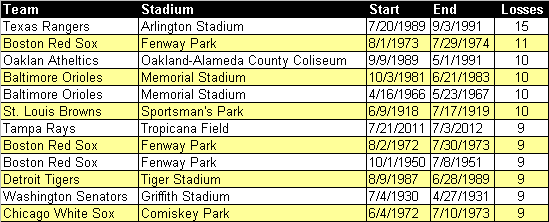
The Yankees finally found a cure for TB. After losing nine straight games at Tropicana Field in Tampa (OK fine, St. Petersburg), the Bronx Bombers finally broke the schneid on Robinson Cano’s game winning two-run single with the bases loaded. If not for Cano’s timely hit (and Kyle Farnsworth’s four consecutive walks), the Yankees, who have seemingly saved their worst baseball for the unfriendly confines of the dome, would have recorded their seventh double-digit losing streak at a road stadium.

Yankees’ Longest Losing Streaks at a Road Stadium, Since 1918
 

Source: Baseball-reference.com

Even though the Yankees probably weren’t heart broken about the three game sweep in Tampa that occurred at the end of last season, the nine game skid was still the longest in any one road ballpark since the Bronx Bombers went winless in 15 straight games at Arlington Stadium from 1989 to 1991. Unfortunately, the Texas heat wasn’t the only thing that caused the Yankees to wilt during that span. Over the same period, the Yankees dropped 10 consecutive games to the Athletics at the Oakland-Alameda County Coliseum. Of course, during that period, the Yankees didn’t have much luck beating the Bash Brothers, or anyone for that matter. From 1989 to 1991, the team’s .437 winning percentage was the fifth lowest of any three-year span in franchise history and the worst since 1913-1915.

Yankees’ 15 Game Losing Streak at Arlington Stadium, 1989 to 1991

Source: Baseball-reference.com

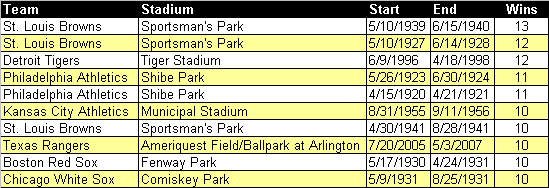
As you’d expect from a team with the highest road winning percentage in baseball, the Yankees have had more double-digit road ballpark winning streaks than losing skids.  The all-time high run of 13 straight victories dates back to 1939-1940 against the hapless St. Louis Browns at Sportsman’s Park, but the most recent double-digit streak was also deep in the heart of Texas, as the Yankees reeled off 10 straight victories versus the Rangers from 2005 to 2007. That mark, as well as the all-time franchise record for most wins in a single road ballpark, could be in jeopardy later this month when the Yankees visit Oakland. The last time the Bronx Bombers lost at the Athletics’ home field was on April 22, 2010, the same day that Alex Rodriguez violated the sanctity of Dallas Braden’s mound. Since then, the Yankees have won nine straight victories in “the 209”, and could tie the current longest streak of 13 road ballpark wins with a four game sweep in the teams’ final series in two weeks.

Yankees’ Longest Winning Streaks at a Road Stadium, Since 1918

Source: Baseball-reference.com

But Never at Dusk

Over at Esquire, our pal Scott Raab interviews Sarah Silverman:

SR: Out of all the different performing arts, stand-up to me is by far the most fascinating — the idea of one human being standing up and the audience saying, “Okay, kill me.” And you have lived that life for years.

SS: I can’t believe how much time has passed. The first time I did stand-up I was 17, and I was really a stand-up once I was 19 in New York, and now I’m 41, and I still feel like I haven’t found myself onstage. Earlier in my career, I was really tight, really together, and knew who I was and I was confident. I kind of feel in between now.

SR: Is that because you’re taking on other jobs and not doing as much stand-up?

SS: I’m doing a lot of stand-up, but not like when you’re living in New York and you can do three sets a night and it’s your life, and you sleep all day and you wake up and you eat with a bunch of other comics and then get ready for the night. I’m doing it a couple times a week at least, but I’m still just finding myself, you know? I don’t think I’ll ever feel done. I’ve realized that being beholden to some sort of character you found success in just makes you a caricature of yourself. I feel bad naming names because it’s not their fault, but there are great, famous ’80s comedians — Dice comes to mind — who found wild success and now still go on the road, and they want to kill and they want to give the audience what they want because that’s inherently a comedian’s desire. So he puts on the jacket, you know? To not grow and change and be so different from 20 years ago, to still be in that place because you’re afraid? It gives the audience what they want, what they’re expecting, but it’s not current. I wish those comics would take the chance to be who they are now onstage. You have to be willing to disappoint the audience for a while.

It’s No Capital Crime

Ted Conover had a piece in the Times Magazine last week about a snitch. It was the latest impressive piece of work from Conover who has produced good articles for a long time.

A bunch of those stories can be found at Conover’s website, including this one: an appreciation of Dance With the Devil: The Rolling Stones & Their Times, by Stanley Booth:

He is strongest when writing about the music — the history of it, the business of it, and the experience of it. Booth’s believer’s passion results in all sorts of luminous insights into the enterprise: “The Stones’s show was not a concert but a ritual; their songs . . . were acts of violence, brief and incandescent.” And later, “Making love and death into songs was exactly the Stones’s business.” Booth tells a story in which “Each night we went someplace new and strange and yet similar to the place before, to hear the same men play the same songs to kids who all looked the same, and yet each night it was different, each night told us more.” He suggests that “In the sixties we believed in a myth — that music had the power to change people’s lives. Today people believe in a myth — that music is just entertainment.” He writes about what it was like backstage and what it was like in the audience, what it felt like when things really clicked and what it was like when they did not.

The backstage view is, of course, the main draw to a book like this, and Booth offers anecdotes intriguing, disgusting, and amusing. He writes about a comely woman in the studio audience during the taping of the The Ed Sullivan Show who does not succeed in getting taken advantage of: a minion picks a “big blond in buckskin” to visit the boys backstage instead. Booth writes of leaving the studio with a friend, “the pretty little girl in the brown outfit ahead of us, smiling, lucky to be left with her dreams.” He reports on how, a couple of days after a recording session, the Stones “made more money than they had ever made in one day by recording a television commercial for Rice Krispies . . . .” In one particularly delightful scene, Booth describes Jagger on his hotel bed after a concert, exhausted, eating Chinese food, and taking flack from others for his smelly socks:

Mick drew his feet up under him . . . and began talking to me about the future, where to live, what to do . . . . “I’ve got to find a place to live, got to think about the future, because obviously I can’t do this forever.” He rolled his eyes. “I mean, we’re so old —we’ve been going on for eight years and we can’t go on for another eight. I mean, if you can you will do, but I just can’t, I mean we’re so old — Bill’s thirty-three.”


Through the Park, Bitterman (You Know How I Love the Park)

Nice review in the Times today of “Central Park: An Anthology,” a collection of essays about our cherished park (edited by Andrew Blauner).

It’s a book worth having.

Here’s Buzz Bissinger’s piece, reprinted over at Slate.

[Photo Credit: Nataliemarie]

Million Dollar Movie

A new DVD set of “The Gold Rush” has just been released. It includes a 1942 sound cut of the movie. Cool.

[Photo Credit: Sid Avery]

Bricker-Bracker, Fire-Cracker, Sis, Boom, Bah…

As Grady Seasons said in “The Color of Money”: It’s like a nightmare, isn’t it? It just keeps getting worse and worse.

The Yanks lost nine-in-a-row to the Rays in Tampa coming into this afternoon’s game and had to deal with David Price. The Rays’ ace was on his game too, throwing his fastball in the upper 90s and breaking off a nasty slider and change-up to boot.

Now, whadda ya gunna do with that?

Not much. The Yanks didn’t put a runner on base until the fourth (a walk by Curtis Granderson), get their first hit until the fifth (and that runner was erased on an inning-ending double play), or put a run on the board until the seventh (a solo home run by Mark Teixeira). The score was tied, 1-1, on the strength of a good start by David Phelps.

After Teixeira’s homer, Alex Rodriguez doubled and with one out, Nick Swisher walked. Andruw Jones was at the plate when Rodriguez took off for third. The catcher stepped back and his hand knocked into the home plate umpire’s mask and the call came to do it over, a head-scratcher for sure. Jones flew out to right field and Rodriguez stole third with Russell Martin batting but was stranded there when Martin grounded out to short.

And that’s how it’s been for the Yanks in Tampa. Double-down on that, in fact, because Carlos Pena hit a long two-run home run against reliever Boone Logan in the bottom of the seventh. I would have taken more time to appreciate what an impressive shot it was if I hadn’t been so pissed off watching it sail into the seats.

That put the Rays up, 3-1 and well, this Fourth of July party looked to be another dud for the Yankees.

Relief came in the form of an old friend, however, one Kyle Fransworth who walked the bases loaded in the eighth inning. He did strike out Derek Jeter but the bases were juiced for Rodriguez. Now, I’m sure there was some joking going on for Yankee fans watching at home. And those jokes turned to groans when Rodriguez swung through a 2-1 fastball around his shoulders. The count went full and Rodriguez took a slider off the outside corner for ball four and an RBI. It was a close pitch but it was a ball.

That knocked Farnsworth out of the game and narrowed Tampa’s lead to 3-2. Jake McGee, a lefty, replaced him and got ahead of Robinson Cano. Made him looked silly on one swing. But on the 2-2 pitch, a fastball, low and over the plate, Cano delivered a hard-hit ball up the middle, good for a base hit and a couple of RBI and the Yanks were ahead. He was right on the pitch and nailed it.

Never mind that they reloaded the bases two more times (Martin, who is in the depths off a miserable slump, flew out to end the eighth; Cano hit a bullet line drive to deep center to end the top of the ninth), David Robertson worked around a two out walk in the eighth and Rafael Soriano pitched a clean ninth to give the Yanks a satisfying 4-3 win.

Reason to cheer. The Boss would be happy.

[Photo Credit: Al Messerschmidt/Getty Images; Mike Carlson/AP]


Nine Lives

So the Yanks have lost nine straight in Tampa and today David Price will try to make it ten. David Phelps gets the start for the Yanks. I suspect he’ll give them some good innings.

Up to the batters to score some runs.

Two tough loses so far in Florida. Here’s hoping the Yanks “Win one for the Boss”–the ol’ birthday boy.

Derek Jeter SS
Curtis Granderson CF
Mark Teixeira 1B
Alex Rodriguez DH
Robinson Cano 2B
Nick Swisher RF
Andruw Jones LF
Russell Martin C
Jayson Nix 3B

Never mind the fire works: Let’s Go Yank-ees!

Happy Fourth Everyone.

[Images via: This Isn’t HappinessRetrogasm]

The Ninth Circle of Hell

All right, maybe that’s a bit of an exaggeration, but after watching the Yankees lose their ninth straight game in Tampa — and listening to Lou Piniella for nine innings — the title seemed appropriate if a bit reactionary.

There’s something about the Rays that really bothers me. When the Red Sox were at the peak of their powers, each series definitely raised my blood pressure, but I respected those teams. Terry Francona respected the game, and the players not named Papelbon, Pedroia, and Youkilis were actually a bit likable. They played the game the right way, and it was hard to hate them for it.

It’s not that the Rays don’t play the game the right way, because they do. They run out every ground ball, go from first to third, steal bases, all that stuff. But Joe Maddon is infuriating. He creates a new lineup each night, moving hitters four or five spots in the batting order from one night to the next, and haphazardly deploys his fielders, heeding voices only he hears.

The truth of it all, though, is that none of it would be remotely infuriating except for one thing — it works. All of it.

The matchup seemed to be in favor of the Yanks on Tuesday night, with the streaking Ivan Nova on the mound for the Bombers and the disappointing James Shield starting for the Rays. (How befuddling is Shields? Try this stat on for size: Complete games — 0 in ’09, 0 in ’10, 11 in ’11, o in ’12.)

The Yankees jumped on Shields early. Derek Jeter absolutely smoked the first pitch of the game, sending it to the wall in left center for a double, then scored on a laser that Curtis Granderson hit past Carlos Peña at first for another double. After the obligatory strikeout from Alex Rodríguez, Robinson Canó rifled a single through the Maddon Shift for a 2-0 Yankee lead.

DeWayne Wise homered in the third to bump the lead up to 3-0, but Nova was struggling enough to make it clear that more than three runs would be needed. He faced twenty batters over the first four innings, and he started twelve of them out with ball one. As a result, it seemed like he was working hard all night, even when no one was on base.

In the bottom of the third, however, the Rays got some folks on base. There were two outs and runners on first and second when B.J. Upton came up to the plate and immediately grounded a single through the left side of the infield. Wise charged the ball well and came up throwing, looking to get Elliot Johnson at the plate. Wise’s throw beat Johnson, but the ball came loose in the collision and the run scored. I’ve never seen a play this scored as an error, but Russell Martin got the E-2. Jeff Keppinger came up next and singled in two more runs to tie the score. All three runs were unearned, but all three can be attributed to Nova’s shakiness.

The Yankees took the lead right back in the top of the fourth when Raúl Ibañez doubled and came home on an Eric Chavez single, but that lead was immediately erased in the bottom half of the inning by two-run home run by Sean Rodríguez.

Trailing for the first time in the game, the Yankees looked to even the score in the top of the sixth. Reigning American League Player of the Week Canó opened the frame with a single, and two batters later Ibañez blistered a ball over the first base bag and into the right field corner. Third base coach Robby Thompson bravely waved Canó home, but Robinson it immediately looked like the wrong decision. After the relay throw arrived at the plate, catcher José Molina poured a cup of tea and let it steep for a bit before applying the tag on a sliding Canó. It kind of summed up the entire night.

From there, the Yankee hitters went down like lambs as the bullpen coughed up a couple more runs, including one on a double steal, making the final score Rays 7, Yankees 4.

Strange as it might seem, I can’t wait to get to Fenway Park.

[Photo Credit: Mike Carlson/AP Photo]

Quick Pick Me Up

As Jon mentioned in his recap of last night’s game, the Rays find a way to bust Yankee chops.

Let’s hope that ain’t the case tonight. Ivan Nova’s on the hill.

Derek Jeter SS
Curtis Granderson CF
Alex Rodriguez 3B
Robinson Cano 2B
Nick Swisher RF
Raul Ibanez DH
Eric Chavez 1B
Russell Martin C
Dewayne Wise LF

Never mind the shift: Let’s Go Yank-ees!

[Photo Credit: John Black]

Blind Faith

Here’s another bowling story. This one, by the late Jeff Felshman, is a keeper, a funny and understated gem:

Only the dead don’t bowl. Everybody’s tried it, anybody can do it, nobody wants to see it. Would you pay to watch bowling? Of course not. Not if the match featured the greatest bowlers of all time. Who are the greatest bowlers of all time? Who knows? As a spectator sport, bowling isn’t much. Most bowlers don’t pay much attention to their own game much less anyone else’s, especially after a couple of beers. That’s the downside of bowling’s great accessibility: even when you’re good at it, nobody cares.

Most of the bowlers at Timber Lanes the first Saturday in June don’t watch; most of them can’t see. It’s the last day before the summer break for the blind bowling league from the Chicago Braille Center. They won’t be getting together again until the middle of August. By then they should know if they’ve repeated as national champions of the American Blind Bowling Association. The results from this year’s tournement (which was held over Memorial Day weekend in Atlanta, and drew about 700 bowlers from 170 blind bowling leagues) won’t be tabulated until August. The league secretary, Virginia Okada, doesn’t think Chicago Braille Center won this year; but until they hear otherwise they’re still the national champs.

A sign on the door says Timber Lanes welcomes seeing eye dogs, but no one brought the dog today. The group is large enough as it is, about 40 being a crowd in the small bowling alley on Irving Park Road. There’s someone here from practically every American group–that’s–black, white, Spanish, American Indian, Asian, old, young, middle-aged. Usually in America when people try to put together such a broad-based racial and ethnic coalition they fail, but the blind bowlers not only can’t see much difference they have a common cause: they’re all trying to stay out of the gutter.

Somehow, it didn’t make The Best American Sports WritingGlenn Stout has more.

[Photo Credit: Xaxor]

Working My Way Back to You

Couple of stories on Joba Chamberlain:

Harvey Araton in the Times.

Daniel Barbaris in the Wall Street Journal.

[Photo Credit: N.Y. Post]

Ringside

There’s a major George Bellows retrospective at the National Gallery in Washington D.C. through early October.

Might be worth a road trip.

Breaking Hearts by the Bay

The morning after David Robertson served it up to the White Sox, I told my son that the Yankees lost a “heart-breaker.” Now he looks at the scoreboard every morning and every one-run game is a “heart-breaker.” We played Scrabble, he beat me 110 to 108, promptly informed me that I just lost a “heart-breaker.” Someday he’ll learn that not all heart-breakers are created equal. Some heart-breakers are really head-scratchers with fangs.

How do these Rays keep doing this to the Yankees? Even without Longoria, with one of their lesser pitchers on the mound, in the midst of a horrendous stretch of baseball, they can sting the Yankees like no one else. Look around the diamond do you want any of those guys on the Yankees? Zobrist is a nice player, but this is a terrible baseball team right now and the Yankees should have been looking to step on their throats. Instead the Rays won a game they had no business winning, 4-3 and put the Yankees on the ropes to start one of the biggest weeks of the season.

Though both recent catastrophes have multiple culprits, they have a lot in common. The Yankees turned routine outs into shocking errors, and David Robertson got tagged. The errors were so freakish that you almost want to write them off. This time Mark Teixiera whiffed on an easy, inning-ending bounder down the first base line allowing the go-ahead run to score. The ball may have hit the bag, but Teixiera a) should have had his body in front of the ball and b) should have caught it anyway. None of this would have mattered of course if David Robertson was pitching well.

Robertson came in to the game with the Yankees leading 3-2 in the seventh, two out and a runner on second. I thought Girardi made a good call to bring him in in such an important spot. But Robertson fell behind, couldn’t locate and some doofus named Brooks Conrad blasted him off the wall in right. Then he got ahead of Elliot Johnson and couldn’t put him away because he had no feel for the breaking ball. Johnson grounded to Teixeira and the game was lost. (Alex Rodriguez did give it a whirl in the eighth, but those fly balls to right-center just don’t clear the fence when you don’t inject your Wheaties.)

Freddy Garcia, who had to throw it twice to reach 80 MPH on the radar gun in April, started and pitched well. I thought he was done as a Major Leaguer after the first few turns through the rotation, but I’ve got a terrible track record this year assessing Yankee pitchers, so I guess that doesn’t carry much weight. When you are ancient and getting by with smoke and mirrors, one morning you wake up and find that the smoke machine has crashed into the mirror and you go back to sleep.

Garcia didn’t quit however and accepted a demotion to the least important spot on the 25-man roster. In over 17 innings as the last man in the bullpen, Garcia turned in a 1.56 ERA and pitched well enough to earn this start replacing Andy Pettitte.

Garcia was on a short leash – only expected to throw 65-70 pitches. He used those pitches efficiently as they got him through five innings. The only blemish was a solo jack by B.J. Upton in the fourth. He was pitching so well, and the Rays looked so helpless against his particular brand of precision-slop, that Joe Girardi got greedy and sent him out for the sixth with a 2-1 lead. The first batter grounded to short, but the second batter, Carlos Pena, tattooed the 74th pitch, an 84 MPH flatball, to right to tie the game.

The Yankees scored two in the first when they strung a few hits together and Hideki Matsui badly misplaced a fly ball to right, but that was it until the top of the seventh. Curtis Granderson gave them the lead 3-2 when he battled his way to a hard-won sac fly to left. Maybe they should have had more runs. Rays rookie Matt Moore was good enough to get by, but not good enough to impress. The Yankees had the better starter, the better hitters. They had the game in their pocket.

But the story of these two teams head-to-head is that Rays dismantle the Yankee bullpen and the Yankees can’t sniff Fernando Rodney, who has two wins and three saves against them already this year. Typing that sentence just caused a panic sweat to break out on my back and my right arm is tingling. I wonder if it is my heart?


AP Photo by Brian Blanco


Fab Five Freddy Told Me Everybody’s High

The Yanks look to end the first half on an up-note this week. They’ve got three in Tampa and then four this weekend in Boston. Won’t be easy.

Fab Five Freddy goes tonight against a struggling Rays team. Be interesting to see what he’s got to offer as a starting pitcher after a poor start to his season and a long time buried in the bullpen.

In the meantime, Corey Wade was optioned today to make room on the roster for Philadelphia whipping boy, Chad Qualls.

How about an appearance from the Yankee Score Truck?

Derek Jeter DH
Curtis Granderson CF
Mark Teixeira 1B
Alex Rodriguez 3B
Robinson Cano 2B
Nick Swisher RF
Andruw Jones LF
Jayson Nix SS
Chris Stewart C

Never mind letting up now: Let’s Go Yank-ees!


July 2, 1941: Game 45

The Yankees beat the Red Sox 8-4 for their sixth straight win, increasing their American Leauge lead to three games over Cleveland. With DiMaggio having already tied Keeler’s mark, the crowd was much smaller, but those 8,662 in the Stadium that day watched as he took the record and stood alone at forty-five games in a row. DiMaggio’s lone hit was a screaming liner that rocketed over Ted Williams’s head and found the left field seats for his eighteenth home run of the season. After the game, a young Williams admitted admiration for DiMaggio. “I really wish I could hit like that guy Joe DiMaggio. I’m being honest.” Williams could hit pretty well himself. He was hitting .401 at the time.

[Drawing by Margie Lawrence]

Almost Famous

From D Magazine comes a bowling story by Michael J. Mooney.

Don’t Look Back


Adapted from his foreword to a new Modern Library Edition, here’s John Jeremiah Sullivan on William Faulkner’s masterpiece, “Absalom, Absalom!”:

A poll of well over a hundred writers and critics, taken a few years back by Oxford American magazine, named William Faulkner’s “Absalom, Absalom!” the “greatest Southern novel ever written,” by a decisive margin — and the poll was conducted while looking back on a century in which a disproportionate number of the best American books were Southern — so to say that this novel requires no introduction is just to speak plainly.

Of course, it’s the kind of book a person would put first in a poll like that. You can feel reasonably confident, in voting for it, that nobody quite fathoms it enough to question its achievement. Self-consciously ambitious and structurally complex (unintelligible, a subset of not unsophisticated readers has always maintained), “Absalom, Absalom!” partakes of what the critic Irving Howe called “a fearful impressiveness,” the sort that “comes when a writer has driven his vision to an extreme.” It may represent the closest American literature came to producing an analog for “Ulysses,” which influenced it deeply — each in its way is a provincial Modernist novel about a young man trying to awaken from history — and like “Ulysses,” it lives as a book more praised than read, or more esteemed than enjoyed.

But good writers don’t look for impressedness in their readers — it’s at best another layer of distortion — and “greatness” can leave a book isolated in much the way it can a human being. (Surely a reason so many have turned away from “Ulysses” over the last near-hundred years is that they can’t read it without a suffocating sense of each word’s cultural importance and their duty to respond, a shame in that case, given how often Joyce was trying to be amusing.) A good writer wants from us — or has no right to ask more than — intelligence, good faith and time. A legitimate question to ask is, What happens with “Absalom, Absalom!” if we set aside its laurels and apply those things instead? What has Faulkner left us?

I have never read the book, though I’ve started it a few times and have read four other novels by Faulkner. This article has me curious to try again.

[Painting by Steven Sullivan]

feed Share on Facebook Share on Twitter Share via email
"This ain't football. We do this every day."
--Earl Weaver