
"A New York Treasure" --Village Voice
Category: 1: Featured

Color By Numbers: Untapped Power

At the beginning of March, Dodgers’ first baseman James Loney talked confidently about being a legitimate candidate for the batting title in 2012. Considering how many people view him as a disappointment, not to mention he has never even hit over .300 in a qualified season, Loney’s optimism was intriguing to say the least. So, last week, I took a look at other batting champions who had never hit .300 before their 28th birthday and, not surprising, discovered very few.

Before writing about Loney’s pursuit of a batting crown, I hadn’t given the first baseman much thought. However, while listening to Vin Scully broadcast a recent Dodgers’ spring training game, the left handed hitter was thrust to the forefront once again. During the game, Scully relayed a story about adjustments Loney had made that the lefty believed would allow him to hit for more power…even as many as 30 home runs this season. Once again, for a player who had never hit more than 15, Loney seemed guilty of wishful thinking.

Career Home Run Leaders Among Late Bloomers*
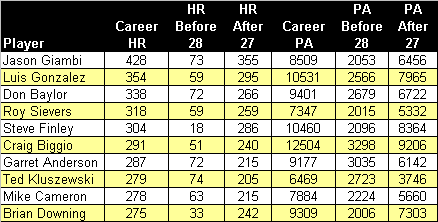
 *Includes players with at least 2,000 PAs before their age-28 season who hit 75 or fewer homers.
Source: baseball-reference.com

Since 1901, 685 players (including Loney) with at least 2,000 plate appearances hit 75 or fewer home runs before their age-28 season.  From this group, only 31 went on to hit more than 200 home runs in their entire career. Going one step further, only seven batters from this segment hit more than 200 long balls without having recorded more than 15 homers in a season during this timeframe. In other words, if Loney does turn on the power, it will qualify as a historical achievement.

Career Home Run Leaders Among Even Later Bloomers*
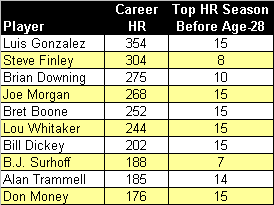
*Includes players with at least 2,000 PAs before their age-28 season who hit 75 or fewer homers and never more than 15 in any one season.
Source: baseball-reference.com

To be fair, Loney only implied that he could hit 30 home runs in a season. However, even this accomplishment would go against the tide of history because only 27 players (in 50 seasons) from the group of 685 defined above wound up having their first 30 home run season after turning 28. What’s more, most of those hitters gradually worked their up to 30 home runs, whereas Loney would have to double his output in order to reach that level in 2012.

Late Bloomers* Who Had First 30 Home Run Season at Age-28
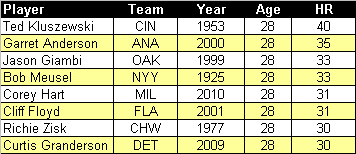
*Players with at least 2,000 PAs and no more than 75 homers before their age-28 season.
Source: baseball-reference.com

The list above includes three players who offer Loney some immediate hope. For most of his Yankees’ career, Bob Meusel was a productive, but often overlooked member of Murders’ Row. That’s what happens when you play alongside Lou Gehrig and Babe Ruth. By their standards, Meusel wasn’t really a power hitter, but in reality, his more modest totals were still good enough to rank among the league leaders. In 1925, when Gehrig was just breaking in and Babe Ruth was suffering from “the bellyache heard around the round”, Meusel finally was the top dog. That season, the left fielder belted 33 homers to lead the league. It would be the highest total of his career and only his second season with more than 16.

With bulging biceps exposed by his trademark sleeveless uniform, Ted Kluszewski became synonymous with power. And yet, Big Klu was a late convert to the long ball. In 2,723 plate appearances before turning 28, the muscular first baseman only had 74 home runs, or only seven more than Loney. Over the next four years, however, he hit 171, including 40 or more in three consecutive seasons. During that span, no one hit more home runs than Kluszewski, but thanks in large part to several nagging injuries, the slugger’s power quickly dissipated as he combined to hit only 34 home runs in his last five seasons.

Garrett Anderson vs. James Loney, Pre Age-28 Seasons

Source: baseball-reference.com

Before turning 28, Garrett Anderson’s statistics were very similar to Loney’s. So, if the pattern holds, the Dodgers’ first baseman just might be in line for a breakout power season. In 2000, Anderson, who had only once hit more than 16 homers (21 in 1999), belted 35 long balls, beginning a four-year stretch in which he flirted with that plateau in each season. Considering the similarities, maybe the Dodgers can just go ahead and pencil in more power from first base?

If Los Angeles has a little patience, the real poster boy for late power is Steve Finley. Before entering his age-31 season, the left handed centerfielder had only 47 home runs in nearly 4,000 plate appearances. Then, all of a sudden, he flipped the switch. Not only did Finley belt 30 long balls as a 31-year old in 1996, but he maintained his power over the remainder of his career.

At the rate he is going, James Loney will enter the season convinced he can win the triple crown. Has he made a believer out of you? I am still skeptical, but for the first time, I’ll be keeping a close eye on Loney’s pursuit of history.

Oh, by the way, did I mention this is Loney’s contract year? Ironically, if the Dodgers first baseman does have the breakout season he is predicting, it could mean the end of his days in Los Angeles, especially with teammate Andre Ethier also headed for free agency. Almost 10 years ago, the Dodgers faced a similar situation when Adrian Beltre parlayed a career season into a big free agent contract with another team. The Dodgers were wise to let Beltre go back then, but this time around, a big season from Loney might compel the new ownership group to keep him. In that respect, a lot more than just history is riding on Loney’s 2012 season…millions of dollars are at stake as well.


Let’s Make a Deal

Here’s another excerpt from “Damn Yankees.” Over at Deadspin, check out Dan Okrent’s piece on the famous Peterson Kekich wife swap:

In the late 1970s, on my very first assignment as a baseball writer, I found myself in the press box at the Yankees’ spring training home in Fort Lauderdale. On one side of me sat Murray Chass of the New York Times, fairly early in his own career as the most prolific and most boring baseball writer in the paper’s (maybe any paper’s) history. On the other side my seatmate was Maury Allen of the New York Post.

It was only an exhibition game, but I had never been paid to watch baseball before, and even the cramped little press box in Lauderdale seemed like some sort of heaven to me. I gurgled something about this being my first professional gig as a sportswriter, and Chass looked at me briefly, emitted a noise composed entirely of consonants, and went back to his crossword puzzle. Allen was friendlier. He introduced himself, shook my hand, wished me luck, and spent the first couple innings chatting amiably about his life as a sportswriter. Around the top of the third, he paused in mid-anecdote, looked at the field briefly, and tapped a pencil on the arm of his chair. “I love everything about the job,” he said, “except the fucking games.” Then he got up and left.

It would be cheap to contradict the defenseless Allen, who died in 2010, and point out that his role in what was almost precisely a fucking game may have been the most exciting moment in his career. In the summer of 1972, the biggest trade in Yankees history originated at a party at Allen’s house in Westchester County, when pitcher Mike Kekich drove home with the wife of pitcher Fritz Peterson, and Peterson drove home with Mrs. Kekich.

The Magic Number

Guess who moved up in the batting order?

Peter Kerasotis has the story in the Times.

Here’s more Yankees notes from the Post on GrandyFreddyJoba, Hiroki,Swish and Cust.


Shall We Dance?

Kudos to the Grantland’s “Director’s Cut” series for reprinting this gem by the late Paul Hemphill (may he not be soon forgotten).

Here is “How Jacksonville Earned its Credit Card” (from Sport, June 1970):

It must have been the fall of 1962 when I first met Joe Williams. Most newspapermen, at one point or another, succumb to the illusion of public relations — thinking it is the rainbow leading to money and class and peace of mind — and I had just quit writing sports to become the sports publicist at Florida State University. It was football season all of a sudden and I was buried in brochures and 8-by-10 glossies and travel arrangements when Bud Kennedy, the FSU basketball coach, walked in one day and introduced Joe Williams as the new freshman basketball coach. Even then Williams was not the kind to make dazzling impressions. He was quiet and pleasant, tall and hunched over, a man in his late twenties, who grinned out of the side of his mouth and looked up at you, in spite of being 6-foot-4, through bushy black eyebrows. He was, it seems, sort of a part-time coach while doing graduate study or something.7 Florida State was just beginning to flex its muscles in football then, and so Bud Kennedy (who died recently) and assistant coach Hugh Durham (now the head basketball coach at FSU) and, by all means, Joe Williams sort of hovered about like extra men at a picnic softball game.

Joe did have a beautiful young bride named Dale, whom he had met while he was coaching high-school basketball in Jacksonville.8 But she was the only outwardly outstanding thing about Joe Williams, and they lived in what sounded like a fishing-camp cabin in the swamps outside Tallahassee, and I suppose I had his picture taken for the basketball brochure and I suppose the freshman team played out its season. I just don’t know. I went back to newspapering very shortly, and Joe took an assistant coaching job at Furman University, both of us roughly the same age, both of us just looking for a home, and we went separate ways without looking back.9

Jacksonville’s basketball program was, in those days during the early sixties, almost nonexistent. I had seen them play, against teams like Tampa and Valdosta State and Mercer, and it was a twilight zone of dark and airy gyms, small crowds, travel-by-car and intramural offenses. There was a line in the papers about Joe Williams leaving Furman in 1964 to become head basketball coach at Jacksonville University,10 not the most exciting announcement but at least news about an acquaintance. Jacksonville, you could find out if you bought a Jacksonville paper, got progressively worse — from 15-11 to 8-17 in Joe’s first three seasons — and people like me who had known him however vaguely were wondering whatever in the world possessed him to take a job like that.

Watch the Closing Door

Check out this beautiful short by Tim Sessler:

The Lowdown

There’s a long oral history by Sam Kashner on The Sopranos over at Vanity Fair. Mind candy for those of you that dig that sort of thing.

Uh-Oh, It’s Magic

The Dodgers to go Earvin’s group. Here’s our pal Jon Weisman with the details.

I like this take by Craig Calcaterra over at Hardball Talk. And here is more from Dylan Hernandez in the L.A. Times.

Batter Up

There’s a game on tonight.

[Photo Credit: Life in My Eyes]

Million Dollar Movie

Because it never gets old.

Salt Peanuts

This is goodness: Peanuts by Charles Bukowski.

Hughes Betcha Ya

Phil Hughes has looked good this spring. Mark Feinsand has more.

All in Together Now

The Miami Heat photographed last week. A rare occasion of politics mixing with professional sports.

Backstage Pass

John Dominis—Time & Life Pictures/Getty Images
Brookyln Dodgers Property Manager John Griffin sitting in the locker room, 1955.


Observations of Spring Training: Lefty Relievers, Utility Infielders, and Trade Rumors

Once Hideki Okajima failed his physical, most Yankee observers assumed that Joe Girardi would carry only one left-hander–the erratic Boone Logan–in the Opening Day bullpen. That situation may have changed now, thanks to the remarkable spring performances of two obscure pitchers, veteran Clay Rapada and minor leaguer Cesar Cabral. The two southpaws have pitched so well in Grapefruit League play that Girardi and Brian Cashman are now considering the possibility of carrying a second left-hander.

On the surface, Rapada is not that impressive. He’s a 31-year-old journeyman who’s pitched for four teams in five years, doesn’t throw hard, and carries a lifetime ERA of 5.13. But thanks to one of the funkiest lefty deliveries I’ve ever seen, he is virtual Kryptonite to left-handed hitters, holding them to a batting average of .153 and an on-base percentage of .252 in his career. Combining funk and finesse, Rapada has clearly demonstrated the ability of overmatching lefty swingers. This spring, he has struck out nine batters in seven innings while not giving up a single run.

Cabral is a lesser known quantity than Rapada, but has the higher ceiling. Very quietly, he was selected by the Yankees out of the Red Sox’ system in December’s Rule 5 draft. He was above average at Double-A Salem last year, pitching to the tune of a 3.52 ERA and striking out 46 batters in 38 innings. With a smooth and fluid delivery, Cabral throws a fastball in the low nineties, topping out at the 95 mile-an-hour mark. He also has an excellent swing-and-miss changeup which can make him effective against right-handed batters. That ability would make him more than a lefty-on-lefty matchup reliever.

Like Rapada, Cabral has been brilliant this spring. The 23-year old has struck out 11 batters and walked only one in eight-plus innings. The Yankees have been duly impressed.

Here’s the trick with Cabral. As a Rule 5 draftee, he has to stay on the Yankee roster all season or be offered back to the Red Sox. If the Yankees try to slip him through waivers, he has almost no chance of clearing; someone will take a chance on a young left-hander with his ability.

If I were a betting man–and I’m not, unless it’s someone else’s money–I’d bet on the Yankees carrying two left-handers on Opening Day. After all, Girardi does love his late-inning matchups. And if I were to wager on either Cabral or Rapada, I’ll predict the Yankees take Cabral. With youth and stuff on his side–not to mention the chance to stick it to Bobby Valentine and the Red Sox–Cabral will be the choice.

By the way, if Cabral makes the Opening Day roster, he’ll become the first Yankee with the name of “Cesar” since Cesar Tovar played for Billy Martin in 1976.

***

In case you’re wondering why you haven’t seen Russell Branyan in any of these Grapefruit League exhibition games, it’s because he remains sidelined with a bad back. The injury has prevented “Russell The Muscle” from playing any games in Florida; somehow the Yankees have been listing him as day-to-day on their pregame notes, dating all the way back to the beginning of spring training.

Branyan’s inability to hit or play the field will likely cost him any chance of making the Opening Day roster. His chances were slim to begin with, but if he could have proven his ability to play a little third base and still hit with some power, he might have been a valuable backup. Now, his best chance of staying with the Yankees could depend on his willingness to go to Triple-A Scranton/Wilkes Barre, where he could be an infield insurance policy. It might be Branyan’s best bet. Given his age and health, I find it hard to believe that any of the other 29 teams would give a guaranteed major league contract to Branyan.

With Branyan pretty much out of the picture, Eric Chavez becomes a lock to make the team as a backup third baseman/first baseman and occasional DH. The question now becomes: who will be the main utility infielder, Eduardo Nunez or veteran Bill Hall?

Clearly the favorite, Nunez is younger, faster, and more athletic. Many observers have already penciled him in as the primary utility infielder, but until the Yankees release Hall, there is a sliver of doubt. While Nunez has more natural talent and youth on his side, Hall has more power and has more experience filling the difficult role of being a part-time player. He also does not have chronic trouble throwing the ball, a habit that plagued Nunez throughout last season. Based on spring training performance, Nunez currently has the advantage. He’s hitting over .300 while Hall is batting in the low .200s.

Perhaps the wise thing to do would be to start the season with Hall, see if he has anything left at the age of 31, and let Nunez compile some regular at-bats in Triple-A. If Hall proves he cannot play, the Yankees can always make the switch to Nunez in mid-season…

***

Very few trades are made during spring training, but the Yankees’ depth in pitching and in the middle infield could result in a deal or two. According to one report, the Yankees have offered Freddy Garcia to the Marlins, but Miami, which has already added free agent Mark Buehrle, wasn’t interested. Still, there are always teams looking for pitching in the spring; the list of Garcia suitors could include the Cardinals and the Tigers. Another rumor has the Yankees talking about a swap of Garcia for Bobby Abreu, but the Angels would have to throw in some money to offset Abreu’s $8 million salary. Garcia is making only $4 million.

On a completely different front, the Phillies, who are currently working without Chase Utley and his ailing knees, have talked to the Yankees about middle infield help. The Phillies are legitimately concerned that Utley will miss the entire season, if not have his career come to an abrupt end. Backup infielder Michael Martinez is also injured, so the Phillies have approached the Yankees about Ramiro Pena, who has no chance of making the Yankees’ Opening Day roster and is destined to start the season for the Scranton/Wilkes Barre traveling baseball show. Pena would likely serve as a defensive caddy behind Placido Polanco, who may be moved back to second base if Utley’s knees are as bad as the Phillies fear.

[Picture by Bags]

Bruce Markusen writes “Cooperstown Confidential” for The Hardball Times.

Loose Balls

Michael Pineda pitched well yesterday. Over at ESPN/New York, Kieran Darcy has the details as well as a post on the unsung heroes of Yankee camp so far this spring.

At It’s About the Money, Stupid, Brien Jackson thinks it’s time to stop worrying about Pineda’s velocity. 

Meanwhile, at River Ave Blues, Mike Axisa recaps last week’s top Yankeeness.

If You Really Love Me…

Sugar on My Tongue

BERT_SUGAR-NYC-1998--2.jpg

R.I.P. Bert Sugar.

[Photo Credit: Alexander Hellner]

Sit Back, Relax

It’s Baylor vs. Kentucky and Kansas vs. Carolina. Yanks, too.

Happy Sports.

Sundazed Soul

Groovin’…

[Photo Credit: We Heart It]

Saturdazed Soul


Coolin’.

feed Share on Facebook Share on Twitter Share via email
"This ain't football. We do this every day."
--Earl Weaver