
Raise a glass to Furman Bisher who passed away yesterday. He was 93.
The featured image shows Bisher and Shoeless Joe Jackson.



Raise a glass to Furman Bisher who passed away yesterday. He was 93.
The featured image shows Bisher and Shoeless Joe Jackson.

“Damn Yankees” is a winning new collection of essays about the Bronx Bombers. Edited by Rob Fleder, it features an All-Star lineup and is a must not just for Yankee fans or baseball fans but anyone who appreciates good writing. I recently talked to Fleder about the project. Here’s our chat. Enjoy.

Rob Fleder at Yankee Stadium
RF: We’ve been catching up the TV series “Friday Night Lights.” I don’t really watch much TV but it’s great, just so well done. If you summarized the plot line, it would sound like cliché after cliché, but that never occurs to you because it’s great story telling, it’s so well executed. It makes me think of Colum McCann’s piece in the book. We’ve all read some version of that story. If you’re a Sports Illustrated editor you’ve seen it a hundred times—and almost none of them have worked. It’s very rare that someone can pull it off, and he did spectacularly. I think it’s a fantastic piece.
BB: It’s the father-and-son piece, the outsider-coming-to-baseball story.
RF: Right, but you don’t even think about reducing it to those terms because it’s so beautifully done.

BB: I think it’s one of the best pieces in the book. Now, when you approached Colum, did you know that was the piece he was going to write?
RF: Yeah. Even before I got in touch with him, I knew from Dan Barry that Colum had a son and that he’d come to baseball through his son. He has lived here for many years but he’s still an Irishman too. His kids have grown up here. I’d read “Let The Great World Spin” and some other things by him and loved his work. I thought if anybody could do this kind of story, it’s him. What’s cool is that because he didn’t grow up in a baseball culture, I think he was more or less oblivious to the fact that he was doing something that many other people have tried, usually without much success.

BB: There is no guile or irony in his story.
RF: That’s right, and it’s an enduring theme in baseball, fathers and sons—except that he does turn the whole thing on its head, in a way. He’s coming to the game through his son, and that process takes him back to his father and grandfather. It’s great when someone is artistic enough to take material is familiar and seems predictable in some ways and does something truly original with it. That’s the magic—to take something that’s right in front of the readers eyes and to dazzle him by revealing something he never saw. That’s what good writing is about to me.
BB: The other piece in the book that I think took a familiar theme and did a nice job making it work is Will Leitch’s essay, which is really a Babe-in-the-Woods story. It’s funny, and I think he really got the tone right.

RF: Very much so. I hadn’t met Will, but he’s a friend of my friend Dave Hirshey, who’d edited him at Harper Collins. So Dave said, let’s go get a drink with Will Leitch. And when I started this whole project, my son, Nick, a deeply knowledgeable sports kid, said, “Oh, you’ve got to get Will Leitch, he’s really funny and a really good writer.” We sat down at a bar and we connected immediately. He had an idea for the book, and I was like, “Yeah, Huckleberry Finn comes to New York, that’s it.” And he ran with it. Again, a hard one to pull off, but he did a great job with it. His piece is laugh-out-loud funny but it’s also sincere. The irony in it doesn’t create distance, it does just the opposite.
BB: Going back for a minute, how did this book begin?

RF: Roy Blount was in some ways the genesis of the whole book. Dave Hirshey reminded me of this, because I’d forgotten. There is a charity dinner I go to every year where Roy is a featured guest, and he’s always hugely entertaining. So I mentioned to Hirshey that I’d been to this dinner and Roy was telling all these great old Yankee war stories from his days writing sports. I don’t know how the subject came up but Roy had all these great stories. I mentioned this to Hirshey in passing and he called me the next day and said, “Do think there’s a book in this? The best writers you can think of, writing about the Yankees?” At the very least, I thought, it’d be a lot of fun to think about, and that’s how the whole thing started.
BB: Did you know what you wanted each writer to do before you approached them or did they have an idea in mind when you first talked to them? Or did you say, I want Leigh Montville, I want Richard Hoffer, and they’ll figure it out?
RF: Some had specific idea, and some didn’t. I tried to have several possible ideas for each writer I called, things I thought might appeal to them and they might be especially good at, but I always wanted to hear the writers’ ideas first—if they had anything specific—before I suggested possible topics for them. But I did want them to be aware of the range of possibilities, so I would tell them the sorts of things other writers were doing.
BB: You do have such a wide range in the book, not only of writers but of takes on the Yankees. I mean, you’ve got Dan Okrent and Frank Deford who are classic Yankee haters.

RF: Plus, there is a little cluster from Boston, Charlie Pierce and Leigh Montville. Montville, of course, had written a big biography of the Babe as well as one of Ted Williams, and Jane Leavy had written about Mickey Mantle. And these are big books—-not just “big” as in best-sellers, but deeply researched, substantial volumes that cover a lot of ground. So I asked, “What’s the best thing that didn’t make the book?” It took Leigh a while and of course he drew on material that he’d used in the book, but his take was new, and I think what bubbled up for him with passage of time was a new perspective, a fresh insight about Ruth. And Jane just went out and did a whole lot of new reporting. She had a situation with Frank Sullivan, the old Red Sox pitcher, where she mistakenly pronounced him dead in her Mantle book. Sullivan contacted her and wondered when she planned to announce his rebirth—or something like that. It was very funny. She was mortified by her mistake, but he had a great sense of humor about it. So she dug into it and—typical of her—she did more reporting and came up with a terrific piece. So sometimes I went to people who’d already written about subjects involving the Yankees and other times I went to people who were just writers I admired who I knew had some feeling for baseball, though I didn’t know what their feelings were about this team.

BB: Who were some of those guys?
RF: I knew our friend Dexter watched every Yankee game. And as much as I’ve talked to him about the Yankees over the years—even gone to Yankee games with him—it’s never clear what Pete’s going to come up with, how he’s going to land on a subject. That’s true with anything that he’s going to write.
BB: Yeah, like that book review he did last year for the Times on the Jim Harrison novel.
RF: The book report, he called it. Exactly. You’ve read his columns and magazine pieces. That’s part of Dexter’s genius—-you never know where he’s going to be coming from on a particular subject, or where he’s going to land.
BB: Were you amused then when in typical Dexter fashion he chose Chuck Knoblauch, of all people, to write about?

RF: Well, Pete had been very sick a few years ago, very nearly died, as he writes about in the piece. Then it took him a long time to come back and there was a stretch where he felt seriously damaged by his illness, where he couldn’t write. And it was awful. And it was during that period when he landed on the idea of Chuck Knoblauch, a guy who had done something as well as anyone in the world, had done it every day of his life, and then woke up one day and suddenly couldn’t do it at all. Pete had a personal connection to that story, something you couldn’t have predicted. I mean, I knew about Pete’s illness and its aftermath, but I never could have predicted that he would connect it to that Yankees by way of Chuck Knoblauch. And you look at it and it’s a brilliant, funny piece about the awful things that went wrong for him and for Knoblauch. Nobody else could have written that piece.
BB: You’ve known and worked with Pete for a long time. You edited “Paper Trails,” his collection of newspaper columns and magazine pieces. How much editing did you do with him on his piece, and with the other writers too, for that matter? Did Pete give you a final draft and that was it or did you actually work on the piece with him?

RF: It varied with each writer how much editing it took to get from the first draft to the final. In Pete’s case, it’s hard for him to let go of what he’s writing. He’s a perfectionist. He will rewrite everything until you badger him to give you a peek at it. He sent a draft and it was late in the process of the book’s production—meaning I was feeling the crushing weight of a deadline. The piece was brilliant, it was fall-out-of-your-chair funny but he kept working on it. He was just getting back up to speed for himself. A week or so later he sent a draft that was completely different. He tried to come at the same subject from a totally different direction. It was written like a mock children’s book, and it might have been one direction too many. He sent me about half or two-thirds of it. He’d written the whole thing and then lost the original version on his computer— he was having technical difficulties as he sometimes does. It was like “Paris Trout”—
BB: Jesus. That’s when he lost more than 100 manuscript pages somewhere in his computer back in the mid-‘80s and then took a baseball bat to the machine and had to start over from the beginning.
RF: Right. The second version of his Yankee piece was still funny but I liked the earlier way he did it better. So he did a third version, which was recreating the first version, different and better. That was classic Dexter.
BB: You talked about Pete not wanting to let things go and being a perfectionist, does there ever come a point where a writer can cross a line and keep hold of something too long?
RF: I think it happens to writers all the time, and usually they know it and can see that they’ve pushed it too far or changed directions once too often, and will go back to the sweet spot that was working before. For instance, Pete bounced the second version of his piece off me, and by the time I got it and read it—we don’t work electronically with Pete, it still comes the old fashioned way, on paper, by Fed Ex—he’d already gone back to his first version, or what he could remember of it, and finished it that way.
BB: Is he the only writer in the collection who works like that?
RF: In technological terms, Frank [Deford] was like that for a long time—he was the last guy I worked with who used a typewriter—but he moved decisively into the electronic mode a long time ago. But there were other writers who were as meticulous as Pete, who worked on things until the last minute and wanted to see every draft, every galley, every version. It’s a matter of style, I think—some writers work one way, some work another. It doesn’t mean that someone like Frank or Jim Surowiecki or Roy Blount, who file pieces that are virtually finished the first time you lay eyes on them, are any less meticulous or aren’t perfectionists. Their process is different—at least, that’s the way it looks from the vantage point of an editor—but I think they’re all trying to make their words as good as they can possibly be, one way or another.
BB: I’m sure for some writers it’s never going to be good enough, even when the book is published they’ll still look at their piece and want to tinker with it.

RF: Yeah, Bruce McCall is a very meticulous writer who found things he wanted to fix in his piece until the very end. And when the book was about to close we shot this little video, and Dan Okrent left the shoot with a copy of the galleys, which were outdated by that point, and by the time I got home from the video shoot I had a message from Dan saying that there were two mistakes in Bruce’s piece. And Bruce is a careful writer. We were able to correct the things Dan found at the last minute, even though the book was already at the printer. I know there will be other things that we missed—it’s inevitable—but you do the best you can in the time that’s allotted.
BB: That’s agonizing but at some point—
RF: You have to let go. And the writers do the same thing. Some writers sent me drafts that were virtually perfect.
BB: Was Richard Hoffer one of those guys?
RF: Actually Rick and I worked on it because he was worried in his first draft of the piece about making it baseball-y enough. I always think of Hoffer as a great essayist. He’s always been one of my favorite SI writers.
BB: So understated and yet he’s not humorless. There’s a strong sense of wit in his writing. It’s just dry.
RF: Very much so. He’s extremely skillful and has a distinctive voice. And he has truly original thoughts in a world that I think is filthy with group-think. A Hoffer piece is never just the same old thing.
BB: And you don’t think of him as a baseball guy especially.

RF: No, but Hoffer’s one of those guys that I want to read on anything. I had an idea that I thought would make a perfect Hoffer essay, but at first he did much more of a narrative history piece without much of the essay component. He said to me as we were working, “I have two gears: this one and the other one.” I told him that I was envisioning a piece that included more of the other one, so he wrote a draft that was almost pure essay and left out much of the great historical narrative, all these great details. So we took both versions and put them together and I think it worked out beautifully. I love the piece. And I think it’s quintessential Hoffer.
BB: You were at Playboy and Esquire and SI as an editor and have worked with many of the writers featured in this collection. How many of the writers had you not worked with before?
RF: I can count them. I didn’t know J.R. Moehringer or Nathanial Rich or Jim Surowiecki. Pretty much everybody else I was at least acquainted with or had worked with directly. I met Will Leitch in the very early stages of the book. I’d been introduced to Colum McCann at Dan Barry’s book party, but that was the extent of it at that point. I’d admired Mike Paterniti’s work for a long time and tried to get him to write for me at one magazine or another, but can’t say I really knew him.
BB: What about Bill James?

RF: Bill James I’ve known since he was sending out his Abstract on mimeograph. I met him when I was a fact checker or a baby editor at Esquire. Okrent introduced Bill to us at Esquire, and in some sense, Esquire introduced him to a wider audience. It was great. Okrent wrote the first big piece about Bill that I remember and I worked on a little piece Bill wrote for an Esquire baseball package one year, and he was obviously an original thinker and, I thought, a terrific writer. I touched base with him every so often over the years and followed his ascension. I’d write to him from SI and say, “I don’t know if you remember who I am but would you be on a panel to pick the greatest all-time team…” or whatever. And he always remembered our connection from way back and was always generous with his time. So I called him for this book. He works with the Red Sox but is still as clear-headed about baseball as anyone I’ve ever read, and he’s a funny, quirky writer. I had no idea what he’d write about and neither did he, as it turns out. One day, late in the process, I got an e-mail from him in which he said, “I’ve been thinking about Yankee catchers….” And he was off and running.

BB: And it’s really a perfect kind of Bill James piece. It’s smart and irreverent.
RF: Analytical and full of all his digressions and humorous asides and deep baseball knowledge.

BB: That’s one of the things I noticed about the book, you’ve gotten kind of a quintessential piece from so many of the contributors.
RF: That’s the ideal—what you dream about as an editor. You pick writers of this quality and then you hope they get into it and just do what they do.
BB: I also like the variety. There are humorous pieces, memoir pieces—Sally Jenkins’s piece that is so evocative of New York City, historical stories, analytical pieces.

RF: I’m glad it hit you that way. My big picture idea was to have a bunch of voices that I really like to hear on the subject of the Yankees, more or less directly. In some cases I had specific topics in mind, like Jane Leavy on Mantle or Tom Verducci on Jeter. I told every writer who some of the other contributors were, so they knew who else was playing, and I just hoped all the writers would bring their game. As it turned out, they did.
BB: I’m forever grateful for Charlie Pierce’s piece if only because he punctured that horseshit Seinfeld routine, which has somehow become celebrated, that rooting for a sports team is like rooting for laundry.

RF: Charlie is another one you can count on to come up with something unpredictable.
BB: Right, because he starts there and shifts gears in the middle of the piece about growing up and what the Yankees meant growing up in Boston.
RF: He does lay waste that whole Seinfeld bit about laundry. But in a much larger context he also writes about what baseball’s tribal experience means to people who come to this country from somewhere else, and he does it in a way that is immediate and on a human scale. Charlie’s piece has a lot of common ground with Column McCann’s, but they are totally different essays.
BB: Taken as a whole were there any surprises in the collection, a theme, or a player who jumped out as somebody that appeared in more than a few of the pieces?
RF: There are some threads that run through the book, yeah. And I was aware of them when I was figuring out the order of the pieces and was conscious of spacing them out so that they didn’t come together too quickly. Catfish Hunter comes up more often than I would’ve anticipated. And he’s the focus for Mike Paterniti, who wrote just a beautiful piece.

BB: The book ends with Steve Rushin talking about Catfish, too.
RF: And I was aware that. I’d really admired Mike’s classic Thurman Munson piece in Esquire. When I spoke to him, he mentioned that he’d seen Catfish Hunter near the end of his life and had written a quick remembrance of him in the early days of Esquire.com. He sent me the little post he’d done and he went back to that and really dug in. So I knew that Mike and Steve were going to touch on some of the same ground, and Rushin wrote a gem of a piece in which he gets the last word in the book, which is fitting. And Catfish also comes up again in Bill Nack’s amazing story about the Bronx Zoo Era Yankees. There’s a different focus and context in each of the three pieces in which Catfish appears.

BB: Also, what a beautiful guy to come up. A guy with a sense of himself and a sense of humor about the Yankees and how crazy George was even though he was the first big free agent. Yankee fans love him but also probably saw himself as being apart from that too.

RF: And there was another surprise in the book. Steinbrenner comes up, obviously, over and over again. But Jim Surowiecki, the financial writer for the New Yorker, who is another really original thinker, did a revisionist analysis of what Steinbrenner did with the team economically—a totally fresh take on Steinbrenner’s ownership .
BB: I also like that there are a few essays on the modern Yankees. Verducci on Jeter but also Steve Wulf on Robinson Cano, which is important I think—to talk about a Latin star.

RF: As the book was taking shape I knew Tom was going to do Jeter but I thought it’d be good to have a piece on a player who represented the future. I think of Steve as the guy who first wrote about Dominican baseball, about Dominican shortstops. I remembered his piece from the ‘80s, and I thought Cano was the guy for this book. He is a monstrously good player and will be the center of gravity when Mariano and Jeter are gone. Steve took it and ran. He’s been an editor at ESPN for a while now, but he was a great baseball writer at SI for a really long time and knows the game as well as anyone. It was a perfect match of writer and subject.
BB: And it’s an important piece because for so many years the Yankees didn’t have Dominican players, certainly not stars, despite playing a stones throw from Washington Heights.
RF: That’s right. Another surprising piece came from Dan Barry.
BB: Which is great because the Mike Burke, CBS years were covered.
RF: The last thing you think of is the Yankees as underdogs.

BB: Celerino Sanchez.
RF: “Poor Celerino Sanchez,” is a little refrain from Dan’s piece, which is both poignant and very funny. And he had a deeper connection to that team than I expected before I talked to him. Then there’s Roy Blount, who I knew had Yankee stories to tell, but the nature of a Blount piece—the beauty of a Blount piece—is that you have no idea how he’s going to get at his subject and can’t possibly predict where he’s going to go with it.
BB: Then you see writers like Moehringer, McCann and Dexter and you think, I wonder what those guys have to say about them?
RF: J.R. Moehringer had an intimate connection with the team through his grandfather, who was a key figure in his life. “The Tender Bar” is J.R.’s great memoir about growing up with an absent father, and his grandfather is in that book. But what J.R. has done here is an element of the story that wasn’t in his book.
BB: And Moehringer is a Mets fan.
RF: I contacted him and he said that he wanted to write about the Yankees from a Mets fan’s point of view. And I already had Nathaniel Rich doing that. In fact, I had Nathaniel’s story already, and it was terrific, extremely amusing. So I told J.R. that I had that piece but that I really wanted him to write for this book. At that point I suggested a couple of topics, but he had something else he wanted to try. And after a while he sent me what he said was a really rough draft of something that was well on its way to being this piece. He’s another one who goes back to his copy over it over and over again, making it better and then going back to it again. It’s a wonderful piece about how he connected with baseball. It’s amazing.
BB: Plus, watching the games on TV and listening to the Scooter. You needed to get the Scooter in there.

RF: Had to. And he’s another thread. He’s also gets a prominent mention in Rushin’s piece.
BB: Yankee fans will obviously be interested in the book but there are enough of the writers in the book who are Yankee-haters that I suspect you want to draw readers that aren’t Yankee fans, too.
RF: Yeah, I think anybody who is interested in reading good writers is the potential audience for the book. The natural audience is Yankee fans, baseball fans. They are a team that people have strong feelings about: people love them and people really love to hate them.
BB: This is the book you want to read.
RF: That was the hope. The plan, insofar as I had one, was to get the writers I want to read on a subject I want to read about. Beyond that I didn’t really know where it would go. I wanted to be surprised and delighted, and by that measure I think the book is a real success.
“Damn Yankees” is available for pre-order at Amazon. It will be published on April 3rd.
[Photographs via N.Y. Daily News, N.Y. Times, ESPN, Corbis, Marisa Kestel, Peter Adams, SI, Illustration by Bruce McCall, photo of Pete Dexter by Stuart Isett]

Superman had his kryptonite. Mariano Rivera had Edgar Martinez. In 23 plate appearances against the immortal closer, the Mariners’ prolific DH batted an incredible .579/.652/1.053. When there’s a clash of the titans, someone has to win, and in this rare instance, the great Rivera was usually on the wrong side of the battle.
If Martinez was Rivera’s kryptonite, Ray Durham was his spinach. In 26 plate appearances against the closer, the former All Star 2B never got a hit. Although extreme in his level of futility, Durham has plenty of company among hitters who have been dominated by Rivera. Over 40% of the 83 players with at least 15 plate appearances against the all-time saves leader have posted an OPS below .600, so, just like a real life superhero, the Yankees closer is accustomed to getting his man.
Kryptonite and Spinach for a Selection of Top Pitchers
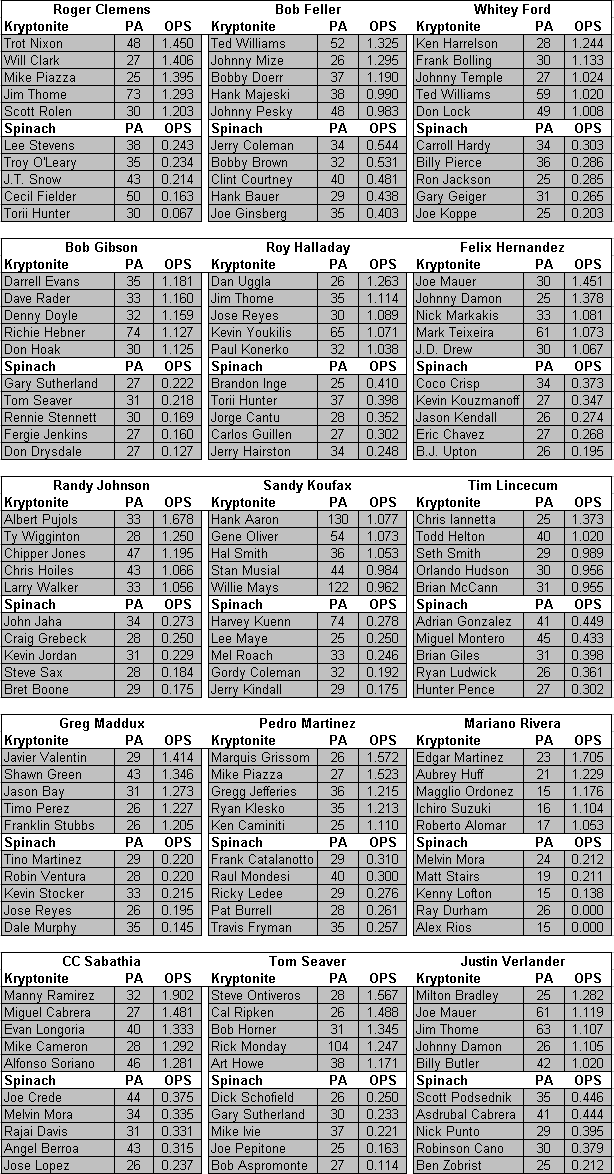 Note: Based on hitters with a minimum of 25 plate appearances (15 PAs for Rivera) against each starter. Includes post season results.
Source: Baseball-reference.com
The chart above lists the five hitters with the most and least success (i.e., the kryptonite and spinach) against Rivera as well as a selection of top starting pitchers from both the present and past. As you can see, the chief nemeses for an elite pitcher are often hitters of equal renown. For example, Bob Feller had Ted Williams, Randy Johnson had Albert Pujols, and Sandy Koufax was made human when facing the immortal trio of Hank Aaron, Stan Musial and Willie Mays. However, there are some anomalies, such as Steve Ontiveros’ success against Tom Seaver. In 28 plate appearances, the former corner infielder for the Giants and Cubs, who had a career OPS of .731, managed to more than double that rate when facing Tom Terrific. The same relationship also existed between Greg Maddux and Javier Valentin, a light hitting catcher who somehow managed to solve the riddle of the Braves’ right hander.
The Seaver/Ontiveros and Madduz/Valentin pairings are probably the most surprising from the chart above, but that doesn’t mean the other elite pitchers haven’t had their share of unlikely antagonists. Marco Scutaro has been one of Rivera’s more frequent tormenters, while teammate CC Sabathia has found Rod Barajas to be one of his toughest outs. Two light hitting infielders, Jose Lopez and David Eckstein, have given Roy Hallday headaches, while Jerry Hairston Jr. is on a very small list of hitters who had Pedro Martinez’ number. Very few pitchers have been more intimidating than Bob Gibson, but that didn’t stop one of the worst hitters in baseball history from dominating the right hander. No hitter with at least 4,750 plate appearances has an OPS+ lower than Tim Foli’s 64, yet, somehow the journeyman managed to bat .483/.516/.586 against Gibson. Not to be outdone, Neifi Pérez, who matched Foli’s infamy by posting an OPS+ of 64 in over 5,500 plate appearances, also picked on one of the game’s greatest pitchers. In 42 plate appearances against Randy Johnson, Pérez raised his game exponentially, batting .333/.333/.619 against the Big Unit.
Unlikely Antagonists
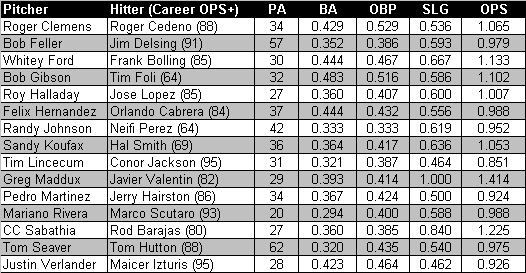
Note: Hitters selected based on a combination of plate appearances and OPS+. Includes post season results.
Source: Baseball-reference.com
The chart below displays the distribution of OPS rates compiled by batters with a minimum number of plate appearances against our selection of great pitchers (see note for explanation of criteria used). Rivera and Clemens are the only two pitchers from the group to keep a hitter under an OPS of .100, while Clemens also scored the lowest percentage of hitters who racked up an OPS over 1.000. Among the starters, only Pedro matched Rivera in terms of the number of hitters with an OPS against below .700; Tim Lincecum is the leader of the actives. Finally, all but Feller, Sabathia, and Hernandez have more “blue” than “red” on their charts, but it should be noted that trio pitched more seasons in a higher run environment than all others but Rivera and Halladay.
“OPS Against” Distribution for Select Group of Top Starters

Note: Based on hitters with a minimum of 25 plate appearances (15 PAs for Rivera) against each starter. Also, a 7% OPS adjustment (based on a crude comparison of league OPS in the different eras) was used to approximate the lower run environment that existed during the careers of Seaver, Ford, Gibson, and Koufax. Includes post season results.
Source: Baseball-reference.com

The Yanks won today. Hiroki Kuroda pitched well and the bats went to work. Here’s Chad Jennings on Mariano and Wallace Matthews with the Alex Rodriguez quote of the day;
Meanwhile, Tyler Kepner looks at the Rangers bullpen in the New York Times.
Tonight, the Knicks are in Indy to play the Pacers. I’m curious to see how the New Yorker’s will respond after a beatdown at the Garden last night.
More NCAA, too.
Go Sports.

Yankee game is on TV this afternoon.
Chad Jennings does a nice job of recapping the Andy Pettitte story over at Lo-Hud. And here is more from Ken Rosenthal.
Play Ball.
[Picture by Bags]

Knicks vs. Pacers, Heat vs. Sixers, Spurs vs. OKC, and all the NCAA that you can watch.
Have at it.
[Photo Credit: Felp Flores]

Here’s Cliff, William Juliano, Craig Calcaterra, Andrew Marchand, and Jack Dickey on the return of Andy Pettitte.
[Picture by Craig Robinson; featured image by Larry Roibal]

Here’s a must-read. John Lahr on the new production of “Death of a Salesman”:
Cast to a T, and beautiful in all its scenic dimensions (with Jo Mielziner’s original, 1949 set design), this staging of “Death of a Salesman” is the best I expect to see in my lifetime.
And Ben Brantley writing in the New York Times:
…The tears that brimmed in my eyes in those initial wordless moments receded almost as soon as the first dialogue was spoken. And at the production’s end I found myself identifying, in a way I never had before, with the woman kneeling by a grave who says, “Forgive me, dear. I can’t cry. I don’t know what it is, but I can’t cry.”
Mr. Nichols has created an immaculate monument to a great American play. It is scrupulous in its attention to all the surface details that define time, place and mood. (Ann Roth’s costumes and Brian MacDevitt’s lighting feel utterly of a piece with Mielziner and North’s original contributions.) And as staged and paced it is perhaps the most lucid “Salesman” I’ve ever seen.
…That Mr. Hoffman is one of the finest actors of his generation is beyond dispute. His screen portraits, whether in starring roles (like his Oscar-winning turn in “Capote”) or supporting ones (“The Talented Mr. Ripley,” “Boogie Nights”), are among the most memorable of recent decades. Though he was brilliant in the 2000 revival of Sam Shepard’s “True West,” his stage work has been more variable.
Certainly his performance here is more fully sustained than those in “The Seagull” (for Mr. Nichols) and “Long Day’s Journey Into Night.” But as a complete flesh-and-blood being, this Willy seems to emerge only fitfully. His voice pitched sonorous and low, his face a moonlike mask of unhappiness, he registers in the opening scenes as an abstract (as well as abstracted) Willy, a ghost who roams through his own life. (And yes, at 44, Mr. Hoffman never seems a credible 62.)
Mind you, there are instances of piercing emotional conviction throughout, moments you want to file and rerun in memory. Mr. Hoffman does terminal uncertainty better than practically anyone, and he’s terrific in showing the doubt that crumples Willy just when he’s trying to sell his own brand of all-American optimism. (His memory scenes with his self-made brother, played by John Glover, are superb.) What he doesn’t give us is the illusion of the younger Willy’s certainty, of the belief in false gods.

According to Jack Curry, Andy Pettitte has signed a 1-year, $2.5 million minor league deal with the Yanks. Was retirement that boring? Is Freddy Garcia that hurt? Maybe Andy’s wife couldn’t stand having him around the house.
Go figure.

Here’s Chad Jennings on Michael Pineda’s outing yesterday:
“That’s my baby,” Pineda said. “I threw a very good slider today, but I’m very excited because my changeup was great. I threw a lot of changeups today and felt comfortable. … Last year, I didn’t throw a lot of changeups, so this year, I’m focused a little more on my changeup and making a good pitch all the time. I’m not worried about my fastball. I don’t know how my fastball is right now, but it feels good.”
That’s the progress the Yankees were hoping to see.
“It’s nice to have success when you’re working at something,” Girardi said. “If you’re making a change or you’re trying to learn a new pitch, it’s nice to have success because I think if you don’t, you’re going to get frustrated, and you’re going to question, do I use it or not? But he’s had some success.”
And more, from Russell Martin:
“I think he was like 88-90 in Clearwater, so it’s coming along. I’m not worried about it. I just want to see the guy pitch. He’s a pitcher like anybody else out there. I just wanted to see him execute pitches. His velocity, he has it in him, it’s just a matter of time. As soon as you put on your uniform, you’re in New York and you get the juices flowing, the velocity is going to pick up no matter what.”
…And if you’re looking for more fastball specifics: “(Pineda) was a little inconsistent trying to throw his fastball away to right-handers. It looked like he was pulling off a little bit.” Martin said it’s an easy thing to correct and could be fixed in a single bullpen.
I’m really looking forward to seeing this kid pitch.

The Cinderella Story is bullshit. It’s just an excuse to laugh and point at the misery of teams and fans with deservedly high expectations. We’re Yankee fans, we should get that.
“Who do you want to win the Series, man on the street?”
“Anyone but the Yankees.”
“Thanks, man on the street. You’re an asshat.”
Whatever. The Yanks are the bullies and the badasses and the rich kids and the guys who get the girls. If anyone deserves that treatment, it’s the Yankees. But the celebration of generic upsets that is March Madness is just cynicism thinly veiled with smile and fist pump.
“Yes, I am really happy really just happy that Bumblefuck U and their 15 fans have won a game and not at all reveling in the tears of that number one or two seed that is obviously a way better team.”
“Man, are you the same asshat that we met on the street earlier?”
The NCAA tournament is one of the great sinkholes. Fall in on a Thursday, emerge on Sunday night. Three days to recharge and reenter on the second Thursday. By the time you climb back out on that second Sunday night, will your job and family still be waiting? Saints, all of them, if they are.
But if your team gets upset on opening night, you’re ripped from the cocoon. Even worse, you’re out, everyone else is in, and you can’t escape the proceedings. You just have to hang at the back of the dance hall, moping, and wait for someone else to join you.
My team has been ousted on opening weekend by lower seeds in its last three appearances and I’m pretty sick of it. One of the matchups featured a good old fashioned soul fucking by the referees and a future NBA star auditioning his supernova in the second half (Davidson and Steph Curry). The other two losses were to teams sprinkled with magical pixie dust – one fast acting (Ohio), the other long lasting (VCU).
Just get to that second weekend. Extend our stay down in the hole. Please. We’ve only got so many more of these tournaments before the NCAA’s blatant corruption and exploitation collapse the enitre eco-system.
This year, the most popular upset pick is Belmont. They didn’t even have to win a game to become this tournament’s darlings. In the past, at least the media would save its slobber for an actual winner. Great for Belmont and all the bullshit offensive fouls they will draw on Friday.
Perhaps it will be mentioned that Ken Pomeroy ranks them as the 23rd best team in the country, and thus likely the best 14th seed in the history of the tournament? Suddenly an upset would not seem so staggering nor suggestive of all that’s right with America. Simply calling it “a fairly likely outcome” wouldn’t even put in dent in Jim Nantz’s hair. But I hope someone at least tells the refs they can call it straight.
I wonder what it does for a big team to be counted out before they even take the floor? What happens when you tell the bad guys the fairy tell ending in advance? I don’t know what follows, but my team copes well with paranoia. So go ahead Belmont. Chuck your threes and and let’s see what happens.


HBO’s series, “Luck,” has been cancelled.
Here are reports by Jon Weisman in Variety, Andrew Cohen in the Atlantic and Matt Zoeller Seitz in New York magazine.
Brings to mind a story Pat Jordan once wrote called “The Horse Lovers.”

Will Leitch on Bryce Harper in the new issue of GQ:
What makes Harper far more anticipated than your typical phenom is a sense that he not only recognizes the vastness of his potential but also feels plenty comfortable telling you about it. One minute he informs me that “baseball needs more superstars.” The next, while discussing Albert Pujols signing with the Angels, he offers thoughtlessly, “Albert and I know each other and respect each other.” In a sport in which “paying your dues” is practically in the job description—an institution that once made Michael Jordan ride around in a bus for five months—Harper seems to have emerged fully formed to piss off the baseball establishment.
On his way up, he didn’t shrink from his sometime moniker, the LeBron of baseball. He poured vats of eye black on his face to make himself look like a professional wrestler. In a minor league game last year, after hitting a home run, he blew a kiss to the opposing pitcher. (Harper tells me, “It was an ‘eff you’ from the mouth.”) That’s the sort of business that will get a major leaguer a fastball in his ear. As Hall of Fame third baseman Mike Schmidt put it: “I would think at some point the game itself, the competition on the field, is going to have to figure out a way to police this young man.”
In other words: Harper is awesome—exactly what baseball needs. He’s essentially a throwback: a cocky, ornery cuss who can back it all up. Ty Cobb minus the racism and chaw, Lenny Dykstra before the bankruptcy. He tells me Pete Rose, a.k.a. Charlie Hustle, is his favorite player and that “I want to play the game hard. I want to ram it down your throat, put you into left field when I’m going into second base.”
[Photo Via The Baseball Analysts]

Over at River Ave, Larry Koestler looks at the 2012 NY Yankees All-Projection Team.
Here’s more on Freddy Garcia from George King in the Post.
[Picture by Bags]

Chris Ballard has a bonus piece on the fall of Antoine Walker in this week’s SI. Worth a read.