



Now You Get It
The Yankees got a break in the first inning tonight when the umpires turned Justin Morneau’s two-run homer into an inning-ending strikeout. With images of Joe Girardi’s reserved response to yesterday’s home run review fresh in his mind, Ron Gardenhire decided to teach the Yankee manager a lesson in automatic ejection. Morneau lofted the ball over the right field wall deep into the seats in foul territory, but luckily Dana DeMuth was not on hand to misinterpret the foul pole.
CC Sabathia looked better than he had against Boston and Tampa, but was still a notch or two below his best. He struck out nine, but the Twins made enough hard contact to bother the big fella several times. He took the ball for the seventh with a 6-2 lead and a very reasonable pitch count.
The Twins chipped away a run with three straight singles. Eduardo Nunez, in his haste to record a force out at third after spearing a grounder to his right, dropped the ball and the bases were loaded with nobody out. Joe Mauer, Morneau and Jim Thome were the next three hitters. Gulp.
CC needed to miss bats, but all three Twins hitters struck true. Mauer lined deep to left for a sac fly. Morneau flew deep to right. And Thome lost an RBI single to all 72 inches (and then some) of Robinson Cano. Sometimes the ball finds the gloves.
The Yankees escaped the seventh with a 6-4 lead and laid three nails out for the Hammer in the eighth. He pounded them.

David Robertson has not allowed a run on the raod this year. Minnesota is on the road, so no runs tonight either. Cory Wade mopped up when the lead bulged to four and the Yankees put CC back on the winning track with a 8-4 victory.
The Yankees offense overcame a top-of-the-order blackout as Derek Jeter and Curtis Granderson only racked up five hits and one run. YES mentioned that Curtis Granderson’s tenth triple of the year makes him the first Yankee since Snuffy Stirnweiss in 1945 to have double digit homers, triples and steals. He fills up a box score with joy.
To pick up for the slack up top, Mark Teixeira, Nick Swisher and Andruw Jones hit home runs and Francisco Cervelli knocked in two big insurance runs with two out in the ninth. Jones and Teixeira both probed the depths of this big stadium with massive shots. Jones hit it 434 feet.
The Red Sox beat the Royals to remain a half game behind the Yankees.
On Target

The Yanks are in Minnie for four games. Cliff’s got the preview:
A popular pre-season pick to repeat as AL Central champions, the Twins have had nothing short of a disastrous season. On June 1, the Tigers completed a sweep of the Twins at home, dropping Minnesota to 17-37 (.315) and 16.5 games back in last place. The Twins perked up a bit from there, going 33-22 (.600) in June and July and cutting their deficit in the division to five games on July 20, but they were playing over their heads during those two months as they allowed as many runs as they scored during that span and never got above fourth place. They have since returned to their early-season level, playing .286 ball in August and falling 10.5 games back in the Central, which seems closer to their actual level. According to third-order wins, only the Astros have been worse this season, and a quick look at the Twins roster shows little reason to expect them to pull out of their current slump.
To begin with, the Twins had Joe Mauer and Justin Morneau in the lineup at the same time in just eight of their first 117 games. They went 2-6 in those games, two of them coming against the Yankees in early April, both losses. With Morneau being activated from the disabled list on Friday, the Twins have now had Mauer and Morneau in the lineup in each of the last five games, but have won just two of them, scoring a total of four runs in the other three. It’s too early to know what to expect from Morneau, who hit .226/.281/.338 through early June before hitting the disabled list with a herniated disc in his neck that required surgery later that month. Mauer, who missed two months early in the season with bilateral weakness in his legs, a neurological condition effecting the strength of his leg muscles, has hit just .289/.356/.353 since his return in mid-June and has started behind the plate on four consecutive days just once since then and three consecutive days on just two other occasions.
Tonight, Ol’ Reliable, C.C. Sabathia aims to regain his form.
Derek Jeter SS
Curtis Granderson CF
Mark Teixeira 1B
Robinson Cano 2B
Nick Swisher DH
Andruw Jones RF
Eduardo Nunez 3B
Francisco Cervelli C
Brett Gardner LF
Let’s Go Yank-ees!


Color By Numbers: Hit and Run

At the beginning of the year, many feared the Yankees were hitting “too many home runs”. According to the most often expressed concern, the team’s inability to play small ball would eventually prove costly in October (a myth disproven in an earlier CBN post). Well, those worried by the Yankees’ reliance on the long ball can rest easy now because the team’s offense has evolved into the most balanced in the American League.
Yankees’ A.L. Rankings in HRs and SBs, 1901-2011

Note: Yellow markers indicate years in which the Yankees led in both categories.
Source: Baseball-reference.com
Over the years, the Yankees have been synonymous with power. In 37 of 110 seasons (not including the present), the Bronx Bombers have finished first in home runs, so it should come as no surprise that the 2011 team currently leads the league with 160. However, some might be shocked to know the Yankees’ 120 stolen bases are tied with the Kansas City Royals for the top spot (the team’s success rate of 76% is also tops in the A.L.).
The last time the Yankees led the league in steals was 1985, when Rickey Henderson set a then single season franchise record with 80 (Henderson would break his own record in 1986 and 1988). However, before that season, no Yankees’ ball club had finished first in steals since 1938, when the team set the pace with a relatively low accumulation of 91. In total, eight teams in franchise history have led the league in steals, which illustrates how much more the Yankees have relied on power.
Yankees’ Top-10 Seasons in Home Runs and Stolen Bases
| Year | HRs | Team Leader | Year | SB | Team Leader | |
| 2009 | 244 | Mark Teixeira (39) | 1910 | 288 | Bert Daniels (41) | |
| 2004 | 242 | Arod, Sheffield (36) | 1911 | 269 | Birdie Cree (48) | |
| 1961 | 240 | Roger Maris (61) | 1914 | 251 | Fritz Maisel (74) | |
| 2003 | 230 | Jason Giambi (41) | 1912 | 247 | Bert Daniels (37) | |
| 2005 | 229 | Alex Rodriguez (48) | 1908 | 231 | Charlie Hemphill (42) | |
| 2002 | 223 | Jason Giambi (41) | 1901 | 207 | Cy Seymour (38) | |
| 2006 | 210 | Jason Giambi (37) | 1907 | 206 | Wid Conroy (41) | |
| 1998 | 207 | Tino Martinez (28) | 1913 | 203 | Bert Daniels (27) | |
| 2000 | 205 | Bernie Williams (30) | 1905 | 200 | Dave Fultz (44) | |
| 2001 | 203 | Tino Martinez (34) | 1915 | 198 | Fritz Maisel (51) |
Source: Baseball-reference.com
Although the 2011 Yankees are unlikely to approach the franchise records of 244 home runs (2009) and 288 stolen bases (1910), they could become only the fourth pinstripe squad to finish first in both categories (the only other A.L. franchise to accomplish that feat was the 1995 Cleveland Indians). Once again, you have to go all the back to the 1930s to find a Yankees’ team that displayed preeminence in both power and speed. In fact, all three dual first place rankings occurred during that decade, although it should be noted that the leading totals were relatively low because the era deemphasized the stolen base.
American League Category Leaders by Franchise, 1901-2011

Note: Rankings for each category do not total 110 season because of ties. Teams listed in order of most cumulative category leading finishes.
Source: Baseball-reference.com
Not surprisingly, the Yankees led the league in runs during each season in which they also finished first in home runs and stolen bases. The same trend also holds this season. Despite all of the publicity given to the Red Sox offense, the Yankees are the team that leads the American League in runs scored (albeit by only three). If they can hold onto that margin, it would give the Yankees the top spot in runs for the 31st time in franchise history, and the fifth time in six years, a level of dominance surpassed only by the 1926-1933 lineups, which outscored the league in seven of eight seasons.
Using the long ball and small ball, the Yankees’ offense has proven to be one of the most dynamic in franchise history. Only five other teams in club history have scored more runs relative to the league average, so the lineup’s diversification has clearly paid dividends. As a result, the Bronx Bombers’ bats have left little reason for concern, which only means Yankees’ fans will now have to find something else about which to worry.
Looking Back

Nice note about C.C. Sabathia’s visit to the Negro League Museum in Bats over at the Times. In the same piece, David Waldstein has an update on Alex Rodrgiuez:
Alex Rodriguez is still expected to join the Yankees in Minnesota on Thursday, but Joe Girardi said that he might not be immediately activated from the disabled list because of uncertainty about whether his right knee is ready.
“We may not activate him for a couple of days,” Girardi said.
Rodriguez, who had arthroscopic surgery on the knee last month, played third base for Class AAA Scranton/Wilkes-Barre on Wednesday, then was expected to fly to Minnesota. (He went 1 for 2, with two walks.) Girardi said he wanted to talk to Rodriguez and perhaps have him get some treatment from the trainer Gene Monahan, work in the batting cage and take ground balls before making a decision.
“A couple of days, if you rush it, could cost you a couple of weeks if you end up hurting something else,” Girardi said. “That’s why we want to take a look at him with our own eyes tomorrow and see how far he is away and see if he’s ready.”
Girardi said he might initially use Rodriguez as the designated hitter in order to ease him back into action.
When a Fence is not a Fence
Robinson Cano has been magnificent of late. Spectacular in the field and prodigious at the plate. But with bases loaded in the ninth trailing by two runs, his willingness to hack helped Joakim Soria escape a terrible jam. Mark Teixeira walked on four pitches in front of Cano to load the bases with one out. Soria threw five straight balls to Cano, but Robbie ripped at two of them. Soria won the battle as Cano flew out to left.
That was the big out of the inning, but the Yankees still had life. Swisher walked (on four pitches, Robbie) after a passed ball and the bases were loaded again. Birthday boy Jorge Posada followed. I hope his cake is extra sweet, because he struck out without taking the bat off his shoulders. Two of the pitches looked outside, but the last one was too close to take. Maybe ripping ain’t such a bad idea when the umps can’t find the strike zone. Or the outfield fence.
When Mariano Rivera needs to be restrained in the dugout, that’s probably a blown call. In the third, the umpiring crew saw a ball that clearly bounced off the fence as a home run. But the fence is segmented, so that a small chain link fence sits above a green padded wall. More green padding edges the top of the chain link section. Common sense dictates that the entire structure represents the “fence” but this is Kansas City, so apparently nobody knows for sure.
Billy Butler, reaching for his helmet to return to second base, could not contain a smirk when he saw the signal. “He’s looking like the cat who ate the canary,” said David Cone. Kim Jones talked with Royals personnel, including the great Frank White, and reported that no, it was not a home run.

After the game, Joe Girardi explained that crew chief Dana DeMuth understood the ground rules differently. He didn’t think it needed to clear the entire fence to be a home run. Girardi assumed the umpire knew the ground rules and didn’t protest. He plans to check on the ground rules tomorrow by calling the League Office. What is this, 1954? Everybody in KC is out celebrating the victory? Gimme a break, we should have that information before this post is finished.
Since he didn’t protest at the time, it’s likely the Yankees have lost the chance to protest the game – though they should at least make the attempt. Maybe they can send a message to the League Office by carrier pigeon.
With better pitching from Bartolo Colon or more timely hitting from the Yankees, that run would not have mattered. Though the Yankees pounded Bruce Chen’s offerings early and often, they only managed to charge three runs to his account. In the first two spots of the lineup, Derek Jeter and Curtis Granderson combined to go seven for nine with a walk, two doubles and a homer, but somehow only contributed three runs. The Yankees went one for ten with runners in scoring position.
Jeter singled to lead off the game and was caught stealing by Chen’s pick off move just before Granderson homered. When Granderson doubled off the wall, Jeter wasn’t on base. And second baseman Johnny Giavotella robbed Granderson of a base hit and RBI after Jeter’s long double. When they finally joined forces to lead off the seventh with a single and a walk, Teixeira, Cano and Swisher struck out in succession. (Both the umpire and the three Yankees lost track of the strike zone during those at bats – the first slider to Swisher was the only sure strike for me.) Russell Martin stranded five in his first two times up and then hit a lonely homer in the sixth. Before you knew it, Bruce Chen was racking up a victory, 5-4.
The Royals smashed Yankee starters all series long, so it should be no surprise that Bartolo Colon got lit up. The Yanks offense didn’t support him the way they did Burnett and Nova and the bullpen was spent, so perhaps he would have pulled when he was in trouble in the fifth. Kauffman Stadium played like a bouncy castle this series, so Yankee starters will be glad to see Minnesota.
The Yanks are now done with KC, so we bid farewell to Melky Cabrera. He’s among the top twenty hitters in the American League and hit the ball hard all series long. The Yankees traded him, stud prospect Arodys Vizcaino, who’s already in the Major Leagues for Atlanta, and Michael Dunn for a batting practice machine with Javy Vazquez’s name on the back. I think this is going to leap past the Marte-Nady deal as the worst of Cashman’s tenure.

Tabata’s where Melky was at 22; Melky’s finally taken a few steps forward. And while Karstens is having a nice year, Vizcaino has oodles more talent. Of the Dunn-Logan-Marte loogy triumverate, Marte’s spotless Postseason in 2009 rates over what the other guys have done, though if Logan does something special this year, he’d shoot to the top.
The Red Sox lost earlier in the day so the Yankees squandered a chance to increase their lead in the standings. Bummer.
Top Photo via Zack Hample
Lump Lump

It’s Bruce Chen Fireworks Night, folks. Seems to good to be true. Which means the Yanks’ll lose, right?
Let’s hope not.
Derek Jeter SS
Curtis Granderson CF
Mark Teixeira 1B
Robinson Cano 2B
Nick Swisher RF
Andruw Jones DH
Russell Martin C
Eduardo Nunez 3B
Brett Gardner LF
And Let’s Go Yank-ees!
From Ali to Xena: 26
A Vanishing Art
By John Schulian
Somewhere along the line, human beings went out of fashion in America’s sports pages. You wouldn’t think it was possible, given that flesh-and-blood people play our games, but the tastemakers have deemed statistics and cockeyed opinion more important. There are exceptions, of course, like Joe Posnanski when he was pounding out a humanity-infused daily column that would have been a treasure in any era. And there are others who would love to craft character sketches and mood pieces, but realize that won’t put any biscuits on their table. And then there are the glory seekers who latch onto people only when they have a sob story to tell, because sob stories win prizes. But all the prizes tell me is that the writers who chase them so shamelessly are manipulative at best, hypocritical at worst. Forgotten are the small dramas that are played out every day in sports, and the people who inhabit them, and the artistic impulses they stir.
Over lunch, a friend who has just finished writing a non-fiction book about a boxer tells me he used a column of mine from 1980 as part of his research. The column opened with someone describing Joe Frazier’s manager, Yank Durham, in full flower as a hard ass. Frazier was about to fight Ron Stander, whom he could have beaten blindfolded, but Durham bitched loud and long about some TV lights he said were part of a plot to blind Smokin’ Joe. The people televising the fight pleaded innocent, but Durham refused to believe them. “That’s it,” he said. “We ain’t fightin’.” The TV people went into shock. So, for that matter, did Frazier. But Durham didn’t let up until the lights were taken down. That was how boxing worked then, and that’s how it works now. The guy with the biggest balls wins.
“Great column,” my friend said, “but you couldn’t write it today.”
I couldn’t write it because I used the tools of fiction – character, dialogue, dramatic tension – to depict a hard man in a hard business. I couldn’t write it because I populated the column with human beings, and I didn’t pass judgment on them. It was up to the reader to choose between Yank Durham and the TV people. I thought it was permissible for a columnist to do that. What did I know?
Let me tell you what else I couldn’t write today. Once in a great while, I would do a column about duende, an Andalusian word that is best defined by example: Willie Mays had duende, Henry Aaron didn’t; the Rolling Stones had it, the Beatles didn’t. I was borrowing shamelessly from the late George Frazier, an eccentric general interest columnist who made his last stand at the Boston Globe with a red carnation in the lapel of his Brooks Brothers suit and a quote from F. Scott Fitzgerald for every situation. I was following in the tradition that inspired many another columnist to borrow Jimmy Cannon’s pet gimmick, “Nobody asked me, but . . . ” You didn’t think Mike Lupica came up with “Shooting from the Lip” by himself, did you? He and I were indulging in what Hollywood likes to call “an homage” because it sounds so much better than “theft.”

Whatever, I had a fine time passing myself off as an arbiter of style in my duende columns. In fact, I would encourage today’s columnists to do the same, but my friend Randy Harvey, once an intrepid sports writer and now one of the top editors at the L.A. Times, says duende wouldn’t fly. The wounded look on my face when I hear his verdict seems to touch something deep inside him, though. “Okay,” Randy says, “I’d let you write duende once a week if your other three columns were on the Lakers.” Call me an ingrate, but that still doesn’t sound like such a great deal.
I’m the product of an era when a sports columnist was pretty much left to his own devices. Sometimes the news dictated what I wrote about, and sometimes there were subjects that just couldn’t be ignored whether I was interested in them or not. But the rest of the time, my column reflected who I was, for better or worse. When I wrote a sad one, it was because the subject touched my inner blues man. When I did a rip job, I was putting my mean streak on display. But never was I so infatuated with myself that I thought readers wanted a dose of my opinions every day. They were smart enough to figure out where I was coming from personally and politically without my beating them about the head and shoulders with the first person.
More than anything else, I wanted to write about the human condition, good or bad, happy or sad. The fact that the people I wrote about wore uniforms, had their names in headlines, and cashed big paychecks for their labors was mere coincidence. The important thing was to let my readers know that their heroes were people, too, not the remote gods who dwell in the parallel universe that exists today.
One of the beautiful things about newspaper work is that you never know whom you’re reaching, or what your words mean to them. There are letters to the editor and angry phone calls, of course, but there are also the personal notes that become small treasures. And one night at the Chicago Sun-Times, I heard the highest praise I ever received. It came from the cleaning lady who swept the floor and emptied the wastebaskets in the sports department. She had a bad eye and a balky hip that crabbed her stride, and she was there the day I started at the paper and probably long after I left it. I’d say hello to her, but I never wondered whether she read the paper or, if she did, made it as far as the sports section. But when she reached my corner of the office that night, she looked at me and said, “You got a lot of soul.”
I know I thanked her more than once. Other than that, everything is a blank. I’m only guessing when I say I think she liked a column I had written about Johnny Bratton, a former welterweight champion who was living on the street. But maybe the subject isn’t as important as the fact that this woman had seen something in my work that had nothing to do with winners and losers and everything to do with the forces that drove me.

Still, there were times I wasn’t aware of just how much of myself I was revealing in print. I’m thinking of one column in particular, written in 1983 about regrets and missed opportunities. It opened with my musings on the White Sox, who were very good that year, as I drove home from Wisconsin on a rainy late-summer night, and then it veered into personal territory I rarely visited. By the time I finished writing, I had quoted William Blake and Tom T. Hall and pretty much revealed myself to be a ball of confusion. I could feel the first rumblings of profound changes in my life, and change was a stranger to me.
A few days later, I ran into a documentary maker named Ken Solarz and the first thing he said was, “Man, you were really hurting.” Though he and I would later arrive in Hollywood at about the same time and become great friends, I barely knew Kenny then. But he was very perceptive. I was hurting. And it would only get worse.
El Duque Leaves the Game
Orlando Hernandez has officially retired.
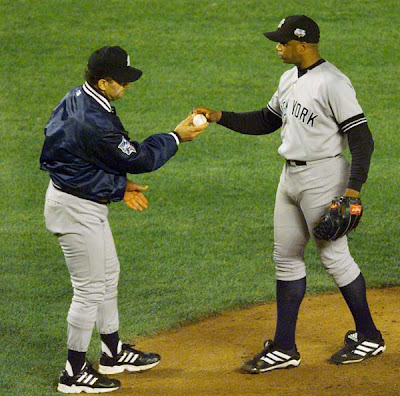
Other Yankees have been around longer. Other Yankees contributed more to the last dynasty. And certainly, many other Yankees were consistently better. But El Duque is one of the first guys I think of from that era. As a morbidly pessimisstic fan in those days (I think I’ve evolved past the morbid part in the intevening decade), no other starter inspired security like El Duque.
I’ll never forget the first inning of the 1999 ALDS against the powerful Rangers lineup. Pudge doubled with one out and El Duque faced the heavy hitters. He gave the lefties Greer and Palmeiro nothing at all and walked them both to load the bases. But the righties Gonzalez and Zeile he attacked with his full arsenal and exploited their aggression with ever-widening sliders until he had them fishing for pitches a foot outside.
And if there was a more crucial postseason game in the three-peat than his his ballsy victory in Cleveland in Game Four of the 1998 ALCS, I don’t know if I want to remember.
His pitching style was unforgettable and almost impossible to replicate on the stick-ball blacktop, though it didn’t stop us from straining our gluts giving it a try. His feisty confidence was refreshing and his arguments with Posada during mound visits were always entertaining.
When he walked those Texas lefties, there was no doubt it was part of a master plan. Perhaps that plan was a little foolish and left too little margin for error, but I don’t think El Duque ever worried that it wouldn’t work. And watching at home, I wasn’t worried either, which is probably why he was my favorite starter.
The Yankees had two players during the most recent dynasty who delivered performances vastly better than their career statistics would have you believe was possible. The great Mariano and El Duque. Mariano went from Hall of Famer to statistical impossibilty in the Postseason and El Duque, a quality middle-of-the-rotation arm, turned into Bob Gibson.
His baseball-reference page will have my kids wonder what all the fuss was about. I can’t wait to tell them.

The Old Man and the River
Here’s another gem from Pete Dexter.

The Old Man and the River
By Pete Dexter
Early morning, Seeley Lake, Montana. The sun has touched the lake, but the air is dead still and cooler than the water, and the fog comes off the surface in curtains, hiding some of the Swan Range three miles to the east. And in doing that, it frames the rest. It is the design here, I think, that nothing is taken without compensation, except by men and fires. They leave all the holes.
On the lake a cutthroat trout breaks the surface; pieces of it follow him into the air. He breaks it again, falling back. The water mends itself in circles; the circles disappear. You could never say exactly where, but that’s how things mend; it’s how you get old, too. Not that they are necessarily different things. The place is quiet again. The sun has touched the lake, but the lake still belongs to the night. To the night and to the old man.
He is in the main room of the cabin putting wood on the fire. I hear him humming—a long, flat note, more electric than musical. I think it is a sound he makes without hearing it. He moves from the fireplace to the kitchen wearing a fishing hat, runs lake water out of the spigot into a dented two-quart pan, puts that on the stove to heat. He starts a pot of coffee, leaves it on a counter, and pushes out the door to urinate in the yard. He and his father built the cabin in 1922 as a retreat from whatever civilization there was in Missoula, and they didn’t do it to come down off the mountains and have to look at an indoor toilet.
He comes back in, humming, and surveys the kitchen. He scratches his cheek, remembering where he is. He locates the coffeepot, checks to see what is inside. Part of him is somewhere else. Probably not so much of him that he’d piss in the fireplace and throw the wood out the door, but it isn’t impossible.
The guess is that the part of the old man that’s not in the kitchen is someplace tangent to August of 1949, Mann Gulch, Montana, where thirteen of sixteen smoke jumpers were killed in the first hours of a wildfire that got into the crowns of the trees there. He is in the last chapter of that story now—the jumpers have become his jumpers, he looks at tall trees and imagines fire in their tops, sucking the oxygen out of the air, and feels how helpless a man is in its presence—and while it’s still three hours until he sits down and puts himself back in Mann Gulch to confront it, he is headed there already, feeling his way over what has already been done, measuring what is left.
As far as I know, that’s the only pleasure there is in writing—until something’s finished, anyway. And the old man works carefully and is entitled to his time alone with what he’s done. I stay in bed looking out the window, waiting for him to call me for breakfast.
#1 With A Bullet

Boom.
Greetings, Banterers. The Yankees moved into first place in the AL East tonight – for now – in a sloppy 9-7 win over the Royals that didn’t relly make anyone except Robinson Cano look good. Ivan Nova didn’t have it, but neither did the Royals pitchers, and Cano’s mega-homer in the interminable fourth inning was the difference. Nova gave up all seven of those runs in 5 and a third, and while one might hope that nine runs would be enough for an easy victory, this was tighter than it should’ve been. Nova’s exceeded expectations enough that I’m willing to spot him a few, however, and KC pitcher Danny Duffy (who has a fantastic mlb.com profile photo, by the way) gave up eight in just three, so maybe it was one of those something-in-the-water games.
Ned Yost got ejected arguing balls and strikes on Duffy’s behalf in that fourth inning, but Cano hit his monster shot immediately afterwards to cap off a great 12-pitch battle, so apparently getting tossed didn’t have quite the fire-up-the-troops effect Yost was going for. Though again, it was a great at-bat from Cano, and Duffy hardly disgraced himself although things did not exactly go his way.
Also coming through for New York were Derek Jeter (now up to .283 and OBPing .344, though with no slugging percentage to speak of), Mark Teixeira, Russell Martin and Brett Gardner; the bullpen quartet of Boone Logan, Rafael Soriano, Dave Robertson, and Mo, who seems to be just fine, thankyouverymuch.
I’d be shocked if the Red Sox didn’t take the lead back at least once or twice, and frankly surprised if they didn’t end up with it, given the eyebrow-raising nature of the Yanks’ rotation. But hey, it’s gotten them this far. Starting tomorrow: the Incredible Colon.
It’s a Super Nova
Nova on the hill.

Derek Jeter SS
Curtis Granderson CF
Mark Teixeira 1B
Robinson Cano 2B
Nick Swisher RF
Andruw Jones DH
Russell Martin C
Eduardo Nunez 3B
Brett Gardner LF
No frills:
Let’s Go Yank-ees!
[Photo Credit: R. Swan]
Quote of the Day

“Any man who can write a page of living prose adds something to our life, and the man who can, as I can, is surely the last to resent someone who can do it even better. An artist cannot deny art, nor would he want to. A lover cannot deny love.”
Raymond Chandler
[Photo Credit: The Portland Mercury]
Grizzly

Over at ESPN, Jonah Keri writes about six teams you don’t want to face in the playoffs.
[Photo Credit: USA Today]
What’s the Latest?

First Grantland and now comes The Classical, a new site that will feature the talents of Tim Marchamn, Eric Nusbaum, David Roth and Bethlehem Shoals. It’s been an interesting year for new sites.
Also, while I’m at it, Sports Feat is a good spot to find long form sports writing. You should also keep an eye on Adi Joseph’s blog, Hard-Charging.
[Photo Credit: Scott Armstrong]
The Baumer
The Yankees have half-a-dozen starters for five slots so A.J. Burnett’s job assignment has been getting a lot of attention lately. He has been very bad for a good, long stretch now. When the Yankees have to make tough decisions, many, many fans would prefer to see him exiled to the bullpen, sent to the DL, or even released. How much of this has penetrated A.J.’s inner sanctum I have no idea, but he knows how bad he’s been lately and he can count to six. So I’m sure he appreciated the extra scrutiny on tonight’s start against the last-place Royals.

Burnett was protecting a 2-0 lead and potential victory when he faced Melky Cabrera with one out and the bases loaded in the fifth. It was a tough spot and Melky’s no slouch with the stick. Burnett leaped ahead of Cabrera 0-2 with a decent sinker and a good curve. He stood him up with an inside fastball. And then Burnett made his kill-pitch – the low hard curve down around Melky’s ankles. Melky spoiled it. A.J. looked frustrated that Melky hadn’t whiffed and fired his next three pitches indiscriminately towards the general back-stop area. Melky walked, cut the lead in half and Billy Butler followed with another hit that gave the Royals a 3-2 lead.
Stellar defense by Swisher (limiting Butler to a single on a liner towards the corner) and Cano (starting a gorgeous double play to end the inning) kept the score at 3-2, but A.J. Burnett left the mound spinning. And Yankee fans were knee-deep in another Burnett stinker. Through the fifth, he had allowed nine hits, a walk and three runs. Good defense saved him from a lot worse than that.
But the Yankees offense immediately responded to the deficit and pushed three runs across. With the new lead and A.J. somehow in line for a win, he was the last guy I expected to come out for the sixth inning. But there he was. He retired the first batter, allowed a single after a long AB, and then got Salvador Perez to fly out to center. Joe Girardi almost tripped over himself getting out to the mound. He lifted Burnett for Boone Logan. As Burnett left the game, Derek Jeter stopped and whispered something in his ear.
I think both Girardi and Jeter felt that sixth inning was of vital importance to A.J.’s mental state. To leave the game after the disaster in the fifth would have felt like a massive failure regardless of who ended up winning. But by sending A.J. out for the sixth, he might feel like he contributed something to the victory.
This game played out like a scenario contrived specifically for A.J. to work out his problems. That’s the state of the Wild Card race these days, and that, of course, is the state of the Kansas City Royals. I think if this were an important game, Girardi would have yanked Burnett after he walked Melky. Burnett appeared broken when Melky fouled off his out-pitch. And I think if it was even a semi-important game, Burnett would never have come out for the sixth. But it was a totally meaningless game, so Girardi experimented. Hopefully whatever he mixed in the test tube will be useful down the road.
In order for the psycho-drama to function properly, the Yankee offense needed to score first, but keep it close so they could fall behind. The defense had to be top-notch, as the Royals can hit a little bit and are aggressive on the bases. And then they needed to bounce back and give A.J. support when he needed it most. All parties performed their roles superbly. Gardner chopped run-scoring singles and Jeter had three hits and three RBI, the big blow a long triple to right-center that reclaimed the lead in the sixth.
I’d quibble about the first-inning bunt, but apparently, it was just part of the script tonight. Good thing it also called for a flawless Mariano save and a Yankee victory, 7-4. Rehire this creative team next time they play Boston.
Burnt Ends (Freakin’ Lickum)

Yup, it’s our boy A.J. on the hill tonight. You feelin’ it?
I’m feelin’ it.
First of three for the Yanks in Kansas City.
The Royals entered this season with by far the best farm system in baseball and have since stocked their major league roster with prospects, including first baseman Eric Hosmer, second baseman Johnny Giavotella, third baseman Mike Moustakas, lefty starter Danny Duffy (who will pitch on Tuesday), and relievers Aaron Crow, Tim Collins, Louis Coleman, Greg Holland, Everett Teaford, and Rule 5 pick Nathan Adcock. Those players haven’t accomplished much more than getting their feet wet, however.
Moustakas has been awful. Hosmer has hit just .254/.317/.384 since June 8. Giavotella has been solid but has only been up for ten games. Duffy has just six quality starts in 15 turns. Crow, a curious choice for the team’s lone All-Star selection, has a 4.08 ERA and three blown saves in his last 16 outings. Tiny Tim Collins has walked 6.7 men per nine innings. Teaford has just one more strikeout than walk. Coleman and Holland have been excellent, but neither was considered among the cream of the farm system, and Adcock, who is in this discussion only by virtue of being a rookie, has a 5.23 ERA.
That said, the Royals do have a roughly league-average offense thanks to the unexpected performances of their outfielders, two of whom were roundly mocked when the Royals acquired them this offseason. Alex Gordon, who is finally fulfilling his potential at age 27 is actually one of the most valuable players in the league according to Baseball Prospectus’s WARP (Wins Above Replacement Player). Melky Cabrera is, at 26, having by far the best season of his career, hitting for unprecedented average and power. Jeff Francoeur is having his best season since his rookie year of 2005, thanks in part to a career-high walk rate and his best power performance since 2006. Add in Billy Butler’s typical not-great-but-good showing at DH, and the Royals have half of a solid major league offense.
Of course, that has been undermined by Joakim Soria going rotten, posting the worst save percentage among the 24 men with 20 or more saves this season, most recently collaborating with Crow to blow a 7-3 lead against the Rays last Wednesday. Put it all together, and the Royals have the third-worst record in baseball, which is an unfortunately familiar place despite all those new faces, and are 2-8 over their last ten games coming into this series
Brett Gardner LF
Derek Jeter SS
Curtis Granderson CF
Mark Teixeira 1B
Robinson Cano 2B
Nick Swisher RF
Eric Chavez 3B
Jorge Posada DH
Russell Martin C
Grab yer napkins and let us dream of K.C. bbq as we cheer:
Let’s Go Yank-ees!
[Photo Credit: Kevin’sbbqjoints.com]
Center Stage

Steve Goldman looks at Curtis Granderson as an MVP candidate. He examines stats from Baseball Prospectus, Fangraphs and Baseball-Reference and says that:
One of the main reasons for variance between these measurements is the way they handle fielding, with each having different ways of tabulating a player’s defensive contribution. What is fascinating is that despite this, all three rankings agree that Granderson shouldn’t be anywhere near the MVP award, and they agree on the reason: they think he has been a poor defensive player this year. Conversely, they agree that Brett Gardner has been a spectacular defensive player, which is why he shows up in the top 10 for two of the three sites (Gardner ranks 17th in BP’s hierarchy). BP’s fielding runs say that Granderson has set the Yankees back about 10 runs with the glove beyond what an average defender would have done, equivalent to a full win. Fangraphs’ version of the same says about the same thing with -8 runs, while BB-Ref generously only penalizes him seven runs.
What perplexes me here is that I can’t see it, whether on television or at the ballpark. When we talk about Derek Jeter’s defensive deficiencies, I have always been able to see his difficulties going to his left. The statistics merely confirmed what I already knew. In this case, Granderson’s problems aren’t obvious to me, so I ask you: have you noticed Granderson fail to play a solid center field?
That’s a good question. I have a hard time wrapping my head around fielding stats, that’s for sure.
[Photo Credit: ESPN]
What’s in a Name?

Over at The Yankee Analysts, Mike Jaggers-Radolf plays Name That Pitcher.
[Photo Credit: N.Y. Daily News]


--Earl Weaver