
“Burning House” By Carrie Schneider





Photograph by Larry Fink.

Kottke has more on the almost-always, mostly-free Criterion Collection.

Charlie Pierce has a nice piece on the Knicks over at Grantland. A reminder that reading about sports can be, you know, fun:
By this time in the NBA season, every team, good and bad, needs a healthy dose of ridiculous in its game to keep the fans interested and the snark flowing until such time as the playoffs begin and everybody has to get grimly serious about the whole business. (Back in the day, there was never a better time to cover the Larry Bird–era Celtics than during the trackless days of mid-February and early March. Those teams had Bird and McHale — and, earlier, Cedric Maxwell — as snarkmasters supreme and, eventually, they had Bill Walton come aboard as a dartboard. It was open-mic night four times a week.) Right now, and much to his dismay, New York Knick Jason Kidd is the element of ridiculousness that’s adding a certain je ne sais clang to what is, at the moment, the best team not only in your Atlantic Division, but also in your five boroughs.
Kidd is in a slump. No, check that. Kidd is in a morass. No, check that. Kidd is in the Great Grimpen Mire and we may never see him again. Jason Kidd, who already has a plaque gathering dust as it waits for him in Springfield, has missed 34 of 41 3-point attempts, including six Sunday night, in a closer-than-it-should-have-been, sparing–you–from–watching–Seth MacFarlane 99-93 win over the Philadelphia 76ers. He has missed them long and he has missed them short. He has barely missed them and he has missed them by a time zone or two. Anne Hathaway had as good a chance of hitting a 3-point shot Sunday night as Jason Kidd did. But what’s interesting is that this amazing pile of statistical roadkill likely will not even matter in two months. The Knicks didn’t sign Kidd to hit 3-pointers in February. They signed him to hit Carmelo Anthony in the eyeball with a pass at a critical moment of a game in June. And, if he is a step slow at that, too, and he is, he is still being paid a handsome $9 million or so for three or four passes that people will remember long after the sound of The Bells of St. Mary’s fades.
[Photo Credit: Joe Camporeale/USA Today]

Chad Jennings with yesterday’s Yankee notes from Florida.
[Photo Credit: Matt Slocum/AP, via It’s a Long Season]

Talkin’ bout…Hey Love.

Here’s something to bookmark: Screen Slate. This site keeps us up-to-date on all the happenings at the revival houses in town.

Another beaut from our man Dexter. This one originally appeared in the Philly Daily News on June 2, 1980. It is collected in Paper Trails, a must-read if there ever was one, and is featured here with the author’s permission.
“Dead Dogs and Manhood”
By Pete Dexter
The year I turned 5 my family moved to a little town in central Georgia called Milledgeville where my father taught physics at the military college. Our house was on a red clay road, next to a pine woods and a saw mill. The plums came off the trees hot from the sun, and I had a cocker spaniel puppy that followed me everywhere I went. And nobody wore shoes all summer long, except to Sunday school.
The puppy was almost grown when he was killed. A city garbage truck hit him and left him where he stopped rolling, beside the road on a hill half a mile from the house. I heard about it from a kid named Kenny Durkin, who was the kind of kid who would spend half the afternoon looking for you to be the one to tell you your dog was dead.
He is probably working for a newspaper now.
Anyway, Kenny found me down at the saw mill, walking around the inside edge of a round cement building where they burned scrap wood. The building had a clay floor, dug out into a pit, and if you fell off the edge that’s where you ended up, in there burning with the wood.
My friends and I went there once or twice a week and waited for the watchman to chase us out. We wanted to see it when he fell off the edge.
Kenny Durkin stuck his head into the open door and yelled at me. “Peter,” he said, “the city truck done run over yer dog and kilt him dead.”
We ran from the saw mill to the hill where the city truck had left my dog, stopping every now and then for Kenny Durkin to get his breath. I was scared and excited at the same time – I’d never seen a dead dog before.
By the time we got to place on the hill, the sun had baked one side of the dog’s coat so hot you could hardly touch him. The flies were all over his ears and eyes, and I brushed them away and picked him up. He had never seemed so heavy before. I told Kenny Durkin to go away.
I carried the puppy up the hill, stumbling under the weight. I fell in some stones, and he rolled into the ditch. I pulled him out by a leg, and there was a trail of blood and bubbles where his mouth had slid along the ground. It was cool in the ditch and I thought about leaving him there, but there was something worse in that than in what had already happened.
I picked him up and started for home again. I moved him from one shoulder to the other, trying to get rid of the ache in the muscles. But the ache got worse and worse and the next time I fell I couldn’t pick him up again, so I
dragged him home by the leg.
And I was crying as much from the ache as for the dog.
A neighbor woman came out from behind her screen door and told me to leave the puppy out in the street. “Come on in and have some ice tea,” she said.
“Your daddy’ll be by directly.”
But I was dizzy from the heat by that time, watching my feet move, one in front of the other against the red Georgia dirt, and I didn’t answer.
I didn’t have anything to say, and I had something to do. And a long time went by before I got the puppy home.
I remembered all that last week. I was driving some back roads near Elmer, N.J., when I came on a kid carrying a dead dog.
He was older than I had been – he might have been 9 or 10 – but you don’t pick the times you grow up, they pick you. The dog was a mongrel, maybe 35 pounds, and the kid was trying to balance it in front of him on the frame of his bicycle.
He’d pedal a few yards, then the handle bars would get away from him. He’d reach up to steady himself and the dog would fall off onto the road. I stopped the car behind him and asked what had happened.
“He got run over,” he said. The dog was lying at his feet and boy couldn’t control his voice any more than the handle bars. Everything was falling apart all at once.
I said, “Maybe I can help you get him home.”
He said, “I can do it.” He picked up the dog and lay him across the bicycle. The eyes swung in the air. The boy got back on the bicycle and tried again, the dog fell off again. “Oh, Goldie,” he said.
“How far do you live?”
The kid kept his face away when he answered, so you couldn’t see him crying.
“Just a little bit up the road. I can do it.”
“Close enough to walk? ” He nodded, still keeping his face away. I said, “Then hold her on the bicycle and walk her home.”
The kid put his dog across the bicycle, held her there with one hand and began to walk toward a red and white farm house a long ways down the road. From the back you could see the crying take over his body. Maybe if I’d asked him again, he would have let me drive him home.
But I didn’t ask.
He was finding out about himself, and tonight, after the dog was buried, that would be all he would have to take her place.
[Photo Credit: Sally Mann]

Via Ego Trip, check out Gilles Peterson’s Donald Byrd Tribute mixes.
Another good episode of this fine series.

I made this painting when I was nine-years old and gave it to a family friend. When she died, her son gave it back to me and it now hangs in my apartment.

From this card.


Yanks need to replace Curtis Granderson, at least for a little while.
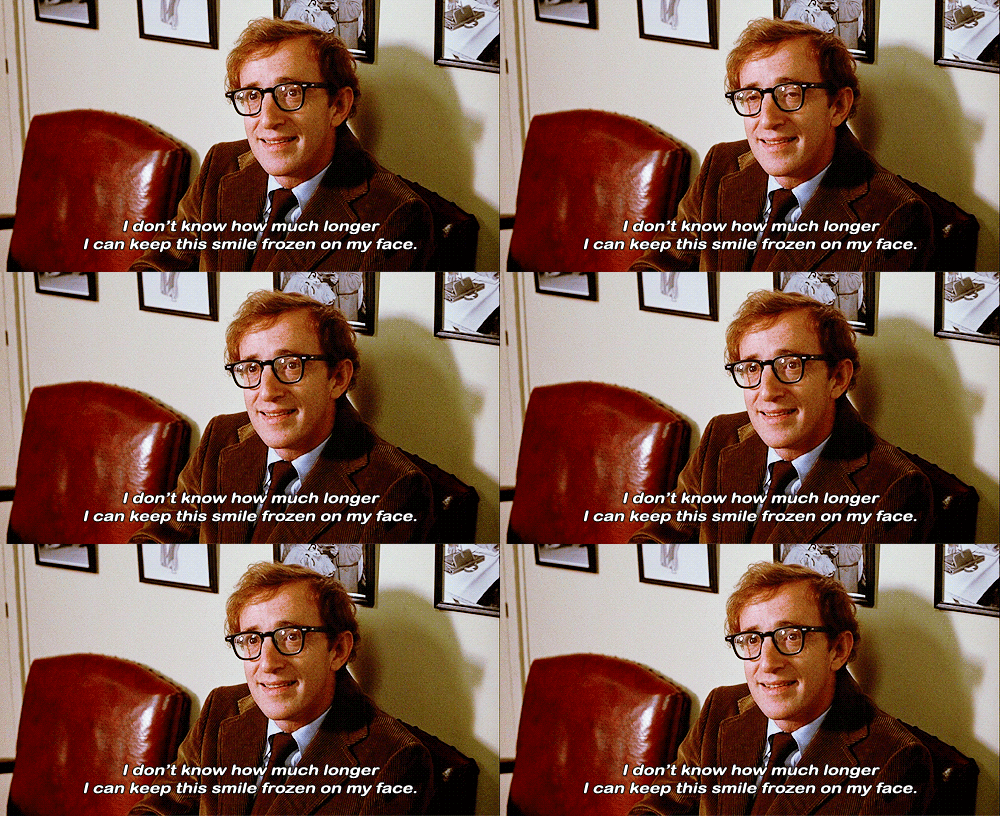
The Oscars. Have at it…if you like that sort of thing.

Curtis Granderson was hurt today. He’ll be out for a while.