"A New York Treasure" --Village Voice

The Banter Gold Standard: Jimmy the Greek

Peter Richmond is one of the finest takeout writers of the past thirty years. According to his website:

Peter Richmond attended Yale University, where he studied under the late, great John Hersey and the very alive, great David Milch. Somewhere in there he also attended auto mechanics school, from which he never graduated, but which led to his eventual purchase of a ‘77 Eldorado which is currently his family’s most mechanically reliable vehicle. He was awarded a Nieman Fellowship in Journalism at Harvard, where he studied art, architecture, paleontology, playwriting and humility.

His stories have been anthologized in 13 books, including “Best American Sportswriting of the Twentieth Century,” and four appearances in “Best Sportswriting of the Year” anthologies. (And, yes, he had the title essay in Riverhead Press’ “I Married My Mother-in-Law.”) He is the co-host, with author David Kamp, of a public radio show about his tragic attachment to the New York Giants called “Tangled Up in Blue,” which airs weekly on NPR’s smallest affiliate, WHDD-FM.

…His work has appeared in several periodicals, including Grantland.com, The New Yorker, The New York Times Magazine, Vanity Fair, Rolling Stone, Parade, GQ, Details, Architecture, Parade, Golf Digest, Travel + Leisure Golf and TV Guide, as well as two amazing magazines which, sadly, no longer exist: Play and New England Monthly.

He forgot The National where, along with Charlie Pierce, Johnette Howard, and Ian Thomsen, he made “The Main Event” a must-read.

Please enjoy this story, originally published in The National, and reprinted here with the author’s permission.

“Jimmy The Greek”

By Peter Richmond

His words break the silence of a breakfast conversation that has wound down to nothing. They are as soft and insubstantial as rust flaking away, so soft that at first you think you might have heard him wrong, except that his eyes are focused on something that isn’t there, and the flesh of his face has gone completely slack, and part of a bagel sits forgotten halfway to his mouth, and there really couldn’t have been any mistaking them at all.

“I’m dead.”

He doesn’t mean he’s dead tired. He doesn’t mean he’s dead because he’s in trouble. He doesn’t mean he’s literally dead; in fact, after spending nine months in and out of Miami Heart Institute, with the bad heart and the chicken pox and shingles and diabetes, he’s looking much, much better than last year, if dangerously overweight, certainly younger than 71.

He means he’s dead as in without life. He’s says “I’m dead” because no other word wraps as neatly around the emotion that dominates his life. Because when CBS took away his job two years and four months ago with a one-paragraph release that called him “reprehensible”—to be precise, it was his remarks they called reprehensible, not him, but that distinction blurred long ago within Jimmy Snyder’s mind—they apparently carved his guts right out, which have since been replaced completely by the singular obsession that he was wronged. And instead of diminishing, that sense of injustice has festered, until all that seems left of Jimmy Snyder is the core of anger and bewilderment.

“I still don’t know what I did,” he says, but there’s no outrage to the words, no heart to them, no Greek to them. The Greek would have bellowed those words. Not whispered them into a bowl of granola.

Andy Rooney, the apparent philosopher, no simple setter of odds, may or may not have said that blacks watered down their genes, but he definitely did say that “homosexual unions” were a cause of “premature death.” He didn’t say this in a spontaneous interview in a restaurant, but in a prerecorded network television show. Then, in a draft of a letter to a magazine, Rooney said that he considered sex between men “repugnant.” For this, Rooney was given a three-month suspension. Within days his producer, Don Hewitt, said, “I spend 90% of my waking hours trying to get Andy Rooney back.” And 22 days after the suspension was announced, Rooney was indeed back.

Jimmy the Greek said some strange and unconscionable things about black athlete, which he insists reflected his admiration for them, although it didn’t come out that way, and now he’s dead. His own boss, Brent Musburger, within days of The Greek’s indiscretions, excised Snyder’s name from history the way Winston Smith used to eviscerate history for a living in Orwell’s 1984. Today no one at CBS is losing any sleep over the return of Jimmy Snyder. In fact, except for a director who has since quit the “NFL Today,” no one from CBS has even given him a phone call since they pulled the trap door.

Maybe no one really thought he’d take it this hard. Maybe that’s why Brent and Ted Shaker and the rest of the crew haven’t bothered to drop so much as a postcard in the mail. Maybe they all said to each other, “Forget it, guys, it’s just The Greek.” As if for The Greek all the rules were different. As if maybe he wasn’t the guy Musburger’s kids once loved, or the guy Shaker once thanked for having paid for the new extension on his house because the ratings of the show he was producing had grown so high.

Maybe they all thought that if anyone was a survivor, The Greek was, and that losing the “NFL Today” gig was no different than losing his right to vote when the feds convicted him of interstate gambling in 1962. But it was different. It was everything.

The truth is, The Greek had spent the first 50 years of his life in one world and then vaulted, to his surprise, into another, and he wanted, desperately, to finish his life in that second world. The first was a fringe kind of world where a man might be a “felon or might not be, where money might flow unnaturally swiftly from sources best left unseen, where distinctions between good and bad were as vague as the distinction between night and day in a town where the neon glowed 24 hours. The second was the network TV world, a place where the morals are similar but the trappings arc not.

And while it may have never seemed to the people who watched him on Sunday afternoons that it mattered to The Greek that he was on a sound stage instead of at a betting window, it mattered more than you can imagine. A man who’d once been surrounded by federal marshals loosed by Bobby Kennedy had suddenly found himself surrounded by makeup artists and the high-priced talking-head spread of Brent and Phyllis and Irv, and it felt not only good, but legitimate.

So when they yanked it out from under him, the way The Greek sees it, they might as well have yanked out the stool from beneath the feet of a man with a noose around his neck. And here he is, living in an overstuffed luxury hotel on Miami Beach where the other guests glance at him in sidelong fashion as he fills the corner table alone.

“I got to start doin’ something,” he says. “I wake up some mornin’s and you say, ‘Jesus Christ! You’re not doin’ nothin’!’ And you get a little lonesome. And disgusted. With everything. It gets a little lonesome. No one comes around. No one calls.”

And here it is again:

“I’m dead.”

Iit’s not true. A few days later, he is besieged by autograph-seekers and the rest of the bit players who make up the supporting cast of his life at the race track. As he peels hundred~dollar bills with his left hand from the baseball-sized clot of bills in his right, Jimmy the Greek is wildly alive. And if it’s only alive the way a character on stage for the 2000th production of a fraying Broadway play is alive, it nonetheless breathes and moves and barks and snarls, which beats the hell out of being dead.

So there he sits, in his customary chair near the $50 window in the clubhouse at Gulfstream, still too weak from the three months in a hospital bed to jump to his feet and run to the window when the odds suddenly get good. So he throws fifties and hundreds at the half-dozen men with the oddest of morphs who circle him like distant planets all day without ever leaving the orbit.

“Jeff!” he’ll yell, or Mike, or someone else, and Jeff will skip over and take the hundred and head for the window while The Greek says, “Get the one-four and the four-one for 50 each.”

Sometimes the one-four hits. Sometimes not. He’s down a couple thousand after the sixth race. After the seventh he’s up a couple thousand, after picking the winning horses in the fifth, sixth and seventh, the Big Three, for $3,500. One of his pals cashed his ticket, and he had to be careful on the walk back across the floor lest the bills all spring out of his hand, they’re so thickly stacked. In this he is still The Greek. When the five horse runs in and The Greek shouts in glee, other horseplayers smile and say, “Way to go, Greek,” mostly because they’re so glad to see him looking half-alive again.

But even afloat on a seas of green, The Greek’s mind is elsewhere. He’s motioned to a tall blond kid to come over for a second.

“You play basketball?” The Greek says, and the kid nods. The kid’s built like a lamppost. The kid is a friend of one of The Greek’s track friends. The kid has wandered over because The Greek is a friend and The Greek is all right.

“C’mere,” says the Greek, and the kid steps up close to the Greek’s chair.

The kid walks over. The Greek reaches out and lays his incongruously lean and fragile fingers—they should be sausages with a body like his, but they’re more like angel-hair pasta—on the kid’s calf. In the adjacent chairs, The Greek’s track friends lean in to listen, as do some other people he doesn’t know.

“See how he’s built?” says The Greek as he describes the contours of the kid’s leg with his left hand. “See how his calf is like this, then it leads up to his thigh, and there’s hardly any difference in the size? The thigh’s hardly any bigger’n his calf?”

His friends nod, and the kid is looking down at The Greek’s hand with remarkable detachment considering the circumstances.

“Now the blacks, the thigh would go out like this, and that’s where they get their spring,” says the Greek.

“But you can’t say that,” the kid says.

“Can’t say what?” The Greek asks, pleading.

“‘Black,'” the kid says. “You can’t say ‘black.'”

The friends all nod, and their heads go up and down like pistons. “Work for CBS, tell the truth, get fired,” says one of them.

“We have a coach, he was a scoring champion in his conference,” says the kid, adding, “and his thighs are, like, out to here.”

“That’s all I said!” says The Greek, spreading his hands. “That’s all I said!”
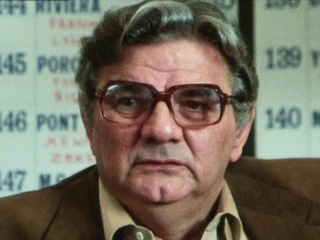
NOT ENTIRELY. What he said during lunch at Duke Zeibart’s on the Friday of Martin Luther King Day in 1988, was, essentially, three things. The first was, “If they over coaching, like everybody wants them to, there’s not going to be anything left for white people.” This one packed the most immediate impact. Snyder insisted afterward it was just a bad joke, and a compliment to blacks, too. They’ve taken over all of sport because of their drive and their desire. They want it so badlv they’ve pushed the whites right out. (Look, he said, if anyone should have been mad, it was whites. He said whites were lazy. No whites got angry at what Jimmy said.)

Then he said, “There’s 10 people on a basketball court. If you find two whites you’re lucky.” The last word was the killer. Otherwise, it’s no different from the famous tabloid basketball columnist saying, a few years ago, “The blackest thing about the Celtics is their sneakers” in reverse. But he never should have said “lucky.” He might have been using it In nothing but a careless sense. but can’t be careless with live ammunition. More than anything, this was the statement that was indefensible.

Finally, he said, “[Black superiority] goes all the way back to the Civil War, when during the slave trading the owners would breed his big black with his big woman so he could have a big black kid.”

This is the one that stuck.

At any rate, within hours, Musburger and Shaker had viewed the tapes and talked to the CBS brain trust, most of whom happened to be in Hawaii. Later than night CBS issues a statement saying it found his remarks to be “reprehensible.” No one actually said he was fired. But when Sunday showed up, he’d been deleted.

“You know, on Friday afternoon, our former colleague Jimmy the Greek, made some regrettable and offensive remarks for which he has apologized,” Musburger said the way he might have recited the Seahawks’ injury list. “Yesterday, CBS issued a statement disassociating itself from those remarks. It goes without saying that his comments do not in any way reflect the thinking or attitude of the rest of us here at CBS Sports. While we deplore the incident, we are saddened that our 12-year association with Jimmy had to end this way. And the “NFL Today” will continue from RFK Stadium in Washington in just a moment.”

And that was the sum total on CBS of discussion about the several issue The Greek had raised. Elsewhere, reaction was mixed, and Snyder had his defenders.

“Much of what he said seemed unexceptional to most whites and a good many blacks as well.” wrote Washington Post columnist Richard Cohen. “Blacks are more athletically gifted than whites. He spoke of racial differences. That is a taboo. Never mind that there are such things.”

“He’s right.” Jim Rice said a few weeks later, in the weight room off the Red Sox locker room at Fenway Park, during an interview for a Miami Herald series that had been prompted by The Greek’s firing. “It’s just a gift. Raw talent.” And a few days after that, at Yankee Stadium, Jesse Barfieid nodded: “Leaping, running—physiologically, we have an advantage.”

Recently, Synder’s former colleague, Jayne Kennedy-Overton, said, “If he was telling the truth, why blame Jimmy? Why not blame the people who made the history he spoke of?”

 

AFTER THE eighth race, he was up several thousand. He’d taken the 10 horse across the board for $400, and it won at 6-1. After the ninth, he was up another couple thousand with the two horse. He now had a bundle of hundred-dollar bills the size of Zeus’s fist in his right-hand pants pocket, all earned in a dizzying 90-minute span that left your mouth dry and your hands shaking just to he next to him. He has not mentioned the money on the drive back to Miami Beach.

“Brent panicked,” he says. “If he’d opened up his mouth that day for me. he could have saved my job. But he didn’t. Or if he did, it wasn’t to say anythin’ good. If only [Howardj Stringer had been there, he’d have looked at the tapes, and sat everyone down, and they coulda suspended me for that last game, and that would have been enough. But the big guys were in Hawaii, and Brent and Shaker were the only ones talkin’ to ’em. Nobody stood up for me. When you got the No. 1 producer and Brent against you nobody’s going to go against them. Who’s gonna say somethin’? Irv? The only guy who could have said somethin’ was Madden, but he was at a meeting of some sort and said it was all over by the time he got there: Summerall said somethin’ good in my behalf.

“Aw,” he says, “don’t let me start this.”

It’s absolutely huge, Jimmy’s car, as wide as a whole lane. It has a blue leather interior and the dashboard looks wooden, but it’s really only wood-pattern contact paper. On the glove compartment the pattern has all peeled away, leaving a bare metal panel. The inside of the passenger door is pocked with gray spots from the ash of his cigar, like a wall that’s been riddled with bullets.

Gliding the Cadillac to the hotel curb is like trying to dock a tugboat. It’s a car that has somehow survived beyond its age and now it is unwieldy and impractical. In these respects, it’s a lot like Jimmy. He has not gone into the new age gracefully. Watch him yelp at the pretty women—”Hey! Are you married?”—with that old man’s license to leer. He struts through his hotel, this outsized guy all in white and gold with his cane with the heavy steel knob as a handle, this purely exotic figure from some Graham Greene novel, part Sidney Greenstreet, talking too loudly, flashing that wad of hundreds. He doesn’t seem to realize that we’re in the mall age now, where the people we admire don’t come outsized any more They come in a garb of discreet homogeny. They come smooth. They come so they fit into a preconceived notion of special.

He’s not alone in this stumble into the late 20th century. Surely some of Rooney’s indiscretion can be chalked up to his inability—voluntary or otherwise—to evolve with the flow of time.

Most of us adapt. Some adapt by shedding ignorance. Others adapt by burying it. Only The Greek knows which camp he’s in. No one who’s ever spent any time at all with The Greek thinks he’s racist—”No black ever got mad at me,” he says. “The blacks all loved me”—but it doesn’t matter anymore.

Now he’s winking at the little girl in the scotch-plaid dress in the lobby. He is mugging. His face is all rubbery. She is fascinated. Her mother is leery. He loves kids. He’ll drop anything—anything—to wink a kid. How could he not? He lost two to cystic fibrosis, and he was never one himself, not after his mother was shot to death by his aunt’s estranged husband when Jimmy was 9. So he pats them and reaches out to them and laughs at them and mugs for them, and the kids love it, but the mothers wonder what in the hell this old guy is up to. And, of course, the mothers don’t know who The Greek is. The mothers only know who Bryant Gumbel and Willard Scott are.

“Without even saying goodbye. After 13 years. You think that’s fair? You think that’s fair?”

In the morning he’ll try to walk a mile on the beach, but it takes an hour. He’d rather linger over breakfast for a couple of hours until it’s time to go to the track, although these breakfasts can daunt an ego, because in the restaurant there are often several young families with children who won’t be all that amused by the man in the gold chains who frequently commandeers the telephone in the middle of the dining room and starts swearing at his stockbroker.

“I got some money in an Austrian money fund. and it was doing really good until this morning Gorbachev said somethin’ and it’s going straight down,” he says, returning to the table after one rant. “The market’s all I got. It’s the only excitement I have out of life. I win or lose 10 or 20 (thousand} a day. That’s all I got.”

He is spending a lot of time in Miami Beach. His wife, Joan, is in the house in North Carolina. “We don’t want to talk about that,” he says. Then he grows disgusted with himself: “Oh, listen, you take the good with the bad, what else you gonna do.”

Wilburn, the waiter, refills his cup. Wilburn is from Jamaica. Wilburn knows what Jimmy wants to eat before Jimmy can tell him. Jimmy regularly summons Wilburn by saying, “Get your black ass over here.” He loves to say things like, “I’m gonna get your black ass fired,” and Wilburn laughs.

Jimmy speaks like this loudly enough for the people in the restaurant to turn around and some of them smile. He does this because he wants the world to know that that is the Steubenville way he speaks, and that is the way he was speaking on Martin Luther King Day, casually, and not from prejudice. He will not allow the perception to endure. He simply will not. He Is adament.

That is the most important thing now. Not the firing. The firing, he concedes, was inevitable.

“It had gotten to the point where I kept fighting’ over the show with Shaker almost every Sunday by the end,” he days. “The last year they a;most cut me off completely. Shaker kept wantin’ to know what I was going to say beforehand. But I never knew. Which is what made it a great show. Tell him first? I’m sitting there with 100 things to say and I never knew what I was going to say. That’s what was so great about it. Everything was spontaneous.

“But I overcome that. I overcome so much. I overcome hittin’ Brent. I overcome a situation where I went to a racetrack and asked someone for figures and they were trying to grab the guy. Turned out he was a bookmaker. I overcome that. I went to Denver on a speaking engagement and said something about rednecks. Overcome that. I told Phyllis I hated her friggin’ husband, right on the air. Overcome that. I overcome everything. Then all of a sudden the thing I was paid to do I was fired for.”

Now there’s passion. The Greek has turned his chair to face his companion head on, and he’s squinting. Suddenly, it’s The Greek’s voice, all blustery and rough.

“Listen. I was the only person who never went with one camp or the other. l never cared about personalities. All I ever cared about was the good of the show. Ask anybody. I didn’t have grudges. I didn’t have vendettas. The show was everything to me. I thought this was supposedly going to be my life. “NFL Today” was … I mean I had a good PR firm, but little by little I gave everything up because of a show, then all of a sudden I woke up one day and I didn’t have it. All of a sudden I was the sonofabitch who said blacks were better athletes.”

Three men have dropped by the table. They have tans like they watched a nuclear test in person. They are on their way hack to the marina to sell more boats at the boat show, for $375,000 each.

“You got screwed, Greek,” says one, and the other two nod. After they leave, The Greek’s smiling.

“Next to survival, what’s the most important thing?” he says after they’ve gone. “Recognition.”

More important than health? Family?

Silence.

“Those are both part of survival,” he says.

Silence.

“I had a son and I lost him,” he says. Quietly. “So brilliant. He was a mathematic marvel. Professors from all over the United States—Michigan, Indiana—used to send him problems when he was a student at UNLV. He’d sit there for hours. Finally he’d look at me and say, ‘I got it Dad.” Once when a teacher went on vacation they let him teach the class. That’s how good he was. The teacher said, ‘The guy can spot me the deuce and still beat me at mathematics.'”

Silence.

“Oh, well”—these words like marbles dropping off the edge of a kitchen table.

Silence.

“He was somethin’. Tried so hard to live. He was 26. He was supposed to be dead at 2.”

Silence.

“Look,” Jimmy says. “I’ll survive. I’ll get a show. I’ll have a 900 number by the fall.”

Silence.

“Why’d they have to do it the way they did it? I begged them to not use reprehensible. It was just a word that wasn’t needed. “Take that word out,” I said. They wouldn’t. I said, “I can’t overcome that.”


Beat of the Day

Get lost.

[Photograph by Melvin Sokolsky]

Dollar Sign on the Russell?

How much is Russell Martin worth?

[Photo Credit: Thomas A. Ferrara]

Changing City: Bleecker Street

Please go to this blog: James and Karla Murray Photography. And buy their book. Inspiration.

The Great Game Changer

Marvin Miller, one of the most important figures in 20th century American sports, has died. He was 95.

I had the opportunity to speak to Miller more than a dozen times when I was writing a book about Curt Flood and a few years later I visited his apartment to talk about the possibility of making a documentary about his life. He was gracious, bright, and funny.

I will compile all of the tributes to Miller later today or tomorrow so that you can get a full appreciation of the man and his lasting professional accomplishments.

Meanwhile, here is a Q&A I did with him talking about Flood for the Banter back in 2003.

Taster’s Cherce

Over at a cool site called Forty-Sixth at Grace, check out the “For the Love of Pie” series.

Picture by Nicole Franzen.

Morning Art

Painting by Jasper Johns via Just Another Masterpiece.

Rock the Spot

Here’s a Yankee site that you must check out, bookmark, and make part of your regular Yankee reading: 161st and River (not to be confused with the stellar River Ave. Blues–and speaking of RAB, they have word today that the Yankees have reportedly resigned Ichiro and are close to a deal with Andy Pettitte).

As for 161st and River,  dig these recent posts: ALCS Programs; Whirled Serious Programs; SI Covers.

New York Minute

Last night I was waiting on the uptown platform at 103rd Street. There was a kid playing the guitar across the tracks and at first I didn’t notice him but then I couldn’t help but listen. He wasn’t playing a song just jamming. I waited for him to finish so that I could applaud. He was good. But he didn’t stop. So I saw that my train wasn’t coming yet and ran up the stairs, crossed over to the other side, ran down the stairs and threw a dollar in the kid’s guitar case.

“You are doing work,” I said.

When I got back to the uptown platform I was able to capture this just before my train rolled into the station.

Soul Surfer

Listening to that dude play made my day.

[Photo Credit: Frederick JG]

Beat of the Day

Give her good lovin’…the kind she understands.

[Painting by Jesus Leguizamo]

Million Dollar Movie

Over at the Los Angeles Review of Books, Greil Marcus chats with David Thomson.

[Photo By Sander Meisner via Je Suis Perdu]

Taster’s Cherce

Food 52 does leftovers.

The Banter Gold Standard: Sympathy for the Devil

His was an all-too short career, much of it spent writing about his favorite blood sports, boxing and politics, but it’s most remarkable aspect may have been the improbable sequence of events at its fairytale inception. At age thirty, Joe Flaherty (c. 1936-1983) was still a laborer on the New York waterfront whose unpaid (and often un-bylined) stories occasionally appeared in his Brooklyn community weekly. When the weekly deemed his account of a rowdy police gathering too hot to handle, a friend surreptitiously sent it to The Village Voice. Impressed, the Voice’s editors hired Flaherty to write a follow-up story, an assignment that ended when the fledgling reporter came to blows with one of his subjects. Flaherty’s next piece incensed Pete Hamill, largely because it painted an unflattering picture of a middleweight named Joe Shaw, in whom Hamill, Norman Mailer, and George Plimpton had acquired an interest. The New York Times Magazine then asked Flaherty to write an expanded follow-up about the feuding Brooklynites, thus launching a career that would produce bylines in magazines from the Saturday Review to Playboy, the journalism collected in Chez Joey (1974), the novels Fogarty & Co. (1973) and Tin Wife (1983), and Managing Mailer (1970), an account of his experience as campaign manager for Norman Mailer’s 1969 mayoral run. As Flaherty put it: “A lesson for young journalists: in your early rounds forget the body and go for the head.”

—George Kimball and John Schulian on Flaherty in At the Fights (now out in paperback).

Here’s another good one: Joe Flaherty on Jake LaMotta. This piece originally appeared in the January 1981 issue of Inside Sports. It is reprinted here with permission of Jeanine Flaherty.

“Sympathy For The Devil”

By Joe Flaherty

All lives are failures in some degree or another. Somewhere along the line we fudge the pristine youthful dream. Even when we achieve, the compromises we’ve made, the injuries we’ve inflicted sully the prize. But most of us can live with this, since we deal in minor declinations of the soul.

Not so with Jake LaMotta. LaMotta’s fortunes and misfortunes have been so cosmic they could be considered godlike if it weren’t for the sacrilege implied. The ruin he has heaped on himself, and on many of those who’ve come in contact with him, seems pagan. Those who lament LaMotta would have you believe Attila the Hun would have to move up in class to get it on with Jake.

When you go in search of the good word on LaMotta, no soft, illuminating adjective is forthcoming. Since most of the naysayers are from within boxing, the word is even more damning. The ringed world is awash with evocations of loving motherhood, guiding priests and golden-hearted gladiators. Cauliflower corn pone bows only to the jab as the basic element of boxing.

But when the talk turns to LaMotta’s character (his boxing ferocity is always lauded), the usual benediction of hot water turns to spit. The only bow to grace is that no one wants his quotes attributed, though this “nicety” could be interpreted as fear of retribution, since no one believes the 58- year-old LaMotta has mended his savage ways.

Thus, one of the game’s gentlest promoters calls LaMotta “a reprehensible, obnoxious, despicable sonnuvabitch,” and then apologizes that he has characterized a human being in such a fashion.

To be sure, it’s a tough assessment, but even LaMotta wouldn’t deny he worked like a bull to earn his unsavory rep. Born on the tough Lower East Side of New York, he and his family moved to the Bronx when he was a boy. In that borough of hills (peaks and valleys in psychological jargon), LaMotta’s cyclonic emotions got untracked. Young Jake wasn’t one of those angels with dirty faces, a wayward street urchin with tousled hair who pinched apples from outside, the grocery store and puckishly threw rocks at schoolhouse windows. Jake’s mayhem was main arena, armed robbery, assault, rape.

As a teenager he pummeled the head of the local bookie (whom he liked!) in a robbery attempt and left the man for dead with a crushed skull. Subsequently, the papers falsely reported the bookie’s death and LaMotta did not learn until years later, after he won the middleweight championship, that the bookie, following a hospital stay, had moved to Florida to recuperate. In fairness, LaMotta had ongoing pangs of conscience about “the murder,” but the primal concern of the heart was how best to beat the rap, not the devil.

The horror his early violence wreaked also didn’t stop him, in later years, from battering various wives for “love” and numerous opponents for loot. LaMotta’s Life has been so unappetizingly gamy, so foully unpalatable, it bends the conventional limits of social understanding, as graphically documented in the film of his life, Raging Bull.

Even those who shared the same mean streets can find no sympathy. An Irish trainer from the same boyhood Bronx said, “Look, he just went too far. I grew up there, too. We always hustled a fast buck, put out other guys’ lights in fistfights, and even brawled with cops. Hell, the Irish are great cop-fighters. But we stopped short of some things, the animal stuff. Beating people’s head in with weapons and wife-beating, Christ, that’s as low as you can get.

“Ask anyone. That bastard didn’t even know how to say hello. But don’t take my word for it. The Micks are notorious. for not having a good word for Wops. Go ask his own kind. His own kind hate him because he was a squealer. He even screwed them. You go ask the italians what they think. When your own kind hate you, that tells you something.

Indeed, the “wise guys,” the sharp money guys who always have leeched on the tit of boxing, long ago wrote off LaMotta for his testimony before the Kefauver Committee that he went into the water for the mob when he fought Billy Fox in Madison Square Garden in 1947. But even before that, !he wasn’t acceptable. Hustlers who live off “the edge” dislike dealing with a “crazy” man.

EVEN ITALIAN-AMERICAN  director Martin Scorsese, while creating a technically beautiful film and coaxing marvelous ensemble acting from his cast, was in the moral quandary about what to make of LaMotta the man. If the film had to stand on redeeming social qualities, Raging Bull would have been castrated by the censors. Scorsese, like so my who have faced LaMotta, was overwhelmed with the brutishness of the life and in the end, using Robert DeNiro’s great talents, settled for an exposition of poetic rage. The violence is softened by slow motion and an operatic score. This creates the illusion that one is dealing with a demon.

But the frightening things about LaMotta is that he is very real, and removing him from our orbit with technical skill and art is cleverly slipping the punch. The only way to explore LaMotta’s life is to delve into the festering place in his heart of darkness.

The LaMotta you meet today hardly qualifies for a portrait in ferocity. If it weren’t for his classically failed soufflé of a face and the thickness of his articulate speech, you wouldn’t suspect he had made his living at demolition. His weight is back to the 160-pound middleweight limit, and his manager is deferential. His hands belie their destructive force in that they are small, slim and tapered.

“I should have been an artist, or a fag,” he jokes. But the jibe has insight. They look like the hands of someone who would beat helplessly on the chest of a bully.

ONLY THE eyes give a clue to his former life. They are so sad and placid, they almost look burned out. Twin novas which which didn’t survive the Big Bang, memos to some terrible past.

So you’re not surprised when he responds to a question about his current life, “I’m a recluse. I stay at home and read, play cards, and watch television. And I love to cook. I’m a gourmet cook. It’s a knack.”

His oldest son Jack Jr. (by his second wife, Vikki) concurs: “I’d rather eat at home with him cooking than go out to a fine restaurant.”

LaMotta’s forays outside are restricted to long walks, infrequent trips to an East Side bar to meet Rocky Graziano, who pulled time with him at reform school when they were in their teens, and some evening blackjack games. “I don’t want to go out anymore,” he says. “I seen it all, and I had it all.’ Fame, fortune, Cadillacs. There’s nothing out there for me. Besides, I don’t like the kind of people I attract.”

When asked to elaborate, he has trouble pinning if down. “I don’t know. Other people like to go out. It must be me. I dislike a lot of people.” He amends, “I don’t mean a majority of people. Maybe I’m too cynical. But sometimes I hear the first word out of their mouths, or see a smirk on their faces, and I know they’re not sincere. They’re jealous or something. Jealousy is a word I use a lot, but I think it’s right. Well, I think like that anyway. I guess I attract those kind of people, so I stay home.”

The recluse pose is really nothing new, if one applies it to LaMotta’s inner emotions. In his fighting days, though public, he was notorious for being a loner in the things that mattered. He managed his own career, ostracized the mob until it promised him a shot at the crown for dumping to Fox, and had the intimate counsel of no one. He viewed his wife of that period, Vikki, with insane jealousy and suspicion, and forced his brother Joey, who worked his corner, “to do my bidding.” The adjectives applied to Jake were “suspicious,” “paranoiac.”

Now divorced from his fifth wife, he is even more insular. The film is a hiatus in this isolation. Jack Jr. is up from North Miami Beach on leave from his job to guide his father through the publicity maze connected with the film. Vikki and his five other children also came to New York for the film’s opening and some of the attendant hoopla. But when the stardust settles, he will be back living alone in his Manhattan apartment. The isolation may be complete for a long period if some job offers don’t result from the film since LaMotta, in earnest, declares, “I’m now practicing celibacy,” which could be construed as the last word on the people one attracts.

Jake attributes his decision on unilateral withdrawal to “the failures of my romantic life.” His first marriage broke when he met Vikki, “the love of my life.” Vikki left when LaMotta lost all control of his temper, his calorie­ and alcohol intake, and his ability to find his way home to his wife’s bed after his retirement. “I think I suffered a nervous breakdown during that period,” he says, “and didn’t realize it. I was crazy. I was drinking a bottle or two .a day. I owned my own joint [in Miami Beach], the price was right. Plus, there were a lot of broads. I blacked out a lot and didn’t remember. I really think I was crazy and didn’t it.”

LaMotta seems to be hesitant about going all the way back. His notion is that life would have been fine if he and Vikki could have worked out their problems. If they had been “mature” enough to realize he was going through a bad time after retiring, “the small death” all athletes must face, as the novelist John Updike called it. Similar is the lament that three marriages broke up because finances were tight, and the one thing he regrets is his dump of the Fox fight. The one thing?

LAMOTTA DEALS with his woeful experiences piecemeal, not as the pattern of a life. For LaMotta, to have led a conventional life, it seems he would have had to be born in different circumstances, or somehow been able to overcome the ones he was dealt. The latter is no mean trick. The should is cankered with barnacles of who and what spawned us. Only the imperial George Bernard Shaw had the audacity to state that if he had one thing to change in his life it would have been his parents. And for good reason. There’s a reverberation in that shot that might ricochet back to our own siring.

LaMotta makes some earnest attempts. “You know, I think they brainwashed us. You know, this is your life, you’re poor, and this is the way it’s going to be. I always felt I didn’t deserve good things. I was always guilty. I thought I killed someone, but it was more than that. Years later, I even thought of the way I fought. Letting guys hit me in the face. I didn’t have to do that. I think I was brainwashed to be punished.”

If you want to find the man, it helps to find the boy, and then the father of the boy. LaMotta’s father was an Italian immigrant who beat his kids and beat his wife, and it’s safe to say Jake was tutored in raucous romance early. And even though LaMotta hated the bullying, like so many sons of fathers who beat, drank, molested or committed suicide, he replayed the old man’s aberrations. The psychiatric statistics are too firm in these area to be taken, as happenstance. In dismal surroundings finesse is lost, you take what is offered.

Since the home life was a microcosm of the neighborhood, he had only to expand the MO of violence. In such neighborhoods the glittering prizes of bread, broads and booze wenI to the wise guys. “Artists and fags” (same thing really) need not apply.

To anyone who knows those streets, the real triumph is to make it through time-honored devices in the neighborhood, not in the outside world, There’s a sense of betrayal when one makes it “legit” and moves away. You turn your back on the highest gutter canonization—”a regular guy. It’s not for nothing that artists with such roots can’t completely resist the swagger, highlighting the accent, the tough-guy stance. These are love notes thrown back over the barricades from their now “effete” surroundings. Worldly success is so much manure—the real bones are still made back on he block.

LaMotta only seems an aberration to us because he achieved celebrity and money and didn’t find the happy life. That is the height of anti-Americanism. But to use Willard Motley’s phrase, “Knock on any door,” and you could find countless LaMottas—violent, suspicious, self-destructive, who have left disasters in their wake, but there was nobody there to chronicle them. We prefer happy endings to our social neglect: saccharine Sylvester Stallones. pugs who are pussycats or flower girls who end up at Ascot.

But even in the field of achieving and then destroying celebrity, LaMotta is not unique. Streetwise black, basketball players with fat NBA contracts still get high on more than slam dunks, and up-from-the-pavement union leaders who have had access to the seats of government can’t resist the chance to turn a little change on the side. The outside world might be astonished, but the boy on the block understand all too well. What’s felonious to some is “regular” to others.

When LaMotta got the chance, he didn’t get out. When he made his score in boxing, his first move was to buy an apartment house in the Bronx for his family (parents, brother, sisters). Obviously, to erect a shrine in such heathen lands as the other boroughs never occurred to him, nor should it have. It had to be accessible for worship by those who lay down turf theology.

YEARS LATER, when he was broke and serving time on a Florida chain gang for allowing a teenage prostitute to work his nightclub (he claims innocence about her age and trade), his father sold the apartment house (it was in his name but Jake’s property), deserted his family and moved back to his native Italy alone.That’s the caliber of doublebank that makes street legend.

If one knows the code of the streets, wife-beating is no surprise either. Women (mothers exempted) were only revered as sexual trophies. The language of lovemaking sounded like contracts: “bang,” “screw”—love delivered from a running board. Jealousy is easy to divine, too. You simply ascribed to others the reason you wanted women. If your own intentions were base, so were the world’s.

One has only to remember the photos of Vikki LaMotta then, or to look at her now to realize her erotic worth as a trophy. At age 50, after giving birth to four children (three by Jake and one by a subsequent marriage that also ended in divorce), she still could make a bishop want to break a stained glass.

Vikki realizes the cloud a sexual aura casts. “People see the blonde hair, the beautiful body and look no further. They never search for the dignity. My problem with Jake was that he consumed me. He did it in a very beautiful way, but he consumed me. I was only 15 when we met in June 1946, and we were married in November of the same year. In a way you could say Jake kidnapped me.”

It’s a lovely turn of phrase: “kidnapped me.” It evokes Fay Wray and her rough-hewn suitor. “Our marriage was fine when Jake had control. On the beginning he trained me, molded me to be his kind of woman, but later on when I matured and deviated from what he wanted, he couldn’t handle it. I watched Pygmalion on television the other night, and I saw many similarities.”

LaMotta’s mad jealousy was fueled by the long periods of sexual withdrawal when he was in training. He believed in the old adage that sexual activity sapped strength. “It was a mistake, but in a way it worked. It made me an animal in the ring. Bu now I think I should have had it once in a while.”

Worse, the intensity of training began to render LaMotta impotent when he wanted to perform. For man like LaMotta to fail at all, but especially with his “kidnapped” goddess, was excruciating. So instead of swatting airplanes, Jake disfigured opponents such as Tony Janiro, whom Vikki found handsome; his brother, who had introduced Vikki to Jake, and who made the mistake of kissing her warmly whenever they met; and Vikki herself, for offering her cheek to be peeked by friends.

The beatings were serious enough to require medical attention, and when once Vikki retaliated, she said, “It was a mistake. He reacted like a fighter. He came back at me and nearly killed me.”

Yet for all this, she claims they had glorious times together (rarely shown in the film), and finds her ex-husband spiritual. “Just look into those sad, soft eyes. Whenever I’m sick, Jake is the first at my bedside. What greater love? I love him dearly. No longer in a sexual way, but who knows? That could come back, though I’m frightened to put the heat back into the relationship. It’s so loving and warm now. I just don’t think of him in a sexual way. To be blunt, I have no desire to ball him. He doesn’t like me to say that, but it’s the truth. And I’d need that to get back with him. I’m a woman, and a woman means hot. But love him I do, and who knows what the future will bring? That’s the exciting thing about the future.”

They, have stayed in constant contact 34 years. Jake visits Vikki in North Miami Beach (in the home he bought for her) a few times each year and stays at the house. “Separate bedrooms,” he is quick to add. He talks to her by phone three or four times a week. And he admits that his continuing affection for Vikki hindered his other marriages. “Aw, they knew,” he says. “I’m not smart enough with women to hide anything.”

Of course, LaMotta’s love for Vikki might be heightened by their golden period together. “We had everything,” he says. “Love, home, children, money, the championship, his and hers Cadillac cars.”

Their children hint at more solid stuff. The two boys I met, Jack Jr., 33, and Joe, 32, seem well-adjusted and carry no scars. Neither remembers the parental brawls. Those took place in private, and Vikki says that when she was black and blue she retreated behind her bedroom doors until the damage healed. There is a courageous civility about that.

Jack Jr. is sympathetic about the forces that fashioned his father’s life. “He grew up in the Depression, and everything was struggle. Everything was denial. His generation had to fight to get out. That’s why you don’t see fighters with the ferocity of the ’40s fighters anymore.”

JACK CONCURS. “The fighters today are spoiled. Only Duran and Muhammad Ali could have stood with the greats of the past. You know, we fought every three weeks. When I started to make money, I couldn’t get enough. It was a Depression thing, I’d fight anyone. Then when I made it, I didn’t know how to handle it. After all those years of denying myself, I went crazy with everything from booze to broads.”

Fight everyone, he did. Nobody puts a knock on LaMotta as a fighter. Harry Markson, the retired president of Madison Square Garden boxing, said “Outside Sugar Ray Robinson, he was the greatest middleweight of that era. He fought black fighters, both light-heavyweight and middleweight, that no one else would touch. He was fearless.

Much is made of LaMotta’s dump to Fox, but many forget he was top-ranked for five years without getting a title shot. And going the in the water wasn’t his province alone. It is common knowledge that good black fighters of that era often had to swoon for the mob to get bouts. Robinson was one who refused and had wait until he was 30 to get his crack at the middleweight crown, which, perversely, was granted by LaMotta.

Also, some members of the pious press didn’t seem to have the clout to force legitimate showdowns. This wasn’t for ignorance of fistic worth, but for the most venal of reasons. You still hear gossip about members of the fourth estate who picked up “envelopes” under the guise that they were gifts for their kids’ birthdays, graduations, or some such.

Harry Markson, while making no case for LaMotta’s action (“Robinson never did it”), added that boxing commissions were either nonexistent or had no clout, and that the press and television didn’t have the power they have today. “Let’s just say that in that period there was ample skullduggery.”

LaMotta’s sole defense is that he wanted the crown. “I always hated those creeps and never let them near me. They offered me a hundred thousand to dump, and I refused. I only wanted the title. And even when I went along, I still had to kick back $20,000 under the table to get the fight with Cerdan.”

Jake testified before Kefauver when the statute of limitations ran out. In his original affidavit Jake named Blinky Palermo as the fixer, but later testified he didn’t know who masterminded the dump. “You know who was around in those days. Palermo, Carbo, draw your own conclusions.”

LaMotta, in a way, as like John Dean. He validated the bad news in high places everyone knew about but no one wanted to talk about. Finking no matter how cleansing, is never appreciated. It isn’t strange that LaMotta can recite verbatim Brando’s Terry Malloy speech, “I coulda been somebody …” from On the Waterfront with feeling.

When Jake finished talking about this painful period, Jack Jr. massaged his shoulders into relaxation. “No one knows my father except his family. They only know of him back then. Not what he became. A gentle, sweet man. The ending is the exciting part of his life.”

Jake, grandiose as ever, proclaimed, “Now I have the patience of a saint. You’ll lose your temper before me.”

Joe and Vikki concur. Jake, realizing the “saint” line is as gaudy as his leopard-skin fighter’s robe (the material of macho bathing suits in the ’40s, though LaMotta didn’t add the black slim comb as a final fillip), tempers his canonization: “I still make mistakes, but less and less. Isn’t that what life is about? It has to be less and less, if I am going … going to …” He trails off.

Jack says he finds lessons in his father’s life: “There are deep meanings in dad’s struggle.” LaMotta, where his family is concerned, seems not to have passed on the sins of his father.

MARTIN SCORSESE defends his unrelenting, unprobing film portrait of LaMotta by declaring he didn’t want to apply tired psychology, that he found LaMotta to be an “elemental man.” By which I gather he means a man unfettered by influences. It’s a quaint notion: The Abominable Snowman Comes to Mulberry Street. The director’s peg tells us more about Scorsese than about LaMotta.

Numerous articles have related that Scorsese was sickly child, consumed by movies and movie magazines, looking down from his window on those mean streets below. As a man, the same articles tell us, he is still house bound, running endless private tapes of movies in a more spacious, affluent setting. This sequestered life comes through in all Scorsese’s films, the art of a meticulous voyeur.

Scorsese gets the mannerisms, the speech patterns, the language and the interiors precisely right. What formed the tableau seems beyond him. From a bedroom window—his first viewfinder—barbaric action in the street with an opera record playing in the background might indeed look like the rites of a primal society.

The only way to dispel reverential awe was to know those streets. Saloons and poolrooms were not pagan temples, merely colorful neon way stations in a drab culture. Bright bars were concrete equivalents of the neighborhood’s best painted women, and a rack of pool balls cascading under fluorescent lights transported the shooter into a colorful galaxy. People didn’t die gothic deaths on those streets. Life was drained by the dullness. If LaMotta’s hook were a little slower, his temper a shade less manic, he would have been the Friday night undercard in the local beer joint, not a celebrated “Raging Bull.”

For Scorsese to plumb LaMotta’s psyche he would have to have a narrative curiosity, and that is not the art of a window kid for whom stories take place down below—on the streets. Talk is the province of the comer guys, the verbal spritzers who gaudily throw it around in lieu of money, dreams or hope.

And, of course, narrative is interruptive. It breaks up, sullies the purity of the scene. To visually oriented artists such as as Scorsese, narrative is as sacrilegious as inserting dialogue balloons on a Magritte

So Scorsese too an astringent tone in his film. With Raging Bull, he effectively holds boxing films such as Champion and Body and Soul, which explored Social beginnings, up to ridicule. Through attempts at reason and understanding, these films made overtures to the heart. To Scorsese, obviously, these were cluttered films, weakened by sentiment. So he used his camera as an unsympathetic X-ray machine, the bed boy finally making his bones.

CONTRARY TO stereotypes, “house-grown” kids are often filled with confidence. The doting of parents, the coloring books and ice cream brought to bedside, the extra blanket for the precious body, the music spinning in the background are the trappings of tyke kings. Consequently, they learn to manipulate an audience early. So it’s not surprising Scorsese couldn’t understand LaMotta’s self-loathing and lack of confidence. LaMotta was only one of the litter.

Also, LaMotta feared and hated priests early. When Scorsese made a bow to such emotion in his Mean Streets, he had Harvey Keitel sacrilegiously bless his whiskey glass, evoking Stephen Dedalus in Joyce’s A Portrait of the Artist as a Young Man. The Jakes and Studs Lonigans of he world took damnation seriously, not as baroque artistic fodder. To LaMotta, the fear of immolating fire was never aesthetic, it was real: “I felt for some reason my opponent had a right to destroy me.”

Since street kids get by with hustle, not substance, they always doubt themselves. The leopard skin was worn to keep outside tribes at bay. Street kids feel con, not concreteness, is their deliverance. When you work with con and swagger the final damnation is going to be your unmasking in the larger world.

When I was first published at age 30, after working the docks for most of my life, I was terrified instead of being elated. When I was at a social function with my betters, Norman Mailer, Robert Lowell, Arthur Miller, I laced myself with booze against the impending mass denunciation I felt would expose me as a cultural bodysnatcher. This dread was fortified by the oppressive Catholicism of the ’40s and ’50s. The most deeply felt commandment was that earthly glitter was suspect; it was tawdry, whorish rouge on both your religion and your roots. God, like the old gang, only dug regular guys.

An operatic score is much too florid for LaMotta’s life. It is a cultural pretension, akin to the canard that all the Irish are familiar with Yeats. For LaMotta’s odyssey of self-loathing, the Catholic hymn; “Lord I Am Not Worthy,” would have come closer.

Indeed, it is because LaMotta is not “elemental man” that he survived and softened his life. LaMotta is what he is today because he has made intellectual decisions, no visceral ones. Through reading, self-hypnotism and study of various religions, through studying acting and grooming himself as a lecturer—all things foreign to him *and elemental man)—he has found some grace in life.

These are disciplines of the mind, and LaMotta knows his is a life that has to be sentried. He carries this over to his physical well-being by dieting and shunning booze. His decision to be reclusive and his acquiring the domestic arts of cooking and cleaning are further monitors. In the future, he wants to talk to kids about violence and alcoholism (“I think they’ll listen to me”) and do charity work in hospitals. “You know, tell people stories, do some recitals from my stage and nightclub act Make people laugh.”

He’s a man who declares, “I love to do things. To keep busy. That’s why I love Vikki and the kids with me now. I cook every meal. I won’t let any of them touch a dish. I love projects.” Projects are the Dobermans that prowl his darker impulses. He is still a man who suspects before he greets. In frustration, Graziano says, “He’s very complex, very deep.

I tell him to relax, but he can’t. I introduce him to someone, and he says, ‘Who is he? ‘What does he do? What does he want?’ He can’t realize it’s someone who just wants to meet him; He just don’t know. I say hello to the world . He just don’t know.”

Even now, when someone greets Vikki in public with a kiss, he looks on with distrust, but he doesn’t act. Reason has brought him to that simple point. He mistrusts success, as well he should. Every high point in his life has been followed by a crash. The title “nobody is going to take from me” was gone 20 months later, lost to Robinson. From the crown, he went on to divorce, alcoholism and conviction on morals charges. He says now, “I can’t be happy, everything is going so well.”

Not quite that well. Again, success has a rectal side. The IRS has leaned on him for money accrued from the movie, his fifth wife is suing for an alimony settlement and his brother is suing the entire movie production staff, including Jake for their portrayal of him. In his most emotional statement, Jake declares, “Aw, that’s nothing. It’s part of living in this vicious, fuckin’, mixed-ups, sick world.”

To LaMotta’s credit, he keeps such dark rage on a tight leash these days. He has learned the elemental lesson of those streets. You can’t go back because some unhealed part never leaves. In this world our initial address, like tragedy, forever haunts.

For more Flaherty, check out “Toots Shor Among the Ruins.”

New York Minute

My grandparents lived across the street from the Museum of Natural History and my brother, sister, and I visited them almost every weekend. They weren’t the kind of grandparents to get down on the floor and play with children so when they wanted to get us out of the apartment they took us across the street. It got so the museum was like an extension of their place–over-heated and boring. That’s what I remember of it, anyhow. We had to be well-behaved. Man, it was tedious.

I stayed away from the museum for years and it wasn’t until I was in my twenties that I went back. And I realized it was a great, mysterious place. I especially loved the scenes like the one pictured above  and recognized then how big an impression they’d made on me as a kid.

[Photo Credit:  Joel Zimmer]

Wait a Minim

According to George King, Russell Martin and Ichiro Suzuki are willing to wait on the Yankees. So? Bring ’em both back, just one of them? Which one of these?

And how would you feel if Nick Swisher signed with the Red Sox?

[Photo Credit: Al Bello/Getty Images]

Electric Boogaloo

Over at GQ, here’s Gideon Lewis-Kraus behind-the-scenes at the Electric Daisy Carnival:

The only really crucial thing to note here about the music is that the whole thing is about the bass. People who know a lot about electronic music will disagree with me, but knowing a lot about electronic music is, these days, entirely beside the point. The progression of a house track, and one plausible reason for house’s ascendancy, goes like this: There’s some twinkly pirouetting melody in the higher registers, then some bass for a while, and then the introduction of a soaring, optimistic vocal track about saving the world or, for the slightly less ambitious, having a feeling re tonight’s bestness, then the simultaneous near-crescendo of the twinkles and the all-out vocal redemption, and then, right at the moment of presumed climax, the bass goes away for a few beats, everybody misses the bass so much and can’t wait for it to come back, maybe the snare reintroduces itself after a few seconds to remind you to get excited for the prodigal bass’s triumphal homecoming, a good DJ takes just longer than expected to bring the bass back, 20,000 or 50,000 hearts stop as one, lever arms hanging anxiously in midair, and then, when the bass kicks back in, the crowd goes out of their motherfucking minds, just like they did the time the bass disappeared and came back four minutes ago, pumping their right arms in genuinely exhilarated unison, survivors all of the briefly yet catastrophically lost bass.

[Photo Via: All You Can Love]

Beat of the Day

Monday after a long holiday weekend. Let’s get stoopit, shall we?

“Humpty Rita”–Ill Chemist

Flipped

“Naughty Rita”–Fletcher Henderson meets The Beatles

[Photo Via: This Isn’t Happiness]

Morning Art

“South Wind in Marc’s Garden,” By Paul Klee (1915)

Sundazed Soul

End of the holiday weekend gives shopping, chores, and football.

Shake it.

“So Fresh, So Clean”–Outkast

[Photo Via: mOrtality]

feed Share on Facebook Share on Twitter Share via email
"This ain't football. We do this every day."
--Earl Weaver