"A New York Treasure" --Village Voice

The Break Up

Fat and Skinny works in comedy partnerships: Laurel and Hardy, Abbott and Costello, Siskel and Ebert. The Yankees didn’t get the memo when they hired Charlie Steiner to work with John Sterling–it was like Hardy and Hardy.

Mike and the Mad Dog have been the most successful fat and skinny radio duo in sports radio history and now, a few weeks shy of their 19th anniversary at WFAN, they are splitting up. Mike will stay at the FAN. Russo is reportedly going to Sirus.

Like them or not–I found them entertaining in measured doses–they were an institution in New York sports coverage and this is certainly the end of an era.

Here is one of the best Russo rants of them all:


The FAN won’t be the same without the Angry Puppy.

July Farm Report

Better late than never, right?

There are just a few weeks left in the minor league season, so my next Farm Report will serve as a summary of the season as a whole. That makes this my last mid-season update. Here’s my June Farm Report, which in turn links to May, etc.

Triple-A Scranton/Wilkes-Barre

The big news in Scranton was the fact that three of the team’s starting pitchers were shipped to the Pirates in the Xavier Nady deal. With Daniel McCutchen, Ross Ohlendorf, and Jeff Karstens out of the system, the Scranton rotation now consists of a rehabbing Phil Hughes, three-time loser Ian Kennedy, the unwanted Kei Igawa, and double-A call-ups Alfredo Aceves, and lefty Chase Wright. When Kennedy was called up to start for the Yankees, Jason Jones was called up from Trenton to fill his spot. Jones has since been sent back to Trenton, but I expect he’ll be recalled when Phil Hughes is called back to the bigs.

Hughes is scheduled to make his fifth rehab appearance on Sunday. In two outings for low-A Charleston, he pitched 6 2/3 scoreless innings, striking out six and allowing just five baserunners (three hits and two walks). In two starts for Scranton, he’s posted a 2.70 ERA and a 0.90 WHIP. In his last start, he struck out four in 5 1/3 innings while allowing just three hits and a walk. He’s likely to return to the major league rotation next weekend when the Yankees are in Baltimore.

Aceves has not pitched well in Scranton since having a groin injury delay the start of his triple-A career. In his four starts since stretching back out, Aceves has allowed four runs every time out, resulting in a 6.97 ERA over those four starts, which is paired with a 1.60 WHIP.

Wrote Chad Jennings last week, “To be honest, Aceves has more or less lived up to my expectation — he throws strikes and doesn’t miss by much when he misses — but hitters at this level seem to be having an easier time making solid, consistent contact than the hitters in Double-A and A ball. Triple-A is an adjustment, and Aceves is going through it. He allowed three hits in the second inning and four hits in the fourth, but he also sent the side down in order in both the first and the third. I don’t think he’s overmatched at this level, he’s just challenged at this level to be more than a guy who throws strikes.”

Wright, who went 8-2 with a 2.96 ERA in 16 double-A starts, has made just three starts for Scranton, the last of which was unimpressive. Jones, who went 11-5 with a 3.03 ERA in 21 starts for Trenton, pitched well in his two triple-A starts.

Out in the bullpen is where you’ll find Phil Coke, the lefty who was initially reported to be a part of the package for Nady. He’s pitched well in his new role, but could return to starting next year.

The big name in the Scranton bullpen is Mark Melancon, who has allowed just one run in 9 2/3 triple-A innings while allowing just six baserunners and striking out ten. Comming off surgery, Melancon has thrown 84 2/3 innings this season, which makes a big-league promotion unlikely (other than to let him hang out on the bench), but he seems sure to be in the picture for next year’s pen.

(more…)

Notes on an American Master

Untitled

"Bill Heinz is a walking contradiction of the stereotype of the phlegmatic Teuton. He is emotional and demonstrative. He can sink into depressions so deep they would give a sandhog the bends. His highs are several stories high. As cityside reporter, war correspondent, sports columnist, freelance journalist, and novelist, he was and is a dedicated craftsman and a penetrating observer who never gives half measure.

‘Bill,’ his doctor once told him, ‘if you don’t stop trying to be the greatest writer in the world, you’re going to kill yourself.’

‘I’m not trying to be the greatest writer in the world,’ Bill said, ‘I’m only trying to be the best writer I can be.’"

Red Smith, from the Introduction to Heinz’s collection, American Mirror.

W.C. Heinz, one of the finest journalists this country has ever produced, died earlier this year. A few months ago, a tribute was held in Vermont in his honor, and Adam White wrote a fine piece on the event for the Bennington Banner. In it, he quotes Bob Matteson, who was the editor-in-chief of the Middlebury College newspaper when Heinz was sports editor in 1936-37.

"He could spot make-believe – or phoniness – right away in a person," Matteson said. "And he wanted no part of it."

White continues:

Therein would seem to lie the key to Bill Heinz’s writing, his true method for distilling parable from the mundane. There is a sort of universal admission among those who were close to Heinz that he could be averse to, even dismissive of, certain people and personality types – but there is equally compelling evidence that such an attitude stemmed from his heightened sense of intuition regarding truth. Without such intuition, it is unlikely that he could have even recognized – let alone captured – the majesty and romance that pervades so much of his work.

"The secret is love," (Jeff) MacGregor said. "It’s his empathy, [though] not for individuals; I don’t know that [Heinz] even liked people. His genius was his empathy for the situation that we all share, that common cause of human enterprise. The truth that [Heinz] wrote about is the struggle that we all face, every day, when we get out of bed – and how good a fight we put up before the end of the day."

(more…)

Re-Run?

In the New York Sun, Tim Marchman wonders if next year’s Yankees won’t look an awful lot like this year’s edition.

Hang Time

Is there anything more New York than the sight of kicks hanging from a wire?
Untitled

Yankee Panky 61*: Is It Wait ‘Til Next Year Time Already?

In a conversation with our Banter host Alex Belth over the weekend, I said, “I haven’t seen it written anywhere, but how good does Ian Kennedy, Phil Hughes and Melky Cabrera for Johan Santana look right about now?”  Alex’s response (and I paraphrase): “Dude, don’t even say that. Oh, man.”

Well, I’ve seen it written somewhere, but I had to do some searching. My fellow Ithaca College alum, Andrew Marchand of 1050 ESPN Radio had a similar nugget in his Tuesday blog post. He did not tap my phone.

If the Yankees don’t make the playoffs, Kennedy could be the most to blame. He is one of the guys whom the Yankees decided to keep instead of getting Johan Santana.

If the Yankees had dealt Kennedy and Phil Hughes to Minnesota then Santana would likely be a Yankee. Instead Kennedy’s teammates are raising their eyebrows over his words and lack of success. He is 0-4 with an 8.17 ERA.

Kennedy’s lack of development, along with Phil Hughes’ incomplete for this year, is going to make CC Sabathia richer.

Kennedy’s post-game comments after Friday’s debacle in Disneyland led the Yankees to send him to Scranton on Mr. Toad’s Wild Ride for the third time this year.

_______________________________________

The Yankees are off today. Perhaps they will rest as they prepare for the short weekend series with the Kansas City Royals. Perhaps they will reflect on a dismal 3-7 road trip that has them in danger of missing the playoffs for the first time in the post-strike, Wild-Card era.

(more…)

Dem Bums

The Yanks lost again yesterday, finally ending what Pete Abraham aptly called their 3-7 "stumble across America."  It was more of the same–no hitting, and poor, sloppy fielding.  Hard to tell where the Yankees’ heads are at.  Sure ain’t in the game. The final was 4-2.

Back up the bugle folks.  This team looks out of life.

More Runs Please

D. Rasner is back on the hill this afternoon out in Minnie as the Yanks go for the series win. Pete Abe’s got the line-ups.

Last night was exhausting. Let’s hope for better things this afternoon.

Bombs Away!

Peg o My Heart

Alex Rodriguez is having another fine season, but his lack of production with runners in scoring position has been a glaring weakness (a couple of days ago, SG had an informative post on Yankee clutch-hitting). For his career, Rodriguez is .302/.403/.553 with runners in scoring position. Still, over at Dugout Central, John Paciorek has some thoughts as to how Rodriguez can be even better:

Let’s compare Rodriguez to Barry Bonds and [Albert] Pujols and see if we can figure out what’s going on.

Rodriguez does something that the other two don’t (or potentially in the case of Bonds “didn’t”) – and the result is that he has a larger margin for error. This error margin is what holds him back from being even better.

When Bonds bats, his front foot hardly lifts off the ground. It moves just slightly forward while Bonds keeps his head and eyes perfectly still and maintains a low center of gravity. Pujols only lifts the heel of his front foot, while staying balanced and low. One result is maximized visual acuity. Another is the ability to get the front foot properly planted when it’s time to attack the ball with the synergistic forces of the legs, hips, shoulders, arms and hands. Very seldom can a pitcher catch either Bonds or Pujols off balance enough to disrupt their swing.

Rodriguez is different. His stance begins balanced, low and stable. But as the pitcher releases the ball, Rodriguez starts an obtrusive attack with what I’m sure he thinks is a precise timing mechanism to generate a power surge. It isn’t and it doesn’t. What happens is that Rodriguez lifts his front foot high off the ground while he waits in suspended animation to detect the speed, direction and nuances of the pitch before he abruptly lunges forward and down to plant the foot so as to begin the swing. If the plant is too early, he’s out in front of the pitch and loses much of his power. If he is late with the plant, the fast ball is by him.

There wasn’t anybody on last night in the 12th inning when Rodriguez hit the go-ahead homer. No matter, it was a much-needed shot in the arm for both the team and Rodriguez, especially on a night when Mariano Rivera blew his first save of the year and Hank Steinbrenner all but conceeded the season.

Not Dead Yet

Mike Mussina pitched well enough to earn his 16th win of the season last night, leaving the game after seven strong innings and 104 pitches with a 5-3 lead. The Yankees got to Twins starter Nick Blackburn early when Johnny Damon homered on the second pitch of the game, and though the lead changed hands four times in the early innings, the Yanks began to pull away as Mussina settled down to end his night with three scoreless frames.

An insurance run in the top of the eighth made it 6-3 Yanks, but three batters into the bottom of the inning, Damaso Marte had put runners on the corners, forcing Joe Girardi to go straight to his closer in a game the Yankees really needed to win. Delmon Young fouled off Mariano Rivera’s first two pitches, but when the third drifted over the plate, Young smacked it off the opposite-field foul pole for a game-tying home run.

Rivera got the next two outs, then spent the top of the ninth steaming in the dugout, cursing to himself, throwing his gum, staring at the ceiling, and constantly shifting in his seat, unable to keep his blood from boiling.

After the Yankees failed to do anything with a one-out Derek Jeter single in the top of the ninth, Rivera returned to the mound and pitched around a bad call on a two-out infield single by Nick Punto to push the game into extra innings.

Joe Nathan set the Yanks down in order in the top tenth, but Jose Veras returned serve in the bottom of the inning, at which point the discrepancy between Mike Mussina’s and Nick Blackburn’s performances earlier in the game came back into play. Entering the 11th inning, Joe Girardi had used just three relievers–Marte, Rivera, and Veras, the last of whom came back out and pitched another 1-2-3 inning in the 11th–while Ron Gardenhire had just two left, Matt Guerrier and Brian Bass. Guerrier pitched around a two-out infield single by Johnny Damon in the 11th, but wasn’t so fortunate in the 12th.

Alex Rodriguez was 0 for 5 entering the twelfth inning. His previous at-bat came with two outs in the top of the ninth. Derek Jeter had singled earlier in the inning, but the Captain fouled a ball of his left instep earlier in the game and his mobility was limited. After Bobby Abreu made the second out, Girardi sent Melky Cabrera in to run for Jeter so that the Yankees would be able to take the lead on a double. Instead, Rodriguez swung at the first pitch he saw and hit into an inning-ending fielder’s choice.

Untitled Facing Guerrier in the 12th, Rodriguez took the first pitch for a ball, then crushed the next one over the 408 sign in dead center to give the Yankees their fourth and final lead of the game. Ivan Rodriguez followed with a double, and Xavier Nady, who drove in four of the Yankees’ nine runs on the night, topped things off with another homer into the vampire seats off Guerrier.

With Rivera having blown his first save of the year, Edwar Ramirez earned his first save of the season with a 1-2-3 bottom of the twelfth to nail down the much-needed 9-5 Yankee win.

Alex Rodriguez got the key hit, but Nady, Mussina, and the combination of Veras and Ramirez, who pitched three perfect innings, deserve at least as much credit. Now the Yankees have a chance to pull out a series win against Kevin Slowey this afternoon to salvage a 4-6 record on the road trip.

Sweet Sixteen?

The Yankees’ last victory was Mike Mussina’s 15th of the season. Now, after a four-game losing streak, Mikey Moose is back to try to make it sweet sixteen and save the sad sack Yanks from slipping into the cellar (or shake them from their slumber, so to speak). To break this bummer, he’ll have to beat Nick Blackburn who takes the ball for the bad guys.

The Yanks have faced Blackburn twice this year, once they beat him badly, touching him up for six runs on seven hits (including an Alex Rodriguez homer) in just 1 2/3 innings. The other time, they just broke his nose. Blackburn has a 2.25 ERA in three starts since last facing the Yanks, and I can’t imagine he’s thrilled to see them again, no matter how poorly they’ve been playing.

Speaking of which, what’s the deal with Robinson Cano? Over the past week or so I’ve noticed a number of ground balls to both his left and right scoot past him when I was convinced he was at least going to knock them down. As recently as a month or so ago, Cano was one of the best defensive second baseman in the game, and it’s quite possible that his fine play has created unrealistic expectations on my part (certainly most if not all of the grounders of which I speak would have required above average to great plays to turn them into outs, but it seems Cano had been making those plays until recently), but what appeared to be one or two well-placed hits “past a lunging Cano” (note: he’s not diving) a week or so ago now seem to be regular occurrences. Perhaps not coincidentally, Cano has hit just .222/.276/.352 since the Yankees’ eight-game winning streak was snapped in Boston. This team has a lot of problems right now, and that has allowed what seems to be a lackluster effort on Cano’s part to go largely unnoticed, but it’s worth keeping and eye on and, if real, needs to be addressed by Joe Girardi and his coaching staff.

Johnny Damon is back in the lineup and in center field tonight. Jason Giambi is back in the lineup and at DH. Wilson Betemit plays first base. Melky Cabrera rides pine. As always, Jose Molina catches Mussina.

Untitled Meanwhile, the Red Sox picked up Paul Byrd from the Indians for a player to be named later. The roughly league-average, contact-pitching Byrd will replace struggling rookie Clay Buchholz (0-5, 7.42 ERA in six starts since being recalled in early July) in the rotation. Over that same stretch, Byrd, who is a free agent after the season, has gone 4-0 with a 1.80 ERA in five starts, but the Yankees didn’t bother to put a waiver claim on him, allowing him to slip through to the Red Sox. Bri-Bri, you got some splain’ to do.

It Hurts, It Hurts

Jonah Keri reminds us of a painful moment in baseball history.  (Thanks to Repoz for the link.) How about a pouring vinegar on a paper cut while you are it, bro? 

Ah, late summer, ’94.  I had just been kicked out of my dad’s apartment–or was just about to be kicked-out–and my one-year stint as a waiter was about to begin.  I had spent the first six months of the year working on Ken Burns’ "Baseball" series (my first post-college job) which was the only thing about baseball that kept me going that summer–that, and oh yeah, a pretty swell season by our New York Yankees.  

It was a drag for Yankee fans, yet the start of beautiful things to come.  The Expos on the other hand…the vinegar still stings… 

New York Moose Huntin

Ship o Fools

As our friends round the way have noted, the Ship be Sinkin.  Meanwhile, Steven Goldman, writing in the New York Sun, has more:

This might have been a championship-level lineup a few years ago, when Jeter still had his speed, Abreu and Ivan Rodriguez were still .300 hitters with power, and Sexson could be counted on for 30 to 40 home runs a year. Now it represents only the compromises that injuries and a lack of vital youth can force on a team. Worse, it’s not even the best lineup the Yankees can play.

The lineup represents Girardi’s worst quality. An affable and intelligent manager, Girardi can be headstrong in his choices, sticking to his guns in the face of evidence that his tactics aren’t working. This can be seen clearly in his decision to push Damaso Marte into a second inning of work twice in one week, resulting in losses both times. That’s just two games. His wrongheaded embrace of platooning provides a more protracted example of a decision that hasn’t paid off. For all his machinations, the Yankees remain a game under .500 when a left-hander starts against them.


Sunrise, Sunset

Feelin’ blue, Yankee fans?  We could be in a rage, but that’s exhausting, and anyway, we can save our Fists of Fury for game time.  For the moment, I’m resigned to what is, and this beautiful song by the Kinks sums up my mood perfectly:

Golden Oldie

Tyler Kepner has a nice piece on tonight’s starter, Mike Mussina, today in the Times:

The question now is what Mussina will do next season. He said he would wait until November to decide if he wanted to keep pitching, if he had the patience to deal with the struggles that might come up. Not knowing the answer, he said, is one reason he is having more fun than ever.

“Before, there was always some future in front of you,” Mussina said. “At 39, I don’t know what it’s going to be. It’s like being a senior in high school. You enjoy it because you don’t know what the next year’s going to bring.”

Mussina is 22-6 lifetime against the Twins. With the Yanks desperate for a win, they’ll need another strong outing from Moose tonight.

Permanent Press

The pressure is on the Yankees and it shows.  Our boys are cracking.  They are flat, they are pressing.  Pick any cliche you like.  Most any one will fit.

Against Glen Perkins, a soft-tossing left-hander (okay, he can throw 92-93, still, he’s not throwing cheese), they were hacktastic, seemingly without an offensive game-plan.  As John Flaherty mentioned time and again on the YES broadcast, the Yankee hitters looked frustrated as they swung early and often, putting themselves in the hole, before Perkins put them away.  The Yankee hitters just missed a host of pitches–Nady, Sexson, Cano…Pudge Rodriguez had at least three good hacks at fat pitches that he couldn’t put in play.  Perkins threw eight shut out innings; while stuff is not overly impressive, he worked quickly and threw strikes.  Joe Nathan struck out the side in the ninth.

The Yankees had four cruddy hits as they lost 4-0.

The closest thing they had to a rally came in the second when Cano singled to start the inning and then advanced to third on a wild throw by Perkins.  Sexson walked but Pudge Rodriguez popped out and couldn’t bring the run home.  Melky Cabrera swung at the first pitch he saw and bounced into a 6-4-3 double play. 

The futile offensive showing stings even more when you consider that Sidney Ponson actually threw a nice game.  He gave up a two-out walk in the second and then a two-run homer to Adam Everett.  The Twins manufactored another run in the sixth (double, sacrifice bunt, sacrifice fly), and then hustled another one across the plate in the eighth.  Otherwise, Ponson worked quickly and efficiently.

Joe Girardi’s decision to sit Johnny Damon in favor of Justin Christian (0-4), a move that was openly questioned by the Yankee broadcast team of Flaherty and Michael Kay, will be fodder for blogs, tabloids and talk radio tomorrow.  "It’s getting hard to explain what’s going on," said Kay when it was all over.

Honestly, there is plenty to be vexed about if your team is the Yanks.

At least it was brisk.  The game took two hours and fourteen minutes to complete.  I can’t tell if that’s a good thing or just something else to be furious about.


Minnesota Twins III: Back Where We Started Edition

UntitledThree weeks ago, the Twins arrived in the Bronx holding a two-game lead over the Yankees for second place in the Wild Card race. The Yanks swept past Minnesota in that week’s three game series, but have since fallen back into the back. As a result, the Yankees head into Minneapolis tonight once again trailing the Twins by two games for second place in the Wild Card race.

While the Yankees have been struggling to remain relevant to the Wild Card picture, the Twins have had bigger fish to fry. Three days after leaving New York, the Twins hosted the AL Central-leading White Sox and took three of four games to close the gap atop the central to a half a game. Since then, the Twins have twice slipped past the Pale Hose, only to slip back behind them the next day. They enter tonight’s action trailing the Chisox by just a half game and the two teams have been within 1.5 games of one another for the past week.

The Twins have been hanging tight in the Central all year, and a week ago they finally brought rehabilitated lefty ace Francisco Liriano up to replace aged innings eater Livan Hernandez in the rotation. The Yankees are fortunate not to have to face Liriano (2-0, 2.31 since being recalled) this week, but given the Twins’ spectacular record at home (.650 winning percentage), and the fact that Minnesota actually has something to fight for, they’ve got their work cut out for them anyway.

The Yanks split a four-game series in the Homer Dome as May turned into June, and will kick this week’s three-game set off tonight by sending Sidney Ponson to the mound against Glen Perkins. Ponson has faced the Twins thrice already this year. He pitched 5 2/3 innings in the opening game of the Yankees’ July sweep and picked up a win thanks to 12 runs of support. His first start of the season saw him pitch 5 1/3 innings against the Twins in Texas, give up four unearned runs, and take a no-decision. His one start at the Metrodome, however, was one to dream on, a 110-pitch complete game in which Sir Sidney allowed just one run on six hits and a walk while the Rangers cruised to a 10-1 victory. Perkins, meanwhile, has faced the Yankees twice, once in each location, both times coughing up five runs, which is exactly what he did against the Mariners in his last start as well.

The lefty Perkins won’t have to deal with Jason Giambi or the hot-hitting Johnny Damon tonight, as Richie Sexson gets the start at first base and Justin Christian starts over Damon in left field with Xavier Nady DHing. Damon DHed in both weekend games after slamming his sore left shoulder into the wall on Friday night in pursuit of a rocket hit off Ian Kennedy, so it seems likely that Joe Girardi is simply using the opposting lefty as an excuse to give Damon a needed day off. Still, starting both Christian and Melky Cabrera over Damon hurts, as Damon has had two singles in each of the last five games, is hitting .370 over his active 11-game hitting streak, has hit .333/.413/.420 with five steals in as many tries since being activated from the DL after nursing that same sore shoulder back to relative health, and, if you hadn’t noticed, is actually leading the league in batting average. Similarly, while Sexson has quietly hit .292/.400/.458 as a part-timer since joining the Yankees, the clean-shaven Giambi is hitting .313/.500/.875 with three home runs on the current road trip.

(more…)

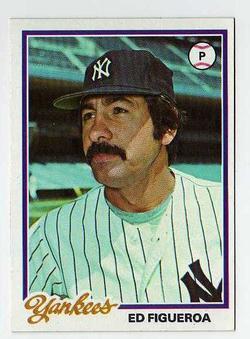
Card Corner–Ed Figueroa


Untitled

Perhaps we should call him "Forgotten Figueroa." For most Yankee fans, the 1978 season triggers memories of Ron Guidry’s Cy Young performance, Reggie Jackson’s stirring presence in the lineup and locker room, the mid-season transition from Billy Martin to Bob Lemon, and, of course, the looming specter of "The Boss." Yet, no one ever talks about Ed Figueroa’s contribution to the cause. Pitching in the thin but substantial shadow of Guidry, Figueroa (as seen here on his 1978 Topps card) quietly won 20 games, gobbled up 253 innings, and gave the Yankees a perfect right-handed complement to "Louisiana Lightning." Heck, on most teams, Figueroa would have qualified as a full-fledged ace, a natural to start a one-game playoff tiebreaker or the first game of a World Series. But on the ’78 Yankees, Figueroa was the proverbial second banana—the Vida Blue to the A’s Catfish Hunter, the Dave McNally to the Orioles’ Jim Palmer, the Frank Tanana to the Angels’ Nolan Ryan.

Aside from the obvious Guidry factor, why has Figueroa faded so much in our collective memories? Several factors may be conspiring against Figgy. First, he wasn’t overpowering, lacking the strikeout ability that both mainstream and Sabermetric types seem to favor. By the time that Figueroa traded in his Angels halo for Yankee pinstripes (as part of the Bobby Bonds for Mickey Rivers swap), he had become a four-pitch pitcher: fastball, slider, curve, and change-up. He threw mostly a sinking fastball, which he liked to mix and match with his breaking and off-speed pitches. That didn’t add up to a lot of strikeouts, just a lot of quiet effectiveness during his halcyon days from 1976 to ’78.

Then there was Figueroa’s lack of staying power. As good as he was during the Yankees’ mini-dynasty, topped off by his peak in 1978, he faded quickly from the scene. He threw a lot of innings in the mid-1970s. Over a four-year span, he averaged 248 innings per season, a substantial workload that became exacerbated by an awkward motion. In his wind-up, Figueroa tucked his left leg and left arm in toward his mid-section; by the time he put himself in position to deliver the pitch, he was throwing the ball across his body. It was a fun delivery to imitate (as I know well from hours of throwing a ball up against a boulder outside of my house), but it sure did appear to put extra stress on the arm and shoulder. Figueroa’s arm problems began in 1979; by 1981, he was fully cooked.

Finally, Figueroa’s personality may have soured any hopes of long-term appreciation. Figgy had his share of run-ins with Billy Martin (then again, who didn’t?) and the manager’s enforcment of his own strict set of policies regarding his pitchers and their approach against each batter. Portrayed as surly by some of the New York media (which may or may not be fair, given the treatment of Latino players by some writers), Figueroa came across as dour to a young fan like me. When I think of Figueroa, I envision the "Lieutenant Castillo" character that Edward James Olmos once portrayed on "Miami Vice." Yes, he was highly effective and very good at his job, but not exactly someone you’d send an invitation to amidst hope that he’d enliven the atmosphere at your local block party.

Given Figueroa’s mix of pitching style, longevity (or lack thereof), and personality, we are left with a retired pitcher who often attends Old-Timers’ Day at the Stadium but remains a figure wrapped in obscurity. With that in mind, here are a few things that you may or may not know about Ed Figueroa.

*A veteran of the Vietnam War, Figueroa saw the start of his major league career delayed by military service in 1969. He missed all of that minor league season while in the war, losing a valuable year of development. Figgy didn’t make the major leagues until 1974, when he was already 25 years of age. He probably would have arrived a year or two sooner, if not for Nam.

*By winning 20 games for the ’78 Yankees, Figueroa became the first Puerto Rican pitcher to achieve the milestone, ending a drought that began with Hiram Bithorn’s debut in 1942. Juan Pizarro, a 131-game winner for his career, never won 20. Neither did Ruben Gomez. Today’s winningest Puerto Rican pitcher, former Yankee Javier Vazquez, has never won more than 16 in a single season. Figueroa might have reached the milestone even sooner, had a late-season game in 1976 not been rained out. Figueroa settled for a 19-10 mark that year, emerging as a major factor in securing the Yankees’ first pennant in a dozen years.

*Because of arm troubles, Figueroa’s prime ended by his 28th birthday. After the 1978 season, he never pitched more than 104 innings and never had another winning season. By the time he was 32, Figueroa had thrown his final major league pitch as a member of the Oakland A’s.

Figueroa will never make the Hall of Fame, never receive the loudest cheers at Old-Timers’ Day, and never have his number retired by the Yankees. But he deserves to be remembered as an essential piece—the right-handed anchor—of the ’78 Yankees. Without him, there would have been no tiebreaker against the Red Sox, no playoff appearance against the Royals, and no World Series date with the Dodgers. It’s long overdue, but we just want to say thanks, Figgy.

Bruce Markusen, an avid fan of the ’78 Yankees, writes "Cooperstown Confidential" for MLBlogs at MLB.com.


Big Daddy

 Soul legend Isaac Hayes passed away on Sunday.  He was 65. 

Untitled 

Hayes is most famous for composing the title theme to "Shaft," but he did far more than that.  

Along with David Porter, Hayes was the major creative force behind Stax Records in the Sixties–their most enduring work is the classic, "Soul Man."  His vocal stylings paved the way for Barry White, and years later, Hayes, a Scientologist, had a successful cameo on "South Park."  

Dag, another meaningful loss.   

I love Hayes’ moody rendition of "Walk on By":

feed Share on Facebook Share on Twitter Share via email
"This ain't football. We do this every day."
--Earl Weaver
