"A New York Treasure" --Village Voice

Stadium to Baseball: Don’t Go

The fourth and final All-Star Game in Yankee Stadium started out as something of a dud, but it sure did get interesting before the AL came away its eleventh-straight win after 15 innings and nearly five hours of baseball.

Scoreless after four innings, the early part of the game was notable only for its lack of offense. Derek Jeter singled and stole second in his first at-bat, but was stranded there, ground into a double play in his second trip, and ground out again to kill a fifth-inning rally in his final at-bat. Alex Rodriguez fouled out and struck out in his two at-bats. The AL had five runners in the first four frames, but one was erased by Jeter’s double play, and Milton Bradley was picked off first base after reaching on a Hanley Ramirez throwing error in the fourth. The NL had just three baserunners in the first four frames. Of those three, Albert Pujols was nailed by a laser throw from Ichiro Suzuki while trying to stretch a single into the right field corner into a double. That play was the highlight of the early part of the game, though everyone had a good laugh when Carlos Zambrano’s first pitch to Manny Ramirez in the bottom of the fourth was a curveball that broke over and behind Ramirez’s head.

The NL finally broke the dam when Matt Holliday led off the fifth with an opposite-field solo homer off Ervin Santana that was also the first extra-base hit of the game. The senior circuit added another run against Justin Duchscherer the following inning when Hanely Ramirez and Chase Utley singled to put runners on the corners with no outs, and Lance Berkman plated Ramirez with a sac fly to center.

The game was still 2-0 with two outs in the bottom of the seventh when J.D. Drew tied things up with a two-run homer that plated Justin Morneau (who had doubled to lead off the inning), making Drew the first Boston player to get a genuine cheer from a Yankee Stadium crowd in my memory.

(more…)

The All-Star Game: 2008

The NL has the better lineup and the roster that better represents the best of their league, but they haven’t won one of these things since 1996, when the AL was shutout by a nonet of pitchers that included Mark Wohlers, Steve Trachsel, and Phillies closer Ricky Bottalico, and they won’t get last licks tonight.

The NL has had some turnover in its roster since it was first announced. In addition to Corey Hart, who was added via the Final Vote, David Wright, who finished second in that voting, replaces the injured Alfonso Soriano, and Carlos Marmol replaces his bullpen-mate Kerry Wood, who developed blister on his right index finger last weekend. What’s more, today there have been reports that the Giants sophomore sensation Tim Lincecum, my pick to start for the NL squad, fell ill with the flu yesterday and may not even make it to the Stadium. The only roster issue for the ALers was the injured David Ortiz being replaced by Final Vote winner Evan Longoria.

Here are the lineups:

American League

RF – Ichiro Suzuki (L)
SS – Derek Jeter (R)
CF – Josh Hamilton (L)
3B – Alex Rodriguez (R)
LF – Manny Ramirez (R)
DH – Milton Bradley (S)
1B – Kevin Youkilis (R)
C – Joe Mauer (L)
2B – Dustin Pedroia (R)

P – Cliff Lee (L)

National League

SS – Hanely Ramirez (R)
2B – Chase Utley (L)
1B – Lance Berkman (S)
DH – Albert Pujols (R)
3B – Chipper Jones (S)
RF – Matt Holliday (R)
LF – Ryan Braun (R)
CF – Kosuke Fukudome (L)
C – Geovany Soto (R)

P – Ben Sheets (R)

In lieu of FOX’s Zelaskoed pre-game coverage, check our man Alex’s write up on the Stadium over at SI.com, and let’s all hope this won’t be the last night they break the bunting out at the old yard.

More fun: Paul Lukas on All-Star Game uniform shenanigans, including several of those mentioned in my 1977 game recap earlier today.

The All-Star Game: 1977

Untitled The last All-Star Game to take place at Yankee Stadium was played on July 19, 1977, five days after the blackout that devastated parts of the city. It was the second season of the renovated Stadium, which had already seen Chris Chambliss hit his ALCS-winning home run against the Royals and the Reds sweep the Yankees in the World Series the previous October. At the break, the Yankees were in third place in a tight race in the AL East, 2.5 games behind the Red Sox and three games behind the Orioles, both of whom would finish the season 2.5 games behind the repeating AL champions.

The Yankees had five representatives at the All-Star Game that year, not counting AL manager Billy Martin and his coaching staff. Reggie Jackson, in his first year with the team, started in right field and was booed loudly by the home crown upon being announced by Bob Sheppard before the game. Willie Randolph, in his second season as a Yankee, made his first All-Star start at second base. Thurman Munson, Graig Nettles, and Sparky Lyle all made the team as reserves.

While the six members of the 1976 World Champion Reds on the NL roster (Joe Morgan, Johnny Bench, George Foster, and Dave Concepcion in the starting lineup, Pete Rose and Ken Griffy on the bench) were booed loudly by the Yankee Stadium crowd, the loudest ovation during the pre-game introductions went to another Red, Tom Seaver, who had been traded to Cincinnati by the Mets just a month earlier. Watching the game now, it’s also striking to see future Yankee stars Dave Winfield and Goose Gossage, both playing for the NL squad, met with near silence by the Stadium fans, and to see Billy Martin cheerfully greet his first base coach, White Sox manager Bob Lemon, who would replace him as Yankee manager the following season.

Orioles ace Jim Palmer started for the AL squad. Having thrown 638 innings over the previous two seasons, Palmer had thrown 187 2/3 innings in the first half of 1977 and was clearly fatigued. Joe Morgan, who had started the scoring in the 1976 World Series with a first-inning home run off Doyle Alexander, led off and put Palmer’s sixth pitch into the right field box seats. As Reggie Jackson ran out of room to chase Morgan’s leadoff homer, he pressed his face against the right field wall and rolled around as if to say "here we go again." The NL had won the previous five All-Star Games and 18 of the previous 20. They would win this one and the next five as well before Fred Lynn’s grand slam off Atlee Hammaker finally broke their dominance in 1983.

(more…)

The Natural.

The reason why baseball movies will never get it right is because no amount of clever CGI can ever replicate what we saw from Josh Hamilton, a real life Roy Hobbs, last night at the Stadium. I still feel buzzed.

“C” is for “Crazy”

“If I was managing the team, I would close,” [Jonathan] Papelbon said. “I’m not managing the team, so it don’t matter.”

…”We’ve both earned that right; us, by winning the World Series and having the opportunity of having our manager there and our team being represented, and Mariano by what he’s done for this role, we’re in Yankee Stadium and blah, blah, blah,” Papelbon said. “It’s not that easy. Everybody thinks it’s a cut and dry answer, but it’s not.”
(N.Y. Daily News)

Well, Jonathan Paplebon is an athlete. And I’d rather have a guy who is dumb and good than smart and crappy. So this wasn’t an especially bright thing to say. He isn’t paid to be bright.

Glorified Batting Practice

ESPN will broadcast the Home Run Derby at Yankee Stadium at 8pm tonight. It will be the first and last Home Run Derby in the Stadium’s history as the Derby only dates back to 1985 and Yankee Stadium last hosted the All-Star Game in 1977.

The balls for the Derby tend to be a bit juiced, so it’s quite possible that there will be balls hit to previously unreached portions of the park tonight. If you follow the link above, you’ll find a video that shows where the furthest-hit balls in this decade’s Derbies would have landed in Yankee Stadium. A several of them would have landed safely in the left field bleachers, a section that’s only been reached once during a game, and one would have hit off the wall behind those bleachers.

Unfortunately, none of the seven hitters responsible for the blasts in that video will be participating tonight. In fact, if you look at the top home run totals over the 2004 to 2007 seasons, Lance Berkman is the only member of the top 10 who will be taking his hacks tonight, and the next participant on the list is Justin Morneau all the way down at 27th.

(more…)

Trader Woes

Joe Pos takes a look.  Peep, don’t sleep.

Da Belle of Da Balls

Over at New York magazine, Will Leitch weighs in on the latest Alex Rodriguez circus:

As we watch A-Rod’s tabloid excoriation across our tabloid media this week—He’s having an affair with Madonna! No, it’s only spiritual! He dates strippers and bodybuilders! He’s a bad dad!—it’s worth considering that the breakup that has landed A-Rod in his predicament isn’t necessarily the one with his wife, Cynthia; it’s the one he had with Scott Boras last October.

Over the past sixteen years, Boras was the one constant in A-Rod’s life. A-Rod’s job was simple: Hit baseballs a very long way. Boras, his agent, managed his money, public image, contract negotiations, you name it. Then, when negotiations with the Yankees went haywire, he dumped Boras, and Madonna’s longtime manager, Guy Oseary, was hired to remake A-Rod’s image. Which has happened now, spectacularly.

You can say that again.

Pretty Damn Good


Rob Neyer has a fine appreciation of Bobby Murcer’s career today at ESPN:

After playing briefly for the Yankees in 1965 and ’66, Murcer was one of the very few major leaguers drafted into the military during the Vietnam War. Inducted into the army during spring training in 1967, he missed all of that season and the next while serving as a radio operator. Murcer worried that his career was over, but would later tell author Philip Bashe, "What I thought was going to be a horrible experience was really a positive thing for me in the long run. I learned responsibility and, obviously, a little bit of discipline. When I got out I was ready to proceed with my baseball career on a much more mature level."

No kidding. Murcer, who had struggled in the majors before going into the army — understandably, considering that he’d been a 160-pound teenager — got off to a brilliant start in 1969. He homered on Opening Day and drove in three runs. He homered in his next game, too. When Murcer hurt his ankle in late May, he was leading the majors with 43 RBIs.

He cooled off after getting back into the lineup, but still led the club with 82 runs and 82 RBIs. Also that season, Murcer finally moved into Mantle’s old spot in center field. Murcer, like Mantle, had been a shortstop in the minors, and he’d stuck there during his first stints with the Yankees. But in 1969 they moved him to third base, an experiment that lasted five weeks and included 14 errors. He spent the next months in right field, and finally moved to center in late August; the transition was complete, and in 1972 Murcer won a Gold Glove (something Mantle never did).

In 1971, Murcer’s first great season (and his best), he played in his first of five straight All-Star Games. They didn’t all come with the Yankees, though. In 1974, Murcer became the highest-paid Yankee ever — his $120,000 salary topped the $100,000 earned by Joe DiMaggio and Mantle. But Murcer hit only 10 home runs in 1974, and shortly after the season the Yankees traded him to the Giants for Bobby Bonds.

(more…)

Straight Shootin

Andy Says:

"If we want to make the playoffs, we have to be better," said Pettitte, who took the loss Sunday. "We stink right now for the most part. As a team, we’ve kind of stunk it up here lately, so we need to play better."

…"We’ve got to find a way to put it all together for an extended period of time with our pitching and our hitting combined," Pettitte said. "It seems like right now, we’re feast or famine."
(N.Y. Daily News)


(more…)

Whiff

Hustle Buck Tater.

All Jays

The Blue Jays scored four runs off Andy Pettitte in the second inning yesterday, which was more than enough for Yankee-killer A.J. Burnett. The Yanks got a man as far as second just twice through the first eight innings and didn’t break through until Jason Giambi’s opposite-field solo homer off a tiring Burnett in the ninth inning. Jorge Posada followed Giambi with a single to bounce Burnett, but facing closer B.J. Ryan, Robinson Cano bounced into a double play to give Toronto a 4-1 victory in the game and a 2-1 victory in the series.

The Jays got their breakout inning going when Bobby Abreu completely misjudged a would-by fly out to right into a double. Abreu then spent the rest of the game making up for his blunder, but to no avail. Abreu led off the top of the fourth with a double, but the middle of the Yankee order couldn’t even get him to third base. With men on the corners in the bottom of the fourth inning, Marco Scutaro, whose three-run homer capped the Jay’s four-run second inning, lifted a foul ball to shallow right field. Abreu made an impressive ranging catch, whirled, and fired a strike to Posada to nail Scott Rolen attempting to score for an inning-saving double play. In his next at-bat, Abreu reached on an infield single and got to second on an Alex Rodriguez single, but was again stranded at the keystone.

Abreu was the only Yankee to reach second base all day other than Giambi on his ninth-inning home run. Peter Abraham reports that all but seven of the Yankees 32 plate appearances against Burnett were over within three pitches, four of them being three-pitch strike outs. Scutaro was the third opposing in the last week who failed to get down a bunt and then homered in the same at-bat.

The Yankees enter the break having scored 3.67 runs per game in their last 15 contests and 2.15 runs per game in 13 of those 15 games. They are six games behind the first-place Red Sox in the AL East and 5.5 games behind the second-place Tampa Bay Rays. They’re in fourth place in the Wild Card race behind the Rays, Twins (3 GB), and A’s (1 GB), the last of whom they will face in their first series after the break.

Meanwhile, the Futures Game was played back at the Stadium. For all of the promotion the All-Star Game and associated events have received in the past week or so, the Futures Game seemed to go completely unmentioned. The Tino Martinez-managed World team beat the U.S. squad 3-0. Yankee catching prospect Jesus Montero contributed a single in two at-bats.

Bounce Into The Break

With the Yankees offense scuffling, Joe Girardi finally made a meaningful tweak to his lineup yesterday, dropping struggling rookie leadoff man Brett Gardner to ninth in the order and moving everyone else up a spot. That meant Derek Jeter, who has hit a Jeter-esque .311/.385/.444 since June 1, leading off, Bobby Abreu batting second, Alex Rodriguez batting third, etcetera. His team responded by scoring nine-runs in the first four innings of the game, kick started by Jeter’s leadoff home run on the second pitch of the game. Tucked away at the bottom of the order, Gardner reached base four times in four trips, with a pair of singles, a pair of walks, a pair of runs scored, and three RBIs.

It worked so well, he’s doing it again today, though with Jorge Posada catching, Jason Giambi playing first base, and Wilson Betemit slipping into the eighth spot in place of yesterday’s catcher, Chad Moeller.

That lineup will look to give the Yankees a series victory heading into the All-Star break with a win against A.J. Burnett in today’s rubber game. Burnett is something of a Yankee killer. He beat them back on April 2, his only start against the Bombers this season, and is the only Blue Jay pitcher other than Roy Halladay to have defeated the Yankees this year. In fact, the only time the Yankees have beaten Burnett since he joined the Blue Jays came in September 2006.

The good news is that Burnett enters today’s game with a 6.91 ERA in last seven starts, has allowed 15 runs (13 earned) in his last two starts, and is pitching on three-day’s rest for just the third time in his career. He’ll face Andy Pettitte, who has a 1.82 ERA in last six starts (5-1) and is coming off eight shutout innings against Rays in which he looked absolutely dominant, allowing just four hits, three of them singles, and walking none.

Once (More) Around the Ballpark

Good Night, Old Pal

The Yankees 9-4 win over the Blue Jays this afternoon, which featured Derek Jeter’s 200th career home run as well as Alex Rodriguez’s 537th career bomb (moving him past Mickey Mantle on the all-time list), was overshadowed by the news that Bobby Murcer has passed away.

Murcer was a solid star player for the Yankees during the late 60s and early 70s–good but never truly great–and later, a friendly voice in the broadcast booth. Murcer knocked a game-winning, pinch-hit homer over the right center field wall against the Orioles in September of 1981. I was at that game with my dad and my brother. I’ll never forget watching two drunk guys sitting down the row from us in the upper deck, chanting "Bob-by, Bob-by!" and then all hell breaking loose when Murcer hit the dinger.

George Carlin, now Bobby Murcer. It certainly hits a lot closer to home when you grew up watching and then listening to a guy. Sixty-two is too young, man.  At least he’s not in pain anymore.  Let’s hope he’s at peace.  I know it’s the natural order of things and all, but, good goosh, we’ve been talking an awful lot about death lately.

Time’s Up

Time for a win.

Let’s Go Yan-Kees.

Blankity Blank

Yes, the Yankee offense has been less than inspired of late, but there ain’t much that even the best hitting teams can do when they face a buzz saw like Doc Halladay. The Blue Jays’ ace delivered a vintage performance on Friday night, throwing a complete-game, two-hit, shutout against the Yanks. Jays 5, Yanks zip. Joba Chamberlain pitched well, giving up three runs in 6.2 innings, striking out nine without a walk. Just one of those nights.

Rufus Ratus Johnson Brown, whatta ya gunna do when the rent comes round?

Toronto Blue Jays III: Gimme A Break Edition

When Dustin McGowan hit the DL, the Yankees thought they were going to get through their final series of the first half without having to face any of the Blue Jays’ best pitchers, but now the Jays have Roy Halladay going tonight and A.J. Burnett going on Sunday. That’s not going to help the Yankees break out of their offensive funk. The Yankees have gone 4-2 against Toronto thus far this season, but their two losses came against Halladay and Burnett and saw the Yankees score a total of 5 runs.

The good news is that the Yanks have Joba Chamberlain and Andy Pettitte opposing those two. Pettitte, who faces Burnett on Sunday, has a 1.82 ERA and a 5-1 record over his last six starts, which includes his stinker against the Red Sox. Since pushing his pitch counts into the 80s with his start against the Astros, Chamberlain, who starts against Halladay tonight, has a 2.22 ERA with 29 Ks in 28 1/3 innings over five starts. The Yankees are 4-1 in those games, though Joba has gotten the decision just once due to the offense’s struggles.

Chamberlain’s only weakness since becoming a starter has been the base on balls, as he has a 5.08 BB/9 over those five starts and has thus only made it past the sixth inning once. That trend started with his first major league start, which came against the Blue Jays at the Stadium and saw the Toronto hitters exploit his pitch limit by taking an inordinate number of pitches. It will be interesting to see if the Jays’ approach differs tonight now that Joba’s no longer on an artificially-low pitch count.

As for Halladay, he’s 1-1 with a 3.46 ERA in two starts against the Yankees this season. He was out-dueled by Chien-Ming Wang on the rain-delayed Opening Day Night, and was the beneficiary of the Jay’s approach against Chamberlain in the start described above. Tonight could be the first of many unencumbered duels between these two AL East aces.

Jorge Posada is finally back behind the plate, as Jason Giambi returns to the lineup as the DH in the American League park, Wilson Betemit slips into Jose Molina’s spot in the lineup at first base, and Brett Gardner returns to the leadoff spot and left field.

If the Yanks can pull out two of three this weekend, it should give the team a boost heading into the break, even if they have to do it with pitching rather than hitting. The Jays have the third-worst offense in the AL and just lost Vernon Wells to the DL with a hamstring strain, so the opportunity is there, but the pressure is on Joba and Andy get it done.

(more…)

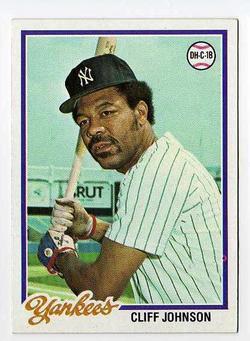
Card Corner–Cliff Johnson


Untitled

As I’ve watched the Yankees throughout the first half of 2008, I’ve come to the conclusion that they could use someone like Cliff Johnson. Of course, Cliff is 60 years old now, and probably not in condition to bend his knees behind the plate or swing a bat in anger. In actuality, I’m referring to the Cliff Johnson of roughly 30 years ago, when he gave the Yankees the kind of right-handed hitting and bench strength that this year’s Yankees so badly require.

For much of the 1970s, the Yankees tried to acquire some extra right-handed hitting. In 1973, they purchased Jim Ray Hart, who lasted only a calendar year as a platoon DH before it became obvious that he was washed up, in part because of his problems with drinking. After the season, the Bombers acquired switch-hitting Bill “Suds” Sudakis from the Texas Rangers. Sudakis succeeded in one thing—making headlines when he brawled with Sweet Lou Piniella during a road trip in Milwaukee. In the spring of 1974, the Yankees acquired Walt “No Neck” Williams as part of a larger deal with the White Sox. Williams made a splash, but mostly because of his unusual head-and-shoulders appearance. Later that season, the Yankees made a last-minute deal for Alex Johnson, followed by a December transaction that brought in Bob Oliver from Baltimore. Both players had once been highly productive; both players failed to last a full season at Shea Stadium.

In the spring of 1976, the Yankees gave Tommy Davis, one of my favorites, a look-see. He never made it into a game, released on the eve of Opening Day. Then came another favorite, Cesar Tovar, who was also one of Yankee manager Billy Martin’s preferred pets. Tovar could play anywhere, but unfortunately couldn’t hit anything—at least not any more. After the season, the Yankees appeared to have hit the jackpot with the perennially underrated Jimmy Wynn. But “The Toy Cannon” had little fodder remaining; he batted .143 in 77 at-bats and received the boot.

Still searching for a right-handed role-playing bat in 1977, the Yankees then pulled the trigger on a deal just before the June 15th deadline. General manager Gabe Paul sent three extraneous minor leaguers—first baseman Dave Bergman, infielder Mike Fischlin, and lefty Randy Niemann—to the Houston Astros. In exchange, the Yankees received what they desperately needed on two different counts—a right-handed bat and a backup catcher. Cliff Johnson had finally come to town.

Coming to bat 142 times for the ’77 Yankees, Johnson provided exactly what Martin and Gabe Paul wanted. Heathcliff batted .296 with 12 home runs; more significantly, he slugged .606 and compiled a .405 on-base percentage. When the opponent threw a left-hander at the Yankees, Martin rightly found a place for Johnson in the lineup. Granted, Johnson wasn’t much of a catcher—at six-four and 240 pounds, he was clumsy and owned hands of stone—but he could play the position in short doses. He could also fill in at first base and the outfield corners (though he never did play in left or right field during his Yankee days). Most critically, Johnson could hit—swinging the bat better than any backup catcher the Yankees had featured since the salad days of Johnny Blanchard.

Johnson became an important part of the Yankees’ second-half surge that summer. He also devoured the Kansas City Royals’ pitching staff in the ALCS. In 16 at-bats, Johnson delivered six hits, swatted one home run, and slugged .733, helping the Yankees clinched the American League pennant in a wild five-game series. As far as June 15th trade deadline deals were concerned, Johnson had become one of the best mid-season acquisitions in Yankee history.

The 1977 season turned out to be the peak of Johnson’s career in pinstripes. In 1978, the bottom fell out of his game. Losing his stroke in his continuing role as a spare part, Johnson batted .184 with only six home runs in 174 at-bats. He became a nonentity in the postseason, going hitless in three at-bats against the Royals and Los Angeles Dodgers. The following spring, Johnson became a liability in the clubhouse. In late April, he took offense at some playful ribbing from Goose Gossage and gave the Yankees’ relief ace a slap of his hand. That led to a full-scale wrestling match—and a tumble into the bathroom toilet stalls. Johnson escaped unharmed, but the Goose endured a torn ligament in his pitching thumb. He would miss the next three months of the 1979 season, which turned into a lost journey for the Yankees.

With that one incident, Johnson signed his Yankee death notice. Within two months, he was gone—shipped off to the Cleveland Indians in a bad deadline deal for a mediocre left-hander named Don Hood. (Hood was better than Billy Traber, though. Hood could have helped the 2008 Yankees, too.) Johnson would eventually resuscitate his career as a power-hitting DH and occasional catcher, and would later become a highly effective pinch-hitter for the Toronto Blue Jays, but his days as a Yankee had come to an ungracious end.

I wish it had turned out different for Johnson. I’ve always liked journeyman ballplayers who aren’t stars, but are still useful players—just like Johnson was. I remember how Phil Rizzuto used to playfully refer to him as “Heathcliff.” That wasn’t his real first name (it’s Clifford), just a clever-sounding nickname. Others called him “Topcat,” for reasons that remain a mystery to me to this day. Not surprisingly, Gossage described Johnson as a “lazy and worthless piece of crap” in his 2000 autobiography, ripping into Johnson for his tendency toward “moping around,” around the bullpen, where he allegedly refused to warm up pitchers from time to time. I read those descriptions with some sadness, mostly because they didn’t jell with the image I had of Johnson as a mammoth man who spoke softly but carried a big bat—literally.

Come back, Cliff Johnson. We could use someone like you in 2008.

Bruce Markusen writes “Cooperstown Confidential” for MLBlogs at MLB.com.

McClout or Take Two and Call Me When They’re Scoring

In a post-script to my wrap-up of Wednesday afternoon’s walk-off win against the Tampa Bay Rays, I expressed concern about the Yankees’ continued lack of offense, even through their recent four-game winning streak:

While the Yankees have won four games in a row, they have only averaged 3.5 runs scored over those four games and 3.63 runs per game over their last 11 contests. Setting aside their 18-run outburst against the Rangers a week ago, they’ve averaged 2.4 runs per game in ten of their last 11 games. Take out their two game-winning runs in extra innings, and they’ve scored just 2.2 runs per game during regulation in those ten games.

All of those numbers have gone down as a result of another weak showing last night, this one against Paul Maholm and the Pittsburgh Pirates.

The Bucs got on the board first when ninth-place hitter Jack Wilson led of the third inning by doubling off Mike Mussina and was later plated by a Freddy Sanchez single. Mussina would later single himself with two outs in the fifth inning and be moved to second by a Derek Jeter single before being stranded by a Bobby Abreu strikeout. Moose’s four-year-old son told him he’d hit better if he cuffed his pants high, and Mussina obliged on both accounts, but as always seems to be the case, the inning after the pitcher ran the bases, he gave up another run, though this one was hardly his fault.

In the bottom of the fifth, Wilson again led off with a hit. Nate McLouth then hit a double-play ball to second, but Derek Jeter’s relay throw tailed down and up the line, tipping off first baseman Jorge Posada’s outstretched glove to allow McLouth to reach safely. Posada was playing first in order to get his bat in the lineup against a lefty in a National League park (he went 1 for 4) while also allowing Mussina to pitch to his personal catcher, Jose Molina (Mussina allowed two runs in six innings). Posada didn’t make the most impressive stretch for the ball, which a more experienced infielder likely would have come up with. Still, a better throw from Jeter, who was in no way threatened by the charging baserunner, would have avoided that problem. Two pitches later, McLouth stole second and moved to third when Jose Molina’s throw skipped into center field. On the next pitch, Freddy Sanchez lifted a sac fly to give the Pirates a 2-0 lead.

The Yankees, meanwhile, had nothing going against Maholm. Derek Jeter led off the game with a single and the Yankees had men on the corners with two outs in the first, but Robinson Cano struck out on four pitches. Bobby Abreu walked and stole second with two outs in the third, but Alex Rodriguez flew out to strand him. Mussina and Jeter singled with two outs in the fifth, but Abreu struck out on three pitches.

That was it until the Yankees finally broke through, again with two outs, in the seventh. Justin Christian and pinch-hitter Wilson Betemit singled. Derek Jeter took a 2-2 pitch off the left foot to load the bases, and Wednesday’s hero Bobby Abreu tied the game with a single to right that plated Christian and Betemit. Alex Rodriguez ground out to end the inning, but the two-out rally seemed to signal a shift in the game.

Jose Veras shifted it back with just six pitches. Again Jack Wilson led off the inning by reaching base, this time walking on five pitches (though ball four looked like strike two). Nate McLouth followed by bunting a ball foul and then, like Carlos Peña the day before, crushing a home run to right field on a pitch in on his hands.

Christian drew a full-count walk against Pirates closer Damaso Marte in the ninth to bring Jason Giambi to the plate representing the tying run, but Giambi flew out at the end of a strong seven-pitch battle and Derek Jeter grounded out weakly to end the game and give the Pirates both a 4-2 win and a 2-1 series victory.

Tonight, the Yankees face Roy Halladay. Here’s hoping Joba Chamberlain has no-hit stuff. He may need it.

feed Share on Facebook Share on Twitter Share via email
"This ain't football. We do this every day."
--Earl Weaver

