"A New York Treasure" --Village Voice

The Awful Truth

Bottom Line:

“The whole game bothered me, we stunk, we stunk,” Girardi said. “We keep putting [runners] out there. We have to turn it around because we are missing opportunities. We had a lot of opportunities. The defense didn’t help us, the pitching didn’t help us and the runners in scoring position …”

…”I don’t think he needed to express that,” said Alex Rodriguez, who went 0-for-5 and hitless in two at-bats with runners in scoring position. “We all were upset.”
(N.Y. Post)

The Bad News Bears Go to PNC


Have Bats, Will Travel

Due to a quirk in our schedule, Cliff isn’t available to present his usual series preview tonight (he’ll miss the Subway Serious too, but will be back for the Rangers). I’m not going to even front and try to do what he does so well. But I can tell you that I’m really looking forward to watching this series, and not only because the Yankees should be able to handle the Pirates. No, it’s more because PNC ballpark is one of the most breath-taking Stadiums in the country. At least it is on TV. Which means it’ll be three times dope on HD-TV.

The cityscape beyond the center field wall is a tremendous sight. I’ve never been but a few years ago they held some kind of throwback night where they turned off the electric scoreboard and the booming soundtrack. They only effects that night came from the organist. I can’t recall wanting to be at a non-Yankee game more in recent years. Another time, during Rickey Henderson’s final year with the Mets, the legend was thrown out attempting to steal second base. As he trotted off the field, the organist played "The Old Gray Mare." Now, that’s old-timey style.

So, instead of our regular preview, let me direct you over to our good pal Pete Abe, who has the starting line-ups, pitching match-ups as well as a couple of roster moves (we have a new face in left tonight).

Ain’t nuthin else much to say ‘cept the obvious:

Let’s Go Yan-Kees.

The Sweet Sound of Summer

Lovely piece by John Branch in the Times the other day about an 89-year old organist Lambert Bartak.  Worth a click.  Man, baseball organists are a beautiful thing, no?

Switch my Pitch Up

I’m a sucker for oral histories.  I just love ’em.  They are the kinds of books you can pick-up and put-down at your leisure.  And they don’t have to be perfect in order to stimulate convesation, debate, and get the old juices flowing.  Change Up: An Oral History of 8 Key Events that Shaped Modern Baseball, by Larry Burke and Pete Foranatele is a fine addition to your baseball library. You can argue about the chapter selection, which is half the fun, but that’d really be missing the point, because it is what is in the chapters that’s winning.

Here is Thomas Boswell on the one-of-a-kind shortstop, Cal Ripken, Jr.

Everyone on Earth saw that he was a prototypical third baseman except for one person: Earl Weaver.  Only Weaver had the imagination to see that Bobby Bonner needed to go and that Ripken would work as a shortstop.  I was covering the team then as the daily beat writer and there is no question that this was 100 percent Earl Weaver against universal indifference or mild hostility to the idea from everybody else in baseball.  Nobody else though Cal Ripken could play shortstop.  Period.  Anybody who says differently wasn’t there and is wrong.

I guess we can credit Weaver for helping pave the way for Jeter and Rodriguez. 

In a wonderful chapter on the Latino Wave, here’s Luis Tiant:

I don’t go to my country for 46 years.  I want to go before I die to see my country, to see some of my family, if they’re still alive.  I haven’t had contact with them for a long time.  My aunts–I think, I know I have a couple of aunts still alive.  One time I was on a cruise ship over there in Key West.  You can see Cuba right there.  It was so close you could see the cars and the people.  It makes you sad.  You’re that close and you can’t go to your country.  Forty-six years here is a long time.  You say the number easy, but it’s a long time, a lot of days and nights.  A lot of Latino players from the other countries, like two weeks before the season was over they all talk and laugh, "I’m going to go back to my country and go to Christmas and eat and party every day."  And, I sit down there and listen to them, and they’re happy.  All of these lucky guys.  They can go back to their countries, and I don’t know when I’m going to go.  It’s amazing.  It’s a real bad feeling.  You have to do what you have to do.

For a more detailed look at baseball in Cuba, check out Michael Lewis’ long piece for Vanity Fair.

Beep, Beep, Beep, Beep, Yeah

I like driving enough.  I got my permit at sixteen like everyone else in the suburbs.  But I’ve never owned a car, never cared to, and have never had anything but a passing interest in them.  I live in a city where you don’t need a car–though that never stopped my old man, one of the true Manhattan crackpots who prefer having a car (he knew the alternate side of the street laws better than he knew the Passover Haggadah).  As a kid, I loved saying the word "Volvo," and could recognize the boxy cars easily.  Everyone loved a VW bug.  But my favorite American car was a Cadillac.  And only becacuse I liked the how the tail lights looked.  

I have a general memory of being a kid leaving my grandparents apartment at night.  As we waited for my father to pull the car around, we waited under the canopy of 15 West 81st street, across the street from the Hayden Planetarium and the Museum of Natural History, I looked at the bright red and yellow lights moving up and down the street.  I was usually half-asleep.  I remember being captivated by tail lights on the Caddy’s.  They weren’t the usual, blocky lights, they were sleek slits of lights, standing erect. 

My other favorite car was the plump, old Citroen’s, which I saw often during visits to my mother’s family in Belgium.  They really did it for me.

Any of you guys care about cars? 

If so, which ones float yer boat?

Chew on This

Derek Jeter is the leading vote-getter in the American League for the All-Star Game. He’s the guy you want to build a team around, he’s the most overrated player in the game. He’s a future Hall of Famer, yet Jeter has struggled through much of the first half of the season. Mark Feinsand has a good piece on the Yankee captain in the News today:

Jeter won’t even offer a guess at the reason for his declining numbers, but Yankees hitting coach Kevin Long has his own theory.

“I can tell you that he probably lost 30-35 points in his average due to his hand injury, but he’d never admit that,” Long said. “His swing wasn’t the same, he was favoring it and he got into some problems when it came to staying behind the baseball, which has always been his strength. He still contributed and helped us in other ways, but his hitting suffered.”

…Jeter began expanding his strike zone, swinging at pitches on the corners or off the plate. As Long watched those bad habits, he knew something wasn’t right.

“How much damage can you do with a pitch that’s (a foot) off the plate?” Long said. “Since he’s been healthy, he’s had to get out of some of those bad habits, and now he’s starting to put a little something together.”

Meanwhile, in the New York Sun, Steven Goldman explains why the Yanks should move Melky Cabrera:

The reason the Yankees can deal their starting center fielder for need without opening up another hole is the performance of prospect Brett Gardner at Triple-A Scranton. The speedy center fielder is currently batting .292/.408/.436 with 10 doubles, nine triples, three home runs, and 52 walks in 73 games. He has also stolen 29 bases in 37 attempts. Gardner, 24, will not be an impact player in the major leagues. However, given his patience, a .275 batting average, and his ability to run balls down with his speed, he should be at least as productive as Cabrera and provide a better on-base threat at the bottom of the order, creating more opportunities for Johnny Damon, Derek Jeter, and the top of the lineup.

Finally, could the end be near for Mike and the Angry Puppy? Say it ain’t so.

Seriously Funny

For more than ten years I’ve talked about records, record labels, record producers, rare 45 b-sides and comedians with my dear friend Alan who knows more about records and record history than anyone I know, and it’s not even close.  When we see each other, we usually go right into an old Carlin routine, or a Lenny Bruce sketch, or Bugs Bunny riff.  Alan was the first guy I thought of this morning. When he got into work and saw the red light on his phone, he knew who the message was from

(more…)

Wino Time, Bing-Bong, Five Minutes Past the Big Hour of Five O’Clock

 I couldn’t resist.

Here’s my beard.
Ain’t it wierd?
Don’t be sceered,
Just a beard.

Card Corner–Mike Paxton


Untitled

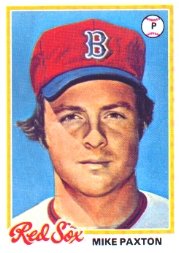
Yes, I know what you’re thinking: A dreaded Red Sock. (Or is it Red Sox?) But there is method to my folly. After all, this card comes from Topps’ 1978 set, the favorite set of Bronx Banter chieftain Alex Belth. And it is an intriguing card because of its rather surreal appearance.

Over the years, Topps has airbrushed logos and uniform colors on countless cards, but during the seventies and eighties it was pretty rare for the company to use anything but actual photographs of players on the cards. In this case, we find an example of a card that seemingly had no photograph, only an apparent drawing, from the cap and the uniform to the player’s face, neck, and hair.

So who is Mike Paxton and why was a picture of him drawn onto his 1978 Topps rookie card (No. 216), rather than photographed? Well, I could answer the first question easily enough, but the second query remained a bit of a mystery. An ordinary player, Mike Paxton is probably best remembered for being included in the trade that sent Dennis Eckersley from the Indians to the Red Sox; in the deal, Eckersley and backup catcher Fred Kendall went to Boston in exchange for Paxton, veteran right-hander Rick Wise, third baseman Ted Cox, and catcher Bo Diaz. Prior to the trade, Paxton had risen through the Red Sox’ farm system in the mid-1970s, emerging as one of their better pitching prospects despite the lack of an overpowering fastball. As a rookie in 1977, Paxton made an immediate impact, winning 10 of 15 decisions as a sometime starter and reliever. Standing only 5’11" and sporting a lower body nearly as bowlegged as Bucky Dent, Paxton compensated for a lack of velocity with tenacity and a willingness to throw inside that earned him the nickname, "Bulldog."

More significantly, the soft-spoken Paxton was—and presumably still is—deeply religious, a devout Baptist and a member of the Fellowship for Christian Athletes. Initially, I thought that explained why his image was drawn and not photographed for the 1978 Topps card. Although I hadn’t been able to verify this through any written documentation, I had heard it speculated that Paxton and another pitcher, Seattle Mariners left-hander Rick Jones (who was featured on a 1977 Topps card), didn’t want to be photographed on their cards for religious reasons. Topps has always negotiated its contracts with players on an individual basis, so it seemed possible that Paxton and Jones specifically made the request for drawings, and not photographs, on their cards. While the religious interpretation seemed like as good a reason as any in explaining why a photograph wouldn’t be used at a time when photos of players were in large supply, it didn’t explain why Paxton’s two subsequent Topps cards (1979 and ’80) featured photographs and not drawings. Thus, the mystery continued.

As it turned out, religious reasons had nothing to do with the "drawings" on the Mike Paxton and Rick Jones cards. There existed a much simpler explanation, which I received from former Yankee public relations man Marty Appel, who has also done public relations work for Topps over the years. Appel says that it was simply a case of Topps not having color photographs for either player. As a result, Topps took a couple of black-and-white photos and "colorized" them, giving them the effect of looking like drawings. So technically this card does feature a photograph, though it has been given the Ted Turner treatment.

Yes, sometimes there are easy answers to seemingly complex mysteries; you simply have to know whom to ask.

Bruce Markusen writes "Cooperstown Confidential" for MLBlogs at MLB.com.

Tell Us a Story

When it comes down to it, the story is the thing. Whether we are talking about one of the great comics like George Carlin, or a great movie, a magazine article or blog entry, we are attracted to stories and to storytellers. Baseball of course is replete with wonderful stories, some true, some not. (As Rob Neyer explores in his new book, sometimes the truth can only get in the way of a good story.)

Has anyone ever read Prophet of the Sandlots, Mark Winegardner’s gem of a book about travelling with Tony Lucadello, one of the most successful scouts in big league history? If you haven’t, there aren’t many baseball books I’d recommend more. Lucadello signed a ton of guys, including Jim Brosnan, Alex Johnson, Toby Harrah, Larry Hisle, Fergie Jenkins and Mike Schmidt. Like many scouts, he was a great storyteller. Here is a scene, featuring Carl Loewenstine, one of Lucadello’s protogees:

Though Carl is in his late thirties, with a drawl, a bushy red mustache, a chaw of tobacco, a Dodgers World Series ring, and friends in the country-music business, he has more in common with his mentor than appearances suggest.  After Tony secured him the full-time job with the Phillies in 1979, Carl was first assigned to the Deep South.  As we sat in an unheated press box in rain-soaked Dayton watching mediocre playes flail about on a muddy field, Carl started telling stories.  The best involved a quaest into deepest bayou country on the trail of a huge high-school dropout with a blazing fastball, no shoes, a drinking problem, and a pregnant twelve-year-old girl friend.  Carl ended up signing the kid, whose can’t-miss fastball couldn’t save him when he left his minor league team in Oklahoma to rob a bank, tryingo to get enough money for the girl friend to buy her own house.

I asked why baseball has always been such fertile territory for stories and storytellers. My theory is that ball players, coaches, and scouts have so much time to kill that those who can tell the best, funniest, most ornate stories are naturally the most popular, which helps them stay in baseball, which allows them to amass and embellish more stories.  Carl nodded, spat, and said maybe so.  "My own theory on that," he said, "is that every player in major league baseball has overcome the odds.  Only a tiny fraction of the players who are stars in high school or college ever get signed.  Then, probably only one in two hundred of those players make it to the majors.  Then, only about half of the those players stay around long enough to say so. Of the ones who do, most are out of the game in five or six years.  Your players who make it, really make it, are one in several million.  Everybody’s a long shot.  But there’s always that chance.  And that’s the great equalizer, the thing you’ll find in most every real baseball story.”

Ah, to be able to hang with the likes of grouchy old’ Don Zimmer for a spell. Or Joe Torre. David Cone might offer some good ones as the season rolls along, and I bet Giambi’s got more than few good stories to tell, dont’ ya think?

A Place for his Stuff

I was ten when my parents split up. My mother broke the news to us in the car after dropping my father off at the Metro North Station. My twin sister and younger brother were in the back seat.  I was in the passenger seat. When she was finished telling us the what was going to happen, I turned to her and said, "Don’t worry, Mom, I’ll take care of you now."

We grew up quickly over the next few years. My father started dating a woman who lived on the same block as my grandparents on the Upper West Side, and soon they were living together. She was good to us, gave us sex education tips without shame or titilation–straight, blunt, sound advice. I remember seeing a shiny box, The Devil in Miss Jones, next to the other videos on a shelf in her bedroom, but I never had the nerve to watch it on the sly.

Everything was grown-up. When we visited my dad, we hung around adults.

Perhaps the most important discovery I made in her apartment was when I pulled a record from the shelf with a picture of a hippie sitting on a stool. The record was AM/FM, the lp that won a Grammy Award for Best Comedy Album and the one that put George Carlin on the map for good. It wasn’t a racy record–heck, by this point, we had Eddie Murphy to idolize–and it was dated, filled-with Vietnam Era references that I didn’t understand. But it had curse words as well as Carlin’s elastic imagination, nibble word-play, and funny-sounding voices. Carlin sounded like a grown-up kid.  Friendly, approachable, caustic, but decent.

We were hooked. I can’t tell you how much material I swiped from Carlin and claimed as my own when I was a kid.  Later, Carlin’s follow-up records, Class Clown and Occupation Foole became like the Torah for me (I still remember my old man taking us to King Carole Records on the west side; I proudly selected Toledo Window Box). There is his legendary routine about the seven words you can’t say on Television, and who’ll ever forget his contribution to the debate between football and baseball?

For years, in high school and throughout college, I would go to sleep with the sounds of a comedy record playing in the background. Bill Cosby and Carlin were always good choices–Mel Brooks and Richard Pryor were too lively for that time of night. I must have listened to "Occupation Foole" five hundred times easily. I know Carlins’ inflections, the rhythms of his voice, his faces, all of his characters, as well as I know a member of the family.

So, it is a sad Monday morning as George Carlin passed away yesterday at the age of 71. That is too young. He was from Morningside Heights in Manhattan and he ranks up there with Lenny Bruce and Richard Pryor as one of the Giants of stand-up comedy.

I want to take this moment to thank him for everything he gave me.  He made me feel grown when I was a kid, and has made me feel young as I’ve gotten older.

The Brown Bomber Delivers the Biggest Night in Yankee Stadium History

We’re going to spend a lot of time waxing nostalgic about Yankee Stadium this year, sharing our own favorite memories and listing the all-time great moments. For all the Yankee highlights the place has seen, not to mention one of the most famous football games ever, the biggest event ever to go down in the House that Ruth Built may well have been the Joe Louis/Max Schmeling rematch which took place seventy years ago today (Here is audio from the fight).

In her review of "Beyond Glory," David Margolick’s acclaimed book about Louis-Schmeling, Joyce Carol Oates wrote:

Boxing is the most pitiless of sports, as it can be the most dazzling, theatrical and emblematic. Where race and nationalism are involved, as in the famous Joe Louis-Max Schmeling heavyweight fights of 1936 and 1938, two of the most widely publicized boxing matches in history, the emblematic aspect of the sport can assume epic proportions. When the second fight, of June 1938, pitting the 24-year-old American Negro titleholder, Louis, against the 32-year-old Schmeling, the Nazis’ star athlete, was fought at Yankee Stadium, the contest was as much between the United States and Nazi Germany as between two superbly skilled athletes. There were almost 70,000 spectators and an estimated 100 million radio listeners throughout the world: "the largest audience in history for anything."

…Most of the chapters are impersonal historical accounts, culled from numerous sources, in which the author’s voice is subordinate to his material. Amid much summarizing, press clippings of the era, many of them painfully racist, provide candor and color; occasionally there are outbursts of a kind of comic surrealism, as in this rapid collage following the dramatic outcome of the 1938 fight:

"In the stands there was bedlam. Tallulah Bankhead sprang to her feet and turned to the Schmeling fans behind her. ‘I told you so, you sons of bitches!’ she screamed. Whites were hugging blacks. ‘The happiest people I saw at this fight were not the Negroes but the Jews,’ a black writer observed. ‘In the row in front of me there was a great line of Jews – and they had the best time of all their Jewish lives.’ . . . ‘Beat the hell out of the damn German bastard!’ W. E. B. Du Bois, a lifelong Germanophile who rarely swore, shouted gleefully in Atlanta. In Hollywood, Bette Davis jumped up and down; she had won $66 in the Warner Brothers fight pool. . . . ‘Everybody danced and sang,’ Woody Guthrie wrote from Santa Fe. ‘I watched the people laugh, walk, sing, do all sorts of dances. I heard "Hooray for Joe Louis!" "To hell with Max Schmeling" in Indian, Mexican, Spanish, all kinds of white tongues.’ "

If you didn’t catch HBO’s fine Joe Louis documentary earlier this year, it’s well-worth watching.

It’s difficult to fathom the magnitude of that night. But it begs the question: Has an event held at Yankee Stadium ever had a greater social impact on the entire country, let alone the rest of the world?

I Can See Cleary Now…the Rain Has Gone

After being wowed by the Reds’ arms all weekend, the Yankees needed a hundred dollar bill performance on Sunday from their veteran, Andy Pettitte.  And that’s exactly what they got.  Pettitte was able to get himself out of a couple of dicey-looking jams, in the fourth and the sixth.  With the bases loaded and one out in the fourth, Pettitte fanned the pesky Joey Votto and then Jay Bruce to end the inning.  It was an overcast day, but the sun peaked-out just as Pettitte delivered the 3-2 pitch past Bruce. 

Two innings later, the sky was dark and the wind was whirling around the Stadium.  The wind was so violent, kicking up the infield dirt, Brandon Phillips had to step-out of the box several times before he could hit.  With runners on the corners and just one out, Pettitte got Paul Janish to pop a bunt up in the air, caught easily by Jorge Posada.  Pettitte stood on the mound, straight and tall, his pants rippling against the strong wind.  It brought to mind James Agee’s description of Buster Keaton: "mulish imperturbability under the wildest of circumstances."  Pettitte struck Votto out.

Jason Giambi’s mustache looked noticably darker than it did a day earlier.  When he was at the plate, it looked as if he was wearing one of those fake Groucho disguises.  Whatever he did, it worked, as Giambi collected three hits and a couple of RBI.  He also stole a base in the second inning.  He ran on a full count pitch to Posada, who took it for strike three.  When Giambi was on second, he looked toward the Yankee dugout and gave his boys a little shoulder shimmy shimmy ya

Kyle Farnsworth served up a solo shot to Junior Griffey in the eighth.  It was career dinger #601 for Griffey.  Mariano Rivera was called to record a four-out save after Farnsworth left the game with an injury to his finger.  Mo worked around two dinky singles to start the ninth, didn’t allow a run, and earned his 21st save of the season (in as many chances) as the Yankees salvaged the final game of the homestand, 4-1


Knife in the Water

image credit: http://homepage.mac.com/craigstephens/images/knife.jpg


The weatherman says we’re going to get summer storms this afternoon. Hopefully, they get the game in. I expect the Yankees to knock the hell out of the ball today, don’t you?

Cincinnati Chili

If you can’t beat ’em…eat ’em. 

http://farm3.static.flickr.com/2150/2074791613_3950c1fc12.jpg

I’ve never tried Cincinnati Chili, a truly weird n wunnerful sounding-dish, but my cousin Jonah and his wife Jenn absolutely love it.  Here is an introduction from Jenn, followed by a fool-proof recipe from the good people at Cook’s Illustrated (aka America’s Test Kitchen):

"My husband and I first learned about this chili recipe while babysitting our nephew Archer one Sat morning.  We had just discovered America’s Test Kitchen tv show and when they were demonstrating this recipe it literally stopped us in our tracks.  We sat enthralled at why someone would ever want to blanch ground chuck.  And then when we saw them mixing all those spices, we started salivating.  By the time they got to the buttered spaghetti, it was over: our jaws were on the floor, tongues agog a la Wyle E. Coyote.  America’s Test Kitchen = super geniuses.  At that point we both turned to each other and, without a word, we both knew what was for dinner that night.

The great thing about this recipe is that it’s super easy to throw together and it’s got enough interesting flavors to whet anyone’s palette. Since we made it the first time, we’ve been making it pretty much once a week.

I suppose you could sub ground chicken / turkey for the beef but what makes this dish delicious is the fat and I’m not sure chick or turk have enough of it (but I could be wrong).  The spices – in particular the cocoa – are what make it pop and give it a rich, beautiful color.

You must do all the required toppings for the big finale: the sharp tang of the cheddar, the sweet bite of the raw diced onion, and the mellow smoothness of the warmed red kidneys all add a nice dimension to the beefy, spiced chili.

While some people prefer to avoid having leftovers, for this dish it’s actually fine. It still tastes excellent the second time around (you can do both stove-top sauce pan method or the cover with foil in the oven method, though with the oven method the noodles do get a little crispy, if you’re into that)."


(more…)

A Warm, Unhappy Afternoon for the Yanks in the Bronx

On Friday night, Joe Girardi’s decision to intentionally walk Jay Bruce in the fifth inning–a move his pitcher Mike Mussina did not agree with–back-fired. However, the Yankees were also overwhelmed by Edinson Volquez. Johnny Damon said “He’s one of the better guys that we’ve seen in a long time.” Jason Giambi agreed. “He’s got Pedro-type stuff. You’ve got to tip your cap. The kid threw a good game.” As usual, Derek Jeter got right to it. “Sometimes guys are going to be better than you. He was better than us.”

A mere blip. It happens. I don’t think anyone expected the Yankees to get shut-down on Saturday afternoon by a kid making his major league debut. But that happened too. Fresh direct from Double A, Daryl Thompson woke up at 4:30 in the morning, was understandably amped up, and then went out and threw five scoreless innings, getting out of a bases-loaded jam in the second. Four other Cincy relievers combined to shut-out the Yankees, 6-0.

For the Yankees, Dan Giese, was equally impressive. Unfortunately, a throwing error by Giese in the seventh lead to a four-run rally by the Reds, enough to do the Yankees in.

Missed it by That Much

Edinson Volquez out-dueled Mike Mussina on Friday night as the Reds beat the Yanks 4-2. It was a terrific evening at the Stadium, weather-wise, and the Yankees had their chances–the tying run was at the plate in the bottom of the ninth, and Jason Giambi just missed a change up with two men on in the seventh (he would hit a long fly out to death valley, another one he was just behind). Mussina scattered ten hits over eight innings but really only made one mistake–a flat fastball to Jolbert Cabrera in the fifth. Johnny Damon lost a fly ball in the lights to start the inning:

“I saw it, I felt I had a bead on it,” Damon said. “Then, you’re seeing shadows. It makes me disgusted. I didn’t realize it hit off my glove. That’s tough to overcome when you’re facing a tough pitcher. Unfortunately, losing the ball in the lights cost us three.”
(Lapointe, N.Y. Times)

It was a night of near-misses.

Volquez was a lot of fun to watch. He was “effectively wild,” but not like Daniel Cabrera. He wasn’t wild enough to be hitting guys. But his pitches darted every which way. More to the point, when he fell behind in the count, he was able to come up with the big pitch. He was supremely confident, and why not? He hasn’t allowed more than three runs in any start this season.

It’s hot n hazy again in New York today. A 1:00 start promises to bring plenty of heat.

Let’s Go Yan-Kees!

Cincinnati Reds

Cincinnati Reds

2007 Record: 33-39 (.458)
2007 Pythagorean Record: 71-91 (.441)

2008 Record: 33-41 (.446)
2008 Pythagorean Record: 32-42 (.431)

Manager: Dusty Baker
General Manager: Walt Jocketty

Home Ballpark (multi-year Park Factors): Great American Ball Park (104/105)

Who’s Replacing Whom:

Joey Votto replaces Scott Hatteberg
Jay Bruce replaces Josh Hamilton
Paul Bako has taken playing time from Dave Ross and Javier Valentin
Corey Patterson replaces Jeff Conine
Jolbert Cabrera is the latest to fill in for Alex Gonzalez (DL)
Andy Phillips is filling in for Ryan Freel (DL)
Paul Janish is filling in for Jeff Keppinger (DL)
Edinson Volquez replaces Matt Belisle (minors)
Johnny Cueto replaces Kyle Lohse and Bobby Livingston (DL)
Francisco Cordero replaces David Weathers as closer
Weathers replaces Todd Coffey (DL)
Jeremy Affeldt replaces Mike Stanton
Bill Bray inherits Jon Coutlangus’s innings
Mike Lincoln replaces Victor Santos

25-man Roster:

1B – Joey Votto (L)
2B – Brandon Phillips (R)
SS – Jolbert Cabrera (R)
3B – Edwin Encarnacion (R)
C – Paul Bako (L)
RF – Ken Griffey Jr. (L)
CF – Jay Bruce (L)
LF – Adam Dunn (L)

Bench:

L – Corey Patterson (OF)
R – Norris Hopper (OF)
R – Dave Ross (C)
R – Paul Janish (IF)
R – Andy Phillips (IF)
S – Javier Valentin (C)

Rotation:

R – Aaron Harang
R – Edinson Volquez
R – Johnny Cueto
R – Bronson Arroyo

Bullpen:

R – Francisco Cordero
R – Jared Burton
L – Jeremy Affeldt
R – David Weathers
L – Bill Bray
R – Mike Lincoln
R – Gary Majewski

15-day DL: R – Ryan Freel (UT), R – Jeff Keppinger (IF), R – Jerry Hairston Jr. (UT), R – Josh Fogg, R – Todd Coffey
60-day DL: R – Alex Gonzalez (SS), L – Kent Mercker, L – Bobby Livingston

Typical Lineup

L – Jay Bruce (CF)
R – Jolbert Cabrera (SS)
L – Ken Griffey Jr. (RF)
R – Brandon Phillips (2B)
L – Adam Dunn (LF)
R – Edwin Encarnacion (3B)
L – Joey Votto (1B)
L – Paul Bako (C)

The Gookie

Harpo doin the Gookie.

This was the can’t-miss, home run, bust-a-gut move for Harpo Marx.  Whenever the Marx brothers were doing a show and started to bomb they’d send Harpo up to do the Gookie.  Once he busted it on you–seemingly out of nowhere–you were at his mercy.

(more…)

feed Share on Facebook Share on Twitter Share via email
"This ain't football. We do this every day."
--Earl Weaver