"A New York Treasure" --Village Voice

The Chase Is On

Due to the rash of injuries that have placed Mike Mussina and Carl Pavano on the disabled list alongside Chien-Ming Wang and Jeffrey Karstens, the Yankees were forced to dip into their minor league system for a starter for tonight’s (and likely Sunday’s) game. The three pitchers whose turns fell on the right day were Tyler Clippard and Steven Jackson in triple-A and Chase Wright in double-A. Of the three, Wright was both the only one already on the 40-man roster and the pitcher who’d had the most success in his two starts thus far this season. Clippard’s had two middling outings for Scranton. Jackson has faired a tad better, but neither has lasted more than five innings in either outing. Wright, meanwhile, has dominated in a pair of seven-inning outings and will make his major league debut tonight in the Bronx against the Indians.

Here’s what I wrote about Wright back in February:

L – Chase Wright (24)

A third-round draft pick in 2000, Wright has spent six years in the Yankees system without cracking double-A. He’s made large strides over the last three seasons however. Check these trends:

Year League Level ERA H/9 K/9 BB/9
2004 Midwest A 5.44 10.47 5.34 5.97
2005 Sally A 3.75 8.00 6.88 4.31
2006 Florida State A+ 1.88 7.14 7.52 3.23

Wright claims the difference has simply been an uptick in confidence. I suppose it could be that after bottoming out in 2004 he figured he couldn’t do any worse if he just challenged hitters. If so, it worked. Wright’s best pitch is a changeup that works off his low-90s fastball, and he’s working on developing his curve. He’s still a work in progress, but it’s certainly encouraging to see such rapid progress by a lefty starter. Indeed, he’s come far enough that the Yankees had to add him to the 40-man to protect him from the Rule 5 draft last fall.

To that I’ll add his spring training and double-A lines from this year:

Level ERA H/9 K/9 BB/9 IP
Spring Training 2.84 6.39 7.10 4.26 12 2/3
AA 0.00 2.57 12.21 0.64 14

Those 14 innings at double-A are divided evenly between two equally excellent starts in which Wright has posted a fantastic 2.29 groundball-to-flyball rate. Accordingly, Wright hasn’t allowed a home run in any of his 26 2/3 innings thus far this year and allowed just one round-tripper in 119 2/3 innings last year.

After I wrote the above, I received a note from Kevin Goldstein, Baseball Prospectus’s minor league guru. Kevin said that one thing he felt I got wrong was my estimation of Wright’s velocity (which I got from assimilating various on-line scouting reports). According to Goldstein, Wright’s fastball tops out in the high 80s, adding something to the effect that if Wright did throw in the low 90s, he’d be a world-beater. Judging by his recent results this season and last, I tend to wonder if Wright’s recent improvement has had as much to do with an uptick in velocity as with an increase in confidence. I’ll certainly be keeping an eye on the YES radar gun tonight. If it turns out that he is indeed working in the low-90s . . . look out world.

(more…)

The Cleveland Indians

The Cleveland Indians are a hard team to figure out. Two years ago they looked like an up-and-coming powerhouse in the Central. Built around stone cold masher Travis Hafner, the up-the-middle excellence of Victor Martinez, Jhonny Peralta, and Grady Sizemore, and emerging ace C.C. Sabathia, they won 93 games in 2005, just missing both the Wild Card and AL Central titles due to a collapse in the season’s final week. Last year, they collapsed altogether, winning just 78 games and finishing a distant fourth behind the Twins, Tigers, and White Sox in an increasingly competitive Central division. One seemingly obvious cause of this fall was the loss of Jhonny Peralta’s production (he hit just .257/.323/.385 last year, down from .292/.366/.520 in 2005), but closer inspection shows that the Indians collapse was largely illusory.

In large part due to an abysmal showing by their bullpen, the Indians underperformed their Pythagorean record by a staggering 11 games in 2006. In fact, looking at their runs scored and allowed totals, the team the 2006 Cleveland Indians most resembled was the 2006 New York Yankees. The Indians were second to only the Yankees in all of baseball in runs scored per game last year (this despite Peralta’s poor showing), and also finished right behind the Yankees in runs allowed per game (seventh in the AL to the Yanks’ sixth). In fact, the Yankees and Indians had identical team ERAs in 2006 with the Indians holding a slight advantage in ERA+ due to playing in a less severe pitchers park.

One thing that tripped Cleveland up last year, in addition to their shaky bullpen, was poor defensive play. The Tribe was 25th in the majors in both defensive efficiency and fielding percentage. This year that trend has continued. Though the Yankees are dead last in the majors in fielding percentage thanks to their major league worst 14 errors (nearly half of which are Derek Jeter’s), their defensive efficiency–the rate at which they turn all balls in play into outs–is actually the fourth best in baseball, just as it was a year ago. Cleveland, however, is 27th in fielding percentage (having made nine errors in nine games) and 21st in defensive efficiency. That means their pitching staff has to work that much harder to keep runs off the board.

Amazingly, it’s been able to do that thus far. The Indians staff ERA is the third best in the American League, while the ERA of their rebuilt bullpen is second best in the AL to that of the Yankees’ pen. The offense, however, is in a bit of a slump, though their scheduling problems may have played a part in that.

The big story of the Indians season thus far is that the entirety of their home opening series against the Mariners was snowed out and that their subsequent series against the Angels was moved indoors to Milwaukee’s Miller Park because of the ongoing winter weather. The Indians scored 7 2/3 runs per game while taking two of three from the White Sox in Chicago to start the season. They then sat idle for four days as their games against the Mariners were snowed out, rescheduled as double headers, then snowed out again. They finally resumed play with three games in Milwaukee, then returned home for a series against the White Sox and have scored just 3 2/3 runs per game over those last six games.

Of course, it may not be fair to judge the Indians on their performance thus far this season. While the team has gone 6-3, winning all three series, six of their nine games have come against the White Sox. Their eventual home opener at Jacobs Field was played in front of just 16,789 people (as opposed to the usual 42,400 or so), and their catcher and cleanup hitter Victor Martinez has played only three games, suffering a quadriceps injury in the last game of their opening series in Chicago. That is to say, the Cleveland Indians are a hard team to figure out largely because there’s not a lot to go on.

Still, the bullpen looks suspect as the new faces are Joe Borowski, Roberto Hernandez, and Aaron Fultz. C.C. Sabathia (who’s still just 26 years old) is a true ace and Jake Westbrook is a strong mid-rotation starter and every bit as extreme a groundball pitcher as Chien-Ming Wang, but Jeremy Sowers’ strike out rate is alarmingly low for a flyball pitcher and neither Paul Byrd nor extreme flyballer Cliff Lee or his replacement Fausto Carmona inspire much enthusiasm. On offense, Peralta, who had corrective vision surgery in the offseason and supposedly has put behind him some personal problems that contributed to his poor 2006 season, looks to be rebounding, Martinez should return to action this week, possibly even tonight, and the decision to platoon the outfield corners smells of small market brilliance. On the flip side, that platoon means Casey Blake still has a job, and everyone’s still waiting for Andy Marte to hit. As they were two years ago, the Tribe was a trendy pick to win the Central this year. I’m not entirely sold. They’re a good team, but not a great one. If they win, I suspect it will have as much to do with the decline of their competition as with their own success.

(more…)

Yankee Panky #5: Yankees vs. Red Sox — The Media

The non-coverage of Derek Jeter’s six errors through the first two weeks of the season is a subject I’d love to get into. However, I want to wait on the Jeter issue to see if it
actually does become a story beyond the statistics table. Will any writers or broadcasters call him out and question his defensive ability? (I’ll be surprised if Steven Goldman doesn’t mention the Jeter situation in the Pinstriped Bible tomorrow).

So, with the first round of Yankees-Red Sox games taking place this weekend, I figured this would be a good time to bring the banter fully to you the readers and get an informal poll of which team has the better mainstream and blog coverage.

TV
Yankees: YES
Red Sox: NESN

YES play-by-play: Michael Kay
NESN play-by-play: Don Orsillo

YES analysts: Ken Singleton, Joe Girardi, Al Leiter, John Flaherty, Paul O’Neill, Dave Justice
NESN analysts: Jerry Remy, Jim Rice, Dennis Eckersley, Dave McCarty

YES field reporter: Kim Jones
NESN field reporter: Tina Cervasio (who used to voice the show “Running” on YES, and auditioned for the field reporter job that eventually went to Jones)

YES studio host: Bob Lorenz, Nancy Newman (backup), Chris Shearn (Batting Practice)
NESN studio host: Tom Caron, Hazel Mae (rewind), Kathryn Tappen (weekends)

TV NETWORK WEB SITES
Yankees: yesnetwork.com

Red Sox: boston.com/sports/nesn

MLB.COM OFFICIAL SITES
Yankees: yankees.com
Red Sox: redsox.com

RADIO
Yankees: WCBS 880-AM
Red Sox: WEEI 850-AM

Yankees radio team: John Sterling, Suzyn Waldman
Red Sox radio team: Joe Castiglione, Dave O’Brien, Glenn Geffner
–> Geffner is the the team’s former media relations/PR head

NEWSPAPERS
Yankees: NY Daily News, NY Post, New York Times, Newsday, Journal News, Newark Star-Ledger, Bergen Record, Hartford Courant, New Haven Register
–> Alternates – Times Herald-Record, Staten Island Advance, New York Sun, Village Voice, AM New York

Red Sox: Boston Globe, Boston Herald, Providence Journal, Hartford Courant, New Haven Register, Connecticut Post, Portland Press Herald, Concord Monitor, Nashua Telegraph, Manchester Union-Leader, Springfield Union-News, Worcester Telegram, Quincy Patriot-Ledger, Woonsocket Call

BLOGS
See sidebar

LITTLE KNOWN FACT
During each regular season Yankees-Red Sox series, the beat writers and columnists for the two teams play a game against each other at the ballpark. The writers get very stoked for this. They talk about it for weeks and discuss their exploits prior to that particular night’s real game between the Yanks and Sox. The New York crew has a secret weapon: Bob Klapisch, who pitched at Columbia University.

* * *

Which group of media serves its audience best? Which group of writers and/or broadcasters provides the most comprehensive, intelligent, and provocative coverage? I’ll join in the discussion when I can throughout the week. We can discuss it in more detail next week, when the aftermath of the three-game set at Fenway has dissipated somewhat.

Bad Day

Sunday didn’t start or end well for the Yankees, though they did have a seven-inning oasis in the middle of it all.

The day started with the announcement that both Mike Mussina and Carl Pavano had been placed on the disabled list, leaving the starting rotation in shambles behind Andy Pettitte. Pettitte then took the mound and four of the first five A’s he faced reach base, the first on Derek Jeter’s sixth error of the year. With just one out in the bottom of the first, the A’s had a 2-0 lead and two men on. The Yankee bullpen, which had marched each of it’s seven members out to the mound the night before, began to collectively weep.

Pettitte then rallied to strike out Bobby Crosby and get Todd Walker to ground out to short. From there things started to look up. Pettitte settled down, pitching around a pair of singles in the second, stranding a two-out triple by Eric Chavez in the third, and setting down 13 of the next 14 men he faced after Chavez. Oakland starter Rich Harden was even better, but the injury-prone righty left the game due to shoulder stiffness in the seventh, opening the door for a three-run Yankee rally. The Yanks added another run in the eighth, handing a 4-2 lead to Mariano Rivera in the ninth, Mo’s first save opportunity of the season.

Mo got Chavez to ground out on an 0-1 pitch, then, after failing to get a called strike three call on Bobby Crosby, got the Oakland shortstop to fly out to right for the second out of the inning. Mo’s next pitch bore down and in on Todd Walker, but Walker was able to flare it out to left for a two-out single. Walker then moved to second on defensive indifference as Jason Kendall swung through a high fastball to run his count to 1-1.

(more…)

G’Bombee

Jason Giambi’s bat has been ice cold, and he was 0-5 last night when he hit a solo home run in the top of the 13th inning last night to help boost the Yankees to a 4-3 win over the A’s. Alex Rodriguez hit his seventh homer of the year, Jorge Posada had a huge pinch-hit double, and Robinson Cano banged out three hits.There was more sloppy fielding for the Yanks–four errors in all, two more by Derek Jeter–but the bullpen was outstanding. Starter Darrell Rasner allowed three runs in the first and then settled down. He was relieved in sixth and the Yankee bullpen, seven pitchers in all, allowed zero runs on just two hits. At this rate, it’s a good thing that the Bombers have some off-days, because the pen sure is getting its work in.

I watched most of the last two games in Oakland, stayed up as long as I could before my eyes just couldn’t stay open any longer. Dude, I’m a lightweight. Not that I’ve got anything on my mind. I’m only getting hitched.

Em and I are leaving tomorrow for the Bahamas, where we’ll be spending the next week enjoying our Marrymoon. We’re actually getting married on the beach, just the two of us, no family, no friends (“No Roger, No Re-Run, No Rent”), just a minister, a photographer and us, this coming Thursday afternoon at 1:30. The Yankees and Indians should be in the second inning, weather-provided, so raise a cup to us at some pernt during the game. I won’t be rushing to check the score–which is why we’re getting married in the spring and not the fall–but will check in on the Banter periodically.

Cliff and company will be holding it down around these parts, as the Yanks host the Tribe and then take on the Red Sox for the first time this year. You’re in good hands, as the old commerical used to go.

Hey, how about a nice send off from the Yankees today as Andy Pettitte goes against Oakland’s ace, Rich Harden.

Who’s Managing This Club, Mr. Whipple?

The A’s and Yankees played a thrilling eleven-inning game last night, but let’s skip straight to the action in the eighth inning, as it was in the top of the eighth that the worm turned for the Bronx Bombers.

With the game tied 4-4, Oakland manager Bob Geren called on his ace set-up man Justin Duchscherer to face the heart of the Yankee order. Alex Rodriguez singled on Duchscherer’s first pitch. Jason Giambi followed by yanking a double into the corner in right field, pushing Rodriguez to third. Joe Torre sent in Kevin Thompson to pinch-run for designated hitter Giambi at second base with Jorge Posada coming to the plate. Posada worked a 2-1 count then hit a blistering liner directly at first baseman Todd Walker for the first out. Geren then elected to have Duchscherer intentionally walk Robinson Cano to load the bases, thus allowing Duchscherer to Doug Mientkiewicz with a force at every base.

At this point Mientkiewicz was 0 for his last 18 with just one walk over that span. In his three previous at-bats in this game he had struck out and hit into two double plays, the first a line-drive to left that doubled up Posada at first, the second a conventional 4-6-3 that plated a run, but otherwise killed a bases-loaded, no-out rally in the sixth.

Now, if you’re Joe Torre, or even Yankee bench coach Don Mattingly, what do you do in this situation.

(more…)

The Oakland Athletics

The A’s, at least in the early going in 2007, are a pretty easy team to figure out. They don’t give up very many runs, but they don’t score very many either. Only two American League teams (the Red Sox and Angels) have allowed fewer runs per game thus far this season than the A’s’ 3.4, but only two major league teams (the Nationals and Giants) have plated fewer runs per game thus far than the A’s’ 2.8. The A’s are also dead last in the majors in home runs, having hit just two through ten games. Obviously a line-up with Eric Chavez, Mike Piazza, Nick Swisher, and Milton Bradley is going to pick up the homer production at some point, but that’s a crippling lack of production. The A’s are 4-6 thus far this season. Two of those four wins had final scores of 2-1, and one of them required a two-run rally in the bottom of the ninth against the White Sox’s closer, Bobby Jenks (a favor the A’s bullpen aces returned the next night).

In a near perfect inversion of the Yankees’ season thus far, the only thing that’s really been working for the A’s in the young season has been their starting rotation, which has been the stingiest in the American League and is bested only by the Mets and Braves in the NL. Despite losing Barry Zito to free agency and Esteban Loaiza to the DL, the A’s rotation has posted a 1.98 ERA after two full turns. The best of their bunch, as expected, has been the Healthy Rich Harden, whom the Yankees will face on Sunday. Harden has struck out 13 and allowed just 12 base runners in 13 innings, but is curiously not the staff leader in ERA despite his 1.38 mark. No, that man is tonight’s starter, Dan Haren, who’s 0.69 ERA is in stark contrast to his 0-2 record. Such are the A’s.

As for the Yankees, they’ll get to see what Kei Igawa can do in a moderate climate (temperatures in Oakland are in the mid-60s as I write this, though they’ll likely drop in to the 50s by tonight). Igawa was flat out awful in his first major league start (the most encouraging sign was that he walked “only” three men in five innings), but nerves and the weather likely played a part in that, and the steady improvement he showed during spring training gives reason for optimism, as do the dormant Oakland bats.

What it all comes down to tonight, then, is the stingy Oakland starting pitching against the explosive Yankee offense, and the explosive Yankee starting pitching against the stingy Oakland offense. Which will give most?

(more…)

Card Corner–George


George Medich—Topps Company—1978 (No. 583)

The word "heroes" has taken on additional and perhaps even more bewildering meaning because of the popularity of a first-season television show featuring that very name. For a much longer time, the word "heroes" has been attached to figures from the sports world, often with results no less confusing or ambiguous.

For the most part, baseball players are not heroes. (They shouldn’t be role models either, but they nonetheless are, given the widespread influence they have on the younger set.) The truly heroic figures in American society are the underpaid teachers, the studious doctors, the honest police officers, and the selfless members of the military. Yet, in some cases, baseball players can truly double as heroes. In 1978, a handsome veteran pitcher named George Medich earned that distinction.

Coming up as a rookie with the New York Yankees in 1972, Medich went on to post a solid career as a starting pitcher. Medich’s career began encouragingly with the Yankees, but his years in Pinstripes coincided with the team’s final few failures before the eventual pennant glory of 1976. (Still, Medich did contribute to that level of success indirectly, as the principal trade bait sent to the Pittsburgh Pirates for a second baseman named Willie Randolph.) A solid No. 3 starter, Medich went on to win 124 games for the Yankees, Pirates, Texas Rangers, Oakland A’s, Seattle Mariners, New York Mets, and Milwaukee Brewers. As if the travels and demands of a typically lengthy major league season didn’t sap enough of his time, Medich taxed himself further by attending medical school, eventually earning his degree from the University of Pittsburgh. While all of his Topps cards list him as George Medich, his procession through the rigors of medical school prompted most baseball people to refer to him as Doc Medich.

Although the travails of the long baseball season forced Medich to subvert some of his healing passions, he did put his medical training to good use under the most dire of circumstances. During a 1976 game between the Pirates and Philadelphia Phillies, Medich made his way into the stands at Veterans Stadium to perform CPR on a 74-year-old man who had suffered a heart attack. While awaiting the arrival of an ambulance, Medich performed mouth-to-mouth resuscitation. Medich’s efforts notwithstanding, the elderly man died later in the day.

Two years later, Medich’s heroic ventures paid off far more tangibly. On July 17, 1978, another man suffered a heart attack during a game at Memorial Stadium between Medich’s Rangers and the hometown Baltimore Orioles. Medich once again rushed into the stands and performed CPR on the 61-year-old victim. An emergency medical services team soon arrived and rushed the man to a local hospital, where he received further treatment. This man recovered from the heart attack, surviving to live several more years. He likely would not have enjoyed those "extra" years if not for the quick and effective reactions of a right-hander/doctor named George "Doc" Medich.

After his pitching days, Medich became a successful orthopedic surgeon. He eventually opened up an orthopedic clinic in Beaver, Pennsylvania. Unfortunately, his story did not end up happily ever after, at least not in the way that we expect it will with Hayden Panettiere. In a shocking post-baseball development, the onetime medical hero eventually ran intro trouble with the law. In 2001, the 53-year-old Medich was found guilty of illegally possessing painkillers and sentenced to nine years probation. Pleading guilty to 12 counts of possession of a controlled substance, Medich had written a dozen false prescriptions in the names of his patients so that he could obtain painkillers for himself. Explaining that Medich had struggled with drug addiction for years, his lawyer called his crime a "cry for help."

Sadly, even our truly legitimate sports heroes have their blemishes.


Bruce Markusen is the author of the award-winning A Baseball Dynasty: Charlie Finley’s Swingin’ A’s and the writer of MLB.com’s Cooperstown Confidential, found at www.bruce.mlblogs.com. Bruce, his wife Sue, and their daughter Madeline reside in Cooperstown, NY, a stone’s throw from the National Baseball Hall of Fame and Museum.

Yankee Panky #4: Unlucky 7

By Will Weiss
Bronx Banter Correspondent

We’re at the point in time where the media’s day-to-day coverage includes unnecessary game stories, the occasional feature, the building up of a player who’s succeeding, thereby setting up the inevitable fall, and of course, injury updates. On YES, every game will be treated as if it’s Game 7. On radio, John Sterling will tell stories and occasionally mention what’s going on in front of him as it pertains to the broadcast. Standard-issue stuff that tells us the season has started. And judging from posts on this site and others, ESPN’s Red Sox love/anti-Yankee tilt is in midseason form.

I wanted nothing to do with that this week. The Mets dominated the back pages while the Yankees’ performance – save for A-Rod’s game-winning grand slam on Saturday – relegated them to “other team” status.

I was struck by a different story. Three friends, my wife and my mother sent me an article about a New Jersey math professor named Bruce Bukiet, who developed a formula projecting winners and losers in the major leagues, based on teams’ starting lineups. Not surprisingly, the computer spit out a 110-win season and a 10th consecutive AL East title for the Yankees. The formula is essentially a means to help gamblers, and the article says as much. It even points to Bukiet’s “detailed projections” on a corresponding gambling site.

I enjoyed this paragraph near the top of the piece:

“So far, Bukiet is on track. The Yankees won their season opener against the Tampa Bay Devil Rays on Monday.”

(My editorial reflex would have eliminated that graph, considering that the next section details the formula. Plus, basing a 110-win season on a comeback win over the Devil Rays is as convincing as projecting Daisuke Matsuzaka will win the AL Rookie of the Year, Cy Young Award and Triple Crown because he stifled the Royals in his Major League debut. Oh, wait…)

Sentences like that occur in many places, and as a reader and a fan, it’s a bit off-putting. When I read lines like that, I begin questioning the writer’s credibility. How do you, as fans and readers, react to that? Does it bother you? Do you let it go? How about if you hear announcers trip over themselves or say something off-base on the air? What do you do then?

(more…)

Statistical Correction

Okay, so that wasn’t exactly a “slugfest.” I was right about the Yankees having to rely on their bullpen, but for the wrong reasons. Ramon Oritiz hurled a gem at the Bombers, limiting them to one run on three hits and a walk over eight innings. That one run came in the fourth when Johnny Damon led off with a single, was pushed to second when Derek Jeter worked the only walk Ortiz issued all night, moved to third on a fly to right by Bobby Abreu, and was plated by an Alex Rodriguez sac fly.

Mike Mussina looked better than he had in his first outing, but pulled up lame in the third inning with what proved to be a balky left hamstring and removed himself from the game (more on Moose’s injury below). Mussina allowed a pair of singles before coming out of the game with a 2-1 count on Luis Castillo. Pressed into emergency duty, Sean Henn got Castillo to pop out on his first pitch, then escaped the inning thanks to a fabulous play by Derek Jeter. With Luis Rodriguez running from second on the pitch, Nick Punto hit a flair to shallow left. Jeter made a great over-the-shoulder, wide-receiver-style catch, then, in one continuous motion, spun and fired a strike to Robinson Cano at second to double up Rodriguez.

Henn turned in two more scoreless frames, but gave up a ringing double to Nick Punto to lead off the sixth. After Joe Mauer bunted Punto to third, Joe Torre went to Scott Proctor to face the right-handed Michael Cuddyer only to have Proctor give up a game-tying single on his second pitch. Proctor did manage to retire Justin Morneau and Torii Hunter to strand Cuddyer, and Luis Vizcaino contributed a perfect seventh inning with the help of a fantastic diving stop by Doug Mientkiewicz at first, but what was shaping up as a white-knuckle ballgame fell apart when Kyle Farnsworth took the mound in the eighth.

Farnsworth had nothing, walking Luis Castillo on four pitches to start the eighth. On Farnsworth’s fifth toss, a called strike to Nick Punto, Castillo stole second. Punto bunted Farnsworth’s next pitch foul and waved over top of a slider in the dirt for the first out, but Joe Mauer singled Castillo home three pitches later, taking second on Melky Cabrera’s throw home. Farnsworth’s first pitch to Michael Cuddyer was several feet away from Jorge Posada’s target, shooting between Cuddyer and Posada’s glove straight to the backstop to move Mauer to third. Cuddyer then singled Mauer home to run the score to 3-1. Justin Morneau cracked Farnsworth’s next pitch to deep right for a double, driving Cuddyer home with the fourth run, and Torii Hunter repeated the feat, knocking an 1-0 Farnsworth offering off the baggy for another RBI double. It was only then that Joe Torre relieved Farnsworth of his duties, bringing in Mike Myers to get the final two outs.

Down a seemingly insurmountable four runs against the man who, all due respect to Mariano Rivera, is likely the best closer in baseball, the Yankees did manage to mount a rally against Joe Nathan. Derek Jeter lead off the ninth with a single and, after Bobby Abreu hit a screaming liner at Castillo for the first out, Alex Rodriguez hit a booming ground rule double into the gap in left to put runners on second and third. That brought Jason Giambi to the plate with first base open and a chance to bring the tying run to the plate in the person of Jorge Posada, but Giambi hacked at Nathan’s first pitch, popping out to third. No longer in a position to tie the game, Posada took four pitches to run the count to 2-2, only to pop out to short to give the Twins a 5-1 win.

Consider this game a bit of stat correction for the Yankees’ unusually low bullpen ERA and unusually high number of runs scored per game. Heck, even Mussina’s two scoreless innings helped shed a few tenths of a run off the starters’ ERA. If there’s one lesson baseball teaches us, it’s that everything comes back to the center in time.

As for Mussina, he said that he felt his hamstring grab during the first batter of the third inning and, when it grabbed at him again later that inning, he decided to get out of there before he wound up with a long-term injury. On his last pitch of the game, you could see Mussina’s front leg stiffen up. Rather than ending up in his usual fielder’s stance, Moose hopped off to the third base side of the mound, at which point he shook his head in disappointment and gestured for Joe Torre and Gene Monhahan to come out and get him. Said Mussina after the game, “It was more than a cramp, but it’s not bad. I don’t limp, and I can still touch my toes.” The Yankees are hoping they won’t have to place Mussina on the disabled list, but it looks like Darrell Rasner will take Mussina’s next turn on Tuesday against the Indians at the Stadium. The Yanks won’t need a fifth starter until Sunday April 22 in Boston, so look for Mussina to make his return to the rotation during that weekend series at Fenway if he’s able to avoid the DL.

As for the other two pitchers the Yankees do have on the disabled list, both Jeff Karstens and Chien-Ming Wang threw bullpens down in Tampa earlier this week. Karstens is scheduled to throw three innings in a rehab game on Saturday. If that start goes well, he could be available to bump Rasner or fill in for Mussina at the end of next week. Wang, meanwhile, will need two rehab starts before being activated. Since the date of his first start has yet to be announced, it seems Wang will not be able to return any earlier than the team’s final homestand of the month, one turn through the rotation later than Karstens assuming both stay on pace.

Bombs Away

There was reason to believe that Carl Pavano and Andy Pettitte would do what they did over the past two games, dropping the Yankee starters’ collective ERA more than three runs from 9.97 to 6.75 over the course of 13 stellar innings, but, I have to say, I’m a lot less enthusiastic about what we might see from Mike Mussina tonight. Unlike Pavano or Pettitte, Moose wasn’t hurt all that much by his defense in his first outing. Instead he was just plain roughed up, allowing eight hits, four of them doubles, walking three, and hitting a batter in a mere four innings. Moose allowed the Orioles to score in three of those four innings and in the lone exception he had runners on first and second and used up 21 pitches (and would have used more had Corey Patterson not laid down a successful sac bunt on the first pitch he saw). I suppose one could point to Moose’s four strikeouts in those four innings and respectable 62 percent strike rate as positive signs, but after seeing the way he struggled through spring training, I’m not convinced.

On the other side of the ledger, the Twins are throwing Ramon Ortiz to the wolves. Ortiz is a better pitcher than Sidney Ponson, but that’s not saying much. It’s comical to recall that Ortiz was dubbed “Little Pedro” when he emerged with the Angels last century. Ortiz aged three years in one winter as a result of the post-9/11 crack down on documentation. That year he surrendered 40 home runs. The next he posted a 5.20 ERA. In 2004, he lost his rotation spot. Jumping to the National League in 2005, Ortiz spent the next two seasons in two wildly disparate pitching environments in Cincinnati and Washington and was lit up in both (his home and away splits confirming that his ability to suck was uneffected by his home environment). Giving up 31 homers in 33 games while playing your home games in RFK Stadium is a nifty trick and one that doesn’t bode well for a pitcher facing the hottest offense in baseball (7.29 R/G) and the team tied for third in the majors in home runs.

Of course, Ortiz handled the Orioles in his last start (7 IP, 5 H, 2 R, 1 BB, 4 K, 0 HR), but I’m more interested in what the Yankees did to him when they met in the nation’s capitol last July, knocking him around for seven runs in 4 1/3 innings on eleven hits including homers by Jorge Posada and, you guessed it, Alex Rodriguez. That was the game in which Shawn Chacon, Matt Smith, T.J. Beam, Scott Proctor, and, shockingly, Mariano Rivera combined to blow a 9-2 lead. I don’t expect tonight will be quite as ugly, but I think we’re in store for another slugfest nonetheless. Fortunately, the Yankees have already taken the series (their first series win of the year), winning the first two games by a combined score of 18-3. They also have an off-day tomorrow, which means it could be all-in from their rebuilt bullpen, which posts the second-best bullpen ERA in the majors (1.27).

It’s a Start…

You could see the seeds of this story being planted back in the first weeks of spring training, and now, nearly two months later, Carl Pavano’s comeback is proceeding apace. In a nice bit of timing, his start on Monday — which was genuinely good, but looked brilliant thanks to the Yankee rotation’s abysmal opening week — fell immediately after Easter Sunday; I think you could probably find a workable metaphor in either the Resurrection or, if you prefer, the giant mythical bunny rabbit with candy.

The truth regarding Pavano’s last few seasons is elusive, and what’s more, it keeps changing. The better Pavano pitches now, the more he was a victim of bad luck; the higher his ERA this season, the more he was shamefully sitting around collecting a fat paycheck, unwilling to fight to return to the mound.

There’s nothing new about this: in sports, talent and achievement tend to morph into character. That’s why Ted Williams is known as a beloved icon instead of a total dick, and Joe DiMaggio is regarded as a symbol of class and lost elegance instead of an emotionally troubled loner. I’m not saying there’s anything wrong with this – we enjoy watching great players perform, and what they’re like off the field isn’t necessarily important. We’re not looking to Carl Pavano for life lessons, we’re looking to him for quality starts. But in any case, it’s probably not a good idea to make moral judgments based on WHIP.

We may never know exactly what happened with Pavano. Clearly he’s been legitimately injured, but equally clearly, his own teammates thought that he could be doing more to return; I don’t know if they were right, but I can’t recall ever seeing the Yankees disparage a teammate the way they publicly and on the record called out Pavano over the last year, taping the tabloids’ “Crash Test Dummy” headlines to his locker and dismissively joking about his wrecked Porsche. The result was brutal press coverage like this Bergen Record column, which called Pavano a gutless, lying weasel, more or less in those words. At this point you almost have to hope he was avoiding the mound last season – because if he tried his hardest and was simply too hurt to pitch, he’s been treated awfully unfairly.

(more…)

And Like That — Boof! — He’s Gone

Hey gang, I’ll be subbing in as your recapper today. Andy Pettitte followed Carl Pavano’s lead (!) last night and gave the Yankees their second quality start of the season, while the offense, true to Cliff’s game preview, hurt Twins starter Boof "Boof" Bonser with the long ball: Yankees 10, Twins 1.

The game was actually decided in the first inning, when Derek Jeter singled to right and, after Bobby Abreu flied out, Alex Rodriguez stepped in. I’ll let Alex Belth, via stoked in-game email, take it from here:

"Boof started A-Rod with a slider (as he did in his second at bat too) and didn’t challenge him with the fastball until the count was full. I was at home saying, "Dude, you’re not going to try and get that sh** past A Rod, are you?" Sure enough, he came right into A Rod’s kitchen. Yo, A Rod just murdalized that ball. Goddamn, that was awesome."

Yes it was. There’s actually some difference of opinion as to what kind of pitch it was that A-Rod destroyed; Tyler Kepner agrees it was a fastball, but John Flaherty called it a slider, and Mike Mussina (per Kim Jones) claimed it was a changeup — after overhearing A-Rod tell reporters that he himself didn’t know. What I can tell you with certainty is that it ended up deep in the left field stands. Rodriguez now has six home runs on the season and a 1.107 slugging percentage; this homer, his 470th, tied him with Manny Ramirez, who is three years older. What’s changed since last year? His stance? His strategy? His mental health? I say it’s the socks.

Those runs were all Pettitte needed, though he eventually got a lot more. He looked sharp throughout, cruising through six shutout innings, changing speeds and using both sides of the plate. He allowed singles to Punto and Mauer to lead off the fourth, but swiftly worked out of it with a double play on Cuddyer and a groundout from Mourneau… and that was about as tense as things got. If there’s anything to quibble about, it’s that he could have been more economical, since by the end of the sixth he’d already thrown 96 pitches (60 for strikes); but credit the Twins hitters with some patience there, as well as a knack for irritating two-strike fouls.

The Yankee offense, meanwhile, continued on its path to world domination. Melky Cabrera got his groove back, starting with a single up the middle that plated Cano in the second, and finishing the night 3-for-4 with a nifty running, jumping, twisting catch on a Cuddyer line drive in the eighth. In the fifth, Mientkiewicz and Melky were aboard for a booming Johnny Damon home run, his first of the year. Bonser only made a few significant mistakes, but he paid for all of them, and was removed for a string of Twins relievers of varying efficacy.

Later in the fifth, by the way, Rodriguez was intentionally walked for the first time this season; get used to that.

My favorite Twins reliever by far is "Sideshow Pat" Neshek (nickname via awesome Twins blogger Bat Girl), who has a truly odd, jerky, flailing sidearm delivery; at one point his elbows nearly hit each other behind his back, though I can’t explain how they get there. Think of a stork being violently tickled, but with much better control. Baseball Think Factory has the visuals and the breakdown.

In the Yankee seventh Torre turned to Scott Proctor, who, with the variety of reliable (knocking on wood) arms in the pen this year, needs a new nickname – Semiweekly Scott? You guys can come up with something, I’m sure. Proctor didn’t have it, though, walking Morneau and Hunter to lead off the inning, despite being staked to a then-six-run lead. He did manage two fly-ball outs, but after a broken-bat Jason Kubel single gave the Twins their first and only run, Torre called for Vizcaino.

Finally, Mariano Rivera came in to mop up in the ninth. You know, I realize the guy needed to get some work in, but it seems a little unfair to crush a team 10-1 and then trot out Rivera to top it off, doesn’t it? Mo dispatched Morneau and Tyner with a combined three pitches, then used unfortunate pinch-hitter Luis Rodriguez as a guinea pig for his new changeup — which missed badly, high — before popping him up. So the change isn’t quite ready for prime time yet. Alex Rodriguez, though, definitely was.

Boof Bam Boomer

The Yankee starters finished their first trip through the rotation with a 9.97 ERA. That was no more likely to hold up than are the bullpen’s current 1.07 ERA or the offense’s 6.83 runs per game. Indeed, Carl Pavano began the correction of that starters’ ERA last night with seven innings of two-run baseball, dropping the figure nearly two runs to 8.16. Expect Andy Pettitte to continue that trend tonight.

Pettitte’s first outing was the best of those first five Yankee starts (an admittedly low standard), and only came to an end after four innings because he was on a strict pitch limit necessitated by the back problems that interrupted his spring training schedule. Looking back over the game log, Andy got a double play to end the third and set the Devil Rays down in order in the fourth only to run into his pitch limit. Prior to that, he was undone by three walks, a wild pitch, a passed ball, an error, a stolen base, and three singles, one of which didn’t leave the infield. A lot of that is his own fault, and he was similarly rescued by that double play and his own great sliding tag of B.J. Upton at home, but it’s significant that he didn’t get cuffed around like Mussina (four doubles), Igawa, or Rasner (two homers and a double each). The only extra base hit Pettitte allowed was a two-out Jonny Gomes double in the first, which he stranded by getting Ty Wigginton to fly out on the very next pitch, and that fly out was the only one of the game as Pettitte (as evidenced by the double play, infield single, and error) did an excellent job of keeping the ball on the ground.

So, while Pettitte’s first start wasn’t good by any stretch, there were a lot of positive indicators. Since then, he tossed a scoreless inning of relief on his throw day and, at the risk of sounding like a broken record, gotten in out of the cold. I like his chances to turn in a solid outing tonight.

In fact, tonight’s game has the potential to be something of a pitcher’s duel, as the Twins will counter Pettitte with 25-year-old sophomore Boof Bonser. Despite making 18 major league starts last year, Bonser has never faced the Yankees during the regular season. He did, however, face them this spring. In that game, Bonser allowed a pair of solo homers to Bobby Abreu and Josh Phelps, but held the Yankees to just two other hits over six innings while striking out seven. He had a similar outing in his first regular season start against the Orioles last week, striking out six in six innings while allowing just two runs on three hits, one of them a solo homer by Melvin Mora.

The most compelling thing about Bonser, however–other than the fact that he’s officially changed his name to Boof (his birth name was John)–is that his mannerisms on the mound make him a dead ringer for a young, right-handed David Wells. A sloppy, heavy-set fellow with a brown goatee, a baggy jersey, and a big overhand delivery, Boof recalls the Boomer of 1997 and 1998, the ace of the 1998 Yankees and author of a perfect game against none other than the Minnesota Twins. Bonser and Wells are opposites when it comes to pitching style, however. In addition to throwing with the opposite hands, Wells pitches to contact, with historically low walk rates and correspondingly high hit rates, while Bonser tends to miss bats both in and out of the strike zone, suppressing hits along the way. Bonser does give up his share of homers, however, and it will be up to the Yankees tonight to make sure they have a few men on base when that inevitable long ball leaves the park.

In other news, the Twins disabled two players yesterday, placing Jeff Cirillo and Rondell White (surprise) on the 15-day DL and recalling infielder Alexi Casilla and outfielder Josh “Broccoli” Rabe from triple-A (see Aaron Gleeman for more). Unfortunately, Rabe’s name is pronounced “RAY-bee,” so his nickname only works in print.

Served to Order

Carl Pavano gave the Yankees exactly what they were looking for last night: a solid performance from a starting pitcher. The Yanks beat up on the Twins, 8-2. Pavano gave up just two runs over seven innings. He got ten ground ball outs and pitched aggresively (he pitched to contact as they like to say). Even in the seventh inning, when Joe Mauer and Torii Hunter roped line drives against him, Pavano kept his composure, and challenged hitters. He got out of the inning having given up just one run.

“When he was on the Marlins, he was pretty aggressive on the mound,” said Abreu, who faced Pavano when both played in the National League East. “That’s the way I saw him back in the day. Today was a pretty good start to going back.”
(Tyler Kepner, N.Y. Times)

It helped that the Yankee offense jumped all over Sir Sidney Ponson early. Bobby Abreu had four RBI an a homer, and later, Alex Rodriguez hit an absolute rocket over the right field fence that was still going up when it crashed into the seats. It was Rodriguez’s fifth home run in six games. (When he’s going the opposite way, you know he’s locked-in.) Jorge Posada added two RBI of his own, Johnny Damon had a couple of hits, and Derek Jeter had three (Melky Cabrera is one of the few regulars who are struggling offensively). Even better, the Yankee defense finally had a good night. Jeter made two nifty plays–going up-the-middle to snag a base hit away from Mike Redmond in the third, and charging a high-bouncer from Luis Castillo in the sixth.

But Pavano was the story. After he was taken out of the game, he sat next to Andy Pettitte in the dugout. I always felt that Pavano could be related to Pettitte. Maybe they could be cousins. Both are big guys, with big legs and big rumps, and somewhat narrow shoulders (at least it looks that way when they pitch). They both have dark, good looks. Andy’s got the Roman nose, Pavano’s got that classic chin. You could make pretty good busts out of those mugs. Anyhow, the announcers mentioned that the two have become pals. That should be fun to watch as the season unfolds.

Mel at Yogi

Speaking of classic Yankee pitchers, Mel Stottlemyre will be at the Yogi Berra Museum tonight between 6-8 promoting his new book, Pride and Pinstripes. If you are out in Jers, roll on through and check it out.

The Minnesota Twins

The Yankees play just seven games against the central-division Twins this year, and it’s rather advantageous that they’re getting three of them out of the way now. That may seem an odd statement given that the Yankees are 2-3 and have yet to get a quality start (or anything even close) from their starting rotation, while the Twins are 4-1 and have allowed just 2.4 runs per game, but a quick look at the pitching probables for this series shows that the Twins are repeating their mistakes from a year ago.

Last year, the Twins broke camp with Tony Batista at third base, Juan Castro at shortstop, and Kyle Lohse and Carlos Silva in the starting rotation. It wasn’t until mid-May that the team began to figure out that they had to do better, eventually ridding themselves of Batista, Castro, and Lohse, and benching underperforming right fielder Lew Ford. While their solutions in right field (Michael Cuddyer) and the left side of the infield (Nick Punto and Jason Bartlett) are still in place (though Punto is unlikely to be a long-term fix at the hot corner), the Twins have taken a step backwards in the rotation. Silva continues to hold a spot and, in place of the retired Brad Radke, the injured Francisco Liriano, and 2006 solution Matt Garza, who had an excellent spring, they’ve turned to proven patsies Ramon Ortiz and, believe it or not, Sidney Ponson.

Admittedly, Garza got roughed up pretty good last year, but that came late in the year as he was inching toward his career mark for innings in a single season (he ultimately threw 185 2/3 over four levels, just surpassing his total from the previous season split between Fresno State, rookie ball, and low-A). One could argue that Garza’s on the Phil Hughes plan, but there are three key differences. Garza, a first-round draft pick out of Fresno State in 2005, is nearly three years older than Hughes. Hughes is on a 180-inning limit this year, but Garza has already passed that in each of the last two seasons. Finally, Hughes had never pitched above double-A coming into 2007, while Garza threw 50 major league innings at the end of last season. Also unlike Hughes, Garza sailed through spring training with a 1.50 ERA. Garza’s a top prospect who’s ready to join the major league rotation. So who do the Twins block him with? Sidney Ponson, a man who was relased by three teams in a 12-month span from September 1, 2005 to September 1, 2006 and this spring had a WHIP of 1.56 and struck out just 6 men in 16 innings. They must have been really blown away by Sir Sidney’s 3.94 ERA.

That or they plan to skip the fifth spot in their rotation as often as possible and wanted Garza to get regular work in the minors. Fortunately for the Yankees, one of the times the defending AL Central Champs need their fifth starter is tonight. Meanwhile, Johan Santana, who’s officially the greatest pitcher on the planet, pitched last night. So, you see, it’s rather advantageous that the Yanks are getting three of their games against the Twins out of the way now, because the Twinks will surely haved wise up by the time they come to the Bronx around Independence Day, and it’s unlikely that the Yanks will miss Santana again in that four-game set. It will also benefit the Yankees to come in from the cold to the climate-controlled Metrodome. In both cases (and I never thought I’d say this about the Hubert H. Homerdome, but given the weather in the Bronx of late . . .) the Yankees should enjoy it while you can.

Carl Pavano takes his second turn tonight. He actually looked pretty good through his first four innings on Opening Day, allowing just one unearned run following Derek Jeter’s throwing error. In fact, if you convert that error to an out and erase the remainder of that second inning in which Pavano allowed a walk and an RBI single before getting the final out, Meat’s line through four innings would have been 4 IP, 1 H, 0 R, 1 BB, 2 K. Even as played, his four-inning line was a very respectable 4 IP, 2 H, 1 R, 0 ER, 2 BB, 2 K. The fact of the matter is he flat ran out of gas in the fifth, which is not unusual considering how long it’s been since he’s pitched regularly. That fatigue is yet another reason to trade Pavano in late May, assuming he pitches well enough to fetch a good return and the rest of the rotation shapes up, of course. Between his injury risk and lack of stamina, the chances of Pavano continuing to pitch well all year (if he gets there at all) are very slim. His chances of outlasting his opponent tonight are much better. Sidney Ponson is bad.

(more…)

Ice Cold

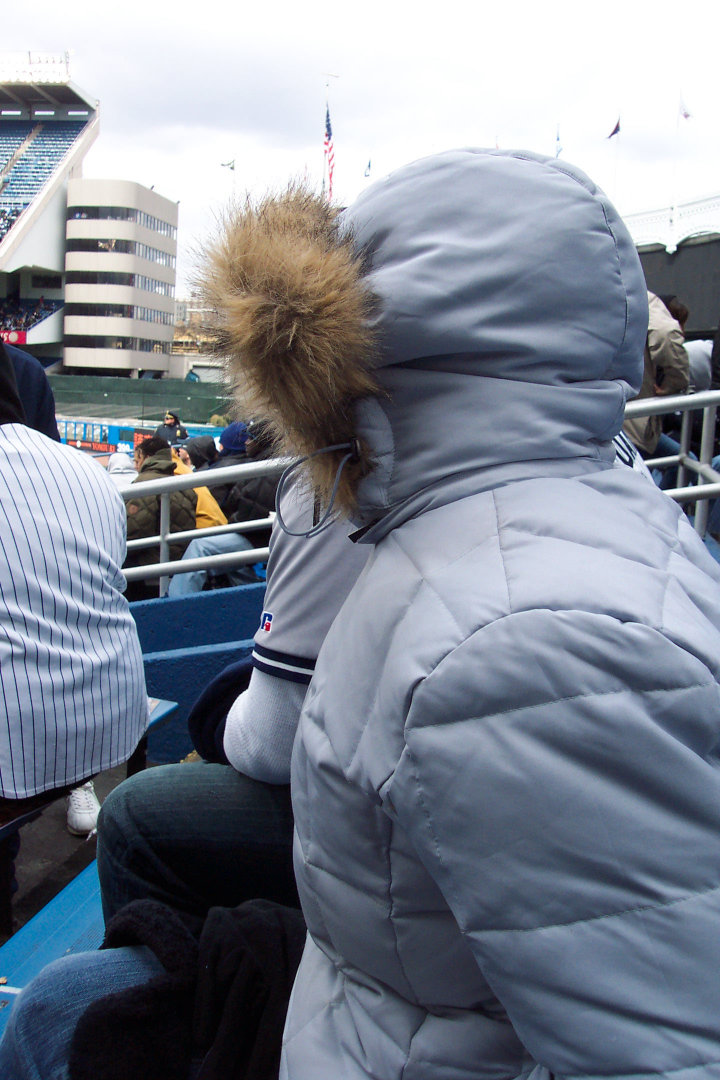
It was freaking cold in the Bronx on Sunday. The box score says it was 41 degrees, but it was overcast with a 20-mile-per-hour wind and snow flurries filled Yankee Stadium off and on throughout the game. Undeterred, Becky and I had the perfect plan.

A hearty meal at the Court Deli:

And lots and lots of layers:

To be perfectly honest, our plan worked about as well as the Yankees’, which was based around getting a solid outing from Darrell Rasner. Rasner looked sharp in the first, and the Yankees jumped out to a 3-0 lead when Melky Cabrera and Derek Jeter singled, Bobby Abreu plated Melky with a sac fly and Alex Rodriguez launched his first pitch to the Armitron sign in right field to give him two home runs and six RBIs on his last two swings.

Already freezing, Becky turned to me and said, "So that’s it, right? They won and we can go home?" If only.

(more…)

Momentum

Is only as good as the next day’s starting pitcher. Fortunately, Darrell Rasner has a very real chance to turn in the best start by a Yankee thus far this season. Of course, everything’s relative.

After four games:

Yankee offense: 7.25 R/G

Yankee bullpen: 1.44 ERA, 0.86 WHIP, 18 2/3 IP

Yankee rotation: 9.87 ERA, 2.25 WHIP, 17 1/3 IP

Eric Bedard was lit up by the Twins in his first start (6 ER, 10 H, 4 2/3 IP). Here’s hoping the Yankee offense, which will get Damon back today, but has lost Matsui to a hamstring injury until Friday at the earliest and will likely be without Jorge Posada, who hasn’t had a day off yet this season and played a day game after a night game yesterday, can keep on keeping on.

One Man Wrecking Crew: Rodriguez has First and Last Word

It was another sluggish day for the Yankees’ starting pitching and their fielding. Hideki Matsui left the game with a tight hamstring (early reports indicate that he’ll be okay). Kei Igawa became the first Yankee starter this season to make it through the fifth inning. Unfortunately, he didn’t make it to the sixth, allowing seven runs, all of them earned, off of eight hits and three walks. A forgettable debut, indeed.

Alex Rodriguez’s two-run dinger in the first got the Yankees on the board; he doubled in the fourth and scored on Jorge Posada’s RBI single (one of those line drives to right at the Stadium that narrowly missed being a homer), then walked and scored on Jason Giambi’s three-run bomb in the eighth. But would any of that matter to the uncompromisingly tough New York fans if Rodriguez failed in the ninth? Trailing by just one run, Rodriguez came to the plate with two men out and the bases juiced. He took a ball from Chris Ray and then swung through two fastballs.

Emily and I always hold our breath when Rodriguez comes up late in the game in big spots. I don’t know if there is any Yankee player since Reggie that I root for in exactly the same way. I feel like I’m a kid again as far as he’s concerned. My heart pumps faster when he’s up, and I’m almost physically pained when he fails. I guess I respond to Rodriguez’s neediness. As with Reggie, I feel like he really needs me.

I sat on the floor and prayed with Emily. “Just get a single, bro, nice and easy.” Instead, Rodriguez launched Ray’s 1-2 pitch into the black seats in center field for a grand slam home run. Sweet Georgia Brown. Final Score: Yanks 10, O’s 7. I jumped up and down and yelled and hugged Emily, who will officially be my wife in less than two weeks. Rodriguez had a huge smile on his face as he circled the bases. His teammates mobbed him and when they all returned to the dugout, Derek Jeter pushed Rodriguez back-up the steps for a curtain call.

According to our pal, Pete:

Alex Rodriguez is one of three players in history with three walk-off slams. The others are Vern Stephens of the old St. Louis Browns and Cy Williams of Philadelphia. Nobody has done it since 1950.

There was more general lousiness from the Yanks today, but Rodriguez was the star, from soup-to-nuts (Em says tomorrow’s headlines should be directed at Rodriguez’s detractors: “F*** All of You,” or “Shut Your Pie-Hole”). And that, my friends, is a beautiful thing.

Looking For Signs of Life

It is an overcast, brisk spring day in New York. The sun is trying to peak out. Kei Igawa is on the hill for the Yanks this afternoon. Time for the bats to bomb away.

feed Share on Facebook Share on Twitter Share via email
"This ain't football. We do this every day."
--Earl Weaver