"A New York Treasure" --Village Voice

Joe Torre:Tie Games On The Road::Superman:_______

a) Speeding Bullets
b) Locomotives
c) Tall Buildings
d) Kryptonite

Last night was a cold, wind-whipped night in Boston that would end bitter for Yankee fans for reasons other than the cold. Tim Wakefield started things off by setting the Yankees down in order in the top of the first, thanks in part to that wind which kept a Jason Giambi bomb from reaching the centerfield corner of the Red Sox bullpen, just as it would stop several shots off the Red Sox’s bats short of the Green Monster throughout the game. That same wind would later cause Derek Jeter to do something he rarely does, look absolutely foolish on a pop up in the seventh inning, though the botched play wouldn’t hurt the Yankees.

Chien-Ming Wang followed in the bottom of the first by walking Kevin Youkilis on four pitches. Youkilis then moved to second on a Mark Loretta groundout and was singled home by David Ortiz, who served a low outside pitch through the shortstop hole vacated by the shift. Wang then walked Manny Ramirez and Trot Nixon to load the bases for Mike Lowell, but got Lowell to ground into a fielder’s choice in which Miguel Cairo, starting at first base because of a solid history against Wakefield, threw home to force out Ortiz. With the bases still loaded and two outs, Wily Mo Pena got ahead of Wang 3-1 and drove a ball to shallow right but Bubba Crosby, starting for the injured Gary Sheffield, made what for the next six innings would look like a game-saving catch to end the inning.

Wang worked a quick, clean 1-2-3 second, but got into trouble again in the third when a one-out walk to Ortiz was followed by a Manny Ramirez single. Trot Nixon followed Ramirez with a hot shot just to the right of second base, but Robinson Cano made a running stab on the ball and flipped it over his shoulder to Derek Jeter, who turned a double play to end the inning. It was the start of a terrific night for Cano, who went 2 for 3 against Wakefield and made another great play up the middle in the seventh to stab a Mark Loretta line-drive (which essentially evened out with Jeter’s botched pop up later that inning).

Having dodged that bullet, the Yankees fired one of their own, following a Derek Jeter lead-off walk in the fourth with walks by Jason Giambi and Alex Rodriguez. A Matsui groundout tied the game and, after a second groundout by Jorge Posada, Robinson Cano singled up the middle to plate the two walks and give the Yankees a 3-1 lead.

Wang followed that with a seven-pitch 1-2-3 fourth, but once again got into trouble when the top of the order came back around in the fifth. The trouble started when ninth-place hitter Alex Cora beat out a well-placed bunt to the third base side. Youkilis followed with a single to push Cora to second, but an attempted sacrifice by Loretta backfired when Wang forced Cora at third. David Ortiz followed with another single to left, loading the bases. Manny Ramirez followed with a broken bat single that looped just over Miguel Cairo’s leap to plate Youkilis, and a Nixon groundout tied the game.

All of those small nicks in the fifth required just 14 pitches, leaving Wang at 77 at the end of five, but Joe Torre decided to start the sixth with Aaron Small, who had just been activated from the DL earlier in the day. Small, a pitcher who had yet to throw a major league pitch this season and was quite obviously performing over his head during his stint with the club last year, was a dubious choice at best, but made Torre look smart by pitching a scoreless sixth and getting Pena to fly out with the bases loaded and two outs in the seventh to maintain the tie.

Then it all went wrong. After the Yankees failed to do any damage against Mike Timlin in the top of the eighth, Joe Torre once again fell victim to Jeff Weaver Syndrome. Tell me if this sounds familiar:

We’ve seen this before, most famously in Game 4 of the 2003 World Series. On the road in a tie game, when the time comes to use Rivera, Torre thinks to himself, “I have no idea how long this is going to go. I’m not going to burn Mo here. I’m going to save him to get those last three outs once we get a lead. In the meantime, I’ll use my long man because he can pitch all night while we wait for the offense to score.” Usually that long man only gets an inning or two of work in because, with no room for error in a game that will end the second the home team scores, that’s exactly what happens. The home team scores off the sixth best man in the pen and the game ends without Rivera throwing a pitch. We saw it with Jeff Weaver in the 2003 Series and we saw it again last night.

The situation was a tad different last night in that Small, quite literally the last man in the pen by virtue of his being activated that afternoon, was already in the game and the eighth inning was not yet a sudden death situation, but results were the same. Torre stuck with Small to start the eighth rather than turning to Rivera or Kyle Farnsworth. Small started okay by getting even newer arrival Doug Mirabelli to ground out to start the inning, but followed that by walking Alex Cora on four pitches. Cora was Small’s third walk in six batters, but perhaps consumed by his desire to avoid making a pitching change prior to bringing in Mike Myers to pitch to third-place hitter David Ortiz, Torre left Small in to pitch to lead-off man Kevin Youkilis. Small’s first pitch hit Youkilis in the elbow, pushing the go-ahead run to second and forcing Torre to make a change.

So who did he bring in? Not Rivera. Not even Farnsworth. No, he brought in Tanyon Sturtze, who has the worst ERA of any man in his pen. Sturtze gave up a bouncing-ball single to Mark Loretta that went right through his legs to plate the go-ahead run. Torre then went to Myers as planned, only to have Myers fall behind Ortiz 2-0 and 3-1 before running the count full. Hoping to avoid walking his only batter, Myers then left a fastball over the plate, which Big Papi launched into the Red Sox bullpen for a three-run home run which landed poetically in the glove of Boston closer Jonathan Papelbon, who was warming for the ninth. Papelbon, who has yet to give up a run this year, set the Yankees down in order in the ninth, and that was that. 7-3 Red Sox.

I can’t blame Torre for using Myers the way he did, and I credit him for Small’s unexpectedly strong performance (though things did get rocky for him in his second inning of work and he did wind up with the loss) as well as with starting Crosby over Bernie in right and Cairo over Giambi at first, as both saved key runs with their defense, but once Torre got to the eighth inning with the game still tied, there was no excuse for not going to his big guns. True, both Farnsworth and Rivera had thrown more than an inning on Sunday, but neither pitched in either of the two games before that, and Rivera needed just 12 pitches to get through his 1 1/3 innings on Sunday. Once that go-ahead run got into scoring position it officially became Rivera time. Because Torre failed to recognize that, his team lost a full game in the standings, a full game that will count just as much on October 1 as it does this morning.

A: d)

Boston Red Sox

Since the 2002 season, the Yankees and Red Sox have played a whopping 90 times (postseason included) and have split those 90 games right down the middle, 45-45, with each team winning a seven-game ALCS. That’s scary, especially when one considers the fact that there are just five Red Sox left from the 2002 team (Manny, Tek, Trot, tonight’s starter Tim Wakefield, and his newly reaquired personal catcher Doug Mirabelli) and just six Yankees (the fab four of Jeter, Jorge, Bernie and Mo, Mussina and Giambi). Despite all that turnover these two teams remain deadlocked, which suggests that it’s not just the men on the field who are of equal ability, but the men who run the team as well. Indeed, 2002 was John Henry’s first full season as Red Sox owner and, after his team went 9-10 against the Yankees that year, he hired Bill James, Theo Epstein et al. the following winter.

Red Sox fans might argue that Epstein and company are smarter than their Yankee counterparts but their intellectual advantage is negated by the fact that the Yankees spend more money, but I don’t buy it. John Henry is wealthier than George Steinbrenner. If he wanted to outspend George, he could. His decision not to is part of how he runs his business, just as hiring Epstein and James was. Yankee fans might counter by saying that Brian Cashman’s hands were tied by George and the Tampa contingent until this past winter, and that going forward, the Yankees just might have the advantage. That doesn’t quite work either. Equally disruptive office politics pushed Epstein out for part of this past winter, and he didn’t join the team until November 2002.

Anyone looking for a reason that this rivalry has climbed to a, pardon the phrase, fever pitch over the past four seasons need look no further than the fact that this tie simply refuses to be broken. It’s fitting, then, that the Yankees and Red Sox enter this quickie two-game series in Fenway tied for first place (the Yankees lead by percentage points and one game in the loss-column due to having played two fewer games) and very easily could emerge in the same position.

I, for one, find it exhausting, and not always in a good way. That said, I think the high rate of turnover has helped. I doubt there would have been 22 James Bond films if Dr. No was the baddie in every one of them. Variety is the spice of life and the Red Sox have did a lot to spice up this rivalry over the winter, turning over a full half of their roster. Out go old warhorses Kevin Millar, Bill Mueller, Bronson Arroyo and a couple of current Yankees (Johnny Damon and Mike Myers). Ended are failed experiments Edgar Renteria, Wade Miller and Matt Mantei. Gone are roster-fillers Tony Graffanino, Gabe Kapler, John Olerud, Chad Bradford, John Halama and Jeremi Gonzalez. In come ex-Marlins Josh Beckett, Mike Lowell and Alex Gonzalez. Given are expanded rolls to Kevin Youkilis, Jonathan Papelbon, and Lenny DiNardo. Filling things out are Coco Crisp (currently on the DL in favor of Willie Harris), Wily Mo Pena, J.T. Snow, Dustin Mohr, El Loco Julian Tavarez, Rudy Seanez and David Riske (also on the DL in favor of rookie Manny Delcarmen) and you’ve got a whole new ballclub, and that doesn’t even count the rejuvinated Curt Schilling or the at least healthy again Keith Foulke.

Exactly what the result of all of this turnover will be for the Red Sox is hard to say at the moment. Their offense is scuffling (ninth in the AL in runs scored, 17th in the majors), but Crisp has been on the DL with a broken finger for most of the season and Manny got off to a slow start. That said, Varitek and Loretta have yet to hit and there’s reason to believe they might not come around.

The pitching, meanwhile, has been no better (in fact it also ranks about mid-pack both in the league and the majors). In the bullpen, Papelbon has been nearly perfect as the closer (he has yet to give up a run), but Foulke and Timlin have been just good enough (Timlin’s excellent ERA masks poor peripherals) and the imports have all been disappointing thus far. In the rotation, Matt Clement and DiNardo (filling in for the injured David Wells) have been terrible. Josh Beckett, has been no better than average. If not for the strong return of Schilling, this team would be in a very bad way on the hill.

Which brings us to tonight’s starter, Tim Wakefield. Take out an ugly first start against the Rangers in Texas and Wakefield has a 2.20 ERA over his past four starts. The only problem has been that the Red Sox have scored a total of two runs in the last three. As the dean of the Red Sox, Wakefield has quite a bit of history with several of the Yankee hitters and has been successful against just about all of them, Matsui (who’s in one of his annual lunging-at-the-ball slumps) and Giambi especially. Wakefield went 1-4 against the Yanks last year, but still held them to a .184 average. With Sheffield likely out of the line-up due to swelling in his wrist after his collision with Shea Hillenbrand on Saturday, the Yanks might be hard pressed to get much going against Wake tonight.

Chien-Ming Wang, meanwhile, will be making just his second career start against the Red Sox, having lost a well-pitched game to start the season’s final series last year when his defense and then his control abandoned him. One wonders if Wang’s control problems in that game were related to the problems pitching from the stretch that he demonstrated against the Orioles in his penultimate start. The Yankees have been working on that since and Wang looked in control in his last start, echoing his pre-Orioles outing by allowing just two runs in seven innings. Could be Chien-Ming is rounding into shape this season. Let’s just hope the hard Fenway infield doesn’t give his opponents the extra bounces they need to win.

(more…)

To Boo or Not to Boo?

Steve Silva, who runs the provocative “Boston Dirt Dogs” site, is calling for Red Sox fans to cheer for Johnny Damon tonight at Fenway Park. There are a lot of yahoos at Fenway Park (just as you’ll find, oh maybe, perhaps one or twelve hundred knuckleheads in the Bronx). At the same time, there are also a lot of appreciative, knowledgeable fans up there too (after all, Boston fans have given Joe DiMaggio and Joe Torre ovations in the past). I expect Damon to hear some cheers to being with and figure he’ll be booed soundly after that.

Sunny Sunday Delight

A fine pitcher’s duel, and crisp 4-1 victory for the Yankees yesterday at the Stadium was marred only by some inept umpiring from the man behind the mask, Andy Dowdy. Dowdy is a minor league ump who has been called on to work big league games as an alternate since 2002. On Sunday, before a packed house in the Bronx, he looked overmatched. Dowdy’s strike zone was all over the place by the fifth inning, and his shoddy work provoked each manager to get tossed–both arguing balls and strikes.

Mike Mussina believed he got jobbed on three pitches during the top of the frame–which ended with him striking Shea Hillenbrand out on a full-count pitch with the bases loaded. Mussina got Hillenbrand to chase a change-up that was up in the zone. As Hillenbrand slammed his bat to the ground in frustration, Mussina barked at Dowdy. By the time the game came back from commerical, Joe Torre was gone. According to the Daily News:

“I came (into his office) between (half) innings and watched the pitches that were in question (on TV). And I just went out there and expressed my disapproval,” Torre said. “I just told him from the top step of the dugout, or I asked him about one particular pitch and he thought it was high, and I didn’t think it was high.”

The Yankee manager’s heated discussion went into Gustavo Chacin’s warmups. Torre said the finale of the argument was when he held up three fingers at Dowdy as the team came off the field.

“He asked me what that meant. And I said I thought you missed three pitches,” Torre said. “And he threw me out.”

Andy Phillips knocked a solo home run to right field in the bottom of the inning, tying the game at 1. Gustavo Chacin had been pitching well, but he too was effected by Dowdy’s strike zone, and with two outs, the bases were loaded for the struggling Alex Rodriguez. The 2-2 pitch, was down and in and looked like strike three. The next pitch was almost in the same spot, but no strike three. Instead, Rodriguez drew a bases loaded walk, putting the Bombers ahead for good. Chacin, notable for being a young pitcher with poise, yelled out loud as he walked back to the dugout. Cue Toronto skipper John Gibbons: He puts in his two cents and get tossed.

Kyle Farnsworth replaced Mussina in the seventh and was impressive. He left a fastball down to Alex Rios who stroked a single to left. Rios then stole second but was called out. The Yankees have been on the wrong side of a slew of calls so far this season, but they got one back there–Rios was clearly safe. After falling behind Frank Catalanotto, Farnsworth blew two fastballs–right over the plate–past the Yankee killer. Catalanotto didn’t stand a chance. Farnsworth came back with two nasty sliders to whiff Vernon Wells.

Jason Giambi, the Yankees’ best offensive player for the first month of the season, smacked a two-run home run (on a full-count pitch from Pete Walker) off the facade in right field to pad the lead. Farnsworth caught Troy Glaus looking on strikes to start the eighth and then got Shea Hillenbrand to pop out after giving up a one-out double to left by Lyle Overbay (Farnsworth was hitting 100 mph on the radar gun, according to YES, he just left a fastball down in the zone to Overbay). Mariano Rivera came on and retired the last four Toronto hitters on a weak pop out and three ground balls.

It was a rewarding victory, and a particularly good way to head up to Boston. Right. In case you hadn’t heard, the Yankees and Red Sox are meeting for the first time this year for one of those strange little two-games series. There will be plenty of hoopla over Johnny Damon’s return to Fenway, but Yankee fans are more probably more preoccupied with the health of Gary Sheffield. Josh Beckett goes for the Sox tomorrow night and perhaps the Yanks will get to see Boston’s icy young closer, Paplebon too. Should be tense and nervous and excitable, as it normally is when these two teams meet.

Soporific Saturday Slaughter

A beautiful day did not make for a beautiful game. Actually, Saturday’s ballgame was often tedious, though there was some upper deck excitement provided by Johnny “Double Dutch” Damon, Jason Giambi and Jorge Posada. The slumping Alex Rodriguez made a great backhanded catch (it’s funny, Rodriguez is clearly in a funk at the plate and yet his numbers are still respectable–he was 0-4 yesterday but scored three runs and had an RBI) as the offense crushed Toronto pitching.

Final score: Yanks 17, Jays 6.

The most alarming moment of the game came when Gary Sheffield collided with first baseman Shea Hillenbrand. Both went down hard, with Sheff staying down longer. At first I thought, “Oh, God, his right shoulder.” But according to the early reports, Sheff has a bruised right knee and banged up both of his wrists. It was a scary moment though. Oh yeah, and Randy Johnson got beat about the face and neck again by the Jays. This time, he was bailed out, but it was another underwhelming outing for the Big Unit against Toronto.

Otherwise, the game was a snoozer, perfect time for Yankee fans to take a mid-afternoon nap without fear of waking up suddenly in a panic. The Blue Jays could simply not throw strikes, almost every count went deep and the Bombers scored runs in all eight innings they came to bat, only the second time in team history that they’ve accomplished that feat (the first was back in 1939).

They played deep enough into the afternoon for the shadows to become a factor in the last couple of innings. The intense spring light against the grass is just different enough from the more mellow, autumn light–and the shadows they create–to really give you a sense of time and place.

Mr. Chacin goes against Mr. Moose this afternoon, another drop-dead gorgeous day here in the Bronx. Our man, Cliff Cocoran will be on hand, drinking it all in.

Go get ’em Moose.

Beautifical Day for Ball in the Bronx (ain’t it?)

It is a sterling spring day here in New York as Randy Johnson goes against the Blue Jays this afternoon. Really, not a cloud in the sky, sunny, but breezy, in the low sixties. It’ll be chilly later on. Of course, the Big Unit was served by the Blue Jays last week in Toronto. They just pounded him. Let’s see what he has for them this time around. The Yankee offense has sputtered for the past three games. How much longer can that happen?

Let’s Go Yan-Kees.

Howe Come (Bernie)?

The news of Steve Howe’s unpleasant death hovered over Friday night’s game, didn’t it? Michael Kay didn’t exactly go out of his way to say anything flattering about Howe, who was probably a real hard-on to a guy like Kay in the clubhouse. Or any repoter, for that matter. Joel Sherman was on Channel Nine later on and he too painted Howe as this hyper-active, amped-up nut. I’m sure this is was true–that Howe was what the Brits call the “c” word to the writers. But he was evidentally appreciated by some of his teammates, including none other than Gentle Ben, Bernie Williams. According to Filip Bondy in the Daily News:

He didn’t always tell people the truth, and that probably included himself. But Howe made memories in New York, was a real character with real character flaws. Bernie Williams talked yesterday about exactly that – how Howe was wacky in the clubhouse, dead serious on the mound.

“He’d do anything for his teammates,” Williams said. “He tried to keep us loose in the clubhouse. He was a prankster. He took me under his wing.”

It is hard to imagine how a wild personality like Howe would be something of a mentor for a steady, straight-arrow star like Williams. But Howe was like that. He could be extremely helpful, amiable. He also just happened to be in trouble, almost all the time.

Great to hear that Howe played the mentor to Bernie. That is a great pairing to imagine, right? I never really disliked Howe, who was an effective part of those Buck Showalter-Stick Michael rebuilding teams. Talk about a presence. Howe came across like one of those nutzo spaz performances by James Woods, or the guy Mel Gibson played in “Lethal Weapon.” But had more of a Jim Bouton-square face. He was uncomfortably wound-up. All sweaty and on-the-edge, ready to burst. I don’t think he was altogether unappealing, but man was he volatile. If he didn’t like you it must have been brutal. It’s nice to know he had an warm side. Howe is possibly hilarious from a distance, but if you found Howe amusing at all, it is because you enjoy laughing nervously. Or if you liked Howe it is also because you probably just sympathized with his kind of schlimazzel. But as troubled as he was, he left Yankee fans with compelling memories, on and off the field. It’s too bad that his story ended sadly, but it sure doesn’t come as a surprise.

(more…)

Mismatch

On paper, last night’s Roy Halladay-Jaret Wright matchup screamed landslide victory for the Blue Jays. As it turns out, the Jays won 7-2, but the game was far closer than that score indicates.

Jaret Wright allowed a two-run home run to Frank Catalanotto before getting an out in the first, but then held the Jays scoreless through five innings, thanks in part to four double plays turned by the Yankee defense. Not that he pitched all that well. He walked four and struck out none, throwing just 52 percent of his pitches for strikes. Wright left in the sixth with two men on and none out. Scott Proctor came on and got away with a hanging curve to Troy Glaus only to have another to Shea Hillenbrand leave the park to make it 5-0. Much like Wright, Proctor settled down from there to pitch two more scoreless frames, though through more of his own doing, striking out two, walking none, and throwing 69 percent of his pitches for strikes. The Hillenbrand homer was the only hit Proctor allowed in three full innings of work.

Roy Halladay, meanwhile, kept the Yankees off the board entirely through five and a third, despite throwing just 55 percent of 99 pitches for strikes. Scott Schoeneweis came on to face lefties Giambi and Matsui, but walked Matsui and then surrendered Bernie Williams first home run since August 26 of last year (184 plate appearances ago). The home run was just Bernie’s second extra base hit since September 7 of last year (151 PAs ago). Williams’ next at-bat came with two outs in the eighth with the Yanks down 5-3 and runners on the corners and ended in a 5-4-3 double play that was aided by first base umpire Bruce Dreckman, who called Bernie out despite the fact that he was clearly safe.

Joe Torre then handed the ball to Tanyon Sturtze, who, after getting Lyle Overbay to ground out, gave up another Hillenbrand homer, a Bengie Molina single, an Alexis Rios double (oddly the red hot Rios did not start the game), and a sac fly by Aaron Hill that put the game out of reach.

Today, the script is flipped as Randy Johnson, who has been outstanding in four of his five starts (the one exception being a very off night in Toronto last week), takes on Josh Towers, who is 0-4 with an 8.35 ERA after four starts. Here’s hoping the results are similarly reversed.

Blue Jays Vol. II

Tonight, the Yankees open a three-game weekend series with the Blue Jays in the Bronx. These two teams last met in Toronto just over a week ago, splitting a two-game “series” due to radically disperate performances by Randy Johnson and Mike Mussina. Not much has changed about this Blue Jay team in the interim. The only change to their roster is that A.J. Burnett (hereafter known as the Canadian Pavano) is back on the DL and has been replaced in the rotation by hot prospect Casey Janssen, who was drafted out of UCLA in 2004. Burnett did not pitch against the Yankees last week and Janssen will not pitch in this weekend’s series, so for all the Yankees will know, this team is unaltered.

They have shuffled the line-up however, primarily because of Alexis Rios, who at 25 appears to finally be living up to his early hype. Rios was rushed to the majors at age 23 after just 185 unimpressive triple-A at-bats and has struggled mightily the past two seasons to the point that he was supposed to platoon in right field this year with twice displaced former Rookie of the Year Eric Hinske. Poor Eric.

What’s been most startling about Rios thus far is his power. Rios had just 31 professional homers coming into this season and no more than 11 in any single season at any level, or combination of levels. Thus far, in 18 games he’s homered six times and is hitting .368/.375/.772. Certainly he’s not that good, but a month into the season, he doesn’t appear to be cooling off very much, having gone 3 for 4 with a homer against the Orioles on Wednesday. Last week in two games against the Yankees, Rios went 3 for 7 with a homer, two doubles, four RBIs and two runs scored (doing most of that damage against Randy Johnson whom he’s now 6 for 11 against career with three extra base hits). You just can’t keep that kind of production in the eighth spot, so Rios moves up to second in the order, pushing Frank Catalanotto (or Reed Johnson) into the lead-off spot, and dropping Russ Adams down to his vacated eighth spot. The result looks like this:

L – Frank Catalanotto (LF)
R – Alexis Rios (RF)
R – Vernon Wells (CF)
R – Troy Glaus (3B)
L – Lyle Overbay (1B)
R – Shea Hillenbrand (DH)
R – Bengie Molina (C)
L – Russ Adams (SS)
R – Aaron Hill (2B)

The man who will try to stop some version of that lineup tonight will be Jaret Wright. Wright is making just his second start of the year in addition to a lone relief appearance, both of those prior outings having ended badly. Wright claims that the long rest and excitement about finally getting on the mound caused him to overthrow against the Twins two weeks ago. We’ll see if he’s able to dial it down a bit tonight. He’ll certainly shock the pants off of everyone watching if he is. Making matters worse, his mound opponent is Blue Jay ace Roy Halladay. Halladay hasn’t been his dominant self yet this season, and was even skipped two turns ago due to stiffness in his pitching forearm, but still comes into the Bronx sporting a 3.60 ERA, which should be more than enough to outpitch Jaret Wrong.

A couple quick line-up notes: Kelly Stinnett will catch Wright tonight so that Posada can catch Johnson in tomorrow’s day game. Johnny Damon is back in the field, as is Bernie, who will play right for tonight’s DH, Gary Sheffield.

Yanks Win a Close One

Shawn Chacon and Mark Hendrickson, last night’s two junk ball starters, were both effective with plenty of the soft stuff. Joey Gathright made a sterling play in the bottom of the first inning to snatch a home run away from Gary Sheffield. However, an error later in the game by Tampa Bay’s third baseman Russell Branyan paved the way for the slumping Hideki Matsui, who came through with the winning hit for the Bombers–a seeing-eye single that was reminiscent of Luis Sojo’s ground ball in Game 5 of the 2000 World Serious. After a horribly frustrating night for the New Yorkers, the home team prevailed, 4-2. Derek Jeter had three hits himself and is now batting over .400. The bullpen performed well and this was just the kind of win the Yankees needed, wouldn’t you say?

Like Rubbah

The three-game series is baseball’s perfect package. It exposes enough of each team’s pitching to prevent any single hurler from dominating the competition, but doesn’t go on so long as to overstay is welcome. Five games may not be enough for a postseason series, but they are way too many for a regular-season confrontation, particularly when a team such as the 2006 Royals, Orioles, Mariners or Devil Rays is involved. Two games are unrewarding, over too fast and often without exposing the true nature of the teams involved. Baseball is a game for people who savor the moment and chew their food before swallowing. Until recently it wasn’t uncommon for teams to have two games scheduled on the same day. A two-game “series” is as big an affront to the game as artificial turf (which may be why the Yankees always seem to play two against Toronto). Four games are fun for marquee matchups, such as when the Red Sox come to town, but the possibility of a 2-2 series split just doesn’t belong in a game that refuses to end in a tie. Indeed, it’s the fact that a three-game series must have a winner that, above all else, makes it baseball’s ideal regular season sample size.

Tonight, the Yankees play their third rubber game of the year, having previously dropped their first in Oakland and won their second this past Sunday against the Orioles. I guess that makes it something of a rubber rubber game. At any rate, they’ll be digging in against lefty Mark Hendrickson, who needed just 106 pitches to hurl a three-hit, one-walk shutout against the O’s in his first start, but has been on the DL with tendonitis in his pitching shoulder ever since.

Last year, Hendrickson made a whopping five starts against the Yankees, posting an ERA more than a full run better than his overall mark. As one might expect from a 6’9″ lefty, Hendrickson is murder on fellow southpaws (career .225 GPA), but he’s rather useless against right-handed hitters, who hit him to the tune of .312/.356/.504. Taking a closer look at his five starts against the Yanks last year, he gave up at least four runs in four of them, but only once gave up as many as five. He also lasted a minimum 6 2/3 innings in four of those starts, pitching a full five in the one exception. That surprisingly consistent, and suggests that, if Hendrickson is fully healthy and on his game coming off the DL, Shawn Chacon will have to do his part tonight.

Chacon, meanwhile, is coming off a tremendously lucky outing against the Orioles in which he held the O’s to one run over seven innings due almost entirely to a .182 opponent’s average on balls in play. Prior to that, Chacon had racked up a representative 8.03 ERA across two disappointing starts and a pair of ugly relief outings. Here’s hoping he gets a few lucky bounces tonight.

Dervish

Speaking of Roger Angell, after going to hear David Maraniss talk about his new book on Roberto Clemente last night, I was reminded of Angell’s description of Clemente in the 1971 World Serious. Maraniss spoke about Clemente’s game going deeper than what the numbers can tell us, and I don’t think he meant it as a cop-out. It was meant it as a way of describing somebody whose very body language was memorable–all of a piece. “Sensations” was the term Maraniss used and Clemente certainly made the country take notice with his performance–on the bases, in the field and at the plate–in that Serious (by the way, for what it is worth, Maraniss believes that Clemente would have been a fine player today, and he compared him to two other athletes of that era whose games suggested something timeless–Gayle Sayers and Earl Monroe).

Before Game 7, Clemente told Angell, “I want everybody in the world to know that this is the way I play all the time. All season, every season. I gave everything I had to this game.” The final game hadn’t begun yet, when Angell, summing-up the first six games, wrote:

And then too, there was the shared experience, already permanently fixed in memory, of Roberto Clemente playing a kind of baseball that none of us had ever seen before–throwing and running and hitting at something close to the level of perfection, playing to win but also playing the game as if it were a form of punishment for everyone else on the field.

Now, that’s a sensation.

Oy

Talk about a night to forget in the Bronx. The Devil Rays set a dubious team record issuing fourteen walks, but the Yankees only managed to score two lousy runs (how’s the old blood pressure, Yankee fans?). The Bombers stranded sixteen men on base. The two teams combined for nine stolen bases, but poor base running cost New York. In the end, the Rays rallied against Mariano Rivera in the tenth and won the game, 4-2. Gary Sheffield grounded out with the bases loaded to end the game.

Sam Borden reports in the Daily News:

Despite the unsightly performance, Joe Torre wasn’t angry. Asked to explain how a lineup of All-Stars could miss on so many chances to break out against a mediocre pitching staff, the manager simply nodded to the baseball gods.

“There is just no explaining it,” he said. “The quality of the at-bats was there. Nobody gave anything away. You scratch your head sometimes over how things happen but you know there’s nothing you can do. I can’t find fault with anything but the result.”

As Roger Angell once wrote–trying to describe how the Orioles swept the once mighty Dodgers in the 1966 Fall Classic–“the only explanation must be that baseball is still the most difficult, and thus the most unpredictable and interesting, of all professional sports.” Look for the Bombers’ bats to bounce back tonight.

Everybody Wang-McClung Tonight

Worst. Headline. Ever.

Meanwhile, duck and cover tonight folks. The one team Chien-Ming couldn’t solve last year was the D-Rays, against whom he posted a 6.94 ERA across four starts. Aside from one ugly start against the eventual NL Central Champion Cardinals that lasted a mere four innings, his work against the Rays was by far his worst aggregate performance against any single team in his rookie season. Underlining that fact, the Devil Rays were the only team other than the Cardinals to collect more than a hit per inning off of Wang. Distressingly, they were also the team he faced the most last year, as he didn’t face any other single team as many as three times. Sadly, Wang’s performance thus far this year doesn’t suggest that his fortunes are about to change, though the B-squad line-up the Rays are running out there due to injuries to Huff, Lugo, and Cantu (day-to-day with a bruised foot) could help.

All of that said, there’s something curious about Wang’s four starts thus far this season. One would expect him to do poorly on turf as the groundballs he induces are more likely to speed through the infield for hits. Indeed, it would seem that’s partially to blame for his struggles against the Rays last year (though he did just as poorly against them in the Bronx). But Wang’s one dominant outing this year came on the Metrodome turf. That start also saw his lowest single-game groundball-flyball ratio of the year (1.75 compared to a typical 3.14 in his first two starts combined and a staggering 14.00 in his most recent outing), in combination with his highest strikeout total (eight Ks versus five total in his other three outings combined). Perhaps the solution to Wang’s early-season struggles isn’t getting the ball down, but actually getting away from thinking groundball all the time and making more of an effort to go for the strikeout, even if it means going high in the zone to blow one of his mid-90s heaters past a hitter.

For his part, the hard-throwing McClung has been godawful this year save for one solid, but unimpressive outing against the Royals. The Yanks feasted on him last year and he has a 14.00 ERA in nine career innings against the Bombers, all of which suggests that Wang might have some room to experiment tonight.

Bubba Crosby gets his first start of the year tonight, batting ninth and playing center in place of DH Johnny Damon. Encouragingly, Bernie continues to ride pine. For the Rays, Crawford is expected back tonight, Cantu remains questionable, and Edwin Jackson has already been send down in favor of tomorrow’s starter Mark Hendrickson.

Slow, Slower…

Last week, Buster Olney wrote about how Mike Mussina has been making like Greg Maddux and throwing his soft stuff even slower. Today, Tom Verducci gives us more insight into why Moose has been so successful this spring:

“I threw in an intrasquad game in spring training,” Mussina said. “People were like, ‘Why are you pitching in an intrasquad game?’ Really, the only reason why I did was that you back everything up from the start of the season, counting five days between starts, and five days before my first spring training start happened to be a day when we had an intrasquad game.

“So I’m pitching in this intrasquad game and [Jorge] Posada is up. The count is 3 and 2 and I throw a changeup. Now for some reason, Posada is right on the pitch and he smokes it. Hits it on a line. We got him out, but I was surprised that he would be right on a 3-and-2 change.

“So after the game I asked him, ‘How could you be right on that changeup I threw you?’ He said, ‘I saw your fingers on top of the ball as it was coming out of your hand. I could tell it was a changeup.'”

What Posada saw were Mussina’s index, middle and ring fingers splayed across the top of the baseball, a grip that makes it impossible for a pitcher to throw anything but an off-speed pitch. (Only two fingers, the index and middle, top the ball for a fastball.) Posada saw the dead giveaway, kept his hands and weight back and timed the changeup perfectly.

Mussina is 37 years old and has been pitching in the major leagues since 1991. No one had ever told him what Posada told him. So Mussina decided to change his grip. He slid his index finger more to the side of the ball than the top of the ball — not quite the grip for a circle changeup, in which the thumb and index finger form a circle on the side of the ball, but a modified version of it.

The pitch worked perfectly. Not only was Mussina able to disguise the pitch, but he also was able to throw it slower and generate better downward movement on it. “It doesn’t so much run,” Mussina said, referring to the sideways motion some pitchers get from their changeup, “but it just kind of dies at the end. It tumbles under the hitter’s bat. And to think if I didn’t bother pitching in an intrasquad game, none of this would have happened.”

A few years ago, I did a pre-season Q&A with a bunch of sportswriters. One of the questions I posed was whether Mussina would finally win 20 games that season. Most thought he’d be a lock for at least 15. We’ve seen Mussina break down with injuries for the past two years, and so the old “Will he win 20?” was not exactly the first question many Yankee fans had on their mind when considering Mussina in 2006. But wouldn’t it be wunnerful if he did win 20 this year?

I know, it’s a jinx to mention it, but screw it, Mussina has enough bad luck on his own–I’m not going to be the one that puts the whammy on him. Regardless, I hope he gets at least 15 and has a terrific year. It’s been cool reading the comments section lately and seeing how many fans he has out there. Cliff and I have always been big supporters. Should be interesting to see how he fares against the Jays this weekend, as they get their second look at him. Friday night, which pits the Big Unit v. Roy Halladay could be something special too.

The Tortoise and the Hare

The biggest story of the season thus far for the Yankees has to be the resurgence of Mike Mussina, who has found the fountain of youth in the form of a 70-mile-per-hour changeup. Moose did it again last night, stymieing the Devil Ray’s B-squad for six innings, holding them to four hits in six innings while walking none and striking out seven. Only a first-inning Jonny Gomes homer (his league-leading tenth) managed to spoil Moose’s evening.

Fireballer Scott Kazmir, meanwhile, was unable to uphold his end of the bargain, walking Johnny Damon on four pitches to start the evening and then surrendering a two-run homer to Derek Jeter to hand over the lead before he had recorded a single out. By the time the first inning ended on a broken-bat grounder by Andy Phillips, who didn’t strike out once in his rematch with Kazmir, the Yanks had a 3-1 lead and were off to the races.

In the fourth, Phillips delivered a one-out opposite-field single and came around to score. In the sixth, Tampa manager Joe Maddon replaced Kazmir, who walked five and threw 101 pitches in his five innings of work, with Scott Dunn and watched as Dunn and subsequent reliever Ruddy Lugo doubled the Yankee run total to make it 8-1. In the eighth, the Yanks plated a lead-off double by Jeter–who was 3 for 5 with a double, a homer, three runs scored and three driven in on the night–to push the eventual final score to 9-1. Sturtze, Villone and Proctor mopped up for Moose, allowing just one baserunner across three innings (a single off Villone).

Other highlights included Miguel Cairo going 2 for 3 with a pair of doubles and a walk (though he did get picked off second following the first double). Not bad for his first start since April 12. Jason Giambi, meanwhile, went 2 for 3 with a double, a walk and three RBIs from the DH spot giving him a two-day DH line of 7 AB, 3 R, 5 H, 8 RBI, 2 2B, 2 HR, 1 BB, 0 K. Hmmm, maybe he can hit in that role after all.

Finally, making his fourth start in five games at first base, Andy Phillips made a pair of nice plays in the field and is starting to look more comfortable at the plate. Phillips has singling in each of the last two games, worked a full count with the bases loaded in his third at-bat last night (though that AB ended in another broken bat groundout), and drove a ball to deep center in his final trip. He’s also struck out just twice in his last 11 plate appearances. These are small signs of what I hope will be greater things to come. Hopefully Phillips will start again on Thursday against lefty Mark Hendrickson.

Tampa Bay Devil Rays

As strange as it might be to say, the Devil Rays are actually a pretty interesting team. Despite finishing in last place in 2005 for the seventh time in their eight-year history, the team’s long-rumored youth movement finally bore some fruit, enabling the Rays to assemble the league’s sixth most productive offense in the season’s second half and give the Yankees hell for most of the season. Prior to their final head-to-head series of the year, which the Yankees swept decisively, the Devil Rays were 11-5 against the eventual division champs, having scored 102 runs in those first 16 games. This winter, minority partner Stuart Sternberg bought out founding owner Vince Naimoli and overhauled the front office in the hopes of capitalizing on the team’s emerging talent before Naimoli and the administration of ousted GM Chuck LaMarr could do any more damange. Sounds crazy, but it just might work.

Last year, to established stars Aubrey Huff and Julio Lugo and the still-emerging talent of Carl Crawford, the Rays added second baseman Jorge Cantu and finally found room for slugger Jonny Gomes and speedster Joey Gathright. On the mound, Scott Kazmir spent his first full season in the bigs, and reliever Chad Orvella pitched well enough to make Danys Baez and former All-Star Lance Cater trade bait.

This year should bring further maturation from Kazmir (22) and Crawford (24), full seasons of Gomes and Gathright (both 25), and allow Cantu (24) to settle in at second base after being yanked back and forth between second and third last year. Exactly what will come of Orvella (25), who failed to make the team out of camp, or Huff (29) and Lugo (30), both of whom were shopped in the offseason due to their impending free-agency after the current season, remains to be seen. But should Huff or Lugo be moved, uberprospects B.J. Upton (21) and Delmon Young (20) should be ready to step into their shoes, though Upton’s ability to remain at shortstop remains in doubt.

Curiously, neither Huff nor Lugo will see action in the Bronx this week, as both are on the 15-day DL. In their place, the Rays will send out not Upton and Young, but Tomas Perez and Ty Wiggington. I was startled at the outpouring of emotion when Perez was released by the Phillies this spring. Apparently, Perez was considered something of an institution in Philadelphia and in the Philly clubhouse. I didn’t even realize he was still in the league. Turns out Perez was the Phillies jack of all trades and resident prankster for the past six seasons, though he appeared to have sustained that position on the basis of hitting .304/.347/.437 in 135 at-bats in his second year with the club. Since then he’s hit just .245/.300/.372. Good news for the Yanks there. Wigginton, meanwhile, couldn’t stick with the Pirates last year after coming over in the Kris Benson trade the year before, but, starting at the hot corner for the injured Huff, has been crushing the ball to the tune of .284/.333/.687, with eight homers in 17 games.

Thus far this season, the Devil Rays offense has been Wigginton and Gomes (.302/.444/.746) with a helping of Cantu. Wigginton is clearly playing over his head, but Alex’s boy Gomes just might be this good. Okay maybe not, that good, but his .282/.372/.534 performance last year seems utterly legit. If nothing else, his performance should teach the Yankees and their fans a lesson about judging my man Andy Phillips on 40-odd scattered at-bats. Over 30 plate appearances in 2003 and 2004 Gomes hit just .103/.161/.138 (3 for 29 with a double and one walk), but when finally given regular playing time last year he posted that .282/.273/.534 line. It’s not a perfect comparison as Gomes is three and a half years younger than Phillips. Then again, Gomes, despite having success in triple-A, didn’t demolish the International League the way Phillips has the last two years.

Of course, all of this swing don’t mean a thing if the Rays don’t get their pitching in order. Speedster Kazmir, who will start tonight against slowpoke Mike Mussina in what I hope will be a stirring pitcher’s duel, looks to be rounding into form, but even with his success, the Rays are only separated from the worst ERA in baseball by the existence of the Kansas City Royals. Last year the Yankees put up thirteen runs on the D-Rays in a single inning twice, and finished the year having put up exactly ten times that against them in 19 games.

There are glimmers of progress. It appears the Rays would be willing to cut bait on Doug Waechter and push hard-throwing Seth McClung into the bullpen should failed Dodger prospect Edwin Jackson (the take for Baez and Carter) and the home grown Jason Hammel take root, but that’s hardly as promising as having Upton and Young on deck, particularly given that duo’s three starts thus far this year. In the meantime, it’ll be more Mark Hendrickson for your money. Indeed, Hendrickson will come off the DL to start Thursday night, which means that Jackson, who will be sent down to make room before Thursday’s game, and Waechter, who is getting skipped due to yesterday’s off-day, will be available out of the pen should the Rays need nine unexceptional relievers to keep the Bombers at bay rather than the seven they normally employ.

Enjoy tonight’s duel. It could get ugly from here.

(more…)

Boricua, Baby

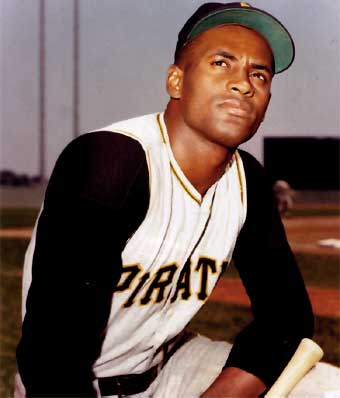
“Clemente,” the new book by pulitizer prize-winning author, David Maraniss, hits the shelves today. It is a fine appreciation of Roberto Clemente, who is undoubtedly one of the most charasmatic players of the post-War era. Although Clemente was a key member of two World Championship teams, he played in relative obscurity in Pittsburgh during the 1950s and ’60s, and was overlooked for his much of his career. Until, of course, his monumental performance in the 1971 Serious, and his untimely death in December of 1972. His legend and reputation have grown ever since.

As my pal Steve Treder put it to me in an e-mail recently:

Clemente was actually slightly underrated until the late ’60s, and especially during the 1971 World Series when he suddenly got noticed by the national media. At that point they all suddenly seemed to think he was better than he actually was, after years of being overlooked. His early tragic death soon afterward froze his image in time. Had he lived, and had a few years of decline phase at the end of his career, his reputation probably would have balanced out about right. As it is, many casual fans seem to think he was the equal of Mays/Aaron/Robinson/Mantle, when in fact he wasn’t nearly as good as any of them.

It is no insult to say that Clemente wasn’t as great as Mays, Aaron, Robinson or Mantle. They are all legends. Fortunately for Maraniss, off-the-field, Clemente was more interesting than most. And between the lines, Maraniss points out, Clemente had a terrific, inimitable style.

There was something about Clemente that surpassed statistics, then and always. Some baseball mavens love the sport precisely because of its numbers. They can take the mathematics of a box score and of a year’s worth of statistics and calculate the case for players they consider underrated or overrated and declare who has the most real value to a team. To some skilled practitioners of this science, Clemente comes out very good but not the greatest; he walks too seldom, has too few home runs, steals too few bases. Their perspective is legitimate, but to people who appreciate Clemente this is like chemists trying to explain Van Gogh by analyzing the ingredients of his paint. Clemente was art, not science. Every time he strolled slowly to the batter’s box or trotted out to right field, he seized the scene like a great actor. It was hard to take one’s eyes off him, because he could do anything on a baseball field and carried himself with such nobility. “The rest of us were just players,” Steve Blass would say. “Clemente was a prince.”

Thanks to Mr. Maraniss and the good people at Simon and Schuster, here is an excerpt from “Clemente.” This section is less about Clemente specifically and more about the conditions that Black and latin players encountered in the early 1960s. But it establishes the backdrop that is essential to understanding Clemente’s story. Enjoy!

BOOK EXCERPT: From “Clemente”

By David Maraniss

“Pride and Prejudice”

[Clemente] arrived at Pirates camp to train for the 1961 season on March 2, a day late. He and Tite Arroyo had been delayed entry from Puerto Rico to Florida until tests came back proving they did not have the bubonic plague, a few cases of which had broken out in Venezuela during the tournament.

On the day he reached Fort Myers, free from the plague, a story ran on the front page of the New York Times under the headline: NEGROES SAY CONDITIONS IN U.S. EXPLAIN NATIONALIST’S MILITANCY. One of the key figures quoted in the story was Malcolm X, the Black Muslim leader, who in the Times account was referred to as Minister Malcolm. Interviewed at a Muslim-run restaurant on Lenox Avenue in Harlem, Malcolm X said the only answer to America’s racial dilemma was for blacks to segregate themselves, by their own choice, with their own land and financial reparations due them from centuries of slavery. He dismissed the tactics of the civil rights movement as humiliating, especially the lunch-counter sit-ins that were taking place throughout the South. “To beg a white man to let you into his restaurant feeds his ego,” Minister Malcolm told the newspaper.

This was fourteen years after Jackie Robinson broke the major league color line, seven years after the U.S. Supreme Court struck down the separate-but-equal doctrine of segregated schools, five years after Rosa Parks and Martin Luther King Jr. led the bus boycott in Montgomery, four years after the Little Rock Nine desegregated Central High School in the capital of Arkansas, one year after the first lunch-counter sit-in in Greensboro. Year by year, the issue of race was becoming more urgent. The momentum was on the side of change, but the questions were how and how fast. In baseball, where once there had been no black ballplayers, now there were a hundred competing for major league jobs, and along with numbers came enormous talent, with ten past and future most valuable players among them. Yet every black player who reported to training camp in Florida that spring of 1961 still had to confront Jim Crow segregation. Even if their private emotions were sympathetic to Malcolm X’s rage at having to beg a white man to let you into his restaurant, the issue in baseball was necessarily shaped by its own history. Having moved away from the professional Negro Leagues and busted through the twentieth century’s racial barrier, black players did not view voluntary resegregation as an option, and separate and unequal off the field was no longer tolerable.

Wendell Smith, the influential black sportswriter who still had a column in the weekly Pittsburgh Courier but wrote daily now for the white-owned newspaper Chicago’s American, began a concerted campaign against training camp segregation that year. On January 23, a month before the spring camps opened, Smith wrote a seminal article that appeared on the top of the front page of Chicago’s American headlined negro ball players want rights in south. “Beneath the apparently tranquil surface of baseball there is a growing feeling of resentment among Negro major leaguers who still experience embarrassment, humiliation, and even indignities during spring training in the south,” Smith wrote. “The Negro player who is accepted as a first class citizen in the regular season is tired of being a second class citizen in spring training.” Smith added that leading black players were “moving cautiously and were anxious to avert becoming engulfed in fiery debate over civil rights,” but nonetheless were preparing to meet with club owners and league executives to talk about the problem and make it a front-burner issue for the players association.

(more…)

Here Comes Da Mums

My mother was born in Belgium and then raised in the Belgian Congo. When she met my father and came to New York in 1966-67, she spoke English well enough, but though she’s lived here in the States ever since, her high-pitched French accent remains. Once you meet her once, you’ll never forget the way she talks. As kids, she’d sing us lullabys–mostly in French–but sometimes in English too. One that I remember with particular fondess was mom singing the chorus of George Harrison’s sweet-natured record, “Here Comes the Sun.” Ma didn’t know any of the lyrics so she’d just sing the chorus and then add her own “Do-da-do-doo doos.” But in her high-lilting voice, it sounded so charming, and for us as kids (my twin sister and younger brother), undoubtedly warming too.

This memory came to mind yesterday as I watched the Yankee game at home with Emily. I had spoken with my co-host Cliff earlier in the day and he expressed some concern about the rainy weather. Cliff’s got a season ticket package for Sundays. Since he was on puppy-duty yesterday he offered his tickets to his mom–who is a bonafide Yankee fan–and a cheery one at that. But he was feeling guilty at the thought of his mom getting soaked out there in the bleachers all afternoon. I could relate to feeling guilty like that, so you can imagine how pleased I was for Cliff and his mom when the sun came out mid-way through the game, and remained for the rest of the afternoon.

When the sun poked through, I thought of Cliff and his mom as I heard my own mother singing “Here Comes the Sun.”

Just a quick, personal memory during yesterday’s 7-1 win at the Stadium. Randy Johnson pitched, Jorge Posada caught, while Jason Giambi supplied the pop.

Rainy Day? Let Them Play!

On a cold rainy afternoon in the Bronx, Shawn Chacon returned to the rotation to work his low BABIP magic against the Orioles. Turning in his first solid start of the season, Chacon only threw 57 percent of 111 pitches for strikes over seven innings, struck out just three and walked just as many, but somehow managed to hold the O’s to one run on four hits. That means that just four of the 22 balls in play fell for hits, a .182 BABIP.

The Yankee bats, meanwhile, plated single runs against Daniel Cabrera in the third and fourth (the first a lead-off walk by Robinson Cano, yes you read that right, that came around to score, the second a lead-off single by Alex Rodriguez that also came around to score), then broke the game open in the sixth. That inning started with a walk to Sheffield, a Rodriguez single, and Jason Giambi’s third walk in as many trips. Hideki Matsui then cracked a bases-loaded double to plate Sheff and Rodriguez and drive Cabrera from the game. After John Halama came on and got Bernie Williams to ground out, Robinson Cano drew his second walk of the game (and the season!), Kelly Stinnett popped out, and Johnny Damon reached on an infield single to Tejada at short that plated Bubba Crosby, who had come on to run for Giambi perhaps because of the weather. Eddy Rodriguez then relieved Halama and started his day by walking Derek Jeter to force in another run.

And that was the ball game. Chacon, Farnsworth and Villone combined to hold the Orioles to a pair of singles (both off Farnsworth) over the remaining three innings and the Yanks won it 6-1.

Today they hope to find another break in the rain to play the rubber game of the series. Jorge Posada will make his second start behind the plate with Randy Johnson on the mound as Johnson looks to rebound from his awful start in Toronto last time out. Bruce Chen has similar things in mind as he was absolutely lit up by the Indians in his last turn, giving up eight runs on eight hits, two of them home runs, and three walks in four innings. Last year, Chen faced Johnson in the Bronx in his first start of the year and handled the Yankees well only to have his bullpen blow the game. After that, the Yankee had his number, dropping 18 runs on him in 10 2/3 innings across their final three meetings. Here’s hoping that trend continues today.

feed Share on Facebook Share on Twitter Share via email
"This ain't football. We do this every day."
--Earl Weaver