
"A New York Treasure" --Village Voice
Category: 1: Featured

Is It Me You Lookin’ Fuh?

Saturday night in New York. The snow has stopped. Perfect night to dip out to the movies or to stay home, lay on the couch and read a book, watch a movie, order takeout. Or maybe fix up a soup or a stew or something that is stick-to-your-ribs good.

NFL championship games tomorrow. The Amazing Knicks back in action tonight. Feel free to kibbitz about whatever comes to mind. In the meantime, check out this cleverness:

[Photo Credit: It’s Johnson!]

Saturdazed Soul

Snow in New York.

Remembering Etta James.

Dig this one: 07 How Deep is the Ocean.

And this: Etta James – You ‘ve Changed.

[Photo Via: It’s Johnson!]

Good For What Ails Ya


Feeling blue?

Need a pick-me-up?

Try Charles Simic’s Buster Keaton Cure:

Charlie Chaplin’s bum is at the mercy of a cruel world. Keaton, with his impassive face and a hat flat as a pancake, is a stoic. He confronts one setback after another with serenity worthy of a Buddhist monk. In one short film, “The Goat” (1921) he’s standing on the sidewalk behind two tailor’s dummies, under the impression that they are at the end of a bread line. When he discovers his mistake, he moves on quietly.

Keaton’s movies were a big success in Europe since his type of comedy doesn’t need a translation. I first saw one of his shorts in occupied Belgrade during the Second World War. I liked him instantly. His films are full of remarkable acrobatic stunts. Keaton started out in vaudeville when he was four years old working with his parents, whose comedy act included a lot of roughhousing; he was thrown by his father across the stage and sometimes even at the hecklers in the audience.

Ah, Buster. My hero.

Picture This

Check out these beautiful photographs by Andrea Gentl over at the lovely site Hungry Ghost (food+travel).

En Garde

Top 10, 20, or Top 100 lists are superficial and dopey. In the right hands, however, they can also be a ton of fun. Especially when the author embraces the silliness of it all, like Bill James does over at Grantland in his list of the 100 best pitchers’ duels of 2011 (“My list of the 100 best pitchers’ duels of 2011 is better than your list, for one reason and one reason only. You don’t have any list.”).

Dig in.

Million Dollar Movie

Here’s a selection of some of Jack’s Greatest Hits, the temper-temper blowups. They are obvious, and perhaps uninspired, highlight reel selections, yet  still damned entertaining.

Easy Rider:

Five Easy Pieces:

Carnal Knowledge:

The Last Detail:

Chinatown:

Here’s the ballgame scene in Cuckoo’s Nest.

The Shining:

Terms of Endearment:

Cool and Calm

Coming close to the dead of winter. Not much doing for the Yanks as they wait to finalize the Pineda-Montero trade. Here’s a throwaway piece by Alvaro Morales at ESPN featuring Alex Rodriguez. Over at River Ave Blues, Ben Kabak makes a brief (and flimsy) case for Johnny Damon. And at It’s About the Money, Stupid, Chip Buck has an informative Q&A with Jim Callis of Baseball America.

Otherwise, it’s cool and quiet round here. Snow coming tonight.

Jock Art

Check out this fun gallery of sports posters from the 1980s over at SI.com.

Kenny Easley was my man.

Color By Numbers: The One that Got Away

Whenever a team makes a trade involving a young prospect, there’s always a fear he’ll wind up becoming a superstar. Considering the potential of Jesus Montero, that concern had to be foremost on Brian Cashman’s mind as he agreed to send the young hitter to the Seattle Mariners in exchange for Michael Pineda, a very promising prospect in his own right.

Years ago, before the information age, prospects seemed to magically appear on the doorstep of the major leagues. Nowadays, however, fans have the ability to track a player’s progress from the moment he is drafted until he takes his first pro at bat, so it’s easy to understand why many develop an attachment to homegrown prospects. And yet, in most cases, the pent-up anticipation usually leads to disappointment.

Since 1901, 379 position players (includes actives) have made their major debut in pinstripes, but only 52 ended their careers with a WAR higher than 15. Of that subtotal, all but 13 either spent most of their careers with the Yankees or were traded after establishing themselves in the big leagues, including 20 of the top 21 on the list. So, for the most part, the Yankees have been pretty good at not giving away their best position player prospects.

The Ones That Got Away
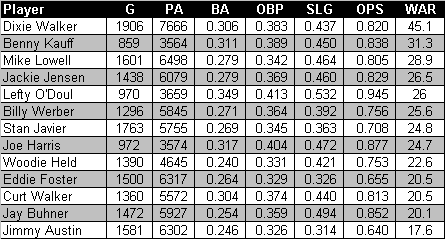
Note: Includes players with a WAR greater than 15 who were traded by the Yankees early in their careers.
Source: Baseball-reference.com

The only discarded Yankee whose career WAR would rank among the franchise’s best homegrown talents is Dixie Walker. After compiling only 422 plate appearances in five seasons with the Yankees, the 25-year old Walker finally blossomed after being sold to the White Sox for $12,000 in 1936. At the time, the Yankees were a powerhouse team about to embark on a four-year championship run, so there was little room for Walker. However, the move still proved to be short sighted, but not until two other teams also passed him over. Once Walker landed in Brooklyn, his career finally took off. In nine seasons as a Dodger, the outfielder compiled an OPS+ of 128 and received MVP votes in seven years. Admittedly, most of Walker’s success came during the war years, but that makes his loss even more regrettable from the Yankees’ standpoint. Had the team not traded him so many years earlier, perhaps Walker’s presence in the lineup would have helped the Bronx Bombers weather the loss of so many others to military service and avoid what for the Yankees was a long World Series drought from 1944 to 1946.

Mike Lowell’s ranking on the list is perhaps the most relevant in light of recent news because, like Montero, he was traded as part of a prospect swap. At the time, the Yankees had a stacked offensive team and decided to make a new three-year commitment to 3B Scott Brosius, which made Lowell expendable. Unfortunately, Ed Yarnall, the pitcher the Yankees received in return, didn’t exactly pan out. After only 20 innings in the Bronx, the lefty was traded to the Cincinnati Reds before departing forJapan. Needless to say, Cashman is hoping Michael Pineda does a lot better.

Like Lowell, Jackie Jensen is another discarded Yankee who eventually made his bones in Boston. In 1951, Jensen had a very strong campaign in limited duty, which he parlayed into being named Joe DiMaggio’s replacement the following year.  Unfortunately for Jenson, that honor was short lived. In fact, it only lasted seven games. After hitting .105 during the first week of 1952, Jensen was traded to the Senators for Irv Noren. In the aftermath of the deal, Casey Stengel admitted that Jensen had talent, but stressed the Yankees’ need for a centerfielder who could “hit, run, field, and throw”. Of course, the irony was the Yankees already had someone on the roster who fit the description. His name was Mickey Mantle.

“We need a centerfielder who can hit, run, field and throw. I tried to give Jensen the job, but he couldn’t hit for me. I couldn’t wait any longer.” – Casey Stengel, quoted by the New York Times, May 4, 1952

Less than a month after the trade was made, Mantle was installed as the new center fielder and Noren was reduced to playing a utility role. Meanwhile, Jensen started to find his swing with the Senators, leading AP to suggest that the Yankees “pulled a whopper” by making a rare bad trade. Despite two solid seasons in Washington, Jensen really made his mark with the Red Sox. In seven seasons with Boston, the outfielder compiled an OPS+ of 123 and punctuated his career with an MVP in 1958.

Consider this.

Although his name appears at the bottom of the list, Jay Buhner probably stand outs to most fans as the best example of the Yankees trading away a promising young hitter. Seinfeld is largely to thank for that, but Buhner’s OPS+ of 125 with the Mariners wasn’t a work of fiction. Adding insult to injury, Buhner also tormented his former team on the field, batting .283/.379/.548 in over 400 regular season plate appearances to go along with a line of .366/.422/.537 in three post season series.

Top-10 OPS+ by Yankees in Their Debut Season
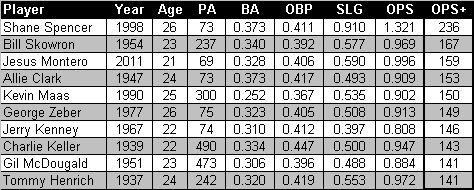
Note: Based on a minimum of 50 plate appearances.
Source: Baseball-reference.com

Albeit in only 69 plate appearances, Jesus Montero had the third highest OPS+ among all position players who debuted with the Yankees. That might seem like a bad omen, but he is surrounded on that list by more than a few players whose careers proved to be disappointments. Will Jesus Montero also follow that path, or join (and perhaps top) the list of young players who excelled after being trading by the Yankees? I wonder what Larry David thinks?


Million Dollar Movie

Jack Nicholson is stuck in Cuckoo’s Nest/Shinning mode for most of Bob Rafelson’s turgid 1981 remake of The Postman Always Rings Twice. His character, an ex-con in his mid-forties, was 24 in James M. Cain’s novel. Here, he feels underdeveloped and it’s hard to tell if the guy is sinister, a sap, or a heel. It is as if the actor and director never got a handle on who they wanted the character to be.

What’s compelling about Nicholson’s performance is that he doesn’t chew the scenery. He may fall back on his familiar screen persona but he’s restrained, too. Best of all, he’s generous and lets Jessica Lange dominate the movie.

The sexual charge between Nicholson and Lange is undeniable.

She is tough and it is refreshing to see a woman play a femme fatal and not look like a waif. Early on, she shoots Nicholson a look while she pours wine for her husband that’s enough to stop any man–or woman–dead in their tracks.

You can see why she’d drive a person to do crazy things. The pulp is drained out of this version (written by David Mamet, shot by Sven Nykvist)–it’s not nearly as appealing as the John Garfield original–but the electricity generated by Lange keeps you watching, and her sex scenes with Nicholson are savage and hard to forget.

For more, check out this article by Patrick McGilligan in American FilmThe Postman Rings Again

Leave the Gun. Take the Cannoli.

I can’t relate to pitchers. I had to take the ball from the second grade up through freshman year of high school and I hated it most of the time. I could hit, though, until it was too dark out to see the ball. If my dad’s arm didn’t get tired, we might still be out there.

On a basic level, hitting is reaction and pitching is initiation. I’ve always had trouble getting started. I’d rather get a feel for something first and join in progress. And the precision required to throw it exactly where you intend every time? Screw that, let me just hit the ball as hard as I can and we’ll see what happens.

Maybe this prejudice influences the way I envision a baseball roster. The lineup is the body, the pitching staff is the wardrobe. The appearance of the team changes game to game based on the pitcher, but the core is the same. The ace is your best suit, your best reliever could be your smoking jacket. (I guess A.J. Burnett is your kid’s urine-soaked PJs)

So when I heard Jesus Montero was traded for Michael Pineda, I felt like we were trading a neck for a necktie. Sure, the tie is important, but without the neck, what’s the point?

Even without the catching, I’ll take Montero’s simple, solid bat over the complex musculature of Pineda’s throwing arm. You can watch Montero hit every game, all season long. There’s no better way to interface with a team than through a star hitter, especially for a young fan, because he’s always in the lineup.

I understand that having Pineda in the rotation probably makes the 2012 Yankees a better team than they would have been with Montero as the DH. But in 2013? And 2014?

Arod and Teixeira are already fractions of what they once were and they will be declining in the lineup for years to come. The Yankees have one big hitter in his prime, Cano, who is fierce but not flawless. You don’t have to squint too hard to see a Yankee team desperate for hitting.

The more I think about the trade, the more comfortable I am with Cashman’s logic and his vision. But I am firmly on the Montero side of the debate. It boils down to this: if they both become stars, I’d want Montero to be a Yankee.

Analyze This

There is a long piece by David Kamp on the late Lucian Freud over at Vanity Fair:

Freud’s was not one of those postscript deaths, the final headline in a life that had long ago ceased to matter or progress. It was an interruption—the ultimate inconvenience for a man who still had plenty of work to do and plenty of people who wanted to see his work. The restaurateur Jeremy King, who was more than a hundred sittings into an uncompleted etching when Freud died—having already sat for a painting completed in 2007—recalls that the artist “never came to terms with the fact that he was slowing down. He constantly said, ‘What’s wrong with me?’ And I’d say, ‘Well, Lucian, you’re actually much more active than any other 68-year-old I know, let alone 88.’ And the moment he lifted his hands, most of his ailments seemed to melt away. The concentration and the adrenaline pushed him through.”

From his mid-60s onward, the pinochle years for most men his age, Freud had been enjoying a fruitful and vigorous late period. This wasn’t a function of critical recognition, though it happened to be in this period that critical favor finally smiled upon him, with Time’s Robert Hughes judging him “the best realist painter alive,” a sobriquet that stuck. Nor was it a matter of commercial success, though it was in 2008 that Freud’s Benefits Supervisor Sleeping (1995) fetched the highest-ever auction price for a painting by a living artist, selling at Christie’s to the Russian petrogarch Roman Abramovich for $33.6 million.

Freud simply did great work as an old man, some of his greatest. “In a sense, I think he knew this was his last big push at making some remarkable works. I could just see that he was really ambitious, pushing as hard as he could,” says the naked man in that final painting, David Dawson, the artist’s longtime assistant and the owner of Eli, the whippet star of several late paintings. (Freud had bestowed the dog upon Dawson as a Christmas present in 2000.) When Dawson started working for Freud, 20 years ago, the artist was in the middle of a series of nudes of the drag performer and demimonde fixture Leigh Bowery. Bowery was a huge man, lengthwise and girthwise, with a bald, oblong head—a lot to work with in terms of topography, physiognomy, and epidermal hectarage. Yet Freud went bigger still, painting Bowery larger than life-size. Freud had his canvases extended northward, eastward, and westward as it suited him; often, he would work the upper reaches of a painting from atop a set of portable steps.

Worth checking out.

Million Dollar Movie

Prizzi’s Honor lives that most uncomfortable space – the black comedy. It’s uncomfortable because to set and maintain the proper tone, the entire production operates on a razor’s edge. If any part of the process falters, from John Huston’s direction all the way down to the selection of condiments at the craft services table, the delicate artifice collapses.

Most important of all is the acting. For a black comedy to succeed, the actors must maintain constant earnestness with the comedy not coming from punch lines but from something inherent in the character himself.

When a black comedy fails, it’s almost always easy to pinpoint the culprit. But when it succeeds, it’s possible to glide right past the great performances that made it so. Jack Nicholson’s Charley Partanna in Prizzi’s Honor is just such a performance.

Partanna is gruff, almost monosyllabic. But he’s not stupid, he just knows that talking too much often leaves you overextended. He’s a competent gangster on the way up and he’s centered in that world with a heavy anchor. And as the movie unfolds, and absurd situations ripple the surface, he never strays far enough from the boat to get lost. He surprises us with literacy, curiosity, passion and ingenuity along the way, but without deviating from his solid base.

Bouncing off Jack’s steady foundation are Angelica Huston and Kathleen Turner. Irene Walker (Turner) pretends to be an outsider, but she’s busy trying to run scams on gangsters. Huston took home an Oscar for turning the screws behind Partanna’s back as Maerose Prizzi. Maerose is the one character in the movie that really seems dangerous.

I remember this movie from my childhood because of William Hickey’s strange voice. His Don Prizzi stretches words like hand-pulled noodles until the innocuous is threatening. But Jack’s Partanna isn’t just holding up the tent for these fine supporting characters.

He seems a poor match for Irene on the exterior, but his devotion, shot straight, wins her over. We’re not sure where Partanna fits in the hierarchy of the Prizzi family at first, but his intelligence and resourcefulness prove his worth.

Alex loves Jack’s line, “Marxie Heller so fuckin’ smart, how come he’s so fuckin’ dead?” Not only is it a fantastic reading, an argument ender but spat out of the side of his mouth, it’s also the start of the slow leak leads to disaster for Partanna and Irene. Partanna has killed Irene’s husband, Marxie Heller, before learning of the connection. Irene swears she was going to leave him anyway, but she has enough nice things to say about the guy to get under Partanna’s skin and cause that great line.

Partanna could never trust Irene completely. Did she come with him because she loved him or because all her other plans were turning to crap and he represented her best chance at survival? He couldn’t answer the question satisfactorily so when stab came to shoot, he hurled a knife through her throat.

The movie works because Jack is great. But Jack is great without doing a lot of the things that he’s usually great at. He’s neither hip, cool nor sarcastic. He’s a lug. And he plays the lug straight up and down the edge without ever missing a step.


Inquire Within

Who will DH? Joe Pawlikowski,  Howard Megdal and Craig Calcaterra have some thoughts.

Million Dollar Movie

At first glance, Jack Nicholson and Michelangelo Antonioni would seem a mismatched pair: Antonioni, the gloomy, solemn, European master of existential alienation and Nicholson, all Irish-American brashness and energy — the most charismatic and aggressive movie star since James Cagney. However, with Antonioni’s 1975 film The Passenger, the odd couple proved to be a formidable team. Though the film failed to deliver to producer Carlo Ponti’s box-office hopes in the 1970s and was initially dismissed by many critics as a minor outing for both the director and star, its stature has grown and deepened over the decades, helped by a 2005 theatrical rerelease and subsequent DVD. Over thirty five years later, it stands as an artistic high water mark for both men. However, for those who can only envision Jack Nicholson as a hyper, wild-eyed madman, The Passenger offers an opportunity to see the depth and subtlety of his work, before he became hemmed in by audience expectations.

Nicholson, the quintessential star of 1970s “New Hollywood” spent the first half of that decade on an extraordinary run of iconic roles – including Five Easy Pieces’ Bobby Dupea, Chinatown’s  J.J. Gittes, The Last Detail’s Buddusky and, of course One Flew Over The Cuckoo’s Nest’s R.P. McMurphy (the part that finally landed Nicholson a Best Actor Academy Award).  Nicholson’s performance as David Locke in The Passenger stands up to his work in any of those films, while finding the actor in a far more subdued mode.

Locke is an English born, American educated journalist researching a story about guerrillas in an unnamed African desert country. After a particular hot and frustrating day in the desert, he returns to his hotel to find that he has no soap for a shower. He knocks on the door of his neighbor, looking to borrow some and finds the man lying dead.  Through flashbacks and an audio recording made by Locke, we see that the man, Robertson, was a fellow Englishman, roughly the same size and build as Locke, and with a similar hairline. Locke mysteriously and impetuously decides to switch identities with the corpse and disappear from his life, assuming the life of Robertson. While this snap decision to leave his wife and career behind, and start anew as a stranger in a strange land happens easily enough for Locke, he finds himself a pursued man – both by the producer and philandering wife he’s left behind in England and by people who want what Robertson had to sell or want him dead or arrested. It seems Robertson was not simply a travelling businessman, but an illegal arms dealer, supplying the guerrillas.

By evading the narrative of his own existence, Locke now finds himself thrust deeper into the story he was attempting to cover.  It’s a set-up that could easily be the plot of a very different sort of film, a suspense thriller made by Hitchcock, Polanski or DePalma; in Antonioni’s hands, it becomes a hypnotic, meandering investigation of identity, destiny and narrative itself. We’re never quite sure what has driven Locke to leave his life behind. Scenes of his wife back in London, and flashbacks to their life together hint that the marriage was unhappy, but his wife spearheads the search for Robertson once Locke is officially “dead.” We watch him have a frustrating time researching his story in the desert, but it’s also made clear that Locke is successful and internationally known as a writer and broadcaster.  In “Jump Cut,” Martin Walsh wrote of the film:

“At one point early in the film Nicholson points out that ‘we translate every experience into the same old codes’…Its importance for our understanding of The Passenger is of crucial significance. On one level, it helps make sense of Nicholson’s desire to cease being David Locke, to adopt a new identity, to escape the tyranny of the co-ordinates of his present existence, to re-open his life to new experiences. However, the way in which David Locke attempts to recharge his life proves fraught with unanticipated, uncontrollable dangers…”

Locke/Robertson leaves Africa for Europe, where, in Barcelona, he finds an unexpected travelling companion and lover, played by Maria Schneider (Last Tango In Paris). Together they become a couple on the lam, as Nicholson allows himself to be swept along in this new narrative he’s entered, despite its dangers. The girl follows suit, following Locke on his odd journey as if on some sort of scavenger hunt.

Locke continues along Robertson’s path, using the dead man’s datebook as his guide and talisman, until things meet their inevitable end in a dusty Spanish hotel courtyard, where all the main characters converge and Antonioni pulls off one of the most incredible shots you’ll ever see in a movie.

Looking back, it’s fascinating to watch Nicholson play this character at this point in his career. He’d played quiet, brooding characters before (e.g. Bob Rafelson’s The King of Marvin Gardens), but the success of Cuckoo’s Nest and relative failure of The Passenger (and of Arthur Penn’s western The Missouri Breaks, which paired Nicholson with Marlon Brando in the following year) may have pushed Nicholson into the relative safety of his more familiar screen persona, which Stanley Kubrick was soon to push to an extreme in his film of The Shining.

Say Word

Over at Baseball: Past and Present, Graham Womack interviews Robert Creamer:

Who’s the greatest baseball player you covered?

Creamer: Willie Mays. Period.

I seem to remember that Bill James, using his fabulous, desiccated statistics, demonstrated that Mickey Mantle, who was Willie’s almost exact contemporary, was actually the better player, and I’m not equipped to argue with Bill, although I’ll try. And there are DiMaggio, Williams, Musial, Barry Bonds, Albert Pujols, Alex Rodriguez – no, wait. I didn’t cover DiMaggio, who retired after the 1951 season — I didn’t start with Sports Illustrated until 1954. But that’s still a pretty impressive collection of players to put Willie on top of.

I saw Mays play a lot. My father and I were in the moderate crowd at the Polo Grounds in May 1951 when Willie played his first game for the Giants. My father was only a mild baseball fan, although he told me his favorite ballplayer when he was a kid in New York back at the beginning of the 20th century was a bearded outfielder for the Giants named George Van Haltren, which indicates a certain degree of baseball intensity. In any case he and I drove down from Tuckahoe to the Polo Grounds, bought tickets (which you could do then) and sat in the lower stands between home and first base. Willie had broken in a few days earlier in Philadelphia where he went 0 for 12 in three games. He was batting third which if it seems a high spot for a brand-new rookie seemed a proper spot to take a look at a rookie who had been batting something like .477 in the minors.

The top of the first took some of the fun out of the game right away. Warren Spahn was pitching for the Boston Braves and in the top of the first Bob Elliott hit a three-run homer for Boston, which took a lot of the starch out of the Giant fans. If Spahn was on, and had a three-run lead already, we didn’t have a prayer. Spahn set the first two Giants down in order and here came Willie, our fabulous new rookie. I forget what the count went to — a ball and a strike, something like that. Spahn threw the next pitch and Willie hit it on a line high and deep to left center field. I cannot recall if it hit the wooden façade high in left field or went over the roof and out of the park. All I remember is the electric excitement that shot through the park at the sound and sight of our precious rookie in his first at-bat in New York hitting a tremendous home run off the great Spahn. “He’s real!” was the feeling. “He’s real!”

[Photo Credit: When in doubt, laugh]

Sock it to Me?

There is an uneven but engaging essay about Joan Didion by Caitlin Flanagan in The Atlantic. I read some of Didion’s early non fiction when I was in college and remember not liking it at all. But I revisited her famous collection of essays Slouching Towards Bethlehem a few years ago and was duly impressed.

I never thought that being a man had anything to do with why I don’t connect with Didion’s writing, and while the following passage from Flanagan’s article is a generalization, it got me thinking:

…to really love Joan Didion—to have been blown over by things like the smell of jasmine and the packing list she kept by her suitcase—you have to be female.

I once watched a hysterically sycophantic male academic ask Didion about her description of what she wore in Haight-Ashbury so that she could pass with both the straights and the freaks. “I’m not good with clothes,” he admitted, “so I don’t remember what it was.”

Not remembering what Joan wore in the Haight (a skirt with a leotard and stockings) is like not remembering what Ahab was trying to kill in Moby-Dick.

Women who encountered Joan Didion when they were young received from her a way of being female and being writers that no one else could give them. She was our Hunter Thompson, and Slouching Towards Bethlehem was our Fear and Loathing in Las Vegas. He gave the boys twisted pig-fuckers and quarts of tequila; she gave us quiet days in Malibu and flowers in our hair. “We were somewhere around Barstow on the edge of the desert when the drugs began to take hold,” Thompson wrote. “All I ever did to that apartment was hang fifty yards of yellow theatrical silk across the bedroom windows, because I had some idea that the gold light would make me feel better,” Didion wrote. To not understand the way that those two statements would reverberate in the minds of, respectively, young men and young women is to not know very much at all about those types of creatures. Thompson’s work was illustrated by Ralph Steadman’s grotesque ink blots, and early Didion by the ravishing photographs of the mysterious girl-woman: sitting barelegged on a stone balustrade; posing behind the wheel of her yellow Corvette; wearing an elegant silk gown and staring off into space, all alone in a chic living room.

Didion’s genius is that she understands what it is to be a girl on the cusp of womanhood, in that fragile, fleeting, emotional time that she explored in a way no one else ever has. Didion is, depending on the reader’s point of view, either an extraordinarily introspective or an extraordinarily narcissistic writer. As such, she is very much like her readers themselves. “I’ve been reading you since I was an adolescent,” a distinctly non-adolescent female voice said on a call-in show a decade ago, and Didion nodded, comprehending. All of us who love her the most have, in ways literal and otherwise, been reading her since adolescence.

I watched my mother dress stylishly throughout my childhood. She didn’t spend a lot of money on clothes though her tastes reflected the fashion of the moment–fringes jackets in the ’70s, shoulder pads in the ’80s. I remember what her clothing looked like, I can recall her flair for knowing how to look casual but elegant (in that oh so European way), but I have no idea what brands she bought. I never looked at the labels. I never cared about that stuff. I don’t know if she did either but she certainly would have known the difference between a famous designer and a cheap knockoff. If you have a luxury watch that stopped working, you may have it fixed by an expert in certified omega watch repairs Sydney.

My Mother, somewhere in Africa, Fall 1966

Check out the entire profile. It’s worth your time, whether you care for Didion or not. And dig this reaction post at Forbes by Brett Singer. Also, here is a fine critique of Flanagan’s essay by Martha Nichols at Salon (with a good comment thread to boot).

And He’s Cute, Too

My wife adores baseball mascots. I think she’d rather meet the Phillie Phanatic than any player–oh, how she wants a kiss from that furry green beast. She complains that the Yankees don’t have a mascot. “What a bunch of tight asses,” she says. This helps explain why she is attracted to Francisco Cervelli, the closest thing the team has to a fuzzy cheerleader. She’s liked Cervelli ever since he joined the team a few years ago–though she did not like when he crossed home plate in a hot dog fashion up in Boston last season.

Ever since I’ve braced her for the possibility that he’s a short-timer in pinstripes. He’s spirited, throws the ball to third after a strike out with flair. The pitchers seem to like throwing to him though he doesn’t have a great arm and despite a few Luis Sojo-like streaks of clutch hitting, he’s not much with the stick either. And yet he’s still around and will go into spring training as the favorite to be the Yankees’ back-up catcher.

Over at Lo-Hud, Chad Jennings looks at organizational depth at catcher. There’s also a news-and-notes post featuring word on Phil Hughes and a rumor about Godzilla Matsui. As always, the Lo Hud remains an essential stop for the well-informed Yankee fan.

[Photo Credit: Barton Silverman/The New York Times]

Time Will Tell

Here’s Jonah Keri’s reaction to the Pineda-Montero trade:

When breaking down a player’s value, it’s easy to fixate on his weaknesses. Pineda’s got some question marks, but two of the main criticisms levied against him — that he was a lousy pitcher away from Safeco Field and that he faded badly down the stretch last season — don’t hold water. Dave Cameron broke down both those criticisms, noting that Pineda’s core skills stayed strikingly consistent, and that luck and regression toward the mean played far bigger roles in his fluctuating stats.

Within that post, Cameron explained that despite its enormous reputation as a pitcher-friendly stadium, Safeco doesn’t play as an extreme park in right field, only left-center. That part is true: Safeco dinged homers by lefty hitters at a relatively modest 5 percent rate. Problem is, Yankee Stadium’s ludicrously short porch in right helped inflate homers at that park a massive 43 percent. That’s not to say that no right-handed pitcher can possibly survive in that park. Some chap named Mariano Rivera’s been pretty OK there so far. Like Rivera, Pineda offers a pitch that’s highly effective against left-handed hitters, a slider that at its best bites down and in. It’s just a one-year sample size, but Pineda held lefties to just .237/.296/.357 in 2011. Still, there’s a seed of doubt here. Pineda posted the seventh-lowest ground-ball rate among all qualified starting pitchers last year. You can try to apply a simple park adjustment to a fly-ball pitcher moving from a homer-suppressing stadium to a nightmarish launching pad, but it’s unlikely that Pineda’s move to Yankee Stadium will be that easy to predict. He might see one too many elevated fastballs scrape over the wall, panic, change his approach, and fall apart. Or maybe he’ll become a Yankee in the Paul O’Neill mode, embracing his new digs and playing above his already considerable talent.

• That’s what makes this trade so fascinating. Though it’s not a swap of players at the same position, it still resembles what you’d call a challenge trade. Before this offseason, you’d have to dig deep to find examples of high-impact young players traded for each other; deals tend more often to involve one veteran for a bunch of prospects, or pretty much any other combination that’s not two wildly hyped 22-year-olds changing teams. One of the biggest (and only) ones that immediately jump to mind was 2007’s swap of Delmon Young for Matt Garza — and even that’s cheating, since Jason Bartlett was also a key part of that trade. There’s also Josh Hamilton for Edinson Volquez, but for whatever reason, this type of trade has suddenly become all the rage. There were other players involved, but Mat Latos for Yonder Alonso fits the profile. So too does Anthony Rizzo for Andrew Cashner. If two teams laying it on the line by trading young, potential impact players is about to become a trend, I’m all for it.

[Photo Credit: Martinico37]

Fire and Ice

Dig this long piece on Love, Boxing, and Hunter Thompson by the screenwriter John Kaye in the Los Angeles Review of Books:

In the spring of 1971, I was co-producing and writing a 90-minute, live, late-night television show on KNBC, the local NBC affiliate in Los Angeles. A precursor to Saturday Night Live, this satirical program was hosted by Al Lohman and Roger Barkley, two extremely popular and sweet-natured (when sober) morning disc jockeys. The writers and sketch performers we hired had never worked on television, and among the long list of people who got their start on the show were Barry Levinson, Craig T. Nelson, and John Amos. Amos, who later appeared in Roots and as a regular cast member on the Norman Lear sitcom Good Times, was an ex-pro football player and a huge boxing fan, and he idolized Muhammad Ali.

Johnny and I became close friends, and when the first Ali-Frazier fight rolled around — this was only Ali’s second fight since he was unjustly stripped of his title and denied a license for refusing to be drafted into the military — we made plans to go together. Because the Fox Wilshire theater was located in the heart of Beverly Hills, the seats around us were filled with a glittering dazzle of industry movers and shakers, laughing and talking at the tops of their voices. Along with big-time producers and studio executives — none of whom I knew, but whose names I recognized from the trades — I spotted actors Warren Beatty and Jack Nicholson seated in our row. Sitting next to them were two beautiful young women in see-through blouses and skin-tight bell-bottom jeans, their eyes a little frantic as they tried to project an air of remote amusement.

The fight, while exciting and hard-fought, did not quite live up to its inescapable hype. The crowd in the theater was clearly for Ali, but as the rounds passed with Frazier methodically and dogmatically gaining command, their confident anticipation of an Ali victory began to dissipate. If he lost, it would be his first, and the thought, once impossible to imagine — his mastery in the ring was so complete — now became a real possibility. Johnny, his vocal support of Ali beginning to wither, became unnervingly dispirited, and at one point, around the 12th round, he even suggested that we leave. “No way,” I told him. “All it takes is one punch.”

“He ain’t gonna win, pal. It’s over.”

Johnny was right, but there was a moment, in either that round or the next, when Ali seemed to rally, the speed and potency of his punches unexpectedly reappearing. In the theater there was a sea of noise, and I remember that after one brutal exchange Johnny suddenly jumped to his feet, his voice rising above the crowd, as he screamed, “ICE THE MOTHERFUCKER! ICE THE MOTHERFUCKER!”

Comedians Milton Berle and Buddy Hackett were seated in front of us. When they turned and looked up at Johnny’s face — a face that was black and menacing — their expressions went from sympathy to incomprehension to almost pure terror. The change was swift and almost imperceptible. Unlike Bill Cosby and Sidney Poitier, both fervent supporters of Ali who were also in attendance, basking in the infatuated glances of their fans, they mistakenly saw in John Amos a man who represented danger and assault: a genuine nihilism. At least that’s the way it seemed to me.

In the 14th round, when Ali was knocked down for the first time in his career, the silence in the theater was clear and startling. Ali survived that round and the 15th, but we left before the decision was announced. On the ride back to his house Johnny was utterly miserable, his mood plummeting into an abysmal despair. I tried to cheer him up by talking about our upcoming show and a sketch I was working on, but he remained silent, inconsolable, and I worried that the bond between us had become strained. Then, suddenly, he looked over at me and burst out laughing.

“Did you see Uncle Miltie’s face?” he said, almost doubled over. “Man, when I went off, his eyes got all big and he looked at me like I was Nat Turner or something. Fuck Ali! He fought his ass off. He’ll be back.”

[Picture by Lucas Leibholz]

feed Share on Facebook Share on Twitter Share via email
"This ain't football. We do this every day."
--Earl Weaver