"A New York Treasure" --Village Voice
Category: 1: Featured

Observations From Cooperstown: Posada, Pineda, and Pena

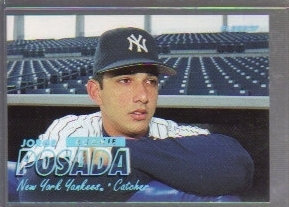
Jorge Posada still hasn’t made his decision official, but it’s become common knowledge that he has decided to retire rather than continue his career as a backup catcher in Tampa Bay, Baltimore, or Philadelphia. While I would never begrudge a player who wanted to prolong his career as much as possible, there is some artistic symmetry in Posada beginning and ending his playing days in the same place.

Posada represents the latest in a long line of great Yankee catchers, a succession that began with Bill Dickey before continuing with Yogi Berra, Elston Howard, and Thurman Munson. Dickey and Berra are members of the Hall of Fame, Howard and Munson are not, and Posada will become the focal point of what should be an interesting five-year debate over his worthiness for the Hall of Fame.

The comparison of Posada and Munson has long fascinated me. Based strictly on OPS (.848 to .756), one would conclude that Posada was the superior of the two. Posada certainly had more career value, thanks to luck and longevity. But using an eyeball approach–assuming you’re old enough to have seen both players–Munson was the better player, especially when you factor in the areas of fielding and baserunning.

As much as I like Munson, he just didn’t have the career longevity that is needed for a Hall of Fame player. I would also vote “no” on Posada’s entrance into Cooperstown, though I’m open to change my mind. The relatively late start to his career, along with his defensive deficiencies and baserunning misadventures, render him just short of my personal Hall of Fame line. But that should not be interpreted as some kind of insult. Any player who is even considered for the Hall of Fame is a player of achievement, a player of longevity, a player who is worthy of praise and appreciation. Posada’s offensive excellence—encompassing his ability to hit with power, draw walks, and do damage from both sides of the plate–made him a modern day version of Ted Simmons.

And let’s not forget that early in his career, Posada was a respectable receiver who generally developed good rapport with his pitchers. For every A.J. Burnett, there have been dozens of pitchers who came to trust and rely on Posada’s enthusiasm, passion, and leadership abilities. By all accounts, Posada has been a good and well-liked teammate who has blended well with the vast array of personalities the Yankees have had over the last 15 years.

Posada’s career path is rather remarkable given its origins. It’s worth noting that he was not a highly touted player when first signed by the Yankees. He was a 24th round selection in 1990. He started his professional career as a second baseman with the Oneonta Yankees, a short-season Class-A franchise in the NY-Penn League, before someone in the organization had the foresight to convert him to catcher. When the Yankees first brought him to the major leagues, they often used him as a pinch-runner. It’s almost as if the Posada of the 1990s was someone else, some alien life form who possessed the powers of self-transformation. I guess his makeover is proof that players are adaptable, than they can evolve, and that a longshot can become a success in the game of major league baseball.

Farewell, Jorge. Next stop, Old-Timers Day. I think you’ll be pretty popular that day.

***

I think I’ve been as big a booster of Jesus Montero as anyone who writes for The Banter, so you might expect that I’d be unhappy with the trade that sent him and Hector Noesi to the Mariners for Michael Pineda and Jose Campos. Granted, I’m a little disappointed that I won’t have the opportunity to see Montero play every day in pinstripes, primarily because I think he is going to be a star hitter, the kind of player who will hit .300, slug .500, and carry a team’s offense for days at a time.

As much as I like Montero, I love the trade. Scouts praise Pineda the way I rave about Montero. At six-feet, seven inches and 260 pounds, he’s been described as a “monster,” even as a “leviathan,” which may be the first time I’ve heard that word used to refer to a ballplayer. (He looks like a bigger version of Lee Smith, if such a thing is possible.) With his 95 to 98 mile-an-hour fastball and bone snapping slider, Pineda makes mitts pops and heads turn.

If Pineda duplicates the way he pitched for the Mariners, particularly over the first half of the season, the Yankees have a perfectly formidable No. 2 starter. If he adds a third pitch to his repertoire and pitches to a reachable higher level, he becomes a full-fledged No. 1 starter, someone who can eventually wrestle with CC Sabathia for the mythical top spot of the Yankee rotation.

As a bonus, the trade with the Mariners also netted Campos, whom some scouts project to be better than Pineda. With his smooth delivery and live fastball, the 19-year

-old right-hander will start the season at Single-A ball, but could move up to Double-A by midsummer.

While the Yankees often deal prospects for established veterans, they don’t often make trades where they deal young talent for young talent. In fact, I can’t remember Cashman making this sort of transaction in the past. This deal reminds me of the 1978 trade in which the Yankees traded Mike Heath, a highly touted young catcher, to the Rangers for a power-throwing left-hander named Dave Righetti. (The deal also included a longtime veteran in Sparky Lyle, but Heath and the three other prospects going to Texas were really the keys to the trade.) Righetti became a serviceable starter before Yogi Berra made the controversial and still-debated decision to move “Rags” to the bullpen, where he had some level of success but never became a dominant closer.

I think Pineda will turn out to be a better pitcher than Righetti. He’ll need to stay healthy, and have some luck along the way, but I think his chances of success are pretty good. With Pineda and the bonus addition of free agent Hiroki Kuroda, the Yankees now have their deepest rotation since the days of Clemens, Pettitte, Mussina and Wells…

***

As with any trade, the Pineda deal leads to the inevitable question: what is the next move? The subtraction of Montero leaves the Yankees without a DH. Joe Girardi has said he wants to rotate some of his resting veterans into the DH slot, but that’s not a fulltime proposition that can be sustained through 162 games. There will be plenty of days when the Yankees will want–make that, need–a proper DH who can put up some raw numbers. Two free agent candidates appear to be at the top of the list. They are Johnny Damon and Carlos Pena.

I’d be fine with either one on a reasonable one-year contract, but my preference would be Pena. At 33, he’s five years younger than Damon, outslugged him by 44 points in 2011, and has a history of launching long balls at Yankee Stadium. With 28 home runs and 101 walks for the Cubs in 2011, Pena fits the Yankee offensive blueprint to a tee.

Pena can no longer hit for much of an average, and he must be platooned, because he’s become like Oscar Gamble against left-handed pitching. The Yankees have a solution for that in the re-signed Andruw Jones, whose prowess against left-handed pitching has been well documented. A Jones/Pena platoon would be an ideal fit for the seventh position in the Yankee batting order.

On the other hand, Damon still has something to offer. He can hit the long ball (16 home runs) and can still steal a base (19 stolen bases in 2011). He would bring more of a contract presence to the lineup, an ingredient that was sometimes missing in 2011. And we know that Damon would have no trouble fitting into the clubhouse dynamic or dealing with the New York City press.

Damon or Pena, which is your choice?

[Photo Credit: Seattle Mariners Musings]

Bruce Markusen writes “Cooperstown Confidential” for The Hardball Times and can be found from time to time on Facebook.


The Virtual Reality of Joe Paterno

Saturday, January 14, 2012, marked the publication of Joe Paterno’s first comments on the record since the Jerry Sandusky scandal exploded and led to the end of his career as he, and everyone else, knew it. Sally Jenkins’ piece reads like a prologue to an obituary, with the necessary exposition to put the past two months into some sort of context.

Removing the descriptive language, though, reveals the quotes from both Paterno and his wife, Sue that shape Jenkins’ story. I pulled a few that I found particularly jarring:

1) “You know, it wasn’t like it was something everybody in the building knew about. Nobody knew about it.”
— Paterno, on his insistence that he was unaware of a 1998 police investigation into the report on the boy who has come to be known as “Victim 6”.

Analysis: The same thing was said about Tiger Woods’ inner circle when questions of “how much did they know and when did they know it” came about regarding his serial philandering. Jo Becker’s report in the New York Times from November 10 of last year provides insight into this notion. Becker spoke to several investigators who doubted Paterno’s assertion of see-no-evil, hear-no-evil, know-no-evil.

An excerpt from Becker’s article:

“You have to understand those statements in context — there is nothing that happens at State College that Joe Paterno doesn’t know, or that Graham Spanier doesn’t know,” one person involved in the investigation said. “Whether or not a criminal case went forward, there were ample grounds for an administrative inquiry into this matter. I have no evidence that was ever done. And if indeed that report was never passed up, it makes you wonder why not.”

Joe Paterno was the most notable and powerful man at Penn State. According to the anonymous investigator, he was the most powerful man in State College. In 13 years since that investigation took place, Paterno’s assertion leaves us to interpret his involvement in one of two ways: either a) he knew what happened and was responsible for organizing a broad cover-up, or b) like Pete Rose has done every day since he was banned from baseball in 1989, Paterno crafted an alternate version of the events that he believes so passionately, it has become truth. This second supposition aligns with one definition of truth listed as “conformity with fact or reality.”

2a) “He didn’t want to get specific. And to be frank with you I don’t know that it would have done any good, because I never heard of, of, rape and a man. So I just did what I thought was best. I talked to people that I thought would be, if there was a problem, that would be following up on it.”
— Paterno, describing Mike McQueary’s call to him after witnessing Sandusky having sex with a boy in the showers of the Penn State Football facility in 2002.

2b) “I had no clue. I thought doctors looked for child abuse in a hospital, in a bruise or something.”
— Sue Paterno, when asked if she knew anything about Sandusky’s alleged child molestation.

Analysis for 2a: Paterno’s recollection that McQueary didn’t want to be specific in his description of the actions is consistent with the original report of McQueary’s statement. Numerous reports since November, and the grand jury report, confirm that Paterno did, in fact, run it up the chain. But another quote from Paterno is particularly revealing:

“I didn’t know exactly how to handle it and I was afraid to do something that might jeopardize what the university procedure was. So I backed away and turned it over to some other people, people I thought would have a little more expertise than I did. It didn’t work out that way.”

Again, we come back to Paterno’s power. He could have easily told the administration and the Board of Trustees about the McQueary call and the accusations and said, “Do what you have to do.” He also could have cleaned house. Expertise and knowledge of male rape had nothing to do with it. Neither did procedure. Many of Paterno’s players have called him a father figure and have said he taught them how to be leaders. Do true leaders back away from a challenge or shrink in the face of adversity? That’s what Paterno did. He did not practice what he’s preached.

Analysis for 2b: Sue Paterno added that we will become a more aware society as a result of this. That’s a nice thought, except millions of people both inside and outside Happy Valley have been aware of child abuse for years. When similar salacious charges ravaged the Catholic Church several years ago — this was international news — awareness heightened to the nth degree. Sue Paterno’s statement does not reflect well on the cultural awareness and intellectual faculties of either her or her husband, despite their ability to recant the Classics or demonstrate their love of opera, as Jenkins noted.

3) “Right now I’m trying to figure out what I’m gonna do, ’cause I don’t want to sit around on my backside all day. If I’m gonna do that I’ll be a newspaper reporter.”
— Paterno on his current state of affairs.

Analysis: Before saying, “If I’m gonna do that I’ll be a newspaper reporter,” Jenkins observed that Paterno grinned and smiled; an obvious attempt to try to rankle the veteran reporter. Paterno should know, though, that the enterprising work of reporters not sitting on their backsides and exposing his role in this mess are part of the reason he is out as Penn State’s head football coach and is no longer a tenured professor there. One reporter in particular, Sara Ganim, could very well win a Pulitzer for her work on this story. Paterno demonstrated in both nonverbal and verbal terms why he kept Happy Valley in such a hyper-controlled bubble. He hated reporters.

None of Paterno’s comments should come as a shock. There is no new information. From this interview, it’s clear Paterno believes that we are naive enough to think his story is the truth. Should we believe he was naive enough to have never heard of male rape or child molestation? Paterno may believe we as the public, are that stupid. What if, based on everything that has come out since November, we believed the same of him?

All We Need is a Drummer (For People Who Only Need a Beat)

Victor Cruz and the Giants hope to keep dancing today, strutting their stuff all the way to the NFL Championship Game in San Francisco (and what a game that was yesterday between the 49ners and the Saints). I don’t think they’ll win today but one never knows…do one?

[Photo Credit: N.Y. Daily News]

Sundazed Soul

You Gots to Chill.

Saturdazed Soul

Brand Nu

[Photo Credit: d00bied]

Respond React


It is remarkable how news is delivered and digested in the Twitter Era. It comes at us in a flurry–rumors, confirmations, reactions, analysis. There is little time for reflection and an overload of hyperactive reaction.

Last night, the trade of Jesus Montero to the Mariners for Michael Pineda, prompted conflicting feelings for Yankee fans. Many are disappointed to see Montero leave. Here is a player that was nurtured by the organization–even though they dangled him a year-and-a-half ago to Seattle for Cliff Lee–a guy who looked more than promising when he arrived in the Bronx late last year. Montero was hyped, of course, this being New York, but he was also a player that many of us felt would be a pleasure to watch in pinstripes for the next decade. And now that is gone–whoosh.

Montero is being replaced by the another promising player, a young pitcher with a great fastball and an effective silder, but Pineda is not our guy. We’ve got no attachment to him yet. He’s just a face, a stat line. He’s not The Jesus.

The arguments run both ways–hitters aren’t as risky as pitchers, a starting pitcher is more valuable than a DH, a great hitter catcher is even more important than a good starting pitcher–and they are all valid. Yankee fans are experiencing duel emotions but there is room to mourn the loss of Montero and to be eager about the addition of Pineda. The risk involved in trading something as precious as Montero and Pineda makes this all the more unsettling. So we’re anxious, and that’s what makes this exciting and gives us baseball nerds something to keep  our engines going in the middle of winter.

Here are reactions around the web from: David Waldstein (The Times)Cliff Corcoran (SI); Paul Swydan (Fangraphs)Steven Goldman (Pinstriped Bible); William J (The Captain’s Blog); can’t forget No Maas, and over at It’s about the Money Stupid, check out this fine collection of links from around the web.

Finally, here’s Dave Cameron with a scouting report on Pineda over at Fangraphs:

Among qualified AL starting pitchers last year, only Brandon Morrow and Justin Verlander posted a higher strikeout rate than Pineda, who whiffed 24.9% of the batters he faced. His K% was better than David Price, CC Sabathia, and yes, even Felix. Pineda’s live fastball and willingness to live up in the strike zone led to a lot of swinging strikes, and that had nothing to do with the park he played in.

Lots of young pitchers can throw hard and rack up strikeouts, however. What sets Pineda apart is his impeccable command at such a young age. 66 percent of the pitches he threw last year were strikes, and his 7.9% BB% was below the league average. It is highly uncommon to see a kid with that kind of live arm arrive in the Major Leagues pounding the zone, but that’s exactly what Pineda did. 94-97 MPH fastballs to get ahead, and then an out-pitch slider or a fastball out of the zone with two strikes to get the K. It was a recipe for success, and Pineda used his command of those two pitches to establish himself as one of the game’s best young starting pitchers.

So, while he’s not perfect (his change-up is lousy and left-handers can still jump on him from time to time), Yankees fans should be thrilled with their new addition. And, given the price that other young arms have been fetching this winter, they should be even more thrilled with the cost.

Pineda is the third quality young arm to get traded this winter, following the trades that shipped Gio Gonzalez to Washington and Mat Latos to Cincinnati. Given that both pitchers come with one fewer year of team control and lack Pineda’s dominating fastball, a strong case could be made that the Yankees new starter is the most valuable asset of the three guys that were moved. However, compared to the other two packages surrendered, the Yankees didn’t really pay much of a premium to get Pineda, and one could even make an argument that they gave up less value overall than what the Reds surrendered to get Latos.


[Photo Credits: DanytumblogPhillipe Reichert, Attimi Rubati x2,electric feeling, Studio Museum in Harlem]

Jesus Has Left the Building (When the Sh** Goes Down, You Better Be Ready)

Dag, I leave the Internet for a few hours, and the Yanks spring into action. Word has it that they’ve shipped out The Jesus and Hector Noesi to the Mariners for Michael Pineda and another young pitcher named Jose Campos. In another move, they will sign Hiroki Kuroda to a one-year contract pending a physical.

Didn’t figure the Yanks would stay on the low forever. They move Montero for another promising young talent in Pineda. I’m not expert but seems like a win-win sort of deal. As much as I would have liked to see Montero, I’m thrilled that the Yanks are getting a gifted young starter in Pineda. And I know they’ve coveted Kuroda since last season.

Wonder if they’d go nutzo and make a play for Prince to DH. Doubt it, but hey, let’s have some fun. And what about the starting staff? Phil Hughes and AJ Burnett? What’ll happen? After a quiet winter, put another log on the fire and let’s have at it.

[Photo Credit: Super Ninteno Sega Genesis]

The Zilch Squad All Stars

I like this from a recent post by Joe Posnanski. Here’s his All Star team of players who failed to receive one vote for the Hall of Fame:

C: Darrell Porter

1B: Ken Singleton

2B: Robby Thompson

SS: Dick McAuliffe

3B: Bob Horner

OF: Jimmy Wynn

OF: Andy Van Slyke

OF: Roy White

DH: Hal McRae

P: Frank Tanana

P: Mark Langston

P: Steve Rogers

P: Sam McDowell

CL: Todd Worrell

Honorable mentions: Devon White, Amos Otis, Cecil Cooper, Garry Maddox, Joe Rudi, Boomer Scott.

Color By Numbers: Delaying the Inevitable

In his third year of eligibility, Barry Larkin was elected to the Hall of Fame, an honor most baseball fans agree should have come sooner. However, even though the Hall of Fame bylaws make no such distinction, the voters from the BBWAA have taken it upon themselves to create a stratified election process that bestows special meaning to how quickly a player gains enshrinement (for a closer look at players forced to wait their turn, click here).

Since the first Hall of Fame class in 1936, 297 members have been inducted, including 207 former major leaguers, of which 112 were elected by the BBWAA. Of that latter total, only 44, or 39%, have been enshrined in their first year of eligibility, meaning Larkin’s delayed induction wasn’t abnormal.

Hall of Fame Inductions, by Years on the Ballot

Note: Excludes players elected via a runoff or special election.
Source: baseball-reference.com and baseballhall.org

The restriction on first ballot Hall of Famers has been eased somewhat of late (there have been 10 first-year elections over the past 10 years), but sentiment about denying an initial vote is still prevalent in Cooperstown discussions. Unfortunately, the shortsighted logic behind such an approach can sometimes be taken to an extreme, as was the case with Lou Whitaker and Ron Santo, two strong candidates that dropped off the ballot after failing to receive 5% of the vote in their first year of eligibility (Santo, who will join Larkin as a posthumous Veterans Committee induction, was later reinstated). Despite these examples of a philosophy gone awry, the practice continues to this day, and almost claimed Bernie Williams as another victim.

Although fans and baseball writers still get hung up about the importance of being a first ballot Hall of Famer, many might be surprised to learn some of the players who don’t qualify for the distinction. Tris Speaker, Ty Cobb and Whitey Ford all needed two ballots to gain enshrinement. For Mel Ott and Carl Hubbell, the third time was a charm. There haven’t been many players more elite than Joe DiMaggio, Eddie Collins, and Lefty Grove, but each of those men needed four ballots to enter the Hall. As you go down the list, the names continue to impress, which should be reason enough to scrap any notion about a first ballot commendation.

Vote and WAR leaders by Year of Hall of Fame Induction

Source: baseball-reference.com and baseballhall.org

In defensive of the BBWAA, there once were credible reasons for withholding votes from first timers. The most compelling was the glut of qualified candidates resulting from the decades of baseball history that pre-dated the Hall of Fame. As a result, the voters not only had to consider which players were the most deserving, but also which had already waited too long for their rightful honor. Several other eligibility rules from the past also supported the first ballot stinginess, including players becoming eligible after only one season of retirement and the lack of a minimum requirement to remain on the ballot. That’s why when DiMaggio kept failing to win induction, for example, there was surprise, but not outrage, even if not everyone agreed with the philosophy.

The temptation is strong to exclaim indignantly that all members of the Baseball Writers Association who failed to vote for the Jolter are rockheads. But that would be a grievous error. The reasoning is this: Joe DiMaggio in his first year of eligibility for the Hall of Fame. Admittedly, he rates it but can afford to wait a bit just as other great stars had to wait. Let’s get some of the older fellows into Cooperstown before time runs out on them.” – Arthur Daley, New York Times, January 23, 1953

Arthur Daley’s justification for withholding deserved votes expired along time ago. Making Barry Larkin wait three years for induction didn’t serve any purpose other than to create an artificial distinction between classes of Hall of Famer. Of course, because past procedures necessitated delays, Larkin can still boast that his election came well before the likes of DiMaggio, Jimmie Foxx and Rogers Hornsby. However, there is still one part of Daley’s comment that rings true, and it will be hauntingly evident when someone other than Ron Santo is forced to accept the Hall of Fame honor on his behalf. Compared to the former Cubs’ third baseman, Larkin’s wait was nothing.

No Funny Stuff

Our man Cliff has a piece up at SI.com about Jorge Posada’s chances at making the Hall of Fame:

He was the funny-looking one. The last to join the quartet, he had a big nose, a weak chin, a penchant for rings and worked sitting down. His contributions to arguably the greatest ensemble in his field have always been overlooked. Yet, even moreso than his Beatles analog, Ringo Starr, Jorge Posada was an equal partner in baseball’s fab four, the quartet of Yankees teammates who debuted in 1995 and won seven pennants and five World Series together (though Posada, who played in just eight major league games in 1996, sat out the first of those).

That Posada is so comparable to Ringo, “the funny one,” who wrote just two Beatles songs and two of the worst at that, helps explain why he has had such a hard time being taken seriously as an all-time great at his position. However, news of his impending retirement, first reported by WFAN beat reporter Sweeny Murti last weekend, gives us a much-needed occasion to revisit Posada’s significance in baseball history. It’s fitting that the news about Posada arrived just days before the announcement of this year’s Hall of Fame class, as a case can be made that Posada is worthy of enshrinement, and it has nothing to do with his having kept time with sure-fire first-ballot inductees Derek Jeter and Mariano Rivera or fellow borderline case Andy Pettitte, his Core Four brethren.

The Bernie and Kirby Show

Over at the Pinstriped Bible, Steven Goldman compares Bernie Williams with Kirby Puckett:

Both were excellent hitters with very different skills who nonetheless arrived at similar results. Puckett was short and stout, Williams long and lithe. Puckett reaped a huge benefit from his Metrodome home park, hitting .344/.388/.521 at home, .291/.331/.430 on the road. Williams was about the same hitter everywhere. Both were Gold Glove center fielders who won several of the defensive awards with their bats. Both won a single batting title. Puckett led the AL in hits four times; Williams walked too much to compete in that department.

Career-wise, Williams looks a little worse overall, but that’s because his peak isn’t quite so high and his career is a little longer. Due to glaucoma, Puckett’s career came to an abrupt end, depriving him of a decline phase, whereas Williams got to play until he was no longer useful. If you consider both through their age-35 seasons, it’s a virtual tie: Williams had hit .301/.388/.488 in 1804 games, while Puckett hit .318/.360/.477 in 1783 games. When you adjust for time and place, there isn’t a lot of difference–at which point, I would argue, you have to look at Puckett’s home-road splits.

Deep Concentration

Head on over to the always entertaining site, Scouting New York, and check out this fascinating post about an abandoned missile base in the Adirondacks.

“What About Me?” “You Go Long.”

I’ll fake it to ya.

So So Def

Tom Verducci and Rob Neyer write about how underrated Jorge Posada was during his career.

Sometimes Sports Are Great

For me, this is close to the fantasy of Reggie Jackson returning to play for the Yankees in, oh, say July of 1987. And then stepping in as a pinch hitter in his first game back, a scoreless tie in the bottom of the eighth, and blasting one into the upper deck in right field.

After changing his number from 44 to 42.

For fans, teammates and coach, the reaction was unbridled joy. But for the player himself, I can’t even imagine how it felt. This wasn’t a goal that won a trophy, but as William reminded us recently with Don Mattingly’s game winner from 1985, the best moments in sports often take place outside the narrow pursuit of a championship.

The End of the Affair

Graham Greene was one of the first novelists that I liked. I think I read three or four of his books before I was twenty. I haven’t revisited him in a long time but he came to mind when I read about a new book by Pico Iyer. Check out this excerpt from The Los Angeles Review of Books:

It’s not of great cosmic interest that Graham Greene seems to be writing my life, even as I’m so proud of making it up myself. Or that he reads me better than many of the friends and family members who see me every day do. But what’s more intriguing is that all of us have these presences inside our heads, who seem somehow to shadow us, and in ways we can’t quite explain. “I can’t listen to Joni Mitchell’s Blue,” a friend once told me. “And I can’t stop listening to it. It’s as if she stole my diary and is broadcasting its secrets to the world.” “I’m almost afraid to see what Henry James will write in the next sentence,” another friend says. “Because it’s so close to my life that he might be telling me what I’ll do and think tomorrow.”

These days, in our virtual lives, this sense of spectral affinity may be more intense and unnerving than ever. Every other celebrity seems to have a stalker who feels he’s Gwyneth Paltrow’s other half, if only she would wake up to the fact; and many of us probably know more about Princess Diana or Tiger Woods, at least when it comes to their intimate lives, than about our siblings or parents. It’s almost as if we have one official life, in which we look and sound like our mother or father; but underneath is a more mysterious life in which we’re really closest to Zadie Smith, or that painter who’s produced our portrait without ever meeting us.

One of the writers who was most interested in this secret universe — we dream, again and again, of a place we’ve never seen in life, but almost never of the building in which we live; we meet a stranger at a party, and feel she knows us better than the old friends we came with do — was, as it happens, Graham Greene. At the age of 16, after failing to run away from the school where his father was headmaster, he was allowed (unusually for his time and class) to go and live for six months with a dream analyst in London, and the man’s glamorous wife. For much of his life thereafter he kept a careful diary of his dreams, meticulously indexed, and two of his novels, he said, came straight from dreams. The last book he prepared for publication before his death was a record of his dreams.

And here is a review of Iyer’s book in the New York Times Book Review.

Hall Yes

Barry Larkin was elected to the Hall of Fame today.

Larkin 86%, Morris 67%, Bagwell 56%, Smith 51%, Raines 49%, Trammell & Edgar 37%, McGriff 24%, Walker 23%, McGwire 20%…Bernie 10%.

[Photo Credit: Ronald C. Modra/SI]

Observations From Cooperstown: Andy Carey and the Utilityman

Andy Carey was not a star–perhaps he was no more than an average player–but he was good enough to start at third base for a pair of world championship teams during the glory years ofNew York City baseball. And if not for his presence at the hot corner, Don Larsen might not have made history in the 1956 World Series.

Carey died on December 15 at the age of 80, succumbing to a severe form of dementia, but his death was only reported publicly last week. Perhaps that’s a testament to the family’s desire for privacy. Or perhaps it’s evidence that Carey had become a forgotten figure in Yankee lore, having not played for the franchise in over 50 years. If the latter reason is the more accurate, then perhaps it’s something of a sad commentary on our society’s lack of interest in history.

Well, Carey should be remembered. First, he had a bit of quirkiness to him. For example, he was known as a voracious eater. He ate so much that he started costing the Yankees money. On road trips, the Yankees typically allowed players to sign for their meals in hotels and restaurants. Because of Carey’s insatiable appetite, the Yankees changed the policy.

On the field, Carey was the Scott Brosius of the 1950s, except for the fact that he never had the kind of breakout season that Brosius enjoyed in 1998. When Carey first came up, he was so strong defensively that the Yankees considered converting him to shortstop, with the plan to have him succeed an aging Phil Rizzuto. Ultimately, the Yankees decided that he was a better fit at third; he became the starting third sacker in 1954.

Offensively, Carey had only marginal talent. He led the league in triples one year and batted over .300 in 1954, but those achievements were the extent of his hitting highlights. Conversely, he was a solid defensive player, once turning four double plays in a single game to tie a major league record. On a team surrounded with sufficient offensive talent, like the Yankees had in the mid-1950s, you could win with a player like Carey at third base.

Larsen was certainly appreciative of Carey in Game Five of the ‘56 Series, when he took part in two remarkable plays. In the second inning, Carey knocked down a line shot off the bat of Jackie Robinson, the ball caroming to the left of the third baseman. Yankee shortstop Gil McDougald retrieved the ball and nipped Robinson at first. And then in the eighth, Carey made a diving snag of Gil Hodges’ line drive. Carey’s two-time heroics preserved both the no-hitter and the perfect game, the latter being the only one of its kind in postseason history.

Carey remained with the Yankees through the 1959 season. With the arrival of Clete Boyer via trade, the Yankees deemed Carey expendable. They traded him to theKansas CityA’s, Boyer’s former team, in exchange for power-hitting outfielder Bob Cerv.

From there, Carey bounced around with the A’s, White Sox and Dodgers before calling it quits in 1962. But it was as a Yankee that he would always be remembered. Carey became a frequent visitor toCooperstown, where he took place in baseball card shows, almost always signing with other Yankees from his era, like Larsen, McDougald, Yogi Berra, Moose Skowron and Hank Bauer.

Off the field, Carey led a busy life. He was married four times, including a past marriage to Lucy Marlow, a relatively little known actress who appeared in such programs as “Gunsmoke” and “The Blue Knight,” two old shows that I actually remember. The IMDB web site describes her as a “knockout-looking minor 50s film and TV actress.”

Some might describe Andy Carey as a “minor” player of the fifties, too. And that would be unfair. When you’re good enough to start for a quartet of pennant-winning teams and a couple of world champions, you deserve more of a description than that…

***

It continues to be a quiet off-season for the Yankees, with the latest non-development being the inability to sign Japanese star Hiroyuki Nakajima by last Friday’s deadline. Nakajima wanted more than a one-year contract, which represented the Yankees’ limit, and was not thrilled with the prospect of playing a backup role inNew York.

While most observers have fluffed off the non-signing, I think there’s something deeper here. That the Yankees had such interest in Nakajima, an All-Star shortstop inJapanwhom Brian Cashman projected as a utility infielder, indicates that they are not completely satisfied with Eduardo Nunez, last year’s utility man, or totally enamored with the prospects of re-signing Eric Chavez.

The Yankees love Nunez’ raw tools–he has an appealing combination of power and speed–but they are legitimately worried about his throwing problems. Derek Jeter and Alex Rodriguez are going to need more days off in 2012, not fewer, so Nunez will have to become more accurate in making throws from the left side of the infield. Perhaps that deficiency explains why the Yankees have been willing to include Nunez’ name in trade talks with teams like the Braves and the White Sox.

With regards to Chavez, he did play well before breaking his foot, but then showed little power after his return. And then there’s the problem of his repeated trips to the disabled list, which have become an annual occurrence. If a utility infielder cannot be trusted to stay healthy and fill in when needed, he loses a lot of his value.

If the Yankees don’t re-sign Chavez, where will they turn? On the free agent market, the pickings are slim, but there are some intriguing names, including Carlos Guillen, Bill Hall, Jeff Keppinger, and Miguel Tejada. All carry asterisks, if not outright questions. Guillen was once a star, but he’s now 35 and can’t stay healthy. Hall played so poorly for a bad Astros team that he was released in mid-season, and then he flopped during a 16-game trial with the Giants. Keppinger can really play only one position, second base, and doesn’t have the ability to play shortstop for more than a game at a time. Tejada, at 37, is as cooked as the Christmas goose in Scrooge.

All in all, the choices appear so limited that the Yankees may be forgiven for having the following thought: Is Chicken Stanley still available?

[Photo Credit: Hy Peskin]

Bruce Markusen writes “Cooperstown Confidential” for The Hardball Times.

Bound Away

Check out this long appreciation of Townes Van Zant by Aretha Sills in the Los Angeles Review of Books:

TVZ: There’s so many good young people and old people, I can’t listen to it all. I end up listening to Muddy Waters and Mozart, Muddy Waters and Mozart. Hank Williams every so often, and Lightnin’ Hopkins. I mean, I listen quite a bit, but mostly I’m playing. Traveling and playing. And when I’m in a car, somebody gives you a tape, you listen to it. That’s one of the best places, but eventually it comes down to the hum of the wheels.

TVZ: But this land is covered with brilliant young and old musicians. What it takes is perseverance, and you have to be lazy. You have to be too lazy to work. When you start, at least, it helps not to have a family, because I started before I had a family. Young men come up to me and say, ‘I’d really like to do what you, how shall I go about it?’ I say, well you get a guitar or a piano (I prefer a guitar because it’s a lot easier to carry than a piano), then you’ve got to blow off security, money, your family, your loved ones, your home, blow it all off and stay with your guitar somewhere under a bridge and learn how to play it. That’s how it goes. That’s what I did. And that discourages a lot of them, ‘cause some of them are like, ‘I have two kids and I work in a gas station. I’m going to save my money and go to Nashville for a week.’ But that ain’t it. And girls, young ladies, occasionally ask me. I say, well first off, you’ve got to cut all your fingernails on your left hand off. And that stops most of them. But it ain’t easy. I mean, it’s not hard; it ain’t easy. It’s killing me, I know that. Something’s killing everybody. Just sometimes I get so tired that I can’t even sleep.

[Photo Credit: Al Clayton]

The Ballad of Johnny France

We’re proud to present a classic magazine profile by Richard Ben Cramer. “The Ballad of Johnny France” first appeared in the October, 1985 issue of Esquire and it is reprinted here with permission from the author.

The Ballad of Johnny France

Listen to the story of the lonesome lawman who went hunting in the mountains for Don and Dan Nichols, and who finally got ‘em, right there, by the campfire

By Richard Ben Cramer

You probably heard of the case, the young woman from Bozeman, Montana, who got kidnapped by Mountain Men. Her name was Kari Swenson. She was a world-class biathlete. Last July, as she was training, running a trail near the Big Sky resort, two men jumped out of the woods, grabbed her, and chained her up to a tree. These were Mountain Men, father and son. Turned out they were hunting a wife.

Well, they couldn’t have picked worse. Not that Kari wasn’t good-looking, or strong enough, or able to teach them a thing or two about social graces. She was all that and more: twenty-three, a graduate of Montana State U, tops at skiing and shooting, friendly in better circumstances. In fact, you could call Kari Swenson a proper belle of Bozeman, the perfect flower of the New West. Just happened the New West and these Mountain Men didn’t have much in common.

Did they mean to woo her with the squirrel they served? The boy so proud: he’d caught dinner with his cunning snare. And the old man, clever, careful; tending his crusted skillet on a smokeless squaw-wood fire. But Kari wouldn’t eat their mess. When the father left the campfire, she pleaded with the son: “You could let me go. I wouldn’t tell anyone.” The young man seemed to consider this. He said: “No, you’re pretty. I think I’ll keep you.”

Did the old man think they might win her over? “Just stay three days and you’ll start to love it….” But his mountain-wife dream wouldn’t last that long.

By dawn, there were fifty people on the trail or on their way: her parents from Montana State U, all hangs from the dude ranch where she worked, dogs, helicopters, lots of lawmen, Sheriff Onstad from Bozeman. This was tough country, steep and wild, and you couldn’t see ten yards through the timber. Sure enough, two searchers from the dude ranch would have walked right past Kari and her captors. But then they heard the shot.

They busted in on the campsite. Kari was chained up and bleeding. The young Mountain Man was crouched near the campfire, holding a gun, crying: “Oh, God, I didn’t mean to shoot her. Oh, God…” Kari had taken a .22 slug through her lung and out her back.

One of the searchers, Al Goldstein—he’d been in Montana only two years—circled around the campsite, dug in a pack, came up with a pistol. He yelled: “Put down your guns. You’re surrounded by two hundred men.” But the old man had a rifle. He wheeled and shot. Goldstein went down hard, on his back, the pistol in one loose hand, a walkie-talkie in the other, with one eye open and the other shot away, his mouth full of blood to the top.

The other searcher ran for his life. Father and son took the chain off Kari, left her to die. They said they’d kill anyone who came after them. They took off through the timber, and so began a five-month hunt for two men in the wilds of America.

But first there’s Kari Swenson, bleeding in the woods back up on the ridge. And below at the trailhead, there’s her father, Bob Swenson, chairman of the physics department at Montana State U, screaming at the sheriff from Bozeman: “DO SOMETHING!” And there’s Sheriff Onstad, trying to explain that he is doing something, that his men are searching in the air, on the ground, and anyway, there’s a problem: he has looked at a map and it’s not his county, not a case for Bozeman, or even Big Sky. They’re over the county line, off his turf. In fact, Kari’s six-mile run took this case right out of the New West.

Onstad explains that it’s Madison County, and that’s Sheriff Johnny France, and…Where is Johnny?

Well, Johnny does get there, at least in good time for the rescue. He’d stopped to commandeer a helicopter from an oil business near Ennis. As a matter of fact, it’s Johnny’s chopper that winches down an aluminum basket to hoist Kari off to the hospital. But when they lift her into the basket and flash the high sign and the chopper swings up, damn if they don’t mash that poor woman right into a dead lodgepole pine. “Yuh, almost dropped her,” recalls Johnny France. “Didn’t, though.”

Johnny gets busy at the crime scene: borrows a camera, takes the pictures himself. Mostly, they’ll just come out blank. He picks at the campsite for clues on the killers: a bit of flour and a few shell casings. Maybe some computer can match the shells—but that‘ll take time. Deputies with dogs want to get on the trail. Sheriff Onstad is setting up roadblocks already. Word has spread to Big Sky and back to Bozeman. The men of the New West are taking up guns. Women are locked in their houses. Maniacs loose in the woods! And where is Johnny?

Well, Johnny comes out of the woods pretty late. He’s thinking, doesn’t hurry. Drives the others nuts. “You know,” he tells a deputy, “there’s a fellow used to stay near the power plant, up the Beartrap. Had a son. Have to check, but, uh, his name mighta been Dan….”

Turns out he didn’t have to check—not for names, anyway. Search and rescue men with chain saws were already cutting on a pine tree at Ulery’s Lake. They carried out a three-foot stretch of log, emblazoned with a careful, curly print:

DAN
AND
DON
NICHOLS
LIVE IN
THESE
MTS.
July 14,
1984.

Once, when the boy was only nine and didn’t come home from summer in the woods with his daddy, the mother called Madison County, set the sheriff to hunting father and son. Old Roy Kitson was sheriff then. He and Deputy France had to hunt ten days to find Don and Dan up Beartrap Canyon. The mother drove down from White Sulpher Springs the following day. Meantime, Kitson took the boy home to give him a meal, maybe a bath. The boy had only his dirty clothes, a sleeping bag, and heavy field glasses that hung from his neck. Kitson’s wife, Minnie, tried to make conversation: “Oh, Danny,” she said, “where’d you get the big binoculars?” The boy didn’t seem to understand. Minnie reached out to touch the field glasses: “These…” But the boy twisted away. “No,” Dan said, “those are my people watchers.” He wouldn’t say much more.

Back in those days—that was ten years ago—Don only had summers to teach the boy in the woods. Come fall, it was hard to give him up. Don adored that boy: “I’d lay down my life for him,” he used to say, and no one who saw them together could doubt it. They’d come off the mountains, get to a store, and the topic was always, What does Dan want? More soda pop? Candy to take back to the woods? Nothing was too good for him. Don went without to give him presents, or money if he had any. But mostly he wanted to give Dan teaching: that’s what he’d missed.

Don Nichols’s father worked the mines around Norris, until he died in a car wreck. Don’s mother raised the kids, cleaning houses or doing other little jobs. Don never seemed to have a good coat, or the right shoes for the snow. He was a quiet kid, a hiker and hunter, smart enough to graduate at the head of Harrison High. But when his mother remarried, Don never got on with the new man or the new rules. He went off to the Navy, and no one in Norris saw him much after that, though they knew he’d come back—Montana was the only home for him.

Don left the Navy on a Section 8, mental instability. He talked like he’d put one over on the Navy, and he did seem straight enough. He found a wife in West Virginia, got a job there for Union Carbide. He made good money, they had Dan and a daughter, and another man might have been happy. Not Don. More and more, he talked about Back to Montana. He’d build them a cabin in the mountains. Well, Verdina, the wife, came from the mountains. She knew what hauling water was, and she liked her washer-drier. She’d come along to Montana, all right, but as to mountain life—“Living like the Indians,” Don said—no, there she drew the line.

(more…)

feed Share on Facebook Share on Twitter Share via email
"This ain't football. We do this every day."
--Earl Weaver