"A New York Treasure" --Village Voice
Category: Staff

Misery, Meet Company

Before we jump whole hog into spring training, let’s take a look back at the way we left things in 2012, after a seven game World Series featuring an all-time classic in Game 6.

Poised one strike away from their first World Championship the Rangers gacked both chances and lost Game 6 and then the Series.

So unbelievably close to ecstasy. Twice. Fans surely began plans for the parade as Neftali Feliz offered to David Freese, wrecked them, revived them, and then wrecked them again in a matter of minutes. Nelson Cruz misplayed Freese’s two-out, two-strike flyball into a game tying triple. Josh Hamilton reestablished the two-run bulge, only to watch Lance Berkman’s two-out, two-strike single tie the game again in the tenth. Freese homered to win it in the bottom of the next inning.

The Rangers jumped out to another two-run lead to start Game Seven, but by this point they should have realized that two-run leads were just making the Cardinals angry. The Cardinals erased the lead and stormed ahead to their eleventh title.

It’s the saddest of all losses, for me anyway, to be so close to success, only to have it slip away. Miserable. Horrible. Indelible. But not, as it turns out, uncommon.

Twenty one World Series have featured a team on the cusp of winning a ring, leading the potentially deciding game (OTC games from here on, for On The Cusp), only to lose the game and the Series. The losing team held that lead with six or fewer outs to go eleven times. Two losers whittled immortality down to a single, slender strike.

Here are the worst losses of all time, according to me. It’s a reminder that the brightest lights of baseball history for some cast out some of the darkest shadows for others.

Let’s get the Yankees out of the way first. As bad as these losses were, even in the throes of despair, we wouldn’t have traded places with any other fans of any other team in any other sport in the history of the universe.

In Game 7 in 1960, the Yanks led the Pirates by three with six outs to go to claim the title (and reached a 94% win probability, the fourth highest of all time for a losing team), but the Pirates capped a five run outburst with a two-out, two-strike, three-run homer to take a 9-7 lead into the ninth. The Yankees did manage to tie, but lost on the famous Mazerowski death blow. Devastating to be sure, but if any team and fan base could be insulated from a loss like that, it was the 1960 Yankees who had won eight of the previous twelve titles before the loss and would win the next two afterwards.

The 2001 World Series, for so many of us here on the Banter, was the worst loss we’ve ever experienced. Hard to recall that night and believe there were many worse fates on a baseball field. But for me, the Yanks never seemed likely to win. The lineup appeared to be broken beyond repair and Andy Pettitte allowed fifty runs in their first shot at it in Game 6. In Game 7, the Yankees bundled an improbable 2-1 lead to Mariano, thanks to Soriano, Clemens and a nifty relay to third. Mariano had good stuff in the eighth, but in the ninth, things went off the rails immediately. Because of the slim lead and Mo’s error on the bunt, the Yanks win expectancy never got higher than 82%, which isn’t even in the top ten of all time OTC losses.

The first team to lose the World Series in a truly heart wrenching fashion was the 1912 New York Giants. They approached Game 8 of the series (Game 2 had ended in a tie) with Christy Matthewson on the hill and confidence high. Matty coughed up two late leads. In the seventh, he allowed a two-out pinch-hit double which tied the game at one. Then leading by a run in the tenth, his centerfielder dropped a ball and Matty couldn’t recover. The Giants, who reached a maximum of 85% win expectancy (WE), got within two outs, but like the Yankees in 2001, this deciding inning never looked secure. Tris Speaker tied it with a single to right and the ill-advised throw to the plate set up the winning sac fly.

The fallout was extreme for one man – Fred Merkle stood in Soriano’s position during the 2001 Series, about to be the hero with a go-ahead hit prior to the meltdown. Instead, Merkle is now only known for the time he failed to touch second base in the 1908 pennant race. I’m sure he’d have liked to add a “slash hero” to his boner.

The Giants also pop up as the second team to lose with victory close at hand. In 1924, up three games to two, they led Game 6 of the Series in the fifth but couldn’t hold on. They then rebounded and took a two-run lead into the eighth of Game 7, but blew it when Bucky Harris tied the game with a two-out, bases loaded base knock. The Giants stranded a lead off triple in the ninth, and lost in the 12th. Walter Johnson pitched four scoreless in relief for the win for Washington.

The Big Train was in the station again the following year, taking the ball in the Game 7, but with the opposite result. The Senators bats were ready to repeat and staked him an early four spot, but Johnson gave it all back. He held a 6-4 lead in the seventh, and blew it. He held a 7-6 lead with two outs and nobody on in the eighth. And again, he gave it away. Consecutive doubles tied the game and then a walk and an error by his shortstop extended the inning for Hall of Famer Kiki Cuyler, who dealt the telling stroke with a two-run ground rule double. It was the 15th hit off a spent Train.

The Senators never won again, so that sucks. And they have the distinction of being the only team in history to lead three OTC games, and to lose them all. They kept getting closer, 20 outs away in Game 5 (66% WE), 19 outs in Game 6 (71% WE) and then four outs in Game 7 (85% WE) only to blow it each time.

Walter Johnson, Christy Matthewson and Mariano Rivera figure in the worst losses of all time. A rotten occasion, but good company nonetheless.

The 1985 Cardinals were two outs away from winning the World Series, and should have been only one out away. Don Deckinger’s infamous blown call to start the ninth set up an inning from hell for Todd Worrell. Much like Mariano in 2001, he almost righted the ship when he nailed the lead runner at third on a sac bunt attempt to leave runners at first and second with one out, but Daryl Porter gave up a passed ball to undo that good work. Dane Iorg delivered a game winning, pinch hit single.

The Cardinals held a 3-1 series lead in 1985, but they never led in Games 5 and 7. They reached a WE of 84%.

What’s left? I’m sure you can guess. The 1986 Red Sox, the 1997 Indians, the 2002 Giants and the 2011 Rangers. Each team was plagued by significant title droughts. The Giants had never won since abandoning New York, the Indians were such a living joke that, like the Senators in the 1950s, they could only win in fiction, The Red Sox made otherwise sane people believe in curses, and the Rangers, while lacking in historical collapses, had, unlike the other teams, never, ever won one.

I’m going to put the 1997 Indians fourth here. The long-suffering fans of Cleveland had not celebrated anything since a Browns championship in 1964. Lebron James was only 13 years old, and perhaps already rooting for the Yankees. They led Game 7 against the Marlins 2-1 and had a chance to increase the lead in the top of the ninth. Big Jim Thome could not drive in Roberto Alomar from third with one out (WE peaked here at 89%) and the one run lead didn’t budge.

Closer Jose Mesa came on in the ninth and went single, whiff, single to set up the tying sac fly. The Indians didn’t threaten in extra innings and Renteria won the game with two outs in the eleventh.

I know this was hard to take in Cleveland, but I don’t believe many Indians fans were sure of victory. First of all, they only had 86 wins and had to beat far superior teams in the ALDS and the ALCS. Plus, Mesa had blown two games already in that same Postseason. I’m not sure any Indian fan’s stomach was settled when he took the ball. These were not the 1954 Indians.

Those guys lost to the Giants, who happen to also own the third worst loss in history. In 2002, the Giants were looking at a championship drought just about as long as those 1997 Indians (48 years vs 49 years). In 2002, with Barry Bonds putting on a Ruthian display of dominance, they came to the brink. With a 3-2 lead in the Series, they led Game 6 by five in the seventh. That was good for a WE of 97%, second highest of all time for a loser.

Russ Ortiz got one out before two singles in the seventh. Dusty Baker decided to go to the bullpen, but as Ortiz left the mound, Baker gave him the game ball. From Little League up on through to the Show, back to down to beer league softball, I’ve never even heard of someone doing that. (Unless it was a record, or a first MLB hit or whatever, but that’s not the same). Felix Rodriguez came in and allowed a three run jack to Scott Spezio.

Baker finally got out of the seventh with Tim Worrell, but he did not go for the kill in the eighth with Robb Nen. He let Worrell get in deep trouble first. (If you haven’t had enough Yankee misery, this inning reminds me a lot of Game 5 in the 2004 ALCS when Torre let Gordon put the game in inescapable jeopardy instead of going for the kill with Mariano.) Worrell let up a bomb and two hits and Nen came in for a really tough save. He couldn’t get it. He let up a go ahead double to Glaus.

The Giants took a brief lead in Game 7, but the Angels equalized in the same inning. Garret Anderson’s bases clearing double in the third was all the Angels would need for the Series win.

The 1986 Red Sox and the Rangers have the last two spots and it’s up to you how you want to rank them. I put the Red Sox misery ahead of the Rangers. The Red Sox were 68 years deep in an 86-year drought. The Red Sox fan base let itself believe that fate was against them, refusing to put proper accountability on the players and the management. The Red Sox came the closest to winning without actually winning, attaining a 99% WE at 5-3 with two outs and nobody on in the tenth inning of Game 6. And that after blowing 79% WEs in the fifth and seventh (a 2-0 lead and a 3-2 lead). The Rangers got to 96% in the ninth and then blew it. They scaled back up to 93% with Josh Hamilton’s tenth inning blast. Then they blew that.

If we just left it there. I think it’s a slight edge to the Sox. Each team got within one strike of winning the World Series. Twice. (Knight and Wilson in’86 and Freese and Berkman in ’11) Even after putting the outcome in doubt, the Red Sox were down to a final strike on Mookie Wilson. Bob Stanley uncorked a wild pitch to tie the game. Bill Buckner did his thing for the winning run. Two devastating, rapid fire body blows. The Rangers big play was the two-strike Freese fly ball. Would have been caught by most right fielders. Maybe even should have been caught by the hobbled Cruz. But a guy reaching for a ball he can’t quite reach won’t live on in the same kind of eternal infamy as the ball trickling through Buckner’s legs.

And Lance Berkman is a borderline Hall of Famer with an incredible track record. Mookie Wilson was just OK. Berkman got a clean hit. Mookie, well, you know…didn’t.

But maybe that’s splitting hairs. No matter, the real separation comes in Game 7. The Rangers took a lead, but blew it immediately. The Cardinals controlled the game from there. 1n 1986, the Red Sox took a 3-0 into the sixth inning. They had a WE of 88% in that inning, by itself the seventh highest perch from which a team has fallen. And it all came crashing down a second time.

I don’t konw what misery would do without all that company.


It’s Baseball Season?

Three weeks ago, with the Knicks floundering amid the Giants’ Super Bowl victory, the anticipation of Yankees’ arrival in Tampa for the start of Spring Training would have been met with great anticipation and fervor. Jeremy Lin changed that. The Knicks are relevant. Madison Square Garden is buzzing. Baseball is on the back burner, save for those of us who follow the sport more closely than the winter sports.

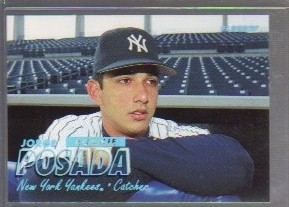
From a newsmaking perspective, it was a relatively quiet winter for the Yankees. They took care of the CC Sabathia contract early; Jorge Posada’s retirement marked the next phase of the end of the Core Four; the pursuit of CJ Wilson wasn’t as aggressive as the pursuit of Cliff Lee a year ago, so it wasn’t as much of a shock or a perceived loss when the Orange County Angels signed him. The Yankees did make the backpages — in baseball-related news, anyway — by trading Jesus Montero and Hector Noesi to the Seattle Mariners for Michael Pineda. Shortly thereafter they signed Hiroki Kuroda. The respective deals left no doubt that Allan James Burnett’s time as a Yankee was limited.

And so it was that the Yankees ended the Burnett Era on Friday by paying the Pittsburgh Pirates $20 million to take him off their hands in exchange for two minor leaguers. Burnett can now put the “Pie” in Pirate.

The timing of the Burnett trade was similar to the one that sent Alfonso Soriano to the Texas Rangers in exchange for Alex Rodriguez eight years ago, although to be sure it is not nearly as significant a deal, and it won’t cause anywhere near the circus that A-Rod did. Jettisoning Burnett is more of a simple “addition by subtraction” move. There were many who viewed getting rid of Alfonso Soriano similarly (considering what he has become, and how that move indirectly pave the way for Robinson Cano’s emergence, maybe the folks with that view were correct).

Monday’s signing of Raul Ibanez assures they have a left-handed hitting DH who can also play a little outfield to spell either Brett Gardner or Nick Swisher. It also marks a homecoming for Ibanez, a native New Yorker. Look for many of those stories over the next six weeks, particularly as the Yankees prepare to break camp.

Other than the typical puff pieces — how does the pitching staff shape up, particularly now with three arms under the age of 30; how is the respective health of the aging left side of the infield; who is the 25th man, etc. — it figures to be a quiet Spring. That was until Mariano Rivera revealed that 2012 would be his final season.

Even with the buzz Mo’s statement caused both locally and nationally, it won’t cause nearly the level of craziness that David Wells’ book, Jason Giambi and Gary Sheffield’s respective roles in the BALCO scandal, a certain trip to Japan, or the afterglow of a World Series championship did. And that’s fine by the Yankees. It leaves more time and room for Jeremy Lin and the Knicks to own the spotlight.

Won’t Be the Same Without You

That’s what I thought when I read this farewell to Yankee blogging post by our old pal Cliff Corcoran. Of course, you can read Cliff all season long over at SI.com but it looks like his days as a Yankee blogger are over. It’s good news for him–he’s got wonderful reasons for calling it quits–and sad news for us, if we’re going to be selfish about it. Cliff’s series previews have been a part of the fabric of each Yankee season here at the Banter for years. They will be missed.

It’s been a terrific run. Congrats, Cliff. And again, we’ll be reading you over at SI.com.

You’re the man.


New York Minute

Found on the walk between uptown pre-schools a few weeks ago: one of New York City’s greatest mysteries.

To me, anyway. The first time I remember seeing sneakers strung across telephone wires I was in the Bronx around Yankee Stadium. I asked why, and I’m sure I received an answer, but the answer didn’t have sufficient tack to stay with me.

Here are a bunch of theories, though not exclusive to New York. I like the idea that when you get a new pair, you throw the old ones up there. And since my wife snapped this pic on a block between my kids’ schools, let’s be tooptimistic and rule out the crack, murder and gang-related explanations.


Observations From Cooperstown: Russell the Muscle and A.J. the Ex-Yankee

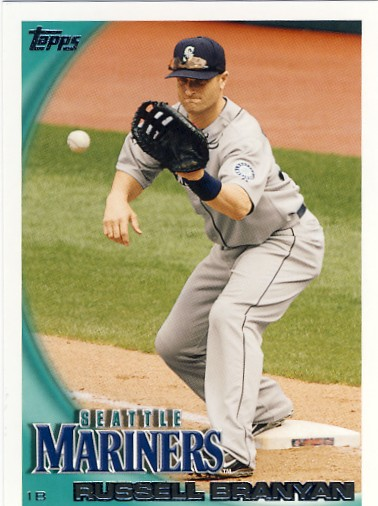
The Yankees might actually have a good bench in 2012, something we haven’t been able to say very often over the past decade. With returnees Andruw Jones, Chris Dickerson and Eduardo Nunez and free agent acquisitions Bill Hall and Russell “The Muscle” Branyan all in the mix (and Eric Chavez possibly on the way), the Yankees have a chance to cobble together a decent corps of backup players.

Put me down in favor of the Yankees’ signing of Branyan to a minor league contract. Although he’s 36 and coming off a bad season split between Arizona and Los Angeles (the Angels, not the Dodgers), he has enormous power, the kind of power that makes teams pull out the tape measure when he makes contact. I’ve seen Branyan hit some absolutely monstrous home runs, particularly to center and right-center field. He’s one of the strongest players I’ve ever seen, right up there with Reggie Jackson and Willie Stargell in his ability to hit for sheer length. Of course, he hasn’t hit nearly as many home runs as those two Hall of Famers, so that’s where the comparison has to stop.

Branyan also draws a decent number of walks and has a history of success at Yankee Stadium. (He’s the only player to hit a home run against the glass facing of the center field batter’s eye at the new Stadium, having accomplished that feat in 2009.) The key to Branyan’s situation with the Yankees is this: can he still play third base? If he can, then he gives the Yankees someone who can spell Alex Rodriguez against the occasional right-hander, while also providing backup at first base and at DH.

A check of Branyan’s record at Baseball Reference shows that he appeared in two games at third base for the Angels last season. Prior to that, you’d have to go back to the 2008 season for any prior experience at the hot corner; he made 35 appearances at third for the Brewers that season. So it remains somewhat questionable whether Branyan can log any serious time at third base at this late stage of his career.

If Branyan cannot play third, then his value would lie mostly in his ability to DH against right-handed pitching. As a DH, he would need to revert to his 2010 level in order to be helpful. That summer, he slugged 25 home runs and slugged .487 for the Indians and Mariners.

So there are plenty of questions regarding Branyan. But on a minor league contract, with a relatively small salary coming to him if he makes it to Opening Day, Branyan is worth a look. Besides, how can you not love a guy nicknamed Russell the Muscle?..

***

How do I feel about the possibility of trading A.J. Burnett? Where do I sign? Or perhaps I should say, “Great trade, who’d we get?” Even if the Yankees acquire little of value in exchange for Burnett, they figure to save $3 to $4 million in 2012 salary and can then use that money to add a left-handed DH or another piece to the growing bench. And if Brian Cashman is able to pry a meaningful player out of Pittsburgh in the deal, that’s all the better.

Media reports indicate that three or four teams are interested in Burnett, including the Pirates. The Yankees asked for Garrett Jones in a Burnett deal, but were quickly rebuffed by the Bucs. Jones is a left-handed hitting first baseman/outfielder with power, so he’d be a fit for the role as a platoon DH role and backup outfielder. On the downside, he’s already turned 30, is not a nimble defender, and has seen his OPS fall from .938 to .753 over the past three seasons. Therefore, a player like Jones should not be a dealbreaker. Perhaps the Yankees can throw in another player, or perhaps they can find another match on the Pirates’ roster. How about a left-handed reliever like Tony Watson, who could then compete with Boone Logan and Hideki Okajima for the southpaw bullpen role? Or perhaps a minor league outfielder like Gorkys Hernandez?

The fact that the Yankees are engaging teams in serious discussions for Burnett indicates that the enigmatic right-hander has little future in the Bronx. Even if he’s not traded, he has no guarantee of returning to the rotation. He’ll have to beat out both Freddy Garcia and Phil Hughes for the fifth spot, which is no small task. If Burnett is not traded and has a bad spring, the Yankees still have the option to stick him in the bullpen and use him as a long man. The bottom line is this: Burnett has no birthright to the starting rotation, not after the way he’s pitched the last two seasons.

So start the clock on Burnett’s departure from New York. I’d put it better than 70/30 that he’s an ex-Yankee by the end of the month. Heck, it might happen before the Yankees open camp on Sunday. I’d imagine quite a few readers of Bronx Banter would be pleased by that possibility…

***

Now that Luis Ayala has signed with Baltimore, there may be an opening in the bullpen for another right-handed reliever. It could be filled by Manny Delcarmen, who is one of the more interesting names among the 27 non-roster players that the Yankees have invited to spring training. First, the bad news. Delcarmen didn’t pitch at all in the major leagues last season, and he struggled badly in Triple-A ball for two different organizations. Now the better news. He’s only 29, is durable, has had decent success against the American League East in his career, and has plenty of postseason experience.

In 2007 and 2008, Delcarmen was highly effective as a Red Sox set-up reliever, striking out nearly a batter per inning with a WHIP near 1.00. He has struggled badly since then, resulting in a demotion to the minor leagues last spring. In many ways, he reminds me of Ayala–at one time an effective reliever who has fallen on hard times. He’s just the kind of reclamation project that pitching coach Larry Rothschild specializes in, so it’s worth the relatively small gamble of a minor league contract.

When he’s right, Delcarmen throws in the mid-90s and has an excellent curve ball, which he uses as his out-pitch. Remember, Joba Chamberlain won’t be ready by Opening Day, Burnett could be traded, and Cory Wade, while effective in 2011, seems like a candidate for regression in 2012. So Delcarmen has a chance to make the team as the 12th pitcher–and that might not actually be a bad thing.

[Featured image photo credit: Nick Laham/Getty Images]

Bruce Markusen writes “Cooperstown Confidential” for The Hardball Times.

Morning Art

The Kid Stays in the Picture.

Street shot by our man Bags.

Observations From Cooperstown: Bill Hall, Mel Hall, and Jimmie Hall

The Yankees’ rumored interest in free agent utility man Bill Hall is a bit puzzling. Should we interpret that interest as a sign that the Yankees do not believe that Eduardo Nunez can handle the defensive responsibilities of being a utility infielder. Alternatively, is it a signal that the Yankees would like to trade Nunez, perhaps in a deal for a left-handed bat who can fill part of the DH role? To be honest, I’m not sure which of those thought processes are running through the mind of Brian Cashman.

Still, Hall is an interesting player. In 2006, he hit 35 home runs as a starting shortstop and looked like a budding star at the age of 26. Stardom never happened. In 2010, he was a reasonably productive utility man for the Red Sox, filling in around the infield and outfield. Then he signed a free agent contract with the Astros, where he flopped as the team’s everyday second baseman. After being released by the ‘Stros, the Giants took a flier on him, but watched him hit a mere .158 in 38 late-season at-bats.

Now 32 years old, Hall will never be a 30-home run man again, that’s for sure. But if he can revert back to the player of 2010, a versatile player who can play three infield positions and all three outfield positions while hitting with some pop, he’s be a useful guy to have. If not, if his 2011 numbers are an indication of his true current ability, then the Yankees will have to tread lightly here. If they sign Hall and trade Nunez, there may not be a safety net available in the event of a Hall breakdown.

When you’re a baseball fan, it’s funny how the mind works. When I hear the name “Hall,” I think of the Hall of Fame, and I think of past Yankees with the same last name. The Yankees have not had a player named Hall since the now-infamous Mel Hall, who was one of the team’s bright spots during the fallow years of the early 1990s. Hall played hard, pounded right-handed pitching, and delivered his fair share of clutch hits, but then he took some “hazing” of a young Bernie Williams to ridiculous extremes, driving the young outfielder to the verge of tears. He repeatedly referred to Williams as “Zero.” When Williams began talking in Hall’s presence, the veteran outfielder chided him by yelling, “Shut up, Zero.” Why this treatment was allowed to go on unchecked remains one of the great mysteries in Yankee history.

Hall also failed to make friends with the front office when he brought his two pet cougars–yes, a pair of pet cougars–into the Yankee clubhouse without warning, creating a mild panic in the process.

Yet, the hazing and the cougar incident pale in comparison to Hall’s post-career problems. Hall is currently sitting in a federal prison, where he will remain until he is old and gray because of his repulsive relationship with two underage girls. Hall was convicted of sexual assault; he essentially raped the girls, one of whom was 12 at the time of the relationship. Sentenced in 2009, he will have to serve a minimum of 22 years, or the year 2031, before he is eligible for parole. If he does not gain parole, the total sentence will run 45 years, putting him behind bars until 2054. Hall is 51 now, so that would put him at a ripe old 93 years. So who knows if he’ll even live that long.

There is one other “Hall” that I remember playing for the Yankees. He was Jimmie Hall, a left-handed power hitter of the 1960s. He began his career with a flourish, putting up OPS numbers of better than .800 in his three major league seasons with the Twins. As a rookie, he set a record for most home runs by a first-year player in the American League, busting the mark set by Ted Williams in 1939. He also had the ability to play all three outfield spots, making him particularly valuable toMinnesota.

Apparently on the verge of stardom, Hall then fell off the map. He struggled so badly in 1966 that the Twins traded him to the Angels. Some say his early decline was the result of being hit in the head with a pitch. Others pointed to his inability to handle left-handed pitching. And then there were those who felt that he was done in by the changes to the strike zone that hurt so many hitters during the mid-to-late sixties, when the second deadball era set in.

By the time that Jimmie Hall joined the Yankees, he was a fragment of the player who had once torn through the American League. The Yankees acquired him early in the 1969 season, picking him up from the Indians in a straight cash deal. Hall came to the plate 233 times for the Yankees, but hit just three home runs and reached base only 29 per cent of the time. Even in a deadball era, those numbers didn’t suffice.

Hall didn’t last the season in theBronx. On September 11, the Yankees dealt Hall to the Cubs for two players with wonderfully opposite names, minor league pitcher Terry Bongiovanni and outfielder Rick Bladt. If you remember either of those players, give yourself a cigar.

So that’s it for the Yankees’ legacy of Halls. Mel and Jimmie. If the Yankees end up signing Bill Hall, we can only hope that he’ll be a better player than Jimmie and a better man than Mel.

Bruce Markusen writes “Cooperstown Confidential” for The Hardball Times.

New York Minute


A pair of sisters walked onto the train at 145th st this morning. I pegged them at eight and twelve. They both carried brown paper bags and the younger sister opened her bag and extracted a muffin. She raised it to her mouth with her right hand and took a bite. As she ate, her left hand lost interest in holding the bag and she dropped it to the floor.

Our eyes followed the bag to the floor and then as we reset our viewpoints, we found ourselves staring at each other. There was a fraction of an instant of panic in her eyes as she realized that I witnessed her blatant littering. She recovered quickly and replaced the panic with confidence, perhaps remembering that littering is not a crime and that I was not a cop.

I took her confidence as a challenge, though one I had no desire to take up. I don’t like littering, but I had already spent half an hour trying to get children to listen to me earlier this morning without any hint of success, and those children depend on me to delineate the borders of the DC and Marvel Universes and to unlock the cabinet containing the cereal. This little girl doesn’t need anything from me.

I did not accept her challenge, but I also didn’t want to let her off the hook completely. I searched for a facial expression that could convey disappointment and rejection at the same time. My go-to is a ponderous head shake, eyes closed, with a slight frown. Too engaging for this situation. I thought of an exaggerated frown. But it seemed like that was an admission of defeat rather than a dismissal.

I settled on a quick combo. A heavy eye roll and a weird lip scrunch. I wanted it to say “Whatever. Litterer.”

I don’t think it worked, and I’m sorry that somebody else to pick up the brat’s garbage, but I’m glad I didn’t get in an argument with a little girl.


[Brown Bag via stelladoll7]

The Hitting Catcher

The Yankees have won 27 World Series titles, 24 of those teams have featured good hitting catchers. The Yankees have qualified for the postseason 51 times, or would have if not for the season-ending strike of 1994, and 44 of those teams have featured good hitting catchers. (Forgive me, I used OPS+, which I know measures nothing, but is right there on the main stat line of baseball-reference.com’s team pages and tempts the weak.)

When the Yankees have not merely good, but great hitting catchers they really cash in. Yankee teams with starting catchers (again, by baseball-reference’s definition) sporting an OPS+ of 130 or higher won an average of 99.3 games (prorated for a 162 game season where necessary). When their catcher was between 110-129, they won 96.8 games. The average hitting catchers (90-109) played for teams that won 89.9 games and when the catchers could not hit at all, they won 84 games per season.

By no means is this to say that these players are solely responsible for the successes and failures. But I do think their presence on the roster makes a significant contribution. There are other ways to win for sure, but if it ain’t broke… 

Typical offensive output behind the plate is so anemic that when a catcher carries a big stick, it’s an obvious advantage. Factoring in the financial clout of a team like the Yankees, the team does not have to skimp on the rest of the lineup to accomodate a star catcher, cements the gain. The Yankees built dynasty after dynasty on the backs of good hitting catchers.

Dickey, Berra, Howard, Munson and Posada all spring easily to mind. But important platoon guys filled in the cracks. Aaron Robinson helped usher in the Yogi-era; Pat Collins backstopped the legendary late twenties teams. Before them, Wally Schang contrbuted mightily to the first World Series teams by getting on base at a .403 clip from 1921-1923. And as Bruce Markusen pointed out the other day, Mike Stanley helped slug the Yankees out of the misery of the early 90s.

Joe Girardi is the worst hitting catcher on a championship Yankee squad. Most, including me, would forgive him his 75 OPS+ as a Yankee for his triple off Greg Maddux and his graceful yielding of his position to Jorge Posada in 1998.

Now that same light hitting catcher is at the helm as the Yankees try to create their next dynasty. The trade of Jesus Montero means that there is nary a hitting catcher in sight (depending on your squinting abilities). Or if you prefer, the trade of Jesus Montero is probably an admission by the Yankees that he could not be a hitting catcher. Regardless, if the Yankees successfully build a dynasty without one, it’ll be the first time.

But as Yoda might have said, there is another Montero.

Miguel Montero is a good hitting catcher from Arizona who might become a free agent next year. And he can catch it, too. If he does become available, the Yankees could be in the market. Over at RAB, Mike Axisa takes a look at what it might take to get him.

Under normal operating conditions the Yanks would rather have Michael Pineda and Miguel Montero at catcher over Jesus Montero as a non-catcher. But these are not normal times. If the $189 million ceiling for the 2014 team is made of bricks, then signing Miguel Montero to a market-rate deal next offseason makes everything else they have to do that much harder.

Where the Yankees go from here is anybody’s guess. Their minor leagues contain promising catchers, though the hitters are far away from the show. For a team whose championship DNA is riddled with catcher code, if they aspire to another dynasty, I hope a catcher is coming soon and he’ll be bringing a big bat. 


Beat of the Day

Alex is out sick, but he still found time to give us a beat for the day.

Observations From Cooperstown: Ibanez, Mike Stanley, and Burnett

So who will be the Yankees’ designated hitter? The first DH name that came up in the aftermath of the Jesus Montero trade was Carlos Pena. But he wanted too much money for the Yankees’ liking and returned to Tampa Bay. The second name belonged to Johnny Damon, who instead expressed an interest in returning toDetroit, only to see the Tigers sign Prince Fielder to that ridiculous nine-year contract. So Damon is still in play for the Yankees, at least for the moment. Next up on the list is former Phillie, Mariner, and Royal Raul Ibanez, who is also a free agent. My reaction to the possibility of Ibanez becoming a Yankee? Don’t touch this guy with a ten-foot bat, corked or otherwise.

Ibanez is a native New Yorker, a good guy with a strong clubhouse reputation, and a left-handed hitter with power, so it’s only natural that his name would come up in connection with the Yankees. But that’s where the interest should begin and end. At one time, Ibanez was a fine hitter with the Royals and Mariners, capable of slugging at or near .500. Those days are over. He’s 39, hit only 20 home runs last year despite playing in a hitter’s playground, and slugged a mere .419. His on-base percentage was more strikingly worse, a meager .289. This guy’s not a lefty DH. He’s barely even a good pinch-hitting candidate at this point in his career.

With Ibanez, there’s no consolation coming from his defensive play. Though he spent the last three years playing left field for the Phillies, his fielding is–and always has been–atrocious. There’s a video somewhere on the Internet from a game in which Ibanez is playing for the Mariners against the Yankees. After he fields a ground ball down the left field line, Ibanez attempts to throw the ball back toward the infield, but he instead accidentally spikes the ball, which travels a few feet to the right and straight down to the ground. Video records are incomplete, but it may be the worst throw in the history of major league baseball.

Of course, that play represented Ibanez at his worst, but his general level of fielding acumen ranks somewhere between bad and poor. For his career, TotalZone puts him minus 5 for his play in left field, a ranking that matches his awful reputation. As a point of comparison, former Yankee Marcus Thames has a career TotalZone of minus three. So, by this rating, Ibanez is even worse than Thames, a frightening proposition. Yikes.

So other than DH, there’s no where to play Ibanez without risking further embarrassment. And if he’s not good enough as a hitter to be a DH, then there should be no role for him on the 2012 Yankees…

***

In assessing the great catchers of Yankee lore last week, I discussed Jorge Posada and Thurman Munson while referencing Elston Howard, Yogi Berra, and Bill Dickey. Though he was neither a particularly strong defensive player nor a longtime Yankee, I should have included at least a footnote mention of Mike Stanley. In terms of pure offense, Stanley was one of the best catchers the Yankees have ever had, putting up OPS numbers of .800, .923, .929, and .841 from 1992 to 1995. In 1993, he even received some votes in the MVP balloting. Stanley’s emergence as the No. 1 catcher coincided with the Yankees’ return to glory in the mid-1990s.

Why have we forgotten Stanley so quickly? Unfortunately, he didn’t join the Yankees until he was 29, the result of one of Gene Michael’s prudent free agent signings. He played four full seasons in New York, left when the Yankees acquired Joe Girardi, spent a year and a half with the Red Sox, and then returned to the Yankees as a DH for the tail-end of 1997. As a matter of bad luck, he missed the Yankees’ 1996 title while in Boston, and was not brought back for the world championship season of 1998. The end result was zero titles for Stanley.

The emergence of Posada over the last decade and a half also made it easier to overlook the prior contributions of Stanley. But Stanley was a very good player, a right-handed hitter with power who had a terrific opposite field stroke, and brought the kind of patient, grinding style at the plate that became a hallmark of the Yankees in the mid to late-1990s. He wasn’t Posada and he wasn’t Munson, but Stanley was an important part of the Yankee turnaround, and that makes him an important part of franchise history…

***

A few Yankee fans have asked me which of their bottom-of-the-rotation starters will be traded between now and Opening Day. I don’t think it will be Phil Hughes, if only because the Yankees would be trading him while his value is so low. This Yankee administration hasn’t forgotten that Hughes was once their top prospect, and the front office would love nothing better than to see Hughes report to spring training in good shape and take aim on the potential that he seemed to be tapping two years ago. I also don’t think that the Yankees will trade Garcia, who is probably the one pitcher best suited to serving as a long man/spot starter. Nothing seems to phase “The Chief,” so I’d expect he’d handle the Dick Tidrow/Ray Burris/Ramiro Mendoza role without a hitch.

That leaves A.J. Burnett, who still has two years to go on that nonsensical contract and continues to be Yankee fans’ greatest source of frustration. Is Burnett tradeable? Sure, anyone is, assuming that the Yankees pick up enough of his contract. But I do get the feeling that Brian Cashman will want something tangible in return, whether it’s a lefty DH or a utility infielder. If the Yankees eat something like 80 per cent of the $33 million owed to Burnett, then Cashman will expect a player in return, and not just some 25-year-old middle reliever pitching in Class-A ball.

There have been suggestions of a swap sending Burnett to the Cubs for Alfonso Soriano, but there is a problem with that. Soriano has three years remaining on his monstrosity of a contract, meaning that the Yankees would have to commit an extra year compared to the two years left on the Burnett deal. Soriano also happens to be a right-handed hitter, making a platoon with Andruw Jones a bit unfeasible.

Still, there may be a deal out there somewhere. At the right price, a team might just think that it can fix A.J. Burnett.

Bruce Markusen was born on January 30. Hey, that’s today!

[Drawing by Larry Roibal]

Sundazed Soul

Morning.

[Picture by Bags]

Saturdazed Soul

But I can see clearly now the rain is gone.

[Picture by Bags]

New York Minute

As the subway train settled at its first stop this morning, a voice rang out. “Dyckman St! This is a downtown A Train to Lefferts Boulevard. Next stop is 190th St. Stand clear of the closing doors. Please!”

The voice did not come over the PA however. It belonged to a child. I scanned the faces of the other riders, some hadn’t flinched, no trace of amusement. But many others were smiling, a few even chuckling.

Each successive stop the little boy bellowed the information. Starting at 168th St, it gets complicated. He included all the transfers. His only slip up came when he started his 125th St call a few seconds too early. He stopped, regrouped, and delivered again in full when the train finally arrived.

At each stop he lost some support. A few of the initial smiles disappeared. New passengers were more suspicious, maybe because they weren’t present at the outset and weren’t sure how to respond.

There was one man, however, sitting with his back to the boy, and he was delighted. He was an older Black man, with a graying beard, a slim face and one of those fashionable knit driving caps that looks way cooler on him than on me. He braced himself for each stop and when the kid began shouting he broke out in a big grin. He nodded his head along with the accuracy of the information, like a proud teacher.

When there was a thinning of the crowd at one stop, I leaned over to catch a glimpse of the orator. It was one of my neighbors, six years old, named Jack. Thanks for the laugh this morning Jack. And for one guy at least, you made his day.

Legacy Students

Joe Paterno died Sunday at age 85. Life and career retrospectives abounded. Wins and losses were mentioned, as were bowl game triumphs, the iconic look he brought to the sidelines every Saturday. Most of all, his contributions to the “student athlete” and the culture he created outside the gridiron and the towering edifice that is Beaver Stadium were discussed.

Not be ignored, though — and it wasn’t — was his role, his actions and his inaction regarding a certain former assistant coach and alleged pedophile. The Onion’s satirical headline spoke volumes: “Joe Paterno Dies In Hospital; Doctors Promise to Tell Their Superiors First Thing Tomorrow”.

Legacies are meant to demonstrate an example to be set for successors. Sounds simple but legacies are complicated. Look at Ty Cobb, Babe Ruth, Pete Rose, Woody Hayes, Bear Bryant, Bobby Knight, Vince Lombardi, Wilt Chamberlain, Mike Tyson, Michael Jordan, Magic Johnson, Tiger Woods, Kobe Bryant, Lawrence Taylor, or most recently, Bill Conlin. Look at any iconic athlete, coach, writer, celebrity or politician whose indiscretions  made them as infamous as their contributions to their chosen fields made them famous. Look at the names I just listed. If we were playing word association, you could probably think of the words racist, drunk, womanizer, gambler, bully, insane, drug addict or kid toucher as quickly as you could think of Hall of Famer, Hit King, 714 home runs, 6 titles or  14 majors. Bryant, winner of 5 NBA titles and still considered in many circles the best player in the sport, was acquitted of the rape charges nine years ago; yet when a philandering husband suddenly buys a lavish gift for his spouse as a means of apologizing, it’s called a “Kobe Special.”

Observing how the media has treated those players and coaches over the years, has there been a reluctance to hold any of them accountable for their actions? In many cases, no. Thus, in reading and listening to the Joe Paterno tributes, I was curious how the media would address Paterno’s role in the Jerry Sandusky scandal in the context of his legacy.

The common refrain was that while we can’t dismiss his management of the Jerry Sandusky situation, we shouldn’t let that cloud our view of the man. If you knew someone who had a reputation of always going above and beyond for others, yet suddenly did the bare minimum and expected that to be enough, what would you think?

In The Nation, Dave Zirin wrote:

…according to our conception of who this man was supposed to be, there was no authority above Joe Paterno. There was instead an expectation that this man of integrity would without hesitation do far more than just fulfill his minimum legal requirements. Is that fair? When it’s your statue on campus and when the buildings bear your name, most would say hell yes.

Howard Bryant wrote one of many commentaries for ESPN.com on Paterno’s death. He brought forth a similar sentiment as Zirin:

…Paterno had too much power with not nearly enough oversight. He was bigger than the school, and the school cowered to him. Paterno gave millions back to Penn State; and as his power grew and grew unchecked over four decades, the university lost the ability to control whether he was benevolent or a tyrant.

It was not a power particularly special to Paterno, but to his industry. The entire culture of the coach deserves deconstruction and revision, for the same can be said in varying degrees of Bryant and Knight, Bowden and Calhoun, Krzyzewski and Boeheim.

When it was time for Paterno to use the power that he had accrued — when he became aware that for years, children allegedly were being molested under the ceiling of the football monument he had built — he did not lead.

Joe Posnanski is writing a book about Joe Paterno. He did not blog about JoePa’s death, but he filed a piece for SI. The last words of the column quote Paterno, who said that “hopes the victims find peace.” Posnanski precedes the quote by writing that Paterno wanted his life measured in totality rather than by “a hazy event involving an alleged child molester.”

Perhaps the most vivid piece of writing about “the hazy event” and Paterno can be found in  this diary. Warning: it’s not for the sensitive. It is heart-wrenching, explicit, and likely represents the anger of many who have sat back and thought “WTF?” regarding Paterno, Sandusky and the events of the past two months.

Jeff MacGregor also posted for ESPN.com, with a take that I’m sure will be used in the Sport Studies curriculum at universities across the country. I’ve written in this space about man, myth, and legend; I did so in my first story on this topic back in November. MacGregor is much better with metaphor:

Joe Paterno was no more and no less than human, and no living man can contend with his own legend. No man can live in his own shadow.

A bronze statue of Joe Paterno standing seven feet high and weighing 900 pounds was swung into place at Penn State on Nov. 2, 2001.

Four months later to the day, March 2, 2002, Mike McQueary stood at Joe Paterno’s door. He had a terrible story to tell.

There’s a poignant scene in “The Deer Hunter” near the intermission when Robert De Niro’s character, Michael  is carrying Steven (John Savage), a badly injured friend, over his shoulder to safety. It is one scene among many makes the film’s title so significant; Michael is carrying Steven the same way he’d carry a deer after shooting it. Steven had become the deer carcass. Similarly, is it not reasonable to believe, based on MacGregor’s closing paragraphs, that four months after his statue was erected at Penn State, that Paterno became the statue?

Paterno told Posnanski he wanted the victims to have peace. The first step could have been taken right then and there. Maybe even sooner. That, for many, is the focal point of any discussion about the late Joe Paterno’s legacy. And in the cumulative analysis of the man, the coach, the academic, the philanthropist, benefactor and humanitarian, we cannot be afraid to hold him accountable for that.

[Photo Credit: Dr Brady]

Beat of the Day

Extra points if anyone can guess who sampled this one (no cheating, now).

[Picture by Bags]

Card Corner: 1972 Topps–Felipe Alou

As hard as it is for me to believe, I started collecting baseball cards 40 years ago. (Yes, I am becoming old.) To celebrate the anniversary, along with a set that collectors now consider iconic within the hobby, I’ll be spotlighting certain Yankee players from the 1972 Topps collection here in 2012.

For some reason, Topps chose yellow as its baseline color for Yankee cards. Yellow has never been part of the team’s color scheme; it has always been Navy blue and white, with some red thrown into the old Yankee Doodle hat logo. But yellow is what Topps selected, making that the color of memory for the ‘72 Yankees.

As with all of the regular issue ‘72 cards, Yankee players appeared in photographs that were either portraits, profiles, or posed shots. Topps did issue some “In Action” cards for a few Yankees, including Thurman Munson, Johnny Ellis, and Fritz Peterson, and we’ll tackle some of those throughout the year. But our emphasis will be on the regular issue cards, which were photographed at the original Yankee Stadium, various American League ballparks, or at the Yankees’ spring training site inFt.Lauderdale.

So let our tour of 1972 cards begin, with a player who is not often remembered for being a Yankee. Felipe Alou’s card shows him wearing the Yankees’ road uniform in a ballpark that may or may not be Anaheim Stadium. The photo, which is slightly out of focus, shows Alou finishing a practicing swing while giving the cameraman a serious stare. As posed shots go, it is classic Topps.

For those who recall Alou as the manager of the Expos and Giants, it’s easy to overlook just how good a player he was throughout the sixties and early seventies. The native Dominican was one of those five-tool players we hear so often about, but rarely get to see. In his prime, he hit with legitimate power, ran well enough to steal 10 to 12 bases a year, batted in the .280 to .290 range, and possessed enough arm and range to play all three outfield positions. Alou wasn’t quite a Hall of Famer–he was a couple of notches below that–but he was a damned fine ballplayer.

The peak of his career came in 1966, when he played center field for the Atlanta Braves and led the National League in hits, runs, and total bases. With a career high 31 home runs and an OPS of .894, Alou placed fifth in the league’s MVP voting.

By the time that he joined the Yankees early in 1971, Alou was no longer that same player, no longer in his prime. But he was still serviceable, a good role player who gave the Yankees depth in the outfield and at first base. The Yankees acquired him on April 9 of that season, just four days after the opening of the season. They acquired him from the Oakland A’s, who had deemed him valuable enough to be their Opening Day starter in left field.

In truth, Alou had been the center of trade rumors from the latter days of spring training through the first week of the regular season. There had been talk that the A’s might send him to the Brewers for some infield depth, but the Yankees apparently made Charlie Finley an offer that he felt was superior to what was presented by the Brewers. The Yankees sent Finley two pitchers, right-hander Ron Klimkowski and left-hander Rob Gardner. They were two decent middle relievers, but neither was expected to play a huge role with the Yankees in 1971. In fact, Gardner had been sent out to Triple-A Syracuse just before Opening Day.

The consensus of scouts maintained that Finley had not received enough value in return for Alou. The Oakland players knew that they would miss Alou, one of the most well-liked and respected players throughout the major leagues. A’s captain Sal Bando had once offered Alou the highest of praise. “He’s one of the greatest men I’ve ever met in baseball,” Bando told Ron Bergman, the A’s’ beat writer. “You think a man who’s been around as long as he has would pace himself a little. But he embarrasses you the way he hustles.” Yankee management was simply thrilled to have acquired a veteran leader and professional hitter.

Though there had been rumors of a possible trade, the timing of the deal—just a handful of days into the regular season—caught Alou by surprise. He had just moved his wife and children into an Oakland apartment, where they were scheduled to stay for the entire ‘71 season. Those plans would have to be scrapped, but the Yankees graciously gave Alou the necessary time to move his family out of the Oakland apartment and make new accommodations in the New York metropolitan region.

When Alou finally reported to the Yankees a few days later, he found an interesting way to find something positive in being traded from Oakland to New York. It involved the simplicity of his uniform. “At least I know this is the uniform I’m going to be wearing everyday,” Felipe told the New York Times in referring to the traditional home Yankee pinstripes. “Out there, I didn’t know which [A’s] uniform to wear when. We had one uniform for the first game of a doubleheader and another for the second.  Once I put on the wrong uniform.”

Indeed, the A’s led both leagues in the number of uniform combinations. On some days, the A’s wore Kelly green uniforms with gold undershirts. Then there were games when they donned white jerseys (wedding gown white, as Finley called it) and pants with green sleeves. On other days, they wore Fort Knox gold uniforms with green undershirts. Life would be much simpler with the Yankees: pinstripes at home and standard gray on the road.

Five days after the trade, on April 14, Alou made his Yankee debut wearing the pinstripes. He started in right field at The Stadium against Tigers left-hander Mickey Lolich. Alou went just 1-for-5 that day, but he made the one hit memorable–a solo home run that was part of an 8-4 victory over Detroit.

Alou’s arrival in New York also created confusion for us young Yankee fans. We assumed that his name was pronounced “feh-leep ah-lew.” We didn’t realize that you had to pronounce the final “e” in his first name, making it “feh-leep-ay.” For some reason “feh-leep ah-lew” sounded right. But we were wrong, as we often were with the pronunciations of Latino ballplayers.

Alou would become a semi-regular for the Yankees in ‘71, at first playing right field, then moving to first base. He played 56 games in right field, 42 games at first base, and even filled in 20 times in center field. At 36 years of age, he was hardly a force–he powered only eight home runs and slugged a mere .410–but he did hit .289 with an on-base percentage of .334. Under ideal circumstances, he would have been a platoon player for a strong contender, but at 82-80, the Yankees needed him to take on a more prominent role.

With his speed diminishing, the Yankees reduced his outfield role, making him a platoon first baseman with Ron Blomberg. They hoped that Alou could produce at his 1971 level, but one year older, his play continued to fall off. He played only 120 games, his lowest output since his 1969 season with the Braves. He hit only six home runs as his slugging percentage fell below .400. By now it was obvious that Alou could no longer play every day, and might not even be able to help in much of a bench role, but the Yankees brought him back for 1973.

Though Alou’s skills were waning, the Yankees appreciated his demeanor and attitude. When a reporter asked manager Ralph Houk whom he considered the team leader, the skipper thought for a moment before responding, “I’d say Felipe.” In terms of fundamental and professionalism, no one on the Yankees matched Alou. “Felipe plays every day like a pro,” Houk told Yankee beat writer Jim Ogle in 1973. “Have you ever seen him make a mistake? I’m talking about judgment, not [physical] errors. Everyone makes errors, but Felipe doesn’t do the wrong thing very often. Have you ever watched Felipe go down the line, then take the turn at first base on a hit to the outfield? If there is even the slightest bobble, he’s on his way to second.”

Alou’s 1973 season with the Yankees would provide an intriguing twist. The Yankees had made a wintertime deal, sending journeyman Rob Gardner (who had since rejoined the team) and Rich McKinney to the A’s for right fielder Matty Alou. For the first time since 1964, the Alou brothers would play as teammates, just as they had done with the Giants. In fact, withSan Francisco, all three of the Alous—Felipe, Matty, and Jesus—had played together in the same outfield. (The three would have a reunion of sorts in 1973. When the A’s, featuring Jesus Alou, came to Yankee Stadium for a series in 1973, photographers made sure to snap shots of the three brothers together. One of these photographs would become the basis for an SSPC baseball card in 1978.)

Three specific memories stand out for me from the Yankees’ 1973 season. That was the year that George Steinbrenner assumed control of the franchise. That was the spring that Mike Kekich and Fritz Peterson announced the trade of their wives, children, and family pets. And that was the year that the Alous, reunited after a nine-year absence, became two of the notable faces of the Yankee franchise.

The Yankees made Matty their starting right fielder. They put Felipe back at first base. Facially, they looked somewhat alike, which created confusion for some Yankee fans. But for me, it was easy to tell them apart. Felipe wore glasses; Matty did not. Felipe was tall and batted right-handed. Matty was short and batted from the left side.

Matty hit well and fielded well, but it was strange that the Yankees used him, a singles hitter with virtually no power, to bat third instead of leadoff. Felipe struggled, his play falling off even further after the decline of 1972, and he lost the first base job. Interestingly, the Yankees replaced Felipe with Matty, who moved to first base despite being only five feet, nine inches tall. Felipe eventually made some starts in right field, mostly against left-handed pitching, as he platooned with Johnny Callison. But Felipe just couldn’t hit anymore. At age 38, he had lost most of his batting skills.

When the Yankees fell out of contention that summer, the front office felt it was time to move out some of their past-their-prime veterans. So they released Callison. A few weeks later, they decided it was time to cut ties with the aging Alous. On September 4, the Yankees announced two separate but related transactions. They sold Matty to the Padres. They also sold Felipe on waivers to the Expos. It was only fitting that the brothers would depart New York on the exact same day.

Felipe Alou batted .208 in 20 games for the Expos, who sold him to the Brewers after the season. Alou batted three times with Milwaukee, without a hit, and then drew his release. And thus came to an end a 17-year career in the big leagues.

Alou would never return to the Yankee organization. But he and the Yankees nearly enjoyed a reunion of sorts in 1994. Alou, by now the manager of the Expos, was leading his team to the best record (74-40) in the National League. In the meantime, the Yankees led the American League East. Then came the strike. If not for the labor/management conflict canceling the rest of the season and the World Series, it’s quite possible that Alou would have met the Yankees in the Fall Classic.

Like so many possibilities in baseball, it just never did come to pass.

[Photo Credit: Attic Insulation]

Leave the Gun. Take the Cannoli.

I can’t relate to pitchers. I had to take the ball from the second grade up through freshman year of high school and I hated it most of the time. I could hit, though, until it was too dark out to see the ball. If my dad’s arm didn’t get tired, we might still be out there.

On a basic level, hitting is reaction and pitching is initiation. I’ve always had trouble getting started. I’d rather get a feel for something first and join in progress. And the precision required to throw it exactly where you intend every time? Screw that, let me just hit the ball as hard as I can and we’ll see what happens.

Maybe this prejudice influences the way I envision a baseball roster. The lineup is the body, the pitching staff is the wardrobe. The appearance of the team changes game to game based on the pitcher, but the core is the same. The ace is your best suit, your best reliever could be your smoking jacket. (I guess A.J. Burnett is your kid’s urine-soaked PJs)

So when I heard Jesus Montero was traded for Michael Pineda, I felt like we were trading a neck for a necktie. Sure, the tie is important, but without the neck, what’s the point?

Even without the catching, I’ll take Montero’s simple, solid bat over the complex musculature of Pineda’s throwing arm. You can watch Montero hit every game, all season long. There’s no better way to interface with a team than through a star hitter, especially for a young fan, because he’s always in the lineup.

I understand that having Pineda in the rotation probably makes the 2012 Yankees a better team than they would have been with Montero as the DH. But in 2013? And 2014?

Arod and Teixeira are already fractions of what they once were and they will be declining in the lineup for years to come. The Yankees have one big hitter in his prime, Cano, who is fierce but not flawless. You don’t have to squint too hard to see a Yankee team desperate for hitting.

The more I think about the trade, the more comfortable I am with Cashman’s logic and his vision. But I am firmly on the Montero side of the debate. It boils down to this: if they both become stars, I’d want Montero to be a Yankee.

Million Dollar Movie

Prizzi’s Honor lives that most uncomfortable space – the black comedy. It’s uncomfortable because to set and maintain the proper tone, the entire production operates on a razor’s edge. If any part of the process falters, from John Huston’s direction all the way down to the selection of condiments at the craft services table, the delicate artifice collapses.

Most important of all is the acting. For a black comedy to succeed, the actors must maintain constant earnestness with the comedy not coming from punch lines but from something inherent in the character himself.

When a black comedy fails, it’s almost always easy to pinpoint the culprit. But when it succeeds, it’s possible to glide right past the great performances that made it so. Jack Nicholson’s Charley Partanna in Prizzi’s Honor is just such a performance.

Partanna is gruff, almost monosyllabic. But he’s not stupid, he just knows that talking too much often leaves you overextended. He’s a competent gangster on the way up and he’s centered in that world with a heavy anchor. And as the movie unfolds, and absurd situations ripple the surface, he never strays far enough from the boat to get lost. He surprises us with literacy, curiosity, passion and ingenuity along the way, but without deviating from his solid base.

Bouncing off Jack’s steady foundation are Angelica Huston and Kathleen Turner. Irene Walker (Turner) pretends to be an outsider, but she’s busy trying to run scams on gangsters. Huston took home an Oscar for turning the screws behind Partanna’s back as Maerose Prizzi. Maerose is the one character in the movie that really seems dangerous.

I remember this movie from my childhood because of William Hickey’s strange voice. His Don Prizzi stretches words like hand-pulled noodles until the innocuous is threatening. But Jack’s Partanna isn’t just holding up the tent for these fine supporting characters.

He seems a poor match for Irene on the exterior, but his devotion, shot straight, wins her over. We’re not sure where Partanna fits in the hierarchy of the Prizzi family at first, but his intelligence and resourcefulness prove his worth.

Alex loves Jack’s line, “Marxie Heller so fuckin’ smart, how come he’s so fuckin’ dead?” Not only is it a fantastic reading, an argument ender but spat out of the side of his mouth, it’s also the start of the slow leak leads to disaster for Partanna and Irene. Partanna has killed Irene’s husband, Marxie Heller, before learning of the connection. Irene swears she was going to leave him anyway, but she has enough nice things to say about the guy to get under Partanna’s skin and cause that great line.

Partanna could never trust Irene completely. Did she come with him because she loved him or because all her other plans were turning to crap and he represented her best chance at survival? He couldn’t answer the question satisfactorily so when stab came to shoot, he hurled a knife through her throat.

The movie works because Jack is great. But Jack is great without doing a lot of the things that he’s usually great at. He’s neither hip, cool nor sarcastic. He’s a lug. And he plays the lug straight up and down the edge without ever missing a step.


Observations From Cooperstown: Posada, Pineda, and Pena

Jorge Posada still hasn’t made his decision official, but it’s become common knowledge that he has decided to retire rather than continue his career as a backup catcher in Tampa Bay, Baltimore, or Philadelphia. While I would never begrudge a player who wanted to prolong his career as much as possible, there is some artistic symmetry in Posada beginning and ending his playing days in the same place.

Posada represents the latest in a long line of great Yankee catchers, a succession that began with Bill Dickey before continuing with Yogi Berra, Elston Howard, and Thurman Munson. Dickey and Berra are members of the Hall of Fame, Howard and Munson are not, and Posada will become the focal point of what should be an interesting five-year debate over his worthiness for the Hall of Fame.

The comparison of Posada and Munson has long fascinated me. Based strictly on OPS (.848 to .756), one would conclude that Posada was the superior of the two. Posada certainly had more career value, thanks to luck and longevity. But using an eyeball approach–assuming you’re old enough to have seen both players–Munson was the better player, especially when you factor in the areas of fielding and baserunning.

As much as I like Munson, he just didn’t have the career longevity that is needed for a Hall of Fame player. I would also vote “no” on Posada’s entrance into Cooperstown, though I’m open to change my mind. The relatively late start to his career, along with his defensive deficiencies and baserunning misadventures, render him just short of my personal Hall of Fame line. But that should not be interpreted as some kind of insult. Any player who is even considered for the Hall of Fame is a player of achievement, a player of longevity, a player who is worthy of praise and appreciation. Posada’s offensive excellence—encompassing his ability to hit with power, draw walks, and do damage from both sides of the plate–made him a modern day version of Ted Simmons.

And let’s not forget that early in his career, Posada was a respectable receiver who generally developed good rapport with his pitchers. For every A.J. Burnett, there have been dozens of pitchers who came to trust and rely on Posada’s enthusiasm, passion, and leadership abilities. By all accounts, Posada has been a good and well-liked teammate who has blended well with the vast array of personalities the Yankees have had over the last 15 years.

Posada’s career path is rather remarkable given its origins. It’s worth noting that he was not a highly touted player when first signed by the Yankees. He was a 24th round selection in 1990. He started his professional career as a second baseman with the Oneonta Yankees, a short-season Class-A franchise in the NY-Penn League, before someone in the organization had the foresight to convert him to catcher. When the Yankees first brought him to the major leagues, they often used him as a pinch-runner. It’s almost as if the Posada of the 1990s was someone else, some alien life form who possessed the powers of self-transformation. I guess his makeover is proof that players are adaptable, than they can evolve, and that a longshot can become a success in the game of major league baseball.

Farewell, Jorge. Next stop, Old-Timers Day. I think you’ll be pretty popular that day.

***

I think I’ve been as big a booster of Jesus Montero as anyone who writes for The Banter, so you might expect that I’d be unhappy with the trade that sent him and Hector Noesi to the Mariners for Michael Pineda and Jose Campos. Granted, I’m a little disappointed that I won’t have the opportunity to see Montero play every day in pinstripes, primarily because I think he is going to be a star hitter, the kind of player who will hit .300, slug .500, and carry a team’s offense for days at a time.

As much as I like Montero, I love the trade. Scouts praise Pineda the way I rave about Montero. At six-feet, seven inches and 260 pounds, he’s been described as a “monster,” even as a “leviathan,” which may be the first time I’ve heard that word used to refer to a ballplayer. (He looks like a bigger version of Lee Smith, if such a thing is possible.) With his 95 to 98 mile-an-hour fastball and bone snapping slider, Pineda makes mitts pops and heads turn.

If Pineda duplicates the way he pitched for the Mariners, particularly over the first half of the season, the Yankees have a perfectly formidable No. 2 starter. If he adds a third pitch to his repertoire and pitches to a reachable higher level, he becomes a full-fledged No. 1 starter, someone who can eventually wrestle with CC Sabathia for the mythical top spot of the Yankee rotation.

As a bonus, the trade with the Mariners also netted Campos, whom some scouts project to be better than Pineda. With his smooth delivery and live fastball, the 19-year

-old right-hander will start the season at Single-A ball, but could move up to Double-A by midsummer.

While the Yankees often deal prospects for established veterans, they don’t often make trades where they deal young talent for young talent. In fact, I can’t remember Cashman making this sort of transaction in the past. This deal reminds me of the 1978 trade in which the Yankees traded Mike Heath, a highly touted young catcher, to the Rangers for a power-throwing left-hander named Dave Righetti. (The deal also included a longtime veteran in Sparky Lyle, but Heath and the three other prospects going to Texas were really the keys to the trade.) Righetti became a serviceable starter before Yogi Berra made the controversial and still-debated decision to move “Rags” to the bullpen, where he had some level of success but never became a dominant closer.

I think Pineda will turn out to be a better pitcher than Righetti. He’ll need to stay healthy, and have some luck along the way, but I think his chances of success are pretty good. With Pineda and the bonus addition of free agent Hiroki Kuroda, the Yankees now have their deepest rotation since the days of Clemens, Pettitte, Mussina and Wells…

***

As with any trade, the Pineda deal leads to the inevitable question: what is the next move? The subtraction of Montero leaves the Yankees without a DH. Joe Girardi has said he wants to rotate some of his resting veterans into the DH slot, but that’s not a fulltime proposition that can be sustained through 162 games. There will be plenty of days when the Yankees will want–make that, need–a proper DH who can put up some raw numbers. Two free agent candidates appear to be at the top of the list. They are Johnny Damon and Carlos Pena.

I’d be fine with either one on a reasonable one-year contract, but my preference would be Pena. At 33, he’s five years younger than Damon, outslugged him by 44 points in 2011, and has a history of launching long balls at Yankee Stadium. With 28 home runs and 101 walks for the Cubs in 2011, Pena fits the Yankee offensive blueprint to a tee.

Pena can no longer hit for much of an average, and he must be platooned, because he’s become like Oscar Gamble against left-handed pitching. The Yankees have a solution for that in the re-signed Andruw Jones, whose prowess against left-handed pitching has been well documented. A Jones/Pena platoon would be an ideal fit for the seventh position in the Yankee batting order.

On the other hand, Damon still has something to offer. He can hit the long ball (16 home runs) and can still steal a base (19 stolen bases in 2011). He would bring more of a contract presence to the lineup, an ingredient that was sometimes missing in 2011. And we know that Damon would have no trouble fitting into the clubhouse dynamic or dealing with the New York City press.

Damon or Pena, which is your choice?

[Photo Credit: Seattle Mariners Musings]

Bruce Markusen writes “Cooperstown Confidential” for The Hardball Times and can be found from time to time on Facebook.

feed Share on Facebook Share on Twitter Share via email
"This ain't football. We do this every day."
--Earl Weaver