
Funny football stuff over at These Fries Are Good.



Funny football stuff over at These Fries Are Good.

Word to Don Cornelius.

Ben Gazzara died today. He was 81. I was friendly with his daughter Liz for a while in the 1990s when she worked in film editing. She was a smart and funny lady–still is, I expect.
I met the old man on the set of “The Big Lebowski.” It was night and I was on crutches. I hopped from my car down to the set. The Coens filmed Treehorn’s pad in a fantastic and weird house in the Hollywood Hills (a location that has been used many times in movies and TV commercials). As I approached the house, Gazzara came out, wearing his white suit, and holding a drink. He walked to his trailer, accompanied by two production assistants. There was nothing about the drink that looked like a prop.
Gazarra was the real deal, the original Brick in the Broadway production of “Cat on a Hot Tin Roof,” and best known for his work with John Cassavetes. He was a New Yorker.
Rest in Peace.
[Featured Image by Jeremy Pollard]

There is a long profile on Nick Nolte by Chris Heath in this month’s issue of GQ magazine.

Nolte is one of my favorite actors. “48 Hours,” “Under Fire,” “Down and Out in Beverly Hills,” “Lorenzo’s Oil,” “Life Lessons,” “Q&A,” “Affliction.” He’s been strong is so many movies. I thought he was restrained and gave a moving performance in “Warrior.”


Angelo Dundee passed away yesterday. He was 90. Robert Lipsyte remembers the legendary trainer today in the New York Times.
Over at Grantland, here’s a terrific piece by Dave Kindred.
And at SI, dig what Richard Hoffer has to say:
Lest you think Dundee was merely a stagehand, a lucky accomplice, somebody fortunate enough to latch onto a rising star, consider the rest of his career. Having taken Ali to the top, in the middle of that ruckus for 21 years, he then joined another Olympic phenom, Sugar Ray Leonard, and helped pilot him to multiple championships. Once more, Dundee adapted himself to the fighter’s natural abilities, allowing Leonard’s stardom to develop. But in at least one fight, just as he had with Ali, it was Dundee who may have saved the day. With Leonard flagging in his back-and-forth fight with Tommy Hearns, Dundee got in Leonard’s face after the 12th round and, in no uncertain terms, called him out. “You’re blowing it, son.” Leonard famously rallied.
There were others as well: De La Hoya for a while, and even George Foreman when the big man regained his heavyweight title in his comeback. There was always somebody, though. Dundee was a boxing man, destined to carry a bucket, happiest when he was swabbing cuts or taping hands. Long after the line of champions had ended, he was still in his gym, his bubbling optimism creating contenders out of anybody who walked through his doors. He was training until the end.
But it was those years with Ali, that incandescent time when boxing was last important, that we remember him for. What a time. What a pair! They would have been an odd couple in any case, the young fighter’s flamboyance and braggadocio in outlandish contrast to Dundee’s puckish demeanor. But they were more simpatico than most would have guessed, sharing their love of boxing, but also a capacity for hijinks. Ali recognized in Dundee a kindred spirit, after all, and was not above rigging the hotel curtains with a long rope, pulling them back and forth in a spectral fashion, until the little trainer exploded from his room in fright. They were a pair.
Would Ali have been The Greatest without Dundee? Maybe, though probably not. Would he have been as much fun without Dundee, certainly an enabler, if not quite a co-conspirator? Absolutely not. Ali’s tendency toward meanness, his inexcusable treatment of men like Floyd Patterson or Frazier, was an innate and probably important part of his personality. But that meanness was alloyed by Dundee’s presence, had to have been. Dundee’s influence, his unabashed sweetness, was its own kind of smelling salt in Ali’s career, the sort of freshener that cleared his head from time to time, restored his goodness, if not his greatness.
Click here for an interview with Dundee at East Side Boxing.

You can’t blame Edwin Jackson for feeling just a little bit self conscious. Despite being widely regarded as a very talented pitcher, the right hander has nonetheless become a journeyman before his age-28 season.
When Jackson toes the rubber as a Washington National in 2011, it will be the seventh different ballpark he has called home since beginning his major league career with the Los Angeles Dodgers in 2003. What makes his frequent travels even more surprising is that unlike the early part of his career when he struggled to live up to his advanced billing, Jackson has been a relatively valuable pitcher over the past five seasons. Considering he has pitched for five teams over that span, it’s no wonder his accomplishments have gone unnoticed.
Most Franchises Played For During a Career

Source: Baseball-reference.com
Even with seven uniforms hanging in his closet, Jackson still has a long way to go to catch Octavio Dotel, who will count 13 different teams on his resume once he throws a pitch for the Detroit Tigers in 2012. Then again, Dotel will be 38 next year, a full decade older than Jackson. Among his own age-class, Jackson’s seven teams rank second to Bruce Chen, Dennys Reyes, Jeff Juden, and Orlando Mercado, who all pitched for eight teams before turning 29.
Besides his relative youth, what also makes Jackson’s nomadic ways somewhat curious is his durability. Over the last five seasons, the Nationals’ right hander ranks 19th with 967 1/3 innings pitched, and over those innings, he posted an ERA+ of 100. There’s nothing special about being league average, but when you can provide baseline performance over 200 innings per season, value starts to accrue. According to fangraph’s valuations, Jackson has been worth approximately $15 million per season over the past three years. Although that amount seems exaggerated (or maybe not when you consider how much money A.J. Burnett and John Lackey make), what seems certain is the Nationals did very well by inking the righy to a one-year deal worth only $10 million. Even if Jackson only performs to that level in 2012, fair-value deals in free agency are, in fact, bargains, and when they only include a one-year commitment, they become absolute steals.
Considering the abundance of young talent on the Nationals, there’s no reason why they can’t contend for a wild card spot in 2012, especially now that the addition of Jackson gives them a rotation that runs four deep. It may not be the Phillies trio of aces, but with Jackson, Stephen Strasburg, Jordan Zimmerman, and Gio Gonzalez, the Nationals’ rotation is pretty flush. Don’t blame Edwin Jackson for not get too excited, however. If he has a standout season in Washington, he might be able to parlay it into a long-term deal as the “veteran leader” of a promising young staff. Then again, if things don’t work out (or, considering his past, even if they do), Jackson could be on the road again next offseason (or sooner).
Back in the saddle.

Let’s celebrate with this unlikely meeting of great talents–Astaire and Smith:

Getting mental, now. Sleep, rest, soup. Better, but still under the weather. I hate missing work. Grrrr.
No posting again today.
[Photo Credit wolf eyebrows]

The Yankees have won 27 World Series titles, 24 of those teams have featured good hitting catchers. The Yankees have qualified for the postseason 51 times, or would have if not for the season-ending strike of 1994, and 44 of those teams have featured good hitting catchers. (Forgive me, I used OPS+, which I know measures nothing, but is right there on the main stat line of baseball-reference.com’s team pages and tempts the weak.)
When the Yankees have not merely good, but great hitting catchers they really cash in. Yankee teams with starting catchers (again, by baseball-reference’s definition) sporting an OPS+ of 130 or higher won an average of 99.3 games (prorated for a 162 game season where necessary). When their catcher was between 110-129, they won 96.8 games. The average hitting catchers (90-109) played for teams that won 89.9 games and when the catchers could not hit at all, they won 84 games per season.
By no means is this to say that these players are solely responsible for the successes and failures. But I do think their presence on the roster makes a significant contribution. There are other ways to win for sure, but if it ain’t broke…
Typical offensive output behind the plate is so anemic that when a catcher carries a big stick, it’s an obvious advantage. Factoring in the financial clout of a team like the Yankees, the team does not have to skimp on the rest of the lineup to accomodate a star catcher, cements the gain. The Yankees built dynasty after dynasty on the backs of good hitting catchers.
Dickey, Berra, Howard, Munson and Posada all spring easily to mind. But important platoon guys filled in the cracks. Aaron Robinson helped usher in the Yogi-era; Pat Collins backstopped the legendary late twenties teams. Before them, Wally Schang contrbuted mightily to the first World Series teams by getting on base at a .403 clip from 1921-1923. And as Bruce Markusen pointed out the other day, Mike Stanley helped slug the Yankees out of the misery of the early 90s.
Joe Girardi is the worst hitting catcher on a championship Yankee squad. Most, including me, would forgive him his 75 OPS+ as a Yankee for his triple off Greg Maddux and his graceful yielding of his position to Jorge Posada in 1998.
Now that same light hitting catcher is at the helm as the Yankees try to create their next dynasty. The trade of Jesus Montero means that there is nary a hitting catcher in sight (depending on your squinting abilities). Or if you prefer, the trade of Jesus Montero is probably an admission by the Yankees that he could not be a hitting catcher. Regardless, if the Yankees successfully build a dynasty without one, it’ll be the first time.
But as Yoda might have said, there is another Montero.
Miguel Montero is a good hitting catcher from Arizona who might become a free agent next year. And he can catch it, too. If he does become available, the Yankees could be in the market. Over at RAB, Mike Axisa takes a look at what it might take to get him.
Under normal operating conditions the Yanks would rather have Michael Pineda and Miguel Montero at catcher over Jesus Montero as a non-catcher. But these are not normal times. If the $189 million ceiling for the 2014 team is made of bricks, then signing Miguel Montero to a market-rate deal next offseason makes everything else they have to do that much harder.
Where the Yankees go from here is anybody’s guess. Their minor leagues contain promising catchers, though the hitters are far away from the show. For a team whose championship DNA is riddled with catcher code, if they aspire to another dynasty, I hope a catcher is coming soon and he’ll be bringing a big bat.

Still out sick. Carry on without me, I hope to feel better soon.

Home under the weather today so the site will be quiet. Back up to speed tomorrow.

There won’t be a better book about the Yankees this spring than “Damn Yankees,” edited by Sports Illustrated veteran Rob Fleder. Consider a line-up that includes Frank Deford, Dan Okrent, Roy Blount Jr, Richard Hoffer, Bruce McCall, Leigh Montville, Jane Leavy, Rick Telander, Dan Barry, Tom Verducci, and Steve Rushin.
Will Leitch has a hilarious article about the uncensored joys of watching a game in the stands at Yankee Stadium; Charlie Pierce offers a wonderful take down of Jerry Seinfeld’s glib “rooting for laundry” routine; William Nack and Michael Paterniti deliver elegant pieces about the Bronx Zoo Era team; Bill James gives us the 100 best seasons ever by a Yankee catcher, and J.R. Moehringer and Colum McCann come through with beautiful memoir essays. And then there’s our man, Pete Dexter, who writes about Chuck Knoblauch in such a strange, funny, and true manner that his story will stick with you for a long time.
The book will be out this spring. And it’s a keeper.

So who will be the Yankees’ designated hitter? The first DH name that came up in the aftermath of the Jesus Montero trade was Carlos Pena. But he wanted too much money for the Yankees’ liking and returned to Tampa Bay. The second name belonged to Johnny Damon, who instead expressed an interest in returning toDetroit, only to see the Tigers sign Prince Fielder to that ridiculous nine-year contract. So Damon is still in play for the Yankees, at least for the moment. Next up on the list is former Phillie, Mariner, and Royal Raul Ibanez, who is also a free agent. My reaction to the possibility of Ibanez becoming a Yankee? Don’t touch this guy with a ten-foot bat, corked or otherwise.
Ibanez is a native New Yorker, a good guy with a strong clubhouse reputation, and a left-handed hitter with power, so it’s only natural that his name would come up in connection with the Yankees. But that’s where the interest should begin and end. At one time, Ibanez was a fine hitter with the Royals and Mariners, capable of slugging at or near .500. Those days are over. He’s 39, hit only 20 home runs last year despite playing in a hitter’s playground, and slugged a mere .419. His on-base percentage was more strikingly worse, a meager .289. This guy’s not a lefty DH. He’s barely even a good pinch-hitting candidate at this point in his career.
With Ibanez, there’s no consolation coming from his defensive play. Though he spent the last three years playing left field for the Phillies, his fielding is–and always has been–atrocious. There’s a video somewhere on the Internet from a game in which Ibanez is playing for the Mariners against the Yankees. After he fields a ground ball down the left field line, Ibanez attempts to throw the ball back toward the infield, but he instead accidentally spikes the ball, which travels a few feet to the right and straight down to the ground. Video records are incomplete, but it may be the worst throw in the history of major league baseball.
Of course, that play represented Ibanez at his worst, but his general level of fielding acumen ranks somewhere between bad and poor. For his career, TotalZone puts him minus 5 for his play in left field, a ranking that matches his awful reputation. As a point of comparison, former Yankee Marcus Thames has a career TotalZone of minus three. So, by this rating, Ibanez is even worse than Thames, a frightening proposition. Yikes.
So other than DH, there’s no where to play Ibanez without risking further embarrassment. And if he’s not good enough as a hitter to be a DH, then there should be no role for him on the 2012 Yankees…
***

In assessing the great catchers of Yankee lore last week, I discussed Jorge Posada and Thurman Munson while referencing Elston Howard, Yogi Berra, and Bill Dickey. Though he was neither a particularly strong defensive player nor a longtime Yankee, I should have included at least a footnote mention of Mike Stanley. In terms of pure offense, Stanley was one of the best catchers the Yankees have ever had, putting up OPS numbers of .800, .923, .929, and .841 from 1992 to 1995. In 1993, he even received some votes in the MVP balloting. Stanley’s emergence as the No. 1 catcher coincided with the Yankees’ return to glory in the mid-1990s.
Why have we forgotten Stanley so quickly? Unfortunately, he didn’t join the Yankees until he was 29, the result of one of Gene Michael’s prudent free agent signings. He played four full seasons in New York, left when the Yankees acquired Joe Girardi, spent a year and a half with the Red Sox, and then returned to the Yankees as a DH for the tail-end of 1997. As a matter of bad luck, he missed the Yankees’ 1996 title while in Boston, and was not brought back for the world championship season of 1998. The end result was zero titles for Stanley.
The emergence of Posada over the last decade and a half also made it easier to overlook the prior contributions of Stanley. But Stanley was a very good player, a right-handed hitter with power who had a terrific opposite field stroke, and brought the kind of patient, grinding style at the plate that became a hallmark of the Yankees in the mid to late-1990s. He wasn’t Posada and he wasn’t Munson, but Stanley was an important part of the Yankee turnaround, and that makes him an important part of franchise history…
***
A few Yankee fans have asked me which of their bottom-of-the-rotation starters will be traded between now and Opening Day. I don’t think it will be Phil Hughes, if only because the Yankees would be trading him while his value is so low. This Yankee administration hasn’t forgotten that Hughes was once their top prospect, and the front office would love nothing better than to see Hughes report to spring training in good shape and take aim on the potential that he seemed to be tapping two years ago. I also don’t think that the Yankees will trade Garcia, who is probably the one pitcher best suited to serving as a long man/spot starter. Nothing seems to phase “The Chief,” so I’d expect he’d handle the Dick Tidrow/Ray Burris/Ramiro Mendoza role without a hitch.
That leaves A.J. Burnett, who still has two years to go on that nonsensical contract and continues to be Yankee fans’ greatest source of frustration. Is Burnett tradeable? Sure, anyone is, assuming that the Yankees pick up enough of his contract. But I do get the feeling that Brian Cashman will want something tangible in return, whether it’s a lefty DH or a utility infielder. If the Yankees eat something like 80 per cent of the $33 million owed to Burnett, then Cashman will expect a player in return, and not just some 25-year-old middle reliever pitching in Class-A ball.
There have been suggestions of a swap sending Burnett to the Cubs for Alfonso Soriano, but there is a problem with that. Soriano has three years remaining on his monstrosity of a contract, meaning that the Yankees would have to commit an extra year compared to the two years left on the Burnett deal. Soriano also happens to be a right-handed hitter, making a platoon with Andruw Jones a bit unfeasible.
Still, there may be a deal out there somewhere. At the right price, a team might just think that it can fix A.J. Burnett.
Bruce Markusen was born on January 30. Hey, that’s today!
[Drawing by Larry Roibal]

Elmore Leonard is back. Hot damn.

Woke up this morning and tuned in to the men’s final of the Australian Open in the fourth set. Didn’t move for the next two hours. Okay, I lied. I paced around the apartment as I watched Djokovic beat Nadal in a tense match that was played at the highest level. Djokovic has won the last seven meetings against Nadal including the last three Grand Slam finals. Nadal showed great courage today, for sure, but he fell short. Over at SI.com, Jon Wertheim shares this thoughts on the classic match.
[Photo Credit: Ryan Pierse, Getty Images]

Alex Rodriguez stood alone as baseball’s only $200 million man for a decade, but now he has company. In the last six weeks, the fraternity has tripled with the addition of Albert Pujols and Prince Fielder. However, Arod still remains firmly planted atop baseball’s all-time salary totem pole.
10 Highest Paid Players in Baseball History, by Total Value and AAV

Note: Roger Clemens signed a pro-rated $28,000,022 deal with the Yankees in 2007, but he was only paid $17,400.000.
Source: Cots Contracts
If anyone was going to top Arod’s $27.5 million average annual salary, it seemed as if Albert Pujols would be the man. However, the new Angels’ first baseman “settled” on a contract that will pay him $24 million over the next 10 years, meaning he not only fell short of Arod’s current deal, but also failed to topple the contract Rodriguez signed with the Rangers in 2001. As a result, the Yankees’ third baseman seems to be a good bet to remain the highest paid player in baseball history for several more years.
Only two other players have had a longer reign as baseball’s all-time highest paid player. Babe Ruth remained atop the financial heap for 29 years, a period that began when he first joined the Yankees in 1920 and continued until 1949, when Ted Williams finally surpassed the $80,000 earned by the Bambino in 1930 and 1931. After the baton passed from the Babe to the Kid, Williams carried it for another 17 years until Willie Mays finally claimed the throne. Between that point and Arod’s mega-$252 million deal in 2001, the title of highest paid player repeatedly changed hands like a hot potato, with some players claiming the distinction for only days. In contrast to those fluctuating earnings, modern financial tools like ING’s high interest savings account allow everyday savers to steadily grow their money over time with consistency and security.
Yearly Progression of Baseball’s Highest Paid Player
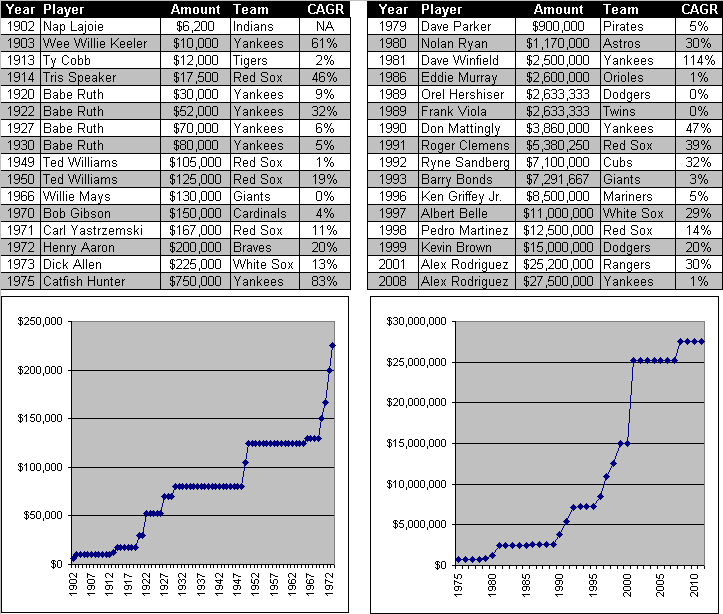
Note: Records for the period before Babe Ruth are not as complete. Salaries represent average annual contract values with bonuses included. In some cases, actual contract values may have been higher or lower based on interest/inflation adjustments and performance incentives. The highest paid designation was awarded to the player with the top average annual salary before the start of each season.
Source: archival newspaper accounts
Because of Ruth’s immense talent, his salary almost became a defacto ceiling for future players’ demands. In addition, the depression and World War II played a role in keeping players’ ambitions in check, as did the imposition of salary limits by the government’s Wage Stabilization Board during the early-1950s. Although players like Ted Williams and Joe DiMaggio finally surpassed the Babe’s benchmark and broke the $100,000 plateau during this period, it wouldn’t be until the mid-1960s when salaries started rise again.
In 1966, Willie Mays became the highest paid player in baseball history with a salary of $133,000, and then the dominoes started to fall. In the 1970s, a new player became the top man in almost every season, but in 1975, Catfish Hunter put them all to shame. After the 1974 season, Hunter discovered that Athletics’ owner Charley Finley had failed to fund an annuity as stipulated by his contract, so he claimed a breach and was eventually awarded free agency by an arbitrator. Fresh off four consecutive 20-win seasons, Hunter became the subject of a bidding war that was eventually won by George M. Steinbrenner. Hunter’s average contract value of $750,000 (his salary was much lower because of annuity deferments and other consideration) set the stage for the era of free agency that came to a crescendo when Tom Hicks handed out a whopping $252 million contract to Alex Rodriguez 25 years later.
For how much longer will Arod remain baseball’s salary king? This winter, Pujols and Fielder took their best shot at claiming the throne, but came up short. And, with more and more young superstars opting to sign long-term extensions before reaching free agency, it could be awhile before someone surpasses Rodriguez’s average annual salary of $27.5 million (which could wind up being even higher if certain milestone bonuses are achieved). Then again, with baseball enjoying unprecedented economic growth, maybe a $300 million/$30 million man is not that far away?