


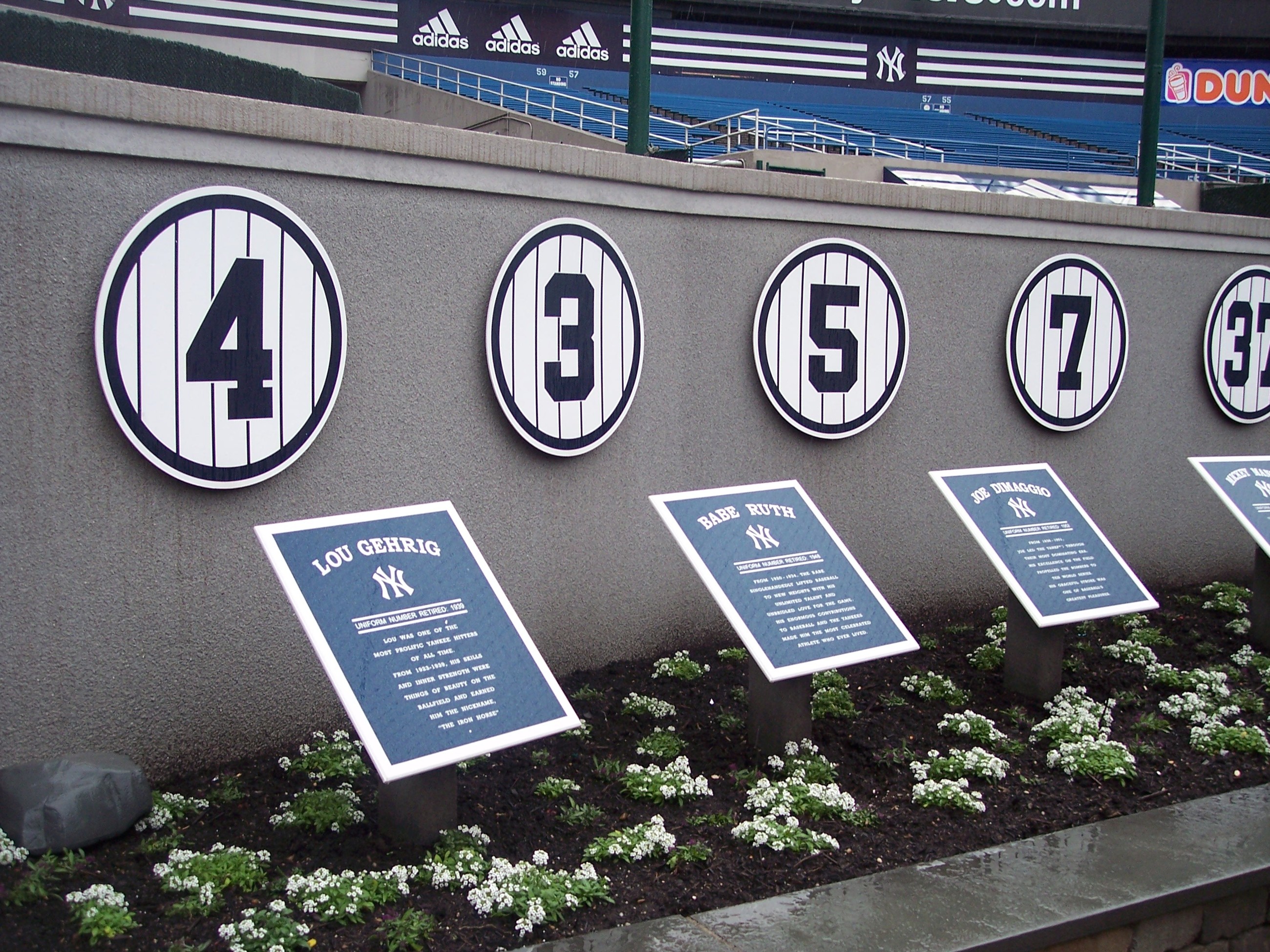
No team in baseball boasts the history of the New York Yankees, and no team in baseball leans into that history in quite the same way that this organization does — for better or for worse. Old Timers’ Day, for example, neatly walks the line between nostalgia and maudlin sentimentalism, and I’ll never get tired of watching former players trot out of the dugout for another round of applause.
But while it’s easy to invite any former player who wants to make the trip for Old Timers’ Day, whether it be Brian Doyle or Derek Jeter, the politics and decisions behind uniform number retirement can be complicated, and it’s led to some glaring mistakes and dangerous precedents. Let’s take a look at all the retired numbers, in order of retirement.
#4 — Lou Gehrig — July 4, 1939
Gehrig wasn’t just the first Yankee to have his number retired, he was also the first baseball player from any team to receive the honor. Given his tremendous career and the tragic nature of his early retirement, this was an easy decision.
#3 — Babe Ruth — June 13, 1948
It’s Babe Ruth. If there was an easier decision than retiring Gehrig’s number it was this one. Kind of shocking that it took more than a decade for this to happen.
#5 — Joe DiMaggio — April 18, 1952
One of the craziest things about the New York Yankees is that you could create a Mt. Rushmore and make a convincing argument that Joe DiMaggio wouldn’t be on that mountain, while he would cleary be the greatest player in the history of most franchises. Everyone knows about his 56-game hitting streak, but maybe the most impressive statistic of his career is that he hit 361 home runs while striking out only 369 times. Pretty easy decision to retire number five.
#7 — Mickey Mantle — June 8, 1969
The Mick is probably the most beloved Yankee of all-time, but as great as he was, even Mickey himself conceded that he should’ve been even better. Alcohol and injuries conspired to limit his career numbers, but they couldn’t limit his mass appeal. No one was like the Mick.
#37 — Casey Stengel — August 8, 1970
Stengel led the Yankees to seven World Series titles in his twelve years as manager, so he was another easy choice.
#8 — Bill Dickey and Yogi Berra — July 22, 1972
Yogi Berra was always a great hitter, but many worried that his lack of skill behind the plate would limit his major league potential. Hall of Famer Bill Dickey tutored Berra in his early days in the organization, and Berra chose to wear Dickey’s #8 to honor his mentor. It made sense, then, that both of these legends had their identical numbers retired in a ceremony on the same day.
#16 — Whitey Ford — August 3, 1974
The Chairman of the Board. Given the length of his career and his World Series success, it’s pretty easy to argue that Whitey Ford is the greatest starting pitcher in Yankee history.
#15 — Thurman Munson — September 20, 1980
Like most Yankee fans my age or older, I still remember exactly where I was when I heard about Thurman Munson’s death in a plane crash. He was the team captain and had already won an MVP award, and his locker remained untouched for almost thirty years until the old Stadium closed down.
#9 — Roger Maris — July 22, 1984
At the time, it felt like the retirement of Roger Maris’s number was an apology for how he was treated when he broke Babe Ruth’s single-season home run record in 1961. Most fans wanted the beloved Mickey Mantle to break the record because Maris wasn’t viewed as a “true Yankee.” Everyone remembers Maris from that ’61 season, but he was just as good in 1960 and won the American League MVP both years. Even so, he only played seven seasons in New York, the second-shortest tenure for anyone on this list. If it were up to me, his number wouldn’t be retired.
#32 — Elston Howard — July 22, 1984
Elston Howard is one of the most important players in Yankee history because aside from being a great player (he won the A.L. MVP in 1963), he stands as a symbol of the franchise’s resistance to integrate. Eight years after Jackie Robinson debuted with the Dodgers in 1947, the Yankees became the second-to-last team to allow a Black player on their major league roster. (The Red Sox would be the final team to integrate when Pumpsie Green showed up in Fenway the following season.) But Howard deserves this honor for what he did on the field — twelve All-Star appearances and four World Series wins.
#10 — Phil Rizzuto — August 4, 1985
I’m not sure if the Scooter would’ve earned this honor solely based on his on field performance, even though he did win the MVP in 1950 and was the starting shortstop on seven World Series winning teams. His tenure as Yankee broadcaster likely tipped the scales in his favor, and I can’t really argue with his inclusion here.
#1 — Billy Martin — August 10, 1986
This is where things began to go awry. Being a Yankee fan in the 1980s was to endure one embarrassment after another, and most of those embarrassments were the result of manager Billy Martin. He was an alcoholic during an era when that was seen as a personality quirk, and his racism was largely swept under the rug by a sympathetic and complicit press corps. George Steinbrenner fired him so many times (five) that their song and dance routine became a punch line in beer commercials, and his psychotic need for control caused him to humiliate his players whether they were stars (Reggie Jackson) or journeymen (he once demanded that struggling left-hander Mike Pagliarulo bat right-handed in a game). Perhaps by way of apology, Steinbrenner decided that all of this was the résumé of a Yankee legend, and his number was retired in 1986. Using Billy Martin as a precedent, almost any former Yankee could make a legitimate claim for inclusion on this list, and that’s a shame.
#44 — Reggie Jackson — August 14, 1993
Okay, get ready for a controversial take. The question is not whether or not Reggie was a great player. His 563 career home runs made him a first-ballot Hall of Famer. The question is not whether or not he was a clutch player. His three home runs on three swings in the clinching sixth game of the World Series is still the greatest single-game hitting performance in the history of the Fall Classic. The question is this — was he a great Yankee? Those three swings in October and the Reggie Bar and the Yankee cap on his plaque in Cooperstown all make it hard to remember that he only played in New York for five of his 21 seasons, the same number of years he spent with the Angels and just half the time he played for the A’s. I absolutely love Reggie Jackson. Really. But should his number be retired? I’m just not sure.
#23 — Don Mattingly — August 31, 1997
The question about Mattingly isn’t whether or not his number should be retired, but whether or not he should be in the Hall of Fame. (I say yes.) In terms of hero worship, Mattingly bridged the generation between Mantle and Jeter, and he famously passed the torch to Jeter that afternoon in spring training when the two of them were working on a back field and Mattingly suggested they run in because “you never know who might be watching.” There was no better player in baseball from 1984-1989 when Mattingly won a batting title, an MVP (and was robbed of another), and five Gold Gloves (of nine his career) while averaging 203 hits and 114 RBIs. Donnie Baseball was my favorite player, and I was lucky enough to be at the Stadium when his number was retired. (You can read my account of that here. Fun fact — I met a teen-age Eli Manning in the subway on the way to the game that day.)
#49 — Ron Guidry — August 23, 2003
Guidry’s 1978 season was one of the greatest pitching campaigns in baseball history, and I can still recite the numbers off the top of my head — 25-3, 1.74 ERA, 248 strikeouts. His 25th win that year came in the one-game playoff against the Red Sox, and all of that might’ve been enough to cement his legacy, but he won 129 games after that and is clearly one of the best pitchers in franchise history.
#42 — Mariano Rivera — September 22, 2013
I have nothing to say here that hasn’t already been said. (But I did write a poem about him once.) He’s easily the best reliever of all time, and he’s the reason no reliever will ever again be good enough for us. Oh, here’s something I learned today — Mo pitched in more than twice as many games as any other Yankee pitcher.
#6 — Joe Torre — August 23, 2014
I was nine years old when the Yankees won the 1978 World Series, so my memories of those teams is a bit hazy even though I was already a fan. Then I spent the next 18 years wondering if I’d ever see another championship. Enter Joe Torre. Yes, the players that arrived with him had a lot to do with it, but Torre was at the helm for four World Series wins and easily could’ve won a couple more. There’s no question here.
#51 — Bernie Williams — May 24, 2015
I love Bernie Williams, so even though he isn’t really an elite player and didn’t stick around as long as the Core 4, I’m okay with his inclusion here.
#20 — Jorge Posada — August 22, 2015
You could easily make a case that Jorge Posada should be in the Hall of Fame. Most people assume that Salvador Pérez, for example, will walk into Cooperstown, but when you compare Posada to Pérez, our guy’s numbers outdistance the future Hall of Famer. Posasda belongs on this list, that’s for sure.
#46 — Andy Pettitte — August 23, 2015
Pettitte is the all-time Yankee leader in strikeouts, and if he hadn’t spent those three regrettable seasons in Houston, he’d also be the leader in wins. His 256 career wins would probably be enough for a ticket to Cooperstown if the writers weren’t scared off by his PED admission. (These are the same writers who happily elected Mike Piazza and Pudge Rodríguez.) Anyway, Pettitte deserves this honor and more.
#2 — Derek Jeter — May 14, 2017
Aaron Judge is putting together a pretty nice résumé, but right now Derek Jeter is the best Yankee that I’ve seen in the 45 years I’ve been a fan, and he will forever be my favorite player. Another easy choice.
#21 — Paul O’Neill — August 21, 2022
One of the best moments of the Yankee dynasty came during the top of the ninth inning when the Yankees were trailing against the Arizona Diamondbacks. Knowing that the retiring O’Neill would never play another game in the Bronx, the Stadium crowd famously serenaded him throughout that last defensive half inning. It didn’t matter that the team was staring at a three games to two deficit; this was a moment when the love the fans felt for individual player superseded the game, and it was beautiful. If that serenade hadn’t happened, I don’t think O’Neill’s number would’ve been retired. He was a really, really good Yankee, but he wasn’t great.
The Omissions
Even with twenty-two numbers retired, there are at least two glaring omissions. Cam Schlittler is wearing #31 this season, and that’s an absolute travesty. Dave Winfield was one of the best players in baseball during his nine plus years in New York, going to the All-Star game in each of his eight full seasons, winning five Silver Slugger and Gold Glove Awards, and driving in 100 runs six times. While people like to remember the second half of George Steinbrenner’s tenure as owner when he would do whatever it took to win, they often conveniently forget that he hired a known criminal to spy on Winfield and then withheld money promised to Winfield’s charity. As the story goes, when Winfield chose a Padres cap for his Hall of Fame plaque, Steinbrenner decided against retiring #31. It’s not too late to fix this.
What if s0meone played 13 seasons for a team, won two MVPs, hit 351 home runs, and drove in more than a thousand runs? What if he led his team to a World Series win, hitting six home runs with 18 RBIs in 15 October games? Most teams wouldn’t just retire that player’s number, they’d build a statue of him outside the park. Alex Rodríguez might be one of the best ten or fifteen players ever to play the game, but the Yankees are still letting people (first Joey Gallo and now Jazz Chisholm, Jr.) wear #13. It’s the hypocrisy that bothers me. The Yankees always knew he was using PEDs, and they were happy to look the other way while he was compiling numbers for them. When Rodríguez announced his retirement midway through the 2016 season, GM Brian Cashman sat at the press conference and set his 2009 World Series ring on the table in front of him and said he wouldn’t have had that ring were it now for A-Rod. So Rodríguez was good enough for them then, but apparently not good enough to be honored alongside the other Yankee greats. Hypocrisy at its finest. But again, it can be fixed.


