


"A New York Treasure" --Village Voice

Blog Archives

Older posts            Newer posts

Easy Peasy, Pt. II

One night after beating the Indians 10-3 on a cold, rainy, sparsely attended night at the Stadium, the Yankees beat the Indians 9-2 on a cold, rainy, sparsely attended night at the Stadium.

The Yankees jumped out to a 1-0 lead in the first when a leadoff walk to Johnny Damon came around to score on a Derek Jeter double and a Bobby Abreu sac fly. Kei Igawa, meanwhile, looked sharp early, getting ahead of hitters and allowing only a Travis Hafner single in the first two frames.

Most of the scoring occurred in the third inning. Igawa started off the third by ringing up Josh Barfield for his third strikeout of the game, but Kelly Shoppach followed with a double to right and Igawa’s 0-2 pitch to Grady Sizemore slipped out of his hand and plunked Sizemore in the tuchus. Igawa got ahead of Jason Michaels as well, but Michaels singled to plate Shoppach on the 0-2 pitch. Again, Igawa got ahead of Travis Hafner 0-2, but his next pitch was in the dirt and rolled away from Jorge Posada, sending Michaels to second. Hafner then tapped a slow three-hopper to the shortstop hole for an infield single that plated Sizemore. Igawa then started Ryan Gargo off with a ball, just the second time in his first 13 batters that his first pitch was out of the strike zone. On his next pitch, Garko hit a check swing flare over the mound. In reaching for it, Igawa sent his glove flipping into the air. Robinson Cano charged and scooped the ball after two quick hops, flipping it to Jeter in one motion to start a 4-6-3, inning-ending double play.

Trailing 2-1, the Yankees let loose on Jeremy Sowers in the bottom of the third. Jeter kicked things off with his second double in as many at-bats. Abreu singled Jeter home to tie the game. Alex Rodriguez ground into a fielder’s choice to replace Abreu at first. Jason Giambi doubled Rodriguez home to give the Yankees a 3-2 lead. Posada singled Giambi to third. Cano singled Giambi home. Josh Phelps singled Posada home. Melky Cabrera flied out for the second out, and Johnny Damon finished the job by singling Cano home and knocking Sowers out of the game.

Igawa gave up just a walk and Travis Hafner’s third single over his remaining three innings, again starting eight of the ten hitters he faced with strikes and erasing Hafner’s single with a double play. All totaled, he threw 67 percent of just 92 pitches for strikes and struck out five in six innings while allowing just seven base runners on five hits (four singles, three by Hafner, one that weakly tapped infield single), a walk, and a hit-by-pitch.

Scott Proctor, Sean Henn, and Chris Britton added three more hitless innings to finish the job, each recording one strike out, with Proctor and Britton each issuing a walk.

Oh, and those last three Yankee runs? Yeah, another two-run Alex Rodriguez jack and a solo shot by Jason Giambi, back to back off different pitchers in the sixth no less. In case you’re wondering, Rodriguez is on pace for 112 home runs, 287 RBIs, 199 runs scored, 62 doubles, and 237 hits. He’s slugging .981 (no, that’s not his OPS).

To sum up, in these first two games against the Indians, the Yankees have outscored Cleveland 19-5, two Yankee rookies have picked up their first major league wins, and the bullpen has contributed seven hitless, scoreless innings while issuing just two walks.

Is it still raining? I hadn’t noticed.

Little Lefty Lupe Lou

Kei Igawa makes his third Yankee start tonight hoping to get the Yankees a series win over the Indians. Igawa’s last start in Oakland looked a heckuva lot like Chase Wright’s outing last night:

Igawa 4/13: 5 1/3 IP, 3 H, 3 R, 1 HR, 2 BB, 3 K, 95 pitches

Wright 4/18: 5 IP, 5 H, 3 R, 1 HR, 3 BB, 3 K, 104 pitches

Is that a compliment to Wright, a fresh-faced rookie out of double-A? An insult to Igawa, a seasoned Japanese veteran whose line above actually represents a significant improvement over his MLB debut a week earlier? A little of each? Curiously Igawa and Wright are both lefties whose best pitch is a changeup. Does that mean the Indians will benefit from seeing similar pitchers two nights in a row or that Igawa should have similar success against the Cleveland lineup because of his similar stuff, with hope for improvement because his Opening Day jitters are now two starts behind him?

So many questions.

Then there’s Cleveland starter Jeremy Sowers, a 23-year-old lefty in his first full season in the majors. Taken out of Vanderbilt with the sixth overall pick in the 2004 draft, Sowers shot all the way to triple-A in his first professional season in 2005 and joined the major league rotation in late June of last year, finishing the season with a 7-4 record and a 3.57 ERA in 14 starts, two of which were shutouts. In Sowers’ second major league outing, he faced the Yankees at Jacobs Field and held them to two runs over seven innings, those two runs coming on a first-inning Jason Giambi homer. Sowers is a finesse pitcher who fits the description of "crafty lefty" to a T and conjures up comparisons to Jamie Moyer and Tom Glavine, but his rate stats are troubling. In sixteen major league starts between last year and this, Sowers has struck out just 3.46 men per nine innings (Moyer and Glavine’s career K/9 rates are both about 5.35). Seeing as he lacks the extreme groundball tendencies with which Chien-Ming Wang has survived a similarly miniscule strikeout rate, it would seem Sowers is going to have to figure out a way to miss more bats in order to keep winning. Indeed, his .257 opponents’ batting average on balls in play last year is bound to snap back to league average (around .300), taking his ERA with it. Still, he’s excelled in his two starts thus far this year, holding the White Sox to just one hit (but two runs on five walks) over six innings in his first start and the Angels to one run over seven innings in his last. Just because a correction seems inevitable doesn’t mean it will happen tonight.

Doomsday Scenario

by Allen Barra

Alex Belth has asked me to fill in again this week with the explanation that he’s getting married. He’s used this excuse on four previous occasions, so all I can say is that this time I’d better see a ring on his finger when I bump into him.

I warned Alex that I didn’t have anything good to say about the 2007 Yankees, and I’m warning you now in case you want to go read something else. My bad feelings about this year’s team go beyond the recent rash of injuries, but I may as well deal with those before moving on.

Matsui’s hamstring, I think, is a fluke, and he’ll be back strong. I’m fed up with Mussina and especially Pavano. Mussina has increasingly become a frequent breakdown pitcher, one whose usefulness to the Yankees is very nearly at an end. Even when he’s not hurting, he’s wasting so much time trying to make that perfect pitch that he’s usually teetering by about the fifth inning and threatening to be a burden on the bullpen. Pavano is simply a disaster, one of the highest priced in Yankee history. I think he’s poised, when he comes off the DL, to replace Jaret Wright as the team’s number one bullpen drainer. What, oh what, are the Yankees going to do when Andy Pettitte hurts himself? (And he will, you know it, before the season is over, probably before the first half of the season is over.)

Looking around the rest of the lineup, I don’t see much to cheer about. Towards the end of last season, Jason Giambi, who really ought to know better, made an ass of himself by contributing all kinds of needless verbiage to articles written about Alex Rodriguez. My favorite comment, and I’m quoting from memory was, We really don’t know who A-Rod is. We’ll find out in the next couple of weeks. Well, when do we find out who the real Jason Giambi is? Actually, I guess we already have. He is now a practically useless ballplayer. He performs like 42-year-old man. He can no longer field and can’t hit to the opposite field, which takes 40 or more points off his batting average. As for his base running ability, any time the Yankees get three hits without scoring a run, Giambi is usually involved.

Giambi is such a bad fielder the Yankees have had to compensate by giving a roster spot to Doug Mientkiewicz. There is no bigger mystery to me than how a team with the biggest payroll in baseball continually gets stuck with players like Mientkiewicz. I don’t know that he’s all that good a fielder, but even if he was the second coming of Don Mattingly or Keith Hernandez he would still be a huge liability. He is one of the worst hitters I’ve ever seen, the first man I can honestly say would lose a home run derby to Sal Fasano. How is it that the Yankees cannot find at least a player of average ability to put into the lineup at this key hitting position?

I can’t say a great deal that is complimentary about the stars, either. A-Rod’s hot start is probably for real, but I’m not yet convinced that his third base woes are over. Jeter’s fielding problems are, I fear, for real and may be linked to his rumored back trouble. (Note his relative lack of power so far.) Yankee fans are reduced to saying "Wait till Chien-Ming Wang comes back," but if I was Wang and looking at the prospect of having opposing batters hit ground balls to this infield, I think I’d stay on the DL.

It’s possible that if the Yankees go on a tear then the ugly disaster of the last road game in Oakland—the worst pitching I have ever seen from Mariano Rivera—will be erased. But with this rotation—and if you put a gun to my head right now, I couldn’t tell you the starters the Yankees plan on using for the next five games—I don’t see how any consistency is possible.

I guess this all sounds a bit doomsdayish, but the truth is I can’t lose. If I’m right, I’ll just remind all of you that you heard it here first. If I’m wrong, I’ll be as happy as the rest of you.

Allen Barra is currently writing a biography of Yogi Berra.

Easy Peasy

Got four starters on the DL? No problem, call up a kid with just two starts above A-ball, knock the opposing starter out in the second inning, and coast to an easy win. The Yankees made it look just that easy last night.

Rookie Chase Wright made his major league debut with a Sean Henn-model glove on his right hand, a steady rain falling on his head, and no where near the reported 38,438 fans in the stands on a cold Tuesday night in the Bronx. Wright went full on his first batter, Cleveland’s Grady Sizemore, and just missed outside for ball four. He then walked Jason Michaels on five pitches to put two men on for Travis Hafner. That drew an early mound visit from his new pitching coach, Ron Guidry. After an enthusiastic pep talk from Guidry, Wright got Hafner and Victor Martinez to ground out (plating a run in the process) and Ryan Garko to line out directly to Derek Jeter.

The Yankee offense then took some of the pressure off the rookie by plating a pair of runs in the bottom of the frame on a Damon walk, Jeter single, Alex Rodriguez RBI single, Giambi walk to load the bases, and a Jorge Posada sac fly to dead center that just missed being a game-breaking grand slam.

Wright again put the first two men of the inning on base in the second via a single and a walk, but again retired the next three in order, this time without yielding a run. Then the Yankees broke the game open for real.

After Melky Cabrera grounded out, Doug Mientkiewicz cracked a solo homer (no, really!) to the short porch in left. Johnny Damon doubled, moved to third on a Jeter groundout, and scored on a Bobby Abreu single. That brought Alex Rodriguez to the plate. Can you say two-run homer to the retired numbers? I knew that you could. That made it 6-1, but the Yankees weren’t done. Jason Giambi followed with a single and Jorge Posada, having just missed that salami in the previous frame, cracked a two-run jack of his own, his 200th career home run. That made it 8-1 Yanks and bounced Jake Westbrook from the game with two out in the second.

(more…)

The Chase Is On

Due to the rash of injuries that have placed Mike Mussina and Carl Pavano on the disabled list alongside Chien-Ming Wang and Jeffrey Karstens, the Yankees were forced to dip into their minor league system for a starter for tonight’s (and likely Sunday’s) game. The three pitchers whose turns fell on the right day were Tyler Clippard and Steven Jackson in triple-A and Chase Wright in double-A. Of the three, Wright was both the only one already on the 40-man roster and the pitcher who’d had the most success in his two starts thus far this season. Clippard’s had two middling outings for Scranton. Jackson has faired a tad better, but neither has lasted more than five innings in either outing. Wright, meanwhile, has dominated in a pair of seven-inning outings and will make his major league debut tonight in the Bronx against the Indians.

Here’s what I wrote about Wright back in February:

L – Chase Wright (24)

A third-round draft pick in 2000, Wright has spent six years in the Yankees system without cracking double-A. He’s made large strides over the last three seasons however. Check these trends:

Year League Level ERA H/9 K/9 BB/9
2004 Midwest A 5.44 10.47 5.34 5.97
2005 Sally A 3.75 8.00 6.88 4.31
2006 Florida State A+ 1.88 7.14 7.52 3.23

Wright claims the difference has simply been an uptick in confidence. I suppose it could be that after bottoming out in 2004 he figured he couldn’t do any worse if he just challenged hitters. If so, it worked. Wright’s best pitch is a changeup that works off his low-90s fastball, and he’s working on developing his curve. He’s still a work in progress, but it’s certainly encouraging to see such rapid progress by a lefty starter. Indeed, he’s come far enough that the Yankees had to add him to the 40-man to protect him from the Rule 5 draft last fall.

To that I’ll add his spring training and double-A lines from this year:

Level ERA H/9 K/9 BB/9 IP
Spring Training 2.84 6.39 7.10 4.26 12 2/3
AA 0.00 2.57 12.21 0.64 14

Those 14 innings at double-A are divided evenly between two equally excellent starts in which Wright has posted a fantastic 2.29 groundball-to-flyball rate. Accordingly, Wright hasn’t allowed a home run in any of his 26 2/3 innings thus far this year and allowed just one round-tripper in 119 2/3 innings last year.

After I wrote the above, I received a note from Kevin Goldstein, Baseball Prospectus’s minor league guru. Kevin said that one thing he felt I got wrong was my estimation of Wright’s velocity (which I got from assimilating various on-line scouting reports). According to Goldstein, Wright’s fastball tops out in the high 80s, adding something to the effect that if Wright did throw in the low 90s, he’d be a world-beater. Judging by his recent results this season and last, I tend to wonder if Wright’s recent improvement has had as much to do with an uptick in velocity as with an increase in confidence. I’ll certainly be keeping an eye on the YES radar gun tonight. If it turns out that he is indeed working in the low-90s . . . look out world.

(more…)

The Cleveland Indians

The Cleveland Indians are a hard team to figure out. Two years ago they looked like an up-and-coming powerhouse in the Central. Built around stone cold masher Travis Hafner, the up-the-middle excellence of Victor Martinez, Jhonny Peralta, and Grady Sizemore, and emerging ace C.C. Sabathia, they won 93 games in 2005, just missing both the Wild Card and AL Central titles due to a collapse in the season’s final week. Last year, they collapsed altogether, winning just 78 games and finishing a distant fourth behind the Twins, Tigers, and White Sox in an increasingly competitive Central division. One seemingly obvious cause of this fall was the loss of Jhonny Peralta’s production (he hit just .257/.323/.385 last year, down from .292/.366/.520 in 2005), but closer inspection shows that the Indians collapse was largely illusory.

In large part due to an abysmal showing by their bullpen, the Indians underperformed their Pythagorean record by a staggering 11 games in 2006. In fact, looking at their runs scored and allowed totals, the team the 2006 Cleveland Indians most resembled was the 2006 New York Yankees. The Indians were second to only the Yankees in all of baseball in runs scored per game last year (this despite Peralta’s poor showing), and also finished right behind the Yankees in runs allowed per game (seventh in the AL to the Yanks’ sixth). In fact, the Yankees and Indians had identical team ERAs in 2006 with the Indians holding a slight advantage in ERA+ due to playing in a less severe pitchers park.

One thing that tripped Cleveland up last year, in addition to their shaky bullpen, was poor defensive play. The Tribe was 25th in the majors in both defensive efficiency and fielding percentage. This year that trend has continued. Though the Yankees are dead last in the majors in fielding percentage thanks to their major league worst 14 errors (nearly half of which are Derek Jeter’s), their defensive efficiency–the rate at which they turn all balls in play into outs–is actually the fourth best in baseball, just as it was a year ago. Cleveland, however, is 27th in fielding percentage (having made nine errors in nine games) and 21st in defensive efficiency. That means their pitching staff has to work that much harder to keep runs off the board.

Amazingly, it’s been able to do that thus far. The Indians staff ERA is the third best in the American League, while the ERA of their rebuilt bullpen is second best in the AL to that of the Yankees’ pen. The offense, however, is in a bit of a slump, though their scheduling problems may have played a part in that.

The big story of the Indians season thus far is that the entirety of their home opening series against the Mariners was snowed out and that their subsequent series against the Angels was moved indoors to Milwaukee’s Miller Park because of the ongoing winter weather. The Indians scored 7 2/3 runs per game while taking two of three from the White Sox in Chicago to start the season. They then sat idle for four days as their games against the Mariners were snowed out, rescheduled as double headers, then snowed out again. They finally resumed play with three games in Milwaukee, then returned home for a series against the White Sox and have scored just 3 2/3 runs per game over those last six games.

Of course, it may not be fair to judge the Indians on their performance thus far this season. While the team has gone 6-3, winning all three series, six of their nine games have come against the White Sox. Their eventual home opener at Jacobs Field was played in front of just 16,789 people (as opposed to the usual 42,400 or so), and their catcher and cleanup hitter Victor Martinez has played only three games, suffering a quadriceps injury in the last game of their opening series in Chicago. That is to say, the Cleveland Indians are a hard team to figure out largely because there’s not a lot to go on.

Still, the bullpen looks suspect as the new faces are Joe Borowski, Roberto Hernandez, and Aaron Fultz. C.C. Sabathia (who’s still just 26 years old) is a true ace and Jake Westbrook is a strong mid-rotation starter and every bit as extreme a groundball pitcher as Chien-Ming Wang, but Jeremy Sowers’ strike out rate is alarmingly low for a flyball pitcher and neither Paul Byrd nor extreme flyballer Cliff Lee or his replacement Fausto Carmona inspire much enthusiasm. On offense, Peralta, who had corrective vision surgery in the offseason and supposedly has put behind him some personal problems that contributed to his poor 2006 season, looks to be rebounding, Martinez should return to action this week, possibly even tonight, and the decision to platoon the outfield corners smells of small market brilliance. On the flip side, that platoon means Casey Blake still has a job, and everyone’s still waiting for Andy Marte to hit. As they were two years ago, the Tribe was a trendy pick to win the Central this year. I’m not entirely sold. They’re a good team, but not a great one. If they win, I suspect it will have as much to do with the decline of their competition as with their own success.

(more…)

Bad Day

Sunday didn’t start or end well for the Yankees, though they did have a seven-inning oasis in the middle of it all.

The day started with the announcement that both Mike Mussina and Carl Pavano had been placed on the disabled list, leaving the starting rotation in shambles behind Andy Pettitte. Pettitte then took the mound and four of the first five A’s he faced reach base, the first on Derek Jeter’s sixth error of the year. With just one out in the bottom of the first, the A’s had a 2-0 lead and two men on. The Yankee bullpen, which had marched each of it’s seven members out to the mound the night before, began to collectively weep.

Pettitte then rallied to strike out Bobby Crosby and get Todd Walker to ground out to short. From there things started to look up. Pettitte settled down, pitching around a pair of singles in the second, stranding a two-out triple by Eric Chavez in the third, and setting down 13 of the next 14 men he faced after Chavez. Oakland starter Rich Harden was even better, but the injury-prone righty left the game due to shoulder stiffness in the seventh, opening the door for a three-run Yankee rally. The Yanks added another run in the eighth, handing a 4-2 lead to Mariano Rivera in the ninth, Mo’s first save opportunity of the season.

Mo got Chavez to ground out on an 0-1 pitch, then, after failing to get a called strike three call on Bobby Crosby, got the Oakland shortstop to fly out to right for the second out of the inning. Mo’s next pitch bore down and in on Todd Walker, but Walker was able to flare it out to left for a two-out single. Walker then moved to second on defensive indifference as Jason Kendall swung through a high fastball to run his count to 1-1.

(more…)

Who’s Managing This Club, Mr. Whipple?

The A’s and Yankees played a thrilling eleven-inning game last night, but let’s skip straight to the action in the eighth inning, as it was in the top of the eighth that the worm turned for the Bronx Bombers.

With the game tied 4-4, Oakland manager Bob Geren called on his ace set-up man Justin Duchscherer to face the heart of the Yankee order. Alex Rodriguez singled on Duchscherer’s first pitch. Jason Giambi followed by yanking a double into the corner in right field, pushing Rodriguez to third. Joe Torre sent in Kevin Thompson to pinch-run for designated hitter Giambi at second base with Jorge Posada coming to the plate. Posada worked a 2-1 count then hit a blistering liner directly at first baseman Todd Walker for the first out. Geren then elected to have Duchscherer intentionally walk Robinson Cano to load the bases, thus allowing Duchscherer to Doug Mientkiewicz with a force at every base.

At this point Mientkiewicz was 0 for his last 18 with just one walk over that span. In his three previous at-bats in this game he had struck out and hit into two double plays, the first a line-drive to left that doubled up Posada at first, the second a conventional 4-6-3 that plated a run, but otherwise killed a bases-loaded, no-out rally in the sixth.

Now, if you’re Joe Torre, or even Yankee bench coach Don Mattingly, what do you do in this situation.

(more…)

The Oakland Athletics

The A’s, at least in the early going in 2007, are a pretty easy team to figure out. They don’t give up very many runs, but they don’t score very many either. Only two American League teams (the Red Sox and Angels) have allowed fewer runs per game thus far this season than the A’s’ 3.4, but only two major league teams (the Nationals and Giants) have plated fewer runs per game thus far than the A’s’ 2.8. The A’s are also dead last in the majors in home runs, having hit just two through ten games. Obviously a line-up with Eric Chavez, Mike Piazza, Nick Swisher, and Milton Bradley is going to pick up the homer production at some point, but that’s a crippling lack of production. The A’s are 4-6 thus far this season. Two of those four wins had final scores of 2-1, and one of them required a two-run rally in the bottom of the ninth against the White Sox’s closer, Bobby Jenks (a favor the A’s bullpen aces returned the next night).

In a near perfect inversion of the Yankees’ season thus far, the only thing that’s really been working for the A’s in the young season has been their starting rotation, which has been the stingiest in the American League and is bested only by the Mets and Braves in the NL. Despite losing Barry Zito to free agency and Esteban Loaiza to the DL, the A’s rotation has posted a 1.98 ERA after two full turns. The best of their bunch, as expected, has been the Healthy Rich Harden, whom the Yankees will face on Sunday. Harden has struck out 13 and allowed just 12 base runners in 13 innings, but is curiously not the staff leader in ERA despite his 1.38 mark. No, that man is tonight’s starter, Dan Haren, who’s 0.69 ERA is in stark contrast to his 0-2 record. Such are the A’s.

As for the Yankees, they’ll get to see what Kei Igawa can do in a moderate climate (temperatures in Oakland are in the mid-60s as I write this, though they’ll likely drop in to the 50s by tonight). Igawa was flat out awful in his first major league start (the most encouraging sign was that he walked “only” three men in five innings), but nerves and the weather likely played a part in that, and the steady improvement he showed during spring training gives reason for optimism, as do the dormant Oakland bats.

What it all comes down to tonight, then, is the stingy Oakland starting pitching against the explosive Yankee offense, and the explosive Yankee starting pitching against the stingy Oakland offense. Which will give most?

(more…)

Statistical Correction

Okay, so that wasn’t exactly a “slugfest.” I was right about the Yankees having to rely on their bullpen, but for the wrong reasons. Ramon Oritiz hurled a gem at the Bombers, limiting them to one run on three hits and a walk over eight innings. That one run came in the fourth when Johnny Damon led off with a single, was pushed to second when Derek Jeter worked the only walk Ortiz issued all night, moved to third on a fly to right by Bobby Abreu, and was plated by an Alex Rodriguez sac fly.

Mike Mussina looked better than he had in his first outing, but pulled up lame in the third inning with what proved to be a balky left hamstring and removed himself from the game (more on Moose’s injury below). Mussina allowed a pair of singles before coming out of the game with a 2-1 count on Luis Castillo. Pressed into emergency duty, Sean Henn got Castillo to pop out on his first pitch, then escaped the inning thanks to a fabulous play by Derek Jeter. With Luis Rodriguez running from second on the pitch, Nick Punto hit a flair to shallow left. Jeter made a great over-the-shoulder, wide-receiver-style catch, then, in one continuous motion, spun and fired a strike to Robinson Cano at second to double up Rodriguez.

Henn turned in two more scoreless frames, but gave up a ringing double to Nick Punto to lead off the sixth. After Joe Mauer bunted Punto to third, Joe Torre went to Scott Proctor to face the right-handed Michael Cuddyer only to have Proctor give up a game-tying single on his second pitch. Proctor did manage to retire Justin Morneau and Torii Hunter to strand Cuddyer, and Luis Vizcaino contributed a perfect seventh inning with the help of a fantastic diving stop by Doug Mientkiewicz at first, but what was shaping up as a white-knuckle ballgame fell apart when Kyle Farnsworth took the mound in the eighth.

Farnsworth had nothing, walking Luis Castillo on four pitches to start the eighth. On Farnsworth’s fifth toss, a called strike to Nick Punto, Castillo stole second. Punto bunted Farnsworth’s next pitch foul and waved over top of a slider in the dirt for the first out, but Joe Mauer singled Castillo home three pitches later, taking second on Melky Cabrera’s throw home. Farnsworth’s first pitch to Michael Cuddyer was several feet away from Jorge Posada’s target, shooting between Cuddyer and Posada’s glove straight to the backstop to move Mauer to third. Cuddyer then singled Mauer home to run the score to 3-1. Justin Morneau cracked Farnsworth’s next pitch to deep right for a double, driving Cuddyer home with the fourth run, and Torii Hunter repeated the feat, knocking an 1-0 Farnsworth offering off the baggy for another RBI double. It was only then that Joe Torre relieved Farnsworth of his duties, bringing in Mike Myers to get the final two outs.

Down a seemingly insurmountable four runs against the man who, all due respect to Mariano Rivera, is likely the best closer in baseball, the Yankees did manage to mount a rally against Joe Nathan. Derek Jeter lead off the ninth with a single and, after Bobby Abreu hit a screaming liner at Castillo for the first out, Alex Rodriguez hit a booming ground rule double into the gap in left to put runners on second and third. That brought Jason Giambi to the plate with first base open and a chance to bring the tying run to the plate in the person of Jorge Posada, but Giambi hacked at Nathan’s first pitch, popping out to third. No longer in a position to tie the game, Posada took four pitches to run the count to 2-2, only to pop out to short to give the Twins a 5-1 win.

Consider this game a bit of stat correction for the Yankees’ unusually low bullpen ERA and unusually high number of runs scored per game. Heck, even Mussina’s two scoreless innings helped shed a few tenths of a run off the starters’ ERA. If there’s one lesson baseball teaches us, it’s that everything comes back to the center in time.

As for Mussina, he said that he felt his hamstring grab during the first batter of the third inning and, when it grabbed at him again later that inning, he decided to get out of there before he wound up with a long-term injury. On his last pitch of the game, you could see Mussina’s front leg stiffen up. Rather than ending up in his usual fielder’s stance, Moose hopped off to the third base side of the mound, at which point he shook his head in disappointment and gestured for Joe Torre and Gene Monhahan to come out and get him. Said Mussina after the game, “It was more than a cramp, but it’s not bad. I don’t limp, and I can still touch my toes.” The Yankees are hoping they won’t have to place Mussina on the disabled list, but it looks like Darrell Rasner will take Mussina’s next turn on Tuesday against the Indians at the Stadium. The Yanks won’t need a fifth starter until Sunday April 22 in Boston, so look for Mussina to make his return to the rotation during that weekend series at Fenway if he’s able to avoid the DL.

As for the other two pitchers the Yankees do have on the disabled list, both Jeff Karstens and Chien-Ming Wang threw bullpens down in Tampa earlier this week. Karstens is scheduled to throw three innings in a rehab game on Saturday. If that start goes well, he could be available to bump Rasner or fill in for Mussina at the end of next week. Wang, meanwhile, will need two rehab starts before being activated. Since the date of his first start has yet to be announced, it seems Wang will not be able to return any earlier than the team’s final homestand of the month, one turn through the rotation later than Karstens assuming both stay on pace.

Bombs Away

There was reason to believe that Carl Pavano and Andy Pettitte would do what they did over the past two games, dropping the Yankee starters’ collective ERA more than three runs from 9.97 to 6.75 over the course of 13 stellar innings, but, I have to say, I’m a lot less enthusiastic about what we might see from Mike Mussina tonight. Unlike Pavano or Pettitte, Moose wasn’t hurt all that much by his defense in his first outing. Instead he was just plain roughed up, allowing eight hits, four of them doubles, walking three, and hitting a batter in a mere four innings. Moose allowed the Orioles to score in three of those four innings and in the lone exception he had runners on first and second and used up 21 pitches (and would have used more had Corey Patterson not laid down a successful sac bunt on the first pitch he saw). I suppose one could point to Moose’s four strikeouts in those four innings and respectable 62 percent strike rate as positive signs, but after seeing the way he struggled through spring training, I’m not convinced.

On the other side of the ledger, the Twins are throwing Ramon Ortiz to the wolves. Ortiz is a better pitcher than Sidney Ponson, but that’s not saying much. It’s comical to recall that Ortiz was dubbed “Little Pedro” when he emerged with the Angels last century. Ortiz aged three years in one winter as a result of the post-9/11 crack down on documentation. That year he surrendered 40 home runs. The next he posted a 5.20 ERA. In 2004, he lost his rotation spot. Jumping to the National League in 2005, Ortiz spent the next two seasons in two wildly disparate pitching environments in Cincinnati and Washington and was lit up in both (his home and away splits confirming that his ability to suck was uneffected by his home environment). Giving up 31 homers in 33 games while playing your home games in RFK Stadium is a nifty trick and one that doesn’t bode well for a pitcher facing the hottest offense in baseball (7.29 R/G) and the team tied for third in the majors in home runs.

Of course, Ortiz handled the Orioles in his last start (7 IP, 5 H, 2 R, 1 BB, 4 K, 0 HR), but I’m more interested in what the Yankees did to him when they met in the nation’s capitol last July, knocking him around for seven runs in 4 1/3 innings on eleven hits including homers by Jorge Posada and, you guessed it, Alex Rodriguez. That was the game in which Shawn Chacon, Matt Smith, T.J. Beam, Scott Proctor, and, shockingly, Mariano Rivera combined to blow a 9-2 lead. I don’t expect tonight will be quite as ugly, but I think we’re in store for another slugfest nonetheless. Fortunately, the Yankees have already taken the series (their first series win of the year), winning the first two games by a combined score of 18-3. They also have an off-day tomorrow, which means it could be all-in from their rebuilt bullpen, which posts the second-best bullpen ERA in the majors (1.27).

Boof Bam Boomer

The Yankee starters finished their first trip through the rotation with a 9.97 ERA. That was no more likely to hold up than are the bullpen’s current 1.07 ERA or the offense’s 6.83 runs per game. Indeed, Carl Pavano began the correction of that starters’ ERA last night with seven innings of two-run baseball, dropping the figure nearly two runs to 8.16. Expect Andy Pettitte to continue that trend tonight.

Pettitte’s first outing was the best of those first five Yankee starts (an admittedly low standard), and only came to an end after four innings because he was on a strict pitch limit necessitated by the back problems that interrupted his spring training schedule. Looking back over the game log, Andy got a double play to end the third and set the Devil Rays down in order in the fourth only to run into his pitch limit. Prior to that, he was undone by three walks, a wild pitch, a passed ball, an error, a stolen base, and three singles, one of which didn’t leave the infield. A lot of that is his own fault, and he was similarly rescued by that double play and his own great sliding tag of B.J. Upton at home, but it’s significant that he didn’t get cuffed around like Mussina (four doubles), Igawa, or Rasner (two homers and a double each). The only extra base hit Pettitte allowed was a two-out Jonny Gomes double in the first, which he stranded by getting Ty Wigginton to fly out on the very next pitch, and that fly out was the only one of the game as Pettitte (as evidenced by the double play, infield single, and error) did an excellent job of keeping the ball on the ground.

So, while Pettitte’s first start wasn’t good by any stretch, there were a lot of positive indicators. Since then, he tossed a scoreless inning of relief on his throw day and, at the risk of sounding like a broken record, gotten in out of the cold. I like his chances to turn in a solid outing tonight.

In fact, tonight’s game has the potential to be something of a pitcher’s duel, as the Twins will counter Pettitte with 25-year-old sophomore Boof Bonser. Despite making 18 major league starts last year, Bonser has never faced the Yankees during the regular season. He did, however, face them this spring. In that game, Bonser allowed a pair of solo homers to Bobby Abreu and Josh Phelps, but held the Yankees to just two other hits over six innings while striking out seven. He had a similar outing in his first regular season start against the Orioles last week, striking out six in six innings while allowing just two runs on three hits, one of them a solo homer by Melvin Mora.

The most compelling thing about Bonser, however–other than the fact that he’s officially changed his name to Boof (his birth name was John)–is that his mannerisms on the mound make him a dead ringer for a young, right-handed David Wells. A sloppy, heavy-set fellow with a brown goatee, a baggy jersey, and a big overhand delivery, Boof recalls the Boomer of 1997 and 1998, the ace of the 1998 Yankees and author of a perfect game against none other than the Minnesota Twins. Bonser and Wells are opposites when it comes to pitching style, however. In addition to throwing with the opposite hands, Wells pitches to contact, with historically low walk rates and correspondingly high hit rates, while Bonser tends to miss bats both in and out of the strike zone, suppressing hits along the way. Bonser does give up his share of homers, however, and it will be up to the Yankees tonight to make sure they have a few men on base when that inevitable long ball leaves the park.

In other news, the Twins disabled two players yesterday, placing Jeff Cirillo and Rondell White (surprise) on the 15-day DL and recalling infielder Alexi Casilla and outfielder Josh “Broccoli” Rabe from triple-A (see Aaron Gleeman for more). Unfortunately, Rabe’s name is pronounced “RAY-bee,” so his nickname only works in print.

The Minnesota Twins

The Yankees play just seven games against the central-division Twins this year, and it’s rather advantageous that they’re getting three of them out of the way now. That may seem an odd statement given that the Yankees are 2-3 and have yet to get a quality start (or anything even close) from their starting rotation, while the Twins are 4-1 and have allowed just 2.4 runs per game, but a quick look at the pitching probables for this series shows that the Twins are repeating their mistakes from a year ago.

Last year, the Twins broke camp with Tony Batista at third base, Juan Castro at shortstop, and Kyle Lohse and Carlos Silva in the starting rotation. It wasn’t until mid-May that the team began to figure out that they had to do better, eventually ridding themselves of Batista, Castro, and Lohse, and benching underperforming right fielder Lew Ford. While their solutions in right field (Michael Cuddyer) and the left side of the infield (Nick Punto and Jason Bartlett) are still in place (though Punto is unlikely to be a long-term fix at the hot corner), the Twins have taken a step backwards in the rotation. Silva continues to hold a spot and, in place of the retired Brad Radke, the injured Francisco Liriano, and 2006 solution Matt Garza, who had an excellent spring, they’ve turned to proven patsies Ramon Ortiz and, believe it or not, Sidney Ponson.

Admittedly, Garza got roughed up pretty good last year, but that came late in the year as he was inching toward his career mark for innings in a single season (he ultimately threw 185 2/3 over four levels, just surpassing his total from the previous season split between Fresno State, rookie ball, and low-A). One could argue that Garza’s on the Phil Hughes plan, but there are three key differences. Garza, a first-round draft pick out of Fresno State in 2005, is nearly three years older than Hughes. Hughes is on a 180-inning limit this year, but Garza has already passed that in each of the last two seasons. Finally, Hughes had never pitched above double-A coming into 2007, while Garza threw 50 major league innings at the end of last season. Also unlike Hughes, Garza sailed through spring training with a 1.50 ERA. Garza’s a top prospect who’s ready to join the major league rotation. So who do the Twins block him with? Sidney Ponson, a man who was relased by three teams in a 12-month span from September 1, 2005 to September 1, 2006 and this spring had a WHIP of 1.56 and struck out just 6 men in 16 innings. They must have been really blown away by Sir Sidney’s 3.94 ERA.

That or they plan to skip the fifth spot in their rotation as often as possible and wanted Garza to get regular work in the minors. Fortunately for the Yankees, one of the times the defending AL Central Champs need their fifth starter is tonight. Meanwhile, Johan Santana, who’s officially the greatest pitcher on the planet, pitched last night. So, you see, it’s rather advantageous that the Yanks are getting three of their games against the Twins out of the way now, because the Twinks will surely haved wise up by the time they come to the Bronx around Independence Day, and it’s unlikely that the Yanks will miss Santana again in that four-game set. It will also benefit the Yankees to come in from the cold to the climate-controlled Metrodome. In both cases (and I never thought I’d say this about the Hubert H. Homerdome, but given the weather in the Bronx of late . . .) the Yankees should enjoy it while you can.

Carl Pavano takes his second turn tonight. He actually looked pretty good through his first four innings on Opening Day, allowing just one unearned run following Derek Jeter’s throwing error. In fact, if you convert that error to an out and erase the remainder of that second inning in which Pavano allowed a walk and an RBI single before getting the final out, Meat’s line through four innings would have been 4 IP, 1 H, 0 R, 1 BB, 2 K. Even as played, his four-inning line was a very respectable 4 IP, 2 H, 1 R, 0 ER, 2 BB, 2 K. The fact of the matter is he flat ran out of gas in the fifth, which is not unusual considering how long it’s been since he’s pitched regularly. That fatigue is yet another reason to trade Pavano in late May, assuming he pitches well enough to fetch a good return and the rest of the rotation shapes up, of course. Between his injury risk and lack of stamina, the chances of Pavano continuing to pitch well all year (if he gets there at all) are very slim. His chances of outlasting his opponent tonight are much better. Sidney Ponson is bad.

(more…)

Ice Cold

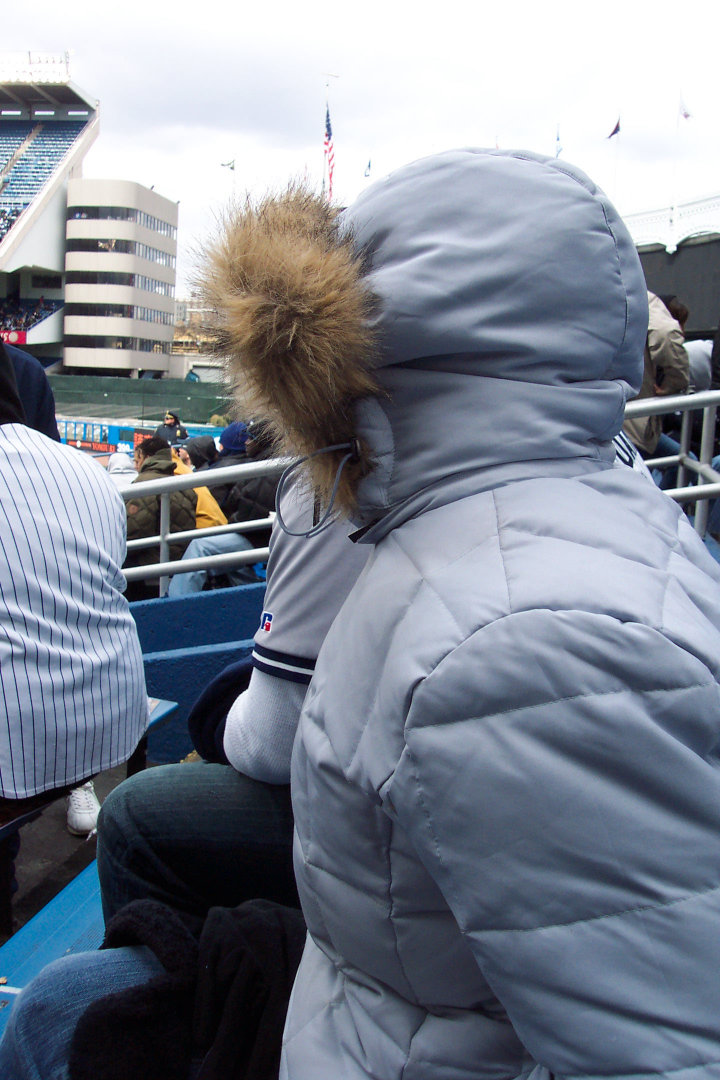
It was freaking cold in the Bronx on Sunday. The box score says it was 41 degrees, but it was overcast with a 20-mile-per-hour wind and snow flurries filled Yankee Stadium off and on throughout the game. Undeterred, Becky and I had the perfect plan.

A hearty meal at the Court Deli:

And lots and lots of layers:

To be perfectly honest, our plan worked about as well as the Yankees’, which was based around getting a solid outing from Darrell Rasner. Rasner looked sharp in the first, and the Yankees jumped out to a 3-0 lead when Melky Cabrera and Derek Jeter singled, Bobby Abreu plated Melky with a sac fly and Alex Rodriguez launched his first pitch to the Armitron sign in right field to give him two home runs and six RBIs on his last two swings.

Already freezing, Becky turned to me and said, "So that’s it, right? They won and we can go home?" If only.

(more…)

Momentum

Is only as good as the next day’s starting pitcher. Fortunately, Darrell Rasner has a very real chance to turn in the best start by a Yankee thus far this season. Of course, everything’s relative.

After four games:

Yankee offense: 7.25 R/G

Yankee bullpen: 1.44 ERA, 0.86 WHIP, 18 2/3 IP

Yankee rotation: 9.87 ERA, 2.25 WHIP, 17 1/3 IP

Eric Bedard was lit up by the Twins in his first start (6 ER, 10 H, 4 2/3 IP). Here’s hoping the Yankee offense, which will get Damon back today, but has lost Matsui to a hamstring injury until Friday at the earliest and will likely be without Jorge Posada, who hasn’t had a day off yet this season and played a day game after a night game yesterday, can keep on keeping on.

The Baltimore Orioles

I’ll be honest, the Orioles bore me to tears. Now nursing a nine-year run of losing records, the Orioles continue to rearrange the furniture, but without a meaningful youth movement, they’ll forever be the AL East’s fourth-place team (until the Devil Rays get enough pitching to pass them, that is). Nick Markakis might be the real deal in right field, but there’s no one behind him in the high minors and now that Melvin Mora’s fallen back to earth he’s less of a production addition than a production replacement. Erik Bedard, whom the Yankees will face on Sunday, is actually about a week older than Johan Santana. Chris Ray is nice and all, but he’s a band-aid on a severed limb. That just leaves the ongoing mystery that is Daniel Cabrera–who acquitted himself well over his last ten starts last year and his first outing of 2007, but still hasn’t shown the dominant form that’s long been predicted for him–and tonight’s starter Adam Loewen. As a rookie in 2006, Loewen faced the Yankees more than any other team, excelling in those four starts (2.62 ERA, 23 K in 24 IP), and Baseball Prospectus’s Kevin Goldstein likes him more than either Cabrera or Ray. Tonight marks his first start of 2007, and it will be interesting to see what he can do against the Yankees’ lefty-heavy lineup after so much exposure to same last year.

As for the O’s as a group, the were swept by the Twins in their opening series by a combined score of 17-8, with half of those runs coming off Johan Santana himself, and are punting the catcher position while trying to decide what to do about Ramon Hernandez’s strained oblique muscle. The Hernandez situation brings to mind the Yankees’ deliberations over Johnny Damon’s sexy calves, but with inferior stand-ins. Actually, Peter Abraham reports that Damon’s feeling better and could play tomorrow. Hernandez, however, is likely DL-bound.

The Orioles are ripe for the picking, but the Yankees have to help themselves first. After making six errors in their first two games, three of them coming from the Captain, who’s never looked worse in the field, their ability to pick anything in doubt.

(more…)

Fungoes

Sports Illustrated.com has started a new baseball blog on their site called Fungoes, which will rotate through seven writers and all six divisions over the course of each week of the 2007 baseball season. Among those seven writers are our founder Alex Belth, who will cover the AL East, fellow Toaster Jon Weiseman, who will cover the NL West, and myself as the seventh man tackling a random baseball topic of my choosing every Friday under the “Wild Card” header.

Alex’s posts will appear every Monday. Check out his first post from this past Monday, in which Alex muses about Opening Day from an AL East perspective. My first post is up today and takes a look at the historical significance of the Arizona Diamondback’s new uniforms (with apologies to Paul Lukas). Mr. Weisman’s first effort, meanwhile, focused on the underrated Colorado Rockies (with apologies to Mark T.R. Donohue, I’m sure).

I hope you’ll all join us over there in addition to your regularly scheduled programming here on Baseball Toaster. And don’t be shy about dropping some comments over at SI, either.

Andy Given Thursday

There were snow flurries in Manhattan as I left work this evening. It’s April 5, the baseball season is well under way, the sun is shining, and here comes a cool cluster of snow crystals, curling down on the brisk breeze to perch on my proboscis.

Much as “sun flurries” (if such a thing truly exists and I wasn’t just dreaming) strike me as a siren-like omen of an impending natural apocalypse, it’s appropriate weather for tonight’s ballgame. A half a score and one more years ago, Andy Pettitte took the hill for the Yankees home opener amid a flock of snow flurries and beat the Kansas City Royals, setting the Yankees on their way to their first World Championship in 18 years and launching the most recent Yankee dynasty. Tonight, thanks to the rain-out yesterday (and I think we can all thank Gore and the Easter Bunny that it was rain and not snow that poured fourth from the heavens), Andy Pettitte will make the first start of his second stint as a Yankee tonight amid the flakes (that is, unless Johnny Damon’s calf strain keeps him out of the lineup).

But seriously, folks, it’s about freaking time. It seems like it’s been a week since the Yankees beat the D-Rays on Opening Day. I’ve had an empty seat at my table for Elijah Dukes for far too long.

Jae Seo starts for the Devil Rays, wondering where went his Weong. It remains to be seen what the Rays will reap from Seo, who seemed to hold so much promise when he signed with the Dodgers last year only to end the season as Mark Hendrickson’s replacement in Tampa. Those of you parsing that last clause for a pun can scratch those plans as there ain’t one.

As for Andy, in case you forgot, he’s sixth on the Yankees’ all-time list in games started, fifth all-time in strikeouts, and ninth all-time in wins as a Yankee. If he wins 15 games this year he’ll tie his former pitching coach, Mel Sottlemyre, for sixth on the all-time Yankee win list. None of those rankings will have any real effect on how he’ll perform tonight (other than the fact that they betray the mileage on his arm), but they’ll have a great deal of effect on how he’s received, and I don’t mean by Jorge Posada.

Quick Notes

While there’s no make-up date scheduled for yesterday’s game just yet, there were a few drips of news yesterday. Well, three to be exact. Johnny Damon, who left Monday’s game with cramps in his calves now appears to have something closer to a strain, which puts his availability in doubt for the time being. Melky Cabrera was going to start in center field in yesterday’s game until it got rained out. Ron Villone, who was officially released at the end of spring training, signed a minor league deal with the Yankees yesterday and will report to triple-A Scranton. He can opt out of the deal if he’s not on the 25-man roster by May 1. Finally, Chein-Ming Wang’s rehab continues to move swiftly. He’s been throwing in the bullpen and might throw a simulated game this weekend.

Scenes from Opening Day


(more…)

Older posts            Newer posts
feed Share on Facebook Share on Twitter Share via email
"This ain't football. We do this every day."
--Earl Weaver