"A New York Treasure" --Village Voice

Daily Archives: April 25, 2006

The Tortoise and the Hare

The biggest story of the season thus far for the Yankees has to be the resurgence of Mike Mussina, who has found the fountain of youth in the form of a 70-mile-per-hour changeup. Moose did it again last night, stymieing the Devil Ray’s B-squad for six innings, holding them to four hits in six innings while walking none and striking out seven. Only a first-inning Jonny Gomes homer (his league-leading tenth) managed to spoil Moose’s evening.

Fireballer Scott Kazmir, meanwhile, was unable to uphold his end of the bargain, walking Johnny Damon on four pitches to start the evening and then surrendering a two-run homer to Derek Jeter to hand over the lead before he had recorded a single out. By the time the first inning ended on a broken-bat grounder by Andy Phillips, who didn’t strike out once in his rematch with Kazmir, the Yanks had a 3-1 lead and were off to the races.

In the fourth, Phillips delivered a one-out opposite-field single and came around to score. In the sixth, Tampa manager Joe Maddon replaced Kazmir, who walked five and threw 101 pitches in his five innings of work, with Scott Dunn and watched as Dunn and subsequent reliever Ruddy Lugo doubled the Yankee run total to make it 8-1. In the eighth, the Yanks plated a lead-off double by Jeter–who was 3 for 5 with a double, a homer, three runs scored and three driven in on the night–to push the eventual final score to 9-1. Sturtze, Villone and Proctor mopped up for Moose, allowing just one baserunner across three innings (a single off Villone).

Other highlights included Miguel Cairo going 2 for 3 with a pair of doubles and a walk (though he did get picked off second following the first double). Not bad for his first start since April 12. Jason Giambi, meanwhile, went 2 for 3 with a double, a walk and three RBIs from the DH spot giving him a two-day DH line of 7 AB, 3 R, 5 H, 8 RBI, 2 2B, 2 HR, 1 BB, 0 K. Hmmm, maybe he can hit in that role after all.

Finally, making his fourth start in five games at first base, Andy Phillips made a pair of nice plays in the field and is starting to look more comfortable at the plate. Phillips has singling in each of the last two games, worked a full count with the bases loaded in his third at-bat last night (though that AB ended in another broken bat groundout), and drove a ball to deep center in his final trip. He’s also struck out just twice in his last 11 plate appearances. These are small signs of what I hope will be greater things to come. Hopefully Phillips will start again on Thursday against lefty Mark Hendrickson.

Tampa Bay Devil Rays

As strange as it might be to say, the Devil Rays are actually a pretty interesting team. Despite finishing in last place in 2005 for the seventh time in their eight-year history, the team’s long-rumored youth movement finally bore some fruit, enabling the Rays to assemble the league’s sixth most productive offense in the season’s second half and give the Yankees hell for most of the season. Prior to their final head-to-head series of the year, which the Yankees swept decisively, the Devil Rays were 11-5 against the eventual division champs, having scored 102 runs in those first 16 games. This winter, minority partner Stuart Sternberg bought out founding owner Vince Naimoli and overhauled the front office in the hopes of capitalizing on the team’s emerging talent before Naimoli and the administration of ousted GM Chuck LaMarr could do any more damange. Sounds crazy, but it just might work.

Last year, to established stars Aubrey Huff and Julio Lugo and the still-emerging talent of Carl Crawford, the Rays added second baseman Jorge Cantu and finally found room for slugger Jonny Gomes and speedster Joey Gathright. On the mound, Scott Kazmir spent his first full season in the bigs, and reliever Chad Orvella pitched well enough to make Danys Baez and former All-Star Lance Cater trade bait.

This year should bring further maturation from Kazmir (22) and Crawford (24), full seasons of Gomes and Gathright (both 25), and allow Cantu (24) to settle in at second base after being yanked back and forth between second and third last year. Exactly what will come of Orvella (25), who failed to make the team out of camp, or Huff (29) and Lugo (30), both of whom were shopped in the offseason due to their impending free-agency after the current season, remains to be seen. But should Huff or Lugo be moved, uberprospects B.J. Upton (21) and Delmon Young (20) should be ready to step into their shoes, though Upton’s ability to remain at shortstop remains in doubt.

Curiously, neither Huff nor Lugo will see action in the Bronx this week, as both are on the 15-day DL. In their place, the Rays will send out not Upton and Young, but Tomas Perez and Ty Wiggington. I was startled at the outpouring of emotion when Perez was released by the Phillies this spring. Apparently, Perez was considered something of an institution in Philadelphia and in the Philly clubhouse. I didn’t even realize he was still in the league. Turns out Perez was the Phillies jack of all trades and resident prankster for the past six seasons, though he appeared to have sustained that position on the basis of hitting .304/.347/.437 in 135 at-bats in his second year with the club. Since then he’s hit just .245/.300/.372. Good news for the Yanks there. Wigginton, meanwhile, couldn’t stick with the Pirates last year after coming over in the Kris Benson trade the year before, but, starting at the hot corner for the injured Huff, has been crushing the ball to the tune of .284/.333/.687, with eight homers in 17 games.

Thus far this season, the Devil Rays offense has been Wigginton and Gomes (.302/.444/.746) with a helping of Cantu. Wigginton is clearly playing over his head, but Alex’s boy Gomes just might be this good. Okay maybe not, that good, but his .282/.372/.534 performance last year seems utterly legit. If nothing else, his performance should teach the Yankees and their fans a lesson about judging my man Andy Phillips on 40-odd scattered at-bats. Over 30 plate appearances in 2003 and 2004 Gomes hit just .103/.161/.138 (3 for 29 with a double and one walk), but when finally given regular playing time last year he posted that .282/.273/.534 line. It’s not a perfect comparison as Gomes is three and a half years younger than Phillips. Then again, Gomes, despite having success in triple-A, didn’t demolish the International League the way Phillips has the last two years.

Of course, all of this swing don’t mean a thing if the Rays don’t get their pitching in order. Speedster Kazmir, who will start tonight against slowpoke Mike Mussina in what I hope will be a stirring pitcher’s duel, looks to be rounding into form, but even with his success, the Rays are only separated from the worst ERA in baseball by the existence of the Kansas City Royals. Last year the Yankees put up thirteen runs on the D-Rays in a single inning twice, and finished the year having put up exactly ten times that against them in 19 games.

There are glimmers of progress. It appears the Rays would be willing to cut bait on Doug Waechter and push hard-throwing Seth McClung into the bullpen should failed Dodger prospect Edwin Jackson (the take for Baez and Carter) and the home grown Jason Hammel take root, but that’s hardly as promising as having Upton and Young on deck, particularly given that duo’s three starts thus far this year. In the meantime, it’ll be more Mark Hendrickson for your money. Indeed, Hendrickson will come off the DL to start Thursday night, which means that Jackson, who will be sent down to make room before Thursday’s game, and Waechter, who is getting skipped due to yesterday’s off-day, will be available out of the pen should the Rays need nine unexceptional relievers to keep the Bombers at bay rather than the seven they normally employ.

Enjoy tonight’s duel. It could get ugly from here.

(more…)

Boricua, Baby

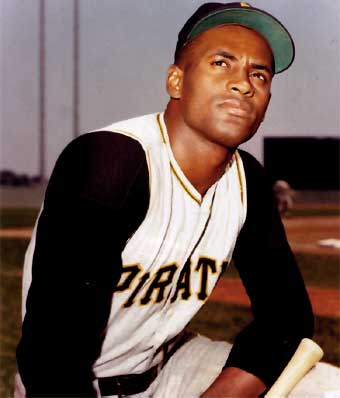
“Clemente,” the new book by pulitizer prize-winning author, David Maraniss, hits the shelves today. It is a fine appreciation of Roberto Clemente, who is undoubtedly one of the most charasmatic players of the post-War era. Although Clemente was a key member of two World Championship teams, he played in relative obscurity in Pittsburgh during the 1950s and ’60s, and was overlooked for his much of his career. Until, of course, his monumental performance in the 1971 Serious, and his untimely death in December of 1972. His legend and reputation have grown ever since.

As my pal Steve Treder put it to me in an e-mail recently:

Clemente was actually slightly underrated until the late ’60s, and especially during the 1971 World Series when he suddenly got noticed by the national media. At that point they all suddenly seemed to think he was better than he actually was, after years of being overlooked. His early tragic death soon afterward froze his image in time. Had he lived, and had a few years of decline phase at the end of his career, his reputation probably would have balanced out about right. As it is, many casual fans seem to think he was the equal of Mays/Aaron/Robinson/Mantle, when in fact he wasn’t nearly as good as any of them.

It is no insult to say that Clemente wasn’t as great as Mays, Aaron, Robinson or Mantle. They are all legends. Fortunately for Maraniss, off-the-field, Clemente was more interesting than most. And between the lines, Maraniss points out, Clemente had a terrific, inimitable style.

There was something about Clemente that surpassed statistics, then and always. Some baseball mavens love the sport precisely because of its numbers. They can take the mathematics of a box score and of a year’s worth of statistics and calculate the case for players they consider underrated or overrated and declare who has the most real value to a team. To some skilled practitioners of this science, Clemente comes out very good but not the greatest; he walks too seldom, has too few home runs, steals too few bases. Their perspective is legitimate, but to people who appreciate Clemente this is like chemists trying to explain Van Gogh by analyzing the ingredients of his paint. Clemente was art, not science. Every time he strolled slowly to the batter’s box or trotted out to right field, he seized the scene like a great actor. It was hard to take one’s eyes off him, because he could do anything on a baseball field and carried himself with such nobility. “The rest of us were just players,” Steve Blass would say. “Clemente was a prince.”

Thanks to Mr. Maraniss and the good people at Simon and Schuster, here is an excerpt from “Clemente.” This section is less about Clemente specifically and more about the conditions that Black and latin players encountered in the early 1960s. But it establishes the backdrop that is essential to understanding Clemente’s story. Enjoy!

BOOK EXCERPT: From “Clemente”

By David Maraniss

“Pride and Prejudice”

[Clemente] arrived at Pirates camp to train for the 1961 season on March 2, a day late. He and Tite Arroyo had been delayed entry from Puerto Rico to Florida until tests came back proving they did not have the bubonic plague, a few cases of which had broken out in Venezuela during the tournament.

On the day he reached Fort Myers, free from the plague, a story ran on the front page of the New York Times under the headline: NEGROES SAY CONDITIONS IN U.S. EXPLAIN NATIONALIST’S MILITANCY. One of the key figures quoted in the story was Malcolm X, the Black Muslim leader, who in the Times account was referred to as Minister Malcolm. Interviewed at a Muslim-run restaurant on Lenox Avenue in Harlem, Malcolm X said the only answer to America’s racial dilemma was for blacks to segregate themselves, by their own choice, with their own land and financial reparations due them from centuries of slavery. He dismissed the tactics of the civil rights movement as humiliating, especially the lunch-counter sit-ins that were taking place throughout the South. “To beg a white man to let you into his restaurant feeds his ego,” Minister Malcolm told the newspaper.

This was fourteen years after Jackie Robinson broke the major league color line, seven years after the U.S. Supreme Court struck down the separate-but-equal doctrine of segregated schools, five years after Rosa Parks and Martin Luther King Jr. led the bus boycott in Montgomery, four years after the Little Rock Nine desegregated Central High School in the capital of Arkansas, one year after the first lunch-counter sit-in in Greensboro. Year by year, the issue of race was becoming more urgent. The momentum was on the side of change, but the questions were how and how fast. In baseball, where once there had been no black ballplayers, now there were a hundred competing for major league jobs, and along with numbers came enormous talent, with ten past and future most valuable players among them. Yet every black player who reported to training camp in Florida that spring of 1961 still had to confront Jim Crow segregation. Even if their private emotions were sympathetic to Malcolm X’s rage at having to beg a white man to let you into his restaurant, the issue in baseball was necessarily shaped by its own history. Having moved away from the professional Negro Leagues and busted through the twentieth century’s racial barrier, black players did not view voluntary resegregation as an option, and separate and unequal off the field was no longer tolerable.

Wendell Smith, the influential black sportswriter who still had a column in the weekly Pittsburgh Courier but wrote daily now for the white-owned newspaper Chicago’s American, began a concerted campaign against training camp segregation that year. On January 23, a month before the spring camps opened, Smith wrote a seminal article that appeared on the top of the front page of Chicago’s American headlined negro ball players want rights in south. “Beneath the apparently tranquil surface of baseball there is a growing feeling of resentment among Negro major leaguers who still experience embarrassment, humiliation, and even indignities during spring training in the south,” Smith wrote. “The Negro player who is accepted as a first class citizen in the regular season is tired of being a second class citizen in spring training.” Smith added that leading black players were “moving cautiously and were anxious to avert becoming engulfed in fiery debate over civil rights,” but nonetheless were preparing to meet with club owners and league executives to talk about the problem and make it a front-burner issue for the players association.

(more…)

feed Share on Facebook Share on Twitter Share via email
"This ain't football. We do this every day."
--Earl Weaver