"A New York Treasure" --Village Voice

Daily Archives: June 23, 2008

Seriously Funny

For more than ten years I’ve talked about records, record labels, record producers, rare 45 b-sides and comedians with my dear friend Alan who knows more about records and record history than anyone I know, and it’s not even close.  When we see each other, we usually go right into an old Carlin routine, or a Lenny Bruce sketch, or Bugs Bunny riff.  Alan was the first guy I thought of this morning. When he got into work and saw the red light on his phone, he knew who the message was from

(more…)

Wino Time, Bing-Bong, Five Minutes Past the Big Hour of Five O’Clock

 I couldn’t resist.

Here’s my beard.
Ain’t it wierd?
Don’t be sceered,
Just a beard.

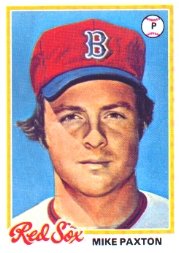
Card Corner–Mike Paxton


Untitled

Yes, I know what you’re thinking: A dreaded Red Sock. (Or is it Red Sox?) But there is method to my folly. After all, this card comes from Topps’ 1978 set, the favorite set of Bronx Banter chieftain Alex Belth. And it is an intriguing card because of its rather surreal appearance.

Over the years, Topps has airbrushed logos and uniform colors on countless cards, but during the seventies and eighties it was pretty rare for the company to use anything but actual photographs of players on the cards. In this case, we find an example of a card that seemingly had no photograph, only an apparent drawing, from the cap and the uniform to the player’s face, neck, and hair.

So who is Mike Paxton and why was a picture of him drawn onto his 1978 Topps rookie card (No. 216), rather than photographed? Well, I could answer the first question easily enough, but the second query remained a bit of a mystery. An ordinary player, Mike Paxton is probably best remembered for being included in the trade that sent Dennis Eckersley from the Indians to the Red Sox; in the deal, Eckersley and backup catcher Fred Kendall went to Boston in exchange for Paxton, veteran right-hander Rick Wise, third baseman Ted Cox, and catcher Bo Diaz. Prior to the trade, Paxton had risen through the Red Sox’ farm system in the mid-1970s, emerging as one of their better pitching prospects despite the lack of an overpowering fastball. As a rookie in 1977, Paxton made an immediate impact, winning 10 of 15 decisions as a sometime starter and reliever. Standing only 5’11" and sporting a lower body nearly as bowlegged as Bucky Dent, Paxton compensated for a lack of velocity with tenacity and a willingness to throw inside that earned him the nickname, "Bulldog."

More significantly, the soft-spoken Paxton was—and presumably still is—deeply religious, a devout Baptist and a member of the Fellowship for Christian Athletes. Initially, I thought that explained why his image was drawn and not photographed for the 1978 Topps card. Although I hadn’t been able to verify this through any written documentation, I had heard it speculated that Paxton and another pitcher, Seattle Mariners left-hander Rick Jones (who was featured on a 1977 Topps card), didn’t want to be photographed on their cards for religious reasons. Topps has always negotiated its contracts with players on an individual basis, so it seemed possible that Paxton and Jones specifically made the request for drawings, and not photographs, on their cards. While the religious interpretation seemed like as good a reason as any in explaining why a photograph wouldn’t be used at a time when photos of players were in large supply, it didn’t explain why Paxton’s two subsequent Topps cards (1979 and ’80) featured photographs and not drawings. Thus, the mystery continued.

As it turned out, religious reasons had nothing to do with the "drawings" on the Mike Paxton and Rick Jones cards. There existed a much simpler explanation, which I received from former Yankee public relations man Marty Appel, who has also done public relations work for Topps over the years. Appel says that it was simply a case of Topps not having color photographs for either player. As a result, Topps took a couple of black-and-white photos and "colorized" them, giving them the effect of looking like drawings. So technically this card does feature a photograph, though it has been given the Ted Turner treatment.

Yes, sometimes there are easy answers to seemingly complex mysteries; you simply have to know whom to ask.

Bruce Markusen writes "Cooperstown Confidential" for MLBlogs at MLB.com.

Tell Us a Story

When it comes down to it, the story is the thing. Whether we are talking about one of the great comics like George Carlin, or a great movie, a magazine article or blog entry, we are attracted to stories and to storytellers. Baseball of course is replete with wonderful stories, some true, some not. (As Rob Neyer explores in his new book, sometimes the truth can only get in the way of a good story.)

Has anyone ever read Prophet of the Sandlots, Mark Winegardner’s gem of a book about travelling with Tony Lucadello, one of the most successful scouts in big league history? If you haven’t, there aren’t many baseball books I’d recommend more. Lucadello signed a ton of guys, including Jim Brosnan, Alex Johnson, Toby Harrah, Larry Hisle, Fergie Jenkins and Mike Schmidt. Like many scouts, he was a great storyteller. Here is a scene, featuring Carl Loewenstine, one of Lucadello’s protogees:

Though Carl is in his late thirties, with a drawl, a bushy red mustache, a chaw of tobacco, a Dodgers World Series ring, and friends in the country-music business, he has more in common with his mentor than appearances suggest.  After Tony secured him the full-time job with the Phillies in 1979, Carl was first assigned to the Deep South.  As we sat in an unheated press box in rain-soaked Dayton watching mediocre playes flail about on a muddy field, Carl started telling stories.  The best involved a quaest into deepest bayou country on the trail of a huge high-school dropout with a blazing fastball, no shoes, a drinking problem, and a pregnant twelve-year-old girl friend.  Carl ended up signing the kid, whose can’t-miss fastball couldn’t save him when he left his minor league team in Oklahoma to rob a bank, tryingo to get enough money for the girl friend to buy her own house.

I asked why baseball has always been such fertile territory for stories and storytellers. My theory is that ball players, coaches, and scouts have so much time to kill that those who can tell the best, funniest, most ornate stories are naturally the most popular, which helps them stay in baseball, which allows them to amass and embellish more stories.  Carl nodded, spat, and said maybe so.  "My own theory on that," he said, "is that every player in major league baseball has overcome the odds.  Only a tiny fraction of the players who are stars in high school or college ever get signed.  Then, probably only one in two hundred of those players make it to the majors.  Then, only about half of the those players stay around long enough to say so. Of the ones who do, most are out of the game in five or six years.  Your players who make it, really make it, are one in several million.  Everybody’s a long shot.  But there’s always that chance.  And that’s the great equalizer, the thing you’ll find in most every real baseball story.”

Ah, to be able to hang with the likes of grouchy old’ Don Zimmer for a spell. Or Joe Torre. David Cone might offer some good ones as the season rolls along, and I bet Giambi’s got more than few good stories to tell, dont’ ya think?

A Place for his Stuff

I was ten when my parents split up. My mother broke the news to us in the car after dropping my father off at the Metro North Station. My twin sister and younger brother were in the back seat.  I was in the passenger seat. When she was finished telling us the what was going to happen, I turned to her and said, "Don’t worry, Mom, I’ll take care of you now."

We grew up quickly over the next few years. My father started dating a woman who lived on the same block as my grandparents on the Upper West Side, and soon they were living together. She was good to us, gave us sex education tips without shame or titilation–straight, blunt, sound advice. I remember seeing a shiny box, The Devil in Miss Jones, next to the other videos on a shelf in her bedroom, but I never had the nerve to watch it on the sly.

Everything was grown-up. When we visited my dad, we hung around adults.

Perhaps the most important discovery I made in her apartment was when I pulled a record from the shelf with a picture of a hippie sitting on a stool. The record was AM/FM, the lp that won a Grammy Award for Best Comedy Album and the one that put George Carlin on the map for good. It wasn’t a racy record–heck, by this point, we had Eddie Murphy to idolize–and it was dated, filled-with Vietnam Era references that I didn’t understand. But it had curse words as well as Carlin’s elastic imagination, nibble word-play, and funny-sounding voices. Carlin sounded like a grown-up kid.  Friendly, approachable, caustic, but decent.

We were hooked. I can’t tell you how much material I swiped from Carlin and claimed as my own when I was a kid.  Later, Carlin’s follow-up records, Class Clown and Occupation Foole became like the Torah for me (I still remember my old man taking us to King Carole Records on the west side; I proudly selected Toledo Window Box). There is his legendary routine about the seven words you can’t say on Television, and who’ll ever forget his contribution to the debate between football and baseball?

For years, in high school and throughout college, I would go to sleep with the sounds of a comedy record playing in the background. Bill Cosby and Carlin were always good choices–Mel Brooks and Richard Pryor were too lively for that time of night. I must have listened to "Occupation Foole" five hundred times easily. I know Carlins’ inflections, the rhythms of his voice, his faces, all of his characters, as well as I know a member of the family.

So, it is a sad Monday morning as George Carlin passed away yesterday at the age of 71. That is too young. He was from Morningside Heights in Manhattan and he ranks up there with Lenny Bruce and Richard Pryor as one of the Giants of stand-up comedy.

I want to take this moment to thank him for everything he gave me.  He made me feel grown when I was a kid, and has made me feel young as I’ve gotten older.

feed Share on Facebook Share on Twitter Share via email
"This ain't football. We do this every day."
--Earl Weaver