The Angels got it together and finally beat the Red Sox. Go Figure that.

Took 12 innings. The series is still alive with Lackey and Lester going tonight. Now, that’s worth the price of admission.



The Angels got it together and finally beat the Red Sox. Go Figure that.
Took 12 innings. The series is still alive with Lackey and Lester going tonight. Now, that’s worth the price of admission.
By Jon Weisman
Mostly, I remember white.
To celebrate my graduation from college in 1989, I went on a mini-ballpark tour with some members of my family. I flew from California to New York to meet my sister, who was living there at the time. A few days later, the two of us would meet up in Boston with my brother and father, and we’d go on to see games at Fenway Park, Skydome and Wrigley Field. But first, it would be New York, New York: Shea and Yankee Stadiums.
At least, that’s what I recalled when I started to write this. But after looking back at Baseball-Reference.com, I realized that I must not have seen the Mets on this trip. It must have been another day in another year that I took the subway out for a hot, sticky day game at Shea and had a lousy hot dog but a good time.
My memory, in some respects, has become just awful. When it comes to my first visits to Yankee and Shea Stadiums, I remember next to nothing about what happened during the games themselves. (By comparison, I distinctly remember that in my first trip to Fenway Park, in 1982, the one-and-only Derek Botelho flirted with a no-hitter in his first major-league game.)
But for my only trip to Yankee Stadium, I couldn’t even tell you who played or who won, without the aid of the Internet. I would have guessed the Yankees won, based on some good vibes I recall feeling among the crowd as we were leaving. I also recall that the game was on the afternoon of Independence Day, and that there was a postgame concert by the Beach Boys that we didn’t end up sticking around for. But I’m not sure you can trust me on any of that.
What I can testify to, two decades later, is the experience of the visit.
We sat high, high behind home plate – it almost felt like a blimp’s-eye view of the action – but I enjoyed the vantage point. I sort of marveled at how much I enjoyed it.
And most of all, I remember white, the dominant color in my mind when picturing Yankee Stadium. Inside the royal blue of the seats stuck out but the outer shell was all white. I had never seen a ballpark that looked like this, and it struck me as so fittingly majestic. I’m a Dodger fan, but I knew I was in hallowed ground. Yankee Stadium had an immediate feel, and that feel was more important to me than anything that was happening on the field. I could be wrong, but I have to think that feel will color the memories of many people as the years go by.
Jon Weisman blogs about the Dodgers over at Dodger Thoughts.
When the Cubs lost the first two games at home against the Dodgers I wasn’t especially surprised. For all of the talk about a new vibe at Wrigley this year, these were still the Cubs after all. They’d need to win at least one round before I started to truly believe.

I called my oldest friend in the world, Lizzie Plummer, whose father, rest his soul, was a long-suffering Cubbie fan. I had been thinking about him for weeks, knowing he would have been reserved about all the good cheer.
"You know what he would say?" Liz told me over the phone. "They’ve come further only to fall farther."
He would not have batted an eye at a first round sweep. Still, my heart does go out to Cub Nation or whatever they are called. This one is for you.
At the same time, I’m thrilled for Dodger fans. Yowza La-La Land, pinch yourself–youse one series away from the World Serious.
By Will Weiss
Part Two of Two: The Personalities
I’m lucky to have my own batch of special memories from my five years covering the team. But the thing I’ll miss most is interacting with the many people who gave the stadium life.
There were a few regular occurrences: the mad rush for positioning in the dugout when Joe Torre would prepare for his pre-game conference with the media; Jim Kaat making a beeline through Brian Cashman’s office to get coffee right before the seventh inning stretch; Bob Sheppard’s sprint to the elevator right after the game (you wouldn’t believe how spry he was) and the way he’d disappear when the elevator reached the lobby. There was also the inimitable way in which official scorer Bill Shannon announced a scoring decision. The first time I heard, “Single, runner takes second on the throw,” or, “E-Five. Error on the third baseman,” I thought it was the ghost of Harry Caray, or at the very least, Will Ferrell’s impersonation of the late broadcaster.
I learned a lot about the press culture and how to act – mainly to shut up and stay out of the way – from Phil Pepe. He covered the team from the early 1960s through the early ’80s, and observed the many internal changes that took place. We would frequently eat dinner together in the press dining room before games, particularly in 2003 and ’04, when he rotated with Bill Shannon, Howie Karpin, and Jordan Sprechman as official scorers.
The press dining room was an interesting place to mingle, network, and get information from “sources close to the situation.” It was routine to see writers chatting up advance scouts from teams both the Yankees and their opponents would be playing within the next week to 10 days. I had some good conversations with members of the A’s staff prior to an Aaron Small start back in 2005, as well as chats with the Twins in 2004 before the playoffs.
It was also a great place to observe the cliquey nature of the New York baseball writers. I found it amazing how they could socialize and be cordial to one another in one setting, but would gouge each other’s eyes out if it came to getting a scoop. You always knew where John Sterling was, based on the level of harrumphing.
Red Sox play Daddy Dearest once again. The great K Rod gets pasted.

The Angels are toast don’t ya know.
Jason Bay hits a three-run bomb as the Sox score four runs in the first inning out in California.

The nightmare continues for the Halos.
By Cecilia Tan
I have so many memories of Yankee Stadium that it is hard to narrow it down to just one to write about today. My earliest memory of the Stadium is of a Bobby Murcer grand slam, which thanks to Retrosheet I now know was August 2, 1974, when I was five years old. I learned to keep a scorecard there. I learned what the word “sucks” refers to there. My 13th birthday party was at the Stadium. I was there for Dave Righetti’s no-hitter in 1983. I’ve been there for half a dozen opening days, about as many Old Timers Days, and for a pile of playoff games (though still no World Series). I’ve been there on the forgettable “Liza” days and for walk-off wins. I was there for the Home Run Derby and All-Star game this past season.
Pick one, he says. Pick one.
Then there are all the times I’ve been there professionally. A photoshoot in Monument Park. Sitting in the press box for my first game. My first time in Joe Torre’s office. Sitting in the dugout during batting practice. Listening to Mike Mussina tell a story during team stretch about getting his wisdom teeth out.
Pick just one to write about?
I can’t. I’m going to remember so many things about the Stadium that are only going to mean something to me. Like how my little brother Julian and I were somehow convinced that Eddie Layton, the organist, had a booth out beyond center field to watch the game from. We used to take binoculars and try to locate him. I have no idea why we thought the organ was behind the black batters eye. Maybe because the lone sound tower at the Stadium was out there? I wasn’t really convinced otherwise until I was in my 30s and took a tour of the Stadium that included the press box and scoreboard operations.
There’s that gap between the bleachers and the grandstand in right field, where you can see the train go by. The elevated track is at just the right height and in the 1970s, we used to see the cars go past festooned with graffiti. When the games got boring (which they did sometimes), Julian and I would play a game where if the next train went right to left I would win, and if it went left to right, he would win. And we’d stare at that grand white limestone edifice, the courthouse, which always looked like a long home run might be able to hit it.
I’ll never forget the thrill of coming out of the dank, dark concrete tunnel into the upper deck, into the wide open brightly lit field of green and blue, and having my breath taken away.
The ladies rooms in Yankee Stadium are pink. The layers of latex paint are so thick that the walls practically feel like rubber. And the way the ones in the upper deck are shaped, there are always two stalls to the right of the door that a lot of people don’t see are there. That’s always where I headed. The ladies rooms have attendants, too, like they do in Broadway theaters. Will we have them in the new Stadium, I wonder?
I caught this bit from Mike Mussina’s brother via Jim Baumbach over at Newsday. Maybe Moose won’t retire after all. As a fan, I sure would like to see him make a run at 300. Even if he doesn’t get there, I would love rooting for him for another couple of two, three years. I’ve been a fan since his days in Baltimore.

Over at ESPN.com, Bill Simmons has a long, rambling, often entertaining and insightful piece on Manny Ramirez. You have to wade through a lot of words to get the nuggets of gold, but they are there. I like how Simmons writes from the perspective of a fan, and I admire that he’s not afraid to criticize ESPN personalities like Peter Gammons. He is a conversational writer, not lean or succint. But part of the fun in reading him are the tangents, to see how he ties it all together. He’s like a late-night underground FM DJ from another era–he riffs:
How much does Manny understand in general? He’s dumb enough to leave uncashed paychecks sitting around and smart enough to earn those checks in the first place. Dumb enough to get seduced by Boras, smart enough to heed his advice. Dumb enough to burn bridges in Boston, smart enough to get what he wanted in the end. Dumb enough to betray his old team, smart enough to embrace his new one. He’s unredeeming in every way until you add up every little moment that made you like him in the first place. Then he’s not so bad. (I swear, this makes sense if you’re me.) And so I refuse to blame him for what happened.39 The one thing I learned from 2001 to 2008 was that Manny judged life by simple things: hits, home runs, salaries, fancy cars, even the efficient way someone set up a pitching machine. When he’s unhappy, he can’t hide it. When he’s happy, he can’t hide it. He could never fathom spending $20 million a year, but he knows it’s the number he should make. He didn’t take it personally that the Red Sox never picked up his 2009 option, just that they didn’t care whether he stayed or left. He moved from a one-bedroom condo to a presidential suite at the fanciest hotel in town, liked living in both places … and if that doesn’t tell you everything you need to know, then I give up.
So, how will this play out? I see Manny leading the Dodgers to the 2008 World Series, breaking their hearts and donning pinstripes next season. He won’t feel bad, because he’s Manny. The L.A. fans will feel bad. I will feel worse. It will be the single most painful sports transaction of my lifetime. It will make me question why I follow sports at all, why we spend so much time caring about people who don’t care about us. I don’t want to hear Manny booed at Fenway. I don’t want to root against him. I don’t want to hold a grudge. I don’t want to hear the "Mah-knee! Mah-knee!" chant echoing through the new Stadium. I am not ready for any of it. You love sports most when you’re 16, then you love it a little bit less every year. And it happens because of things like this. Like Manny breaking the hearts of everyone in Boston because his agent wanted to get paid, then Manny landing in New York because the Yanks offered the most money.
And when it happens, his new teammates will spend an inordinate amount of time trying to figure him out. They will like him. They will make fun of him. They will ride his hot streaks for weeks at a time. Within a few months, they might even swipe his credit card for a night on the town, planning to charge drinks to their idiot teammate all night. Someone else will get stuck with the bill. Manny will drink for free. Everyone will have a good laugh, and they will never underestimate Manny Ramirez again.
And while we are talking baseball legends, let’s go back to Scott Raab, writing about Don Zimmer in Esquire circa 2001:
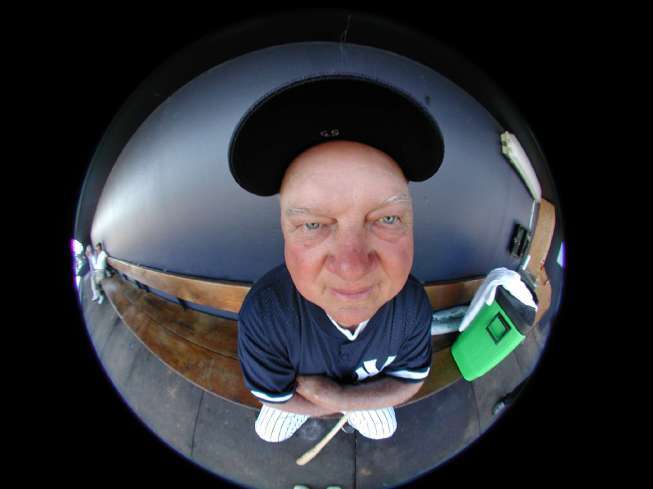
Zimmer managed Tom Yawkey’s Red Sox from 1976 to 1980. Between parties, the Boston media and fans roasted him without mercy.
"Every day," Zim says. "I left the ballpark one night, and sittin’ right by the dugout is my wife and my daughter–she lives up in New Hampshire, but it’s only, like, forty-five minutes north, and I’m drivin’ her up to her house. My wife’s sittin’ in the front, and my daughter’s in the back and she’s cryin’. I turned around and said, ‘What’s wrong with you?’ She said, ‘Daddy, I’m so tired of people booin’ you in this town, and I’m worried that yer gonna get fired.’
"I said, ‘Don’t go to the game no more. Stay home. If it’s gonna bother ya, stay home.’
"Don’t tell me it didn’t hurt–day after day, hour after hour, the same shit. It’s gotta bother ya. But it’s baseball. If you don’t like it, get out. Get a job. That’s the way I looked at it. And that’s the way it was."
There is old school as a slogan of self-advertisement and then there is old school as the baseball way of life Zimmer still loves too much to leave behind.
By Perry Barber
Mr. Baseball
Until he suffered a debilitating heart attack two years ago at age eighty, Arthur Richman was probably the oldest active man in baseball. He spent more than sixty years total as an award-winning sportswriter and columnist for the Daily Mirror and other New York newspapers, traveling secretary for the Mets, then senior advisor and vice-president of media relations for the Yankees, starting in 1990. I was introduced to him in 1983 by Dennis D’Agostino, the Mets’ assistant P.R. director at the time, now a respected author and sports statistician.
Arthur’s sixteen-year tenure with the Yankees was marked by both elation and turmoil. His showdowns with Steinbrenner were legendary, and he used to regale me with tales of how they would yell and scream at each other over some mishegos, then George would “fire” him and Arthur would just show up at work the next day, both of them acting as if nothing had happened, best friends forever.
His office looked out over the field behind the press area where the writers and announcers are stationed during games. Decking its walls were hundreds of signed photos of him and his deceased brother Milton, who is in the writers’ wing of the Hall of Fame, with practically every famous person who ever lived. Arthur liked to joke that he was the only Jew who could get you an audience with the Pope! Books, media guides, Yankee give-aways, hats, baseballs, bobblehead dolls, and more lay stacked up in piles everywhere. His desk was always cluttered with notes of thanks from people for whom he had done something wonderful, or requests for help getting tickets or an audience with a player, all of which he did his best to facilitate. He was always so busy checking in with the beat writers and columnists that he could never sit still and watch a game for long.
I thought David Cone was one of the bright spots in the YES booth this year, didn’t you? He improved steadily as the season progressed and I hope to hear more of him next year.

Hey, ever read Scott Raab’s Esquire piece on Cone back in ’99? Raab caught up with Cone during srping training and the article was a good one: check it out. My favorite part centers around Cone’s anxiety about leaving the game:
"I’ll miss having that ball in my hand," he says, sitting in the clubhouse before practice. "I’m going to have trouble with it, emotionally. I’d like to say, ‘Hey, I’m a little more well-adjusted than that — I have a future and I have a mind and I have things to look forward to,’ but to me it’s just about…I love to pitch so much."
…"I love being out there on the mound with the ball in my hand. I can control the game. I’m out there. No clock — nothing happens until I throw that thing. Nothing happens. I love that feeling."
Something furrows Cone’s brow and drops his voice just then, something few men — athletes or not — give voice to: fear.
"Maybe I should’ve left after last year," he says quietly, "but I’m not ready. It scares me."
Oh, and of course, there is this too:
I depart the clubhouse just in time to see Don Zimmer, the Yankees’ sixty-eight-year-old bench coach, through the doorway of the coaches’ locker room, buck naked. You can call yourself a baseball fan, make the pilgrimage to Cooperstown, and hock your grandma’s silver to buy a Mark McGwire rookie card, but you don’t truly know baseball until you’ve seen Don Zimmer’s cascade of flesh, led southward by the dowsing rod of his manhood.
Manager Joe Torre, talking to a gaggle of reporters in the hallway outside his office, catches the same panorama and winces. "I’m sorry I turned around," he says.
Zimmer was at the track yesterday when Joe Torre called him. Perfect.
Both Manny Ramirez and Jason Bay went deep last night helping their teams, the Dodgers and Red Sox respectively, win Game One of the ALDS. Ramirez’s dinger was one of those Are You Kidding Me? shots. He swung at a pitch only Yogi Berra or Roberto Clemente or Vlad Guerrero could love, and golfed it into the bleachers at Wrigley. The great ballpark in Chicago was almost silent during the last couple of innings, a hundred years of knowing, inevitable dread overwhelming the positive vibes.
Meanwhile, the Red Sox beat the Angels, again, prompting me to wonder if the Angels are men or

It’s only one game, but still. The Angels need to make this a series. C’mon you Halos, get it together.
Okay, so he’s not so new. But as Pete Abe details, Brian Cashman is fired up:

For baseball fans, I think it’s safe to say that Baseball-Reference is the greatest thing since sliced bread (or at least since Retrosheet). Joe Pos sure likes it. Oh, and by the way, Pos is pretty damn good too. And so is this cat Prince Albert.

Happy playoffs.
Bob Timmermann
My last trip to Yankee Stadium (and second overall) was on July 10, 1997. It was Bud Light Umbrella Night and it was the only giveaway I had been to in my life where ONLY the adults in attendance got the prize. The umbrella looked like it could withstand winds of up to 1-2 mph. I ended up giving that umbrella to a coworker and he’s passed away and the ultimate disposition of the umbrella is something I’ve never determined.
I came to the game with a friend of mine who was visiting New York for the first time. She noticed that there was a sign that said “Watch Your Language.” She asked me “How bad can it be?” I told her to wait.
We were in the grandstand in a section that was adjacent to the bleachers. There was some “colorful” interplay between the two sections. When I got back home I asked a New York born friend of mine how parents put up with that sort of behavior and he said, “Ahh, that’s just how they socialize us out there.”
The game was Hideki Irabu’s Yankee debut and the crowd was very excited about the highly touted import. At last, the Yankees would have their own Hideo Nomo. Irabu wasn’t bad, striking out 9 in 6 2/3 innings. But I never got the same sense that the Yankee fans were going to embrace Irabu the same way that the Dodgers fans had embraced Nomo. (Hey, I was prescient!)
But I could tell who the real hero was: Tino Martinez. When Martinez homered off of Omar Olivares in the third, the bleachers went nuts. The love of Tino Martinez is something I never did quite figure out. I think it had something with the fact that people liked to say “Tino.”
As I look back at the boxscore, I see that Derek Jeter went 4 for 5. And I don’t recall it at all. But then he was just Derek Jeter, good young shortstop and not America’s Favorite Shortstop (New England excluded.)
Bob Timmermann blogs about baseball over at The Griddle.
Over at Was Watching, Steve Lombardi isn’t thrilled by the news that Brian Cashman is sticking around as the Yankees’ general manager.
In case you missed Chris Russo’s gleeful little rant about the end of the Mets season, you can check it out here.
For those of you with more refined tastes, check out Biz’s Halloween Beat of the Day:
Brian Cashman has agreed to a three-year deal to stay with the Yankees. Newsday has the scoop.

He’s part of the Family and in the end, Cash didn’t want to leave New York. Can you blame him? After all, if you can make it here you can make it anywhere like the song says. Leaving the big team in the big city and you end up something like Ray Liotta eating spaghetti with ketchup at the end of Good Fellas somewhere in Schnooksville, USA, right? For better or worse, I’m happy that he’s staying…Money, Money…Cash Money.
Got to like the fact that Cash doesn’t mince around. He gets right to it.
Man, I stumbled all over myself in this one. I nailed the first take and then botched the second one. Not that I had anything so revealing to say in the first place…I wish I knew what the Yanks’ll do this winter. One thing is for sure, it won’t be dull. Anyhow, that’s a wrap on the show for now. It’ll be back a couple of times a week during the Hot Stove League:
By Jay Jaffe
The first time Alex asked me to jot down a few thoughts regarding my favorite Yankee Stadium memory for the purposes of this space several months back, a veritable flood of recollections washed over me, things I’d witnessed firsthand at the majestic ballpark over the past 13 years, from the historic to the mundane. Having spent the past eight seasons documenting my time at the ballpark via my Futility Infielder website, I scarcely needed to review my notes except to pluck a few dates for a quick laundry list of memories to share.
But a funny thing happened on the way to delivering this piece, namely the most disheartening season the Yankees have had in a decade and a half. Not only have the cracks in the facade of the team’s roster and player development system been exposed — inevitabilities in the life cycle of even the most championship-laden franchises — but we fans have been struck with reminders of the current stadium’s gradual devolution into a less-than-hospitable venue. The ridiculous sunscreen flap atop the long-settled, none-too-accommodating umbrella and backpack bans, the heavy-handed security forces and the odious and completely un-American "God Bless America" fiasco all serve as reminders of the Steinbrenner family’s overzealous, misguided strategy to maintain the stadium in a post-September 11 world. Furthermore, with a cry of "wait ’til next year" the inevitable outcome of this season of discontent, we’re left to an uncomfortable reckoning with the new ballpark, the ugly back story of its fuzzy math and the gross inflation that will price many of us longtime fans out of the cherished ritual of regular attendance.
Suffice it to say that — for this fan at least — there’s been a mounting pile of baggage blocking the entrance to what the great writer Roger Angell termed "The Interior Stadium", the grand ballpark where each fan has a season ticket to relive the indelible, treasured memories of what we’ve witnessed. A mounting pile, but weighed against the some 130 games I’ve attended at the House That Ruth Built, not an insurmountable one. So having scaled Mount Samsonite, I’m ready to hand over my ticket and commence playing ball.
In the course of attending all of those games at Yankee Stadium II, I’ve come to appreciate the park’s spartan pleasures. I love the way contains the famous reminders of its old history — Monument Park, the white frieze, the flagpole in what used to be the center field patrolled by DiMaggio and Mantle, with the park’s original dimensions preserved by the wall behind it, the black batter’s eye where only the chosen few have reached with their towering blasts — and the portents of its own obsolescence, the narrow concourses, meager amenities, and fatal lack of luxury boxes. As limiting as that latter set is, it’s also been part of the park’s charm, at least to me. If you go to Yankee Stadium, you’re there to see a ballgame, nothing more and nothing less. No fountains, waterfalls, kiddie pools, mascots, slides, or other diversions. Compared to the modern mallparks, the center field public address system is much less intrusive, even when the hated "Cotton-Eyed Joe" blares. What follows here is not one favorite memory of Yankee Stadium, but a subjective top 10 whose glaring omissions might have me rethinking this list the moment after it’s published:
10. My first trip to the ballpark back in 1996, an epic August afternoon where the Yankees and Mariners squared off in a slugfest that went 12 innings and lasted nearly five hours, finishing long after my brother, Bryan, and I had gone home. It was just my second trip to a big-league ballpark (Fenway had been my first back in 1989), and though there were "only" some 44,000 in attendance, the raucous crowd and grand scale of Yankee Stadium made for a sensory overload that overwhelmed me in the summer heat. This marked the beginning of a ritual Bryan and I developed of attending Yankees-Mariners games, one that lasted eight or years before he moved across the country… to Seattle.
9. The time my roommate, Issa, almost caught a foul ball at the Stadium in a game against the Mariners in 1999. Along with Bryan, he and I were sitting in the front row of the Tier Box on the third base side when switch-hitting David Segui came to bat. Batting left-handed, Segui fouled one off, and as I looked at the baseball spinning against the overcast sky, I judged a fly ball correctly for possibly the first time in my life. "That’s yours," I told Issa, who was on the aisle seat. He is a soccer player, with no baseball experience whatsoever. The ball indeed came right into his hands, but rather than cradling it, he lunged at it, knocking it over the railing. With a grimace and a shrug, he slumped back into his seat as what felt like the entire crowd of 41,000 fans showered him with boos.


