Not for nothing, but I watched a good portion of the Mets game last night with some friends on the count of the Yanks-Sox were warshed out. Did anyone see ‘lil Soriano’s home run? Oh my Lord, he absolutely hammered it–deep into the left field seats. Jeez, what a blast.

Thursday
April 16, 2026
Since 2002


Blog Archives
To Boo or Not to Boo?
Steve Silva, who runs the provocative “Boston Dirt Dogs” site, is calling for Red Sox fans to cheer for Johnny Damon tonight at Fenway Park. There are a lot of yahoos at Fenway Park (just as you’ll find, oh maybe, perhaps one or twelve hundred knuckleheads in the Bronx). At the same time, there are also a lot of appreciative, knowledgeable fans up there too (after all, Boston fans have given Joe DiMaggio and Joe Torre ovations in the past). I expect Damon to hear some cheers to being with and figure he’ll be booed soundly after that.
Sunny Sunday Delight
A fine pitcher’s duel, and crisp 4-1 victory for the Yankees yesterday at the Stadium was marred only by some inept umpiring from the man behind the mask, Andy Dowdy. Dowdy is a minor league ump who has been called on to work big league games as an alternate since 2002. On Sunday, before a packed house in the Bronx, he looked overmatched. Dowdy’s strike zone was all over the place by the fifth inning, and his shoddy work provoked each manager to get tossed–both arguing balls and strikes.
Mike Mussina believed he got jobbed on three pitches during the top of the frame–which ended with him striking Shea Hillenbrand out on a full-count pitch with the bases loaded. Mussina got Hillenbrand to chase a change-up that was up in the zone. As Hillenbrand slammed his bat to the ground in frustration, Mussina barked at Dowdy. By the time the game came back from commerical, Joe Torre was gone. According to the Daily News:
“I came (into his office) between (half) innings and watched the pitches that were in question (on TV). And I just went out there and expressed my disapproval,” Torre said. “I just told him from the top step of the dugout, or I asked him about one particular pitch and he thought it was high, and I didn’t think it was high.”
The Yankee manager’s heated discussion went into Gustavo Chacin’s warmups. Torre said the finale of the argument was when he held up three fingers at Dowdy as the team came off the field.
“He asked me what that meant. And I said I thought you missed three pitches,” Torre said. “And he threw me out.”
Andy Phillips knocked a solo home run to right field in the bottom of the inning, tying the game at 1. Gustavo Chacin had been pitching well, but he too was effected by Dowdy’s strike zone, and with two outs, the bases were loaded for the struggling Alex Rodriguez. The 2-2 pitch, was down and in and looked like strike three. The next pitch was almost in the same spot, but no strike three. Instead, Rodriguez drew a bases loaded walk, putting the Bombers ahead for good. Chacin, notable for being a young pitcher with poise, yelled out loud as he walked back to the dugout. Cue Toronto skipper John Gibbons: He puts in his two cents and get tossed.
Kyle Farnsworth replaced Mussina in the seventh and was impressive. He left a fastball down to Alex Rios who stroked a single to left. Rios then stole second but was called out. The Yankees have been on the wrong side of a slew of calls so far this season, but they got one back there–Rios was clearly safe. After falling behind Frank Catalanotto, Farnsworth blew two fastballs–right over the plate–past the Yankee killer. Catalanotto didn’t stand a chance. Farnsworth came back with two nasty sliders to whiff Vernon Wells.
Jason Giambi, the Yankees’ best offensive player for the first month of the season, smacked a two-run home run (on a full-count pitch from Pete Walker) off the facade in right field to pad the lead. Farnsworth caught Troy Glaus looking on strikes to start the eighth and then got Shea Hillenbrand to pop out after giving up a one-out double to left by Lyle Overbay (Farnsworth was hitting 100 mph on the radar gun, according to YES, he just left a fastball down in the zone to Overbay). Mariano Rivera came on and retired the last four Toronto hitters on a weak pop out and three ground balls.
It was a rewarding victory, and a particularly good way to head up to Boston. Right. In case you hadn’t heard, the Yankees and Red Sox are meeting for the first time this year for one of those strange little two-games series. There will be plenty of hoopla over Johnny Damon’s return to Fenway, but Yankee fans are more probably more preoccupied with the health of Gary Sheffield. Josh Beckett goes for the Sox tomorrow night and perhaps the Yanks will get to see Boston’s icy young closer, Paplebon too. Should be tense and nervous and excitable, as it normally is when these two teams meet.
Soporific Saturday Slaughter
A beautiful day did not make for a beautiful game. Actually, Saturday’s ballgame was often tedious, though there was some upper deck excitement provided by Johnny “Double Dutch” Damon, Jason Giambi and Jorge Posada. The slumping Alex Rodriguez made a great backhanded catch (it’s funny, Rodriguez is clearly in a funk at the plate and yet his numbers are still respectable–he was 0-4 yesterday but scored three runs and had an RBI) as the offense crushed Toronto pitching.
Final score: Yanks 17, Jays 6.
The most alarming moment of the game came when Gary Sheffield collided with first baseman Shea Hillenbrand. Both went down hard, with Sheff staying down longer. At first I thought, “Oh, God, his right shoulder.” But according to the early reports, Sheff has a bruised right knee and banged up both of his wrists. It was a scary moment though. Oh yeah, and Randy Johnson got beat about the face and neck again by the Jays. This time, he was bailed out, but it was another underwhelming outing for the Big Unit against Toronto.
Otherwise, the game was a snoozer, perfect time for Yankee fans to take a mid-afternoon nap without fear of waking up suddenly in a panic. The Blue Jays could simply not throw strikes, almost every count went deep and the Bombers scored runs in all eight innings they came to bat, only the second time in team history that they’ve accomplished that feat (the first was back in 1939).
They played deep enough into the afternoon for the shadows to become a factor in the last couple of innings. The intense spring light against the grass is just different enough from the more mellow, autumn light–and the shadows they create–to really give you a sense of time and place.
Mr. Chacin goes against Mr. Moose this afternoon, another drop-dead gorgeous day here in the Bronx. Our man, Cliff Cocoran will be on hand, drinking it all in.
Go get ’em Moose.
Beautifical Day for Ball in the Bronx (ain’t it?)
It is a sterling spring day here in New York as Randy Johnson goes against the Blue Jays this afternoon. Really, not a cloud in the sky, sunny, but breezy, in the low sixties. It’ll be chilly later on. Of course, the Big Unit was served by the Blue Jays last week in Toronto. They just pounded him. Let’s see what he has for them this time around. The Yankee offense has sputtered for the past three games. How much longer can that happen?
Let’s Go Yan-Kees.
Howe Come (Bernie)?
The news of Steve Howe’s unpleasant death hovered over Friday night’s game, didn’t it? Michael Kay didn’t exactly go out of his way to say anything flattering about Howe, who was probably a real hard-on to a guy like Kay in the clubhouse. Or any repoter, for that matter. Joel Sherman was on Channel Nine later on and he too painted Howe as this hyper-active, amped-up nut. I’m sure this is was true–that Howe was what the Brits call the “c” word to the writers. But he was evidentally appreciated by some of his teammates, including none other than Gentle Ben, Bernie Williams. According to Filip Bondy in the Daily News:
He didn’t always tell people the truth, and that probably included himself. But Howe made memories in New York, was a real character with real character flaws. Bernie Williams talked yesterday about exactly that – how Howe was wacky in the clubhouse, dead serious on the mound.
“He’d do anything for his teammates,” Williams said. “He tried to keep us loose in the clubhouse. He was a prankster. He took me under his wing.”
It is hard to imagine how a wild personality like Howe would be something of a mentor for a steady, straight-arrow star like Williams. But Howe was like that. He could be extremely helpful, amiable. He also just happened to be in trouble, almost all the time.
Great to hear that Howe played the mentor to Bernie. That is a great pairing to imagine, right? I never really disliked Howe, who was an effective part of those Buck Showalter-Stick Michael rebuilding teams. Talk about a presence. Howe came across like one of those nutzo spaz performances by James Woods, or the guy Mel Gibson played in “Lethal Weapon.” But had more of a Jim Bouton-square face. He was uncomfortably wound-up. All sweaty and on-the-edge, ready to burst. I don’t think he was altogether unappealing, but man was he volatile. If he didn’t like you it must have been brutal. It’s nice to know he had an warm side. Howe is possibly hilarious from a distance, but if you found Howe amusing at all, it is because you enjoy laughing nervously. Or if you liked Howe it is also because you probably just sympathized with his kind of schlimazzel. But as troubled as he was, he left Yankee fans with compelling memories, on and off the field. It’s too bad that his story ended sadly, but it sure doesn’t come as a surprise.
Yanks Win a Close One
Shawn Chacon and Mark Hendrickson, last night’s two junk ball starters, were both effective with plenty of the soft stuff. Joey Gathright made a sterling play in the bottom of the first inning to snatch a home run away from Gary Sheffield. However, an error later in the game by Tampa Bay’s third baseman Russell Branyan paved the way for the slumping Hideki Matsui, who came through with the winning hit for the Bombers–a seeing-eye single that was reminiscent of Luis Sojo’s ground ball in Game 5 of the 2000 World Serious. After a horribly frustrating night for the New Yorkers, the home team prevailed, 4-2. Derek Jeter had three hits himself and is now batting over .400. The bullpen performed well and this was just the kind of win the Yankees needed, wouldn’t you say?
Dervish
Speaking of Roger Angell, after going to hear David Maraniss talk about his new book on Roberto Clemente last night, I was reminded of Angell’s description of Clemente in the 1971 World Serious. Maraniss spoke about Clemente’s game going deeper than what the numbers can tell us, and I don’t think he meant it as a cop-out. It was meant it as a way of describing somebody whose very body language was memorable–all of a piece. “Sensations” was the term Maraniss used and Clemente certainly made the country take notice with his performance–on the bases, in the field and at the plate–in that Serious (by the way, for what it is worth, Maraniss believes that Clemente would have been a fine player today, and he compared him to two other athletes of that era whose games suggested something timeless–Gayle Sayers and Earl Monroe).
Before Game 7, Clemente told Angell, “I want everybody in the world to know that this is the way I play all the time. All season, every season. I gave everything I had to this game.” The final game hadn’t begun yet, when Angell, summing-up the first six games, wrote:
And then too, there was the shared experience, already permanently fixed in memory, of Roberto Clemente playing a kind of baseball that none of us had ever seen before–throwing and running and hitting at something close to the level of perfection, playing to win but also playing the game as if it were a form of punishment for everyone else on the field.
Now, that’s a sensation.
Oy
Talk about a night to forget in the Bronx. The Devil Rays set a dubious team record issuing fourteen walks, but the Yankees only managed to score two lousy runs (how’s the old blood pressure, Yankee fans?). The Bombers stranded sixteen men on base. The two teams combined for nine stolen bases, but poor base running cost New York. In the end, the Rays rallied against Mariano Rivera in the tenth and won the game, 4-2. Gary Sheffield grounded out with the bases loaded to end the game.
Sam Borden reports in the Daily News:
Despite the unsightly performance, Joe Torre wasn’t angry. Asked to explain how a lineup of All-Stars could miss on so many chances to break out against a mediocre pitching staff, the manager simply nodded to the baseball gods.
“There is just no explaining it,” he said. “The quality of the at-bats was there. Nobody gave anything away. You scratch your head sometimes over how things happen but you know there’s nothing you can do. I can’t find fault with anything but the result.”
As Roger Angell once wrote–trying to describe how the Orioles swept the once mighty Dodgers in the 1966 Fall Classic–“the only explanation must be that baseball is still the most difficult, and thus the most unpredictable and interesting, of all professional sports.” Look for the Bombers’ bats to bounce back tonight.
Slow, Slower…
Last week, Buster Olney wrote about how Mike Mussina has been making like Greg Maddux and throwing his soft stuff even slower. Today, Tom Verducci gives us more insight into why Moose has been so successful this spring:
“I threw in an intrasquad game in spring training,” Mussina said. “People were like, ‘Why are you pitching in an intrasquad game?’ Really, the only reason why I did was that you back everything up from the start of the season, counting five days between starts, and five days before my first spring training start happened to be a day when we had an intrasquad game.
“So I’m pitching in this intrasquad game and [Jorge] Posada is up. The count is 3 and 2 and I throw a changeup. Now for some reason, Posada is right on the pitch and he smokes it. Hits it on a line. We got him out, but I was surprised that he would be right on a 3-and-2 change.
“So after the game I asked him, ‘How could you be right on that changeup I threw you?’ He said, ‘I saw your fingers on top of the ball as it was coming out of your hand. I could tell it was a changeup.'”
What Posada saw were Mussina’s index, middle and ring fingers splayed across the top of the baseball, a grip that makes it impossible for a pitcher to throw anything but an off-speed pitch. (Only two fingers, the index and middle, top the ball for a fastball.) Posada saw the dead giveaway, kept his hands and weight back and timed the changeup perfectly.
Mussina is 37 years old and has been pitching in the major leagues since 1991. No one had ever told him what Posada told him. So Mussina decided to change his grip. He slid his index finger more to the side of the ball than the top of the ball — not quite the grip for a circle changeup, in which the thumb and index finger form a circle on the side of the ball, but a modified version of it.
The pitch worked perfectly. Not only was Mussina able to disguise the pitch, but he also was able to throw it slower and generate better downward movement on it. “It doesn’t so much run,” Mussina said, referring to the sideways motion some pitchers get from their changeup, “but it just kind of dies at the end. It tumbles under the hitter’s bat. And to think if I didn’t bother pitching in an intrasquad game, none of this would have happened.”
A few years ago, I did a pre-season Q&A with a bunch of sportswriters. One of the questions I posed was whether Mussina would finally win 20 games that season. Most thought he’d be a lock for at least 15. We’ve seen Mussina break down with injuries for the past two years, and so the old “Will he win 20?” was not exactly the first question many Yankee fans had on their mind when considering Mussina in 2006. But wouldn’t it be wunnerful if he did win 20 this year?
I know, it’s a jinx to mention it, but screw it, Mussina has enough bad luck on his own–I’m not going to be the one that puts the whammy on him. Regardless, I hope he gets at least 15 and has a terrific year. It’s been cool reading the comments section lately and seeing how many fans he has out there. Cliff and I have always been big supporters. Should be interesting to see how he fares against the Jays this weekend, as they get their second look at him. Friday night, which pits the Big Unit v. Roy Halladay could be something special too.
Boricua, Baby

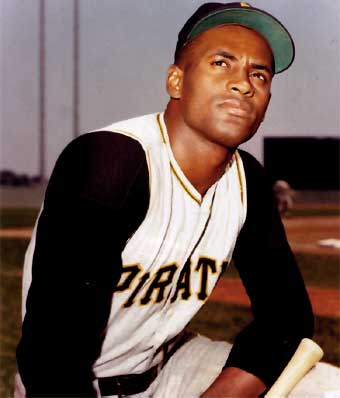
“Clemente,” the new book by pulitizer prize-winning author, David Maraniss, hits the shelves today. It is a fine appreciation of Roberto Clemente, who is undoubtedly one of the most charasmatic players of the post-War era. Although Clemente was a key member of two World Championship teams, he played in relative obscurity in Pittsburgh during the 1950s and ’60s, and was overlooked for his much of his career. Until, of course, his monumental performance in the 1971 Serious, and his untimely death in December of 1972. His legend and reputation have grown ever since.
As my pal Steve Treder put it to me in an e-mail recently:
Clemente was actually slightly underrated until the late ’60s, and especially during the 1971 World Series when he suddenly got noticed by the national media. At that point they all suddenly seemed to think he was better than he actually was, after years of being overlooked. His early tragic death soon afterward froze his image in time. Had he lived, and had a few years of decline phase at the end of his career, his reputation probably would have balanced out about right. As it is, many casual fans seem to think he was the equal of Mays/Aaron/Robinson/Mantle, when in fact he wasn’t nearly as good as any of them.
It is no insult to say that Clemente wasn’t as great as Mays, Aaron, Robinson or Mantle. They are all legends. Fortunately for Maraniss, off-the-field, Clemente was more interesting than most. And between the lines, Maraniss points out, Clemente had a terrific, inimitable style.
There was something about Clemente that surpassed statistics, then and always. Some baseball mavens love the sport precisely because of its numbers. They can take the mathematics of a box score and of a year’s worth of statistics and calculate the case for players they consider underrated or overrated and declare who has the most real value to a team. To some skilled practitioners of this science, Clemente comes out very good but not the greatest; he walks too seldom, has too few home runs, steals too few bases. Their perspective is legitimate, but to people who appreciate Clemente this is like chemists trying to explain Van Gogh by analyzing the ingredients of his paint. Clemente was art, not science. Every time he strolled slowly to the batter’s box or trotted out to right field, he seized the scene like a great actor. It was hard to take one’s eyes off him, because he could do anything on a baseball field and carried himself with such nobility. “The rest of us were just players,” Steve Blass would say. “Clemente was a prince.”
Thanks to Mr. Maraniss and the good people at Simon and Schuster, here is an excerpt from “Clemente.” This section is less about Clemente specifically and more about the conditions that Black and latin players encountered in the early 1960s. But it establishes the backdrop that is essential to understanding Clemente’s story. Enjoy!
BOOK EXCERPT: From “Clemente”
By David Maraniss
“Pride and Prejudice”
[Clemente] arrived at Pirates camp to train for the 1961 season on March 2, a day late. He and Tite Arroyo had been delayed entry from Puerto Rico to Florida until tests came back proving they did not have the bubonic plague, a few cases of which had broken out in Venezuela during the tournament.
On the day he reached Fort Myers, free from the plague, a story ran on the front page of the New York Times under the headline: NEGROES SAY CONDITIONS IN U.S. EXPLAIN NATIONALIST’S MILITANCY. One of the key figures quoted in the story was Malcolm X, the Black Muslim leader, who in the Times account was referred to as Minister Malcolm. Interviewed at a Muslim-run restaurant on Lenox Avenue in Harlem, Malcolm X said the only answer to America’s racial dilemma was for blacks to segregate themselves, by their own choice, with their own land and financial reparations due them from centuries of slavery. He dismissed the tactics of the civil rights movement as humiliating, especially the lunch-counter sit-ins that were taking place throughout the South. “To beg a white man to let you into his restaurant feeds his ego,” Minister Malcolm told the newspaper.
This was fourteen years after Jackie Robinson broke the major league color line, seven years after the U.S. Supreme Court struck down the separate-but-equal doctrine of segregated schools, five years after Rosa Parks and Martin Luther King Jr. led the bus boycott in Montgomery, four years after the Little Rock Nine desegregated Central High School in the capital of Arkansas, one year after the first lunch-counter sit-in in Greensboro. Year by year, the issue of race was becoming more urgent. The momentum was on the side of change, but the questions were how and how fast. In baseball, where once there had been no black ballplayers, now there were a hundred competing for major league jobs, and along with numbers came enormous talent, with ten past and future most valuable players among them. Yet every black player who reported to training camp in Florida that spring of 1961 still had to confront Jim Crow segregation. Even if their private emotions were sympathetic to Malcolm X’s rage at having to beg a white man to let you into his restaurant, the issue in baseball was necessarily shaped by its own history. Having moved away from the professional Negro Leagues and busted through the twentieth century’s racial barrier, black players did not view voluntary resegregation as an option, and separate and unequal off the field was no longer tolerable.
Wendell Smith, the influential black sportswriter who still had a column in the weekly Pittsburgh Courier but wrote daily now for the white-owned newspaper Chicago’s American, began a concerted campaign against training camp segregation that year. On January 23, a month before the spring camps opened, Smith wrote a seminal article that appeared on the top of the front page of Chicago’s American headlined negro ball players want rights in south. “Beneath the apparently tranquil surface of baseball there is a growing feeling of resentment among Negro major leaguers who still experience embarrassment, humiliation, and even indignities during spring training in the south,” Smith wrote. “The Negro player who is accepted as a first class citizen in the regular season is tired of being a second class citizen in spring training.” Smith added that leading black players were “moving cautiously and were anxious to avert becoming engulfed in fiery debate over civil rights,” but nonetheless were preparing to meet with club owners and league executives to talk about the problem and make it a front-burner issue for the players association.
Here Comes Da Mums

My mother was born in Belgium and then raised in the Belgian Congo. When she met my father and came to New York in 1966-67, she spoke English well enough, but though she’s lived here in the States ever since, her high-pitched French accent remains. Once you meet her once, you’ll never forget the way she talks. As kids, she’d sing us lullabys–mostly in French–but sometimes in English too. One that I remember with particular fondess was mom singing the chorus of George Harrison’s sweet-natured record, “Here Comes the Sun.” Ma didn’t know any of the lyrics so she’d just sing the chorus and then add her own “Do-da-do-doo doos.” But in her high-lilting voice, it sounded so charming, and for us as kids (my twin sister and younger brother), undoubtedly warming too.
This memory came to mind yesterday as I watched the Yankee game at home with Emily. I had spoken with my co-host Cliff earlier in the day and he expressed some concern about the rainy weather. Cliff’s got a season ticket package for Sundays. Since he was on puppy-duty yesterday he offered his tickets to his mom–who is a bonafide Yankee fan–and a cheery one at that. But he was feeling guilty at the thought of his mom getting soaked out there in the bleachers all afternoon. I could relate to feeling guilty like that, so you can imagine how pleased I was for Cliff and his mom when the sun came out mid-way through the game, and remained for the rest of the afternoon.
When the sun poked through, I thought of Cliff and his mom as I heard my own mother singing “Here Comes the Sun.”
Just a quick, personal memory during yesterday’s 7-1 win at the Stadium. Randy Johnson pitched, Jorge Posada caught, while Jason Giambi supplied the pop.
Random Girlfriend Question #4080
When I’m watching the ballgame at home with Emily–the ‘lil perfessor–she loves throwing questions my way. At times I have to bite my tongue and contain my smug, male superiority–“God, what a chick thing to say,” I’ll think, rolling my eyes. Then of course, Emily will also come out with things that leave me completely stumped. So the other night, as we watched Johnny Damon make several catches against the wall, she asked about the origins of the warning track. How did it get its name? When was it invented?
Mr. Wizard didn’t have an answer. So I asked around some, and still don’t have a definitive answer. Bill James suggested that they were possibly invented as a response to Pete Reiser, the Brooklyn Dodger outfielder who was famous for running into outfield fences and getting knocked out. Late ’50s, early ’60s was his guess. Steve Treder thinks it could have been a bit earlier but agrees that it was probably designed at the same time other player-safety innovations were created–batting helmets and padded walls. (By the way, I just learned in David Maraniss’ forthcoming book on Roberto Clemente that none other than Branch Rickey came up with the plastic/fiber-glass batting helmet–was there anything that Rickey wasn’t invovled in?) Here is Rich Lederer’s take:
Warning tracks, as we now know them, were fairly standard by the 1950s. I’m not aware of any ballpark without a warning track by the 1960s. Are you?
The first warning track dates back much earlier though. Yankee Stadium had what was known as a running track dating back to the 1920s. It was used as just that: a running track (used for foot races) but it served a dual purpose as a warning track for baseball games, too. I just don’t know if it was a coincidence or not. That said, I have black and white photos in baseball books that backs up this claim.
So, anyone else have any ideas? Paging Mr. Markusen. Hey, my girl’s just got to know.
Slow Down
Buster Olney has some sharp observations on Mike Mussina over at ESPN today:
The last couple of years, Mussina’s success or failure was often predicated on how good his fastball was on a given day. If he threw 88-90 mph, he had a chance to have a pretty good day, throwing his fastball high in the strike zone, while most of his offspeed stuff was in the range of 77-78 mph. If Mussina’s fastball was 85-86 mph, however, he would get wrecked, the hitters always looking like they were all over everything he threw.
The adjustment Mussina has made, it seems, is to slow down his slow stuff. He was bending curves and flopping changeups at 70-71 mph against the Jays, with spectacular location (on an afternoon when both he and Jays starter Ted Lilly took advantage of home plate umpire Paul Runge’s generous and consistent strike zone). Every so often, Mussina — like Schilling, like Pedro Martinez — would look to finish off a hitter with a fastball and suddenly whiz a 91-93 mph four-seam fastball, and because the Jays were kept off-balance by the variance, they were overwhelmed. In one of Troy Glaus’ three strikeouts, the third baseman looked like he started his swing when the ball was already buried in Jorge Posada’s mitt. It was the first time in several years that hitters appeared downright uncomfortable hacking against Mussina, because they never got a firm read on his velocity, the trajectory or the selection of his pitches.
As Mussina changed arm angles and speeds (he reminded me a lot of Orlando Hernandez, in how El Duque pitches), he allowed a run in 7.1 innings and picked up the 226th victory of his career. The Yankees have pitching problems, undoubtedly, but based on how Mussina looked, I don’t think he’ll be a concern. He appears to have learned how to win with slop — good ol’ fashioned slow stuff.
Word, Buster. Got to love the slow stuff.
Giam-Boom Boom
The Yanks bounced back yesterday, as we all hoped, beating the Twins 9-3, featuring strong showings from Chien-Ming Wang, Jason Giambi, Robinson Cano and Alex Rodriguez. Rodriguez was critical of his own performance after Saturday night’s tough loss. According to Sam Borden in the Daily News:
Joe Torre wasn’t surprised to hear Rodriguez was being hard on himself because he’s seen A-Rod “set the bar sky-high” ever since Rodriguez arrived in the Bronx. Torre sometimes wishes Rodriguez would give himself a break.
“He drives himself to the point of expecting himself to do more than any human being is capable of doing,” Torre said. “Alex is very tough on himself because he doesn’t think he should do anything wrong ever. I don’t think we can live our lives that way.”
…”He never tires of physical work,” Torre said. “He’s out there constantly, trying to make himself better. Over 162 games, it takes its toll.”
Rodriguez can be called a lot of things. A slacker is not one of ’em.
Sunday Special: Look Out Below
The Yanks hope to grab a win today before they leave for Toronto. A lackluster offensive outing on Friday night sperled Mike Mussina’s decent outing while fortune was on the Twinkies side against Mariano yesterday. Wang vs. Radke today. Let’s hope Wang gets some groundballs and that the infielders are positioned to gobble them up. As for Radke, well, let’s just say that I expect the bats to be alive this afternoon for the Bombers.
Cliff adds:
Joe Torre has been rotating his corner men through the DH on the Homerdome Turf. Friday night it was Gary Sheffield with Bernie getting his first start in right since the Buck Showalter days. Last night it was Jason Giambi, who got to sit out against the lefty Santana with Miguel Cairo getting the start at first (1 for 4 with a double off Santana) and Andy Phillips getting his first start of the year at DH (0 for 4 with three Ks after being robbed of a home run to dead center off Santana by Torii Hunter). Today it’s Hideki Matsui who will get to sit between at-bats, with either Bernie or Bubba taking his spot in left. This means that Giambi will be back at first with the groundballer Wang on the mound. Giambi has started in the field behind Wang in both of his starts this year with no ill effect, though it still seems as though Torre could have arranged things better to allow Giambi to DH behind Wang as Santana is hardly the sort of league average lefty against whom it makes sense to swap out Giambi, who, it goes without saying, is a superior hitter to both Cairo and Phillips. At any rate, it’s getaway day and the Yankees have tomorrow off, so it’s all in for the win this afternoon.
Seared
When Johan Santana has a four run lead on your team early in the game, you pretty much think it is going to be a short, curt afternoon for your boys. But Santana is not his usual dominant self yet and by the fourth inning, the Yanks started to hit him hard. The Bombers rallied down 4-0 and tied the game on Derek Jeter’s third hit of the game–this in spite Torii Hunter casually swiping a home run from Andy Phillips and Jorge Posada missing a homer to right by two feet. Alex Rodriguez, who has been laboring to find a groove this year, got down in the count and then hit a hard ground ball through the left side to put the Yankees ahead 5-4.
There was a lively discussion of what transpired in the bottom of the eighth inning yesterday in our comments section here yesterday. It involved all of your favorites–Johnny Damon, Derek Jeter, Gary Sheffield and Alex Rodriguez. The Yankees had a man on second with nobody out and weren’t able to get a run home. The debate was sparked about Derek Jeter. Of all people. And it involved a sacrifice bunt. Of all things. Regular commenter and fellow blogger Mike Plugh wrote a good a follow-up post analyzing the inning over at Caynon of Heroes, which you should check out. Far as I saw it, the inning was highlighted by a thrilling duel between Juan Rincon and Gary Sheffield.
And that’s where it stood with Mariano on in the ninth. The first batter Luis Castillo has pestered the Yankees over two games and on the 2-2 pitch barely held up on a cutter. The third base ump opined that Castillo did not go around–it was a generous ruling at best. Castillo then slaps the ball into the turf and beats out an infield hit. Rivera pounced off the mound beautifully and made a strong peg, but it was just a fraction late.
Rivera narrowly missed striking out the next batter Mauer on the 2-2 delivery–a fastball, up and away. The high strike. It’s a pitch Rivera has been known to get over the years. So, on a defensive swing, Mauer slaps the ball into left. Matsui gets it and chucks it to third–an absent-minded decision that proved costly. There wasn’t going to be a play on Castillo at third, but the throw to Rodriguez allowed Mauer to go to second.
Mo then strikes out poor Rondell White, do did manage one base hit on the game, but who is in the midst of a horrid slump. (The Yanks twice walked Mauer to get to White in the game and both times they retired ‘ol Ro.) Mo made him look silly. And then Rivera overwhelmed Torii Hunter for the second out. Caught him looking at a nasty cut fast ball. It fooled Hunter so badly he argued with the home plate ump about the call, but replays showed it just broke devastatingly late. Nothing Hunter could have done about it, but say something. Got to get it out when you get burned that badly.
Then Justin Morneau plunks a soft liner into right, not all that far from Robinson Cano’s reach. Two runs score, and the Twins win the game, 6-5. Other than Mauer’s defensive-swing hit, nobody had hit the ball hard of Rivera.
But these things happen. It was the first game that hit me in the gut this year, that got me pissed and upset. What calmed me down more than anything was watching Rivera being interviewed after the game. He was smiling and saying, “What can I do, they didn’t hit it hard, I felt good, made some sharp pitches, and these things happen. I’ve already gotten over it and moved on.” And he means it, he has moved on. He’s speaking in cliches but he isn’t lying. Rivera is imperturbable. It’s not just schtick with him. That’s what makes him the greatest. Win or lose. And if he’s cool with the ups and downs of the game, I’ve got to ask myself “Why am I all nuts over this?” Way to calm me down, Mo, yer the man.
Dud
The Yankees wasted a good outing from Mike Mussina, who has previously owned the Twins, losing 5-1 on Friday night. The game moved along quickly for the first six-and-a-half innings and the Yankees were just “off” enough–both offensively and defensively–to come up short.
The Twins’ young right-hander, Scott Baker allowed just one run over seven innings, mixing pitches and change speeds effectively. He didn’t throw hard, but had the Yankees off-balance all night. A lot of his pitches were just off the plate, just out of the strike zone, and the Yankee hitters anxiously jumped on them. There were a lot of harmless fly ball outs. Gary Sheffield flew out four times and saw less than ten pitches on the night (he swung at the first pitch in his first two at bats, and the team made six first-pitch outs in the first five innings). According to the New York Times:
“He was like a surgeon,” Yankees Manager Joe Torre said. “He was down. He was up. Hitters like to zone in on location, and they were never able to do that.
“The thing he did the best was get ahead of a lot of hitters, and sometimes we just got caught in-between.”
…”It’s weird, because we need to learn how to win these close games,” Johnny Damon said. “We need to learn how to push across runs. It just shows how good a pitcher can be when he’s around the strike zone and doesn’t walk anybody.”
Mussina pitched well for most of the game–running into trouble in the third and later, in the seventh. Jorge Posada was thrown out at the plate attempting to tag on a fly ball to right. The replays showed that he was safe on a close play. The Yankee catcher was involved in another critical play later in the game.
In the seventh, with two men on and the Twins holding a one-run lead, Juan Castro popped a Mussina change up foul. Posada raced over towards the first base dugout to make the play but couldn’t get there in time. Jason Giambi, who was playing back off the base was too late arriving as well. The truth is, Posada covered a lot more ground than Giambi did, yet if anyone was going to make that play it would have been the first baseman. In what was clearly going to be Mussina’s final batter of the game, Castro worked the count full, then fouled off several pitches before slapping an RBI single to left.
It was just one of those nights. The Bombers put the first two men on in the eighth but Bernie Williams bounced into a double play–they went listlessly in the ninth, almost as if they had a plane to catch. Kyle Farnsworth pitched the bottom of the eighth and allowed two more runs to score.
I’ve complained about Farnsworth’s thought-process in the past and last night was an ideal example of why the guy drives me nuts. Farnsworth’s two best pitches are a plus fastball and a sharp slider. But you don’t get the sense that he knows how to mix his pitches properly–he falls in love with dominating a hitter and makes things tougher on himself in the process.
With two men out and nobody on, Farnsworth was pitching to Torii Hunter, a right-handed hitter. He threw a slider for strike one and then got Hunter to wave at a nasty slider for strike two. Now, I’m thinking, okay, time to come up and in with the heat. Posada signaled for a fastball and you could see him motioning for it to be high and tight. Hunter is a free swinger, after all. Farnsworth shook him off.
C’mmon, Meat, I’m thinking at home. We’re going to go through this Nuke Laloosh routine all year, aren’t we? (Funny to consider Jorge Posada as the sage Crash Davis, huh.) But no, Farnsworth wanted to get him out on another slider. It would be difficult to throw one better than the pitch Hunter had just swung through. Sure enough, the next pitch was a slider, it wasn’t as nasty as the previous one, and Hunter slapped the pitch into right for a double.
Justin Morneau, a lefty, was next. He had a great swing at a Farnsworth fastball that was low and right over the plate. The pitch was fouled straight back indicating that Farnsworth had gotten away with one–Morneau was right on it. He got strike two on another fastball, but this one was up and away, and he simply over-powered Morneau with it. So now, I’m thinking, maybe time for the slider, or another high heater. Instead Farnsworth threw another low fastball–seemingly identical to the pitch Morneau just missed–which was promptly slapped into left field for an RBI single.
Now, maybe Farnsworth’s location was just off. Again, I’ll admit that I’m ready to be critical of the guy so I’m not exactly even-handed when discussing him. He’s clearly got good stuff. I just don’t know that he’s got much sense. And after a long night of lousy at-bats, it was the icing on the gravy so to speak. Farnsworth didn’t lose the game for the Yankees, he just made it uglier.
No breaks for the Bomb Squad tonight as they face Minnie’s ace, Johan Santana. Santana has not pitched well in his first two outings, which is just enough to make me believe that he’ll be on tonight. Jaret Wright goes for the Yanks.
Sweep: Grumble
Randy Johnson was cruising along for the first four innings yesterday afternoon, but he allowed three straight hits in the fifth, giving up a run in the process. He made it through the inning but after throwing only 87 pitches his day was over, sending a tremor through Yankeeland. The team announced that there was nothing physically wrong with Johnson but after the game it appeared that he had in fact experienced some discomfort out there. The Big Unit was his naturally defensive self when he spoke with reporters (if he is uncomfortable, you know he’s going to make the press uncomfortable). Tyler Kepner reports in the Times:
Manager Joe Torre said that Ron Guidry, the pitching coach, told him Johnson was stiff during yesterday’s game, although Torre said he did not know where. Johnson initially scolded reporters for getting the story wrong, but then admitted to some stiffness — sort of.
“Just a little tired, stiffness in the shoulder, if you want to call it that,” he said, adding a disclaimer that seemed to amuse him. “The right shoulder.”
…”I don’t need to go out there every time and pitch seven, eight innings because you might like it,” he said. “I might like it, but I also realize that the innings and the pitches that are going to be mostly counted on from me are going to be late in the year.
“So as much as I want to get my arm where it needs to be — that’s what spring training is for — there’s a time and a place to go out there and throw innings and pitches.”
The Yankee lead was cut to 4-2 when Tony Graffanino greeted Taynon Sturtze with a solo home run in the eighth, that was as close as KC would get. The Bombers scored five runs in the bottom of the frame–highlighted by home runs from Jason Giambi and Johnny Damon, and that was that. Final score: Yanks 9, Royals 3. Gary Sheffield also homered, Hideki Matsui and Derek Jeter both lengthened their hitting streaks and Bernie Williams collected three singles on the afternoon. After the sweep, the Yanks are back on the road this weekend, out to see their old pal Ruben Sierra and his new team, the Twins.
Thump
Yesterday’s game will be remembered for Gary Sheffield’s wicked foul ball in the first inning, which sent third base coach Larry Bowa to the turf. In the same at-bat, Sheffield hit a three-run homer to left, tying the game. According to the Daily News:
Sheffield apologized, but Bowa waved him off. “I told him forget sorry,” Bowa said. “I’ll go down on my back every day for a three-run homer.”
The Royals had a 3-0 lead, but their starting pitcher, Jeremy Affeldt walked Johnny Damon and then Derek Jeter in the bottom of the first (oy) before Sheff’s homer. Oh, those base on balls. The Bombers didn’t look back as they handled Kansas City 12-5. Shawn Chacon wasn’t especially terrific but after a rocky start he was good enough.


"This ain't football. We do this every day."
--Earl Weaver
--Earl Weaver