
The first of two will be played in the Bronx. Then, a trek cross town for the night game at Shea. I’m hoping the Yanks come away with a split this weekend.



The first of two will be played in the Bronx. Then, a trek cross town for the night game at Shea. I’m hoping the Yanks come away with a split this weekend.
Should the Yankees continue to take "Melk" with their outfield cup of coffee? That was the question posed earlier this week in an interesting New York Sun article by the Yes Network’s Steven Goldman. An able and long time chronicler of the Yankees, Goldman feels the Yankees should shop Melky Cabrera, making him a key piece of a package for a pitcher that could cushion the blow caused by Chien-Ming Wang’s foot injury. I’m inclined to agree with Goldman, though I do think the Yankees should wait a few weeks until the timing is just right to move their starting center fielder.
At one time I was a major supporter of Cabrera, fully believing that he would become the next Roy White, but with a much stronger arm that would allow him to play center field on an everyday basis. I saw Cabrera as a player who could hit .280 with lots of walks, hit 15 home runs a year, steal 20 to 25 bases, and give the Yankees above-average defense in center field. I have my doubts now. Though still only 24, Cabrera just isn’t improving. He could still hit 15 long balls a year, but I’m starting to think he might be a .260 hitter who doesn’t draw as many walks (his bases on balls rates are going down, not up), and a defender who repeatedly takes bad breaks on balls hit over his head. I’m thinking more Roberto Kelly now than I am Roy White. That doesn’t make Cabrera a bad player; he just appears that much closer to average, making it imperative that the Yankees surround him with star players in left and/or right field. And given the age of Johnny Damon and Bobby Abreu, who knows what the Yankees will be throwing out in left and right field as we move closer to 2010.
Inevitably, the question becomes: who replaces Cabrera? As Goldman points out, the Yankees have a solid candidate in Triple-A center fielder Brett Gardner, who has always been capable of getting on base, but has added more power and better defense to his minor league resume this summer. Some of the Sabermetric naysayers downplay Gardner, projecting him as no more than a No. 4 outfielder because of his lack of power. I’ve read at least one analyst predict that he’ll amount to nothing more than Jason Tyner. But Gardner’s numbers indicate to me that he could just as easily become another Brett—Brett Butler—who was one of the most underrated outfielders of the late 1980s and nineties. Butler never hit more than nine home runs in a single season, but he somehow managed to achieve a nearly .380 lifetime on-base percentage while playing capably in center field. Yes, I’ll take anything close to that from Gardner, who at last look was sporting a .414 on-base percentage with 30 stolen bases and three home runs for Scranton/Wilkes Barre.
According to all of the scouting reports I’ve seen, Gardner has far more speed and slightly more range than Cabrera, which should make up for the difference in arm strength. The fact that Gardner bats left-handed shouldn’t be a deterrent either. Although Cabrera is a switch-hitter, he has never hit particularly well from the right side, so he does nothing for the Yankees’ problems against left-handed pitching. Another part of Cabrera’s problem is his streakiness. When he’s hot, as he was earlier this season, he looks like a player on the verge of a breakthrough. But that is invariably followed by a long cold snap, which makes him a drain on the back end of the Yankee lineup. Cabrera finds himself in such a slump right now, which is why the Yankees should wait before pulling the trigger on a deal. A .254 hitter with middling power won’t draw much on the trade market, but a .280 hitter with that same level of power and a dose of speed might. If the Yankees are smart, they’ll wait for the next Cabrera hot streak, which might be timed to happen just before the July 31st trading deadline.
That brings us to our next problem, which is general manager Brian Cashman. Frankly, I’ve lost all confidence in Cashman’s ability to do anything but wait for the next pitching prospect to get hot at Triple-A Scranton/Wilkes Barre. Cashman really doesn’t make trades any more, now does he? Quick now, name the last trade of substance that Cashman has made. It took me awhile to remember that it was the Scott Proctor-for-Wilson Betemit exchange, a smart transaction by Cashman but one that has had little impact on the Yankees given Betemit’s frequent injuries and backup status. So quick now, what was the last major trade that Cashman made, one that did have an impact? If we don’t count the Gary Sheffield deal, which thus far has had no positive impact on the major league roster, then the answer would be the Bobby Abreu trade, which dates all the way back to July of 2006. Let’s face it, Cashman isn’t exactly Charlie Finley, Whitey Herzog, or Trader Lane when it comes to making swaps.
So what has happened with Cashman? I get the feeling that, much like former general managers Terry Ryan and Bill Stoneman, he just doesn’t like to make trades. Or perhaps he’s been burned by so many of his trades involving pitchers that he’s become gun-shy. Whatever the reason, he’d prefer to hold onto all of his prospects, especially his pitching prospects, which he hordes as if he were stocking up on canned goods during War of the Worlds. Heck, he won’t even trade pitching prospects for prospects who play other positions—like catcher and shortstop, where the Yankees could use future help—which explains why over 60 per cent of the Yankees’ 40-man roster consists of pitchers. Since trading Cabrera alone is not going to bring back a frontline pitcher, the inclusion of prospects will become a necessity to any trade.
Packaging Cabrera with one or two pitching prospects (guys not named Phil Hughes or Ian Kennedy) might bring the Yankees the kind of frontline starter they will likely need to catch the Rays and maybe even the Red Sox in the American League East. Without such an addition (someone like C.C. Sabathia, Erik Bedard, or Joe Blanton), the Yankees might have to settle for third place. And third gets you nothing in baseball these days—except a cliched cry of "Wait ‘Til Next Year."
Bruce Markusen writes "Cooperstown Confidential" for MLB.com.
My good pal Hank Waddles has an interview with Richard Bradley, author of The Greatest Game: The Yankees, the Red Sox, and the Playoff of ’78, over at Broken Cowboy:
BC: You mentioned that you spoke to a lot of players and people connected with the game. Even though we’re talking about a game that was played thirty years ago, I’m guessing that the people you spoke with didn’t have any trouble recalling its details. Were you surprised by how vivid some of the memories were?
RB: Actually I was surprised at how faulty some of the memories were. I think this is something that happens with iconic events. At some point, say, a faulty memory might get introduced into the conversation, people misremember things just a little bit, and then they repeat it over and over again until it becomes established fact, at least in their own minds. I’ll give you an example. I went down to Florida to meet with Bucky Dent, and I was talking to him about his home run which he hit on a 1-1 count. Remember, this is one of the most famous home runs in the history of the game, far and away the most famous thing that Bucky Dent ever did on the playing field, and Bucky thought – and was adamant – that he had hit that home run with two strikes on him. He said that, and my ears kind of perked up, and I interjected and said, "Actually, no, there weren’t two strikes." And he said, "Oh, yeah there were." And I felt kinda bad, because…
BC: Because you had seen the tape.
RB: Who am I to say to Bucky Dent what the count was? But in fact, I’d always wondered because the first pitch of that at bat was arguably a strike and a check swing by Dent. And I’ve always wondered if on some level in his memory he didn’t sort of think that maybe that had been a strike, and maybe he remembered it that way.
Here is an excerpt from the book. Enjoy.

Yankee life, says Mike Mussina; minor league life, says Dan Giese. Either way, last night’s game will be made up on July 10th.
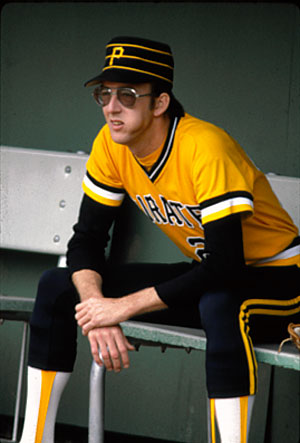
Yo, I just wanted a chance to post a picture of Kent Tekulve, a name that I couldn’t pronounce for the life of me when I was a kid.
Let’s Go Moose!
Over at BP, Kevin Goldstein has the lowdown on which Yankee farm hands could replace Joba as Mo’s set-up guy. In order of “prospecty goodness”:
Marc Melancon: Someone didn’t give Melancon the note about Tommy John survivors having problems getting their control back. In 54 innings this year, the former University of Arizona star has walked just 10, while limiting opposing batters to a .209 batting average. Both his sinking fastball and his hard curve rate as plus pitches, and with the way he’s throwing at Double-A (1.57 ERA in 11 games), he could be in line for a September look.
David Robertson: As a small righty, Robertson doesn’t pass the scouting sniff test, but he keeps getting hitters out, easing concerns about his height. In over 130 innings as a pro, he’s yet to give up a home run, and in 28 appearances between Double- and Triple-A this year, he has a 1.74 ERA and 71 strikeouts in 49 2/3 innings. With a low-90s fastball and outstanding slider, Robertson may not have Melancon’s upside, but he might get the call sooner.
J. Brent Cox: Like Melancon, Cox missed all of last year due to reconstructive elbow surgery, and like Melancon he’s impressed people upon his return. Spread across three levels and now at Triple-A, Cox has posted a 1.38 ERA in 22 games. The one knock against him is that he doesn’t miss many bats (only 13 in 26 innings), but he makes up for it by inducing a good number of groundballs.
After the first game of the inter-city double header tomorrow, Lo-Hud columnist Sam Borden is going to troop from Yankee Stadium in the Bronx to Shea out in Flushing, Queens. It’s a ten mile hike. Sam has set-up a donation page at The American Cancer Society. Yesterday, in an e-mail, he wrote “This isn’t something The Journal News is involved with or affiliated with, which is why I’m not publicizing it on the paper’s web site. It’s just something I think is important, and am hoping to get as many people to know about it as possible.” So, yo, good cause here, peoples. If I didn’t have to work tomorrow and wasn’t still gimpy with a bad ankle, it’s just the kind of thing I’d love to join. Regardless, I’ll post Sam’s write-up on Saturday.
(… title courtesy of Alex Belth, thus sparing you all from the truly repugnant Joba-related puns I’d been planning. You owe him more thanks than you’ll ever know).
I missed Tuesday night’s game, which was apparently for the best. On Wednesday, by contrast, the Yankees were able to meet the goal Joe Girardi set for them during his pre-game interview: “to not stink." Indeed, the team smelled like lilacs and Driven during their 10-0 cruise past the Pirates.
Joba! I’m sure eventually we’ll all settle down and get used to Chamberlain pitching every fifth game, but the bloom’s not off the rose yet. Plus “Joba!” is still super fun to say. He was excellent last night, throwing 6.2 controlled innings of 7 K, 1 BB, 0 R ball and earning his first official win (though the Yankees won the last three games he started, too).
For the most part, Chamberlain dominated. He got in a bit of a jam in the second inning, with two runners on and no out, but both had reached base on relatively soft base hits, and Chamberlain followed with a strikeout and a fly out. Jack Wilson then stroked a hit to short right field, but Pirates third base coach Tony Beasley made the puzzling decision to send Ryan Doumit – who, remember, is a catcher – home from second, even though Abreu was already picking up the ball as Doumit rounded third. (Third base coach: one of those thankless jobs where, if people actually know your name, it means you’ve screwed something up). Abreu’s throw home was good, and Jorge Posada stood there waiting for Doumit for so long that he would’ve had time to plant a small spice garden next to the batter’s box if he’d felt like it. Inning over, and that’s about as sticky as things ever got.
As for the offense, the Yankees picked away at Zach Duke until he was removed for a pinch-hitter after five innings, at which point they unloaded on the Pirates relievers. Whether this was a “the bats are waking up!” moment or a “the Pirates’ bullpen is terrible!” moment, I’m not entirely sure.
The scoring began in the first, when Derek Jeter and Bobby Abreu scored on a Jason Giambi groundout – helped out by an error on Pirates’ shortstop Jack Wilson, the victim of an aggressive (though clean) Alex Rodriguez slide into second. The (newly darkened!) Porn ‘Stache of Doom struck again in the third, scoring Jeter, who had his best game in many moons: three hits, two of them doubles. On top of that, he eked out a hard-earned walk in the sixth that set the stage for the game’s biggest blast, a three-run Bobby Abreu homer that broke the game open. Robinson Cano homered, too, and had three hits total; every starter had at least one, except Chamberlain, and even he did his part offensively.
At the plate, Joba takes just the kind of swings you’d expect him to: full speed ahead, aiming for the fences, to the near-hysterical amusement of the Yankees bench. I was briefly concerned that Jeter and Posada were going to pull something, they were laughing so hard. Chamberlain did work a walk his first time up, however, then laid down a nice bunt his next time up, and finally got some good wood on the ball in the sixth, though he hit it straight to the right fielder. When his flare was caught Joba strode off the field all serious and poker faced, until he got a few feet from the dugout, at which point he could no longer suppress a massive, infectious grin.
He finished his night in with two outs in the seventh inning, not quite able to close it out before his pitch count climbed to 114 (76 of them strikes); but Ross Ohlendorf finished the frame for him, and Jose Veras preserved both the win and the shutout in the ninth.
Finally, much has been written about the 1960 World Series, but I recently happened across a nice piece of writing about the 1927 Series between the Yanks and the Pirates. This was one hell of an overmatch; that ’27 New York team, as I’m sure most of you know, won 110 games and is widely considered one of the most dominant ever. It’s by Frank Graham, who covered the team for the old New York Sun, and I found it in an old book called Press Box: Red Smith’s Favorite Sports Stories. (Which has a few gems, in case you’re wondering, but an awful lot of pieces on boxing and horse racing, neither of which I’m very invested in unless I have money on the line). Here’s Graham on the day the Yanks arrived in Pittsburgh, and took batting practice before the first game:
In the stand the Waner brothers, great ballplayers in their own right but little men, stood talking with Ken Smith, New York Mirror reporter, as the Yankees slugged the ball. Ruth hit one over the fence in center field, Gehrig hit one high in the seats in right field. Meusel hit one over the fence in left field. Lloyd turned to Paul.
"Jesus," he said fervently. "They’re big guys!"
Paul shook his head. The Waners walked out. Most of their teammates followed them. They had seen enough. It is undoubtedly true that right there the Yankees won the Series. Before a ball had been pitched in competition, they had convinced the Pirates that theirs was a losing cause.
And, later in the article, with the Yanks up two games to none and back in New York:
…a newspaperman in a cab with Lazzeri and three other players said:
"If you fellows don’t wind this Series up in these next two games, I’ll shoot you."
And Lazzeri said: "If we don’t beat these bums four in a row, you can shoot me first."
The other players nodded. That’s the way everybody on the ball club felt.
Here’s my question: who would win a Series between the 1927 and 1998 Yankees? I’m inclined to think that modern athletes — bigger, fitter, stronger, possibly injecting cattle hormones — will generally win out, but how do you bet against Babe Ruth and Lou Gehrig at their absolute peaks, plus a staff of Waite Hoyt, Herb Pennock, and the fabulously named Urban Shocker? Discuss.
Yanks need a lift from their young gun. I expect the offense will get the led out too.
Let’s Go Yan-Kees!
I don’t have as many records as I once did. It’s what happens when you live in a small space and have a life long habit of collecting more stuff. In with the baseball books, out with the records, you know how it goes. I’ve sold some vinyl, and put the majority of them my collection storage, leaving me with just a couple of hundred at the crib. I don’t know if there is a story behind every record I own, at least not a good story, but there usually is a fond memory, so I figure I’d start a new series, highlighting a piece of wax each week.
First up is the dancehall classic Bam Bam performed by Sister Nancy:
It’s been sampled to death, but my favorite treatment is “Just Hangin’ Out” from Main Source’s debut album.
Back before re-issues flooded the market about a decade ago, you actually had to hunt around for records. This one wasn’t that hard to find but it took me a minute. When I found it, the store clerk, a Dub afficiando, sniffed at me. “That isn’t even the best track on the record.” Maybe not. There are a few other good joints. But none as memorable as “Bam, Bam.” Least not for my money.

Bottom Line:
“The whole game bothered me, we stunk, we stunk,” Girardi said. “We keep putting [runners] out there. We have to turn it around because we are missing opportunities. We had a lot of opportunities. The defense didn’t help us, the pitching didn’t help us and the runners in scoring position …”
…”I don’t think he needed to express that,” said Alex Rodriguez, who went 0-for-5 and hitless in two at-bats with runners in scoring position. “We all were upset.”
(N.Y. Post)
 It was nothing short of a comedy of errors for the big, bad Yankees on Tuesday night in Pittsburgh and they stumbled their way through an embarrassing 12-5 shellacking. Couldn’t pitch, field, or hit. Darrell Rasner was pasted and the Yankee hitters somehow let Tom Gorzelanny–a guy who looks afraid to throw a strike–off-the-hook early. (One of our regulars here at the Banter suggested that losing to Gorzelanny should count as two losses.) The Pirates got a couple of cheap hits and they crushed some balls too. The Yankees hit into some hard outs and didn’t do a thing when they put men on base. Justin Christian did have a couple of hits in his big league debut, Robbie Cano added three of his own, and Bobby Abreu lined a two-run homer in the ninth, but really, the less said about this one, the better.

Due to a quirk in our schedule, Cliff isn’t available to present his usual series preview tonight (he’ll miss the Subway Serious too, but will be back for the Rangers). I’m not going to even front and try to do what he does so well. But I can tell you that I’m really looking forward to watching this series, and not only because the Yankees should be able to handle the Pirates. No, it’s more because PNC ballpark is one of the most breath-taking Stadiums in the country. At least it is on TV. Which means it’ll be three times dope on HD-TV.
The cityscape beyond the center field wall is a tremendous sight. I’ve never been but a few years ago they held some kind of throwback night where they turned off the electric scoreboard and the booming soundtrack. They only effects that night came from the organist. I can’t recall wanting to be at a non-Yankee game more in recent years. Another time, during Rickey Henderson’s final year with the Mets, the legend was thrown out attempting to steal second base. As he trotted off the field, the organist played "The Old Gray Mare." Now, that’s old-timey style.
So, instead of our regular preview, let me direct you over to our good pal Pete Abe, who has the starting line-ups, pitching match-ups as well as a couple of roster moves (we have a new face in left tonight).
Ain’t nuthin else much to say ‘cept the obvious:
Let’s Go Yan-Kees.

Lovely piece by John Branch in the Times the other day about an 89-year old organist Lambert Bartak. Worth a click. Man, baseball organists are a beautiful thing, no?
I’m a sucker for oral histories. I just love ’em. They are the kinds of books you can pick-up and put-down at your leisure. And they don’t have to be perfect in order to stimulate convesation, debate, and get the old juices flowing. Change Up: An Oral History of 8 Key Events that Shaped Modern Baseball, by Larry Burke and Pete Foranatele is a fine addition to your baseball library. You can argue about the chapter selection, which is half the fun, but that’d really be missing the point, because it is what is in the chapters that’s winning.
Here is Thomas Boswell on the one-of-a-kind shortstop, Cal Ripken, Jr.
Everyone on Earth saw that he was a prototypical third baseman except for one person: Earl Weaver. Only Weaver had the imagination to see that Bobby Bonner needed to go and that Ripken would work as a shortstop. I was covering the team then as the daily beat writer and there is no question that this was 100 percent Earl Weaver against universal indifference or mild hostility to the idea from everybody else in baseball. Nobody else though Cal Ripken could play shortstop. Period. Anybody who says differently wasn’t there and is wrong.
I guess we can credit Weaver for helping pave the way for Jeter and Rodriguez.
In a wonderful chapter on the Latino Wave, here’s Luis Tiant:
I don’t go to my country for 46 years. I want to go before I die to see my country, to see some of my family, if they’re still alive. I haven’t had contact with them for a long time. My aunts–I think, I know I have a couple of aunts still alive. One time I was on a cruise ship over there in Key West. You can see Cuba right there. It was so close you could see the cars and the people. It makes you sad. You’re that close and you can’t go to your country. Forty-six years here is a long time. You say the number easy, but it’s a long time, a lot of days and nights. A lot of Latino players from the other countries, like two weeks before the season was over they all talk and laugh, "I’m going to go back to my country and go to Christmas and eat and party every day." And, I sit down there and listen to them, and they’re happy. All of these lucky guys. They can go back to their countries, and I don’t know when I’m going to go. It’s amazing. It’s a real bad feeling. You have to do what you have to do.
For a more detailed look at baseball in Cuba, check out Michael Lewis’ long piece for Vanity Fair.
I like driving enough. I got my permit at sixteen like everyone else in the suburbs. But I’ve never owned a car, never cared to, and have never had anything but a passing interest in them. I live in a city where you don’t need a car–though that never stopped my old man, one of the true Manhattan crackpots who prefer having a car (he knew the alternate side of the street laws better than he knew the Passover Haggadah). As a kid, I loved saying the word "Volvo," and could recognize the boxy cars easily. Everyone loved a VW bug. But my favorite American car was a Cadillac. And only becacuse I liked the how the tail lights looked.
I have a general memory of being a kid leaving my grandparents apartment at night. As we waited for my father to pull the car around, we waited under the canopy of 15 West 81st street, across the street from the Hayden Planetarium and the Museum of Natural History, I looked at the bright red and yellow lights moving up and down the street. I was usually half-asleep. I remember being captivated by tail lights on the Caddy’s. They weren’t the usual, blocky lights, they were sleek slits of lights, standing erect.
My other favorite car was the plump, old Citroen’s, which I saw often during visits to my mother’s family in Belgium. They really did it for me.

Any of you guys care about cars?
If so, which ones float yer boat?
Derek Jeter is the leading vote-getter in the American League for the All-Star Game. He’s the guy you want to build a team around, he’s the most overrated player in the game. He’s a future Hall of Famer, yet Jeter has struggled through much of the first half of the season. Mark Feinsand has a good piece on the Yankee captain in the News today:
Jeter won’t even offer a guess at the reason for his declining numbers, but Yankees hitting coach Kevin Long has his own theory.
“I can tell you that he probably lost 30-35 points in his average due to his hand injury, but he’d never admit that,” Long said. “His swing wasn’t the same, he was favoring it and he got into some problems when it came to staying behind the baseball, which has always been his strength. He still contributed and helped us in other ways, but his hitting suffered.”
…Jeter began expanding his strike zone, swinging at pitches on the corners or off the plate. As Long watched those bad habits, he knew something wasn’t right.
“How much damage can you do with a pitch that’s (a foot) off the plate?” Long said. “Since he’s been healthy, he’s had to get out of some of those bad habits, and now he’s starting to put a little something together.”
Meanwhile, in the New York Sun, Steven Goldman explains why the Yanks should move Melky Cabrera:
The reason the Yankees can deal their starting center fielder for need without opening up another hole is the performance of prospect Brett Gardner at Triple-A Scranton. The speedy center fielder is currently batting .292/.408/.436 with 10 doubles, nine triples, three home runs, and 52 walks in 73 games. He has also stolen 29 bases in 37 attempts. Gardner, 24, will not be an impact player in the major leagues. However, given his patience, a .275 batting average, and his ability to run balls down with his speed, he should be at least as productive as Cabrera and provide a better on-base threat at the bottom of the order, creating more opportunities for Johnny Damon, Derek Jeter, and the top of the lineup.
Finally, could the end be near for Mike and the Angry Puppy? Say it ain’t so.


