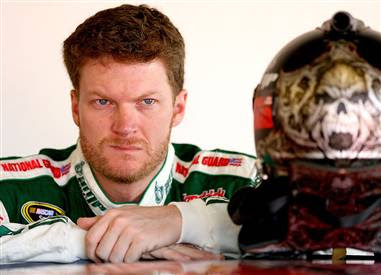
Earnhardt and I were sitting on the sofa talking; his publicist sat on another sofa. We talked for two hours, while his publicist fidgeted, casting expectant glances at us. Earnhardt said nobody calls him Junior or Little E anymore, except his fans. “That’s off my back,” he said. He looked down at his hands while he talked. When I asked him why he races, he said: “I didn’t want to work for a living. What the hell am I gonna do with my life as Dale Earnhardt’s son if I don’t race? I was a mechanic in Dad’s dealership at 18, and those were some of my happiest days. But my name was Dale Earnhardt Jr., man. Working as a mechanic would’ve been a real pain. People saying: ‘What happened to you? You’re Dale Earnhardt’s son.’ ”
…What has been the hardest thing for him to deal with in his career?
He stared at his hands and said: “All my life I’ve been the smaller measure of the man. When my Dad died, I wanted to honor him. But I wanted to distance myself from him too. I wanted to get out from under being Dale Earnhardt’s son.”
In many ways, I am my father’s son. once, in my 60s, I told my father, in his 90s, that I was not much like him. “How so?” he asked. I said, “I never gamble.” He laughed, a dismissive laugh, and said, “You? A freelance writer for 40 years?” He was right. He had taught me how to con people early in my life. I used that knowledge in my late 20s to hustle pool like him. I wore construction clothes at lunchtime. I conned my marks into spotting me the eight and nine in nine ball, and if I lost I always went to the men’s room, climbed out a window, and left without paying. A lesson from the old man. “Always check the men’s-room window before you play,” he said. “Because even if you lose, you’re not gonna pay.” Years later, when I became a writer, I conned editors into giving me assignments. “You got to find out what they want,” he said, “then give it to them. Tell them anything they want to hear to get the assignment, then write it the way you want.”
He taught me so many things that became a part of my life, that determined how I lived my life. He taught me that only a fool believes in perfect justice. “There’s no such thing as an accident,” he said. “You’re supposed to know the other guy always runs the stop sign.” He taught me that a man never quits no matter how defeated he feels, that a man always has to have the courage of his suffering. And most important, he taught me that “there are only three vices in this world, kid: broads, booze, and gambling, and if you’re gonna do it right, pick one and stick to it.” I was in my 20s, with a wife and three kids, and there wasn’t much room in my life for vice. Years later, however, I had more than a passing acquaintance with one of those, and it wasn’t booze or gambling.
But in the one way that really mattered, to me anyway, I was not much like Dad at all. I never had his purity of understanding of the true nature of money. That has always shamed me. I have been burdened, conflicted, cursed, you might say, by my own fearful need to hoard money to forestall that looming disaster always around the bend, the foreclosed house from my youth.
Tiger Woods and I go back a long ways. A little bit over twelve years, truth be told. Back then, I wrote a profile of him just prior to his winning the 1997 Masters, the first major accomplishment of his professional career. Over the course of a day’s worth of interviews, which were themselves the result of negotiations with his People at the International Management Group that were so protracted they should have been moved to Panmunjom, Tiger made some distasteful remarks and told some puerile and sexist jokes. Seeing as how they occurred during my limited interview time, I included them in my story, along with some not-overly-subtle intimations that Tiger had a reputation even among golfers as something of a chaser. The quotes were a Media Thing for a brief time, and the ensuing dust storm looks positively charming compared to what’s certainly coming after the events of this past weekend, which already appears to be something between Al Cowlings on the highway and an episode of The Real Housewives of Gated Communities. Back then, all that happened was that Tiger’s People at the International Management Group accused me of wiretapping a limo driver. (Me and Gordon Liddy!) And that Tiger’s father, Earl, whom I still miss, told Charlie Rose he hoped my story wouldn’t do permanent damage to his son’s career, and that Charlie Rose waved a copy of the magazine and told Earl he intended never to read the story. This is why Earl was an entertaining con man and Charlie Rose is a salon-sniffing Beltway yahoo.
I had the chance to talk to Stout about the book. Here is our conversation. Enjoy. Bronx Banter: I know you are comfortable writing about history, especially in the first part of the 20th century. What drew you to Ederle?
Glenn Stout: Her story is seminal, as central to the story of American sports in this century as that of Red Grange, Babe Ruth, Jack Johnson or Jackie Robinson, yet to most people Trudy, aka Gertrude Ederle, is unknown. I wanted to change that. In many ways she was both the first modern female athlete and one of America’s first celebrities. Had she not done what she had done, which is not only to become the first woman to swim the English Channel, but in the process to beat the existing men’s record by nearly two hours, the entire history of women’s sports would be radically different. You can, I think, break down the history of women’s sports in this country into “Before Trudy” and “After Trudy.” Before Trudy female athletes were anomalies, and their accomplishments, with just a few exceptions, primarily took place out of the public eye. Many early female athletes, like Eleanora Sears, and Annette Kellerman, were sometimes seen as publicity hounds who performed stunts, and not serious athletes. The question of whether or not women were either psychologically or physically capable of being athletes was still a topic of debate – at least by the men who ran sports. Although there would still be some who would stubbornly cling to that belief, by swimming the English Channel and shattering the existing men’s record, Trudy answered that question quite definitively.
She was the answer. One can argue that had it not been for her women would not have been allowed to compete in track and field and many other sports as early as they did – women competed in track events for the first time at the Olympics in 1928. It may have been another generation – until after World War II – before there was any acceptance of female athletes. I am old enough to remember when women could not play little league, or run marathons, and when school sports were pretty much limited to gymnastics and basketball. Now of course, women can and do play everything. Without Trudy that happens much later than it did.
Trudy also has a compelling personal story that I think resonates with any reader. She grew up in New York, the daughter of German immigrants and overcame anti-German prejudice in the wake of World War I to become arguably the most famous woman in the world. At the same time, she was partially deaf, and was able to overcome that challenge. Swimming the English Channel, while perceived to be somewhat commonplace today, is still extremely difficult – it was the first “extreme” sport. More people have climbed Mount Everest than have swum the Channel, and most of those who try to swim the Channel fail. In most years more people will succeed in climbing Everest than in swimming the Channel. When I first began to research the book, that really, really surprised me, and made Trudy’s story even more compelling.
BB: Why isn’t Ederle remembered like Grange, Thorpe, Ruth and the other greats of the first great era of sports? For someone who had such a profound impact, why has her legacy faded?
GS: Hopefully, my book will help rectify that, but there are several reasons. Trudy herself soon discovered she just wasn’t cut out for the spotlight. Within 48 hours of her return to the United States, where New York gave her an enormous ticker tape parade, she was in the fetal position in her bedroom, completely overwhelmed. She was both slow and reluctant to “cash in” on her achievement. Her attorney mis-managed her career, turning down easy money for a grueling vaudeville tour. By the time that got going a male swimmer had broken her record, and a second female swam the Channel, which stole some of her thunder – the public began to think that swimming the Channel was far easier than it is, something that holds true today. She also had increasing trouble with her hearing – she was partially deaf since a bout with the measles as a child, and that made her less comfortable in the public eye. And few years after the swim she fell and was virtually bed-ridden for a time. And let’s face it, swimming simply isn’t a big spectator sport like football or baseball.
BB: What is Ederle’s reputation in the world of women’s swimming? Is she properly recognized?
GS: Swimming historians certainly recognize her as one of the all-time greats, but in a sport like swimming, records have been broken so many times that it is difficult for any swimmer from her era to remain in the public eye. Her only contemporary recognized b y the public today is Johnny Weissmuller, and that’s because of the Tarzan films. But in the world of swimming, she has to rank as one of the top seven or eight swimmers of all-time. No one else combined her success at shorter distances with open water success, and in the world of open water swimming, I think she’s right at the top. Anyone who has ever swum the Channel, or thought about it, knows about her.
BB: How did Ederle manage to beat the existing time of swimming the channel by such a great margin? That seems almost inconceivable.
GS: There are a couple of reasons. For one, she used a stroke known then as the “American Crawl” essentially what most people recognize as the “freestyle” today. Her coach with the Women’s Swimming Association was one of the strokes pioneers and its greatest advocate. And although it had been used for about two decades, no one believed it could be used for long distance swimming – it was thought to be too demanding, physically. Long distance swimmers usually used the breast stroke at the time, with occasional use of the side-stroke and trudgeon. The crawl was much faster, and Handley recognized that women in general, and Trudy in particular, although not as strong as a man, had just as much stamina. She was the first swimmer to use the stroke in the Channel, and proved the superiority of the stroke. Secondly, her trainer for the Channel swim, William Burgess, was a real student of the Channel currents and tides, and he found a somewhat new route across that was something of a breakthrough. Also, before Trudy most of the people who tried to swim the Channel simply were not great swimmers. They had great stamina, and desire, but as swimmers were rather pedestrian. Trudy was world class at every distance from fifty yards on up. She was simply a far, far, far better swimmer than anyone else who had swam the Channel before. For a swimmer of her ability to take on the Channel would be the equivalent of Michael Phelps to do so today – if he had her stamina. And lastly, while Trudy was growing up she spent summers in Highlands, New Jersey, where she spent hours and hours swimming in the ocean. She developed a very special relationship with the water, once saying “To me, the sea is like a person – like a child that I’ve known a long time. It sounds crazy, I know, but when I swim in the sea I talk to it. I never feel alone when I’m out there.” When she was swimming, she was in her place, right where she wanted to be, and where others found only torture, she found joy, and when you love what you do, well, there are no limits.
Imagine that it’s the spring of, say 1931, and you’re starting to think that Babe Ruth just might end up being one of the best players ever to grip a bat. The recent downturn in the economy has left you without a job, so you figure, hey, why not spend the year following the Babe – every game, every at bat, every swing. You drive to places like Boston and Philadelphia, take the train to Washington, and ride busses to Detroit and Chicago. Along the way, you make friends in the bleachers in Cleveland, catch a series with a cousin in St. Louis, and sleep on couches in all corners of the American League. Your bank account feels the bite of your mission, your wife and children become strangers, and close friends question your sanity, but somehow it’s still worth it. I mean, this is Babe Ruth we’re talking about, right? If you could, you’d go back in time and do it in a heartbeat, wouldn’t you?
Now flash forward to 2008 and the Babe Ruth of this generation, Tiger Woods. Writer Bob Smiley shadowed Tiger for every swing of every hole of every tournament in places like San Diego, Augusta, and Dubai, and the result is an extremely engaging book, Follow the Roar: Tailing Tiger for All 604 Holes of His Most Spectacular Season. Last week Bob was kind enough to spend some time talking about his journey. Check it out…
BronxBanter: One of my favorite aspects of the book was that it wasn’t just about Tiger Woods, it was secretly about you, so I thought we might start with Bob Smiley. How important was golf to you when you were growing up?
Bob Smiley: It was really important. It was the first and really only sport I could every really play with my dad. I mean, I played little league and basketball, but golf was something that he taught me how to do when I was eight years old. We would go out and he would try to teach me the point of the game, but I would purposely hit it in the sand trap so I could play in the sand. He really wanted me to embrace the fact that golf is fun and when you get older you’ll appreciate the challenge of it. So for me it was always just a great place, and I had so many memories with my father as I was growing up. When my parents split up when I was a teenager that sort of remained the one spot, even to this day, where he and I still see each other is on the golf course.
At 10 p.m., Amir Khan walked into the arena amid the flash of cameras and TV lights and the Asian girls aiming their cellphone cameras at him. He was wearing his trademark silver trunks, but with a slight alteration: tartan trim had been sewn in. Steve Gethin stood in his corner, his blue eyes wide.
The bell rang for Round 1. Khan loped into the center of the ring and began to stalk Gethin. He moved gracefully, bent over at the waist, bobbing and weaving left and right, his hands dangling low to the canvas. Khan did not look so young now, nor so slight. He looked huge next to Gethin and dangerous in a primitive way. Suddenly he attacked Gethin, hitting him with three quick punches before Gethin could react. Khan did resemble Muhammad Ali in the ring. It’s almost sinuous, the way he moves. He’s a trained fighter, but an instinctive one too.
Khan pursued Gethin, who backpedaled, Khan weaving hypnotically, and then he sprang again, pummeling Gethin with so many quick punches it seemed as if they were all one long, continuous punch. Gethin wrapped his arms around Khan and waited for the referee to separate them.
The fight didn’t last very long. The referee stopped it in the third round, after Khan again battered Gethin’s head with so many quick blows in succession that Gethin could only cover his face with his gloves and forsake any thought of throwing a counterpunch.
Khan raised his arms in victory. Some cheered; others were upset the fight had been stopped early. The members of “Khan’s Barmy Army” poured out of their seats. They began to leave the arena, waving their Union Jack-Pakistani flag at the seated fans. The Scottish fans began to throw things at them. Bottles. Sharpened coins. Cups of beer. “Khan’s Barmy Army” covered their heads. Security appeared from the runways, surrounded Khan’s “army” and hustled them out of the arena. In the ring, Amir Khan, oblivious, was being interviewed on ITV with his father.
Pat did a handful of hockey pieces for Sports Illustraed in the ’70s including a good one on Derek Sanderson. We included a hockey story in our collection, one of his earliest pieces for Sport magazine, about the Bruins at the old Boston Garden. Here is a good little profile Jordan did on Mike Keenan for The Sporting News in 1994, just after coach Keenan left the Rangers for St. Louis.
Italian waiters at Gian-Peppe’s Restaurant in “The Hill” section of St. Louis are wearing tuxedos with frilly shirts. They hover around Keenan at his table as if he were the Mafia Don out of “A Bronx Tale.”
“I used to hang around with seven Italian brothers when I was a kid,” he says. “I was the only Irish kid. If they got a beating from their mother, I got a beating from her, too.” He laughs, and drains his beer. Keenan asks a waiter to bring him a phone. He has to call his daughter, who will visit him tomorrow, and he’s worried that she might not have gotten the airplane ticket he sent her.
“It causes me great pain to be away from her,” he says, as the waiter returns with the phone. “I’m proud of my accomplishments, but maybe my ambition was selfish. You pay a personal price. Loneliness. It’s the only thing that scares me.” He makes the call, but his daughter is not home. The other waiter returns with a beer. For a tough-guy hockey coach, Keenan talks a lot about pain and lone-liness and even fear. He had a fear of failure when he took over at Philadelphia.
“I was confident,” he says. “I felt ready. But there’s always that fear in hockey if you’re not successful you’ll never coach again. I felt I had to be firm with my players and then I’d back off after a while, you know, the way a teacher does. But the players didn’t think I let up as much as I should have. I like to think my relationship with players has improved. I’ve improved. After the separation, I learned to reflect on life. To be introspective, tolerant and understanding. It was an awakening.” He picks up the phone and dials his daughter again.
I’m not a hockey fan and I never have been. I don’t follow boxing but I liked it as a kid. Hagler, Hearns, Sugar Ray. The tail end of Ali. The Rocky movies (seeing Rocky III in the balcony of Loews 83rd street–a theater no longer with us–with the place literally shaking during the big fight at the end, was one of the more memorable movie experiences of my childhood). Larry Holmes v. Tim Witherspoon, vs. R. Tex Cobb, all the way through Iron Mike’s early days.
I want to read more boxing writing at some point–there’s so much good stuff out there. I’d at least like to give it a shot. It’s such an appealing sport for writers because, as Len Shapiro of the Washington Post says, “It’s the greatest sport in the world until they get in the ring.”
Not so long ago, a good friend of mine encouraged me to feel comfortable promoting myself. While it doesn’t come naturally for me, I figured, what the hell, I can talk about Pat Jordan’s writing all day long. The Best Sports Writing of Pat Jordan is coming out just before Opening Day. Each week until then, I’m going to pick one of Pat’s stories that can be found on-line and feature it in a post. Leading off is a fun piece he did a few years ago for the New York Times magazine on Daniel Negreanu, the all-star poker player (the story was featured in The Best American Sports Writing 2006, edited by Michael Lewis).
Negreanu claims not to have much interest in money, except as a means of keeping score. After he won that $1.8 million at the Bellagio, he bought six videos and put the rest of the money in poker chips in a lockbox at the casino as if it were a bus-station locker. The chips are still there. The $1.1 million Negreanu won in Atlantic City was converted into $300,000 in cash and an $800,000 check. Back home in Las Vegas, he discovered that he left the check in his hotel room; the maid threw it out, and Negreanu had to fly back for another check. “I don’t believe much in banks,” he says. “Although I do have one bank account with not much in it, just a couple hundred thousand.” He also doesn’t believe in credit cards, or buying anything he can’t afford to pay cash for, which is why he always travels with a wad of $100 bills held together with an elastic band.
Negreanu has two basic rules for playing poker. First, maximize your best hand and minimize a mediocre hand. Too many novices play too many mediocre hands when not bluffing, which increases their chances of losing. Great players only play hands when they have “the nuts,” or unbeatable cards; otherwise they fold hand after hand. Second, play hours, not results. Negreanu sets a time limit for his play and sticks to it, whether he’s winning or losing. If he goes beyond his time limit, he risks playing “tired hands” when he is not sharp. (Before a tournament, Negreanu gives up alcohol and caffeine. “I do nothing, to numb my brain,” he says, “except watch poker film — just like an N.F.L. team before the Super Bowl.”)
Negreanu says that most great players are geniuses, then lists the kinds of genius they must have: 1) a thorough knowledge of poker; 2) a mathematical understanding of the probabilities of a card being dealt, given the cards visible; 3) a psychological understanding of an opponent; 4) an understanding of an opponent’s betting patterns — that is, how he bets with the nuts and how he bets when bluffing; and 5) the ability to read “tells,” or a player’s physical reactions to the cards he is dealt. Negreanu is a master at reading tells, although he claims it is an overrated gift, since only mediocre players have obvious tells. The best players, of course, have poker faces.
Negreanu says he can break down opponents’ hands into a range of 20 possibilities after two cards are dealt. After the next three cards are dealt, he says, he can narrow the possible hands to five, and after the last two cards are dealt, to two. “It’s not an exact science,” he admits, “but I can reduce the possibilities based on the cards showing, his betting pattern, tells, his personality and my pure instinct.”
Shulman, Card Player’s co-publisher, connects Negreanu’s success to his personality: “Daniel controls a table by getting everyone to talk and forget they’re playing for millions,” he told me. “He makes every game seem like a home game — you know, guys drinking beer and eating chips. They forget what’s happening. Plus, Daniel is the best at reading an opponent’s hands, as if their cards were transparent. He gets guys to play against him when he has a winning hand and gets them to fold when he has nothing. He’s the King of Bluffing. You know some guys can beat bad players and not good players, and some vice versa. Daniel does both.”
Beyond Negreanu’s knowledge and considerable intelligence, what makes him truly great is his aggressiveness in a game — his ruthlessness, some might say. He once bluffed his own girlfriend, also a professional poker player, out of a large pot at a tournament. “I bet with nothing,” he says, “and she folded. To rub it in, I showed her my hand. She was furious. She stormed into the bathroom, and we could hear her kicking the door, screaming, smashing stuff. When she came out she kicked me in the shin and said, ‘Take your own cab home.'” She is no longer his girlfriend.









 . Last week Bob was kind enough to spend some time talking about his journey. Check it out…


