
Don’t miss this wonderful New York Times article by David Gonzalez about capturing the Bronx on film.
Slide-show? Slammin’.



Last night I was standing on a subway platform when a train whooshed into the station. I noticed that my car was almost empty before stepping inside. An empty car in the middle of the summer can mean one of two things: the AC is broken or someone smelly is inside (worse case scenerio brings both). Turns out the AC was busted. But I got in anyhow and enjoyed the space. The Russian Baths on the IRT, why not?
I’ve run into several mentally ill people on the trains lately. Last Friday night, on the Brooklyn-bound B train, a man walked through the car and said, “My man, my man, m-m-m-m-my man.” He held a cup in his hand and kept repeating these words in an insistent, almost pleading voice. I thought about the stuttering character in “Do The Right Thing.” The doors opened and closed but the dude didn’t get off the car. He just kept chanting. It was upsetting. A man sitting next to me looked up from his newspaper and muttered something derogatory about the guy. He’s a sick man, I thought.
Then on Saturday I saw a black woman standing on Broadway and 231st street. She was wearing powder blue shorts and a purple shirt. She had white facial hair under her nose and on her chin. She spoke with an English accent. “Would you kindly spare some change?”
I crossed the street and walked north. Sitting at the bottom of a flight of stairs was a wino I recognized from around the neighborhood. He looked like he could be fishing buddies with Thurman Munson and Dirt Tidrow.
“Hey, can you spare like $1,500?” he asked me.
I smiled and kept walking.
Joba on the hill tonight, weather permitting. Time to start another winning streak, don’t ya think?

It is always the same, the sudden, stomach-dropping, jolt. Walking along a city block, looking up at a familiar store front or restaurant, a Closed sign hanging in the door way, or a vacant window. Something has happened. Change has come, like it or not.
I gasped last night as I walked past Sal and Carmine’s pizza shop on Broadway between 101st and 102nd (They make a salty but delicious slice.) The grate was up and a red rose was taped against the metal. Above it was a small xeroxed obiturary from a New Jersey paper.
Sal died late last week. I’ve been eating their pizza since I was a kid. Sal and Carmine. Two short, taciturn men in their seventies, though they look older. I never knew who was Sal and who was Carmine, just that one was slightly less cranky than the other. These are the kind of men that don’t retire but are retired.
The funeral was yesterday; the shop re-opens today.

As I read the obituary, people stopped and registered the news. They congregated for a few moments, some took pictures with their cell phones, and then slowly walked away, the neighbhorhood taking in the loss.
I got off work and headed downtown yesterday evening just as it started to pour. By the time I reached Union Square, the stairwell leading the street was crammed with people. Some were just waiting for the rain to let up, others were soaking wet. At the top of the stairs an African woman chanted, "Umbrella, umbrella, umbrella." I smiled at her and said, "How’s business?" She titled her head at me, paused and then went back to her mantra.
I braved the elements until I got to Fourth avenue and 12th street, where I stopped underneath an overhang, where several people were huddled. I sat and watched the traffic pass. It’s funny, the rain. Some people are completely unfazed by it. Others will wait it out cause they can’t stand getting wet. A kid in his early twenties passed me, no umbrella, drenched, his t-shirt sticking to his long torso. I remembered being in my early twenties seeing this kid and I smiled at his carefree manner as he strutted by.
Then a familiar face passed. As I thought about who it was, I said, "J?" The dude stopped and sure enough it was J-Live, the MC and record producer. Back in the summer of ’01, the year before I started Bronx Banter, I conducted a long interview with J in the basement of The Sound Library, an upscale record shop, when it used to be on Avenue A. This was just after J’s second full-length album, All of the Above was released. Although it took some time to pin him down once we spoke, J was insightful and a thoroughly decent guy.
I’ve drifted from the music scene in recent years though I did hear that J put out a new record earlier this summer. I congradulated him on the new joint (which I haven’t heard yet), told him what I’m up to, and then let him go. If it hadn’t been raining, I would have never run into him.

A few months ago I invited myself to Ray Robinson’s apartment, ostensibly to get his list of ten essential baseball books, but really so I could lay eyes on his library of sports books. Robinson, an author (Iron Horse) and longtime magazine editor, grew up on the Upper West Side, near Columbia. When he was a kid, Robinson got a delivery job at a local liquor store, and he found himself making stops over at Babe Ruth’s apartment at 110 Riverside Drive. He’d say, ‘Thanks keed,'” Ray told me. “He called everybody ‘keeed,’ because he couldn’t remember anyone’s name. And he would invariably honor me with a couple of dollar bills.”
Ray and his wife, Phyliss were wonderful with me. We chatted in the living room of their comfortable New York apartment for about an hour and Ray shared his selections of favorite baseball books with me. I poked my nose through his collection and as I was about to leave, Ray said, “Oh, would you like to see my scrapbooks?”
“Sure, I would.”
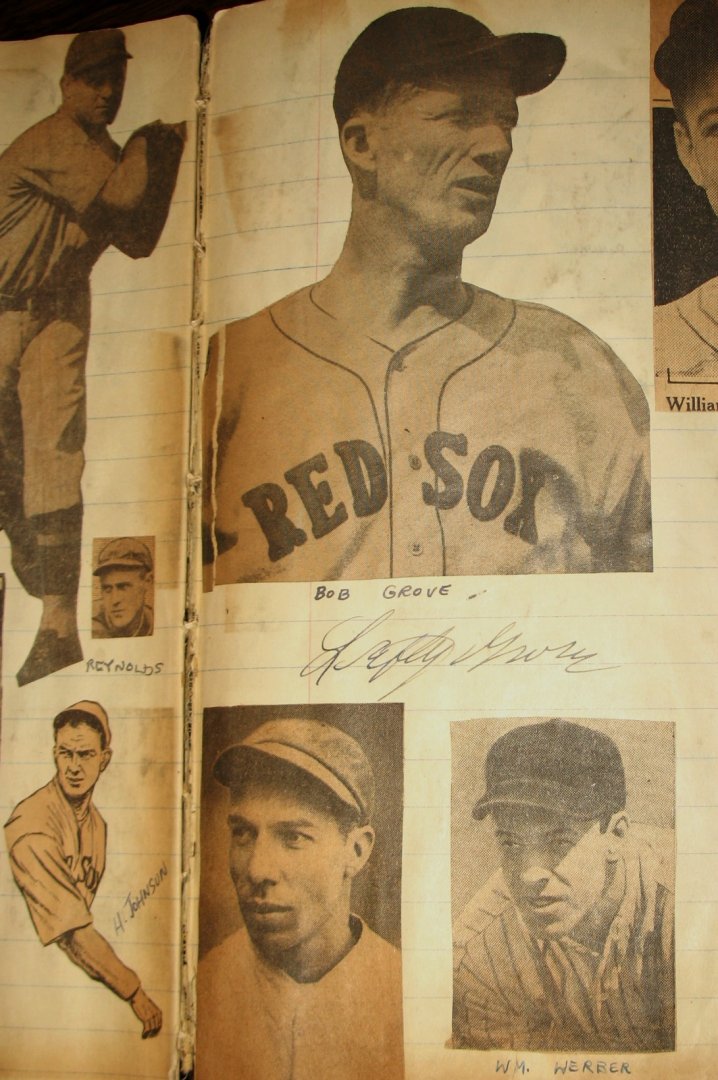
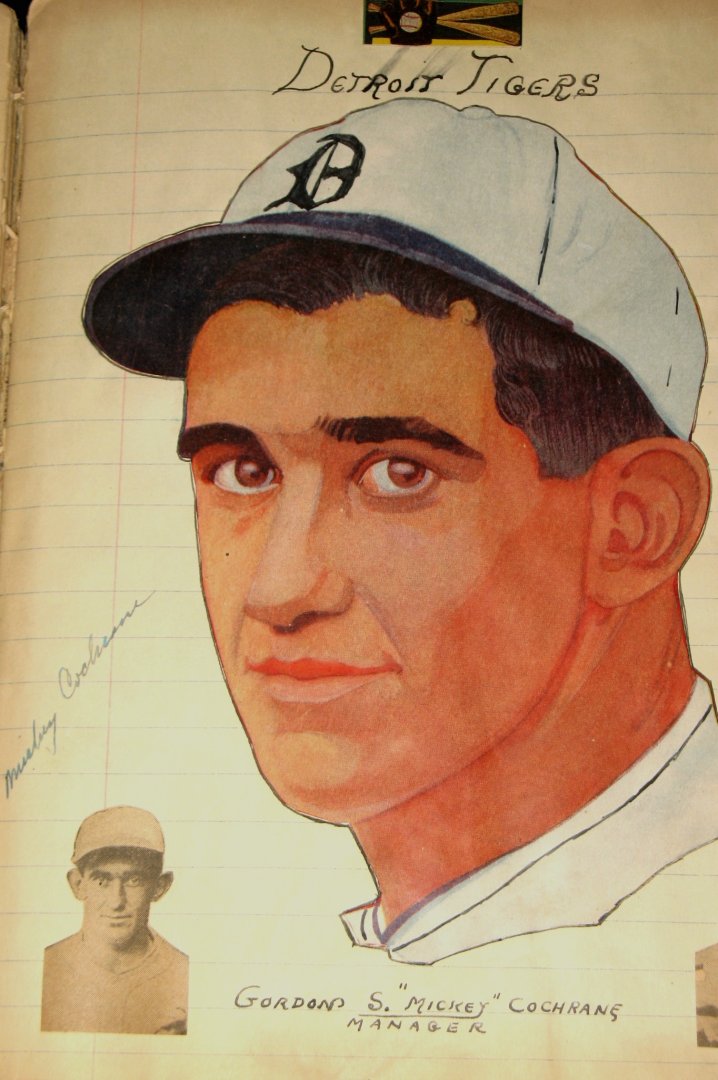
Ray picked-up a bright orange plastic bag from the bottom of the bookshelf, the kind you’d get from the local Chinese take out. He pulled out two weathered books, practically falling apart, one dated 1932, the other, 1933. They were filled with pictures of players from every team in baseball. Ray cut-out images mostly from The New York Sun, The Saturday Evening Post, assorted baseball magazines as well as baseball cards. Then, along with some friends, he’d scout the hotel lobbies where the out-of-town teams stayed, to get autographs.
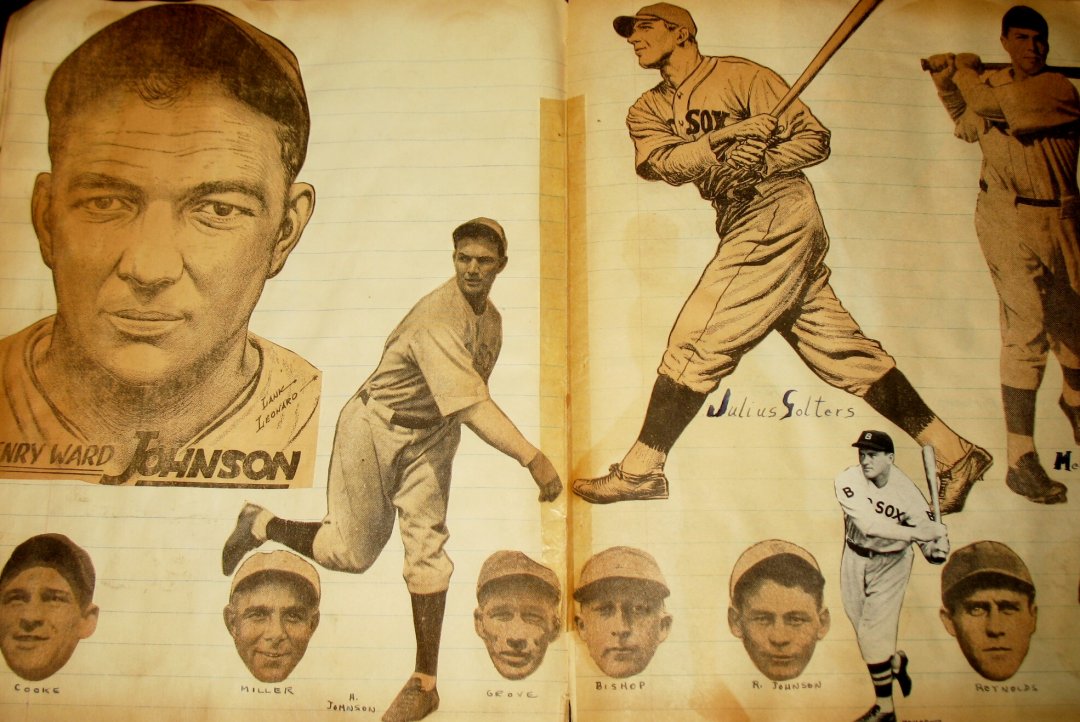
The books are lovingly, obsessively assembled, filled with small notations. Ray expressed some embarrassment when I complemented him on how wonderful, how personal the books are. He dismissed his sketch of the Babe as being awful, but I liked it and his wife did too.
Ray asked if he should sell the books–after all, he’s got a couple of Lefty Groves in there, a Honus Wagner, Dizzy Dean. Phyliss said that she didn’t think that was a good idea. I quickly agreed.
“You can’t sell these,” I said. “They belong in a museum or for your grandkids.”
As I looked carefully through the two books, Ray kept wondering if he should sell them. I said, “No way,” but when I left I felt foolish. Who am I to say that he shouldn’t sell them? There is probably some serious money in those two books. Still, they feel too personal to part with. They are not kept under a glass case, they are in a plastic bag on the shelf, a secret baseball treasure on the Upper East Side.
Yesterday, the New York Times featured a short essay by Ray Robinson about his scrapbooks.
Check it out and dig what I was able to see:
It goes without saying that respect is something that you have to earn in life, but it is especially true in a barber shop. It comes slowly, with time. It can’t be forced, can’t be bought. I have been getting my haircut in Ray’s shop on Smith street in Brooklyn for close to ten years now. That’s where my barber, Efrain, found a chair to cut heads after he lost his store, futher down Smith closer to Atlantic Avenue, when the neighbhorhood started to gentrify in the late ’90s. I’m not really close with Ray or his son Macho, a rolly guy in his early thirties, who cuts heads next to his father. They don’t like baseball. They like boxing.
It was a warm spring afternoon at the barber shop when I walked in a few days ago. Both Ray and Macho greetly me with affection. I went to the back, where Efrain was standing over a man, a straight razor in his right hand and his left palm cupped full of shaving cream.
I put down my napsack and went back to the front of the shop to sit and wait my turn. Three other guys, all regulars, all friends with Macho, were there. I started talking to Ray about a book I had just read, Mark Kram’s Ghosts of Manilla. Soon, he was holding court, telling stories about Ali. A thick, muscular kid who was sitting across from me, told me that he had tons of old boxing matches on videotape, including the Thrilla in Manilla. When I described Kramm’s impressions of the fight, he goes, “Yo, dude, I’m getting goosebumps just thinking about it.” The light poured through the front window of the shop, onto his forearms where I could see the goosebumps.
Real Life

When Reggie Jackson left New York, Ray Negron’s glory days came to an end. Now, he had to adjust to a more mundane reality, and a greater challenge—how to advocate for himself. Negron had defined himself by what he could provide to other, more famous men.
"Growing up is hard," says Negron. "In baseball, you are a kid forever. When I left the Yankees, I didn’t have the players to protect me anymore." Negron married his longtime girlfriend Barbara Wood in 1981; they got an apartment in Far Rockaway, had a son four years later, and were divorced before the end of the decade. "It was hard to give my heart and soul to a situation when I didn’t really want to be there," he says.
While he was with the Yankees, Negron gradually lost touch with his half-brothers who were caught up in the street life, junkies while they were still teenagers. "It wasn’t until the eighties that we got back together again," says Negron. "To them, I was wealthy. When they reached out it would be out of desperation or need. Then my brothers started having kids all over the place, and I couldn’t handle it, I couldn’t handle it." Negron is shy when talking about them because he doesn’t want to embarrass them. "They think that I think that I’m bigger than them. I mean, it becomes very tough because they are still your blood, you understand?"
Negron’s two cousins who had been with him the day he first met Steinbrenner, Edwin and Christopher Perez, died within a year of each other during the mid-eighties; Edwin, in what Negron calls "a gang-related incident," and Christopher, from AIDS, which he got through a dirty syringe. Negron was with Christopher the night Edwin was murdered in Brooklyn. They drove to the Perez home in Brooklyn and were greeted outside of the house by Christopher’s father, and a group of cousins and neighborhood friends.
"My uncle had a cardboard box in his arms filled with guns. He said, ‘Take one, let’s go.’ That wasn’t my style, so I stayed at the house with my aunt. ‘She’s going to need somebody to be with her,’ I said. I wasn’t going to get caught up in that. That wasn’t me. I loved Billy the Kid," he says remembering Martin, "but I wasn’t that Billy the Kid."
Prince of the City

Ray Negron was only supposed to work a couple of games to re-pay his debt, but then one of the regular bat boys got sick, and in no time, Negron had himself a steady job. He moved on the field with the languid movements of a professional, his uniform fitting tightly, his stirrups pulled up just so. At 145 lbs, Negron was too skinny to be confused with a big leaguer though the players occasionally tried to pass him off as one of them when he was on the road with them, to get him laid. "You said it, not me," Negron squeals with delight, remembering today.
When the Yankees took batting practice, Negron was busy with the daily clubhouse chores, but he would sneak in a couple of swings in the batting cage or hang around at shortstop and take ground balls while the visiting team came to hit. One day, the Texas Rangers were in town and Negron was playing short against live bp when he made a couple of good fielding plays. Billy Martin, the Rangers manager, a man rarely without a fungo bat in his hand, was standing on the third base side of home plate. He turned his attention to the boy, motioned with his hand and then tossed a ball up and cracked a hard groundball at him.
"Billy noticed that I could play," Negron recalls. "Later, he introduced me to two of his middle infielders, Lenny Randle and Davey Nelson. Every time Texas came to town, I would ball boy down the right field line so I could hang with them. They taught me and to this day, I can honestly say that I’m still friends with both of them."
"I was impressed by his etiquette and his manners," recalls Lenny Randle today. "A lot of kids are annoying at that age, they just want stuff from you. But Ray wasn’t pushy, he was honest and had an innocence and genuine enthusiasm about him. He was the kind of little brother you wanted to have. Hey, when he was a teenager he was booking us to speak at the Y, at local Little Leagues for a couple of hundred bucks here and there. He had moxie."
A Four-Part Bronx Banter Exclusive
[Author’s Note: This story was written last summer. It covers Ray Negron’s life from the spring of 2006 through the spring of ’07. Some of the basic facts stated in the piece have changed: Joe Torre is no longer the manager of the Yankees; Hank and Hal Steinbrenner have taken control of the team; Negron has just completed his seventh children’s book for Harper Collins. But, despite these events, the essence of Ray’s story remains true. I hope you enjoy.]

Part One
“Let me show you the Boss’s suite,” says Ray Negron. It is a cool evening in early May, 2006, and Negron’s boss, George Steinbrenner, the principal owner of the New York Yankees, is out of town. Several hours before game time, Negron, 51, is walking down the outer corridor of the loge section at Yankee Stadium, his head cocked like an upper classman with the run of the school. He exudes an insouciant confidence, the kind of man who is used to keeping his cool in hot situations. Negron has short black hair and skin the color of café au lait. His large, liquid brown eyes and long eyelashes are almost feminine; his cheeks sag–the sign of a thin man growing older—and lend a sense of gravity to an otherwise boyish countenance. As usual, Negron looks crisp. He is wearing a gray, patterned suit and slim brown shoes. On his right ring finger is a massive gold World Series ring from the 1996 Yankees.
“I can’t wait for the new Stadium,” Negron says. “Maybe I’ll get an office.”
“The ubiquitous Ray Negron,” a veteran New York sportswriter calls him. Negron is a gypsy, constantly on the move, from the executive suites through the press box down to the locker room. He does not even have his own desk; instead, he totes everything he needs in a leather-bound book with a Spaulding logo embossed on the cover: Negron serves as a director of community relations for the sporting goods company, one of his many jobs. The book is filled with notes scribbled in different colored inks–reminders, phone numbers and addresses.
Negron knows everybody and stops to say hello to security guards and executives, retired sportswriters, scouts, and current players. Negron works for the Yankees as a special advisor to Steinbrenner and is primarily employed as an all-purpose utility man. He represents the club at the Kip’s Bay Boys and Girls club, the Hackensack University Medical Center, and grass roots community centers in the Bronx. Like a greeter in a casino, he escorts business men and their children through the corridors of the Stadium, giving his own private tour, and he schmoozes with celebrity visitors, like Patti Labelle, Regis Philbin and Richard Gere, making sure they are comfortable in their seats. Negron, of Puerto Rican and Cuban ancestry, is an avuncular figure to the team’s young Latin players like Robinson Cano and Melky Cabrera. This summer, Negron will enlist the two, along with other Yankee players, to visit classrooms, hospitals and boys and girls clubs around the tristate area, as he promotes his first children’s book, The Boy of Steel, a story about a young boy with cancer who becomes bat boy for the Yankees for a day.
Few people know Yankee Stadium as well as Negron and few people have been around Steinbrenner’s Yankees longer. And it all happened by chance. In 1973, Steinbrenner’s first year as team owner, the Boss caught Negron, a skinny kid with an afro, spray painting an “NY” logo on the outside of Yankee Stadium. But instead of handing him over to the police, Steinbrenner made Negron a bat boy, issuing the kind of punishment that is the stuff of a boy’s wildest fantasies. So began a career in baseball that has lasted more than thirty years. Negron has done everything from shine the players’ shoes and collect their dirty jockstraps, to bring them food from their favorite restaurants and park their cars. He has been an agent, an actor, an advisor, and a liaison; a confidant, a sounding board and a whipping boy to some of the biggest egos in the game. He is whatever he needs to be.
Negron has founded a career off his serendipitous meeting with Steinbrenner and everything that has happened next—from Billy and Reggie to Doc and Darryl. “The Boss essentially saved my life and I’ll never forget that,” says Negron, touching my arm. He likes physical contact, and occasionally touches his listener in a jocular, reassuring way to make sure you’re listening. He speaks in a measured, cautious manner, his raspy voice tinged with an unmistakable Brooklyn accent. Ray speaks so often in public that in private his conversation sometimes feels rehearsed, like he’s an actor repeating the same lines over and over in a play. Yet he is so sincere that it feels as if he’s telling you something for the first time, even if it’s a variation of something he’s said countless times before.
Negron pauses and then adds, “Not saved, really, he gave me a life.”
I visited my friend Johnny Red Sox yesterday afternoon. John lives between York and East End on the upper east side, which is, in the words on my late father, “the ass-end of the world.” (When my brother lived in Brooklyn, Pop told him it was “the ass-end of the planet.” Ben said, “Don’t you mean the ass-end of New York?” And Dad replied testily, “You know what I mean.” As if there was a difference.) John I and trooped back west to Central Park. It was brisk and windy but very nice in the sun. Most of the grassy areas were roped-off, but eventually we found a spot to have our first catch of the year.
A father and son were there throwing a ball around. Shortly thereafter, two French kids–maybe ten and seven, respectively–showed up with mitts and an old ball. The older one was serious-minded. The younger kid was bored. Neither instinctively knew how to catch the ball, but the older one was trying very hard. I gave him a head-nod at one point, and you could tell he was thrilled by the gesture.
They moved around nervously as the ball came their way and dropped more than they caught. The younger kid kept catching the ball accidently with his bare hand. Nothing about the catch seemed fun for him. But the older kid was insistent. I caught glimpses of what they were doing as John and I threw the ball back-and-forth. I thought about helping them out but didn’t and got caught up in conversation with John.
When we took a break, I noticed that the two kids had put their gloves down and were now kicking a soccer ball around. Ah, the International version of having a catch. The little one was zipping around the dirt, enthused. The older one was still serious, but working on some fancy kicking moves. When he booted a ball past the little kid he issued an immediate, “Pardon” (my bad).
There was one infield that was open to the public and we saw two high school kids hitting grounders to each other. One stood at home plate with a mitt on one hand and a bat in the other. He dropped the ball from his glove, and smacked a grounder.
When he got back to John’s crib, the last inning of the Yankee game was on and we watched the highly-touted Jose Tabata hit. Did you guys catch that? It was an impressive at-bat. He looked at fastball outside for a ball, swung through a breaking pitch and then was jammed by a fastball that was in on his fists. He took the next pitch outside for a ball, and then looked at another fastball in on his hands, this time for a ball. (I don’t recall but he may have also fouled off a pitch or two.) The next pitch was a fastball on the outside part of the plate. Tabata lined it over the right field fence for a home run.
SI.com’s Bryan Smith was at the game and e-mailed me later. “Jose Tabata is going to be a star. Love the body on that kid.”

Every time I approach my barber’s shop on Smith Street in Brooklyn, I expect to be greeted by awful news. My barber is too old to work anymore, or worse, he’s dead. I lived in Carroll Gardens, Brooklyn from 1994 through 2000. One day I was looking for a barber shop, and I ran across Efrain. He came to Brooklyn from Puerto Rico in 1955. His father was a barber and his three older brothers were barbers too. He cut my hair with such care and patience that I have been a loyal customer ever since. It’s worth the two-plus hour roundtrip commute to the Bronx. Efrain, a silver-haired man with kind eyes and soft, smooth hands, no longer owns his own shop—he had to give his up five years ago, a victim of Smith Street’s rapid gentrification. He’s past retirement age but still works six days a week.
Now Efrain has a chair up the block from his old place, in a barber shop run by Ray, a self-absorbed Puerto Rican man in his mid-fifties. Ray’s shop is no longer cluttered mess it had been for years, as Ray’s daughter and her boyfriend use the space one a week to give dancing lessons. Three chairs stand in the middle of the space, and both walls are covered with mirrors. Ray has a trim mustache and likes to pontificate authoritatively about boxing, salsa music and women. When he is not holding court, he is sullen and removed as he works. Rays’ son Macho, a plump man in his early thirties with a thick scar on his left forearm, cuts heads too, his chair situated between Ray’s and Efrain’s.
It was overcast and muggy last Saturday morning when I arrived. Macho was walking out as I was walking in. I said my hellos and Efrain motioned to me, tilting his head forward and looking over his glasses, a pair of scissors in his raised right hand. Only three heads waiting in front of me, not bad for Saturday. I stuck my nose into my book. Old Salsa music played over the stereo. I didn’t recognize the tunes, but they were familiar anyhow. This was the music I heard up and down Amsterdam Avenue when I was a kid: Ray Barretto, Willie Bobo, Willie Colon, and Mongo Santamaria. Not ten minutes later, I was pleased to discover Efrain calling me to his chair.
Last night, Cliff and I met up after work for a bite to eat. On my way over to his office–“the ugly building with the rounded corners,” as Cliff calls it, or the building with the garish Frank Stella sculptures in the lobby, as I remember it–I see some girls getting ready for a softball game. On the east side of Hudson street between LeRoy and Clarkson streets is James J Walker Park, which has a fenced-in turf softball field. Beyond right-center field–and moving due east–are a series of handball courts, and behind that is the Carmine Street pool (which was where Martin Scorsese shot the pool sequence in “Raging Bull,” when DeNiro meets Cathy Moriarty). The Hudson River is not far off, and a gentle breeze helps cut through the summer haze.
Have you ever heard the term “passing?” Until recently, I had not. The way I heard it used, “passing” refers to a situation where you decide not to address something that might offend you. For instance, you are in a conversation with some people–at work let’s say–and somebody says something bigoted. It bothers you but you choose, for whatever reason, not to confront it. You change the subject or ignore it altogether. That’s called passing.
Most of us encounter these kinds of situations all the time. Two days ago at the ball game, I found myself unable to “pass.” I was watching the Yankee game with my cousin and two guys I played high school ball with–one of whom is a good friend. The two jocks started talking about women and baseball and the gist of the discussion was, “Let’s make fun of women because they don’t have a clue when it comes to sports.” I just knew where the conversation was going and it instantly made me uncomfortable, not only because my girlfriend is a devoted fan but because sitting in front of us was a woman who is more knowledgable about the game than most men could ever hope to be.
I caught myself and thought, “Aha, so this is a ‘passing’ sitation.” At first I didn’t know how I was going to respond. One instinct was to join them. I had an ideal story. Earlier in the day, my cousin Eric and I were playing stickball on 5th street between first and second avenues. We were pressed for time and only had about ten minutes left to play when a sexy young thing walked towards us. She had been watching us play for a few minutes when she approached me and said, “Can I play?” She was friendly and exceedingly cute. How do you say “no” to that? If I were single, I’d have turned into Charlie Lau and not only let her play with us but I’d teach her how to hit, anything, in the process. But not only am I not single, I don’t have wandering eyes like that and am not that tempted to flirt with hot young East Village women. So I told her that it was nice of her to ask but that we only had a few more minutes left and we wanted to finish our game. “But if you ever see us playing down here again, feel free to stop by and you can join us then.” I was as friendly as possible and it felt good not to compromise the moment Eric and I were sharing. She looked surprised–not quite comprehending how we could turn such an offer down–and quietly walked away.
Anyhow, I was pleased with how I handled the situation–tactfully but with conviction. Now, I could use this story as a way to join the “He Man Woman Hater’s Club” brewing behind me. Screw women, this is our sport, kind of a thing. I turned around to the guys and instead of directly confronting their chauvanism, or joining it, I started talking to them about Emily and how much of a baseball fan she’s become. I told them that sometimes Em will ask me what I think is a ridiculously stupid question but other times she’ll come up with something simple and logical that I just can’t answer. For instance, say the Yankees are at home and have a runner on first. If the opposing pitcher throws over to first more than once the crowd–any home crowd–will start to boo. One day Emily asked, “Why are they booing?” I stuttered and finally had to look at her and tell her I hadn’t the foggiest idea why. “Because…that’s just the way it is,” was the best I could come up with.
My friend Adam was amused by the story and told me I was so right. The conversation shifted and that was that. But it got me thinking about the different, often refreshing sensibilities women bring to a male-dominated world like baseball. Nancy Smith, the woman sitting in front of us, had an opportunity to meet several of the Yankees last summer and she told me that she had a pleasant ten minute conversation with Mariano Rivera. “He’s a very nice man,” she reported. What did they talk about? Where he lives when he’s up here, how much his kids love the winter and the snow. You know, regular stuff. Things that most guys would never think of talking about if they were to ever to meet a baseball player.
I’d be asking him all sorts of questions about baseball, about pitching. I’d never think to talk to him about such mundane things as the weather. The irony is Nancy probably put Rivera more at ease, and had a more intimate, natural conversation with him than I would have in the same situation. She might enjoy being around him as much as any male fan, but even if she was geeked about it, there was probably nothing urgent beneath the surface, no agenda. She didn’t “want” a piece of him, she just wanted to chat.
Nancy’s story reminded me of something Jane Gross, a former sports writer, once told Roger Angell (from the story “Sharing the Beat,” which can be found in Angell’s “Late Innings” collection):
“I think women reports have a lot of advantages [over male reporters], starting with the advantage of the players’ natural chivalry. We women are interested in different things from the men writers, so we ask different questions. When Bob McAdoo gets traded from the Knicks, my first thought is, How is his wife, Brenda, going to finish law school this year? And that may be what’s most on his mind.
Not better, not worse, just different. Sure, there are times when Emily asks a question that has my snotty-ass rolling my eyes. Other times, she’ll just floor me with her insights–whether simple or profound. I deliberately use my love of baseball as a way to relate to other men. But some of the greatest fans I know are women. And that’s a beautiful thing, bro.


