"A New York Treasure" --Village Voice

Daily Archives: July 20, 2007

Flattened

The Yanks not only got smoked by the Rays tonight, they used up six pitchers in the process. Moose was terrible and Edwar Ramirez wasn’t much better and when it was all over, the Rays won 14-4. To make matters worse, the Sox rolled tonight, and just like that, the Yanks are eight games out again. With a killer double header tomorrow. Who is gunna pitch if things get dicey? Oh man, it could be a long weekend.

You may commiserate in the comments section below.

The Devil Rays

The Yankees have done exactly what they’ve needed to thus far in the second half, taking three of four from both the Devil Rays and Blue Jays. Along the way they won five games in a row prior to yesterday’s loss, but the only one of those games that was decided by more than two runs (Wednesday’s 6-1 win), saw the Yanks trailing 1-0 in the seventh. Perhaps these close games are helping the team maintain its focus and avoid any bad habits that might emerge in garbage time at-bats, but I’d think they could use the emotional respite that a nice blowout win could provide (certainly Luis Vizcaino and Mariano Rivera could use an extra day of rest having pitched in six and five of the last eight games respectively).

The pressure won’t ease up until the Yankees either clinch a playoff spot or get eliminated, and it’s right back on them tonight. Having taken three of four from the Devil Rays last weekend, they need to do the same this weekend, and with Matt DeSalvo and Kei Igawa getting the starts in a double header tomorrow that’s sure also see Wil Nieves get a start behind the plate, there’s extra pressure to win tonight behind Mike Mussina, who will be caught by Jorge Posada for the first time since he gave up seven runs in 6 2/3 innings to the Red Sox on May 22. (For the curious, Mussina has posted a 3.40 ERA and a 1.20 WHIP in 11 starts with Nieves behind the plate and a 9.00 ERA and 1.89 WHIP in four starts with Posada behind the plate, one of them being his injury-shortened outing in Minneapolis in April).

As for the Devil Rays, after losing three of four to the Yankees, they took two of three at home from the scuffling Angels by a combined score of 15-8. The Rays have also made a trio of roster moves since the Yankees were in town. Most importantly, they’ve activated closer Al Reyes from the DL, farming out lefty Jon Switzer in the process. They also just tipped their roster from 11 to 13 pitchers in preparation for the four games they’ll play over the next three days in the Bronx. Specifically, they optioned out infielder Jorge Cantu and designated outfielder Dustan Mohr for assignment while calling up righties Jae Kuk Ryu and Scott Dohmann. Word is the Rays will make yet another move to bring up J.P. Howell for a spot start in the second game of Saturday’s double header, while Ryu could get the start in the day game if Jason Hammel is needed to eat innings for Edwin Jackson tonight.

They Yankees, have made a roster move of their own, calling up Shelley Duncan and optioning Kevin Thompson back to Scranton, while moving Doug Mientkiewicz to the 60-day DL to make room for Duncan on the 40-man roster. Duncan has been raking at Scranton, hitting .295/.380/.577 with 25 homers and 79 RBIs, but also 88 strikeouts. A big (6’5″) outfielder/first baseman who’s not particularly adept at either position, he’s got the Adam Dunn skill set, but from the right-hand side of the plate. Duncan is no Dunn, however. He’s 40 days older than Dunn, was a career .251/.334/.468 hitter prior to this year, and didn’t crack triple-A until late last year on the verge of his 27th birthday. Duncan has 128 home runs in his minor league career. Dunn has 224 in his major league career. That Duncan went to college (University of Arizona), but Dunn didn’t is not enough to explain even a fraction of that discrepancy. Still, it’s worth a shot to see if Duncan can keep his bat hot (he’s hitting .367 with four homers since the break) as the Yankee DH, which is where he’ll start tonight (Johnny Damon will play center as Melky Cabrera’s sitting due to the abdominal strain he suffered in yesterday’s game).

Tonight’s mound match-up of Mussina and Jackson is a rematch of Sunday’s finale in Tampa, which the Yankees won 7-6 after some shoddy work by both bullpens. In that game, Jackson, who sports a season ERA of 7.14, held the Yankees scoreless for four frames before coughing up a four spot in the fifth. He finished after six innings having allowed just those four runs on six hits and two walks while striking out six. Mussina got the better of Jackson by allowing just three runs over six innings, but he also allowed five more hits and struck out none. Jackson has been a significantly better pitcher on the road this year, while Mussina has been a touch worse at home, so tonight is no given for the Yanks. They’ll have to keep on fighting.

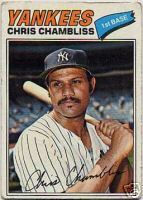
Card Corner–Chris Chambliss

 Chris Chambliss—Topps Company—1977 (No. 220)

With two episodes of The Bronx Is Burning in the books, I can safely say I’m a big fan of the ESPN miniseries. Though it has received mixed reviews, I think the adaptation of Jonathan Mahler’s book is exceedingly well done, full of both entertainment and educational value for someone like me who actually lived through 1977 in the greater metropolitan region of New York. (The interpretations of Billy Martin and George Steinbrenner by John Turturro and Oliver Platt, respectively, have been wonderful. And Leonard Armond Robinson has been appropriately hysterical as Mickey Rivers.) There are some smaller quibbles, such as the lack of a muscular frame or convincing home swing on the part of Daniel Sunjata as Reggie Jackson, but in a film like this, I’m less concerned with the on-field realism as I am the off-field by-play between Jackson and the other major characters.

As with any good historical film, The Bronx Is Burning has shed some light on otherwise little-known facts associated with that tumultous 1977 season. I’ve already learned two tidbits that I wasn’t previously aware of: that Bobby Grich claimed Steinbrenner "threatened" him during failed contract negotiations and that Steinbrenner dropped a hint to Billy Martin that he would pursue Frank Robinson if Martin failed as manager. Of course, The Boss would have needed to work out a deal with the Indians, who had F. Robby under contract as their manager at the time. I wonder if Steinbrenner would have tried to pull off a managerial trade, sending Martin to the Indians for Robinson, a bigger name but one who was less skilled in the area of game management.

In honor of those 1977 Yankees, I thought it might be fitting to pay tribute to perhaps the quietest and least controversial member of that team: Chris Chambliss. Only three seasons earlier, Carroll Christopher Chambliss had joined the Yankees as the centerpiece to one of the most famous "massacres" in the history of the franchise. While Most Yankee fans fondly recall the "Boston Massacre," the memorable four-game sweep of the rival Red Sox in 1978 that helped the New Yorkers claim the pennant, fewer fans likely remember another "massacre"—the "Friday Night Massacre." It took place in 1974, when the Yankees traded away nearly half of their pitching staff in a stunning and controversial deal.

On Friday night, April 26, the Yankees edged the Texas Rangers, 4-3, to remain within a half-game of first place in the AL East. In the meantime, the Yankee braintrust put the finishing touches on a monster seven-player deal with the Cleveland Indians. The Pinstripers surrendered four pitchers—right-handers Fred Beene, Tom Buskey and Steve Kline, and left-hander Fritz Peterson—or 40 per cent of their 10-man staff. In exchange, the Yankees received pitchers Dick Tidrow and Cecil Upshaw and a young first baseman named Chris Chambliss, pictured here in a 1973 Topps card—one of the last times that he would be seen in an Indians uniform.

The trade shocked both Yankee players and fans. "I can’t believe this trade," star outfielder Bobby Murcer told The Sporting News while expressing his belief that the front office had lost confidence in the team’s ability to win. "You don’t trade four pitchers," longtime ace Mel Stottlemyre informed Yankee beat writer Phil Pepe. "You just don’t." Stottlemyre’s batterymate, the often gruff Thurman Munson, offered an even more candid assessment. "They’ve got to be kidding," said a not-so-diplomatic Munson. Yankee fans seemed to agree with the assessment of the team’s veteran players. Hordes of Yankee followers flooded the team’s switchboard with calls of complaint. And when Chambliss, Tidrow, and Upshaw made their first appearances at Yankee Stadium, they received a barrage of boos from the rush-to-judgment contingent in the Bronx.

The media also joined in the criticism—and the questioning. Why did the Yankees give up so many pitchers in one trade, especially someone like Buskey, who had been named the team’s outstanding rookie during the spring? Why did they trade for a first baseman when they really needed a second baseman? (The 1974 version of the Pinstripers struggled to find a pivotman. They started the season with an aging Horace Clarke before making trades for mediocrities Sandy Alomar and Fernando Gonzalez.) What in the world was the front office thinking in making such an unbalanced deal? One Cleveland writer suggested the Indians should send the Yankees a thank-you note for their generous gift of a quartet of pitchers. "Make sure you thank them for me, too," declared ex-Yankee Fritz Peterson in an interview with Cleveland beat writer Russell Schneider.

The barbs didn’t faze Yankee president Gabe Paul, the architect of the blockbuster trade and the man who had created a "Cleveland Connection" with his onetime organization, bringing in former Indians like Sam McDowell, Graig Nettles, Duke Sims, and Walt "No-Neck" Williams over the last two years. Paul maintained that the deal conformed to his general philosophy on making trades. "The way to evaluate a deal is to sit down and look at your club before a deal, and then look at it after a deal," Paul explained to The Sporting News. "If the club looks better after the deal, go ahead and make it. I think we’re a better club with Chambliss…" Paul clearly held a high opinion of Chambliss, whom Yankee pitcher Ken Wright had praised only 10 days earlier by hinting that he would win a batting title. "I think we got an outstanding first baseman in Chambliss," Paul said proudly. "[He’s] a fellow who could be our first baseman for 10 years."

Chambliss didn’t last 10 seasons in Pinstripes, but that was about the only prediction from Paul that proved to be an exaggeration. After flailing away in his first Yankee go-round, hitting only .243 with a mere six home runs in 400 at-bats, Chambliss began to contribute in 1975, hitting .304 and playing an excellent first base. His lack of power (nine home runs) and plate patience (29 walks) remained a concern, but he improved his power output in 1976, accumulating 17 home runs and 96 RBIs and nearly duplicating it in 1977 with 17 home runs and 90 RBIs. All in all, Chambliss solidified the Yankees at first base, which had become a revolving door for one-dimensional players like Mike Hegan (good field, not much hit), Ron Blomberg (good hit, no field, and always injured), and Bill Sudakis (no field, occasional power).

Even if he did little else (and he did plenty), Chambliss forged himself a piece of pinstriped history in 1976, when the Yankees advanced to the postseason for the first time in 14 seasons. In the fifth and final game of a nip-and-tuck American League Championship Series against the Royals, Chambliss deposited a dramatic home run over the right-field wall, victimizing Kansas City relief ace Mark Littell and sealing a New York pennant for the first time since 1964. Providing a calming influence in a turbulent clubhouse, Chambliss then played a key role in helping the Yankees win the World Series in both 1977 and ’78. In the 1977 World Series against the Dodgers, Chambliss hit a solid .292 and slugged .500 in helping the Yankees bring some measure of satisfaction to the Bronx—along with the other troubled boroughs of New York City.

Bruce Markusen is the author of eight books on baseball and also writes the Cooperstown Confidential blog for MLB.com. He, his wife Sue, and their daughter Madeline live in Cooperstown, NY, a short drive from the National Baseball Hall of Fame and Museum.


Series Wrap: vs. Blue Jays

Offense: Blew hot and cold, scoring six runs in games one and three and a total of five runs in games two and four. In their defense, they faced Roy Halladay in game two.

Studs:

Robinson Cano 6 for 16, 2B, HR, 3 RBI, BB
Hideki Matsui 7 for 16, HR, BB, SB
Alex Rodriguez 4 for 15, 2B, HR, 5 RBI, 4 R, BB, HBP
Derek Jeter 5 for 16, 2B, BB, SB

Duds:

Johnny Damon 0 for 13, 4 BB, 3 K
Wil Nieves 0 for 3, K

Rotation: The worst of the four starts was, predictably, Kei Igawa’s. While he looked pretty awful, the end result wasn’t all that bad (5 IP, 7 H, 3 R, 4 BB, 7 K). Indeed, the Yankees won his game. The other three men turned in quality starts, with Pettitte and Clemens allowing just one run each and Pettitte and Wang both finishing seven innings. Overall, a solid performance against a lineup that contains some dangerous hitters.

Bullpen: Allowed just two runs in 11 2/3 innings, but 15 base runners, and both runs resulted in lead changes.

The Good:

Luis Vizcaino pitched three scoreless innings, one hit, no walks. Mike Myers was brought in twice to face a lefty. He retired both to end Blue Jay rallies. The first time he left the bases loaded. The second time he made a great play on a comebacker to turn an inning-ending double play. In total he threw six pitches, four of them strikes, and got three big outs. Mariano Rivera picked up two more saves, one of them a five-out save. He did allow a triple to Troy Glaus in to lead off the ninth in game one, but stranded him on third by striking out the next two batters. Although Joe Torre got fed up when he walked the first batter in the eighth with a 4-1 lead in game three, Bruney retired four of the five batters he faced in the series.

The Bad:

Proctor and Farnsworth again. Proctor allowed eight base runners in 2 2/3 innings including a solo home run by Alex Rios that tied up Monday’s game at 4-4. It was Proctor that loaded the bases for Myers in game three. Farnsworth came into a tied game on Tuesday, gave up a leadoff single, made a wild throw to first with the runner standing on the bag, then gave up a double to plate the go-ahead run.

Defense: Farnsworth’s wild throw was the only Yankee error of the series, though their overall play was less spectacular than in the previous series in Tampa.

Conclusion: Torre seems to be sorting out the bullpen and the rotation seems to be getting on its feet in the second half. The offense is spreading things around (Andy Phillips had some big hits, Bobby Abreu drove in the only runs in the finale, and only Damon didn’t come through in one way or another). Overall, the team is playing well, though the offense is still a bit underwhelming. An offensive outburst could give the team an emotional breather and allow Vizcaino and Rivera to get some real rest and Edwar Ramirez to get some work (though, regrettably, Ramirez will likely be farmed out on Saturday so that Matt DeSlavo can make a spot start in that day’s double header, so I guess it would be too little too late for Edwar for now). Overall, they Yankees are getting the job done, having won their last four series. They’ve also pulled into third place in the Wild Card race, though they still have a long way to go to catch the Indians.

feed Share on Facebook Share on Twitter Share via email
"This ain't football. We do this every day."
--Earl Weaver
