
Via Kottke, check out this 1979 Atlantic magazine profile of George Lucas.




I don’t have a thing for red velvet cake or cupcakes but I saw this picture and damn do I ever want one.
The jammies over at Magnolia are pretty slammin’.
[Photo Via: Add a Spoonful of Sugar]

“Laura, ou l’aurore” via: Rery.

Coming out all high and laughy on some Richard Pryor tapes…
[Photo Via: Past, Present, Future, Perfect]

Over at the Yankee Analysts, Michael Eder writes about Joakim Soria in pinstripes.
And where will Hiroki go? He might not be back in New York.
[Photograph by Andrew Moore]

Next up is this insightful essay by Mark Kram on Marlon Brando (originally published in the November, 1989 issue of Esquire). Kram, a beautiful stylist, was a master of the long form takeout piece:
Though he is chiefly known as a former boxing writer for Sports Illustrated, and in particular for his coverage of the Muhammad Ali-Joe Frazier trilogy, Mark Kram, my late father, aimed his prodigious talent at a wide array of other subjects that he said enabled him to stretch out. On example of that is the lengthy Esquire essay below, which will be included in a collection of his work that I have edited and hope to publish under the title, Great Men Die Twice.–Mark Kram, Jr., author of Like Any Normal Day.
Please enjoy:

“Brando”
By Mark Kram
How civilized the fame game was then, a timid, furtive glimpse for the observer, the observed cordoned off by a dreamlike distance of respect. Worship knew its place; so did greatness. It was caught sharply once by a young American student as he sighted Flaubert suddenly passing his table, their gazes meeting, his eyes like bits of faded blue sky, the huge body looming down, then gone, a magnificent ship of achievement receding in the sunlight like a mirage, leaving behind forever a face, the smell of afternoon wine, and mystery unscarred by any attempt at aggressive familiarity. How easily devotion and curiosity were sated. All that was asked of, say, a Shelley was his ballet of lines, never mind that he was a conniving weasel, an evangelist of free love, a brooder in private about his lack of noisy attention. The exposed colossus was to be the meat of the next century.
No wiser or more wounded authority on that subject exists than Marlon Brando, the tortured exemplar in the age of perfected mythomania. The fame game seems to have eaten him alive, crunched and munched him into a brand-name mythological mush (so many conflicting tales, so many refractions from the light of grinding axes) that repels him, created a dark lore that has fascinated for nearly five decades. The tranquil, public haze that gathered over the likes of Shelley and Flaubert is all he ever seems to have desired, the work dwarfing fraudulent celebrity, the work speaking for the man. To that end, he has gone to dramatic lengths, from playing the imp or the fool when treed for interviews, to coiling into a merciless critic of himself, of the twisted values of the business that spawned him, and of the society that honors him; from the isolation and hermetic gloom of his Beverly Hills remove, to his primitive self-internment in the South Seas.

No matter how inaccessible or contemptuous he is, no matter what he says, nothing seems to diminish the gravity of his name, the wonder, ever since he stood beneath a balcony in A Streetcar Named Desire, an animal in pain, and screamed from the bottom of his being: Stellllaaa! Now, after nearly ten years of chosen estrangement – he seems to use disaffection and distance the way other actors use a false nose – Brando is back to work on the legend again in two films: A Dry White Season, as a South African lawyer for a ten-minute turn well below his price, and the soon-to-be-released The Freshman, in which he plays a Mafia chieftain who crosses paths with a college student (Matthew Broderick) in New York. His choice of these films is instructive.
The South African lawyer appeals to his genuine, almost clinical rage toward injustice. Give him a script and he’ll examine it like a medieval archivist, blowing away the dust of nonsense, looking for villains and saints that correspond to his life views, for themes that illuminate the polished grubbiness of the world. To the ordinary, unobfuscating mind, The Godfather was about people shooting other people all over town, turning blood into marinara sauce, and at its best a well-observed anthropology of a subculture. But to Brando, the Mafia was a metaphor for corporate thuggery in America, Don Corleone the archetype of the man in the Oval Office: humanity masking the capacity for evil. The Freshman would appear to be Brando-proof, free of darkling mirrors, a lap for the money, something that touches the whimsy in him. Except: the director, Andrew Bergman, also wrote The In-Laws, Brando’s all-time favorite film, a threepenny opera about the CIA, the one monolith he despises more than Hollywood and the goonlike media.
But after ten years of absence, it is remarkable that there remains any demand for Brando, and it would be understandable if there were none; he has always carried a lot of unkempt industry baggage. The war stories have traveled down the decades, sure anathema to the new industry, which is sensitive more than ever to a poltergeist loose in their profit line; the very mention of Brando’s name has been known to cause four-star heartburn. The legend, then, the talent, cannot be denied? Would that it were so, but the new executives – who bring to film all the passion they would to a bar of soap – have no patience with historical memory, abominate the heirloom name, except at the Academy Awards, when they gush with soulful treacle. Instant, disposable legends (how many will be around ten, even five years from now?) lashed to flashy, empty vehicles and aimed at the new audience inform the ruling interests; true giants belong to college film festivals, to the art-house movie rats who like to debate the stylistic quiver of a lip into deep revelation.
To the executive mind, Brando might as well be coming back from the dead, doing the Lazarus turn for posterity. Lengthy careers of a singular cut don’t alchemize with the new audience. Orson Welles wasn’t allowed to work for years for many reasons, among them his film sensibility. The same for the great director Elia Kazan, and now Robert Altman. John Huston stayed in action because he was the consummate politician – legend had the powerful Ray Stark clearing the brush for him. Talent needs content, a story and characters to match it, components that are vague to an audience that expects ten-car pileups, orgiastic violence, technological feasts for the eye and comic-book zaps for story, a trend well under way when Brando took a powder. To this audience – say, under forty, certainly under thirty – the Brando name can’t mean much; some fat guy, maybe, sitting around and eating breadfruit on an island.

If they remember him at all, it might be as Jor-El in Superman, to his critics a cynical grab for the money ($3 million for several minutes); to the more sympathetic his effort, perhaps, to catch the new wave, to keep active until the right property showed up. Both views are probably correct; Brando can never be accused of simplicity of motive. If he cared at all – and that can never be certain – the experience had to be unsettling, this glimpse of the possible fate ahead, the actor as harlequin on the make, the queasy recognition that he was doomed to be an Easter Island statue in a cheesy shopping mall. That, of course, grants him a pride to which he has never spoken, a passion for excellence to which he has never admitted, not even at the start of his career, when he disassembled the craft of acting, cleaved at the baroque, when he filled the screen with a ragged, mean diction and projected a humanness stripped of artifice and pretense, flesh and blood all over the place, a soul bared for once, and wriggling in a gauze of light.
The magic is central to the lure of Brando, especially to those over forty, some of whom met him for the first time in The Godfather and Last Tango in Paris, others who were there when it began, all of them waiting for the voltage to hiss and crack one more time. To his older followers, he has always cast a wider net in his roles; the very life of the times ran through him. Like a sudden slap to the face, he seemed to put young males in touch with their maleness, to replace tentativeness with a code, however primordial. After his performance as the dominating baby-beast Stanley Kowalski in Streetcar, urban centers and colleges were filled with young men in torn T-shirts who vowed never to be a pushover for any woman. In The Wild One, he presaged a coming era of rebellion and psychic unrest, made the leather jacket a symbol, and flooded the highways with motorcycles. What was he rebelling against? His character replies: “What have you got?” In On the Waterfront, he struck a resonating twang in many men with a heartbreaker to his double-crossing brother, Charley, lines that are still repeated: I coulda had class, I coulda been a contender, an impeccable thrust to the heart of being a man, to all those futures out there in the dark sure to be glutted with dream rubbers like union boss Johnny Friendly; the massive scar tissue awaits, can you handle it and move ahead with dignity?
And the stories, the lore lived up to the screen identity: there was a long-standing intimation that he could never answer a curtain call during Streetcar’s long Broadway run unless he could produce an erection. “The Slob,” Time called the image. Brando didn’t fancy the label much. Yet, offscreen, his behavior obliged. He hated the feel of new clothes, so he borrowed his agent’s old suits; most of the time he was in jeans, adding to his brute sexuality. He was boorish at parties, with crude put-ons. When a woman columnist finally met him, she said, “Why, you look like everyone else.” He looked at her, then walked away and stood on his head. The first words he said to a Chicago publicist, getting off the train with a pet raccoon on his shoulder, were: “Where can I get Russell fucked?” Was he out to startle, to be the celluloid image (quite doubtful), or was it all just an exterior behind which he could hide and probe for a true self that could cope? The quest, along with shrouding depression, led him into ten-year therapy with Bela Mittleman, and after the psychoanalyst died, he still seemed adrift. With resignation, he once confided: “All I want to be is normally insane.”

There are people who, when they cease to shock us, cease to interest us. Brando no longer shocks, yet he continues to be of perennial interest, some of it because of what he did on film, some of it because he resists definition, and maybe mostly because he rejects, by his style of living and his attitudes, much of what we are about as a nation and people. He seems to have glided into the realm of folk mystery, the kind that fires attempts at solution.
When he first came along, there were just lazy gossip columnists and press agents, all like a swarm of mice nibbling at him. Now there are zoom lenses, photographers dangling from helicopters, an editorial derangement overdosing on the star shot or interview, and guys who would hack through a jungle for a chance to discover what he reads in the bathroom. As he returns to public view, how disgusting it must be to him, how cornered and exposed he must feel, with tiers of insensate cameras whirring and recording the decay of a face and body that stopped women’s hearts and made men squirm over their genetic short change, showing what happened finally to Kowalski, Terry Malloy, the smirking, cocksure Johnny on his cycle, revealing to the star-greedy world raw evidence of how ephemeral and mortal even the gods are; Brando lumbering about, hair whitened, face melting, and carrying three hundred pounds; Brando gorging on crab legs, the butter dripping from his chin like raindrops. He never understood the attitude of the late Harold Clurman, whom Brando knew on Broadway. “What an adventure, life,” he was fond of saying. “What fun, this flop.” The flop part devoured Brando; the fun of fame, money, women, and his talent was impenetrable.
Brando has always disparaged the specialness of acting, equating it with some mindless reflex and an ordinariness common to all humans. Duty, art, that’s simply ethereal piffle for a dronish exercise that is no more romantic than drilling teeth. It is an outlook directly at odds with the holy cosmos of theater and movies; a fire hose on the power of illusion, a deterrent to the tunnel-vision ambition that feeds the tradition. But this attitude has not been rate among actors, particularly Spencer Tracy and Richard Burton. Tracy factored out acting to knowing your lines and not knocking over the coffee table. He thought it an immature calling, and when Brando’s wife Anna Kashfi sought his advice, he told her: “Don’t fret about it. Acting doesn’t require brainpower. Look at your husband.” Burton thought the craft diminished the man into fop, and pined for the beery, bloody Welsh rugby fields that had forged him, where a man’s sense of himself could be made palpable. What a paltry ambition, acting, Brando told an interviewer, then asked: “How come you always ask questions about acting? What else you got?”

Stella Adler, the grande dame of acting scholarship, was the first influence on Brando’s career, in 1943. Irrepressible, dominant, she knew how to fill a room. Her approach was to allow an actor to free the irrational in himself. An actor must contend with words, bring imagination to them. Ever since, Brando has used words as keys with which to enter the deep center of a character. Some have thought that he is incapable of remembering lines; they are printed on cards around the set, even on the foreheads of other actors. Odd, for a mind that can quote obscure passages of Shakespeare without effort. Quite simply – and to him like so much about society’s writ of life itself – the discipline of line rote reduces him to a mechanism, imprisons whatever mood or energy he wants to fire out. He needs a lot of room. Adler gave it to him first, and he’s fought with every stentorian director who’s tried to put his talent in irons. It was Adler’s contention that she taught him nothing, that she “just opened the door, and he walked through it.” She added: “He lives the life of an actor twenty-four hours a day. If he is talking to you, he will absorb everything about you, your smile, the way your teeth grow.”
By an infinite number of perceptions he seems to form tacit conclusions about the fate of a picture, about what amounts of creativity it deserves. He can disappear from the screen, or attempt to commit visual suicide, as he did in The Missouri Breaks, trying to con with a pathetic accent, dancing a jig on credibility when he turns the character of a western killer into a dippy overweight drag queen.

He’s walked through a lot of films; so did the titan Olivier, but none of them stuck to him, nobody counted. Being an earnest technician, the gallant professional who doesn’t let the side down, never figures in the mix. As Burton said of himself, Brando cannot pander to a project; it works or it doesn’t. But even Burton, who admired Brando, said that “I [wish I] could take him in my teeth and shake enthusiasm into him.” Above all else a reverential man of the classic stage, he thought that Brando ruined many performances by underarticulation.
The history of his interaction with his peers doesn’t fit the Brando who disdains his work, minimizes its import. Such a man would be above the fray, would not care enough to respond to the threat of competition. But actors, whipsawed emotionally from day one, are poised on the edge of envy all their lives. They are sensitized to the tiniest slight, can turn any incident into a contest of wills. Even so, the idea of those of huge stature childishly mucking about competitively would seem to be too trivial, a fiction devised by the press. In diaries, Burton enlightens on the subject, how the compulsion to win, always there on the inside, is driven from the outside too. A friend back in Wales asks him: “What do you think of this Brando boy?” Burton replies: “Very good, very good indeed.” The friend draws close, and says: “But Rich, can you beat him?” For all his protestations, Brando played the star business like everyone else. His antennae shot up in the arena; it was just that his method of offense (rattling other actors, turning sets into chaos, playing mind games with directors) was more opaque.
Eddie Jaffe, a press agent, of all people, sees much more. Jaffe and Brando were close in the early days, even shared the same psychoanalyst. “All his actions,” says Jaffe, “what made him, drives him, or cripples him come from a monumental, dark lack of self-esteem.” It began early, and was locked up forever in his mind when he told his coarse father that he wanted to be an actor. “What?” asked the father. “Look in the mirror! Who would hire a yokel like you?”
To Brando, authority, any kind, unbalances him. Brando was in awe of Charlie Chaplin, until he worked for him in A Countess from Hong Kong. Brando has never claimed to be handy with comedy, a deficiency he often regretted when he would endlessly watch Laurel and Hardy films; he thought he would learn from the great Charlie. Instead, Chaplin manacled him with punctilious direction, burdened him with minutiae. But it was more than that, Brando related later. “He was a mean man, Chaplin. Sadistic. He humiliated, insulted his son [Sydney, who had a small part].” It infuriated Brando, and when Chaplin tried the same thing with him, Brando told him where he could stick his movie, frame by frame, adding: “Don’t you ever speak to me in that tone of voice.” Chaplin, he said, was a remarkable talent but a monster of a man.

By then, Hollywood was coming to the same judgment about Marlon Brando. Countess was near the end of a long line of ten failures, not only at the box office. There had been aesthetic collapse in his unengaged work. And though all stars make horrendous choices of films (instincts are not infallible, you have to trust others eventually), the constant yelp of Brando’s dogs quelled the roar of his mystique. He had become a hack, a turbulent hack at that. In Hollywood, genius is equated to money rung up: a place run by cultural swine. His ex-wife Anna Kashfi says Brando had noted this from the first, saying that you could defecate on their rugs out there is the price was right; now his career was in slithers. He spurned a retreat to the stage (unlike Burton and Olivier); theater required a grueling attention span, high-octane commitment; he surely hadn’t forgotten how Streetcar had ravished his psyche. As it was, he drifted, leaving behind much animus but a vast indelibility, a model for future actors. As director Lewis Milestone observed, every punk extra with a couple of lines wanted to do and be a Brando.
It has been conjectured over the years that Brando threw himself so intensely into the role of Stanley Kowalski that he became him, a trampler of other people’s feelings, with a porcine sex drive in relentless snuffle. The latter appealed instantly to men (if that was murder one, then most of them would rise for conviction), and women sensed a freeing sexuality in him, a feral quality that recognized no constraints. Back then sex was a murmur bound with restraints and a rigid exterior of decorum. All the great screen lovers were feathery, rakish threats, perfumed, ample with technique and conscious of sexuality’s exterior. Brando was sweat, jungle demands, and there were no rules, only a room and a bed; a kitchen table would do. And he had no conscience; look what he did to haunted, fragile Vivien Leigh in Streetcar. Kowalski was a reality transplant that never let Brando alone.

“I hated him,” said Brando. “People have asked me if I’m really Kowalski. Why, he’s the antithesis of me. Kowalski is a man without any sensitivity, without any morality but his own.”
There is no reason – except for his swirling love life offscreen and some volatile testimony from an ex-wife – not to take him at his word. He has spent his whole life running from “The Slob” tag. The first thing he said after he became a star was, “Now I have to educate myself.” Since then, he has pursued Eastern religions, read philosophers from Lao-Tzu to Schopenhauer to the point of eyestrain, his single goal being to try to understand himself and human beings, to find The Truth from somebody “you think is not a bullshitter,” somebody who has the eyes of a saint and the perceptions of a ghost. He’s never gone along with Stella Adler, who liked to quote to him: “Don’t try to know who thou art. Long hath this idea tormented thee.” Those who have been close to him say that much from the search eludes him, that he is a man going at an iceberg with a pick, the chips flying up brilliantly to him but never forming a unified whole.
Whatever the depth of his intellect, there is a special, pure, childlike wonder in Brando. He does not want to be what Kowalski communicates, that “we are here for one, terrible, gnashing, stomping moment, and that’s all.” He wants to make sense of things, never more evident than when he used to camp out at night while shooting The Missouri Breaks. With the Montana sky ablaze and banging, he sat in the dark, quietly intense and fingering a computer, timing the lightning strikes, which were enough, he said, to make him feel religious. This side has been shown only rarely. Mostly, he has condescended to inquiry with baiting and a weird, oblique gamesmanship.
One of the few interviews of any length was with Truman Capote. The writer first met him in a deserted theater. Streetcar was in rehearsal, and the young Brando was asleep on stage, on his chest an open book, Basic Writings of Sigmund Freud. He was in denim pants and a white T-shirt, and Capote instantly saw the sexuality. He wrote: “It was as if a stranger’s head had been attached to the brawny body, as in certain counterfeit photographs. For this face was very untough, superimposing as it did an almost angelic refinement and gentleness.” He went on to talk about his aquiline nose and full lips that had a relaxed, sensual expression. Years later, Capote wrote him off as a dummy. “Maybe,” joked Brando, “because I got my nose broken.”
Brando was passionate about boxing, and before On the Waterfront he spent days studying the middleweight Rocky Graziano. During the run of Streetcar, he liked to spar backstage, hence the broken nose. He was not only pleased at how he got it, he was elated that it made his face more interesting. The producer Irene Selznick agreed: “I honestly think the broken nose made his fortune as far as the movies go. It gave him sex appeal. Previously, he had been too beautiful.” It was an appeal that he dismissed. Women, he said, never stared at him when he walked by. If they did, it was the movie-star gawk.

“You’ve got to have love,” he told Capote. “What other reason is there for living? That has been my main trouble. My inability to love anyone.” He didn’t seem to stop long enough to find out; he had harem taste. And he leaned toward dark, dusky women, usually foreign or of foreign extraction. Light-skinned women, he told Kashfi, derailed him sexually, explaining, “My mother was blond, you see.” The Eurasian beauty France Nuyen was one of the few famous women he romanced. Brando drove her so wild that her weight soared and she lost a role in a movie. Another, so frustrated, put a voodoo doll on his lawn. Another attempted suicide, anything to retain his attention. He tried to understand the impermanence of love: “Nothing lasts for more than a little while. You could love a girl so much you could cut your stomach open. A year later you never want to see her again.” He sought beauty, but was more drawn to lives of odd content. “He was talking to me one day,” remembers Eddie Jaffe, “and he said excitedly that he had just met the most beautiful woman ever. Wow, I thought, he’d had some beauties. I asked him why. And he said, ‘She’s had the saddest life I’ve ever heard.’”
Kashfi attributes this preference to Brando’s need to feel superior to women. Their marriage produced one boy, Devi. He supposedly never lived with Movita, a Mexican actress, yet it was a legal union on paper that gave him another boy, Miko. Since then, he’s had a Tahitian wife, who recently sounded rather impatient with him. But it was the marriage to Kashfi that was a nightmare. According to her, it was rife with violence, torment, kinky sexual compulsions (his, of course), and free-fall neurosis.
In her book, she accused him of being a “clumsy seducer” and a sexual hog, a man who all but lit candles to his penis. Some of her nonsex observations are very revealing, if you can believe them, but when it comes to a man and a woman in their bed, or a battle for child custody, it is best to seek a neutrality of judgment. Besides, what did she expect when he first showed up to court her dressed as a Good Humor man, white shirt, pants, shoes, and rode around Hollywood in a convertible with a trick arrow sticking out of his head. To her credit, she dismissed most of the premarital tales she had heard. But she thought he was capable of bizarre constructions; he relished the yarns when she asked.
And who wouldn’t believe anything after Last Tango in Paris? Here was Kowalski with an education and emotionally vanquished. The critic Pauline Kael correctly called it a stupendous film breakthrough. The director, Bernardo Bertolucci, had wrung Brando dry; he hadn’t been guided, slyly coerced into a performance like this since the days of Elia Kazan.

The film is centered in a vacant apartment, an asylum of crushing fears, of bad memories. An ex-boxer and actor-rebel, Paul (Brando) is an aging reject of society, with the harpoons of life exposing torn emotional flesh. All his life he has been in search of love; now he wants a reality he can understand: no names, no identities, detonated sex without love. “You see,” he says to Jeanne (Maria Schneider), “we’re going to forget everything we knew. All the people, wherever we lived. Everything outside this place is bullshit.” He overwhelms her, pummels her sexually into a mere body, sodomizing her and forcing her to recite a declaration against love and society. Watching one scene, Brando’s dresser said, “Something’s up, he’s taking this seriously.”

An actor friend, Christian Marquand, was astounded: “Forty years of Brando’s life experiences went into the film. It is Brando talking about himself, being himself. His relations with his mother, father, children, lovers, friends – all come out in this performance.” At the end of the shoot, an exhausted Brando said: “I will never go through this again.”
With his career inert in the late Sixties, Brando spent all of his time on a Tahitian atoll he had purchased. He was attracted to the lassitude and openness of the society, to the purity of life, and no doubt to the beautiful women, unimpaired psychologically. There is a lot of Rousseau in him, a back-to-nature idealism that drives him to want to remake the world. It would be startling if Brando had not read him, for much of his social thinking echoes Rousseau’s view that “man’s breath was fatal to his fellow men.” On his island of Tetiaroa – tetia meaning “standing alone” and roa meaning “far away” – it was as if Brando were going about putting Rousseau’s meditations into action. When he wasn’t walking naked in the moonlight, he worked like a slave trying to effect a utopia. He poured millions into the environment, threw himself into a myriad of scientific experiments aimed at creating a simple, highly functional society free of Western values.

The Sixties were also a propitious time for Brando’s instinct for social redress. He campaigned hard for the civil rights movement, fought for the Black Panthers, and championed his favorite cause, the plight of the American Indian. Wrongly, critics saw his activities as a device to revive a failing career. His compassion for bottom dogs went way back. Once, when he had his own film company, he was in a funk over the Chinese, and one of his partners shouted: “Stop worrying about eight hundred and fifty million Chinese! Worry about us, two Jews – your partners.” He agreed later to do the film called Burn! with Gillo Pontecorvo. Shooting took place in the heat of Colombia, and he was quickly at odds with the Italian, the way he treated blacks, who got half the pay of whites and were given slumlike living facilities. “I want to kill Gillo,” he was heard saying. “I really want to kill him.” Questioned why, Brando raged: “Because he has no fucking feelings for people.”
Going into the Seventies, Brando moved out of semiexile and into one of the most protean runs of his career. By now, there was a whole new atmosphere in Hollywood, charged by filmmakers and actors who had grown up on his films. He had always had the adulation of younger actors. James Dean used to follow Brando around like a shadow; he was tepid about Dean, even jarred by his wildness, and he told him that he was “mentally disturbed and should go into analysis.” Jack Nicholson said Brando was a heroic figure to him. When he moved out of Hollywood, right next door to Brando, he still stared with awe at his neighbor. “No telling,” he said, “how many people were trying to emulate his timing, his style.” When Brando walked onto the set of The Godfather, Al Pacino lost his composure. He was in a daze, his face white and his hands shaking. “What’s the matter, Al?” an executive asked. “They want you in there. Go on.” Pacino said: “You don’t understand. Have you any idea what it is for me to be doing a scene with him? I sat in theaters when I was a kid just watching him. . . . He’s God, man.”
Coppola had been vindicated after Paramount studio chief Robert Evans questioned his judgment in wanting to hire Brando. “I’m surprised at you, Francis,” said Evans, shaking his head, filled with visions of chaos and a destroyed budget. Not on firm ground himself, the young Coppola pleaded: “You don’t know what an effect he’ll have, you don’t understand his mystical relationship to actors.”

Robert Mitchum rightly observed some time back that no one ever did a film with Brando. “He’ll take you to hell in a dogsled,” said Lewis Milestone. But these new directors seemed to enter a cobwebbed room of Brando’s mind, they jostled his imagination and creativity. “When people deal with him honestly,” said the late director-actor John Cassavetes, “there’s no one better – ask any actor.” Whatever it was, Coppola freed the giant in Brando with Don Corleone, and did it again later as he pulled out the tenebrous, lost reflections of Colonel Kurtz, in a dim, shadowed cave dwelling at the end of Apocalypse Now. A master of improvisation, Bertolucci had Brando right in his gunsight, won his enthusiasm by encouraging him to shape scenes in Last Tango. “An angel as a man,” said Bertolucci, “a monster as an actor. He is like one of those figures of the painter Francis Bacon who show on their faces all that is happening in their guts.”
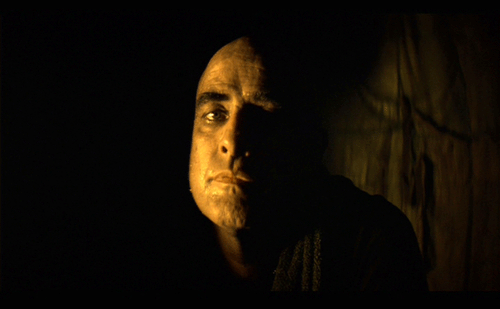
So with two new films, Brando is back, slowly closing the circle of his career. Who is Marlon Brando? Is he Kowalski of Streetcar, the rebel in The Wild One, the lost Paul in Tango? Who will he be next, as he feels his way toward the events of aging and death, fumbling for a serenity that has seldom been there in his life?
Extraordinarily, and emblematic of his disarrayed genius, parts of a self-portrait can be found in most of his films; no actor has thrown himself so naked to our voyeurism. Anna Kashfi says his whole life has been this: “Here I am – don’t look at me.” On film, at his very best, he has had nowhere to hide. And you can ponder what gnarled, semiblinking neuron in his brain has motivated Brando to turn himself into a three-hundred-pound remove from a former self; the apogee of narcissism turned like a knife inward. Striking looks and fame made him feel like a geek; growing ugly closes the case out, seals off affection with a releasing finality. As for his work, a powerful argument can be made that he has been the greatest American actor of this century – the single one who will survive well into the next. As Nicholson says: “The man does scorch the earth, right? I mean, for two hundred miles in any direction. Not much leavin’s.” And when Marlon Brando is gone, a wind will gust around an empty throne, and sway the heavy curtains on the wall.
This story is reprinted her with permission from Mark Kram, Jr.
Do yourself a favor and read Kram Jr.’s beautiful memoir piece about his father, “Forgive Some Sinner.”

Over at Grantland, check out Jonathan Abram’s oral history of The Greatest Team that Never Was.

“Girl with a Hole in Her Stocking,” By Michael Thompson (2008)

[Image Via: Jazz Corner]

I know I’ve shared this with you before but in case you missed it, here’s a sure shot: David Chang’s brussels sprouts (via Food 52).

Joyce Carol Oates salutes Norman Mailer:
I became acquainted with Norman Mailer in the last 10 or 15 years of his life, at a time when he was, shall we say, mellower than he’d been. By this time he’d been married six times and was at this point married to Norris Church—as you all know Norris was one of the most beautiful women … And her physical beauty was matched by an inner, spiritual beauty—she was really quite extraordinary.
I knew them, if not well, as a couple. The first time I’d met Norman was at an event at Lincoln Center—I think it was a fundraiser for a literacy organization. Norman was the MC. And I was one of a number of writers who were giving readings. When I came out on stage, Norman was gracious and shook my hand and introduced me by saying, “Joyce Carol Oates has written this remarkable book On Boxing.” He let that sink in to the audience, then added, “It’s so good I’d almost thought that I had written it myself.” And there were waves of good-natured laughter from the audience and Norman seemed just slightly puzzled, like—Why is that funny?
Norman had meant his remark as the highest praise. In speaking of Norman Mailer we’re speaking of the male ego raised to the very highest, without which we wouldn’t have civilization, I’m sure.
“Quitting the Paper”

On the Kansas City Star you were forced to learn to write a simple declarative sentence. This is useful to anyone. Newspaper work will not harm a young writer and will help him if he gets out of it in time.
—Ernest Hemingway
Late one night in the fall of 1969, with the rain splattering against the front window and the gray light of a television set dancing across the bar, I sat in a booth at Emile’s French Café in downtown Atlanta with a feisty young newspaper reporter named Morris Shelton and methodically proceeded to get paralyzed on Beefeater martinis. By now this had become a daily ritual. I was thirty-three years old. I was the featured columnist for the Atlanta Journal, the largest daily newspaper between Miami and Washington. I had been one of a dozen journalists around the country to be selected to study at Harvard under a Nieman Fellowship the previous year. I fancied myself a sort of Jimmy Breslin of the South, cranking out daily one-thousand-word human dramas on everything from flophouse drunks to Lester Maddox, sufficiently loved and hated by enough people to have that sense of pop celebrity with which most newspapermen delude themselves. I had the most envied newspaper job in Atlanta, if not in the South, and now and then I would see a younger writer in a town like Greensboro or Savannah or Montgomery imitating my style just as I had once stolen from Hemingway and Breslin and too many others to talk about. I had been sloppy and inaccurate, from time to time, but I had also written some good stuff. I had hung around all-night eateries and gone to Vietnam, and hitchhiked and lain around with hookers and shot pool with Minnesota Fats and sat in cool suburban dens with frustrated housewives.
And yet, with the next column due by dawn, I had run out of gas. I don’t know why men make dramatic decisions at the age of thirty-three—change jobs, leave families, kill themselves—but they often do. “You have to remember,” I recalled a friend’s saying as he dumped a secure advertising job and ran off to Hollywood to write scripts, “we are no longer promising young men.” I figured I had written a total of two and a half million words for five newspapers in the previous ten years, at a time when you had to move to another paper and another town for a ten-dollar-a-week raise, and about all I could show for it was bad credit and a drinking problem. Working for the mill, as it were, I was earning from Atlanta Newspapers Inc. a net of $157.03 a week; I was drinking too much, staying out all night, fighting with my wife, and choking on the notion that perhaps it was as a “well-read local columnist” that I had reached my artistic peak.
“No ideas for tomorrow?” Morris Shelton said, once we had run out of fanciful ways to cuss the paper. Morris was about ten years younger than I, an aggressive young Texan who hadn’t yet chased enough ambulances and beat enough deadlines to be weary of it. He was one of the younger ones on the paper who defended me when the old-timers there called me a prima donna and, once I bailed out, much more vigorous stuff.
“Just a title,” I said.
“You always start with the title?”
“This time I do.”
“What?”
“Something like ‘Quitting the Paper.’ ”
“‘Quitting’? You quitting?”
“You’re my star witness, Morris.”

And so we darted through the rain, up to the fourth floor of the old Atlanta Newspapers building, and while he dabbled around the newsroom I called my wife of the time to tell her the apocalypse had arrived (“Come on home and I’ll have a whole bottle ready”). I turned to my typewriter and rattled a stark memo—“Dear Mac … I’m quitting newspapers because I am sick”—and then we went off to get supremely drunk at Manuel’s Tavern. Manuel Maloof, counselor and padrone to scores of journalists over the years, was at first astounded and then fatherly. “You got a half-million people out there gonna be disappointed,” he said. I said, “Let ’em all chip in a penny a week.” When Shelton allowed as how maybe he ought to quit, too, I told him it wasn’t his turn yet.
The next morning broke cold and bleak but, somehow, refreshing. There was the feeling that an exorcism had taken place; that I had successfully negotiated the move from one plateau of my life to another; that after ten years of writing magazine pieces and dabbling in nonfiction books, I would then move on to something else, like writing films or novels or both. I heard from Jack Tarver, of Atlanta Newspapers Inc., around ten o’clock, “astonished,” wanting to know if there had been a personality clash—if so, he said, he could switch me over to the Constitution—but I told him the problem was bigger than that, and we quit as friends. By noon I had an agent in New York, by two o’clock I had a bank loan of $2,500, by five o’clock I had a modest office above a tire-recapping place, and by bedtime I had enough insurance—disability, hospitalization, life—to take care of a Marine platoon in combat. At some point during the day I drifted back to the paper to clean out my desk, while the old-timers glared tight-lipped at one with the audacity to quit (“Well,” one was later quoted as saying, “it takes a certain breed of man to be a newspaperman”), and one of the young ones blurted that it “takes a lot of guts to quit like that.” I said, “Christ, it takes a lot of guts to stay. I can steal the kind money they’re paying me.” I thought, filled with myself, it was a Line to Remember Hemphill By.
Freelancing isn’t recommended for everybody, especially those with mortgages and kids and an attraction for whiskey (“Make your wife lock up the liquor cabinet and take the key to work with her,” was the only advice I had for a friend who recently made the move). All of a sudden there is no Big Daddy to make you write, give you a paid vacation, pay your phone bill for business calls, make sure your typewriter is clean and working, let you take the day off, refund your business expenses, give you a Christmas bonus, deduct your taxes, cover your hospital bills, pay your postage, clean the office, or pay you every Friday at noon. You are out there, alone, you against the editors and publishers in New York, and newspapers and advertising agencies all over the country are stocked with people who had once hankered for the day they could “get away and write.” Making it as a free-lance writer requires many things—talent, energy, a financial cushion—but from my experience the most important quality is the motivation to go to the mines and write every day. It’s a pisser. “I can’t say I enjoy writing,” somebody once said. “I much prefer having written.” Your deadlines aren’t at the copy desk anymore. They are at the bank.
Upon making the plunge, I was in better shape than some. My first book was making the rounds in New York, beginning to show promise—meaning they knew me up there and I could wheedle more advance money from my publisher. During the first week my agent got me a snap assignment for a sports piece, which quickly led to an association with Sport magazine. One piece led to another, and in spite of the shrinking magazine market I found I always had a half-dozen pieces to work on. My book got rave reviews, mostly, and it led to other books and other connections. I wrote for Life and Cosmopolitan and Pageant and TV Guide (I once considered printing up calling cards saying I would do “Anything legal or halfway moral”), and the business, as we say, expanded. There are the hairy moments when the checks are slow, and I have been locked in combat with my old nemeses Johnnie Walker, and the old debts from those years of wandering and grubbing along on newspaper pay make it necessary for me to produce better than two thousand dollars a month to stay out of jail. But it occurred to me when I was offered a fat chance to go back to newspaper columnizing, in a big Eastern city, that I am doing precisely what I want to do: writing what I want to write, when and where I want to write it, which ought to be about all a serious writer should expect out of his life. Now and then you have to write a little tripe to pay the insurance premiums (one more piece about country music or one more about minor-league baseball and they will have to come and get me), but it is the price you pay for relative freedom. Marshall Frady, an Atlanta writer who really does talk as expansively as he writes, said it one time in Harper’s: “I think maybe writers ought to be scattered out over the land … [people who] just have this secret eccentricity to write … And all the time, covertly, you’re actually a kind of undercover agent stranded out in the cold, sending dispatches from the dark, brawling outback of life to Shakespeare, Cervantes, Dickens, all the others, letting them know what’s going on now.”
The temptation is to take out after the Journal and Constitution for their dedication to mediocrity over the years. God knows I’ve got a lot of good stories to tell. Atlanta and the South and the nation are teeming with talented ex-Atlanta newspapermen such as Jack Nelson, one of the country’s most respected investigative reporters (now, alas, with the Los Angeles Times), who would have stayed on with the Constitution in 1964 if he had only been shown a single sign of love. Earning ten thousand a year at the time, Nelson told Tarver he would turn down the Times for something like twenty dollars a week and was accused of using the job offer as a “wedge to get more money.” The paper made famous by Ralph McGill and his early-on pleas for racial moderation suddenly got a craw full of civil-rights coverage (i.e., “nigger news”) and was one of the few of any size in America not to staff the Selma-to-Montgomery march. A star editorial-page columnist there was a retired Marine officer, John Crown, who addressed the Vietnam War with all the compassion and neutrality of a Holmes Alexander. The paper’s best-loved columnist was old Hugh Park, waiting out retirement, who got a lot of laughs out of caricaturing the drunks and niggers and wife-beaters parading before Municipal Court every Monday morning. One of the most lyrical and sensitive writers they ever had was Harold Martin, but he was reduced to writing about squirrels and grandchildren before he quit in a huff when ANI wouldn’t increase his pay from the twenty-five dollars per column he was getting twenty-five years ago. (“Consequently,” he said, “I began writing columns worth twenty-five dollars.”) And there was the night my first wife and I had to break away early from a Christmas bash at the home of my managing editor Bill Fields, because I had to go and take phone calls until three a.m. on high-school football games so we could have some Christmas money. “Why, that’s terrible,” said the wife of the man who had made it all possible. “What a waste of talent.” Yes’m, that’s what me and the little woman was thinking. Bunch of dumb-asses. No wonder the newspaper business is in such a mess. They can’t make up their minds whether they want unionized robots or writers. There have been a lot of good people with the Atlanta newspapers—McGill, Martin, Nelson, Eugene Patterson—and there are good ones now. But seldom have the good ones worked in management. There were too many times, in my day there, when the motto should have been (rather than “Covers Dixie Like the Dew”) something like “No News Is Good News.” If it cost money, or might cause legal trouble, it was likely not to be covered.
But all of that is another story, and from what I hear from others who learned to write on other newspapers, the Atlanta Journal isn’t much different from the rest. A newspaper is (or was, before automation set in) a great place for a Linotype operator but a lousy place for a self-respecting writer to work. It is the first line of news gathering before the glamour boys move in for their glossy “in-depth” pieces and Dan Rather comes along flashing his teeth, and I have the greatest respect and gratitude for the grit and tenacity and dampered fury with which a great one like Jack Nelson firebombs the “public servants” hunkered down behind their stacks of press releases on Capitol Hill. But there aren’t many Jack Nelsons. Most of us are inviting suicide or alcoholism or early senility if we continue to labor for too long at a newspaper, thinking we are going to uncover corruption and change the system, because most newspapers themselves are tidy, model plantations. “Boys,” this beautiful old fellow on the Constitution copy desk would tell us summer interns as we waited for the last edition at one a.m., his voice broken from whiskey and his gnarled fingers yellow from cigarettes, “the newspaper is a monster. You fall in love with it, it’s so big and strong, and you promise you’re gonna feed it every day. But what you feed it is you. Every day you come in and feed it a little more, and then one day you’re out of food. There’s nothing left to feed the monster.” I don’t know whether he did it for emphasis, but he always then broke into a terrible coughing spell that was enough to scare the living hell out of a twenty-year-old journalism major.

What you do, then, is use the paper before it uses you—take what it has to offer about the craft of writing, which is almost everything—and then, as Hemingway learned, “get out in time.” I am convinced that the newspaper is the writer’s boot camp. You learn how to use the language. You learn how to interview people. You learn how to work under pressure. You refine what Hemingway once called a writer’s “built-in shit-detector.” You see things few others see, every day, for as long as you work at it. Unlike magazine writing, with its long time lag, you get an instant reaction to everything you write. But all of these are the fundamentals of good writing, and sooner or later many of us become restless with the discovery that there are the facts and then there is the truth. There isn’t time or space or enough perspective to rush the truth into a newspaper. And so you either stay with the paper and go crazy with that knowledge or you simply thank the paper for its help and move on to places where there is more time to do the job properly. It seems to be an altogether natural progression.
The first full-time boss I had in the newspaper business was Benny Marshall. Benny had grown up in the country outside of Birmingham in Alabama. He attended little Howard College and, during the 1950s, became sports editor and sports columnist for the Birmingham News. A witty gnome who could cry at the sight of a wino passed out in an alley, and then make you cry when he wrote about it, Benny was a one-man show when I joined him as a writer of high-school sports in 1958: absolutely committed to reading, writing, editing, and planning the sports section. He would be in the office making up the paper at six o’clock in the morning, up in the composing room to oversee the makeup, back down to remake the home edition, out to Alabama football practice seventy miles away in Tuscaloosa, and back at his typewriter turning out his daily column as the sun went down. He was like father to me. He boosted my ego and covered up my mistakes and gently showed me the way.
Benny was too good for the Birmingham News or any other newspaper. He was built more along the lines of a novelist, or at least a shimmering magazine writer; instead it was his lot to write two-column forty-two-point Bodoni Bold headlines and interview football players and fight cold wars with fat-bellied compositors. He never said it to me, but I suspect that a sense of dread began to fall over him around the early 1960s, when he turned forty and I left the News to wander. A terrible gambler, drinker, and womanizer—as prolific at each as he was at writing beautiful prose—he was strapped with debts and family obligations and a deteriorating body at a time when, perhaps, if he had gone on to the books and other things, he might have been doing great work. This was not the only cause of Benny Marshall’s demise, but it certainly contributed.
One day in the fall of 1969, just before I was to quit the Atlanta Journal, I went through Birmingham on a column-writing expedition through the South. I hadn’t seen Benny in some time, although I had heard from him now and then (“Fan letter,” he scribbled on the envelope of a note to me in Vietnam, and “To One Who Passed This Way But Wouldn’t Stop” on the flyleaf of a paperback collection of his columns), and I was irked when they said he was in New York accepting some kind of an award. I was sitting at his typewriter, rushing to finish a column on Birmingham before Western Union closed and I would have to drive on down the road to Montgomery, when someone answered a phone and turned to me. “You may have a chance to help out an friend,” I was told. Benny was at the airport, drunk, insisting on coming to the office. Maybe I could take him out for coffee in order to get him out of there. Thirty minutes later the elevator doors opened, and there he was, reeling drunk, waving a cup of coffee at me. “Hemp,” he said, and we embraced.
Suddenly the executive editor of the News, Vincent Townsend, glowered from across the newsroom. Townsend was very good at glowering. He also had a son who floundered through more than one college, flunked the Birmingham News aptitude test, stumbled as a reporter, and finally, as part of his education before ascending to upper management, was put in charge of the paper’s weekly pick-the-winner football contest. (Of course, Vincent Townsend intended to see that the football contest succeeded.)
“Mister Marshall,” Townsend boomed.
Benny weaved and spread his hands. “Chief,” he said.
“Have you ever been to Siluria, Mr. Marshall?”
“Shiluria. Sure I been to Shiluria.”
“How would you like to go back to Siluria?”
“Well, sir, I don’t like Shiluria very much.”
A fellow who ran a service station down the road in Siluria had won the week’s football contest, and Townsend wanted Benny and a photographer to drive down that afternoon for a picture and a story. One of the others talked Townsend out of it, saying Benny was tired from his trip and that he would do it instead, and tried to straighten Benny up before driving him home. “You want to go in and watch a real ass-chewing?” Benny said to him. He stumbled out of the car, negotiated the walk to his front door, went straight to the bathroom, shut the door, put a .38 to his head, and pulled the trigger. The News, under Vincent Townsend’s orders, said fine things about Benny in a front-page editorial the next day. I quit newspapering five weeks later.

This story originally appeared in Southern Voices Magazine. You can also find it in the collection, Too Old to Cry.
It is reprinted here with permission from Hemphill’s estate. His wife, Susan Percy, watched the election last night at Manuel’s Tavern, Paul’s favorite hangout even after he quit drinking. “It’s about the only classic old neighborhood bar around,” said Percy. “It’s a great place to watch the election returns, surrounded by writers, lawyers, journalists, cops, city workers, political junkies and other disreputables. They even let the occasional Republican in.”
For more Hemphill, check out his archive at The Stacks Reader.
[Photo Credit: portrait of the author by Louis Favorite for the Atlanta Journal Constitution; Postcards From Here; Jonathan Phillips; Elvishwisdom]