
Bengals in Houston followed by the Vikings in Green Bay.
Settle in, grab something tasty and enjoy.



Bengals in Houston followed by the Vikings in Green Bay.
Settle in, grab something tasty and enjoy.

There’s a nutty old lady lives a few floors below us, she’s always chatting Emily up. A few weeks ago, I get in the elevator and she’s there. Just the two of us.
She looked up at me and said, “I hate your jacket. I hate that…thing.”
She pointed at “The North Face” logo.
I perked up, eager to know what she had against North Face. She told me that everyone wears North Face jackets. “I see them everywhere, even my grandchildren in California.”
I was happy that she felt strongly enough to give me a piece of her mind.
“The jacket itself is nice, but that–” pointing at the logo again.
The door opened and she walked out. “I just hate it,” she said. “It’s terrible.”

Because Buster makes it better. Without fail.
From “Sherlock Jr.”

For years, Richard Hoffer was a stud at Sports Illustrated (where he still contributes the occasional essay), and before that, he worked for the L.A. Times. He is a master stylist and writes lean, elegant prose–precise and wry. He is funny, though never showy. Combined with skillful reporting and sharp observations (his book on Mike Tyson is a must for any boxing fan) that is enough to make him one of our best.
Take, for instance, this L.A. Times piece on the controversial Sugar Ray Leonard-Marvin Hagler fight.
Written on deadline, it is reprinted here with the author’s permission.
Enjoy.

“Leonard Stuns Hagler With Split Decision”
By Richard Hoffer
Sugar Ray Leonard’s enormous bravado, which was nearly offensive in the pre-fight buildup, became a promise fulfilled Monday night when, after what was essentially a five-year layoff, he returned and upset boxing’s dominant champion, Marvelous Marvin Hagler. The sheer audacity of what he attempted was somehow matched by the strategic elegance with which he did it.
The comeback, culminated before the largest world audience to ever see a bout, had been judged foolhardy by most. The symmetry of their careers, their destinies so intertwined, somehow forgave the circumstances of the obvious mismatch. They deserved each other five years ago, but this was better than never.
Still, only those who believed in time travel gave Leonard any chance against Hagler. Leonard would have to return five years, to a time when hands were fast and legs tireless, to meet the foreboding Hagler on anything near equal terms.

Well, he wasn’t the welterweight of 1982, when he first retired after eye surgery. But there was more about Leonard than his tasseled shoes that recalled his time of greatness. For 12 tactically brilliant rounds, he circled and countered, confusing and confounding the bewildered middleweight champion, until he had secured a split decision.
Though the judges did not entirely agree on what they saw—Lou Fillippo had it 115-113 for Hagler, Dave Moretti 115-113 for Leonard, and JoJo Guerra 118-110 for Leonard—the only person near the ring in the parking lot at Caesars Palace to voice any genuine surprise at the decision was Hagler himself. “I beat him and you know it,” he said immediately afterward. “I stayed aggressive. C’mon. I won the fight.”
But Leonard’s game plan never let Hagler in the fight. He circled outside, daring Hagler to stalk him, occasionally entangling the champion in a brisk flurry. Hagler missed monumentally as he chased Leonard. Although neither was hurt or in any danger of going down, it was clear that Leonard was hitting more than Hagler and gaining angles on a man not particularly known for his balance.
“Hit and run, stick and move, taunt and intimidate,” explained Leonard, facing the press in a jaunty yachtsman’s cap afterward, “a variety of things.”

It was not always pretty and may have disappointed the nearly 300 million people watching, in that it lacked boxing’s concussive conclusion. But it was not ugly, as even Leonard’s attorney, Mike Trainer, had predicted when the comeback was announced a year ago.
Richard Steele, the referee, said: “Maybe he fought him the only style he could win with.”
Leonard, of course, knew better than to lead Hagler into any kind of brawl. Hagler (62-3-2, 52 KO) had leveled Thomas Hearns, the last fighter to try that, in just three rounds. In fact, he did fight Hagler the only possible way.
And he fought him that way the entire night. Leonard (34-1, 24 KOs) danced outside from the first round. The clinching was plentiful. And at times, Leonard leaned back into the ropes, imitating the last great popular champion, Muhammad Ali. It was obviously frustrating for Hagler. His long looping rights missed by feet, it seemed. Once he threw a punch, followed it into a ring post, while Leonard bobbed and returned to the center of the ring.

Leonard gave him head feints, his hands dropped, offering his chin disdainfully. Once, in the seventh round, Hagler threw three large right hands in a row. They sailed wide, tremendous arcs in the desert air.
Leonard was masterful in his attempt to frustrate Hagler. In the fourth round, Leonard mocked his opponent with a bolo punch to the stomach.
Hagler, of course, would not be unnerved in the way that Roberto Duran was, when Leonard frustrated him into submission. Still, he was mad, and the two often crossed stares at the bell, and several times had to be escorted to their corners. Hagler was often exhorting his long-time nemesis, “C’mon, c’mon, c’mon,” he kept repeating.

“Once,” said Leonard, shrugging his shoulders, “he called me a sissy.”
In the later rounds, when Leonard was obviously and desperately tired, Hagler began to close the distance between the fighters. In the ninth round, Leonard appeared in trouble in his own corner, but he battled out of it with a vicious fury. At times, he seemed to die against the ropes. Or was he inviting Hagler in for that staccato counter-punching?
In that ninth round, the best of the fight, Leonard four times ensnarled Hagler in some reckless flurries.

It was dangerous and, considering the scoring up to that point, unnecessary. In the 11th round, Leonard got cute. He got up on his toes, smirked as he circled the champion, and threatened yet another bolo punch.
In the 12th and final round, with Hagler continuing to miss, Leonard mocked him by raising his right glove, apparently in anticipation of victory.
Inasmuch as this fight is expected to pull in more than $60 million, a record gross, there will undoubtedly be some who felt they didn’t get their money’s worth. Yet Leonard, who received a flat guarantee of $11 million to Hagler’s $12 million (plus a percentage of the gross), certainly made an effort to earn his.
For, he won with as much grit as wit. At the fight’s end, he collapsed into the arms of his handlers. Those legs, suspect going into the fight, hadn’t failed him until then.
Leonard, 30, had fought just 32 rounds in six years but his year of conditioning apparently dissolved the ring rust that so affects boxers. Of the unlikeliness of his achievement, Leonard said: “It’s the first time a young guy came back against an old guy.” Previous examples of failure do not apply.

Hagler, 32, was obviously disappointed, and he referred very quickly to the trouble he has with judges in Las Vegas. He lost his first title bid on a controversial draw with Vito Antuofermo here. But he admitted that Leonard, who he had pursued for years, fought a “courageous fight.” He could pursue him, but it doesn’t look like he’ll ever catch him.
Hagler, who was stopped short of his 13th title defense in the sixth and final year of his reign, must now hope for a rematch. Leonard will not likely be quick to oblige, if at all. In the ring he said, laughing, “depends on the contract.” But later, he refused to guess one way or the other as to what he’d do.
The decision certainly creates some interesting matchups, and it will be fun to speculate on the combinations. Hearns, who has lost to both, will want in on the action. Permutations abound. If Hagler and Leonard remain true to their peculiar destinies, they are likely to chase each other around for years more, until finally, they really are too old for this kind of thing.
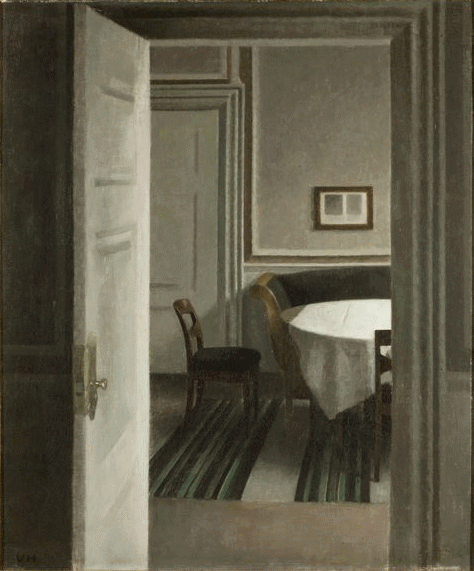
“Interior, Strandgade 30” by Vilhelm Hammershøi (1901)

Over at the Lemon Fire Brigade check out this festiveness: candied tangerine in dark chocolate with poppy seed rugelach.

“Inspiration is for amateurs — the rest of us just show up and get to work. And the belief that things will grow out of the activity itself and that you will — through work — bump into other possibilities and kick open other doors that you would never have dreamt of if you were just sitting around looking for a great ‘art idea.’ And the belief that process, in a sense, is liberating and that you don’t have to reinvent the wheel every day. Today, you know what you’ll do, you could be doing what you were doing yesterday, and tomorrow you are gonna do what you did today, and at least for a certain period of time you can just work. If you hang in there, you will get somewhere.”
–Chuck Close
[Quote Via: A Type of Distraction]

Seen on Sixth Avenue on New Year’s Eve day.

I was getting a slice of pizza the other day when a kid commented on my backpack. He thought it was fresh and wanted to know where I got it. I didn’t know it was cool and couldn’t remember where I’d gotten it. I love being lame.
Anyhow, speaking of backpacks, check out this article over at Slate by Alan Siegel.

“Painter and Model” by Edward Hopper (1902-04)

Here’s David Thomson on Susan Tyrrell in Fat City:
So you say to yourself, this Fat City is pretty damn realistic, even if you know in your heart that “realistic” and Hollywood should not be printed on the same page—otherwise paper ignites. Still, you’re marveling at it, until Oma sits down at a bar counter and starts to talk to Billy. She is going to be what is called his “love interest” or the woman he fucks, but any part of you that feels for Billy is telling him to get out just as we all might remember we have something else to do a long way away if Oma sat down next to us. Except that she is ravishing and inescapable in her downright wildness and unpredictability. She’s in the book, but just try telling yourself that she’s working to a script. And wonder how she ever got in front of the camera.
Maybe she was twenty-seven, but—it’s no lie—she could have been seventy-two. In bars in classier places, like Las Vegas or Los Angeles, you can find women who have had Botox and liquor enough to look like worn-out balloons. Oma is overweight, over-loud, blowsy, unwashed, out-of-line, trashy, drunk, beaten up, tough but self-pitying. She’s like a plate of hot chile, half-eaten, that has gone cold on the table. She is an astonishing creation, dangerous and pathetic, endearing and loathsome. Tyrrell got nominated as best supporting actress, and lost to Eileen Heckart in Butterflies Are Free, a film I refuse to remember. She was nominated by the New York Film Critics Circle, too. Not that winning any award could have made any difference, except that she might have caused a great scene at the Oscars and had to be dragged off stage. Even in 1972, that show needed juice.
She kept on acting, though she admitted that she only worked when she had run out of money. She was in The Killer Inside Me, a lot of TV, many movies you’ve never heard of and in John Waters’ Cry Baby. A little over ten years ago, she had a rare illness—it must have come from thrombocytosis—whereby she had to have both legs amputated just below the knee. I suspect that if she had been thus afflicted in 1972, the fascinated Huston would still have cast her, and let her roam as she wished. He had a true instinct for wild animals, and I can pay the actress no higher compliment than to say that in Fat City she is not just something the cat dragged in. She is the cat.

Over at Chicago Side, here’s Ira Berkow on Hank Sauer.