
Via Laughing Squid, check out these map portraits by Ed Fairburn.




Reading this news item makes me pine for the days, well before most of us were born, of John Lardner or A.J. Liebling. Man, how a story like this would make for a great column in the right person’s hands. A light touch is all that’s needed.

My father loved Damon Runyon’s Broadway stories so I grew up hearing phrases like “certain parties” and “more than somewhat.” I started reading Runyon when I was in high school and had a book-on-tape of Runyon’s short fiction that was read by Joe Mantenga–or was it Jerry Orbach? Either way, I enjoy the stories and every so often will pick up one of his compilations and choose a random piece just to get a taste.

Here’s the novelist William Kennedy writing about Runyon for the New York Times back in 1992:
[The] Runyon merriment was, and is, chiefly an achievement of language — the language of gamblers, hoodlums, chorus girls and cops that he acquired by listening, then infused into his stories, and is therefore credited with inventing. It is a nonesuch argot, and he uses it like no other writer who came before or after him. In the best of his short stories there is a comic fluency in this invented tongue, an originality of syntax, a fluidity of word and event that is wondrous to encounter.
…Far more serious writers than Damon Runyon have fallen on their faces and other parts because they lacked what he had: a love and mastery of language. His plots, on the other hand, were usually convoluted exercises in simple irony — O. Henry reversals, frequently predictable, sometimes zany, with resolutions, at times, sticky with treacle — and will not stand up in court.
And yet he salvaged these stories, more often than not, with his rhythmic street idioms, his indefatigable wit, and his peculiar acceptance of the paralegal rules of this world that he chronicled.
And here is Pete Hamill from the Introduction to a fine Runyon collection:
The beautiful thing about Damon Runyon is that he still speaks to us across the decades. He was born in the nineteenth century—fittingly in Manhattan, Kansas—and died in 1946 after a long struggle with cancer. In between, he wrote millions of words of journalism, some poetry, and the wonderful Broadway stories that make up part of this book.
Almost all of them are tales related by an unnamed narrator (who is surely a stand-in for Runyon), and they describe a world that vanished long ago, if indeed it ever existed at all. The world was located in about ten square blocks of midtown Manhattan during the second and third decades of the twentieth century. Usually the area is called Times Square, although Runyon, who worked for Hearst and never The New York Times, seldom uses that name. It is a world primarily inhabited by the New York children of Irish, Jewish, and Italian immigrants, although Runyon enjoys describing the collisions of his Broadway people with various outlanders: slumming members of the upper class, greenhorns from way out in America, ambitious grifters in town to make big scores. There are almost no African-Americans (and in the racist argot of the era, Runyon refers to various black porters and waiters as “stove lids”). Harlem in that era was vivid with life and ambition. Runyon, the story writer, never bothered going there, except for glancing visits on the way to and from the Polo Grounds, where a team called the Giants once played baseball, long ago.
The Runyon world appears in these stories to be a male club (one critic describes it as “homoerotic”). His gangsters, gamblers, old bootleggers, prizefighters, waiters, musicians, and newspapermen are triumphantly male. Their language has a male rhythm. So do their lives, where the macho codes often lead them to mayhem. But many of the stories feature women, and the effect they have on men. The women are often tougher than men, and certainly more realistic. Most of them accept the notion of love, but they almost never separate that dangerous and delightful emotion from the hard realities of economics. Runyon’s showgirls all seem to understand that their beauty is a transient thing, an accident of genes and luck, but that with clarity and a certain amount of guile, a doll can build a secure future upon that splendid accident. Most of Runyon’s females would have agreed with Runyon’s advice to young writers: “Get the money.”
Hamill continues:
The voice of those stories is usually the “historical present,” as in “Butch Minds the Baby”:
“One evening along about seven o’clock I am sitting in Mindy’s restaurant putting on the gefilte fish, when in comes three parties from Brooklyn wearing caps as follows: Harry the Horse, Little Isadore and Spanish John.”
The narrator is not sitting in Mindy’s while be is telling the story; this unfolding story happened in the past even though Runyon uses the present tense. But the simple device gives the stories a kind of energy that would be absent in most uses of the past tense. It looks easy, until you try to do it. The voice was above all urban, drawing on Yiddish, which in the 1920s was New York’s second language, as Spanish is today. Thus, a five-dollar bill is a “finiff” and various people are “starkers” {tough guys) or “gonophs” (thieves, cheats, pickpockets). Sometimes we can hear Runyon’s people talking above their station, playing social roles that are lies, but we certainly don’t mistake them for cbaracters out of Edith Wharton, who do the same thing.
This is, of course, a fictional world. The gangsters don’t speak the way real gangsters spoke in that era, or in ours. There is no obscenity, for example, no compounding of vile words to express contempt. And in the tales of romance there are subtle implications of sexual activity but no clinical details and no eroticism. Runyon is often accused of sentimentalizing his gangsters, and is sometimes guilty as charged. But a close reading of most of these stories shows us a clear darker side. His people often do terrible things to each other, and out of base motives.
Runyon’s influence on pop culture is undeniable, you can see his language filtered on down through Tony Soprano and his boys. And Francis Ford Coppolar, Martin Scorsese, and David Simon have all been accused of sentimentalizing their gangsters.
Anyhow, if you’ve never read Runyon, I found his Omnibus on-line, so I’m going to take the opportunity to reprint some of his work in this space. Meanwhile, over at the Internet Archive you can find some radio shows based on his stories.

For now, please enjoy…
“Romance in the Roaring Forties”:
By Damon Runyon
Only a rank sucker will think of taking two peeks at Dave the Dude’s doll, because while Dave may stand for the first peek, figuring it is a mistake, it is a sure thing he will get sored up at the second peek, and Dave the Dude is certainly not a man to have sored up at you.
But this Waldo Winchester is one hundred per cent. sucker, which is why he takes quite a number of peeks at Dave’s doll. And what is more, she takes quite a number of peeks right back at him. And there you are. When a guy and a doll get to taking peeks back and forth at each other, why, there you are indeed.
This Waldo Winchester is a nice-looking young guy who writes pieces about Broadway for the Morning Item. He writes about the goings-on in night clubs, such as fights, and one thing and another, and also about who is running around with who, including guys and dolls.
Sometimes this is very embarrassing to people who may be married and are running around with people who are not married, but of course Waldo Winchester cannot be expected to ask one and all for their marriage certificates before he writes his pieces for the paper.
The chances are if Waldo Winchester knows Miss Billy Perry is Dave the Dude’s doll, he will never take more than his first peek at her, but nobody tips him off until his second or third peek, and by this time Miss Billy Perry is taking her peeks back at him and Waldo Winchester is hooked.
In fact, he is plumb gone, and being a sucker, like I tell you, he does not care whose doll she is. Personally, I do not blame him much, for Miss Billy Perry is worth a few peeks, especially when she is out on the floor of Miss Missouri Martin’s Sixteen Hundred Club doing her tap dance. Still, I do not think the best tap-dancer that ever lives can make me take two peeks at her if I know she is Dave the Dude’s doll, for Dave somehow thinks more than somewhat of his dolls.
He especially thinks plenty of Miss Billy Perry, and sends her fur coats, and diamond rings, and one thing and another, which she sends back to him at once, because it seems she does not take presents from guys. This is considered most surprising all along Broadway, but people figure the chances are she has some other angle.
Anyway, this does not keep Dave the Dude from liking her just the same, and so she is considered his doll by one and all, and is respected accordingly until this Waldo Winchester comes along.
It happens that he comes along while Dave the Dude is off in the Modoc on a little run down to the Bahamas to get some goods for his business, such as Scotch and champagne, and by the time Dave gets back Miss Billy Perry and Waldo Winchester are at the stage where they sit in corners between her numbers and hold hands.
Of course nobody tells Dave the Dude about this, because they do not wish to get him excited. Not even Miss Missouri Martin tells him, which is most unusual because Miss Missouri Martin, who is sometimes called ‘Mizzoo’ for short, tells everything she knows as soon as she knows it, which is very often before it happens.
You see, the idea is when Dave the Dude is excited he may blow somebody’s brains out, and the chances are it will be nobody’s brains but Waldo Winchester’s, although some claim that Waldo Winchester has no brains or he will not be hanging around Dave the Dude’s doll.
I know Dave is very, very fond of Miss Billy Perry, because I hear him talk to her several times, and he is most polite to her and never gets out of line in her company by using cuss words, or anything like this. Furthermore, one night when One-eyed Solly Abrahams is a little stewed up he refers to Miss Billy Perry as a broad, meaning no harm whatever, for this is the way many of the boys speak of the dolls.
But right away Dave the Dude reaches across the table and bops One-eyed Solly right in the mouth, so everybody knows from then on that Dave thinks well of Miss Billy Perry. Of course Dave is always thinking fairly well of some doll as far as this goes, but it is seldom he gets to bopping guys in the mouth over them.
Well, one night what happens but Dave the Dude walks into the Sixteen Hundred Club, and there in the entrance, what does he see but this Waldo Winchester and Miss Billy Perry kissing each other back and forth friendly. Right away Dave reaches for the old equalizer to shoot Waldo Winchester, but it seems Dave does not happen to have the old equalizer with him, not expecting to have to shoot anybody this particular evening.
So Dave the Dude walks over and, as Waldo Winchester hears him corning and lets go his strangle-hold on Miss Billy Perry, Dave nails him with a big right hand on the chin. I will say for Dave the Dude that he is a fair puncher with his right hand, though his left is not so good, and he knocks Waldo Winchester bow-legged. In fact, Waldo folds right up on the floor.
Well, Miss Billy Perry lets out a screech you can hear clear to the Battery and runs over to where Waldo Winchester lights, and falls on top of him squalling very loud. All anybody can make out of what she says is that Dave the Dude is a big bum, although Dave is not so big, at that, and that she loves Waldo Winchester.
Dave walks over and starts to give Waldo Winchester the leather, which is considered customary in such cases, but he seems to change his mind, and instead of booting Waldo around, Dave turns and walks out of the joint looking very black and mad, and the next anybody hears of him he is over in the Chicken Club doing plenty of drinking.
This is regarded as a very bad sign indeed, because while everybody goes to the Chicken Club now and then to give Tony Berzola, the owner, a friendly play, very few people care to do any drinking there, because Tony’s liquor is not meant for anybody to drink except the customers.
Well, Miss Billy Perry gets Waldo Winchester on his pegs again, and wipes his chin off with her handkerchief, and by and by he is all okay except for a big lump on his chin. And all the time she is telling Waldo Winchester what a big bum Dave the Dude is, although afterwards Miss Missouri Martin gets hold of Miss Billy Perry and puts the blast on her plenty for chasing a two-handed spender such as Dave the Dude out of the joint.
‘You are nothing but a little sap,’ Miss Missouri Martin tells Miss Billy Perry. ‘You cannot get the right time off this newspaper guy, while everybody knows Dave the Dude is a very fast man with a dollar.’
‘But I love Mr. Winchester,’ says Miss Billy Perry. ‘He is so romantic. He is not a bootlegger and a gunman like Dave the Dude. He puts lovely pieces in the paper about me, and he is a gentleman at all times.’
Now of course Miss Missouri Martin is not in a position to argue about gentlemen, because she meets very few in the Sixteen Hundred Club and anyway, she does not wish to make Waldo Winchester mad as he is apt to turn around and put pieces in his paper that will be a knock to the joint, so she lets the matter drop.
Miss Billy Perry and Waldo Winchester go on holding hands between her numbers, and maybe kissing each other now and then, as young people are liable to do, and Dave the Dude plays the chill for the Sixteen Hundred Club and everything seems to be all right. Naturally we are all very glad there is no more trouble over the proposition, because the best Dave can get is the worst of it in a jam with a newspaper guy.
Personally, I figure Dave will soon find himself another doll and forget all about Miss Billy Perry, because now that I take another peek at her, I can see where she is just about the same as any other tap-dancer, except that she is red-headed. Tap-dancers are generally blackheads, but I do not know why.
Moosh, the doorman at the Sixteen Hundred Club, tells me Miss Missouri Martin keeps plugging for Dave the Dude with Miss Billy Perry in a quiet way, because he says he hears Miss Missouri Martin make the following crack one night to her: ‘Well, I do not see any Simple Simon on your lean and linger.’
This is Miss Missouri Martin’s way of saying she sees no diamond on Miss Billy Perry’s finger, for Miss Missouri Martin is an old experienced doll, who figures if a guy loves a doll he will prove it with diamonds. Miss Missouri Martin has many diamonds herself, though how any guy can ever get himself heated up enough about Miss Missouri Martin to give her diamonds is more than I can see.
I am not a guy who goes around much, so I do not see Dave the Dude for a couple of weeks, but late one Sunday afternoon little Johnny McGowan, who is one of Dave’s men, comes and says to me like this: ‘What do you think? Dave grabs the scribe a little while ago and is taking him out for an airing!’
Well, Johnny is so excited it is some time before I can get him cooled out enough to explain. It seems that Dave the Dude gets his biggest car out of the garage and sends his driver, Wop Joe, over to the Item office where Waldo Winchester works, with a message that Miss Billy Perry wishes to see Waldo right away at Miss Missouri Martin’s apartment on Fifty-ninth Street.
Of course this message is nothing but the phonus bolonus, but Waldo drops in for it and gets in the car. Then Wop Joe drives him up to Miss Missouri Martin’s apartment, and who gets in the car there but Dave the Dude. And away they go.
Now this is very bad news indeed, because when Dave the Dude takes a guy out for an airing the guy very often does not come back. What happens to him I never ask, because the best a guy can get by asking questions in this man’s town is a bust in the nose.
But I am much worried over this proposition, because I like Dave the Dude, and I know that taking a newspaper guy like Waldo Winchester out for an airing is apt to cause talk, especially if he does not come back. The other guys that Dave the Dude takes out for airings do not mean much in particular, but here is a guy who may produce trouble, even if he is a sucker, on account of being connected with a newspaper.
I know enough about newspapers to know that by and by the editor or somebody will be around wishing to know where Waldo Winchester’s pieces about Broadway are, and if there are no pieces from Waldo Winchester, the editor will wish to know why. Finally it will get around to where other people will wish to know, and after a while many people will be running around saying: ‘Where is Waldo Winchester?’
And if enough people in this town get to running around saying where is So-and-so, it becomes a great mystery and the newspapers bop on the cops and the cops hop on everybody, and by and by there .is so much heat in town that it is no place for a guy to be.
But what is to be done about this situation I do not know. Personally, it strikes me as very bad indeed, and while Johnny goes away to do a little telephoning, I am trying to think up some place to go where people will see me, and remember afterwards that I am there in case it is necessary for them to remember.
Finally Johnny comes back, very excited, and says: ‘Hey, the Dude is up at the Woodcock Inn on the Pelham Parkway, and he is sending out the word for one and all to come at once. Good Time Charley Bernstein just gets the wire and tells me. Something is doing. The rest of the mob are on their way, so let us be moving.’
But here is an invitation which does not strike me as a good thing at all. The way I look at it, Dave the Dude is no company for a guy like me at this time. The chances are he either does something to Waldo Winchester already, or is getting ready to do something to him which I wish no part of.
Personally, I have nothing against newspaper guys, not even the ones who write pieces about Broadway. If Dave the Dude wishes to do something to Waldo Winchester, all right, but what is the sense of bringing outsiders into it? But the next thing I know, I am in Johnny McGowan’s roadster, and he is zipping along very fast indeed, paying practically no attention to traffic lights or anything else.
As we go busting out the Concourse, I get to thinking the situation over, and I figure that Dave the Dude probably keeps thinking about Miss Billy Perry, and drinking liquor such as they sell in the Chicken Club, until finally he blows his topper. The way I look at it, only a guy who is off his nut will think of taking a newspaper guy out for an airing over a doll, when dolls are a dime a dozen in this man’s town.
Still, I remember reading in the papers about a lot of different guys who are considered very sensible until they get tangled up with a doll, and maybe loving her, and the first thing anybody knows they hop out of windows, or shoot themselves, or somebody else, and I can see where even a guy like Dave the Dude may go daffy over a doll.
I can see that little Johnny McGowan is worried, too, but he does not say much, and we pull up in front of the Woodcock Inn in no time whatever, to find a lot of other cars there ahead of us, some of which I recognize as belonging to different parties.
The Woodcock Inn is what is called a road house, and is run by Big Nig Skalsky, a very nice man indeed, and a friend of everybody’s. It stands back a piece off the Pelham Parkway and is a very pleasant place to go to, what with Nig having a good band and a floor show with a lot of fair-looking dolls, and everything else a man can wish for a good time. It gets a nice play from nice people, although Nig’s liquor is nothing extra.
Personally, I never go there much, because I do not care for road houses, but it is a great spot for Dave the Dude when he is pitching parties, or even when he is only drinking single-handed. There is a lot of racket in the joint as we drive up, and who comes out to meet us but Dave the Dude himself with a big hello. His face is very red, and he seems heated up no little, but he does not look like a guy who is meaning any harm to anybody, especially a newspaper guy.
‘Come in, guys!’ Dave the Dude yells. ‘Come right in!’
So we go in, and the place is full of people sitting at tables, or out on the floor dancing, and I see Miss Missouri Martin with all her diamonds hanging from her in different places, and Good Time Charley Bernstein, and Feet Samuels, and Tony Bertazzola, and Skeets Boliver, and Nick the Greek, and Rochester Red, and a lot of other guys and dolls from around and about.
In fact, it looks as if everybody from all the joints on Broadway are present, including Miss Billy Perry, who is all dressed up in white and is lugging a big bundle of orchids and so forth, and who is giggling and smiling and shaking hands and going on generally. And finally I see Waldo Winchester, the scribe, sitting at a ringside table all by himself, but there is nothing wrong with him as far as I can see. I mean, he seems to be all in one piece so far.
‘Dave,’ I say to Dave the Dude, very quiet, ‘what is coming off here? You know a guy cannot be too careful what he does around this town, and I will hate to see you tangled up in anything right now.’
‘Why,’ Dave says, ‘what are you talking about? Nothing is coming off here but a wedding, and it is going to be the best wedding anybody on Broadway ever sees. We are waiting for the preacher now.’
‘You mean somebody is going to be married?’ I ask, being now somewhat confused.
‘Certainly,’ Dave the Dude says. ‘What do you think? What is the idea of a wedding, anyway?’
‘Who is going to be married?’ I ask.
‘Nobody but Billy and the scribe,’ Dave says. ‘This is the greatest thing I ever do in my life. I run into Billy the other night and she is crying her eyes out because she loves this scribe and wishes to marry him, but it seems the scribe has nothing he can use for money. So I tell Billy to leave it to me, because you know I love her myself so much I wish to see her happy at all times, even if she has to marry to be that way.
‘So I frame this wedding party, and after they are married I am going to stake them to a few G’s so they can get a good running start,’ Dave says. ‘But I do not tell the scribe and I do not let Billy tell him as I wish it to be a big surprise to him. I kidnap him this afternoon and bring him out here and he is scared half to death thinking I am going to scrag him.
‘In fact,’ Dave says, ‘I never see a guy so scared. He is still so scared nothing seems to cheer him up. Go over and tell him to shake himself together, because nothing but happiness for him is coming off here.’
Well, I wish to say I am greatly relieved to think that Dave intends doing nothing worse to Waldo Winchester than getting him married up, so I go over to where Waldo is sitting. He certainly looks somewhat alarmed. He is all in a huddle with himself, and he has what you call a vacant stare in his eyes. I can see that he is indeed frightened, so I give him a jolly slap on the back and I say: ‘Congratulations, pal! Cheer up, the worst is yet to come!’
‘You bet it is,’ Waldo Winchester says, his voice so solemn I am greatly surprised.
‘You are a fine-looking bridegroom,’ I say. ‘You look as if you are at a funeral instead of a wedding. Why do you not laugh ha-ha, and maybe take a dram or two and go to cutting up some?’
‘Mister,’ says Waldo Winchester, ‘my wife is not going to care for me getting married to Miss Billy Perry.’
‘Your wife?’ I say, much astonished. ‘What is this you are speaking of? How can you have any wife except Miss Billy Perry? This is great foolishness.’
‘I know,’ Waldo says, very sad. ‘I know. But I got a wife just the same, and she is going to be very nervous when she hears about this. My wife is very strict with me. My wife does not allow me to go around marrying people. My wife is Lola Sapola, of the Rolling Sapolas, the acrobats, and I am married to her for five years. She is the strong lady who juggles the other four people in the act. My wife just gets back from a year’s tour of the Interstate time, and she is at the Marx Hotel right this minute. I am upset by this proposition.’
‘Does Miss Billy Perry know about this wife?’ I ask.
‘No,’ he says. ‘No. She thinks I am single-o.’
‘But why do you not tell Dave the Dude you are already married when he brings you out here to marry you off to Miss Billy Perry?’ I ask. ‘It seems to me a newspaper guy must know it is against the law for a guy to marry several different dolls unless he is a Turk, or some such.’
‘Well,’ Waldo says, ‘if I tell Dave the Dude I am married after taking his doll away from him, I am quite sure Dave will be very much excited, and maybe do something harmful to my health.’
Now there is much in what the guy says, to be sure. I am inclined to think, myself, that Dave will be somewhat disturbed when he learns of this situation, especially when Miss Billy Perry starts in being unhappy about it. But what is to be done I do not know, except maybe to let the wedding go on, and then when Waldo is out of reach of Dave, to put in a claim that he is insane, and that the marriage does not count. It is a sure thing I do not wish to be around when Dave the Dude hears Waldo is already married.
I am thinking that maybe I better take it on the lam out of here, when there is a great row at the door and I hear Dave the Dude yelling that the preacher arrives. He is a very nice-looking preacher, at that, though he seems somewhat surprised by the goings-on, especially when Miss Missouri Martin steps up and takes charge of him. Miss Missouri Martin tells him she is fond of preachers, and is quite used to them, because she is twice married by preachers, and twice by justices of the peace, and once by a ship’s captain at sea.
By this time one and all present, except maybe myself and Waldo Winchester, and the preacher and maybe Miss Billy Perry, are somewhat corned. Waldo is still sitting at his table looking very sad and saying ‘Yes’ and ‘No’ to Miss Billy Perry whenever she skips past him, for Miss Billy Perry is too much pleasured up with happiness to stay long in one spot.
Dave the Dude is more corned than anybody else, because he has two or three days’ running start on everybody. And when Dave the Dude is corned I wish to say that he is a very unreliable guy as to temper, and he is apt to explode right in your face any minute. But he seems to be getting a great bang out of the doings.
Well, by and by Nig Skolsky has the dance floor cleared, and then he moves out on the floor a sort of arch of very beautiful flowers. The idea seems to be that Miss Billy Perry and Waldo Winchester are to be married under this arch. I can see that Dave the Dude must put in several days planning this whole proposition, and it must cost him plenty of the old do-re-mi, especially as I see him showing Miss Missouri Martin a diamond ring as big as a cough drop.
‘It is for the bride,’ Dave the Dude says. ‘The poor loogan she is marrying will never have enough dough to buy her such a rock, and she always wishes a big one. I get it off a guy who brings it in from Los Angeles. I am going to give the bride away myself in person, so how do I act, Mizzoo? I want Billy to have everything according to the book.’
Well, while Miss Missouri Martin is trying to remember back to one of her weddings to tell him, I take another peek at Waldo Winchester to see how he is making out. I once see two guys go to the old warm squativoo up in Sing Sing, and I wish to say both are laughing heartily compared to Waldo Winchester at this moment.
Miss Billy Perry is sitting with him and the orchestra leader is calling his men dirty names because none of them can think of how ‘Oh, Promise Me’ goes, when Dave the Dude yells: ‘Well, we are all set! Let the happy couple step forward!’
Miss Billy Perry bounces up and grabs Waldo Winchester by the arm and pulls him up out of his chair. After a peek at his face I am willing to lay 6 to 5 he does not make the arch. But he finally gets there with everybody laughing and clapping their hands, and the preacher comes forward, and Dave the Dude looks happier than I ever see him look before in his life as they all get together under the arch of flowers.
Well, all of a sudden there is a terrible racket at the front door of the Woodcock Inn, with some doll doing a lot of hollering in a deep voice that sounds like a man’s, and naturally everybody turns and looks that way. The doorman, a guy by the name of Slugsy Sachs, who is a very hard man indeed, seems to be trying to keep somebody out, but pretty soon there is a heavy bump and Slugsy Sachs falls down, and in comes a doll about four feet high and five feet wide.
In fact, I never see such a wide doll. She looks all hammered down. Her face is almost as wide as her shoulders, and makes me think of a great big full moon. She comes in bounding-like, and I can see that she is all churned up about something. As she bounces in, I hear a gurgle, and I look around to see Waldo Winchester slumping down to the floor, almost dragging Miss Billy Perry with him.
Well, the wide doll walks right up to the bunch under the arch and says in a large bass voice: ‘Which one is Dave the Dude?’
I am Dave the Dude,’ says Dave the Dude, stepping up. ‘What do you mean by busting in here like a walrus and gumming up our wedding?’
‘So you are the guy who kidnaps my ever-loving husband to marry him off to this little red-headed pancake here, are you?’ the wide doll says, looking at Dave the Dude, but pointing at Miss Billy Perry.
Well now, calling Miss Billy Perry a pancake to Dave the Dude is a very serious proposition, and Dave the Dude gets very angry. He is usually rather polite to dolls, but you can see he does not care for the wide doll’s manner whatever.
‘Say, listen here,’ Dave the Dude says, ‘you better take a walk before somebody clips you. You must be drunk,’ he says. ‘Or daffy,’ he says. ‘What are you talking about, anyway?’
‘You will see what I am talking about,’ the wide doll yells. ‘The guy on the floor there is my lawful husband. You probably frighten him to death, the poor dear. You kidnap him to marry this red-headed thing, and I am going to get you arrested as sure as my name is Lola Sapola, you simple-looking tramp!’
Naturally, everybody is greatly horrified at a doll using such language to Dave the Dude, because Dave is known to shoot guys for much less, but instead of doing something to the wide doll at once, Dave says: ‘What is this talk I hear? Who is married to who? Get out of here!’ Dave says, grabbing the wide doll’s arm.
Well, she makes out as if she is going to slap Dave in the face with her left hand, and Dave naturally pulls his kisser out of the way. But instead of doing anything with her left, Lola Sapola suddenly drives her right fist smack-dab into Dave the Dude’s stomach, which naturally comes forward as his face goes back.
I wish to say I see many a body punch delivered in my life, but I never see a prettier one than this. What is more, Lola Sapola steps in with the punch, so there is plenty on it.
Now a guy who eats and drinks like Dave the Dude does cannot take them so good in the stomach, so Dave goes ‘oaf,’ and sits down very hard on the dance floor, and as he is sitting there he is fumbling in his pants pocket for the old equalizer, so everybody around tears for cover except Lola Sapola, and Miss Billy Perry, and Waldo Winchester.
But before he can get his pistol out, Lola Sapola reaches down and grabs Dave by the collar and hoists him to his feet. She lets go her hold on him, leaving Dave standing on his pins, but teetering around somewhat, and then she drives her right hand to Dave’s stomach a second time.
The punch drops Dave again, and Lola steps up to him as if she is going to give him the foot. But she only gathers up Waldo Winchester from off the floor and slings him across her shoulder like he is a sack of oats, and starts for the door. Dave the Dude sits up on the floor again and by this time he has the old equalizer in his duke.
‘Only for me being a gentleman I will fill you full of slugs,’ he yells.
Lola Sapola never even looks back, because by this time she is petting Waldo Winchester’s head and calling him loving names and saying what a shame it is for bad characters like Dave the Dude to be abusing her precious one. It all sounds to me as if Lola Sapola thinks well of Waldo Winchester.
Well, after she gets out of sight, Dave the Dude gets up off the floor and stands there looking at Miss Billy Perry, who is out to break all crying records. The rest of us come out from under cover, including the preacher, and we are wondering how mad Dave the Dude is going to be about the wedding being ruined. But Dave the Dude seems only disappointed and sad.
‘Billy,’ he says to Miss Billy Perry, ‘I am mighty sorry you do not get your wedding. All I wish for is your happiness, but I do not believe you can ever be happy with this scribe if he also has to have his lion tamer around. As Cupid I am a total bust. This is the only nice thing I ever try to do in my whole life, and it is too bad it does not come off. Maybe if you wait until we can drown her, or something–‘
‘Dave,’ says Miss Billy Perry, dropping so many tears that she seems to finally wash herself right into Dave the Dude’s arms, ‘I will never, never be happy with such a guy as Waldo Winchester. I can see now you are the only man for me.’
‘Well, well, well,’ Dave the Dude says, cheering right up. ‘Where is the preacher? Bring on the preacher and let us have our wedding anyway.’
I see Mr. and Mrs. Dave the Dude the other day, and they seem very happy. But you never can tell about married people, so of course I am never going to let on to Dave the Dude that I am the one who telephones Lola Sapola at the Marx Hotel, because maybe I do not do Dave any too much of a favour, at that.


Peter Richmond is one of the finest takeout writers of the past thirty years. According to his website:
Peter Richmond attended Yale University, where he studied under the late, great John Hersey and the very alive, great David Milch. Somewhere in there he also attended auto mechanics school, from which he never graduated, but which led to his eventual purchase of a ‘77 Eldorado which is currently his family’s most mechanically reliable vehicle. He was awarded a Nieman Fellowship in Journalism at Harvard, where he studied art, architecture, paleontology, playwriting and humility.
His stories have been anthologized in 13 books, including “Best American Sportswriting of the Twentieth Century,” and four appearances in “Best Sportswriting of the Year” anthologies. (And, yes, he had the title essay in Riverhead Press’ “I Married My Mother-in-Law.”) He is the co-host, with author David Kamp, of a public radio show about his tragic attachment to the New York Giants called “Tangled Up in Blue,” which airs weekly on NPR’s smallest affiliate, WHDD-FM.
…His work has appeared in several periodicals, including Grantland.com, The New Yorker, The New York Times Magazine, Vanity Fair, Rolling Stone, Parade, GQ, Details, Architecture, Parade, Golf Digest, Travel + Leisure Golf and TV Guide, as well as two amazing magazines which, sadly, no longer exist: Play and New England Monthly.
He forgot The National where, along with Charlie Pierce, Johnette Howard, and Ian Thomsen, he made “The Main Event” a must-read.
Please enjoy this story, originally published in The National, and reprinted here with the author’s permission.

“Jimmy The Greek”
By Peter Richmond
His words break the silence of a breakfast conversation that has wound down to nothing. They are as soft and insubstantial as rust flaking away, so soft that at first you think you might have heard him wrong, except that his eyes are focused on something that isn’t there, and the flesh of his face has gone completely slack, and part of a bagel sits forgotten halfway to his mouth, and there really couldn’t have been any mistaking them at all.
“I’m dead.”
He doesn’t mean he’s dead tired. He doesn’t mean he’s dead because he’s in trouble. He doesn’t mean he’s literally dead; in fact, after spending nine months in and out of Miami Heart Institute, with the bad heart and the chicken pox and shingles and diabetes, he’s looking much, much better than last year, if dangerously overweight, certainly younger than 71.
He means he’s dead as in without life. He’s says “I’m dead” because no other word wraps as neatly around the emotion that dominates his life. Because when CBS took away his job two years and four months ago with a one-paragraph release that called him “reprehensible”—to be precise, it was his remarks they called reprehensible, not him, but that distinction blurred long ago within Jimmy Snyder’s mind—they apparently carved his guts right out, which have since been replaced completely by the singular obsession that he was wronged. And instead of diminishing, that sense of injustice has festered, until all that seems left of Jimmy Snyder is the core of anger and bewilderment.
“I still don’t know what I did,” he says, but there’s no outrage to the words, no heart to them, no Greek to them. The Greek would have bellowed those words. Not whispered them into a bowl of granola.
Andy Rooney, the apparent philosopher, no simple setter of odds, may or may not have said that blacks watered down their genes, but he definitely did say that “homosexual unions” were a cause of “premature death.” He didn’t say this in a spontaneous interview in a restaurant, but in a prerecorded network television show. Then, in a draft of a letter to a magazine, Rooney said that he considered sex between men “repugnant.” For this, Rooney was given a three-month suspension. Within days his producer, Don Hewitt, said, “I spend 90% of my waking hours trying to get Andy Rooney back.” And 22 days after the suspension was announced, Rooney was indeed back.

Jimmy the Greek said some strange and unconscionable things about black athlete, which he insists reflected his admiration for them, although it didn’t come out that way, and now he’s dead. His own boss, Brent Musburger, within days of The Greek’s indiscretions, excised Snyder’s name from history the way Winston Smith used to eviscerate history for a living in Orwell’s 1984. Today no one at CBS is losing any sleep over the return of Jimmy Snyder. In fact, except for a director who has since quit the “NFL Today,” no one from CBS has even given him a phone call since they pulled the trap door.
Maybe no one really thought he’d take it this hard. Maybe that’s why Brent and Ted Shaker and the rest of the crew haven’t bothered to drop so much as a postcard in the mail. Maybe they all said to each other, “Forget it, guys, it’s just The Greek.” As if for The Greek all the rules were different. As if maybe he wasn’t the guy Musburger’s kids once loved, or the guy Shaker once thanked for having paid for the new extension on his house because the ratings of the show he was producing had grown so high.
Maybe they all thought that if anyone was a survivor, The Greek was, and that losing the “NFL Today” gig was no different than losing his right to vote when the feds convicted him of interstate gambling in 1962. But it was different. It was everything.

The truth is, The Greek had spent the first 50 years of his life in one world and then vaulted, to his surprise, into another, and he wanted, desperately, to finish his life in that second world. The first was a fringe kind of world where a man might be a “felon or might not be, where money might flow unnaturally swiftly from sources best left unseen, where distinctions between good and bad were as vague as the distinction between night and day in a town where the neon glowed 24 hours. The second was the network TV world, a place where the morals are similar but the trappings arc not.
And while it may have never seemed to the people who watched him on Sunday afternoons that it mattered to The Greek that he was on a sound stage instead of at a betting window, it mattered more than you can imagine. A man who’d once been surrounded by federal marshals loosed by Bobby Kennedy had suddenly found himself surrounded by makeup artists and the high-priced talking-head spread of Brent and Phyllis and Irv, and it felt not only good, but legitimate.
So when they yanked it out from under him, the way The Greek sees it, they might as well have yanked out the stool from beneath the feet of a man with a noose around his neck. And here he is, living in an overstuffed luxury hotel on Miami Beach where the other guests glance at him in sidelong fashion as he fills the corner table alone.
“I got to start doin’ something,” he says. “I wake up some mornin’s and you say, ‘Jesus Christ! You’re not doin’ nothin’!’ And you get a little lonesome. And disgusted. With everything. It gets a little lonesome. No one comes around. No one calls.”
And here it is again:
“I’m dead.”
Iit’s not true. A few days later, he is besieged by autograph-seekers and the rest of the bit players who make up the supporting cast of his life at the race track. As he peels hundred~dollar bills with his left hand from the baseball-sized clot of bills in his right, Jimmy the Greek is wildly alive. And if it’s only alive the way a character on stage for the 2000th production of a fraying Broadway play is alive, it nonetheless breathes and moves and barks and snarls, which beats the hell out of being dead.
So there he sits, in his customary chair near the $50 window in the clubhouse at Gulfstream, still too weak from the three months in a hospital bed to jump to his feet and run to the window when the odds suddenly get good. So he throws fifties and hundreds at the half-dozen men with the oddest of morphs who circle him like distant planets all day without ever leaving the orbit.
“Jeff!” he’ll yell, or Mike, or someone else, and Jeff will skip over and take the hundred and head for the window while The Greek says, “Get the one-four and the four-one for 50 each.”

Sometimes the one-four hits. Sometimes not. He’s down a couple thousand after the sixth race. After the seventh he’s up a couple thousand, after picking the winning horses in the fifth, sixth and seventh, the Big Three, for $3,500. One of his pals cashed his ticket, and he had to be careful on the walk back across the floor lest the bills all spring out of his hand, they’re so thickly stacked. In this he is still The Greek. When the five horse runs in and The Greek shouts in glee, other horseplayers smile and say, “Way to go, Greek,” mostly because they’re so glad to see him looking half-alive again.
But even afloat on a seas of green, The Greek’s mind is elsewhere. He’s motioned to a tall blond kid to come over for a second.
“You play basketball?” The Greek says, and the kid nods. The kid’s built like a lamppost. The kid is a friend of one of The Greek’s track friends. The kid has wandered over because The Greek is a friend and The Greek is all right.
“C’mere,” says the Greek, and the kid steps up close to the Greek’s chair.
The kid walks over. The Greek reaches out and lays his incongruously lean and fragile fingers—they should be sausages with a body like his, but they’re more like angel-hair pasta—on the kid’s calf. In the adjacent chairs, The Greek’s track friends lean in to listen, as do some other people he doesn’t know.
“See how he’s built?” says The Greek as he describes the contours of the kid’s leg with his left hand. “See how his calf is like this, then it leads up to his thigh, and there’s hardly any difference in the size? The thigh’s hardly any bigger’n his calf?”
His friends nod, and the kid is looking down at The Greek’s hand with remarkable detachment considering the circumstances.
“Now the blacks, the thigh would go out like this, and that’s where they get their spring,” says the Greek.
“But you can’t say that,” the kid says.
“Can’t say what?” The Greek asks, pleading.
“‘Black,'” the kid says. “You can’t say ‘black.'”
The friends all nod, and their heads go up and down like pistons. “Work for CBS, tell the truth, get fired,” says one of them.
“We have a coach, he was a scoring champion in his conference,” says the kid, adding, “and his thighs are, like, out to here.”
“That’s all I said!” says The Greek, spreading his hands. “That’s all I said!”
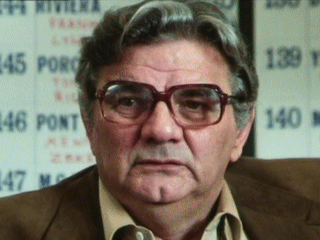
NOT ENTIRELY. What he said during lunch at Duke Zeibart’s on the Friday of Martin Luther King Day in 1988, was, essentially, three things. The first was, “If they over coaching, like everybody wants them to, there’s not going to be anything left for white people.” This one packed the most immediate impact. Snyder insisted afterward it was just a bad joke, and a compliment to blacks, too. They’ve taken over all of sport because of their drive and their desire. They want it so badlv they’ve pushed the whites right out. (Look, he said, if anyone should have been mad, it was whites. He said whites were lazy. No whites got angry at what Jimmy said.)
Then he said, “There’s 10 people on a basketball court. If you find two whites you’re lucky.” The last word was the killer. Otherwise, it’s no different from the famous tabloid basketball columnist saying, a few years ago, “The blackest thing about the Celtics is their sneakers” in reverse. But he never should have said “lucky.” He might have been using it In nothing but a careless sense. but can’t be careless with live ammunition. More than anything, this was the statement that was indefensible.
Finally, he said, “[Black superiority] goes all the way back to the Civil War, when during the slave trading the owners would breed his big black with his big woman so he could have a big black kid.”
This is the one that stuck.
At any rate, within hours, Musburger and Shaker had viewed the tapes and talked to the CBS brain trust, most of whom happened to be in Hawaii. Later than night CBS issues a statement saying it found his remarks to be “reprehensible.” No one actually said he was fired. But when Sunday showed up, he’d been deleted.
“You know, on Friday afternoon, our former colleague Jimmy the Greek, made some regrettable and offensive remarks for which he has apologized,” Musburger said the way he might have recited the Seahawks’ injury list. “Yesterday, CBS issued a statement disassociating itself from those remarks. It goes without saying that his comments do not in any way reflect the thinking or attitude of the rest of us here at CBS Sports. While we deplore the incident, we are saddened that our 12-year association with Jimmy had to end this way. And the “NFL Today” will continue from RFK Stadium in Washington in just a moment.”
And that was the sum total on CBS of discussion about the several issue The Greek had raised. Elsewhere, reaction was mixed, and Snyder had his defenders.
“Much of what he said seemed unexceptional to most whites and a good many blacks as well.” wrote Washington Post columnist Richard Cohen. “Blacks are more athletically gifted than whites. He spoke of racial differences. That is a taboo. Never mind that there are such things.”

“He’s right.” Jim Rice said a few weeks later, in the weight room off the Red Sox locker room at Fenway Park, during an interview for a Miami Herald series that had been prompted by The Greek’s firing. “It’s just a gift. Raw talent.” And a few days after that, at Yankee Stadium, Jesse Barfieid nodded: “Leaping, running—physiologically, we have an advantage.”
Recently, Synder’s former colleague, Jayne Kennedy-Overton, said, “If he was telling the truth, why blame Jimmy? Why not blame the people who made the history he spoke of?”

AFTER THE eighth race, he was up several thousand. He’d taken the 10 horse across the board for $400, and it won at 6-1. After the ninth, he was up another couple thousand with the two horse. He now had a bundle of hundred-dollar bills the size of Zeus’s fist in his right-hand pants pocket, all earned in a dizzying 90-minute span that left your mouth dry and your hands shaking just to he next to him. He has not mentioned the money on the drive back to Miami Beach.
“Brent panicked,” he says. “If he’d opened up his mouth that day for me. he could have saved my job. But he didn’t. Or if he did, it wasn’t to say anythin’ good. If only [Howardj Stringer had been there, he’d have looked at the tapes, and sat everyone down, and they coulda suspended me for that last game, and that would have been enough. But the big guys were in Hawaii, and Brent and Shaker were the only ones talkin’ to ’em. Nobody stood up for me. When you got the No. 1 producer and Brent against you nobody’s going to go against them. Who’s gonna say somethin’? Irv? The only guy who could have said somethin’ was Madden, but he was at a meeting of some sort and said it was all over by the time he got there: Summerall said somethin’ good in my behalf.
“Aw,” he says, “don’t let me start this.”
It’s absolutely huge, Jimmy’s car, as wide as a whole lane. It has a blue leather interior and the dashboard looks wooden, but it’s really only wood-pattern contact paper. On the glove compartment the pattern has all peeled away, leaving a bare metal panel. The inside of the passenger door is pocked with gray spots from the ash of his cigar, like a wall that’s been riddled with bullets.

Gliding the Cadillac to the hotel curb is like trying to dock a tugboat. It’s a car that has somehow survived beyond its age and now it is unwieldy and impractical. In these respects, it’s a lot like Jimmy. He has not gone into the new age gracefully. Watch him yelp at the pretty women—”Hey! Are you married?”—with that old man’s license to leer. He struts through his hotel, this outsized guy all in white and gold with his cane with the heavy steel knob as a handle, this purely exotic figure from some Graham Greene novel, part Sidney Greenstreet, talking too loudly, flashing that wad of hundreds. He doesn’t seem to realize that we’re in the mall age now, where the people we admire don’t come outsized any more They come in a garb of discreet homogeny. They come smooth. They come so they fit into a preconceived notion of special.
He’s not alone in this stumble into the late 20th century. Surely some of Rooney’s indiscretion can be chalked up to his inability—voluntary or otherwise—to evolve with the flow of time.
Most of us adapt. Some adapt by shedding ignorance. Others adapt by burying it. Only The Greek knows which camp he’s in. No one who’s ever spent any time at all with The Greek thinks he’s racist—”No black ever got mad at me,” he says. “The blacks all loved me”—but it doesn’t matter anymore.
Now he’s winking at the little girl in the scotch-plaid dress in the lobby. He is mugging. His face is all rubbery. She is fascinated. Her mother is leery. He loves kids. He’ll drop anything—anything—to wink a kid. How could he not? He lost two to cystic fibrosis, and he was never one himself, not after his mother was shot to death by his aunt’s estranged husband when Jimmy was 9. So he pats them and reaches out to them and laughs at them and mugs for them, and the kids love it, but the mothers wonder what in the hell this old guy is up to. And, of course, the mothers don’t know who The Greek is. The mothers only know who Bryant Gumbel and Willard Scott are.
“Without even saying goodbye. After 13 years. You think that’s fair? You think that’s fair?”
In the morning he’ll try to walk a mile on the beach, but it takes an hour. He’d rather linger over breakfast for a couple of hours until it’s time to go to the track, although these breakfasts can daunt an ego, because in the restaurant there are often several young families with children who won’t be all that amused by the man in the gold chains who frequently commandeers the telephone in the middle of the dining room and starts swearing at his stockbroker.
“I got some money in an Austrian money fund. and it was doing really good until this morning Gorbachev said somethin’ and it’s going straight down,” he says, returning to the table after one rant. “The market’s all I got. It’s the only excitement I have out of life. I win or lose 10 or 20 (thousand} a day. That’s all I got.”
He is spending a lot of time in Miami Beach. His wife, Joan, is in the house in North Carolina. “We don’t want to talk about that,” he says. Then he grows disgusted with himself: “Oh, listen, you take the good with the bad, what else you gonna do.”
Wilburn, the waiter, refills his cup. Wilburn is from Jamaica. Wilburn knows what Jimmy wants to eat before Jimmy can tell him. Jimmy regularly summons Wilburn by saying, “Get your black ass over here.” He loves to say things like, “I’m gonna get your black ass fired,” and Wilburn laughs.
Jimmy speaks like this loudly enough for the people in the restaurant to turn around and some of them smile. He does this because he wants the world to know that that is the Steubenville way he speaks, and that is the way he was speaking on Martin Luther King Day, casually, and not from prejudice. He will not allow the perception to endure. He simply will not. He Is adament.
That is the most important thing now. Not the firing. The firing, he concedes, was inevitable.

“It had gotten to the point where I kept fighting’ over the show with Shaker almost every Sunday by the end,” he days. “The last year they a;most cut me off completely. Shaker kept wantin’ to know what I was going to say beforehand. But I never knew. Which is what made it a great show. Tell him first? I’m sitting there with 100 things to say and I never knew what I was going to say. That’s what was so great about it. Everything was spontaneous.
“But I overcome that. I overcome so much. I overcome hittin’ Brent. I overcome a situation where I went to a racetrack and asked someone for figures and they were trying to grab the guy. Turned out he was a bookmaker. I overcome that. I went to Denver on a speaking engagement and said something about rednecks. Overcome that. I told Phyllis I hated her friggin’ husband, right on the air. Overcome that. I overcome everything. Then all of a sudden the thing I was paid to do I was fired for.”
Now there’s passion. The Greek has turned his chair to face his companion head on, and he’s squinting. Suddenly, it’s The Greek’s voice, all blustery and rough.
“Listen. I was the only person who never went with one camp or the other. l never cared about personalities. All I ever cared about was the good of the show. Ask anybody. I didn’t have grudges. I didn’t have vendettas. The show was everything to me. I thought this was supposedly going to be my life. “NFL Today” was … I mean I had a good PR firm, but little by little I gave everything up because of a show, then all of a sudden I woke up one day and I didn’t have it. All of a sudden I was the sonofabitch who said blacks were better athletes.”
Three men have dropped by the table. They have tans like they watched a nuclear test in person. They are on their way hack to the marina to sell more boats at the boat show, for $375,000 each.
“You got screwed, Greek,” says one, and the other two nod. After they leave, The Greek’s smiling.
“Next to survival, what’s the most important thing?” he says after they’ve gone. “Recognition.”
More important than health? Family?
Silence.
“Those are both part of survival,” he says.
Silence.
“I had a son and I lost him,” he says. Quietly. “So brilliant. He was a mathematic marvel. Professors from all over the United States—Michigan, Indiana—used to send him problems when he was a student at UNLV. He’d sit there for hours. Finally he’d look at me and say, ‘I got it Dad.” Once when a teacher went on vacation they let him teach the class. That’s how good he was. The teacher said, ‘The guy can spot me the deuce and still beat me at mathematics.'”
Silence.
“Oh, well”—these words like marbles dropping off the edge of a kitchen table.
Silence.
“He was somethin’. Tried so hard to live. He was 26. He was supposed to be dead at 2.”
Silence.
“Look,” Jimmy says. “I’ll survive. I’ll get a show. I’ll have a 900 number by the fall.”
Silence.
“Why’d they have to do it the way they did it? I begged them to not use reprehensible. It was just a word that wasn’t needed. “Take that word out,” I said. They wouldn’t. I said, “I can’t overcome that.”

Get lost.
[Photograph by Melvin Sokolsky]

Marvin Miller, one of the most important figures in 20th century American sports, has died. He was 95.
I had the opportunity to speak to Miller more than a dozen times when I was writing a book about Curt Flood and a few years later I visited his apartment to talk about the possibility of making a documentary about his life. He was gracious, bright, and funny.
I will compile all of the tributes to Miller later today or tomorrow so that you can get a full appreciation of the man and his lasting professional accomplishments.
Meanwhile, here is a Q&A I did with him talking about Flood for the Banter back in 2003.

Over at a cool site called Forty-Sixth at Grace, check out the “For the Love of Pie” series.
Picture by Nicole Franzen.

Painting by Jasper Johns via Just Another Masterpiece.

Here’s a Yankee site that you must check out, bookmark, and make part of your regular Yankee reading: 161st and River (not to be confused with the stellar River Ave. Blues–and speaking of RAB, they have word today that the Yankees have reportedly resigned Ichiro and are close to a deal with Andy Pettitte).
As for 161st and River, dig these recent posts: ALCS Programs; Whirled Serious Programs; SI Covers.