


Blog Archives
Clean Slate

George King on the improved fielding of Jesus Montero:
[David] Robertson’s eyes widened when asked about Montero, who went 0-for-3 and is 1-for-6 in two games.
“I first saw him when I signed here and it’s amazing how much better he has gotten,” Robertson said. “He sets up good, blocks balls in the dirt and stays down. He looks good.”
…“I like Montero, I think he is going to be a big-time player,” a scout said. “I know he is big (6-foot-4, 225 pounds), but he will be fine. All he has to do is just keep on catching.”
Switch My Pitch Up…
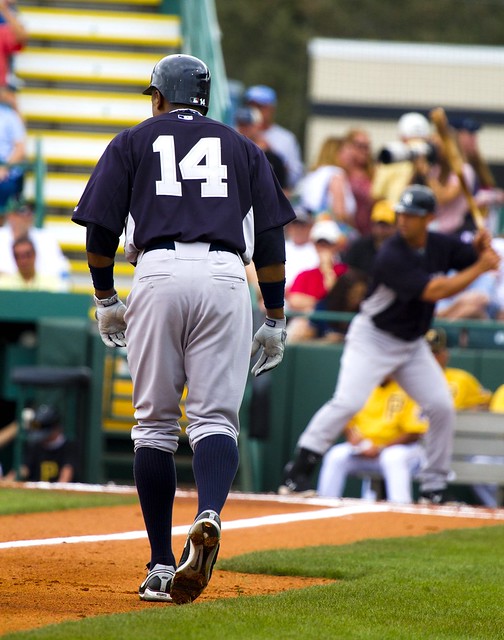
The Yanks played an exhibition game agaisnt the Pirates this afternoon. Chad Jennings has the tips; Michael Baron’s got the flix.
Afternoon Art
“Woman with a Pearl Necklace,” By Mary Cassatt (1879)

Million Dollar Movie

Hey, you movie lovers, do yourself a favor and head on over to Self-Styled Siren and peep For the Love of Film (Noir) Blogathon.


Tender is the Night

The good folks at Gangrey have reprinted Michael Paterniti’s loving 1999 Esquire piece on Thurman Munson:
[Ron Guidry] remembers his first start as a Yankee. He came in from the bullpen, nervous and wired, and Thurman Munson walked up to him and said: Trust me. That’s it. Trust me. Then walked away. As Guidry remembers it, everything after that was easy. Like playing catch with Thurman Munson. Thurman calls a fastball on the outside corner. Okay, fastball outside corner. He calls a slider. Okay, slider. Eighteen strikeouts a game. A 25-3 record. The World Series. Just trusting Thurman Munson. Can’t even remember the opposing teams, Guidry says, just remember looking for Thurman’s mitt. Remembers that very first start: Thurman Munson came galumphing out to the mound, told him to throw a fastball right down the middle of the plate. Okay, no problem.
But I’m gonna tell the guy you’re throwing a fastball right down the middle, says Thurman Munson.
Guidry says, Now, Thurman, why’n the hell would you do that?
Trust me, says Thurman Munson. Harumphs back to the plate. Guidry can see him chatting to the batter, telling him the pitch, then he calls for a fastball right down the middle of the plate. Damn crazy fool. Guidry throws the fastball anyway, batter misses. Next pitch, Thurman Munson is talking to the batter again, calls a fastball on the outside corner, Guidry throws, batter swings and misses. Talking to batter again, calls a slider, misses again. Strikeout. Thurman Munson telling most every batter just what Gator is going to throw and Gator throwing it right by them. After a while Thurman Munson doesn’t say anything to the batters, and Gator, he’s free and clear. Believes in himself. Which was the point, wasn’t it?
[Picture by Larry Roibal]

Oooo La La

Riding on the Metro…Picture taken outside of Brussels by my uncle with his iPhone.
Million Dollar Movie

I was taken with Mark Ruffalo’s performance in “The Kids Are All Right” last year and friends said, “If you think he was good in that, you have got to see ‘You Can Count on Me.'” I finally got around to watching “You Can Count on Me” over the weekend and they were right. Laura Linney and Ruffalo are both wonderful and give the kind of performances that are so believable you forget they are acting.

The movie, released in 2000, was written and directed by Kenneth Lonergan. It is tender without being sentimental. Lonergan shows the kind of restraint that I cherish–he never hits us over the head, never goes for the obvious, over-the-top emotion. He lets uncomfortable feelings hang and is confident enough to leave matters unresolved. It is so expertly directed that watching it, I was reminded that great directing is not just about technical wizardry, it is about serving the story, understanding pace and rhythm, and respecting the audience enough to fill in the blanks. This movie proves that you can be modest without being precious. I’d like to watch it again soon.
Afternoon Art

de Kooning detail…
Man on Spikes

Eliot Asinof is most famous for writing “Eight Men Out.” (He is less famous for once being married to Marlon Brando’s sister.) Asinof played minor league ball in the Phillies system for three years before World War II. His first book, a novel about a minor league lifer, “Man on Spikes” was published in 1955 and to my mind is one of the best baseball novels. It is a hard, gripping portrait of baseball under the reserve system (none other than Marvin Miller wrote the foreword for the most recent edition of the book). The prose is plain and clear, the details are vivid and Asinof displayed considerable skill as a dramatist.

If you’ve never read it, pick up a copy when you can. It’s well worth it. Here is an excerpt, from a chapter about an old ballplayer named Herman Cruller:
And now, before the umpire hollered “Play ball!” for the last time that season, Herman felt deflated. He could not look forward to the tension and excitement of the game. The crowd was there, sweltering even in the shade of the stands behind him, pressing the players with their boisterous presence. Even the bleachers, where the Negroes sat blistering under the naked sun, were full and demanding. They were all there, defying the heat, for this was “the big one,” the game that decided and ended a season of games.
Herman looked up into the stands and watched people fanning themselves with their programs, their throats already parched from rasping calls but soon to be lubricated by long draughts of cold beer. For years he had listened to their routine, opinionated braying during the practice hours, the little pieces of stupidity from the big blaring voices. Sullenly, he watched them hollering their pre-game nonsense: “Lefty Moss stinks. He couldn’t even strike out my Aunt Mabel, and she’s ninety-one!” “I’ll bet ya a ten-spot he goes the route, horseface; I’ll bet ya another ten-spot he wins it too!” “Aah, hell. Gowann.” Thinking with their brains in their asses like a bunch of children betting their hard-earned money as if they knew what they were talking about. For all the years he had played professional baseball, for as far back as he could remember, he hated the loud ones in the crowds who had watched him those thousands of innings. He hated them for their fickleness, their blaring derision, their hooting and squawking, the sadistic way they kicked at the guy who was down. He hated the phony effort at what they called sportsmanship, the brief moment of applause that supposedly justified the hours of razzing they had really come to revel in. It was as if the ballplayers were not playing a game they could watch and enjoy, but were caricatures representing objects of love and hate, were either heroes or villains. And if they had love for a player, still they were quick to jeer at him when he booted one or fanned with a crucial run on base. They seldom considered the player a human being, capable of error as well as competence. Their money was their admission to the arena, and it gave them rights unlimited. For half a buck they could scream and jeer and sound off with their cruddy opinions as if they were speaking gospel. When they felt like it, they unleashed their venom against a ballplayer who displeased them until their scorn itself was part of their picture of him. He was a bum in their eyes, and he had to battle against them with as great a power as he did against the legitimate opposition on the field. When the crowd was down on a kid, the odds were you could count him out, for he was hitting with a pair of strikes against him and the rattling of catcalls in his ears.
He had seen the whims of a crowd make a goat out of more than one good ballplayer and then ride him right out of the league.
But it was the crowd who paid him for his stinking forty bucks a week, fair weather and foul. If he forgot, the management was right there to remind him. Baseball was a big game, and all kinds of people came to watch it for all kinds of reasons. He was paid to play for them all.
But the afternoon was hot and he was tired, and the game was a chore. It wasn’t in him to please this crowd.
You’re bitter, Herm, he told himself finally. You’re bitter and beat by the heat. You’re old and tired and near the end of the stinking line in this game, and you’re taking it out on a bunch of people no different from yourself. Give yourself another year or two and you’ll be paying your dough to sit up there and guzzle beer with the rest of them.
[Photo Credit: Old Film]
A History of Violence

Check out this review of a tough but compelling-sounding memoir:
One Saturday night in the mid-’70s, I stood on the deck of a shabby duplex watching my teenage boyfriend — a character who could have walked out of the pages of Andre Dubus III’s powerful new memoir, “Townie” — beat another boy senseless in the parking lot below. Under the yellowish dusk-to-dawn lights, I could see my boyfriend’s blond sideburns, denim jacket and dingo boots, and I could see him punch the boy in the stomach until he crumpled to the ground, then kick him over and over until his nose and lips were split and bleeding. In “Townie,” which details Dubus’s 1970s coming-of-age in the poor mill towns of Massachusetts, there are none of the usual signifiers of today’s ’70s Nostalgia Industrial Complex, no peace-sign key chains or smiley-face T-shirts, none of the goofy stoners and ditsy girls in tube tops that American television viewers have become accustomed to on “That ’70s Show.” Instead, Dubus writes about “the apartments” where his older sister buys drugs, two rows of three-story buildings surrounded by packed dirt worn smooth, a Dumpster in back always filled with dirty diapers, used condoms and pizza boxes. He writes about an early manifestation of “Fight Club” culture at his school, where, whenever there is a fight, boys and girls rush to one spot “like they were being pulled there by the air itself. . . . Kids were yelling: ‘Kill him! Kill him!’ ”
It was his parents’ divorce that left Dubus fatherless and living in a world of violence and poverty. Dubus’s father (and namesake) was a well-known writer, famous among other things for his short story “The Winter Father,” about a man recently separated from his family. The most vivid image in the story is of the protagonist watching through his rearview mirror as his young son chases after him: “A small running shape in the dark, charging the car, picking up something and throwing it, missing, crying You bum You bum You bum.”
Click here for an excerpt from “Townie,” by Andre Dubus III.
[Photo Credit: Alan Guido]
…Your New York Knicks
…Who beat the Heat last night as the Oscars ceremonies dragged on.

Meanwhile, good stuff from Florida. Here’s Ben Shpigel, John Harper and George King (times two).
And the Winner Is…

My ma is in town visiting, so I made a minestrone soup and we’re going to cool out and watch the cheesefest.
Moment of Silence

Rest in Peace, Duke Snider.
Nice n Easy
Yanks and Phils are on YES again this afternoon.


--Earl Weaver