"A New York Treasure" --Village Voice

Blog Archives

Older posts            Newer posts

Trudy, A Message to You

 trudy2

Glenn Stout, a longtime favorite here at Bronx Banter, is most famous around these parts for his historical writing, particularly Yankee Century and Red Sox Century. Stout also serves as the series editor for The Best American Sports Writing; his oral history Nine Months at Ground Zero is one of the most fascinating and devastating things I’ve ever read about 9.11.

Stout has a website as well as a blog, and his latest book, Young Woman and the Sea: How Trudy Ederle Conquered the English Channel and Inspired the World,  may be the most interesting project of his career. It is the story of Trudy Ederle, the first woman to swim the English Channel (read an excerpt here).

I had the chance to talk to Stout about the book. Here is our conversation. Enjoy.

scan0002
Bronx Banter: I know you are comfortable writing about history, especially in the first part of the 20th century.  What drew you to Ederle?

Glenn Stout: Her story is seminal, as central to the story of American sports in this century as that of Red Grange, Babe Ruth, Jack Johnson or Jackie Robinson, yet to most people Trudy, aka Gertrude Ederle, is unknown.  I wanted to change that. In many ways she was both the first modern female athlete and one of America’s first celebrities.  Had she not done what she had done, which is not only to become the first woman to swim the English Channel, but in the process to beat the existing men’s record by nearly two hours, the entire history of women’s sports would be radically different.  You can, I think, break down the history of women’s sports in this country into “Before Trudy” and “After Trudy.”   Before Trudy female athletes were anomalies, and their accomplishments, with just a few exceptions, primarily took place out of the public eye.  Many early female athletes, like Eleanora Sears, and Annette Kellerman, were sometimes seen as publicity hounds who performed stunts, and not serious athletes.  The question of whether or not women were either psychologically or physically capable of being athletes was still a topic of debate – at least by the men who ran sports.  Although there would still be some who would stubbornly cling to that belief, by swimming the English Channel and shattering the existing men’s record, Trudy answered that question quite definitively.

She was the answer.  One can argue that had it not been for her women would not have been allowed to compete in track and field and many other sports as early as they did – women competed in track events for the first time at the Olympics in 1928.  It may have been another generation – until after World War II – before there was any acceptance of female athletes.  I am old enough to remember when women could not play little league, or run marathons, and when school sports were pretty much limited to gymnastics and basketball.  Now of course, women can and do play everything.  Without Trudy that happens much later than it did.

Trudy also has a compelling personal story that I think resonates with any reader.  She grew up in New York, the daughter of German immigrants and overcame anti-German prejudice in the wake of World War I to become arguably the most famous woman in the world.  At the same time, she was partially deaf, and was able to overcome that challenge.  Swimming the English Channel, while perceived to be somewhat commonplace today, is still extremely difficult – it was the first “extreme” sport.  More people have climbed Mount Everest than have swum the Channel, and most of those who try to swim the Channel fail.  In most years more people will succeed in climbing Everest than in swimming the Channel.   When I first began to research the book, that really, really surprised me, and made Trudy’s story even more compelling.

 ederledoll

BB: Why isn’t Ederle remembered like Grange, Thorpe, Ruth and the other greats of the first great era of sports? For someone who had such a profound impact, why has her legacy faded?

GS:  Hopefully, my book will help rectify that, but there are several reasons.  Trudy herself soon discovered she just wasn’t cut out for the spotlight.  Within 48 hours of her return to the United States, where New York gave her an enormous ticker tape parade, she was in the fetal position in her bedroom, completely overwhelmed.  She was both slow and reluctant to “cash in” on her achievement.  Her attorney mis-managed her career, turning down easy money for a grueling vaudeville tour.  By the time that got going a male swimmer had broken her record, and a second female swam the Channel, which stole some of her thunder – the public began to think that swimming the Channel was far easier than it is, something that holds true today.  She also had increasing trouble with her hearing – she was partially deaf since a bout with the measles as a child, and that made her less comfortable in the public eye.  And few years after the swim she fell and was virtually bed-ridden for a time. And let’s face it, swimming simply isn’t a big spectator sport like football or baseball.

BB:  What is Ederle’s reputation in the world of women’s swimming? Is she properly recognized?

GS: Swimming historians certainly recognize her as one of the all-time greats, but in a sport like swimming, records have been broken so many times that it is difficult for any swimmer from her era to remain in the public eye.  Her only contemporary recognized b y the public today is Johnny Weissmuller, and that’s because of the Tarzan films.  But in the world of swimming, she has to rank as one of the top seven or eight swimmers of all-time.  No one else combined her success at shorter distances with open water success, and in the world of open water swimming, I think she’s right at the top.  Anyone who has ever swum the Channel, or thought about it, knows about her.

BB:  How did Ederle manage to beat the existing time of swimming the channel by such a great margin? That seems almost inconceivable.

GS:  There are a couple of reasons.  For one, she used a stroke known then as the “American Crawl” essentially what most people recognize as the “freestyle” today.  Her coach with the Women’s Swimming Association was one of the strokes pioneers and its greatest advocate. And although it had been used for about two decades, no one believed it could be used for long distance swimming – it was thought to be too demanding, physically.  Long distance swimmers usually used the breast stroke at the time, with occasional use of the side-stroke and trudgeon.  The crawl was much faster, and Handley recognized that women in general, and Trudy in particular, although not as strong as a man, had just as much stamina.  She was the first swimmer to use the stroke in the Channel, and proved the superiority of the stroke.  Secondly, her trainer for the Channel swim, William Burgess, was a real student of the Channel currents and tides, and he found a somewhat new route across that was something of a breakthrough.  Also, before Trudy most of the people who tried to swim the Channel simply were not great swimmers.  They had great stamina, and desire, but as swimmers were rather pedestrian.  Trudy was world class at every distance from fifty yards on up.  She was simply a far, far, far better swimmer than anyone else who had swam the Channel before.  For a swimmer of her ability to take on the Channel would be the equivalent of Michael Phelps to do so today – if he had her stamina.  And lastly, while Trudy was growing up she spent summers in Highlands, New Jersey, where she spent hours and hours swimming in the ocean.  She developed a very special relationship with the water, once saying “To me, the sea is like a person – like a child that I’ve known a long time. It sounds crazy, I know, but when I swim in the sea I talk to it. I never feel alone when I’m out there.”  When she was swimming, she was in her place, right where she wanted to be, and where others found only torture, she found joy, and when you love what you do, well, there are no limits.


 trudy

(more…)

Star Light, Star Bright

Mess around I hit you so hard, you feel it in your arch.

arch

I say the National Leaguers take the game tonight.

Nu, whadda you think?

As We Stand Here Waiting, For the Ball Game to Start

July, the All-Star Game, St. Louie–man, I’m feelin’ patriotic. Very patriotic.

So much that I just had to share this classic routine from our old pal Albert Brooks:

Now I’m in the Limelight

…cause I rhyme tight.

Thurman

MUNSON

Just a note letting you know that Marty Appel, a maven of all things Yankees in the Seventies, will be discussing his new book, Munson: The Life and Death of a Yankee Captain at the Yogi Berra Museum & Learning Center on Sunday, Aug. 2 – the exact 30th anniversary of Munson’s tragic death. Appel’s talk will begin at 3 p.m., and books are available at the Museum for him to sign afterward.

Call (973) 655-2378 for info and reservations. This should be a good one.

Dinger Derby

homerunderby

Will you watch? Listening to Chris Berman for a couple of hours is too much for me to stomach. But I can always watch with the sound off. Cool that Mr. Pujols is participating this year.

Feel the Funk, Baby

The Jackson’s getting down doin’ Isaac Hayes’ version of “Walk On By”:

I the Jury

umps

Ran across this from Bruce Weber in the Times yesterday:

It was in September 2005, just as I was starting research for a book about umpires, that the man who would become chief justice, John G. Roberts Jr., elevated my subjects to the central metaphorical role in American jurisprudence.

“Judges are like umpires,” Judge Roberts declared in the opening remarks to his own confirmation hearings. “Umpires don’t make the rules; they apply them. The role of an umpire and a judge is critical. They make sure everybody plays by the rules. But it is a limited role.”

Whadda ya think? Judges=Umps?

Oh, and if you haven’t read Weber’s book, it’s worth checking out. Here is an excerpt.

To Cry and Die in L.A.

l.a.

Remember the old gag from the Warner Bros cartoons when a plane or a car was racing at incredible speed and the speedometer read “Silly, Ain’t it?” That pretty much sums up another lost weekend for the Yankees in the City of Angels. The Yanks just can’t beat the Angels in California and on Sunday afternoon they found a new way to lose. The Angels survived some shoddy fielding and had lady luck on their side once again. John Lackey out-pitched CC Sabathia as the Angels held off several late rallies by New York to win 5-4.

Sabathia wasn’t horrible but he was tagged for four runs in the fourth inning putting the Yanks in a 4-1 hole. Cut to the seventh. The Yanks scored a run and loaded the bases against Lackey with nobody out.  But Lackey showed chutzpah and struck out Mark Teixeira on a full count curve ball. The pitch would have been a strike regardless–Teixeira whiffed–and it was the third slow curve of the at-bat. Then Alex Rodriguez turned over a pitch and hit a grounder to third. Chone Figgins made a slick pick fielding a tough hop, touched third and then fired a ball in the dirt to first. But Kendry Morales–who had made an error earlier in the inning–picked the ball clean and the Angels were out of trouble.

After the Angels scored another run against Sabathia, the Yanks loaded the bases with nobody out in the eighth too. They scored a run and then Jorge Posada–who entered the game late as a pinch-hitter–hit a sacrifice fly scoring another, pushing the score to 5-4.  Nick Swisher pinch-hit for Brett Gardner and smoked a line drive back through the box. Reliever Darren Oliver stuck his glove out and made the Look-What-I-Found catch. Then he turned and picked Melky Cabrera off first for the double play.

And that’s how it goes for the Yanks in L.A.

lichtenstein_crying_girl

Rodriguez struck out to end the game in the ninth. He had a great hack at the second pitch–a fastball–but missed it, fouling the ball back. He whiffed on another fastball.

So the Yanks end the first half on a down note. They have played well. They have been fun to root for but they go into the break with a bad and all-too familiar taste in their mouths. The Yanks are now three games behind the Red Sox who won again against the Royals.

Well, that’s okay. Whadda ya gunna do? Gives ’em something to remember. We’ll see if they’ve got it in ’em to do something about it.

Stop

 light

The Yanks have played well in the first half but have still not found a way to conquer their two rivals the Red Sox and the Angels. That is something they’ll need to fix in the second half, ain’t it?

In the meantime, the Bombers turn to their big ticket, CC Sabathia, to remedy the weekend blues in Cali.

Let’s see what he’s got…and let’s go Yan-Kees!

Smokin

That’s it. Just listen.

Zah

za1

I know we’ve covered pizza plenty here of late but I couldn’t let this pass without sharing…the Times ran a great feature on NYC pizza this week.

Dig it, dogs.

At Close Range

How to quantify fielding? That is the question. Statistics are often revealing when discussing hitting but fielding is harder to pin down. For instance, how can you accurately determine a fielder’s range when players are often positioned by their coaches? Well, in today’s New York Times, Alan Schwarz takes a look at the future of fielding metrics:

A new camera and software system in its final testing phases will record the exact speed and location of the ball and every player on the field, allowing the most digitized of sports to be overrun anew by hundreds of innovative statistics that will rate players more accurately, almost certainly affect their compensation and perhaps alter how the game itself is played.

Which shortstops reach the hard-hit grounders up the middle? Which base runners take the fastest path from first base to third? Which right fielders charge the ball quickest and then throw the ball hardest and most accurately? Although the game will continue to answer to forces like wind, glaring sun and the occasional gnat swarm, a good deal of time-honored guesswork will give way to more definite measurements — continuing the trend of baseball front offices trading some traditional game-watching scouts for video and statistical analysts.

You Treat Me Like a Burnt Piece of Bacon

AJ Burnett looks to stay burning hot tonight against the Twins.

burn

Here’s hoping he has another good outing.

Let’s Go Yan-Kees!

TB’s Got BO

Or something like that…

Dooke of Earl

earl2

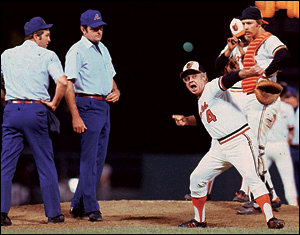
Tom Verducci has a nice long profile of Earl Weaver in the current edition of SI:

As we are watching this 21st-century game in Fort Lauderdale, I ask Weaver if he has ever heard of moneyball.

“Moneyball?” he says, bewildered. “No.”

I tell him it’s shorthand for how Oakland gained a competitive edge by understanding, among many other things, the value of on-base percentage. “Ohhhhh, wait … a … minute!” Weaver bellows. “That was my favorite right there, on-base percentage! Don Buford wasn’t getting to play under Hank Bauer [Weaver’s predecessor]. He’d get in a ball game every now and then and feel like he had to get three or four hits. I told Buford, ‘I’m willing to play you as long as you have a .400 on-base percentage.’ All of a sudden he becomes a regular, and he’s walking a hundred times and hitting right around .300.” Buford had played 669 career games before Weaver was named Orioles manager on July 11, 1968. His OBP was .335. He played 617 games over the rest of his career, all for Weaver. His OBP under Weaver was .388.

Before Moneyball, before Beane, before Bill James—but not quite before Copernicus—Weaver, a white-haired gnome who never played a day of major league baseball, knew what worked. The most recent generation of general managers, armed with their computer printouts and Ivy League–educated assistants, all channel something from the Earl of Baltimore.

“I’ll tell you one thing he did that we all learned from,” Red Sox general manager Theo Epstein says. “He would develop arms on the big league level by bringing up a young pitcher and putting him in the bullpen, mostly out of long relief. Once he got some experience he could move into the rotation. The Twins did it with [Johan] Santana to perfection.”

Off the Wall

And Now For Something Completely Different…

In case you’ve missed Ron Artest’s tribute to Michael Jackson, well, you just shouldn’t miss it. Bless him, Ron Ron’s heart is in the right place, but this clip ranks up there with Jesus is My Friend as the 3,653rd reason why You Tube is too good to be true.

An Empty Feeling

The first person that came to mind when I heard that Steve McNair was dead was his wife. And not just because he was found in a car with his mistress. It was because of an old episode of HBO Real Sports I recall watching. McNair’s wife talked about the anxiety she had watching her husband play hurt repeatedly over the years. She came across as loving and sympathetic.

Now this.

Yesterday in the Wall Street Journal, Allen Barra had a nice, brief appreciation of McNair:

One of my mentors, Jerry Izenberg, who recently retired after more than half a century of sportswriting for the Newark Star-Ledger, offered me a nugget of wisdom: “If you’re in this business long enough,” he said, “you learn that if you’re a sportswriter — a serious, dedicated full-time newspaperman — then you don’t have a job. What you’ve got is a mistress.

“And mistresses make demands. You’ll pay for her one way or another. I paid her price in tons of coffee gulped on the run from plastic cups and in holidays spent away from my family while I was on the road. Mostly, though, I paid her price in loss of innocence through exposure to the evil side of sports in America.”

…There are some, for instance columnist Jay Mariotti of Fanhouse.com, to whom the circumstances of McNair’s death provide “a lesson to all of us about the differences between a façade and reality.” But McNair’s career was a reality, not a facade, and so were the hundreds of hours of commitment he gave to community service. The hours he and his wife spent loading food, water and clothes onto trucks for Hurricane Katrina victims (McNair himself arranged for the tractor trailers) and the three children’s football camps he personally paid for this year weren’t façades.

His death was a shock, and the manner of it cost me innocence I didn’t know I still had. But it didn’t take more from me than Steve McNair’s life and career gave back.

The Boom Squad

CC Sabathia allowed a run on three hits over seven innings last night and had more than plenty of run support as the Yanks pounded the Twins 10-2. Carlos Gomez robbed Alex Rodriguez of a grand slam and the game still wasn’t even close.

APTOPIX Yankees Twins Baseball

Photo by Jim Mone/AP courtesy of ESPN.com.

Every starter in the Yankee line-up got a hit. Mark Teixeira, who has been struggling offensively, had four, Brett Gardner had three, and Robbie Cano and Frankie Cervelli each had a couple. With Jose Molina set to come off a rehab assignment, Cervelli will return to Triple A.  But he sure has been fun to watch, eh?

Oh, and Alfredo Aceves will take Chien-Ming Wang’s turn and start tomorrow afternoon.

Our Lady of Perpetual Agony

man

While much of the country is glued to their computer screens and TV sets watching the Michael Jackson memorial in what already seems to be an endless mourning (cashing in) period, here is the irrespressible Charles Pierce on the return of Manny Ramirez:

I thought the hype ladled onto Manny’s return was excessive, even by ESPN’s elephantine standards for excess. (I mean, honestly, breaking into ESPNews for every minor league at-bat? What if there had been a sudden fantasy-baseball emergency somewhere?) That’s Bonds treatment. Or A-Rod. I always thought Manny Ramirez was a notch below them as a subject for hyperpituitary voyeurism. However, it was of a piece with Manny’s greatest gift as a professional athlete—his innate ability to make everything about baseball that is self-reverentially loathsome look ridiculous. In the great, hushed temple that baseball is perennially building for itself in its own mind, it’s Manny’s who provides the dribble glasses, the whoopee cushions, and the exploding cigars. It is his holy mission to take the living piss out of the self-important, the moralistic, and the people who cling to baseball in order to defend their inherent right to be 13 years old for the rest of their lives.

…At his best—not as a hitter but as a public person—Manny Ramirez always has been most valuable in his ability to be a walking (if an occasionally completely unwitting) satire on baseball’s pretensions, which sorely need to be mocked on a very regular basis. He worked to fashion himself into one of the most feared hitters in the game. By any reasonable standard, he has “respected his talent” a hell of a lot more than did, say, Mickey Mantle, who left too many of his best days on a barstool in Manhattan. Without ever being completely aware of it, he spoofed the whole notion of baseball “professionalism,” which should have been left a bleached pile of bones by the side of the road back in 1970, when Jim Bouton published Ball Four. He was more than a flake. Flakes—like Bill Lee or Moe Drabowsky—generally are aware that they’re flakes. They glory in it. Manny is something sui generis—as natural and instinctive an eccentric as he is a hitter.

Older posts            Newer posts
feed Share on Facebook Share on Twitter Share via email
"This ain't football. We do this every day."
--Earl Weaver