
This Sunday gives a reason to troop out to Williamsburg as Classic Album Sundays makes it’s US debut.

[Featured Image via Lucid and Mysterious]



This Sunday gives a reason to troop out to Williamsburg as Classic Album Sundays makes it’s US debut.
[Featured Image via Lucid and Mysterious]

Can I take your order?

Gimme a couple slices to go.

From the wonderful site, Letters of Note, here is a letter that Hellen Keller wrote in January, 1932. After a visit to the Empire State Building she described what she saw and heard:
Frankly, I was so entranced “seeing” that I did not think about the sight. If there was a subconscious thought of it, it was in the nature of gratitude to God for having given the blind seeing minds. As I now recall the view I had from the Empire Tower, I am convinced that, until we have looked into darkness, we cannot know what a divine thing vision is.
…What did I “see and hear” from the Empire Tower? As I stood there ‘twixt earth and sky, I saw a romantic structure wrought by human brains and hands that is to the burning eye of the sun a rival luminary. I saw it stand erect and serene in the midst of storm and the tumult of elemental commotion. I heard the hammer of Thor ring when the shaft began to rise upward. I saw the unconquerable steel, the flash of testing flames, the sword-like rivets. I heard the steam drills in pandemonium. I saw countless skilled workers welding together that mighty symmetry. I looked upon the marvel of frail, yet indomitable hands that lifted the tower to its dominating height.
Let cynics and supersensitive souls say what they will about American materialism and machine civilization. Beneath the surface are poetry, mysticism and inspiration that the Empire Building somehow symbolizes. In that giant shaft I see a groping toward beauty and spiritual vision. I am one of those who see and yet believe.

Thanks to Diane for passing along this fun tennis ball sculpture by Ana Soler. Via HUH magazine.
Over at Jazz Wax, Marc Myers has two-part interview with Scott Faragher, author of “The Hammond Organ.”
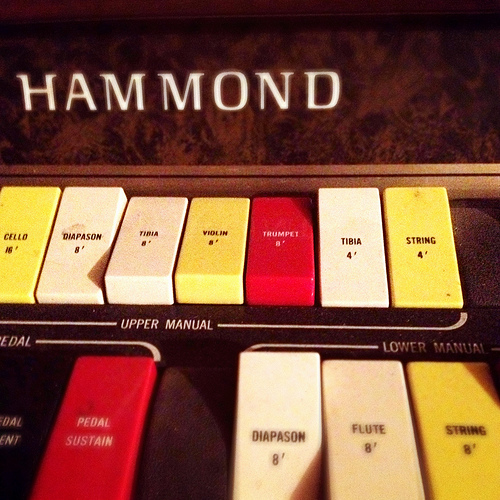
Here’s Part One and Part Two. Don’t sleep.


Like what?

I support this product.

I saw a wonderful documentary over the weekend.
Here’s Buck on Letterman:
Manohla Dargis reviewed the movie last summer in the Times:
Working with the cinematographers Guy Mossman and Luke Geissbühler, and shooting in digital that I often wished were film (the big-sky landscapes deserve a more nuanced texture), she tags after Mr. Brannaman, well, kind of as his trained horses do. That isn’t a bad thing. He and all the pretty horses make for mesmerizing viewing, especially when he’s quieting colts (he calls them babies) and their often more jittery handlers. “A lot of times,” he says in the voice-over that opens the movie, “rather than helping people with horse problems, I’m helping horses with people problems.”
Sometimes they’re the same thing, as a violent interlude with a weepy woman and her seemingly crazed stallion proves. This part of the movie works like a punch to the gut, but, given how close it edges into hagiography, it’s also necessary as a reminder of what’s really at stake. “Buck” is an imperfect documentary. It leaves nagging questions unanswered, including the fate of Mr. Brannaman’s brother, and the movie’s beauty shots at times threaten to embalm nature instead of exalting it. Yet in some sense it was beauty that saved Mr. Brannaman, that of his conscience and that of horses, which, having been tied to humans long ago, became companions, workers and for some, as this lovely movie shows, saviors.
Zorianna Kit’s Q&A with Buck answers some of those nagging questions.
Oh, and Johnny France plays a small but critical role in Buck’s life. Go figure.
[Photo Credit: Flicke Flu]

I never got into Yoo Hoo and as a kid that was upsetting to me because the name was so appealing.
[Photo Credit: LMF RNF]

From the Chicago-Sun Times (via Ego Trip):
Here’s more from David Hoekstra.
[Photo Credit: Brian Jackson]

“Still Life with Lemons, Oranges, and a Rose,” by Francisco de Zurbaran (1633)

Detail…

You can see this gorgeous painting–reproductions don’t do it justice–at the Frick.

[Photograph by Reka Nyari]

Gangsta Gangsta