

Thursday
February 12, 2026
Since 2002


Category: Restaurants
Taster’s Cherce

Dig this New York Magazine profile on April Bloomfield, the chef behind The Spotted Pig and The Breslin:
Bloomfield had planned to be a policewoman in Birmingham, England, until she didn’t get her application in on time. Thanks to that bit of tardiness, she instead decided to follow her two sisters into cooking, working her way up the line in restaurants around London. She worked for Ruth Rogers and the late Rose Gray at London’s River Café and later spent a summer with Alice Waters at Berkeley’s Chez Panisse. But when fellow Brit and River Café alumnus Jamie Oliver recommended her to Friedman, she was still a relative unknown. Her debut at the Spotted Pig drew a lot of attention—not just because of the involvement of Batali and several high-profile investors (Bono and Jay-Z), but because Bloomfield was running a new kind of restaurant that brought together several foodie threads: serious snout-to-tail cooking with a religious adherence to fresh/local/seasonal ingredients, served in a casual atmosphere with a tone of clubby downtown cool. As Anthony Bourdain puts it: “She pretty much wrote the all-time book on how to come from someplace else and make New York love you.”
Bloomfield’s cookbook, A Girl and Her Pig, comes out in 2012, but beyond that and a few odd interviews and TV appearances, she keeps her head in her pots. She’s in the kitchen at the Pig on some nights, the Breslin on most others, and getting the new John Dory Oyster Bar (also in the Ace) ready for opening in early November. She also maintains a food-exchange program with father of head-to-tail eating Fergus Anderson of St. John—they switch spots on occasion to keep up with each other’s shore.
“She’s never worked the room, she’s never played the game,” says Bourdain, “and yet everybody knows who she is—she’s one of the only high-profile chefs who’s almost never on TV, she rarely gives interviews, and every time I walk into the Breslin or the Spotted Pig, I look back there and she’s standing behind the line, actually cooking.”
I haven’t been to The Breslin yet. Sounds like a treat, though.
Taster’s Cherce
I’ve never been to a four-star restaurant. Might be fun to try one day if I ever win the lottery.

In the Times, Sam Sifton gives Del Posto, the coveted four-star rating:
GREAT restaurants may start out that way. But an extraordinary restaurant generally develops only over time, the product of prolonged artistic risk and managerial attention. An extraordinary restaurant uses the threat of failure first as a spur to improvement, then as a vision of unimaginable calamity. An extraordinary restaurant can transcend the identity of its owners or chef or concept.
And of course an extraordinary restaurant serves food that leads to gasps and laughter, to serious discussion and demands for more of that, please, now. The point of fine dining is intense pleasure. For the customer, at any rate, an extraordinary restaurant should never be work.
Slice of Life
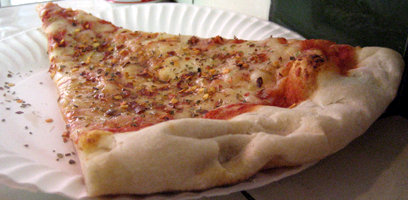
It is always the same, the sudden, stomach-dropping, jolt. Walking along a city block, looking up at a familiar store front or restaurant, a Closed sign hanging in the door way, or a vacant window. Something has happened. Change has come, like it or not.
I gasped last night as I walked past Sal and Carmine’s pizza shop on Broadway between 101st and 102nd (They make a salty but delicious slice.) The grate was up and a red rose was taped against the metal. Above it was a small xeroxed obiturary from a New Jersey paper.
Sal died late last week. I’ve been eating their pizza since I was a kid. Sal and Carmine. Two short, taciturn men in their seventies, though they look older. I never knew who was Sal and who was Carmine, just that one was slightly less cranky than the other. These are the kind of men that don’t retire but are retired.
The funeral was yesterday; the shop re-opens today.

As I read the obituary, people stopped and registered the news. They congregated for a few moments, some took pictures with their cell phones, and then slowly walked away, the neighbhorhood taking in the loss.


"This ain't football. We do this every day."
--Earl Weaver
--Earl Weaver