"A New York Treasure" --Village Voice
Category: Bronx Banter

Grumble, Grumble, Grumble

Well, my streak of fury-less baseball watching is over as the Yankees lost to the Indians 4-3 on Saturday afternoon. It started off poorly and got worse. Em and I listened to the first few innings on our way back from my mom’s house, where we made traditional Belgian waffle cookies this afternoon. It was late in the day and I was crashing from all the sugar. Add John Sterling, a dash of S. Waldman, and well, it was not a good combination. Especially–or “ekspecially,” as Paul O’Neill likes to say, with Ian Kennedy nowhere near the strike zone in the early going.

We got home in time to watch the majority of the game with more friends, Buck and McCarver, who made sure to keep us updated on the baseball game inbetween talking about the NFL draft. To be hoenst, it was a frustrating day for both sides, a game that moved in fits-and-starts, with failed rallies, hard-hit balls turned into outs, lucky double plays, failed bunt attempts (that means you, Melky), and a horrid missed call at second base. The Yankees had no business winning the game and yet they had their chances. They had 12 hits. Alex Rodriguez had a spirited 11-pitch at bat with runners on in the seventh, and just missed three pitches in the sequence, fouling them off, before going down on strikes. Later, with the game tied in the top of the ninth, Mariano Rivera warming in the bullpen, and runners on the corners, Derek Jeter hit into a double play. Here’s the play-by-play ugliness.

Ross Olendorf took the loss when he allowed a bases loaded single to Victor Martinez. But the Yankee pitchers were behind in the count all day long–Kennedy regrouped in his final two innings, but didn’t give the team any length and was subpar once again; LaTroy Hawkins threw six straight balls before throwing a strike, walked the lead-off man in the sixth and seventh, while Kyle Farnsworth walked the first man in the eighth.

Ah, I’m sore just thinking about it. And I’m not the only one who is irritated. Hopefully, the boys will show up tomorrow.

Kids Today

FOX missed the marquee pitching matchup of the Cleveland/New York series by one day. Chien-Ming Wang and C.C. Sabathia rematch Game One of last year’s ALDS tomorrow, but today 25-year-old Jeremy Sowers makes his season debut against 23-year-old Ian Kennedy and his 9.64 ERA. This is Kennedy’s first start since pissing off Joe Girardi by nibbling against the Orioles and walking five men in 2 2/3 innings. Kennedy had pitched well in his two outings prior to that, throwing a quality start at the Rays before getting hit in the hip by a comebacker and pitching well in relief on a rain-soaked night night in Kansas City, retiring nine of his last ten batters after allowing two of the first four to score. He says he’s gotten the message, so look for Kennedy to attack the zone today.

Like Kennedy, Sowers was college hurler who was drafted in the first-round and moved quickly through the minors. Kennedy was drafted 21st overall out of USC in 2006 and made his major league debut in September 2007. Sowers was taken sixth overall out of Vanderbilt in 2004 and made his major league debut in June 2006. Sowers was strong in his rookie season with the Indians, but stumbled as a sophomore last year, pitching his way off the team by mid-June. The issue seemed to be a decline in his ability to induce groundballs, which combined with the steep reduction in his strikeout rate upon reaching the majors essentially eliminated his ability to get hitters out with any consistency. That said, in his one major league start since then, Sowers shut out the Mariners for five innings. Sowers last faced the Yankees last April and got lit up for six runs in 2 2/3 innings, though he also pitched a gem against them in his second major league game in early June 2006.

Sowers is the first of three consecutive lefty starters the Yankees will face to conclude this series. They’ve faced just two previous lefty starters this season, beating John Bale in Kansas City and losing to Brian Burres in Baltimore. In both games, Joe Girardi sat both Bobby Abreu and Jason Giambi. In their places, he played Hideki Matsui in right field and worked Morgan Ensberg into the lineup. He also used the non-catching version of Jorge Posada in those games, at DH against Bale and first base against Burres. With Posada back behind the plate, Girardi will need another righty bat if he wants to continue to rest Abreu and Giambi against lefties.

Enter Shelley Duncan, who has been recalled and will start in right field today (no word yet on who’s being optioned to make room for him). Giambi, coming off his two-homer game last night, stays in the lineup, but lefties Hideki Matsui and Robinson Cano do not. Alberto Gonzalez starts at second base for the second time in his major league career. Morgan Ensberg plays third while Alex Rodriguez takes Matsui’s usual spot as the DH. Given Giaradi’s tendencies thus far, I’d expect to see a different combination against lefty C.C. Sabathia tomorrow. Oh, and unrelated to the pitcher on the mound, Jose Molina will catch in today’s late-day game after last night’s night game.

Home Run Derby

Eight of the ten runs scored in last night’s game in Cleveland were driven in by home runs. The two that weren’t were scored by the Indians and amounted to the difference in their 6-4 victory over the Yankees. The first of those runs came in the bottom of the first after Cleveland leadoff hitter Grady Sizemore reached base on a tough error by Jason Giambi (a hard high hopper to his right kicked off the heal of his glove) and was replaced by Jamey Carroll via a fielder’s choice. Carroll stole second ahead of a high throw that appeared to slip out of Jorge Posada’s hand, moved to third on a groundout, and was plated by a well-placed two-out single by Jhonny Peralta. The second of those runs came against reliever Billy Traber in the sixth. Traber retired the first two men he faced, both of them righties, but walked lefty-hitting Sizemore. Sizemore then stole second on Traber’s slow, elongated delivery and was plated by a single by the right-handed Carroll.

In between, Giambi compensated for his error with a pair of towering homers off Cleveland starter Paul Byrd to give the Yankees a 3-1 lead. Andy Pettitte then coughed up that lead in the fifth when a pair of two-out singles were plated by a Peralta homer that gave the Indians a lead they’d never relinquish. Five pitches later, Franklin Gutierrez added a solo homer of his own. Both Cleveland dingers came on 3-1 counts.

The Indians stole three bases in three tries with Posada behind the plate, but two of them came against Traber’s slow delivery (despite working from the stretch, Traber brings his arm way back and pauses before delivering the pitch). Posada didn’t even bother making a throw on either of those steals as the runners had ridiculous jumps on Traber. Carroll’s steal against Pettitte also came off a great jump, and Posada’s throw appeared to slip out of his hand. So, we still don’t have a good sense of how well Posada is throwing.

On the upside, Jonathan Albaladejo followed Traber with two scoreless, hitless innings, and Giambi is now second in the AL in homers despite the fact that he’s still hitting just .186. That average combined with his .347 OBP and .492 SLG make Giambi’s April a great comp for the final season of Three True Outcome Hero Rob Deer’s career:

Deer 1996: .180/.359/.480, 64 PA, 4 HR, 14 BB, 30 K, 2 singles
Giambi 08: .186/.347/.492, 75 PA, 5 HR, 14 BB, 11 K, 3 singles

The key difference in the above two lines is the strikeouts, which is a good reason to be optimistic about Giambi rounding out his offensive game as the season progresses.

In other news, Brian Bruney’s potentially season-ending foot injury was part of a tragicomic week of bad luck that saw his uncle suffer a heart attack and his truck get wrecked when the 18-wheeler that was moving it to New York got in an accident.

Finally, Morgan Ensberg has a guest post up over on Phil Hughes’ blog, for what it’s worth.

Cleveland Indians

Cleveland Indians

2007 Record: 96-66 (.593)
2007 Pythagorean Record: 92-70 (.570)

Manager: Eric Wedge
General Manager: Mark Shapiro

Home Ballpark (multi-year Park Factors): Jacobs Field (103/102)

Who’s Replacing Whom:

25-man Roster:

1B – Ryan Garko (R)
2B – Asdrubal Cabrera (S)
SS – Jhonny Peralta (R)
3B – Casey Blake (R)
C – Victor Martinez (S)
RF – Franklin Gutierrez (R)
CF – Grady Sizemore (L)
LF – David Dellucci (L)
DH – Travis Hafner (L)

Bench:

R – Jason Michaels (OF)
R – Jamey Carroll (IF)
R – Kelly Shoppach (C)
R – Andy Marte (3B)
R – Ben Francisco (OF)

Rotation:

L – C.C. Sabathia
R – Fausto Carmona
L – Cliff Lee
R – Paul Byrd
L – Jeremy Sowers

Bullpen:

R – Rafael Betancourt
L – Rafael Perez
R – Jensen Lewis
R – Masahide Kobayashi
R – Jorge Julio
L – Craig Breslow
R – Tom Mastny

15-day DL: R – Jake Westbrook, R – Joe Borowski, L – Shin-Soo Choo (OF)

Typical Lineup:

L – Grady Sizemore (CF)
L – David Dellucci (LF)
L – Travis Hafner (DH)
S – Victor Martinez (C)
R – Jhonny Peralta (SS)
R – Ryan Garko (1B)
S – Asdrubal Cabrera (2B)
R – Franklin Gutierrez (RF)
R – Casey Blake (3B)

(more…)

Radioactive

I taped an appearance on Yankee Fan Club Radio before last night’s game. Hop on over to hear my takes on Hank Steinbrenner, Joba Chamberlain, Mariano Rivera, Phil Hughes, Ian Kennedy, Joe Girardi, and Jason Giambi among others. I come in around the 17:45 mark and flap my gums for about 25 minutes or so.

Observations From Cooperstown–Nettles and Game Three

Perhaps the slow pace of contemporary baseball, with the endless parade of late-inning pitching changes, is starting to wear on me. Or maybe I’m just hopelessly nostalgic for the game the way it was played 35 years ago. Or maybe I’m just getting old.

Earlier this week, the Yankees enjoyed their first scheduled off day of the new season, giving the YES Network a chance to broadcast one of its patented Yankee Classics. This week’s selection was Game Three of the 1978 World Series, a game that the Yankees unequivocally needed to win after dropping the first two games of the Series to the dreaded Dodgers. At the same time of the Yankee Classic broadcast, the Mets played a live game against the Cubs at Wrigley Field. Under most circumstances, I end up watching the live game, no matter the teams involved, instead of a game for which I already know the outcome.

On this occasion, I flip-flopped between the two games, spending the majority of the time fixated on the ’78 Classic. I’ve seen highlights of this game countless times, eliminating any kind of suspense, but I just found the baseball more riveting. Featuring a greater sense of purpose and working with two skilled catchers in Thurman Munson and Jerry Grote, starting pitchers Ron Guidry and Don Sutton did little dawdling between pitches. In the meantime, the hitters didn’t seem to be posing for the cameras (not even in a World Series setting), the baserunning was far better and far more alert than what we see in the contemporary game, and the defensive play seemed crisper. Of course, that last characteristic could directly be traced to the fielding heroics of one Yankee third baseman.

With Ron Guidry less than sharp in Game Three—he would walk seven Dodgers on the night—the Yankees’ performance hinged on the acrobatic defensive play of Graig Nettles. Playing third base like no Yankee since then (sorry, Scott Brosius, Charlie Hayes, and Mike Pagliarulo), Nettles speared several hard-hit grounders and line drives, turning what should have been an array of singles and doubles into a series of outs. Without Nettles’ full-scale imitation of Brooks Robinson, the Yankees would have trailed by three or four runs early, Guidry would have given way to an inferior reliever, and the Yankees would have fallen into a 3-0 well that would have been almost certainly insurmountable.

None of that would have been avoided if the Yankees had done something that was rumored four winters earlier. According to a story that appeared in the New York Daily News on December 7, 1974, the Yankees had given serious consideration to a trade that would have sent Nettles to the Cincinnati Reds for Hall of Fame first baseman Tony Perez. According to the article, penned by longtime baseball writer Phil Pepe, the Reds wanted Nettles and another player for Perez, who had hit 19 points higher and slugged six more home runs than Nettles during the 1974 season.

What was the reasoning behind the proposed trade? Dissatisfied with the lack of power production from Chris Chambliss (only six home runs in 400 at-bats) and the frequent injuries to Ron Blomberg, the Yankees sought a first baseman with the durability and power of Perez. They also wanted to balance a lineup in which only one right-handed hitter (Munson) reached double figures in home runs (with a mere 13).

From the Reds’ perspective, they hoped that the acquisition of Nettles and the departure of Perez would enable them to move Dan Driessen, an awkward third baseman, to a more comfortable position at first base. Such a trade would have also helped the Reds balance their lineup, which had only one left-handed power bat in Little Joe Morgan.

In making this deal, the Yankees would have filled their need for a power-hitting first baseman, but would have created a gaping hole on the other side of the infield. Who exactly could they have turned to in finding a third base replacement for Nettles? In looking at the 1974 roster, the choices amounted to a rogue’s gallery rather than a hall of fame. First off, there was veteran Bill Sudakis, a useful and versatile switch-hitter who could play third, first, or catch. A David Soul lookalike, Sudakis would have been better suited playing an undercover cop on "Starsky and Hutch" than handling hot corner grounders on an everyday basis. Then there was Fernando Gonzalez, a journeyman with about as much pop as Alberto Gonzalez. A final option could be found in Otto Velez, who happened to be the Yankees’ best prospect among position players. A strong right-handed hitter with considerable power, Velez was a third baseman in name more than in reality. Principally an outfielder and first baseman, Velez appeared in 16 games at third base for the Yankees in 1974, but had neither the range nor the hands for the position on a fulltime basis.

Sudakis, Gonzalez, and Velez. It would have been difficult to assemble a starting third baseman from that collection. In all likelihood, the Yankees would have needed to make a trade to fill the vacancy. With Brooks Robinson untouchable in Baltimore, that left Buddy Bell and Aurelio Rodriguez as the best defensive third basemen in the American League. But both were young players who would have carried high price tags in the trade market. The White Sox could have offered Beltin’ Bill Melton, but his career had already been curbed badly by back problems. The Red Sox could have dangled Rico Petrocelli, but he was showing signs of being an old 31. A veteran standout like Oakland’s Sal Bando was available, mostly because of Charlie Finley’s dislike for him, but Finley had a habit of asking for Thurman Munson or Bobby Murcer every time he talked trade with the Yankees. And that was simply not going to happen.

The Yankees might have had better luck in trading with the National League, where several teams were shopping available third basemen, including Bill "Mad Dog" Madlock (Cubs), Richie Hebner (Pirates), and Darrell Evans (Braves). In retrospect, Hebner would have been a disaster with the Yankees; "The Gravedigger" hated playing in New York, as evidenced by a later stint with the Mets. Madlock was a fine hitter, but below average defensively at third and with a temperament that might have run him afoul of New York’s media contingent. Of all the possibilities, Evans would have been the best replication of Nettles. Underrated defensively, Evans would not have matched Nettles’ range, but had similarly excellent hands and a strong arm. His 40-home run power potential and ability to draw walks actually would have made him an offensive upgrade over Nettles.

What would the Yankees have needed to acquire Evans? Thirty four years later, it’s really guesswork, but let’s consider that the Braves did trade Evans in 1976, principally for an inferior player in Willie Montanez. The Braves never really seemed to appreciate Evans for his true value, so perhaps the Yankees could have pulled off a swindle of Chambliss and a pitching prospect for Evans, who continues to be a favorite (and legitimately so) among Sabermetric historians.

Of course, all of that is merely speculation after the fact. The trade involving Nettles and the Reds never happened—and that turned out to be a good thing for both the "Big Red Machine" and the Bronx Zoo Yankees. Despite continual floggings from the Sabermetric community for being an undeserving Hall of Fame, Perez served the Reds well as their patented No. 5 hitter behind Johnny Bench, a capable everyday first baseman, and "keep-‘em-loose" clubhouse leader. As for the Yankees, it’s doubtful they would have visited three consecutive World Series without Nettles’ Gold Glove defense and abundant left-handed power, the latter characteristic making him an ideal sixth and seventh-place hitter behind the likes of Munson and Reggie Jackson.

One thing is for darn sure. No living third baseman in 1978—not an aging Brooks Robinson, not even Darrell Evans—would have been able to save Game Three the way that Graig Nettles did.


Bruce Markusen writes Cooperstown Confidential for MLB.com.

Home Run

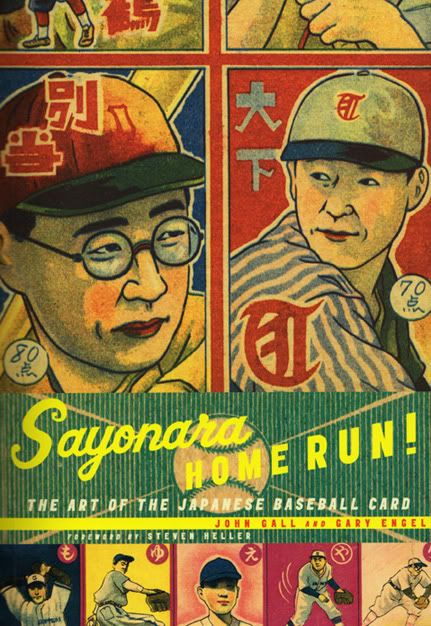
Did you guys ever pick up the tremendous book of old timey Japanese baseball cards, Sayonara: The Art of the Japanese Baseball Card? It’s one of my favorite baseball books, just an absolute little treasure.  I was browsing through it last night and ran across this card—remind you of anyone we know?


Not only is the book a little honey, but at a list price of $18.95 it is an absolute steal.

Hey, Cool Breeze

I’m as plugged-in as the next guy but I still enjoy reading the box scores first thing each morning in the newspaper. If I didn’t have a 40 minute train ride maybe I wouldn’t get the papers at all, who knows? I love to scan around for the names that mean something to me–did Maddux pitch last night? How did Hanley Ramirez do? While today’s boxscores are souped-up compared to how the ones from our youth, they aren’t that much different and I like the continuity.

Today is dress-down Friday. I rode to work this morning, caught up with how the game turned out last night (Joba got his first career loss in a soggy 7-6 affair; Farnsworth, Bruney are hurting), and jammed out to a host of tunes, wearing my oversized I-am-a-dork headphones. When I got to my desk at work, I decided I should probably tuck my shirt into my pants, only to find that my fly was wide open. Dag, Joe Cool the Jadrool. And nobody with the decency to say anything!

Oh well. Yo, check this out–it’s so utterly badass it makes my teeth hurt.

Must See ABs

The Yankees aren’t nearly as fun to watch when Alex Rodriguez isn’t playing. Least for me they’re not. His at bats are Must See TV. I don’t know if the same can be said for anyone else in the lineup. Not that I don’t enjoy watching the other guys hit, but if I didn’t like the Yankees, would I really stop and watch Bobby Abreu or Jason Giambi or Hideki Matsui? Which got me to thinking: What are the Must See AB’s for you? The guys you’ll stop and watch even if you aren’t a fan of the team they play for? Dudes that immediately jump to mind include: Miguel Cabrera, Sheff, Manny, Ortiz, Vlad, David Wright, Ichiro, Pujols, Chipper, Junior and Hanley Ramirez.

Rodriguez is scheduled to rejoin the team in Chicago tonight, but is not expected to play, as the Yanks go for the sweep. Kid Hughes time. And here’s a quick scouting report Cliff sent me:

On the mound for the Sox will be 25-year-old righty Gavin Floyd. Floyd, a member of the Reggie Cleveland All-Stars, was the Phillies’ forth overall pick in the 2001 draft and zipped up to the majors in just his third professional season, but struggled in both triple-A and the majors in 2005 and 2006. He was then flipped to the Sox in the Freddy Garcia deal along with lefty Gio Gonzalez, who has since been sent to the A’s in the Nick Swisher trade. Floyd again struggled in the majors last year, but slipped into the rotation at the end of August in place of rookie John Danks and turned in five quality starts in six tries (though his teammates scored just two runs per game for him, resulting in a 0-3 record and a 1-5 team performance in those six starts). With Jon Garland now an Angel, that performance helped Floyd win the fifth-starters spot out of camp this spring, and he is off to a strong start, with three quality starts in three tries, a 1.40 ERA, 0.88 WHIP, and, thanks to 5 2/3 runs per game of support, a 2-0 record thus far.

Floyd has faced the Yanks just once before, that coming in mop-up relief last year (Floyd entered that game with his team trailing 11-3 and left three innings later down 16-3).

Let’s Go Yan-Kees!

The Great One

Ten years ago, when the Yankees put together that dream season, I constantly reminded myself to stay in the moment, to appreciate what was happening because it wasn’t likely to happen again. I tried my best to appreciate what was happening during the entire ’96-01 run. Today, I love watching Jeter, Rodriguez and Posada, I loved Bernie and miss him, and I loved Joe Torre too, though I haven’t missed him at all this year. With Bernie and Torre, it was time. But Mariano is extra-special, isn’t he? Things really won’t be the same when he’s gone. Close games will be a different, more mortal experience.

Rivera isn’t perfect. But he’s still doing it and doing it and doing it well. The fact that his cutter is still nasty after all these seasons is incredible. And aesthetically, Rivera’s motion is as fluid and smooth and beautiful as any pitcher that comes to mind. Last night, it took him 17 pitches to get five outs. He did it with that expressionless calm that we’ve come to rely on. I’m sure he’ll get roughed up this year, even get hurt, but watching him yesterday just reminded me to stop and soak in the moment, to be thankful for his continued brilliance. It won’t last forever. But the memories he’s provided us certainly will.

Moosada

Mike Mussina and Javy Vazquez were both sharp last night. The Yanks squeezed out a run early with a soft two-out rally in the second that was started by two-out walks to Robinson Cano and Jason Giambi and extended by infield singles by Morgan Ensberg, who lined a shot off Vazquez’s chest, and Melky Cabrera. Melky’s hit plated the run before Vazquez struck out Johnny Damon to leave the bases loaded. There weren’t any terribly hard-hit balls in the game until the fifth, when a two-out double by Jorge Posada plated Damon and Hideki Matsui, both of whom had singled, to make it 3-0 Yanks.

Entering the bottom of the fifth, Mussina had allowed just two singles and a walk, and only one of those two singles left the infield. With one out in that inning, Joe Crede blasted a solo homer to left, but the Yanks broke the game open with three runs in the top of the sixth to chase Vazquez, and Mussina came back with a 1-2-3 sixth of his own.

Moose allowed another solo homer (this to Carlos Quentin) with two outs in the seventh. With his starter up to 99 pitches and Crede due up again, Joe Girardi popped out of the dugout. When he got to the mound, he turned to Posada and asked, “What’s he got?” Posada meant to say “there’s nothing wrong with him,” but it came out “he’s got nothing.” With that, Girardi began to lift his arm to call for a reliever, but Posada, realizing his mistake, quickly stopped his manager and explained what he meant to say. Girardi appeared puzzled, but accepted Posada’s explanation and returned to the dugout without making a change. Mussina then got Crede out on two pitches to end the inning and his evening. (The incident reminded me of this game.)

Mussina was flat-out excellent in his seven innings and was working quickly and efficiently and in an easy rhythm with Posada (who had a great night overall, going 4 for 5 with three doubles). Said Moose after the game:

I didn’t throw hardly any curveballs. Lotta sinkers, lotta cutters, good changeup. I think I had real good movement today. Seems like I jammed a lot of guys. They were diving out over the plate, and the ball ran back in on them a little bit, so I think the movement was my biggest asset today. I usually don’t go out there planning not to throw curveballs. The curveball’s a pretty big part of my game. Just today, right from the beginning, it seemed like I could throw two-seamers and get some run out of it, get some sink out of it, and I got a ton of groundballs, so I just kept on throwing them. [Jorge and I] were just trying to figure out what worked and we found something pretty early, so we just kept doing it. It wasn’t really rocket science, we just kept doing what was working.

Those early grounders became fly balls in the latter innings (thus the two homers), but by then the game was in hand. As for that good changeup, the YES gun clocked a few of Mussina’s pitches at 63 miles per hour. Now pitching, Bugs Bunny . . .

Girardi did bring in LaTroy Hawkins to start the eighth, but after a walk and a single, he turned to Billy Traber to face Jim Thome with one out and a four-run lead. For the second night in a row, Traber failed to retire Thome (he walked him in a completely unnecessary matchup on Tuesday night), giving up an RBI single that made the score 6-3. With Paul Konerko due up as the tying run and Joba Chamberlain having worked an inning and two-thirds the night before, Girardi went straight to Mariano Rivera for a five-out save.

Said Joe after the game, “The game was on the line. That was when we had to shut the door and close the game. . . . that was when we needed him.”

Damn straight, skip. Girardi did the same thing with Chamberlain in the seventh inning on Tuesday night when the Sox, trailing by three, loaded the bases with one out. I applaud his willingness to use his big bullpen guns as stoppers (though I was less convinced of the need to leave Chamberlain in to pitch the eighth on Tuesday with the lead expanded to 9-4). Girardi has called on Rivera in the eighth twice this year and used Chamberlain in the seventh three times and has won all five of those games. The extra outs have thus far totaled up to just three extra innings combined for the two pitchers, which would pace out to about 22 innings over the course of the season.

Oh, and since I’m crunching numbers, if you take Manny Ramirez’s hits and RBIs out of Mike Mussina’s season totals, his ERA drops to 3.04 with a 1.06 WHIP.

Home Run, Javy?

Having taken the opener of their three-game set at Phone Field, the Yanks hope to clinch just their third series win of the season (in eight tries) tonight. Taking the hill for New York will be Mikey Moose, who will be happy not to have to face Manny Ramirez. Moose faced a far weaker White Sox offense at the Cell twice last year, one good, one bad. The third time he faced the Chisox, back in the Bronx, he pretty much split the difference with a solid quality start.

The Sox have moved ex-Yank Javy Vazquez up a day to keep him on normal rest after Monday’s off-day. He has faced his old team twice since being traded to Arizona for Randy Johnson. In 2006 he survived six walks and a Jason Giambi homer by striking out eight and holding the Yanks to two runs (both scored on that dinger) over five innings in a slim 5-4 Chicago win. Last year, he struck out seven Yanks in six innings, walked just three, and kept the ball in the park, but gave up four runs and took the loss as his punchless offense conjured up just one run against Chien-Ming Wang, who pitched a complete game. Thus far this season, he’s picked up where he left off with his comeback 2007 season, striking out 27 in 25 1/3 innings against just 6 walks and holding his competition homerless.

Joe Girardi has posted the same lineup he ran out there yesterday, which marks the first time all season that he’s repeated a lineup exactly. That means Posada’s back behind the plate, and Morgan Ensberg’s still at third base in place of Alex Rodriguez, who is conveniently resting his sore quad while basking in the arrival of his second daughter. The Sox attempted no steals against Posada last night, in part because they just don’t steal. They have three stolen bases in five tries on the season, both marks dead last in the majors. All three successful steals are by Orlando Cabrera. Cabrera singled twice last night with no one on base ahead of him, but did not attempt a steal.

Do Your Thing, Kid

It goes without saying that respect is something that you have to earn in life, but it is especially true in a barber shop. It comes slowly, with time. It can’t be forced, can’t be bought. I have been getting my haircut in Ray’s shop on Smith street in Brooklyn for close to ten years now. That’s where my barber, Efrain, found a chair to cut heads after he lost his store, futher down Smith closer to Atlantic Avenue, when the neighbhorhood started to gentrify in the late ’90s. I’m not really close with Ray or his son Macho, a rolly guy in his early thirties, who cuts heads next to his father. They don’t like baseball. They like boxing.

It was a warm spring afternoon at the barber shop when I walked in a few days ago. Both Ray and Macho greetly me with affection. I went to the back, where Efrain was standing over a man, a straight razor in his right hand and his left palm cupped full of shaving cream.

I put down my napsack and went back to the front of the shop to sit and wait my turn. Three other guys, all regulars, all friends with Macho, were there. I started talking to Ray about a book I had just read, Mark Kram’s Ghosts of Manilla. Soon, he was holding court, telling stories about Ali. A thick, muscular kid who was sitting across from me, told me that he had tons of old boxing matches on videotape, including the Thrilla in Manilla. When I described Kramm’s impressions of the fight, he goes, “Yo, dude, I’m getting goosebumps just thinking about it.” The light poured through the front window of the shop, onto his forearms where I could see the goosebumps.

(more…)

Black Cat Bone

Chien-Ming Wang teetered on the brink of disaster throughout his six innings against the White Sox last night, but somehow allowed only three runs, so in the end — after the Yankee offense poked its head out and didn’t see its shadow — New York won 9-5. The Yanks are now one game over .500, and at with his fourth W of the season, Wang is the fastest major league pitcher to 50 wins since Doc Gooden. (Obligatory disclaimer: wins are an extremely unreliable and inaccurate stat, etc. Still, that’s impressive).

Starting for the White Sox was old frenemy Jose Contreras, another in the long line of big-money free agent busts in New York who’ve gone on to success elsewhere. (He gets a pass, though, since his family was trapped in Cuba most of the time he was with the Yankees. You can see how that might be a tad bit distracting. What’s your excuse, Vazquez?). Contreras pitched a solid game, allowing just one first inning run, when Johnny Damon scored on a Matsui ground out, and one inning later a solo home run from the hollow husk of Jason Giambi. Then he settled in and, like many an April pitcher before him, stifled the Yankees’ offense.

Wang, meanwhile, struggled from the start, throwing almost 50 pitches in the first two innings alone as the White Sox put three quick runs up. (He wasn’t helped by an error on Morgan Ensberg, who was subbing in for Alex Rodriguez at third base. A-Rod, of course, was on paternity leave in Florida, with his wife and newborn daughter…. or, as the Daily News would have it, "welcoming a bouncing bambina into [his] pinstriped world"). After that Wang was somwhat more efficient, but also lucky: the White Sox had a plethora of very hard hit line drives and fly balls land just within reach of the Yankee outfielders. And by the end, Chicago had stranded 13 runners.

The Yankees finally got a little momentum going, and loaded the bases in the 7th – single, walk, infield single – which brought Derek Jeter to the plate with one out. He struck out, and perhaps as a result, looked like the happiest man in Chicago one batter later, when Bobby Abreu whacked Octavio Dotel’s 2-0 pitch just over the left field wall for a go-ahead grand slam.

In the bottom of the inning, perhaps concerned that things might get dull for the viewers at home, Billy Traber and Brian Bruney worked together to load the bases, which brought in Joba Chamberlain. Joba looked good under the circumstances — well, aside from walking in a run — and in the YES booth, David Cone kept gushing about his “moxie,” an excellent word that people just don’t use enough anymore. (Side note: I think Cone’s doing a good job on the whole… but you can just tell he’s dying to curse up a storm, and to tell several dozen potentially libelous stories. I’d love to hear him really cut loose, though I expect the FCC and certain former teammates would not.)

After a three-run homer from Johnny Damon in the eighth – cancel the obit, I think he’s fogging up the mirror! – and another solid inning from Chamberlain, Kyle Farnsworth brought his own special brand of excitement to the ninth inning. But one quick home run, walk, fielder’s choice and wild pitch later, the Yankees nailed down the win.

I’m not sure it’s even worth bringing up, but in the eighth inning, a black cat ran out of the stands, across the field, and straight into the Yankees dugout. I’ve decided to simply ignore this, not being the superstious type. (Though once, in college, I was walking across a courtyard at night, when not one but two black cats ran directly in front of me, one after the other… then proceeded to have loud sex in the bushes next to my dorm. I admit, that did give me pause.)

Finally, announcer Paul O’Neill finally asked the big burning question on all of our minds: “How can they wear black socks when they’re called the White Sox? That just doesn’t make any sense to me.”

Next time on YES: Why do we drive on parkways but park on driveways?

Chicago White Sox

Chicago White Sox

2007 Record: 72-90 (.444)
2007 Pythagorean Record: 66-96 (.406)

Manager: Ozzie Guillen
General Manager: Ken Williams

Home Ballpark (multi-year Park Factors): U.S. Cellular Field (104/105)

Who’s Replacing Whom:

Orlando Cabrera replaces Tadahito Iguchi and Danny Richar (DL)
Joe Crede returns from the DL to replace Josh Fields (minors)
Nick Swisher replaces Scott Podsednik and Darin Erstad
Carlos Quentin replaces Jerry Owens (minors) and Luis Terrero
Alexei Ramirez replaces Rob Mackowiak
Brian Anderson replaces Andy Gonzalez and Alex Cintron
Gavin Floyd inherits most of Jon Garland’s starts (John Danks inherits the rest)
Scott Linebrink replaces David Aardsma, Ehren Wassermann (minors) and others
Octavio Dotel replaces Ryan Bukvich, Andrew Sisco (minors), Mike Myers and others

25-man Roster:

1B – Paul Konerko (R)
2B – Juan Uribe (R)
SS – Orlando Cabrera (R)
3B – Joe Crede (R)
C – A.J. Pierzynski (L)
RF – Jermaine Dye (R)
CF – Nick Swisher (S)
LF – Carlos Quentin (R)
DH – Jim Thome (L)

Bench:

R – Alexei Ramirez (UT)
R – Pablo Ozuna (UT)
R – Brian Anderson (OF)
R – Toby Hall (C)

Rotation:

R – Javier Vazquez
L – Mark Buehrle
L – John Danks
R – Jose Contreras
R – Gavin Floyd

Bullpen:

R – Bobby Jenks
R – Octavio Dotel
R – Scott Linebrink
L – Matt Thornton
R – Mike MacDougal
L – Boone Logan
R – Nick Masset

15-day DL: L – Danny Richar (IF)

Typical Lineup:

S – Nick Swisher (CF)
R – Orlando Cabrera (SS)
L – Jim Thome (DH)
R – Paul Konerko (1B)
R – Jermaine Dye (RF)
L – A.J. Pierzynski (C)
R – Carlos Quentin (LF)
R – Joe Crede (3B)
R – Juan Uribe (SS)

(more…)

Spring has Sprung

Mother’s Day is coming up and most of you are probably like me in that you haven’t given it a moment’s thought.  Well, dig, this, I got something good for you.  My wife Emily always thinks ahead when it comes to holidays. She’s got Christmas and Chanuka all sewn-up by the Fourth of July. But not only is she well-prepared, she’s an artiste as well. Em takes beautiful pictures and then makes beautiful notecards.

She also sells the cards.  Talk about a great gift idea for Mom’s Day! And if you are already set for Mother’s Day, that’s cool, cause these cards are great for any occasion.

They are sure to give you a smile and they are a great way to spread a little Joy. And you can never have too much of that.

Check it out:

[Disclaimer: Actual prints are richer in color than they appear on screen.]

ORANGE TULIPS

(more…)

Wrong is Right

Yankee gm, Brian Cashman:

“He is not going (to the rotation),” Cashman said of Chamberlain, the premier set-up man in baseball. “We are all on the same page. We talked about this during the winter and spring training and we are working toward that because that is the (eventual plan). Right now the time and place is to help in the pen. We are all on the same page.

“It makes for a nice New York story, but there is not a disagreement with my boss and myself.”
(George King, N.Y.Post)

Anthony Mccarron reports in the News:

“It’s all of our intention to try to get (Chamberlain) back into the rotation by the end of the year,” Steinbrenner told The News. “I’ve addressed it many times, as did Joe (Girardi) and (GM Brian) Cashman. I’m just saying it would be nice to have him there right now. He’s going to be great anywhere we have him but, my preference is as a starter and that’s everybody else’s preference, too.

“You see what a premium starting pitching is. The bullpen is important, but starting pitching is 70% of it. Your bullpen can’t do you any good if you’re down by five runs quickly every night. It’s logical.”

But Chamberlain isn’t going anywhere right now, according to Cashman.

“Joba is a starter, but the time and place for him right now is to be in the bullpen,” Cashman said.

I’m no expert but it seems like it would be tough to switch Joba this season. I just don’t see the Yanks being able to afford losing Chamberlain for six-to-eight weeks as he builds himself back into a starter in the minors. I am eager to see him start too, but am also fine with him sticking out this year as Mariano’s set-up man.

What do you guys think?

So You Wanna Be Startin’ Something?

Hank Dog is on the scene. He wants Joba Chamberlain to start.

From the New York Times:

“I want him as a starter and so does everyone else, including him, and that is what we are working toward and we need him there now,” Steinbrenner said Sunday by telephone. “There is no question about it, you don’t have a guy with a 100-mile-per-hour fastball and keep him as a setup guy. You just don’t do that. You have to be an idiot to do that.”

…”The mistake was already made last year switching him to the bullpen out of panic or whatever,” Steinbrenner said. “I had no say in it last year and I wouldn’t have allowed it. That was done last year, so now we have to catch up. It has to be done on a schedule so we don’t rush him.”

…”The starting rotation is not what I would have chosen at the beginning of the year, but that is not a big news flash to anyone,” Steinbrenner said.

Discuss.

The Legend

A few weeks ago, Joe Posnanski ran a fun comparison at his site: Roberto Clemente vs. Al Kaline. I was talking to Jay Jaffe about it and Jay hit the nail on the head when he said, “Clemente the Icon dwarfs Clemente the player.” With that in mind, and since the Yanks have the night off, please consider checking out the Clemente American Experience on PBS this evening. I hope it’s a good one.

Think About It (Just a Little Patience)

When Pat Jordan told me that he still uses a typewriter to write his stories instead of a computer I wasn’t surprised. He’s so old school, why would he change? His wife calls him a trogliodyte, kicking a screaming into the 19th century. A few years later, I visited Pat at his home in Florida and looked through hundreds of manuscripts and drafts. I saw his tools of ignorance: an old Hermes 10 typewriter (he buys old machines on ebay for the parts), yellow second sheets (discontinued), stubby corrective pencils, a glue-pot, a pair of sissors, and even a bottle of yellow white out (also discontinued). Having come from a fine arts background, I could immediately relate to the tactile nature of Pat’s writing process.

And in fact, if I’ve learned anything from Pat, it is how important thinking is to good writing. Jordan is a deliberate and meticulous writer. When he has a magazine assingment, he first researches the subject, reading as many articles as his researcher can find, then composes his own questions before he conducts interviews and takes notes. Then he transcribes those interviews, orgainzes them with his notes and then he begins to make outlines. If afforded the time, he’ll review the notes, the transcribed interviews and his outlines, and revised outlines, over and over before he starts writing. He might not stick to his outlines, might alter them as he goes, but he always has them as a safety net, a way to organize and structure his thinking. When he finally does begin to write, he goes sentence-by-sentence. If he writes two pages a day–a productive day for him–when he starts again in the morning, he’ll review what he wrote, revise anything that needs fixing, and then proceed.

The tools Pat uses to write are antiquated but they are an essential part of his thinking and his writing. When I worked in post-production, I was fortunate enough to be on jobs with Ken Burns, Woody Allen, and the Coen Brothers, who all still cut on film when I was with them (mid-90s). The physical nature of the medium forced the editor and director to make hard, clear descisions. For instance, if you made a cut on Tuesday, it would take a lot of time and man-power to fix it by Thursday. And even after Joel and Ethan had previewed a reel on their KEM flatbed, it would take five, six minutes to rewind the reel to the head, during which time they would sit and contemplate what they had just watched. I learned to value this down-time, how productive it was for them to be able to think things through.

All three filmmakers cut on computers now. Last winter I spoke with Paul Barnes, Burns’ longtime editor, and asked if he’d ever go back to cutting on film. “Not in a million years,” he said. But he doesn’t need to. He got his chops the old fashioned way, so the new technology is simply a dream. However, for a younger generation, who didn’t grown up cutting on film, there can, at times, be too many choices, so many options that the creative process is overwhelmed by possibilites.

(more…)

feed Share on Facebook Share on Twitter Share via email
"This ain't football. We do this every day."
--Earl Weaver