"A New York Treasure" --Village Voice
Category: Bronx Banter

Quick Notes

While there’s no make-up date scheduled for yesterday’s game just yet, there were a few drips of news yesterday. Well, three to be exact. Johnny Damon, who left Monday’s game with cramps in his calves now appears to have something closer to a strain, which puts his availability in doubt for the time being. Melky Cabrera was going to start in center field in yesterday’s game until it got rained out. Ron Villone, who was officially released at the end of spring training, signed a minor league deal with the Yankees yesterday and will report to triple-A Scranton. He can opt out of the deal if he’s not on the 25-man roster by May 1. Finally, Chein-Ming Wang’s rehab continues to move swiftly. He’s been throwing in the bullpen and might throw a simulated game this weekend.

Down on the Farm

By Bryan Smith

Read Alex Belth long enough, and you start to pick up the guy’s biases. I’m not talking his love for rap, Ken Burns or Central Park, but the Yankees that command most of his ink: Bernie Williams, Jorge Posada and Mariano Rivera. Notice the trend.

I’m not bashing my friend Alex here, as I think any team diehard (myself included) does the same thing. As baseball fans, or really, as sports fans, we are drawn to the players we can only imagine in one uniform. Bernie, Rivera, Derek Jeter, these guys are Yankees. Being homegrown is to be one step closer to being a fan favorite. As loved as Paul O’Neil was, he was half a Red. As dominant as Roger Clemens was, he had shoved it for years with the Beaneaters.

If the Major League Baseball draft was different, and trading up in the draft allowed, Derek Jeter would not be New York’s captain. Heck, he probably wouldn’t be their shortstop. Because if trading were allowed, George Steinbrenner would have moved up in the 1993 draft after reading his staff’s reports on a young stud in Miami. Despite taking Jeter the previous year, the Yankees would have bought the top pick from Seattle and drafted Alex Rodriguez.

After suffering through 1994 with Mike Gallego, the Yankees would have never signed Tony Fernandez. Rather, they would have opened 1995 with A-Rod at short, and New York would have fallen in love with him over the next 464 home runs. Jeter would be one helluva leadoff hitter, still loved in New York, but always second fiddle to the Bronx shortstop.

That’s what is funny to be about baseball: although we don’t realize it, fan allegiances to players are as determined by player development as they are effort and media friendliness.

Alex has asked me to write about the Yankees farm system once a month this season because I think he senses a new era with this organization. Starved to end this World Series drought, the Yankees are returning to what defined their ’90s dynasty: scouting. The Yankees demanded their farm system provide them with a foundation – and it did in spades, with all the aforementioned homegrown talents – and then leaned on Brian Cashman (and Steinbrenner’s wallet) to decorate the interior.

(more…)

Go Away, Come Back Tomorrow

It’s cold and it is raining in New York. Instead of making thousands of fans–not to mention the players–suffer through the conditions, today’s game has been postponed.

Pastime Passings

By Bruce Markusen

The baseball world absorbed several significant losses during the month of March. A former commissioner, an All-Star catcher, a World Series stalwart, and two baseball lifers have all passed away in recent weeks. Here are tributes to their lives in the game.

Ed Bailey (Died on March 23 in Knoxville, Tennessee; age 75; throat cancer):

A five-time All-Star, the left-handed hitting Bailey was regarded as one of the National League’s premier catchers of the late 1950s and early 1960s. His prime seasons came with the Cincinnati Reds and San Francisco Giants, before he bounced to Milwaukee in 1964, came back to San Francisco in 1965, and then finished out his career with the Chicago Cubs and California Angels in ’65 and ’66. Bailey enjoyed his finest season in 1956, when he hit .300 with a career-high 28 home runs for the Reds. Over the course of a 14-year career, Bailey hit 155 home runs and collected 540 RBIs. He participated in one World Series, hitting a home run for the Giants during their 1963 Series loss to the New York Yankees.

Bowie Kuhn (Died on March 15 in Jacksonville, Florida; age 80; complications from pneumonia):

The second longest tenured commissioner in major league history behind Hall of Famer Kenesaw Mountain Landis, Kuhn served in baseball’s highest office from 1969 to 1984. His tenure coincided with one of the most tumultuous eras in the history of the major leagues. During Kuhn’s watch, player salaries escalated through arbitration and free agency as the Players Association assumed a far more powerful voice within the game’s infrastructure. Kuhn frequently battled union chief Marvin Miller, both at the negotiating table and through the press, with Miller gaining major strides for the players through both collective bargaining and the decisions of independent arbitrators. Known for his law-and-order approach to running the game, Kuhn frequently attempted to discipline players and owners. He attempted to censure Jim Bouton’s Ball Four, suspended Denny McLain for his ties to gambling and organized crime, disallowed the player sales of Vida Blue, Rollie Fingers, and Joe Rudi by Oakland A’s owner Charlie Finley, and suspended three members of the Kansas City Royals (Willie Mays Aikens, Jerry Martin, and Willie Wilson) after they were arrested for buying cocaine.

COMMENTARY: After first learning of the death of Bowie Kuhn, I read and heard several accounts that described the former commissioner as a pompous stuffed shirt who often seemed stiff and uncomfortable. Well, that was never my experience with Kuhn. I talked to him several times during my years at the Hall of Fame, including an interview that I conducted in front of an appreciative crowd in the Hall’s Bullpen Theater. The former commissioner struck me as thoughtful and well spoken, even charming at times. He took an interest in my work at the Hall of Fame, which is not always the case with guest speakers who come to Cooperstown. I once gave him a ride from the Otesaga Hotel to the Hall of Fame; he was gracious and open during our conversation, and grateful for having saved him from a long walk.
After talking to Kuhn for awhile, it became obvious that he was both a fan of the game and a believer in old-school values. Those are two characteristics that rank highly with me. He was also knowledgeable about the Negro Leagues, having attended games at old Griffith Stadium in Washington. He had a real interest in preserving baseball history, which motivated him to donate his collection of papers from his days in baseball’s front office. He wasn’t just a suit who held the office of commissioner while waiting for something better to come around. This was a man who had a genuine love for the game, and took pride in trying to defend some of its values.

Still, as a commissioner, Kuhn was far from perfect. He made his share of mistakes, which the media of the seventies and eighties usually portrayed in earnest. His legacy was mixed, with some obvious failures, some more subtle successes, and a nearly endless supply of controversy and conflict. But I think it’s safe to say that he was a very important and significant commissioner, a man who presided over the game at a time when it faced major upheaval because of labor issues, drug problems, expansion, the growth of television, and the presence of strong personalities in both ownership and the union. Rather than skirt these issues, he usually faced them, sometimes for good and other times for bad. In writing a complete history of baseball, I think that an author would have to devote at least one chapter to the reign of Bowie Kuhn.

(more…)

Yankee Panky Takes on Opening Day…Sort Of

By Will Weiss
Bronx Banter Correspondent

Since watching the Yankees is no longer my job, I, like many of you, resorted to DVRing the game and watching a three-hour telecast in 12 minutes. However, I did watch all the Geico caveman commercials. They kill me. (Non sequitur alert: I read where ABC is planning a pilot based on the Geico Cavemen. Can cavemen hurdle sharks?)

Back to the point of this bonus entry…What do we make of the Opening Day coverage? As of this writing, the papers hadn’t updated their Web sites to reflect postgame coverage, save for the AP recaps, and Opening Day blogs from Newsday and the Star-Ledger.

My commentary here is a brief scan of the highlights and lowlights of the Opening Day TV, and cyberspace.

TV
* YES’ telecast started well enough, until the question “How do you follow the Yankees from Iraq” was asked to some soldiers in attendance. As for the Cory Lidle factor, it would have been easy to overplay the emotions of the first-pitch ceremony, with Lidle’s wife, Melanie, and son Christopher, throwing out the first pitch. The subtle route was the way to go. The look on Jason Giambi’s face conveyed everything.

* I don’t have the broadcaster lineup taped above my desk anymore, but I’d guess the trio of Kay, Singleton and Girardi will be a common and formidable one throughout the season. Bobby Murcer’s third-inning appearance was a welcome sight. And he sounds as healthy as ever.

* Expect more gems from Joe Girardi like this postgame nugget: “Pavano needs to make adjustments the third time through the order, because the Devil Ray hitters adjusted to him.”

* New feature: Text messaging for the player of the game.

* Oops: YES misspelled Carl Crawford’s last name as he strode to the plate for his at-bat in the top of the seventh. It’s Opening Day for everyone. The Yankees got away with three errors, right?

* I’d have more on ESPN, but I couldn’t stay up for the 1 a.m. Baseball Tonight. Florida’s win dominated Sportscenter for the last hour.

(more…)

Bleacher Banter

By Emma Span

It’s a long subway ride from my apartment in Brooklyn to Yankee Stadium, but I usually enjoy the trip uptown. By the time you pass Grand Central, the train is packed, and almost everyone is wearing Yankee gear and talking baseball. I remember being on the 4 train a few years ago, when a young businessman casually turned to his friend and asked, “So, how many innings do you think Kevin Brown will go tonight?” At which point literally half the subway car turned around – young and old, black and white and hispanic, Christian and Jew — and offered opinions ranging from one to four. Yesterday, I sat next to two college-age girls who rode through most of Manhattan lamenting the fact that Carl Pavano, who should be so hot, has sucked too much to crush on. (But, they agreed, it’s going to be okay: Andy Pettitte is back).

In that same vein, while the view could be better, you absolutely cannot beat the Yankee Stadium bleachers for color commentary. They’re a testament to the diversity of this city’s residents – and, also, to their remarkable and ceaseless innovation in the field of smuggling booze past stringent security. The bleacher experience is only as good as your neighbors, though, so I lucked out yesterday when, deep in the left field side, I found myself sitting in front of Statler and Waldorf.

(more…)

Scenes from Opening Day


(more…)

Opening Day Game Recap

The 2007 season couldn’t have gotten off to a worse start for Alex Rodriguez. With Carl Crawford on third and two outs in the top of the first, Ty Wigginton hit a foul pop up to the left side. Battling a grey sky and some swirling winds, Rodriguez had to loop around Crawford and come nearly two thirds of the way toward home plate to catch the ball. Meanwhile, Jorge Posada and Carl Pavano stood in place despite the fact that Rodriguez, though in hot pursuit, was not calling for the ball (after the game, Joe Torre said it was the catcher’s ball to catch). Rodriguez, for all of the misconceptions about his performance, is indeed awful at catching pop ups. While broadcasting the west coast tilt between the Angels and Rangers on ESPN, Orel Hershiser, who was the Rangers’ pitching coach while Rodriguez was in Texas, said pop ups are kryptonite to Rodriguez’s Superman. At the last second, the ball swirled back behind Rodriguez, who at that point had clearly overrun it and could only make a pathetic backwards stab at it as it fell untouched on the opening day logo painted outside the third base foul line. Rodriguez’s momentum carried him past Posada, who gave him an encouraging pat on the backside, and Pavano retired Wigginton two pitches later on a comebacker, but Rodriguez was nonetheless charged with an error.

(more…)

Tampa Bay Devil Rays

The Arizona Diamonbacks and Milwaukee Brewers, two teams that had losing records in 2006, are considered contenders entering the 2007 season. There’s reason to believe that the Colorado Rockies, who finished 2006 with the exact same record as the Diamondbacks, could surprise some people as well. Over in the American League, the two teams that lost 100 or more games last year, the Tampa Bay Devil Rays and Kansas City Royals, are two of the teams that intrigue me most entering the 2007 season. Not because I think they’ll contend like that NL trio, none of which lost 90 games last year, not even because I think they’ll be particularly good, but because I think they’ll be better, and better for rather compelling reasons.

(more…)

Yankee Panky #2: The Last Writes of Spring (Training)

By Will Weiss
Bronx Banter Correspondent

“Rupert Murdoch should cut me a check for all the papers I’ve helped him sell.”
— Meryl Streep as Miranda Priestley, in The Devil Wears Prada

Sure, the above quote can be applied to Lindsay Lohan, Paris Hilton, Britney Spears, or Brangelina. But since the lead-in to the only display of humanness Meryl Streep shows in the film refers to “another divorce splashed across Page Six,” let’s figure that someone named Steinbrenner was muttering something similar this past week.

The marriage of Steve Swindal and Jennifer (Steinbrenner) Swindal is over, and as a result, Swindal is out as a general partner of the Yankees. The ascent of the top son-in-law is no more. It has ceased to be. Let the race for the New Boss begin.

Just about every angle of this story was examined: reporters and columnists from all the local papers raised the question Swindal’s replacement. Every beat reporter I read rightly mentioned the effect of Swindal’s ouster on Brian Cashman and Joe Torre – it was Swindal who twice convinced Joe Torre to come back, and helped negotiate Cashman’s return and increased the GM’s decision-making power. In his solid Thursday report, Tyler Kepner of the New York Times intuited that Steinbrenner’s other son-in-law, Felix Lopez, could jump to the forefront. Daily News columnist Bill Madden carried this further in his Friday column, writing that Lopez has become more of a fixture on the operations side “to the dismay of the other three siblings.” The Times’ Richard Sandomir wondered which of Steinbrenner’s two sons, Hal or Hank, would take over should the Patriarch look in their direction. Sandomir’s colleague Harvey Araton called for a shift in philosophy and wondered why neither of Steinbrenner’s daughters would be considered to run the team instead of the sons. In addition, Swindal’s DUI arrest and questions of what would become of his shares of the team as a result of the divorce were smartly asked; and notes and quotes from Swindal’s other business associates at Excelsior Racing regarding his group’s bid to buy the thoroughbred franchise completed the coverage.

The Swindal situation provided fodder for the talkies, of course. To be expected, there was a hint of melodrama in their reactions and in their projections regarding the future of the Yankees’ front-office hierarchy. Overall, the mainstreamers did pretty well in keeping things on the level and not going overboard with the tabloid potential of the story.

Reading so many versions of the same story – particularly one like this – is fascinating. Not only is it fun to see the range of sources the writers interview from a competitive standpoint, from a straight writing perspective, it was amazing to see how many different ways the question, “Who will benefit from nepotism as it relates to the Yankees, and when will a decision be made,” was presented.

Per your requests from last week, I turn to the blogosphere for info and insight the mainstream didn’t provide. Derek Jacques, the esteemed proprietor of The Weblog That Derek Built, put it best:

“As someone who was until recently in the marital strife industry, I’m sensitive toward what Steve Swindal and Jennifer Steinbrenner must be going through. The end of a marriage is a real human tragedy, also something truly private and really not the business of anyone outside of the couple and perhaps their immediate family, friends, and business partners.

“But as a Yankee fan, I just gotta look at Swindal and say ‘You jerk! We were counting on you! You had it all in the palm of your hand and you blew it, just completely and totally blew it!'”

(more…)

On The Radio

I made another appearance on Yankee Fan Club Radio last night. At the 20:23 mark here you can hear me weigh in on Josh Phelps, Carl Pavano, the bullpen, Steve Swindal, Alex Rodriguez’s opt-out clause, and make some very off-the-cuff predictions (or rather dodge doing so). My segment lasts roughly twenty minutes.

14-13-3

That’s the Yankees’ final spring record after going 0-1-1 against the Tigers in their final two exhibition games. Since the 25-man roster was set in advance of those games (posted again below the fold for those who missed it), I won’t bother with my usual game wrap, instead, here are some items of interest from the final two days of Yankee camp:

  • Kei Igawa allowed three runs on six hits and no walks (though he did hit a batter) while striking out three and needing just 72 pitches to get through six innings in his final start of the spring yesterday.
  • Andy Pettitte threw 66 pitches over four innings against the Blue Jays’ double-A team on Friday allowing four runs on seven hits and a walk while striking out three. Pettitte said he was “good and gassed” at the end of the outing, his first game action in two weeks. Pettitte hasn’t had any continuing back pain, but team trainers have told him not to run between starts just yet, which, in addition to a simple lack of work, is partially to blame for his lack of stamina. He’ll likely pitch no more than five innings on Wednesday, though with Tuesday’s off-day, he’ll yield to a fully-rested bullpen.
  • Mike Mussina needed just 71 pitches to hold the Blue Jays’ triple-A squad scoreless over seven innings on Friday. He allowed just four hits and struck out five.
  • Kyle Farnsworth, Scott Proctor, Luis Vizcaino, and Mariano Rivera each threw a scoreless inning. Farnsworth allowed the only hit, Rivera the only walk, each struck out one save for Rivera who struck out two.
  • After finding out he had made the team, Brian Bruney went out and gave up three runs on three hits in his lone inning of work on Friday (though he didn’t walk anyone either).
  • In yesterday’s game, Johnny Damon went 2 for 2 with a triple, Josh Phelps hit his fourth home run of the spring, and Wil Nieves went 2 for 2 with a pair of singles.
  • Andy Phillips has cleared waivers and will open the season with triple-A Scranton. He played all of Friday’s game at second base going 1 for 4 with a run scored.
  • No decision yet from Ron Villone regarding accepting a minor league assignment from the Yankees. If he does accept, he’ll have another opportunity to opt out of his contract if he is not called up by the end of April.
  • Humberto Sanchez and Jose Veras have both been placed on the major league 15-day disabled list. Sanchez will stay in extended spring training to continue his rehab from the elbow soreness that kept him out of action all spring. Veras is recovering from surgery to have a bone spur removed from his pitching elbow and is expected to miss two to three months.

(more…)

You’re My Boy, Blue

Tom Verducci has a wonderful piece in the current issue of SI about his experience working as an umpire during a spring training game between the Red Sox and Orioles last week.  The good folks at SI.com saw fit to posting it on the web.  Verducci also has a follow-up column, filled with insights, also at SI.com.  The best part of Verducci’s experiment is that is illustrates just how difficult umpiring is, and how seriously the men in blue take their profession.  It also drives home just how good major league players are.  

From the magazine article:

The baseball we hold dear is a benign, leisurely sport, a "noncontact" pursuit in which we cherish its sweetly proportioned empty spaces. The interlude between pitches. The flanks in the alignment of fielders. The 90 feet between bases. The flight of a thrown or batted baseball offers elegant interruption to the spatial symmetry.

Working from the interior of the infield, however, reveals the power and speed of the game. It’s the difference between observing a funnel cloud from a safe distance on the ground and flying a research plane into the vortex of a tornado. "I tell all the young umpires that come up from the minors, ‘Expect a close play every time,’" says Tim Tschida, 46, my crew chief who is working home plate this game. "[The play’s] only routine here after it’s over. That ball three steps to the right of the shortstop? They don’t get to that ball in the minors and here they might throw the guy out. Middle infielders get to more balls up the middle that minor leaguers would never get to — and not only get to them, but turn them into double plays. I tell the young guys, ‘Don’t give up on anything.’"

From the on-line column:

Star players don’t get their own strike zone.

Said umpire Sam Holbrook, "When I was a rookie umpire in ’98 in the National League, we had interleague play down in Florida. Wade Boggs comes to bat, and the pitcher throws it 92 miles an hour right down the gut. I call it a strike.

"Wade steps back and starts to turn around. I’m thinking, What’s he possibly going to bitch about? He says, ‘Sam, do me a favor. Can you check that ball. I think it’s got a little smudge mark.’

"’Sure,’ I say. The guy throws it in. I look at it and there’s this tiny dot about that big [a quarter-inch] that he saw on a baseball going 92 miles an hour. I said, ‘Holy smokes.’ It just shows you how good the really good ones are."

Said Culbreth, "It’s a myth, this idea that, ‘Do you give Wade Boggs pitches? Because it looks like you do.’ No. Wade Boggs takes pitches because he knows what they are.

"It’s like Greg Maddux. It’s not that we’re giving him that outside pitch. It’s that he never stops throwing out there. If a guy throws a hundred pitches out there and another guy throws 10, it’s always going to appear that this guy is getting the outside."

My father used to ask me what the hardest position in baseball was.  I would say, "Catcher?"  He shook his head.  "Shortstop?"  No.  "The umpire."  I always thought that was funny coming from my dad, who loved to defy authority.  On the other hand, he also had an appreciation for order and rules (maybe he only liked to buck the rules he didn’t like).  The film director Bernardo Bertolucci used to say he’d never work with a film editor if the editor ever won an award for cutting one of his films.  Good editing means that you don’t notice it.  Same as umpiring: you only notice when they screw up. 

Now, I love to curse at umps as much as the next guy, especially the arrogant ones, but after reading Verducci’s story, I will remember not only how hard their jobs are, but how well they perform them. 

Card Corner

By Bruce Markusen


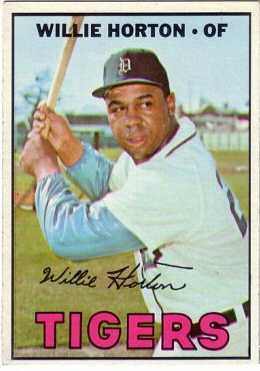
Willie Horton—Topps Company (1967) No. 465


Willie Horton was a favorite player of mine, despite the fact that he never played for two of “my” teams (the Yankees or the Pittsburgh Pirates). One of the most popular Detroit Tigers of the sixties and seventies, Horton made news three years ago when the Michigan legislature honored him with “Willie Horton Day” throughout the state. It was certainly a deserving recognition for the longtime outfielder-DH, who not only made seven American League All-Star teams during his career, but has also continually involved himself in numerous charitable and humanitarian acts throughout the Detroit area. A longtime member of the Tigers’ front office, Horton has worked with such organizations as the United Way, Meals On Wheels, and the Boys and Girls Clubs of America.

Horton’s community activism stretches all the way back to his playing days—specifically to 1967. That season, Horton achieved legitimate hero status when he left Tiger Stadium immediately after a game and traversed directly into the streets of Detroit during the city’s brutal racial riots in an effort to quell some of the violence. Still in full Tiger uniform, Horton climbed aboard a truck to speak to a gathering crowd of insurgents. Horton obviously couldn’t stop the riots by himself, but he did succeed in quieting some of the angry demonstrators, especially when he engaged them in calming one-on-one conversations. It was the kind of brave, civic-minded action that I can’t imagine coming from many of today’s major leaguers, given their general reluctance to “mingle” with the common folks even under more pleasant circumstances, both at the games and in other public locales.

Horton’s bravery under fire in 1967 probably didn’t surprise too many of his Tiger teammates, who had come to respect the quiet, rock-solid left fielder for his understated leadership abilities and unwavering professional approach to his work. Horton was one of just a few black players on the Tigers of ’67 and ’68 (along with backup outfielders Gates Brown and Lenny Green, starting pitcher Earl Wilson, and relievers Les Cain and John Wyatt) and the team’s only full-fledged African-American star. His status as the team’s most prominent minority made him extremely popular with black fans throughout Detroit, helping to attract a number of African-American visitors in creating a diverse crowd at Tiger Stadium. Curiously, white and black fans intermingled without incident at the old ballpark, in contrast to the anger and violence that bubbled between the races in the city streets.

On the field, Horton’s presence loomed just as large as his civic and social involvement. He was one of the most feared hitters of his era, in part because of a sturdy five-foot, 11-inch, 225-pound frame of compact muscle, achieved at a time when few players lifted weights and perhaps none used steroids or other performance-enhancing, bodybuilding supplements. Pound for pound, no one appeared stronger than the robust Horton, whose thick wrists and forearms made him a Bunyanesque figure. A seven-time All-Star during his career, Horton typically hit 25 to 35 home runs a year and put up slugging percentages bordering the .500 neighborhood in an era when pitchers enjoyed most of the “enhancements” that the game provided (an expanding strike zone along with the ingression of larger, full-figured stadiums in Anaheim, Oakland, and Kansas City).  Horton’s performance during the famed “Year of the Pitcher” in 1968 remains one of his landmarks; he hit 36 home runs and slugged .543 in a year where most hitters flailed away at far below their normal levels of production. He then hit .304 and scored six runs in the World Series against the St. Louis Cardinals, but it was one of his fielding plays that really turned the Tiger tide during the Series. Never known as a particularly nimble fielder, Horton aggressively charged a ground single to left and then air-launched a one-hop throw to catcher Bill Freehan, who tagged out Lou Brock to stymie a Cardinal rally in the fifth inning of Game Five. The Tigers went on to win the potential elimination game, then claimed the next two matchups to take the Series.

Horton remained the Tigers’ everyday left fielder until 1972, when injuries and a slumping bat restricted Horton to 108 games and led to a time-sharing arrangement with the lefty-swinging Gates Brown. Tigers manager Billy Martin lost so much confidence in Horton that he began to play a catcher, the awkward and immobile Duke Sims, in the outfield during the American League Championship Series, squeezing Willie out of starts in the fourth and fifth games. (Horton, by the way, says that Martin’s insistence on using Sims in the outfield during the playoffs cost the Tigers the pennant that year. Sims went only 1-for-6 in the final two games and committed an error in the decisive fifth game, which the Tigers lost to the A’s, 2-1. In the meantime, Horton appeared only as a pinch-hitter in those two games, delivering one hit in two at-bats. Man, when will managers realize that catchers in the outfield do not work, as seen in the failed examples of Sims, Manny Sanguillen, and Todd Hundley?)

Plagued by a series of injuries, Horton lost the left-field job completely within three years, as the organization decided to capitalize on the relatively new designated hitter rule, which had been put into place in 1973. Horton made a smooth transition to the DH role in 1975, but slumped considerably the following summer. He remained in the role until the early days of the 1977 season, when the over-the-hill Tigers decided to expedite a youth movement by trading Horton to the Texas Rangers for pitcher Steve Foucault, a hefty right-hander who had enjoyed a mixed bag of success but would last only two more seasons in the major leagues.

Legendary for his superstitions, Horton then bounced from team to team, enjoying varying levels of prosperity as a DH with the Rangers, Cleveland Indians, Oakland A’s, Toronto Blue Jays, and Seattle Mariners, while also earning the Comeback Player of the Year Award after his career had been given up for dead. His newfound status as a journeyman prompted a new superstition to be added to his repertoire of rituals, this one involving his equipment. According to the Horton legend, whenever he changed teams he allegedly refused a newly issued helmet from his acquiring team, instead painting the colors and logo of the new team onto his existing headwear. (For those who collected cards in the 1970s, Horton’s 1978 Topps card with the Texas Rangers provides an example of the alleged artwork on his helmet.) During an interview I did with Horton on MLB Radio, I asked Horton if this was true; he confirmed it during our chat while displaying the pride of a skilled painter. True to form, Horton still owns the battered helmet, which appropriately features the old logo and colors of the Mariners—his last major league team.

Bruce Markusen is the author of seven books, including A Baseball Dynasty: Charlie Finley’s Swingin’ A’s. His newest book, a revised edition of Tales From The Mets Dugout, is now available from Sports Publishing. Bruce is a resident of Cooperstown, NY.


Ladies and Gentlemen, Your 2007 New York Yankees (almost)

Hot off the ticker from Peter Abraham, Josh Phelps, Wil Nieves, and Sean Henn have won the right-handed first base, backup catcher, and second lefty reliever spots respectively, and Jeff Karstens will open the season on the DL. Thus:

1B – Doug Mientkiewicz (L)
2B – Robinson Cano (L)
SS – Derek Jeter (R)
3B – Alex Rodriguez (R)
C – Jorge Posada (S)
RF – Bobby Abreu (L)
CF – Johnny Damon (L)
LF – Hideki Matsui (L)
DH – Jason Giambi (L)

Bench:

R – Josh Phelps (1B)
S – Melky Cabrera (OF)
R – Miguel Cairo (IF)
R – Wil Nieves (C)

Rotation:

R – Carl Pavano
L – Andy Pettitte
R – Mike Mussina
L – Kei Igawa
R – Darrell Rasner

Bullpen:

R – Mariano Rivera
R – Kyle Farnsworth
R – Scott Proctor
R – Luis Vizcaino
L – Mike Myers
L – Sean Henn
R – Brian Bruney*

DL: R – Chien-Ming Wang, R – Jeff Karstens

The asterisks on Rasner and Bruney are because those two spots haven’t been officially announced. With Colter Bean as the only other candidate, however, those assumptions seem safe. The catch is that Karstens’ DL stint was dated retroactively, allowing him to be activated on April 7 if he’s ready, just in time for the fifth starter’s spot to come due on April 8. That means the Opening Day roster could very well include two more relievers and no Darrell Rasner, [UPDATE: Rasner has made the team and is in line to start on April 8.] though the Yankees could always take Rasner north as a long man.

As for the losers of the spring battles, Andy Phillips has been placed on waivers and could potentially clear and end up back in Scranton. Ron Villone has an option to opt-out if he doesn’t make the team, but the Yankees are trying to convince him to accept a triple-A assigment. He’s weighing his options. Todd Pratt, who was going to retire if he didn’t make the team, has left camp.

Also announced today, Josh Phelps will be the Opening Day first baseman against lefty Scott Kasmir, and Andy Pettitte, not Mike Mussina, will start the second game of the season on Wednesday per the order above.

Yankees 6, Blue Jays 3

Lineup:

L – Bobby Abreu (DH)
R – Derek Jeter (SS)
L – Robinson Cano (2B)
R – Alex Rodriguez (3B)
L – Hideki Matsui (LF)
S – Jorge Posada (C)
L – Josh Phelps (1B)
L – Kevin Reese (CF)
R – Kevin Thompson (RF)

Bobby Abreu led off and played the full game to compensate for some of the at-bats he lost to his oblique injury. He went 1 for 3 with a single, a walk, and a strikeout.

Pitchers: Steven Jackson, Ron Villone, Jeff Kennard, Scott Proctor, Kevin Whelan, Colter Bean

Subs: Doug Mientkiewicz (1B), Miguel Cairo (2B), Chris Basak (SS), Andy Phillips (3B), Tim Battle (LF)

Opposition: The Blue Jays’ starters save for Vernon Wells.

Big Hits: Solo homers by Alex Rodriguez (1 for 3), a two-out shot in the fourth, his team-leading fourth of the spring, Robinson Cano (1 for 3) leading off the seventh, and Derek Jeter (1 for 4) leading off the eighth. A double and a two-RBI single by Kevin Thompson (2 for 3).

Who Pitched Well?: Steven Jackson, who was awful in his original spring stint, acquitted himself well against the Blue Jays’ starters, allowing just two runs on five hits and a walk in five innings. Jeff Kennard pitched a perfect sixth inning, stranding an inherited runner. Colter Bean pitched a perfect ninth, stranding two inherited runners.

Who Didn’t?: Ron Villone faced one batter in the sixth. That batter singled. Kevin Whelan faced two batters in the ninth. Both of those batters singled.

Ouchies: Jeff Karstens and Chien-Ming Wang will throw bullpens from half-way up the mound tomorrow.

Battles: Joe Torre has said he’d announce the 25-man roster tomorrow. Peter Abraham suggests that Josh Phelps, Wil Nieves and Brian Bruney will be the right-handed first baseman, backup catcher, and last righty reliever, respectively. That just leaves the second lefty reliever (Villone allowing a single to his only batter tonight is yet another data point in Sean Henn’s favor), and the fifth starter. With Karstens not throwing his bullpen until tomorrow, one assumes Torre’s either already made up his mind there, or that the announcement will come immediately following Karsten’s “bully,” as Torre likes to call bullpen sessions.

Notes: Cory Lidle’s widow and son with throw out the ceremonial first pitch on Opening Day. A correction to yesterday’s note: Mike Mussina’s minor league outing will occur tomorrow, not today, as will Andy Pettitte’s, as initially reported.

UPDATE:

Cuts: The Kevins were optioned to triple-A after the game, but will remain in major league camp through Saturday.

Also: Mike Myers gave up a pair of runs on four hits in two innings, but also struck out four against the Devil Ray’s triple-A campers.

End of the (Family) Affair?

Life after George has just taken a turn. Steinbrenner’s daughter, Jennifer field for divorce yesterday, leaving Steve Swindal’s future with the club uncertain. Tyler Kepner tackles the story in the Times.

Astros 12, Yankee 2

Darrell Rasner tried to give back the fifth starter’s spot, but forgot that there’s no one around to give it to . . . or is there?

Lineup:

L – Johnny Damon (CF)
R – Derek Jeter (SS)
L – Bobby Abreu (RF)
R – Alex Rodriguez (3B)
L – Jason Giambi (DH)
L – Hideki Matsui (LF)
S – Jorge Posada (C)
L – Robinson Cano (2B)
L – Doug Mientkiewicz (1B)

Pitchers: Darrell Rasner, Ron Villone, Sean Henn, Brian Bruney, Kyle Farnsworth, Luis Vizcaino

Subs: Miguel Cairo (2B), Chris Basak (SS), Carlos Mendoza (3B), Eduardo Nuñez (3B), Wil Nieves (PR/C), Kevin Thompson (RF), Kevin Reese (CF), Josh Phelps (DH)

Opposition: The Astros B-squad.

Big Hits: Doubles by Derek Jeter (1 for 4) and Jason Giambi (1 for 3). Bobby Abreu was 2 for 3 and drove in Jeter in the bottom of the first.

Who Pitched Well?: Kyle Farnsworth and Luis Vizcaino each threw perfect innings, though Farnsworth had the only strikeout between them.

Who Didn’t?: Brian Bruney allowed two runs on three hits in his lone inning of work, though he didn’t walk anybody. The big story though was the disaster outings by Darrell Rasner and Ron Villone. Villone faced three men, registered just one strike and gave up a four-pitch walk, a single, and a two-run triple, the last to an A-ball shortstop named Tommy Manzella. Darrell Rasner, meanwhile, gave up a whopping seven runs on nine hits, five of them for extra-bases, and two walks in 4 2/3 innings (Villone was supposed to get that last third, but, fittingly, passed the buck to Sean Henn, who allowed Manzella to score before getting that final out of the fifth). Among the hits allowed by Rasner were three doubles, a triple, and a home run, though all came off the bats of men who will head West with the major league team.

Oopsies: Hideki Matsui flubbed a ball in left.

Ouchies: Andy Pettitte threw 31 pitches in the bullpen yesterday, getting up to full speed and mixing in all of his pitches. He’ll throw a minor league game or a simulated game in Tampa today. Jeff Karstens will throw a bullpen today and says he doesn’t feel any discomfort in his elbow. The big injury news, however, took place outside of camp. Peter Abraham reports that J.B. Cox, who missed spring training because he broke his pitching hand in a fight, had a ligament in his pitching elbow repaired by Dr. James Andrews earlier this week. He could return to action at the end of the season, but any hope of him serving as a late-season reinforcement in the pen is gone. Abraham also reports that 2006 draftee Mark Melancon, a right-handed reliever out of the University of Arizona, had full-blown Tommy John surgery this winter.

Battles: Given Rasner’s poor outing, Jeff Karstens could still break camp with the team as the fifth starter if his bullpen work goes well. The team won’t need a fifth starter until a week from Sunday and could give Karstens an inning or two out of the pen early next week as part of his rehab. Meanwhile, Ron Villone remains in play despite all evidence to the contrary. After the game, Joe Torre said that Villone looks exactly like he did a year ago at the end of spring: “If he wasn’t here last year, then it would be tough to even consider him, but with what we know about him and know about his makeup and all that stuff, I think you still have to make a decision with that infumation being a part of it.” Brian Bruney had a bad outing. Wil Nieves went 0 for 2 with a strikeout. Josh Phelps made out in his only at-bat.

Notes: Mike Mussina will pitch in a minor league game today. The Yankees have called up Steven Jackson and Chase Wright to pitch the major league games in place of Mussina and Pettitte today and tomorrow.

Inside Out

By Emma Span

The day before I left New York to cover spring training, my editor at the Village Voice was abruptly fired. When I got back, I met the new editor for the first time… at which point he abruptly fired me, for reasons he declined to explain, other than that I wasn’t his “taste”. Ah, the thrilling world of print media! I knew I should’ve gone to law school.

In some ways, though admittedly not most, this is actually a bit of a relief: I could already feel, after only seven months on the job, some of the joy being sucked out of the game. Baseball writing is a grind, with few off days and very little time to relax, and sportswriters are quick to admit they’re not fans. (This Joel Sherman post is one of the more recent and, I think, honest examples, but almost any beat writer will echo these sentiments). Nor should they be: they’re supposed to be objective, and as Sherman says, his allegiance is to his column. But when you’re neutral, a baseball game becomes an exercise in aesthetics and plot points. It can still be a pleasure to watch, but it lacks the visceral emotional pull that draws many of us to sports in the first place.

Seeing the players off the field humanizes them – watching Mariano Rivera examine a pair of new sneakers, or Endy Chavez trying and failing to tie a tie, or Farnsworth, Bruney, and Proctor feeding the waterfowl. But the fact is that half the fun of rooting for baseball teams lies with the larger-than-life personalities and storylines. With a game every day, you need heroes and villains, not regular people (incredibly fit and staggeringly wealthy regular people, but you know what I mean) with their mundane complement of merits and flaws.

In many ways I was less disillusioned by the players than I expected to be – our culture takes a dim view of professional athletes these days, but almost everyone I talked to was at the very least polite (even when clearly sick of answering questions), and more than a few came across as intelligent and pleasant. But that’s not the point. The point is that if you’re going to spend three or four hours of your life watching a ball game, you want to cheer for your heroes – not the actual human beings, but your idea of them. Melky Cabrera the person seems like a good kid. I got to interview him through a translator this spring, and he spent most of the time smiling warmly and thanking God and Joe Torre – roughly an equal number of times, which I suppose is probably about right. But I still prefer the Melky of the popular imagination who sprang into the city’s collective consciousness last year.

Sometimes the real world is kind enough to give your imagination what it wants. One of the knocks against the Yankees in recent years has been that they don’t appear to be having much fun. Not a few pundits actually blamed the 2004 ALCS loss on this, though I’d argue that was due more to the Red Sox’s pitching, David Ortiz’s hitting, and Dave Roberts’ legs than any kind of magical positive attitude (FORP – Fun Over Replacement Player?). But as a fan, purely as regards entertainment value, it is generally more enjoyable to watch a group of guys who are having a good time themselves. I wouldn’t say that “fun-loving” is the precise word to describe those 1990s teams, but they did appear to genuinely like each other.

Last year, the Mets often seemed to have the Yankees beat by miles in that regard, but in Tampa this spring the Bombers looked as if they were catching up. I think partly that’s due to the youth influx – Cano and Cabrera together are an exuberant presence, even though (or maybe because) I usually can’t understand what they’re saying. But it’s also a deliberate effort: Johnny Damon and Jason Giambi, in particular, are making loosening up a priority.

“It’s been a slow turn but we’re definitely getting it,” said Giambi of the lightening clubhouse atmosphere. “When I first came over here it was just a different core of guys, they weren’t like that. They were more businesslike, which was great because it was successful for them, as far as winning four world championships… I mean they had fun, but they were a little more businesslike. Whereas Johnny and I are a little more-” he paused to find the right word, and succeeded – “slapdick.”

In the end, playing good baseball will make almost any group likeable. But as both juicy column material, and fodder for cheerfully irrational fandom, I say the more outsized personalities the better — the kind of personalities who can make an impression from a distance. Cano and Cabrera did this last year, and I believe Giambi can do it again, regardless of what kind of artificial help he may have had in the past. Matsui does it without the benefit of speaking English. And hell, Johnny Damon is the master. We’re down to the last vestiges of those 90s teams, if you’ll forgive me for referring to one of the greatest closers of all time as a vestige, and the Yankees need to forge a new identity for themselves. I just want it to be an engaging one — whether I end up watching this season from the press box, the stands, or the futon.

Emma Span is now a freelance writer, apparently, and lives in Brooklyn. She blogs about New York baseball at Eephus Pitch.

Twins 4, Yankees 3

Ron Gardenhire’s son won the game in the bottom of the ninth when Chris Basak booted his grounder up the middle with the winning run on second base.

Lineup:

S – Melky Cabrera (LF)
L – Robinson Cano (2B)
L – Bobby Abreu (RF)
S – Jorge Posada (C)
R – Josh Phelps (DH)
R – Andy Phillips (1B)
R – Chris Basak (SS)
L – Kevin Reese (CF)
R – Miguel Cairo (3B)

Pitchers: Carl Pavano, Colter Bean, Mike Myers, Scott Proctor, Chris Britton

Subs: Ramiro Peña (SS), Todd Pratt (C), Kevin Thompson (RF), Brett Gardner (CF)

Opposition: Most of the Twins starters, but no Joe Mauer.

Big Hits: Solo homers by Bobby Abreu (2 for 2, BB) and Josh Phelps (2 for 4). Phelps is now tied with Giambi and Rodriguez for the camp lead in homers despite having roughly 20 fewer plate appearances than the other two. Abreu, meanwhile, has two homers in just 18 PA. Robinson Cano (2 for 5) picked up his ninth double of the spring.

Who Pitched Well?: Carl Pavano didn’t strike anybody out, but he turned in a quality start allowing just six hits and a walk in six innings and getting 14 of his eighteen outs on the ground thanks to four double plays. He needed just 86 pitches to get through those six innings. Mike Myers threw just two pitches and retired his designated batter, Jason Kubel.

Who Didn’t?: In to face a series of subs in the ninth, Chris Britton issued a four-pitch walk to Luis Rodriguez with one out. After pinch-runner Jason Tyner stole second with two outs, Britton gave up a game-tying single up the middle to Matt Tolbert, a player on loan from the Twins’ minor league camp who wasn’t even invited to major league camp this spring. Tolbert moved to second when Kevin Reese’s throw from center tailed away from cutoff man Andy Phillips, and came around with the winning run when Toby Gardenhire—I kid you not, the manager’s son, Toby, who also was never officially invited to minor league camp—hit another ball up the middle that Chris Basak booted. Tolbert and Toby wore numbers in the 90s and didn’t even have names on the backs of their jerseys. Embarrassing doesn’t cover it.

Oopsies: Chris Basak, playing shortstop, flubbed a grounder to his right on the Yankees’ first defensive play of the game. Playing second base, he then flubbed a grounder to his right on the Yankees’ final defensive play of the game. Basak has made four errors this spring.

Ouchies: Chien-Ming Wang played catch with Ron Guidry from 60 and 90 feet away, making 45 throws. He hopes to beat the Yankees projected return date. Andy Pettitte reported no ill effects from his bullpen on Monday. Jeff Karstens is wearing a protective sleeve on his pitching arm and taking anti-inflammatories. He could start throwing again tomorrow, but will be careful not to rush back to quickly. Ron Villone was hit in the shin by a comebacker in his minor league outing on Monday, but escaped with just a bruise. Humberto Sanchez (elbow) will start the season in extended spring training.

Battles:: Josh Phelps hit a solo home run in the second and singled in the go-ahead run in the ninth, though he did strike out and hit into a double play in his other two at-bats. Phelps is tied with Robinson Cano for the camp lead in RBIs despite having barely more than half as many plate appearances as Cano. Andy Phillips followed Phelps’s home run with a strikeout, then followed that with three more Ks, though he did make some smooth plays in the field. Todd Pratt struck out in his only at-bat. Colter Bean walked the first two men he faced in the seventh, but rallied to post another scoreless inning.

Notes: Twins starter Boof Bonser (who, despite allowing a pair of solo homers, allowed just two other hits and struck out seven in his six innings of work) looks and moves like a right-handed David Wells. Meanwhile, Carl Pavano’s gait on his walk from the mound to the dugout is beginning to resemble Joe Torre’s in the other direction. Despite Pavano’s solid outing, he still hasn’t officially been named the Opening Day starter, though he seems like a lock at this point.

feed Share on Facebook Share on Twitter Share via email
"This ain't football. We do this every day."
--Earl Weaver
