"A New York Treasure" --Village Voice
Category: Games We Play

All Growed Up

Mannish Boy.

Untitled

Barry Zito is the focus of Pat Jordan’s latest profile for the New York Times Magazine. Another stellar job by Jordan. I always figured Zito was a superficial guy, a pretty boy phony, but he comes off as an interesting dude:

Zito told me his pitching problems were caused by the fact that he hadn’t been himself the last few years.

"I wanted to be more ‘professional,’ " he said. "This new guy. Because of the Contract, I wanted people to know I was serious about pitching, not this flaky guy. I allowed the seriousness of things to creep into my mind. The city. The Contract. The fans. My new teammates. I wasn’t a blue-collar Oakland guy anymore."

…He was particularly stunned by the vehemence with which the media and fans greeted news of the Contract. And then he was stunned by the fans’ booing his failed pitching. "Actually, I think the San Francisco fans have been pretty good to him," Righetti said. "If he was in New York, the fans would be off the chart." But Zito wasn’t used to being booed and criticized. His flaky persona had deflected such criticism for years, as if people felt it was unfair to be too harsh on such an innocent sprite. But he’s not a sprite anymore, and his critics are no longer so forgiving. Which is why he has assumed a new persona: the abused guy who can no longer be himself with people. "But it requires so much energy to be inauthentic," Zito said. Which is the point. Zito was never truly "authentic." The free-spirited kid was always something of a construct. Now that he’s a man, it’s time for "serious things," like the apparently premature demise of a once-brilliant career. This is what Zito is struggling with. But how to rewrite the narrative of his life?

"I never thought I was invincible at everything, just baseball," Zito said. "At 30, I became aware of why things happened." He now saw his parents’ psychobabble — "Don’t expect to struggle" — as something that could lead not only to awareness but confusion. "Zen is a double-edged sword," he said. "It guarantees nothing. When I went 11-1, it worked. Next year it won’t. Zen helps you solve some problems, but it’s better at creating problems. Thinking too much is good for life, but not functional for baseball." He’s searching for that mind-set all great, intelligent pitchers have. Compartmentalize. Complexity for real life, simplicity for baseball.

Can an athlete be too smart for his own good? I think so. Being bright might make a jock a more well-rounded person, but also less of a performer. Reminds me of Billy Beane in Moneyball, realizing that he would never be a great player after rooming with Lenny Dykstra who was "dumb" in all the right ways.

Treasure Trove

Untitled

A few months ago I invited myself to Ray Robinson’s apartment, ostensibly to get his list of ten essential baseball books, but really so I could lay eyes on his library of sports books.  Robinson, an author (Iron Horse) and longtime magazine editor, grew up on the Upper West Side, near Columbia.  When he was a kid, Robinson got a delivery job at a local liquor store, and he found himself making stops over at Babe Ruth’s apartment at 110 Riverside Drive. He’d say, ‘Thanks keed,'” Ray told me.  “He called everybody ‘keeed,’ because he couldn’t remember anyone’s name.  And he would invariably honor me with a couple of dollar bills.”

Ray and his wife, Phyliss were wonderful with me.  We chatted in the living room of their comfortable New York apartment for about an hour and Ray shared his selections of favorite baseball books with me.  I poked my nose through his collection and as I was about to leave, Ray said, “Oh, would you like to see my scrapbooks?”

“Sure, I would.”

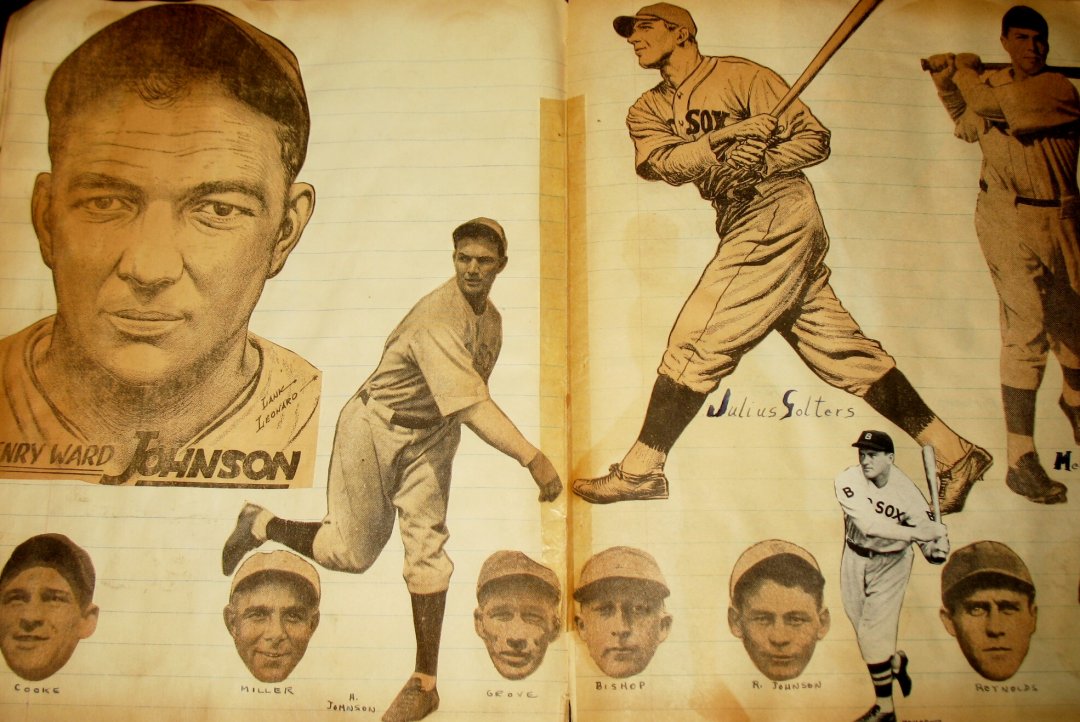
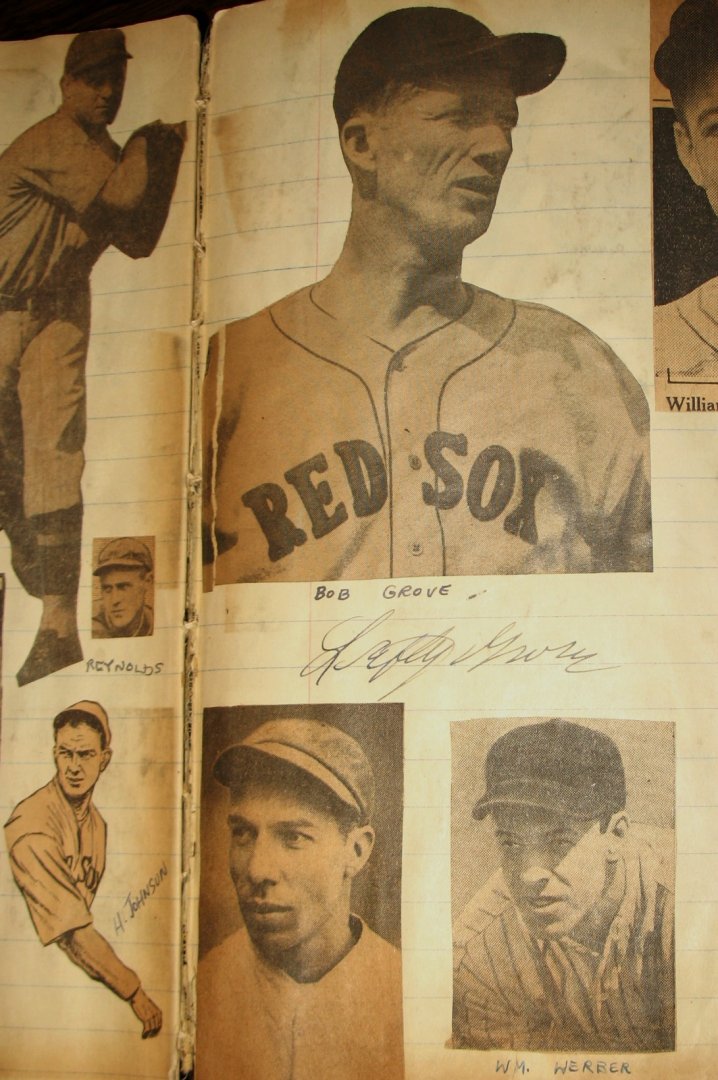
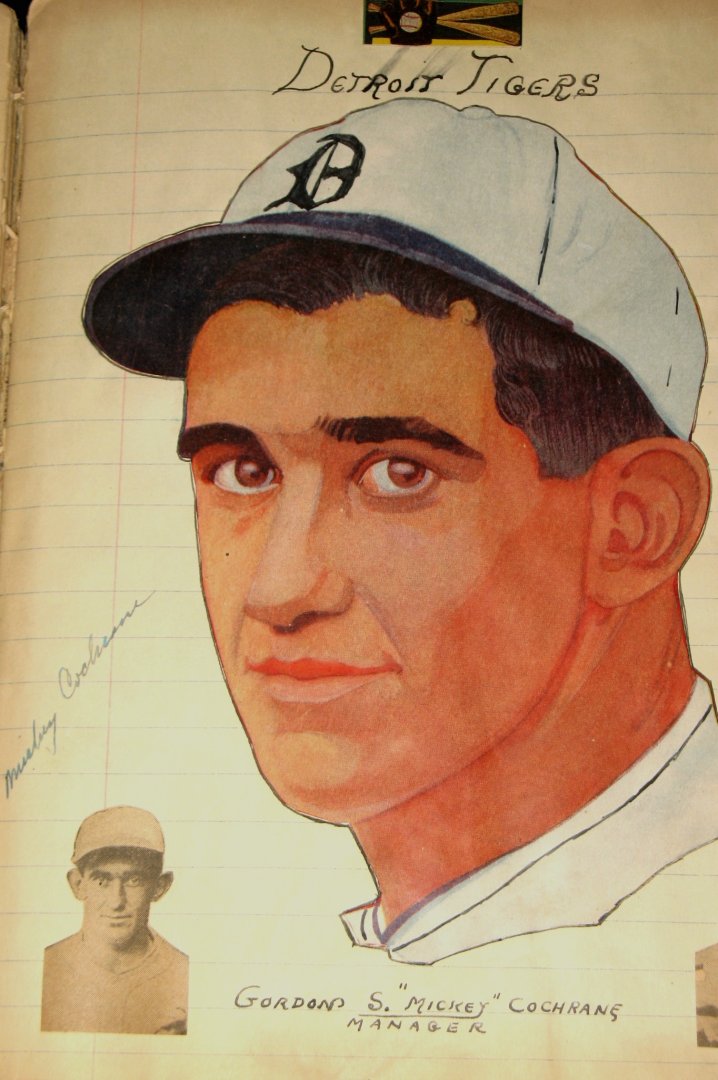
Ray picked-up a bright orange plastic bag from the bottom of the bookshelf, the kind you’d get from the local Chinese take out.  He pulled out two weathered books, practically falling apart, one dated 1932, the other, 1933.  They were filled with pictures of players from every team in baseball.  Ray cut-out images mostly from The New York Sun, The Saturday Evening Post, assorted baseball magazines as well as baseball cards.  Then, along with some friends, he’d scout the hotel lobbies where the out-of-town teams stayed, to get autographs.

Untitled

The books are lovingly, obsessively assembled, filled with small notations.  Ray expressed some embarrassment when I complemented him on how wonderful, how personal the books are. He dismissed his sketch of the Babe as being awful, but I liked it and his wife did too.

Ray asked if he should sell the books–after all, he’s got a couple of Lefty Groves in there, a Honus Wagner, Dizzy Dean.  Phyliss said that she didn’t think that was a good idea. I quickly agreed.

“You can’t sell these,” I said.  “They belong in a museum or for your grandkids.”

As I looked carefully through the two books, Ray kept wondering if he should sell them.  I said, “No way,” but when I left I felt foolish.  Who am I to say that he shouldn’t sell them?  There is probably some serious money in those two books.  Still, they feel too personal to part with.  They are not kept under a glass case, they are in a plastic bag on the shelf, a secret baseball treasure on the Upper East Side.

Yesterday, the New York Times featured a short essay by Ray Robinson about his scrapbooks.

Check it out and dig what I was able to see:
Untitled

Untitled

(more…)

The Way it Was vs. The Way it Is

Slate has the latest from Pat Jordan, Josh Beckett Won’t Return My Phone Calls:

In January, I got an assignment from the New York Times Magazine to write a profile of Josh Beckett, the Red Sox pitcher. I was excited about this because I had always admired Beckett as both a pitcher and a person.

…But, alas, in a single-sentence e-mail from his agent, Beckett declined to be interviewed by me or anyone else. I could understand that. Why would he want me poking around in the closet of his life? Maybe I’d spend four days with him, and catch him saying something derogatory, in a moment of weakness or fatigue, about his manager, Terry Francona, or about Manny Ramirez. He was making, what, $10 million a year? He had just pitched superbly in the 2007 World Series after compiling a brilliant 20-7 record during the season. He didn’t need a New York Times profile or recognition for anything but his pitching.

…But, still, I thought it was a shame Josh wouldn’t let me profile him in the Times. I had a long lunch with him a few years ago, when he was with the Florida Marlins, and came away thinking he was an interesting young man. At the time, and even now, Beckett had a reputation for being a surly, hard-ass, rednecked, Texas country boy in the way of old-timey ballplayers. But the Josh I met over lunch was smart, caustic, funny, sophisticated, and a much deeper and more nuanced man than his public gave him credit for. I would have loved to have burnished his image, to have shown his fans that side of him in a profile. But it wasn’t to be. His fans then lost an opportunity to know the real Josh Beckett.

This has become the curse of modern sports journalism. Writers and fans alike no longer get to know the object of their affections in a way they did years ago. Athletes see us as their adversaries, not as allies in their achievements. They are as much celebrities as rock stars and Hollywood actors are. They live insular lives behind a wall of publicists, agents, and lawyers. They don’t interact with fans or writers. They mingle only with other celebrities at Vegas boxing matches, South Beach nightclubs, and celebrity golf events, all behind red-velvet VIP ropes. We can only gawk at them as if at an exotic, endangered species at a zoo.

Easy Quesy

Yesterday afternoon, Pete Abraham excerpted a portion of Cynthia Rodriguez’s chat with Michael Kay on the new YES program, YESterdays:

“As tough and big as [Alex] seems, he is real wimpy around doctors or any type of medical situation. I don’t know why I thought the birth of our child would be different. In the middle of the night, I realized that I needed to go to the hospital. I wake him up. The first thing that comes out of his mouth, ‘Can we call your mother?’ And I started, ‘No. Let’s wait and make sure that I am in labor, and make sure that, you know, it’s the middle of the night.’ And go to the hospital and everything. And finally, a few hours later, I said, ‘I think you can call my mom now.’

“Uh, and the color came back to his face when I told him he could call my mom. And then forget it. I was like not even having a baby; he was the one. The one nurse had a cold cloth on his head. The other nurse had the blood pressure on his arm. And my mother was like rubbing his back. And he is passed out on a couch. And I am there, in the middle of labor. And really, I am not being paid much attention to besides the doctor and a couple of nurses. And he is there moaning. In between pushing, I am going, ‘Honey, are you OK?’ And are you breathing? Are you OK?'”

I can’t even watch child birth on TV, so I can only imagine how I’d fare up close. Still, this story reminded me of another, more upsetting reality for baseball wives. From Pat Jordan’s classic profile of Steve and Cyndi Garvey, “Trouble in Paradise”:

The other day my daughter fell out of a tree and broke her wrist.  My husband and I rushed her to the hospital.  While she was in the operating room I had to fill out a questionaire for a nurse.  When I said my husband’s occupation was ‘baseball player,’ she asked, for what team?  I told her.  Then she asked, what position?  I got so pissed off, I shoved the paper at my husband and told him to deal with her, she was obviously more interested in him than our daughter.  Now there’s another woman who’s gonna think I’m just a stuck-up wife of a star.
 
Anyway, just before they set my daughter’s wrist, my husband had to leave to go to the stadium.  He couldn’t wait.  That’s the clearest vision of when the game comes first.  Before anything.  It’s so cut-and-dried with him.  I got furious.  It’s always been like that.  Another time I had a baby while he was playing in the World Series.  When they wheeled me back from the delivery room–I’m just coming out of the anesthesia–the nurse is putting on the TV.  ‘I thought you’d like to watch your husband playing in the World Series,’ she says.  I screamed at her to shut it off.  Hell, he didn’t come to watch me.  I could have died in childbirth and my man wouldn’t have been there.  The burden is always on the wife’s shoulders.  Her man is never there.

For a candid and revealing portrait of what is like to be the wife of a ball player, consider Home Games: Two Baseball Wives Speak Out, written by Bobbie Bouton and Nancy Marshall. Both women are divorced their husbands, Jim Bouton and Mike Marshall.

Diggin in the Crates (Rain, Rain Stay Away)

One of the most exciting events of the spring has been the recent launching of the SI Vault. Talk about an embarassment of riches. Dag. To my dismay, the site does not offer anything close to a complete author index, making finding stuff a frustrating experience at best. I can only hope that this is a temporary problem, because it would be a real shame for something as rich and varied as the SI archives to be needlessly difficult to navigate.

Still, here are a couple of gems for you as we wait for today’s game. No telling if the rain will mess with things this afternoon. It’s warm and foggy this morning and the sun is even shinning here and there in the Bronx. I’m gunna throw up this game thread now cause I won’t be around for the start of the game. If they get it in, Andy Pettitte will make his first start of the year. If there is a delay, grab another bowl of soup, and consider the following bag o treats from the SI vault.

Come Down Selector:

A Diamond in the Ashes: Robert Lipsyte’s highly critical take on the rennovated Yankee Stadium (April, 1976).

This Old House: William Nack’s essay on the Stadium (June, 1999), and The Colossus, his piece on the Babe (August, 1998).

The Play that Beat the Bums: Ron Fimrite’s look back at the Mickey Owens game and the 1941 season (October, 1997).

Mickey Mantle: Richard Hoffer’s piece on the legacy of the last great player on the last great team (August, 1995).

A Real Rap Session: Peter Gammons talks hitting with Ted Williams, Don Mattingly and Wade Boggs from the Baseball Preivew issue (April, 1986).

Yogi: Roy Blount’s takeout piece on the Yankee legend (April, 1984).

Once He Was an Angel (March, 1972) and Tom Terrific and His Mystic Talent (July, ’72), two classic portraits (Bo Belinsky and Tom Seaver) by Pat Jordan.

No Place in the Shade: Mark Kram considered this portrait of Cool Papa Bell to be his finest work for SI (August, 1973). And while we’re on Kram, check out A Wink at a Homely Girl, his wonderful piece about his hometown Baltimore that appeared on the eve of the ’66 World Serious (October, 1966).

Laughing on the Outside: John Schulian’s fine appreciation of the great Josh Gibson (June, 2000).

And finally, He Does it By the Numbers: Dan Okrent’s landmark essay, you know, the one that “discovered” Bill James (March, 1981).

There, that should keep you busy for more than a minute.

Yeah, I Gotta Rash, Man

Did anyone catch the segment on Lenny “Nails” Dykstra on the latest edition of HBO’s Real Sports? Ex-ballplayer-turned-shrewd-businessman. It’s worth watching for the highlight clip they show of Nails throwing bolos at Dodger catcher Rick Dempsey back when he was with the Phillies. It’s also interesting to see how Dykstra looks and sounds like a troll, almost as if he’s drugged. (And if you want to get good and steamed, wait around until the post-segment interview between reporter Bernie Goldberg and host Bryant Gumbel, and dig how Goldberg cops out of telling the truth about Dykstra’s alleged use of PEDS.) Pat Jordan wrote a piece on Dykstra for Fortune.com back in December of 2006. The published version concentrates mostly on the nuts-and-bolts of day trading, but Jordan’s original (“The Dude Abides”) focused more on what it was like to hang out with Dykstra.

(more…)

Soul on Ice

I tried to represent as many different sports as possible when I put together The Best Sports Writing of Pat Jordan. Funny thing is, while there may be more great writing about boxing than any other sport, including baseball, no boxing stories made the cut, though Pat’s done some decent ones, like this one about Amir Khan, the Great British-Pakistani-Muslim Hope:

At 10 p.m., Amir Khan walked into the arena amid the flash of cameras and TV lights and the Asian girls aiming their cellphone cameras at him. He was wearing his trademark silver trunks, but with a slight alteration: tartan trim had been sewn in. Steve Gethin stood in his corner, his blue eyes wide.

The bell rang for Round 1. Khan loped into the center of the ring and began to stalk Gethin. He moved gracefully, bent over at the waist, bobbing and weaving left and right, his hands dangling low to the canvas. Khan did not look so young now, nor so slight. He looked huge next to Gethin and dangerous in a primitive way. Suddenly he attacked Gethin, hitting him with three quick punches before Gethin could react. Khan did resemble Muhammad Ali in the ring. It’s almost sinuous, the way he moves. He’s a trained fighter, but an instinctive one too.

Khan pursued Gethin, who backpedaled, Khan weaving hypnotically, and then he sprang again, pummeling Gethin with so many quick punches it seemed as if they were all one long, continuous punch. Gethin wrapped his arms around Khan and waited for the referee to separate them.

The fight didn’t last very long. The referee stopped it in the third round, after Khan again battered Gethin’s head with so many quick blows in succession that Gethin could only cover his face with his gloves and forsake any thought of throwing a counterpunch.

Khan raised his arms in victory. Some cheered; others were upset the fight had been stopped early. The members of “Khan’s Barmy Army” poured out of their seats. They began to leave the arena, waving their Union Jack-Pakistani flag at the seated fans. The Scottish fans began to throw things at them. Bottles. Sharpened coins. Cups of beer. “Khan’s Barmy Army” covered their heads. Security appeared from the runways, surrounded Khan’s “army” and hustled them out of the arena. In the ring, Amir Khan, oblivious, was being interviewed on ITV with his father.

Pat did a handful of hockey pieces for Sports Illustraed in the ’70s including a good one on Derek Sanderson. We included a hockey story in our collection, one of his earliest pieces for Sport magazine, about the Bruins at the old Boston Garden. Here is a good little profile Jordan did on Mike Keenan for The Sporting News in 1994, just after coach Keenan left the Rangers for St. Louis.

Italian waiters at Gian-Peppe’s Restaurant in “The Hill” section of St. Louis are wearing tuxedos with frilly shirts. They hover around Keenan at his table as if he were the Mafia Don out of “A Bronx Tale.”

“I used to hang around with seven Italian brothers when I was a kid,” he says. “I was the only Irish kid. If they got a beating from their mother, I got a beating from her, too.” He laughs, and drains his beer. Keenan asks a waiter to bring him a phone. He has to call his daughter, who will visit him tomorrow, and he’s worried that she might not have gotten the airplane ticket he sent her.

“It causes me great pain to be away from her,” he says, as the waiter returns with the phone. “I’m proud of my accomplishments, but maybe my ambition was selfish. You pay a personal price. Loneliness. It’s the only thing that scares me.” He makes the call, but his daughter is not home. The other waiter returns with a beer. For a tough-guy hockey coach, Keenan talks a lot about pain and lone-liness and even fear. He had a fear of failure when he took over at Philadelphia.

“I was confident,” he says. “I felt ready. But there’s always that fear in hockey if you’re not successful you’ll never coach again. I felt I had to be firm with my players and then I’d back off after a while, you know, the way a teacher does. But the players didn’t think I let up as much as I should have. I like to think my relationship with players has improved. I’ve improved. After the separation, I learned to reflect on life. To be introspective, tolerant and understanding. It was an awakening.” He picks up the phone and dials his daughter again.

I’m not a hockey fan and I never have been. I don’t follow boxing but I liked it as a kid. Hagler, Hearns, Sugar Ray. The tail end of Ali. The Rocky movies (seeing Rocky III in the balcony of Loews 83rd street–a theater no longer with us–with the place literally shaking during the big fight at the end, was one of the more memorable movie experiences of my childhood). Larry Holmes v. Tim Witherspoon, vs. R. Tex Cobb, all the way through Iron Mike’s early days.

I want to read more boxing writing at some point–there’s so much good stuff out there. I’d at least like to give it a shot. It’s such an appealing sport for writers because, as Len Shapiro of the Washington Post says, “It’s the greatest sport in the world until they get in the ring.”

Lot of good boxing movies too, come to think of it: Body and Soul, Somebody Up There Likes Me, Fat City, Rocky, Raging Bull, When We Were Kings. And Slap Shot is arguably the greatest sports movie of them all.

C’MMMMMOONNNNN (That’s a Terrible Call)

The Pat Jordan pick of the week is a profile he did on the ol’ red-headed Deadhead for the New York Times Magazine back in 2001. Here’s Bill Walton’s Inside Game:

Back at the house, Walton goes to practice his piano while his sons go outside to play one of their fierce two-on-two basketball games. Nate and Bruk Vandeweghe, who has lived with the family for 20 years, team up against Chris and a friend. Luke, limping from an ankle sprain he suffered in one of the boys’ recent games, sits in a chair and mimics his father broadcasting the game that is filled with rough play and profanity.

Nate fakes under the basket and tosses in a hook shot. “Nice utilization of the body,” Luke intones. Chris immediately hits a long jumper. “But Chris will not go away,” Luke says.

Chris drives toward the basket and tosses a pass behind his back that goes out of bounds. “A good look,” Luke says, “but a little too fancy.”

Nate and Chris dive for a loose ball and bang heads. Chris screams a profanity at Nate, and Nate curses back. As play resumes, Walton hobbles out on his crutches to watch. “What are you doing here?” Nate says. The boys’ game is deflated. They continue to play, but without their previous fury; no more curses, just a lot of uncontested jump shots until the game expires.

After the game, Vandeweghe sits by the pool and talks about his life with the Waltons. He acts as their unofficial manservant, serving drinks, giving the boys massages on the living-room table and running errands. “This house is in a time warp,” he says. “Like a monastery. Still, there’s a lot going on here you don’t know.” He smiles. “Bill wants everyone to have a good time. At his parties, there are three girls to every guy. Bill lets you do anything with girls as long as you don’t talk about it in front of Lori. She’s subservient, like a geisha. She serves her purpose for Bill. She’s thrilled to be with a star.” He says that the Waltons’ divorce was hard on Susie. “She was like my second mom. She can’t lie. Bill can’t talk about her because he knows she’s right.”

At that moment, Nate, furious, comes out of the house toward Vandeweghe. “Same old garbage!” he snaps. “I told Bill I was gonna see Mom, and he says he wants to talk to me for five minutes, and it goes on and on, nowhere.”

Not everybody loved Jordan’s story. Here is a letter the Times published on November 25, 2001:

In the 20 years since I wrote about the Portland Trail Blazers in an earlier book, Bill Walton and I have become good friends, and I have spent a good deal of time with him and with his sons (Pat Jordan, Oct. 28). The relationship between father and sons has always struck me as loving, supportive and mutually generous; I think it is not unimportant that in a home where the father let all of his sons follow their own stars, all four wanted to play basketball. More important, what Pat Jordan missed was the story right in front of him: the rarest kind of courage and exuberance on the part of an athlete, once gifted, whose ability to maximize the uses of his body is so critical to his psyche but is now so seriously jeopardized by the cruelest kind of injuries to both feet.

David Halberstam
New York

Clearly, Pat never read How to Wins Friends and Influence People.

[Photo Credit: L.A. Times]

The Gambler’s Son

Not so long ago, a good friend of mine encouraged me to feel comfortable promoting myself. While it doesn’t come naturally for me, I figured, what the hell, I can talk about Pat Jordan’s writing all day long. The Best Sports Writing of Pat Jordan is coming out just before Opening Day. Each week until then, I’m going to pick one of Pat’s stories that can be found on-line and feature it in a post. Leading off is a fun piece he did a few years ago for the New York Times magazine on Daniel Negreanu, the all-star poker player (the story was featured in The Best American Sports Writing 2006, edited by Michael Lewis).

Card Stud (Originally published, May, 2005.)

Negreanu claims not to have much interest in money, except as a means of keeping score. After he won that $1.8 million at the Bellagio, he bought six videos and put the rest of the money in poker chips in a lockbox at the casino as if it were a bus-station locker. The chips are still there. The $1.1 million Negreanu won in Atlantic City was converted into $300,000 in cash and an $800,000 check. Back home in Las Vegas, he discovered that he left the check in his hotel room; the maid threw it out, and Negreanu had to fly back for another check. “I don’t believe much in banks,” he says. “Although I do have one bank account with not much in it, just a couple hundred thousand.” He also doesn’t believe in credit cards, or buying anything he can’t afford to pay cash for, which is why he always travels with a wad of $100 bills held together with an elastic band.

Negreanu has two basic rules for playing poker. First, maximize your best hand and minimize a mediocre hand. Too many novices play too many mediocre hands when not bluffing, which increases their chances of losing. Great players only play hands when they have “the nuts,” or unbeatable cards; otherwise they fold hand after hand. Second, play hours, not results. Negreanu sets a time limit for his play and sticks to it, whether he’s winning or losing. If he goes beyond his time limit, he risks playing “tired hands” when he is not sharp. (Before a tournament, Negreanu gives up alcohol and caffeine. “I do nothing, to numb my brain,” he says, “except watch poker film — just like an N.F.L. team before the Super Bowl.”)

Negreanu says that most great players are geniuses, then lists the kinds of genius they must have: 1) a thorough knowledge of poker; 2) a mathematical understanding of the probabilities of a card being dealt, given the cards visible; 3) a psychological understanding of an opponent; 4) an understanding of an opponent’s betting patterns — that is, how he bets with the nuts and how he bets when bluffing; and 5) the ability to read “tells,” or a player’s physical reactions to the cards he is dealt. Negreanu is a master at reading tells, although he claims it is an overrated gift, since only mediocre players have obvious tells. The best players, of course, have poker faces.

Negreanu says he can break down opponents’ hands into a range of 20 possibilities after two cards are dealt. After the next three cards are dealt, he says, he can narrow the possible hands to five, and after the last two cards are dealt, to two. “It’s not an exact science,” he admits, “but I can reduce the possibilities based on the cards showing, his betting pattern, tells, his personality and my pure instinct.”

Shulman, Card Player’s co-publisher, connects Negreanu’s success to his personality: “Daniel controls a table by getting everyone to talk and forget they’re playing for millions,” he told me. “He makes every game seem like a home game — you know, guys drinking beer and eating chips. They forget what’s happening. Plus, Daniel is the best at reading an opponent’s hands, as if their cards were transparent. He gets guys to play against him when he has a winning hand and gets them to fold when he has nothing. He’s the King of Bluffing. You know some guys can beat bad players and not good players, and some vice versa. Daniel does both.”

Beyond Negreanu’s knowledge and considerable intelligence, what makes him truly great is his aggressiveness in a game — his ruthlessness, some might say. He once bluffed his own girlfriend, also a professional poker player, out of a large pot at a tournament. “I bet with nothing,” he says, “and she folded. To rub it in, I showed her my hand. She was furious. She stormed into the bathroom, and we could hear her kicking the door, screaming, smashing stuff. When she came out she kicked me in the shin and said, ‘Take your own cab home.'” She is no longer his girlfriend.

(more…)

Real Dumb or Real Genius? (Is there a Difference?)

“Man, I’m just happy to do something special like that. I’m not trying to show up anybody out there. I’m just trying to go have fun. If somebody strike me out and show me up, that’s part of the game, I love it. I like that. I like to compete, and when people strike me out and show me up, it’s all good. It’s not a hard feeling. I ain’t trying to go out there and show anybody up.”

Manny Ramirez

Reggie Jackson spoke to a group of reporters in the Yankee dugout last week before Game 4 of the ALDS. Initially, he talked about Alex Rodriguez, but soon, he was talking about himself. He recalled how he used his large ego to help him succeed in the playoffs. He talked about how tough Fausto Carmona’s sinker was against the Yankees in Game 2, and then about how daunting it was facing Tom Seaver, Jerry Koosman and John Matlack in the 1973 World Series.

Eventually, someone brought up Manny Ramirez, and Jackson smiled. “Did you see that?” said Jackson referring to Ramirez’s game-winning home run in Game 2 of the Red Sox series against the Angels. Jackson mimicked Manny’s celebration at home plate and cracked everybody up.

Clearly, Reggie admires Manny. He likes the chutzpah, he likes Manny’s flakiness. (“How can you be offended by Manny?” he suggested.) Mostly, he likes the fact that nothing fazes Manny and that Manny hits bombs. How much better can it get?

Ramirez, who has been ridiculously locked-in at the plate this October, pulled his usual home run schtick the other night even though the Red Sox were losing 7-3. Mike Lowell wasn’t sold on the routine, but most of the Indians didn’t seem to mind. Nobody really cares because it’s just part of Ramirez’s make-up, because showboating is an accepted part of the game, and because, like Reggie, most players simply admire Ramiez’s talent.

Yesterday, Manny told reporters:

“We’re not going to give up,” he said. “We’re just going to go, play the game and move on. If it doesn’t happen, so who cares? It’s always next year. It’s not like the end of the world.”

Now, how do you bother somebody with that kind of attitude? Perhaps you can’t.

(more…)

Ain’t Nothing like the Real Thing, Baby

Last night, Cliff and I met up after work for a bite to eat. On my way over to his office–“the ugly building with the rounded corners,” as Cliff calls it, or the building with the garish Frank Stella sculptures in the lobby, as I remember it–I see some girls getting ready for a softball game. On the east side of Hudson street between LeRoy and Clarkson streets is James J Walker Park, which has a fenced-in turf softball field. Beyond right-center field–and moving due east–are a series of handball courts, and behind that is the Carmine Street pool (which was where Martin Scorsese shot the pool sequence in “Raging Bull,” when DeNiro meets Cathy Moriarty). The Hudson River is not far off, and a gentle breeze helps cut through the summer haze.

(more…)

In-Sain in the Head Game

From time to time here at Bronx Banter, we talk about what kind of impact coaches have on a team, particularly the pitching and hitting coaches. I got to thinking about what a pitching coach brings to a team after running across a nice, long quote from the legendary pitching coach Johnny Sain in a 1973 Sports Illustrated article by Pat Jordan (“A Jouster with Windmills”):

“To become a pitching coach you have to start all over again. You have to get outside of yourself. You might have done things a certain way when you pitched but that doesn’t mean it will be natural to someone else. For example, I threw a lot of sliders and off-speed pitches because I wasn’t very fast. But that’s me. I could also pitch with only two days’ rest (he once pitched nine complete games in 29 days) whereas most pitchers need three and four, although I think they shouldn’t. And I never believed much in running pitchers to keep them in shape. I’ve always felt a lot of pitching coaches made a living out of running pitchers so they wouldn’t have to spend that same time teaching them how to pitch, something they were unsure of. It would be better to have those pitchers throw on the sidelines every day, than run. Things like this I learned on my own. I picked up everything by observation, which is the best teacher. Nothing came easy to me. I had to think things over and over more than guys with natural ability did. Maybe this has made it easier for me to get my ideas across to pitchers. It isn’t that I’m so smart, because I know I’m not very smart at all. I don’t know any answers. I don’t give pitchers answers. I try to stimulate their thinking, to present alternatives and let them choose. I remind them every day of things they already know but tend to forget. I repeat things a lot, partly for them but also for my own thinking, to make sure what I’m saying makes senes…I don’t make anyone like Johnny Sain. I want them to do what’s natural for them. I adjust to their style, both as pitchers and people. I find some common ground outside of baseball that’ll make it easier for us to communicate in general. I used to talk flying with Denny McClain all the time. Once you can communicate with a pitcher it’s easier to make him listen to you about pitching. You know him better, too. You know when to lay off him, when to minimize his tensions, and also when to inspire him. That’s why you’ve got to know him. Pitching coaches don’t change pitchers, we just stimulate their thinking. We teach their subconscious mind so that when they get on the mound and a situation arises it triggers an automatic physcial reaction that they might even be aware of.”

“Pitching coaches don’t change pitchers, we just stimuate their thinking.” I’d be curious to know how Ron Guidry feels about his first year as the Yankees’ pitching coach, and how his pitchers feel about him.

Boricua, Baby

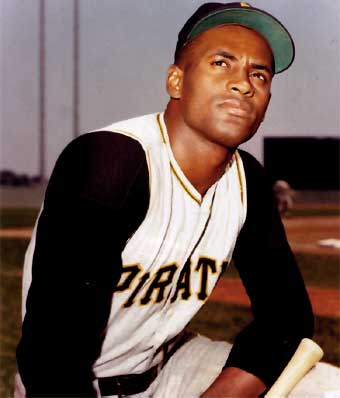
“Clemente,” the new book by pulitizer prize-winning author, David Maraniss, hits the shelves today. It is a fine appreciation of Roberto Clemente, who is undoubtedly one of the most charasmatic players of the post-War era. Although Clemente was a key member of two World Championship teams, he played in relative obscurity in Pittsburgh during the 1950s and ’60s, and was overlooked for his much of his career. Until, of course, his monumental performance in the 1971 Serious, and his untimely death in December of 1972. His legend and reputation have grown ever since.

As my pal Steve Treder put it to me in an e-mail recently:

Clemente was actually slightly underrated until the late ’60s, and especially during the 1971 World Series when he suddenly got noticed by the national media. At that point they all suddenly seemed to think he was better than he actually was, after years of being overlooked. His early tragic death soon afterward froze his image in time. Had he lived, and had a few years of decline phase at the end of his career, his reputation probably would have balanced out about right. As it is, many casual fans seem to think he was the equal of Mays/Aaron/Robinson/Mantle, when in fact he wasn’t nearly as good as any of them.

It is no insult to say that Clemente wasn’t as great as Mays, Aaron, Robinson or Mantle. They are all legends. Fortunately for Maraniss, off-the-field, Clemente was more interesting than most. And between the lines, Maraniss points out, Clemente had a terrific, inimitable style.

There was something about Clemente that surpassed statistics, then and always. Some baseball mavens love the sport precisely because of its numbers. They can take the mathematics of a box score and of a year’s worth of statistics and calculate the case for players they consider underrated or overrated and declare who has the most real value to a team. To some skilled practitioners of this science, Clemente comes out very good but not the greatest; he walks too seldom, has too few home runs, steals too few bases. Their perspective is legitimate, but to people who appreciate Clemente this is like chemists trying to explain Van Gogh by analyzing the ingredients of his paint. Clemente was art, not science. Every time he strolled slowly to the batter’s box or trotted out to right field, he seized the scene like a great actor. It was hard to take one’s eyes off him, because he could do anything on a baseball field and carried himself with such nobility. “The rest of us were just players,” Steve Blass would say. “Clemente was a prince.”

Thanks to Mr. Maraniss and the good people at Simon and Schuster, here is an excerpt from “Clemente.” This section is less about Clemente specifically and more about the conditions that Black and latin players encountered in the early 1960s. But it establishes the backdrop that is essential to understanding Clemente’s story. Enjoy!

BOOK EXCERPT: From “Clemente”

By David Maraniss

“Pride and Prejudice”

[Clemente] arrived at Pirates camp to train for the 1961 season on March 2, a day late. He and Tite Arroyo had been delayed entry from Puerto Rico to Florida until tests came back proving they did not have the bubonic plague, a few cases of which had broken out in Venezuela during the tournament.

On the day he reached Fort Myers, free from the plague, a story ran on the front page of the New York Times under the headline: NEGROES SAY CONDITIONS IN U.S. EXPLAIN NATIONALIST’S MILITANCY. One of the key figures quoted in the story was Malcolm X, the Black Muslim leader, who in the Times account was referred to as Minister Malcolm. Interviewed at a Muslim-run restaurant on Lenox Avenue in Harlem, Malcolm X said the only answer to America’s racial dilemma was for blacks to segregate themselves, by their own choice, with their own land and financial reparations due them from centuries of slavery. He dismissed the tactics of the civil rights movement as humiliating, especially the lunch-counter sit-ins that were taking place throughout the South. “To beg a white man to let you into his restaurant feeds his ego,” Minister Malcolm told the newspaper.

This was fourteen years after Jackie Robinson broke the major league color line, seven years after the U.S. Supreme Court struck down the separate-but-equal doctrine of segregated schools, five years after Rosa Parks and Martin Luther King Jr. led the bus boycott in Montgomery, four years after the Little Rock Nine desegregated Central High School in the capital of Arkansas, one year after the first lunch-counter sit-in in Greensboro. Year by year, the issue of race was becoming more urgent. The momentum was on the side of change, but the questions were how and how fast. In baseball, where once there had been no black ballplayers, now there were a hundred competing for major league jobs, and along with numbers came enormous talent, with ten past and future most valuable players among them. Yet every black player who reported to training camp in Florida that spring of 1961 still had to confront Jim Crow segregation. Even if their private emotions were sympathetic to Malcolm X’s rage at having to beg a white man to let you into his restaurant, the issue in baseball was necessarily shaped by its own history. Having moved away from the professional Negro Leagues and busted through the twentieth century’s racial barrier, black players did not view voluntary resegregation as an option, and separate and unequal off the field was no longer tolerable.

Wendell Smith, the influential black sportswriter who still had a column in the weekly Pittsburgh Courier but wrote daily now for the white-owned newspaper Chicago’s American, began a concerted campaign against training camp segregation that year. On January 23, a month before the spring camps opened, Smith wrote a seminal article that appeared on the top of the front page of Chicago’s American headlined negro ball players want rights in south. “Beneath the apparently tranquil surface of baseball there is a growing feeling of resentment among Negro major leaguers who still experience embarrassment, humiliation, and even indignities during spring training in the south,” Smith wrote. “The Negro player who is accepted as a first class citizen in the regular season is tired of being a second class citizen in spring training.” Smith added that leading black players were “moving cautiously and were anxious to avert becoming engulfed in fiery debate over civil rights,” but nonetheless were preparing to meet with club owners and league executives to talk about the problem and make it a front-burner issue for the players association.

(more…)

A Sense of Who You Are

Bob Klapisch has covered baseball in New York since the heyday of the Mets in the 1980s. He is a columnist for The Bergan Record and a contributor to ESPN. Now in his forties, he continues to play semi-pro baseball. Yesterday, he contributed a terrific post about playing ball to The Baseball Analysts. Klapisch’s article has some keen insights into the pysche of ballplayers, and it is nice to see him write something longer, and more personal. But Klap isn’t just a guy who loves to play the game, at heart he’s a pitcher, and they are a breed apart:

From Little League all the way to Cooperstown, there’s a fraternity convened by the adrenaline rush of throwing a baseball. Bret Saberhagen once told me, “Nothing matches making a hitter swing and miss. It’s the greatest feeling in the world. Guys who retire, they spend the rest of their lives looking for it, but once you stop pitching you never get it back.”

…So why do I keep pitching? Probably for the purest reason of all – it’s what I do, at least when I’m not writing or helping feed the kids. To stop now would mean tearing away layers of psychological flesh. I guess I’m afraid of what’s underneath. Middle age, maybe.

I sent the article to Pat Jordan, the veteran journalist and former pitching prospect for the Braves. He replied:

The allure of pitching is about being in control and playing God. Nothing happens without you. You control the game, good or bad. also the feeling of ball off fingertips and your ability to make it spin and do things is exhilarating. I love to throw a baseball. The feeling of artistry and power in making a ball approach the plate with the speed or curve that I dictate is unrivaled in anything else I’ve ever done, including writing. I was born to be a pitcher, but taught myself to be a writer. I was an artist on the mound, but, alas, am merely a craftsman, like a brick layer, in front of a typewriter.

Which brings me to another thought. Why do the best jock-turned-writers all seem to be pitchers? Jordan, Jim Brosnan, Jim Bouton. Glenn Stout pitched in an over-30 league for years. What gives? Michael Lewis was a pitcher when he was in high school, Rich Lederer was a pitcher back in his playing days, and Will Carroll was too. Bouton thinks that it “may be that pitchers spend a lot of time sitting around.” What do you think?

Center Stage

Book Excerpt

It wasn’t easy to select an excerpt from Howard Bryant’s new book “Juicing the Game,” because so many of them are excellent. But I think that one of the most insightful and powerful sections focuses on Barry Bonds, the greatest player and most controversial figure of his era. So for your summertime reading pleasure, please enjoy Chapter 17 from “Juicing the Game.”

By Howard Bryant

(Part One of Two)

The problem was Barry Bonds. The BALCO testimonies combined with the commotion and compromise that led to a strengthened drug policy, one baseball executive thought, provided baseball with a special opportunity. The sport could start fresh and begin a new era of enforceable drug testing while allowing the suspicion and doubt that plagued the previous decade to slowly recede into history. Bonds, however, would not allow baseball such a clean break from the steroid era.

The problem was that he was too good. To the discomfort of some baseball officials, Bonds would soar so high above anyone who ever played the game that no one would ever be allowed to forget this difficult decade, for he was no longer one of many great players, but arguably the best ever. Bonds already owned the single-season home run record and was set to break Hank Aaron’s career record in 2005 or 2006. In addition, between 2001 and 2004 he hit for four of the top twelve slugging percentages of all time, breaking Babe Ruth’s eighty-one-year-old record in 2001, and, over the same four seasons, recorded four of the top eleven on-base percentages of all-time, breaking Ted Williams’s single season record in 2002 and then demolishing his own record by becoming the first man to reach base more than 60 percent of the time over a full season in 2004.

The result was a bitter irony to that spoke to the odd and unprecedented state of baseball: Instead of celebrating the greatest player the sport had ever produced, numerous baseball officials entered 2005 lamenting the notion that they were being handcuffed by him. Bonds stood as the symbol of the tainted era, of its bitter contradictions and great consequences. Jason Giambi’s was a more open scandal, but Bonds was more emblematic of the larger complexities. If baseball suffered from the conflict of reaping the benefits of high attendance and unprecedented mass appeal while its players individually fought the taint of illegitimacy, then Bonds’ continued ascension, first past his peers and then past every iconic standard in the game’s history, served as an eternal reminder of all the sport did not do to protect its integrity when it had the opportunity. By shattering Mays, eclipsing Ruth, outdistancing Aaron, and putting the single-season home run record even further out of reach, Bonds and the era in which he played would always be present.

Thus, the enormous specter of Barry Bonds loomed, not because of his guilt or his innocence, but precisely because of the impossible question of how much of his phenomenal achievement (and by extension the feats of his peers) was real, how much was due to his use of anabolic substances, and how no one, for or against, friend or foe, could ever discuss the greatest player of his generation or the greatest records in the sport without in turn discussing the drugs that contributed to them. Not only would the decade from 1994 to 2004 be forever associated with steroids, but so, too, would the record books. There would be no escape, either for Barry Bonds or the sport that made him famous.

(more…)

ECKCELLENT

Paul Molitor and Dennis Eckersley were elected to the Hall of Fame this afternoon. Now that Eckersley–most famous as world-class closer for the Oakland A’s–has reached Cooperstown, perhaps the voters will begin to look more kindly on relief pitchers. Still, Bruce Sutter and Goose Gossage, arguably the two most significant relievers of the free agency era, did not make the cut once again.

Eckersley, a demonstrative and volatile performer, has been a nervous wreck of late as he waited to hear if he made it into the Hall. In a report that was published yesterday, he said:

“It’s killing me is what it’s doing…It’s murdering me. Tell me already, so I can deal with it if I don’t. I feel like a little kid, where you’re dangling something in front of me. I can’t even sleep. I’m like a yo-yo.”

Eckersley is as entertaining off the field as he was on it. Terry Pluto covered the swinging salad days of Eck’s career in “The Curse of Rocky Colavito,” while Mike Bryan had an excellent chapter on Eckersley in his book, “Baseball Lives.” Here is an excerpt from Bryan’s book:

People say baseball players should go out and have fun. No way. To me, baseball is pressure. I always feel it. This is work. The fun is afterwards, when you shake hands.

When I was a rookie I’d tear stuff up. Now I keep it in. What good is smashing a light on the way up the tunnel? But I still can’t sleep at night if I stink. I’ve always tried to change that and act like a normal guy when I got home. “Hi, honey, what’s happening?” I can’t. It’s there. It doesn’t go away. But maybe that’s why I’ve been successful in my career, because I care. I don’t have fun. I pitch scared. That’s what makes me go. Nothing wrong with being scared if you can channel it.

I used to hide behind my cockiness. Don’t let the other team know you’re scared. I got crazy on the mound. Strike a guy out, throw my fist around—“Yeah!” Not real classy, but I was a raw kid. I didn’t care. It wasn’t fake. It was me. This wasn’t taken very kindly by a lot of people. They couldn’t wait to light me up. That’s the price you pay.

I wish I was a little happier in this game. What is so great about this shit? You get the money, and then you’re used to the money. You start making half a million a year, next thing you know you need half a million a year. And the heat is on!

Used to be neat to just be a big-league ballplayer, but that wore off. I’m still proud, but I don’t want people to bother me about it. I wish my personality with people was better. I find myself becoming short with people. Going to the store. Getting gas.

If you’re not happy with when you’re doing lousy, then not happy when you’re doing well, when the hell are you going to be happy? This game will humble you in a heartbeat. Soon as you starting getting happy, “Boom.” For the fans—and this is just a guess—they think the money takes out the feeling. I may be wrong but I think they think, “What the hell is he worrying about? He’s still getting’ paid.” There may be a few players who don’t give 100 percent, but I always thought if you were good enough to make that kind of money, you’d have enough pride to play like that, wouldn’t you think? You don’t just turn it on or off.

Eckersley is a good talker. But he’s not as slick as the media-friendly David Cone; he is much closer to Pat Jordan: a straight-shootin’ sombitch. I admire him for his vulnerability and honesty. Bryan’s interview with Eck was conducted during spring training in 1988, with his his greatest years as a relief pitcher ahead of him. But Eckersley was candid about how he felt about life after baseball:

I’ve been very fortunate to pitch for fourteen years in the big leagues. That’s a long time for a pitcher. I’m afraid of life after baseball. Petrified. I’m not ashamed of saying it. I’ll be all right, but nothing will ever compare with this. I will not stay in baseball. I think about commercial real estate and money, big money!

Or maybe I’ll grow up after I get ouf of this fuckin’ game.

Funny that we should be talking about grown-ups with Pete Rose clouding the baseball landscape, but both Mr. Molitor and Mr. Eck are all grown up now, and where they belong: in Cooperstown. Here’s hoping that Blyelven, Ryno, Sutter and the Goose join them soon.

SMOKIN’

I know I’m a couple of days late on this, but Pat Jordan had a piece on flamethrowers in The New York Times magazine last Sunday. I don’t think the article was one of his best—it felt slight—but it is still worth reading. I was, however, taken with Jordan’s portrait of Houton’s Billy Wagner. While interviewing the diminutive southpaw in the Astros locker room, Wagner’s two young boys sat in a nearby chair watching TV:

Wagner is obviously a caring father — as he talked to me his eyes kept flitting toward his sons — in the way of men who experienced difficult, disruptive childhoods. His parents married young in a small Virginia town. They fought a lot and shuffled off their son to live with various relatives. Wagner lived with his grandfather, who used to whip him with a switch, and then his aunt and uncle. No matter where he lived, however, he lived in poverty (food stamps were not unknown) and anger. He remembers as a boy standing outside the home of his aunt and uncle, picking up a baseball and firing it at the house in anger.

”It was the only way I could express myself,” he said. ”I used to rage and explode; now I channel it to aggressiveness on the mound.”

Despite his success, he said, he’s still insecure about it. ”There’s no way I should throw a baseball 100 m.p.h.,” he said. ”I’m small. I see guys 6-foot-8 throwing 88. There’s nothing I did to get it. Maybe throw a football a lot. I have the short, quick arm motion of a quarterback. Some say it’s in my legs, or my wrist. But I don’t know why.”

Jordan has always been able to find the tremendous vunerability in the athletes he writes so well about. That’s probably due to his own experience as a bonus baby prospect, who never made the major leagues. It’s certainly why I find him to be one of the best baseball writers going.

DUKE OF HIS DOMAIN

Pat Jordan was a bonus baby for the Braves in the late ’50s and early ’60s. He threw gas, but never made it to the majors; eventually, he became an accomplished journalist. His first memoir, “A False Spring” is considered a baseball classic. I think that the sequel, “A Nice Tuesday,” is a better book, even if it is more about Jordan’s personal life than it is about baseball.

Jordan still writes for The New York Times magazine, and it is always a treat to read his work, especially if it is about a pitcher. Before “A False Spring” was released in 1974, Jordan published a collection of stories he had written for Sports Illustrated called, “The Suitors of Spring.” All of the articles in this collection are about pitchers, including the likes of Tom Seaver, Bo Belinksky, Bruce Kison, Steve Dalkowski and Sudden Sam McDowell.

I buried myelf in the book last night after suffering through the Yankees game, hoping to take my mind off the pain of the here-and-now. Jordan describes McDowell and Dalkowski as young men who were possessed by their talented; Seaver, on the other hand, was a late-bloomer with less natural talent. Of course, Seaver became on the great pitchers of all time. Dalkowski never made it passed triple A and McDowell never became the great pitcher he was expected to become.

Here is a healthy excerpt from the article on Sudden Sam, “A Talent for Refusing Greatness:”

Like many extremely talented people, Sam McDowell does not judge his accomplishments by conventional standards. His challenges, and their eventual resolution, are very private affairs independent of either the approval or disapproval of anyone else.

…”The only thing I get satisfaction from,” he says, “is accomplishing something I’m not supposed to be able to do. I live for challenges, and once I overcome them I have to go on to something new.”

…It is obvious that McDowell takes great delight in watching his pitches behave even when he’s only warming up. And he admits to often concentrating so much on his individual pitches and their perfection that he loses sight of everything else. His individual pitches then become his goal rather than simply the means of attaining some larger goal–a victory, for instance.

“I try and break things down to their simplest element,” he says, “and sometimes I guess I do it to an extreme. For instance, a game to me is just a series of individual challenges–Me against Reggie Jackson or Me againt Don Mincher. If I find I can get a guy out with a fastball it takes all the challenge away, so next time I throw him all curveballs. If I don’t have a challenge I create one. It makes the game interesting.”

…”No, I wouldn’t say Sudden is the toughest pitcher I ever faced,” says Reggie Jackson. “Now, don’t get me wrong. I like Sudden and I think he’s got the greatest fastball, curveball, slider and change-up of any pitcher I ever saw. I call him ‘Instant Heat.’ But still, I don’t mind facing him. That’s not because I hit him so easy, either, because I don’t. It’s just that Sudden simplifies things out there. He makes it like it used to be when we were kids. You know he’s going to challenge you, his strength against yours, and either you beat him or he beats you. And if you do beat him with a home run or something, hell, it don’t bother him that much. He’s not greedy. He lets you have a little, too. And he won’t throw at you, either, because he’s too nice a guy. He knows that with his fastball he could kill you if he ever hit you. You see, baseball’s still a game to Sudden, the way it should be to all of us. Hell, I’d pay to see him pitch because I know he enjoys himself so much. Do you know he’s got 12 differenet moves to first base? That’s a fact! When he was going for his 1500th strikeout he was trying so hard he fell down on a pitch to me. I took it for a third strike. I loved that, though. That’s why I look forward to facing him even if I don’t hit him a helluva lot. But someday I will. Me and Sudden will be around for a long time, and one of these days I’m going to connect with one of his sudden pitches and watch out! But still, I have to say that Sam McDowell isn’t the toughest pitcher I ever faced. As a matter of fact, I think he’d be tougher if he had less ability. Sounds crazy, huh? But it’s true. Sudden’s just go too much stuff.”

I don’t think that Jeff Weaver is nearly as gifted as McDowell was, and perhaps he isn’t even as interesting a person. But I thought about Weaver after reading this article last night, because he’s a pitcher with great stuff who hasn’t been able to put it together. Of course, you can replace Jeff Weaver with your favorite talent who hasn’t lived up to expectations. The point is, all the talent in the world doesn’t mean spit if you don’t thrive as a competitor.

Anyhow, there isn’t a baseball writer I enjoy more than Pat Jordan. Next time you happen upon one of his books, pick it up and give him a try.

SWEET LOU Pat Jordan is

SWEET LOU

Pat Jordan is one of my favorite baseball writers, and I think he’s surely the best former-player turned writer. Jordan contributes pieces to the Times magazine several times a year, and his latest is on our man in Tampa, Lou Piniella. Worth taking a look at.

feed Share on Facebook Share on Twitter Share via email
"This ain't football. We do this every day."
--Earl Weaver