"A New York Treasure" --Village Voice
Category: Links: Sportswriting

My! It Shure Ain’t Sweet

Historian Glenn Stout finds the smoking gun concerning Tom Yawkey’s take on African Americans. From a 1965 Sports Illustrated article on the Red Sox by Jack Mann:

“They blame me,” Yawkey says, ‘and I’m not even a Southerner. I’m from Detroit.” Yawkey remains on his South Carolina fief until May because Boston weather before then is too much for his sensitive sinuses. “I have no feeling against colored people,” he says. “I employ a lot of them in the South. But they are clannish, and when that story got around that we didn’t want Negroes they all decided to sign with some other club. Actually, we scouted them right along, but we didn’t want one because he was a Negro. We wanted a ballplayer.”

Stout continues:

But then comes the first of two smoking guns: “But they are clannish,” Mann quotes Yawkey as saying of African Americans, “and when that story got around that we didn’t want Negroes they all decided to sign with some other club.”

No single sentence could be more revealing – or more pathetic. First Yawkey offers that all African Americans share the same characteristics – in this case, being “clannish.” That kind of stereotyping is damning enough, but when he states that “when that story got around that we didn’t want Negroes they all decided to sign with some other club,” he fantasy land. Yawkey is making the claim that the reason the Red Sox remained white is the fault of the black ballplayers themselves. He is saying nothing less than “African Americans erroneously thought we were racist so therefore they refused to sign with us.”

yawk

Live at Ledes (Great Ledes Part III)

wc_heinz

How about some more wonderful ledes? (Here’s part one and part two.)

Here’s Gary Cartwright, one of the great Texas sports writers, rising to the occasion after Don Meredith failed to do so for the Dallas Cowboys:

Outlined against a blue-gray November sky, the Four Horsemenn rode again: Pestilence, Death, Famine, and Meredith.

The great Jim Murray on the Indy 500:

Gentlemen, start your coffins.

Vic Ziegel, on the facts of life:

The game is never over until the last man is out, the New York Post learned late last night.

John Updike on Ted Williams’ final game:

Fenway Park, in Boston, is a lyric little bandbox of a ballpark.

How about another John Lardner classic:

When Ezzard Charles won the heavyweight championship by licking J.J. Walcott, two years ago, Ezzard’s manager, Jake (Madman) Mintz, passed out in the ring. Last July when Walcott won the title, it was Charles who fell, while Jake remained on his feet throughout That is my idea of a perfect partnership — always one man conscious, to count the house.

Dig Murray Kempton on Willie Mays:

There was this moment when Willie Mays caught the last ball hit in the National League in 1962 and turned and laughed and threw it at the right-field foul pole. It was his ball and he could do what he pleased with it.

All of a sudden, you remembered all the promises the rich have made to the poor for the last 13 years and the only one that was kept was the promise about Willie Mays. They told us then that he would be the greatest baseball player we would ever see, and he was.

Here’s how Jimmy Cannon said goodbye to Doc Kearns, who managed Jack Dempsey and broke four banks in Shelby, Montana, with a single fight:

It took him 80 years, but Doc Kearns, who died yesterday, finally proved he was right. Daytime’s for sleeping. Nights are for laughs. The working day is nine to five. Doc never played a hand in that game.

And here’s one of my absolute favorites, from WC Heinz’s classic story, The Brownsville Bum

It’s a funny thing about people. People will hate a guy all his life for what he is, but the minute he dies for it they make him out a hero and they go around saying that maybe he wasn’t such a bad guy after all because he sure was willing to go the distance for whatever he believed or whatever he was.

That’s the way it was with Bummy Davis. The night Bummy fought Fritzie Zivic in the Garden and Zivic started giving him the business and Bummy hit Zivic low maybe 30 times and kicked the referee, they wanted to hang him for it. The night those four guys came into Dudy’s bar and tried the same thing, only with rods, Bummy went nuts again. He flattened the first one and then they shot him, and when everybody read about it, and how Bummy fought guns with only his left hook and died lying in the rain in front of the place, they all said he was really something and you sure had to give him credit at that.

“So you’re Al Davis?” one of the hoods said. “Why you punch-drunk bum.”

And you can’t beat that with a stickball bat.

The Shape of Things

babes

Leigh Montville edited this year’s edition of The Best American Sports Writing. If you’ve got the extra scratch, pick-up a copy to see Todd Drew’s terrific Yankee Stadium memory in print. It’s one of the great moments in this site’s history.

WEEI in Boston ran a short interview with Montville who has some interesting thoughts about the newspaper business, Sports Illustrated, and the nature of sports writing today (thanks to the Think Factory for the link).

Also, there’s this on the Babe:

What’s the most surprising thing you learned about Babe Ruth when you wrote that book?

“I think he was smarter than most people think he was. He grew up without much education. He came out of an orphanage. He had that reputation, and it was well-deserved of being a late-night guy, a carouser who ate a million hot dogs and all that stuff. But he was very smart in lining up his career. He had the first real business manager of any athlete. The guy took care of him and his money. Babe Ruth had money until he died and lived a good life. He made sound decisions in the people he enlisted to help him. He got a personal trainer back when nobody had personal trainers, when he was starting to fall apart. The personal trainer got him on the road and got him hitting again. He had the knowledge to straighten himself out. A lot of guys don’t have that — Antoine Walker being the latest one. He had more self control that I think most people give him credit for.”

The Joys of Jeter

Jeter, from day one, became the Yankees’ “Everyman”–everybody’s son, everybody’s brother, everybody’s dream boyfriend. Without even trying, he tapped into every chord of the Yankee mythos like no player since Mantle. He would add a few unmistakable new notes of his own, heralding in a new age for the franchise. Jeter had it all, and from his first day he became the best shortstop in club history. The Yankees couldn’t have invented him had they tried.

Glenn Stout, Yankee Century

When we talk about Derek Jeter we talk about class and dignity and tradition.  Those buzz words that sound cliche. We talk about how he is overrated, but maybe underrated too. About how cool and calm he is, how calculatedly dull but dutiful he is with the press. But what I’ll always remember about Jeter is how much fun he has playing baseball. It is his defining quality for me and one that is virtually ignored in the sea of commentary about Jeter.

Have you ever seen him in a big game not smiling and generally enjoying the s*** out of himself? It is as if he’s impervious to the nerves of the moment.

jetersmiles

Baseball has a name for the player who, in the eyes of his peers, is well attuned to the demands of his discipline; he is called “a gamer.” The gamer does not drool, or pant, before the cry of “Play ball.” Quite the opposite. He is the player, like George Brett or Pete Rose, who is neither too intense, nor too lax, neither lulled into carelessness in a dull August doubleheader nor wired too tight in an October playoff game. The gamer may scream and curse when his mates show the first hints of laziness, but he makes jokes and laughs naturally in the seventh game of the Series.

Tom Boswell, How Life Imitates the World Series

Jeter is a man defined and consumed by his work, an ideal we’d all love to have ourselves but only few share. It’s part of what draws us to him. But Jeter reminds us that work can be play too. Who wouldn’t like to think of themselves handling themselves like Jeter in tough situations?

Pete Rose may have enjoyed himself as much as Jeter but not more.  And it wasn’t easy to share those feelings with Rose. Perhaps the best thing you can say about Jeter is that he’s competitive and has class and dates gorgeous women and he’s not Pete Rose.  Jeter does not let us get too close–we don’t know him away from the field–but the beauty part is that he lets us see all we need to know of him on the field.

The play is the thing, after all.

In an e-mail, Stout added:

I’ve always thought that with Jeter it’s actually really, really simple. You know when he was a little, little boy, he decided he wanted to play shortstop for the Yankees – that’s all he ever wanted, and for as long as he can remember that’s all he has ever imagined doing. He’s about the only person on the planet who has never had to scale down his dream, and since he has imagined himself doing what he is doing his entire life, it feels completely normal, the most natural thing in the world – on the field he is completely at home with himself, completely relaxed and happy. Why not smile?

And that’s why he was there to make the tag on Gomez, and the flip to Posada to get Giambi out way back when, and the home runs he hits right after the other team scores and all those other plays he makes – he’s been living these moments in his head his whole life, from the days he laid on his bed and tossed the ball up toward the ceiling. It’s not natural, but it is natural to him – he’s been playing shortstop for more than thirty years.

And what about the Nick Punto play last night? Stout continues:

I loved the Jeter just calmly explained that he saw Punto out of the corner of his eye then waited for him to commit and made sure he threw a ball to Jorge that he could handle, ho hum, on the fly, instant decision that all took place in about 1/2 a second. He’s like the guy that has learned to solve the Rubik’s cube.

It’s the smirk, the enjoying the moment, that I’ll always remember about Jeter. Not every great player allows you to see them having fun–heck even Mariano doesn’t exude that same vibe. But with Jeter you know he’s loving it. And he loves it when his teammates do well. Did you catch the little kid enthusiasm from Jeter after Alex Rodriguez hit that dinger off of Joe Nathan on Friday night?

58459767

After the game last night, Mariano Rivera talked about Rodriguez to reporters. “He’s feeling great and he trusts himself,” said Rivera. “He’s having fun, having fun, having fun and that’s the most important thing. Before, he was trying so hard and you can’t have fun like that. Now, he’s just enjoying it.”

Just like Jeter.

Real Genius

genius

The one and only Charles Pierce on the one and only Tony LaRussa:

I first became aware of this particular blight when he worked in Oakland a decade or two ago, back in the days before Beane turned the A’s into a mirror with which to show himself his true genius. First thing you heard was that La Russa had a law degree. This was meant to portray him as something of a baseball intellectual, which heretofore had been defined as someone who spit tobacco on his own shoes and not yours. I was fascinated by the fascination with this; I mean, the world is full of lawyers. (So, for that matter, are various low-security prisons, but that’s another story.) I wondered how many of his acolytes would hire Tony La Russa and his law degree to defend them on a capital-murder charge. Not many, I reckoned.

Then there was the ballet school T-shirt. La Russa used to wear this all the time in his post-game interviews. This was meant to portray him as something of a baseball aesthete, which heretofore had been defined as someone who put something larger than a $1 bill into the stripper’s G-string. This particular bluff worked until the night when, while wearing the ballet-school T-shirt, La Russa bum-rushed an elderly reporter from his clubhouse. This is not something Diaghilev would have done — not even to people throwing apples at his head.

But the truly remarkable thing about La Russa is his rather unspectacular record at winning anything that counts. Eugene McCarthy once said of Walter Mondale that the latter “had the soul of a vice-president.” Tony La Russa has the soul of a semifinalist.

For more LaRussa-related ugliness, check out this Deadspin post featuring Buzz Bissinger.

Thanks to Baseball Think Factory for the links.

The Most Valuable Greatest of All Time

louis1

One of the reasons I enjoy reading Joe Posnanski’s blog is because he relishes talking about sports the way fans do. He takes bar room topics, often in list form, and riffs, with reason and humor and a sense of fun. Who was the best so-and-so, what was the greatest such-and-such. The enthusiasm he shows for this kind of banter is what makes Pos so appealing–and he’s as well-liked a sports writer as I’ve ever met. The sabr-numbers crowd dig him and the mainstream guys like him too.

I was in Pos-mode the other day when I read Chris Ballard’s SI cover story on LeBron James. King James is only 24, a man-child, physical-mental freak of historically great proportions. The guy is twenty someodd pounds shy of 300, for crying out loud. I had no idea he was that big. And he’s so fast. He could play strong safety in the NFL.

Along with Kobe Bryant, James is the greatest player in the game and he’s only getting better. So I thought, when we talk about the greatest basketball players in the post-Jordan Era, it’s got to be Shaq, who you can’t really compare with Jordan because of the position; Kobe, who has won three titles and is certainly great, but not at Jordan’s level, especially off the court in terms of mainstream popularity and influence; and James.

Of course the league has been filled with other iconic players since Jordan level, including Allen Iverson, Tim Duncan and Kevin Garnett, but not ones whose appeal crossed over to a wider audience. They are just hall of famers in the game. Nobody has reached the level Jordan attained. Jordan followed the greatestness of Magic and Bird seemlessly and he brought it to a crescendo that was peerless.

I thought about guys on that level—Jordan and Tiger Woods, Babe Ruth—as I read an old GQ article by the novelist William Kennedy. In 1956, Kennedy was a kid reporter working for the Albany-Times Union when he interviewed Louis Armstrong, who was in town for a gig. Kennedy went up to his hotel room and talked with him for an hour and a half. He wrote a short nothing piece on it for the paper but saved his notes.

My awe and reverence for Louis continued to grow through the ensuing years, and somewhere in the late 1970s I conducted an after-dinner poll as to who was the most valuable person who had ever lived, and Satchmo won, with five votes. William Faulkner got four, Michangelo three, Beethoven, Muhammad Ali and Tolstoy two each, and Dostoyevsky and Busby Berkeley one each.

…He was a giant in his youth: the first major soloist in jazz, the man to whom every last jazz, swing, modern jazz and rock musician after hism has been and is indebted, some via the grand-larceny route. Music has changed radically since the seminal days of jazz, but Satchmo’s achievement has not been diminished. No one has superseded him in jazz eminence the way Crosby superseded Jolson and Sinatra superseded Crosby and the Beatles superseded Elvis, and I will never know who or what really superseded the Beatles.

Who else, in sports, in the arts, in popular culture, is on this level?

(more…)

Curtain Call

31_yankeesphotoop_lg

I was at the final game at Yankee Stadium and wrote a bonus piece for SI.com on what the night was like for Ray Negron:

It was just before one o’clock in the morning on Sept. 22, but the scoreboard clock was frozen at 12:21. The last game at Yankee Stadium was over, Sinatra had finally stopped singing New York, New York, and organist Ed Alstrom was playing Goodnight, Sweetheart. The home team had won 7-3 in a game that meant nothing in the standings but everything in a deeper, gut-felt way. The Yankees would not be going to the postseason for the first time since 1993, yet they had drawn 4.3 million fans, including another capacity-plus 54,640 on this night. And now, as the last of them drifted out of the ballpark, it felt like closing night for a hit Broadway show.

Now it was just the clean-up crew swinging into action and a select group of others clinging to the night — players and their families, reporters, radio and TV personalities, cameramen, front office workers, the grounds crew and cops, lots of cops. People hugged and slapped hands and talked and laughed. Players scooped up dirt and grass and put them in paper cups and Ziploc bags. Grown men had their pictures taken at home plate, on the mound and sliding into second. It was like Never-Never Land — everyone was a child. Why would anyone want to go home, knowing they were the last precious few to soak in the Stadium? They stayed, stuck between history and the wrecking ball, until the head of security announced that it was time to leave.

Ray Negron was out on the field, right where he belonged, with the players and sportswriters. Ray had seen them all — from DiMaggio and Mantle to Reggie and A-Rod. He was there when they came to play at the Stadium and he was still there when they left.

alg_negron

True Master

Relax, all right? Don’t try to strike everybody out. Strikeouts are boring. Besides that, they’re fascist. Throw some ground balls – it’s more democratic.

Crash Davis

Of course Greg Maddux is retiring tenth on the all-time strikeout list (3371). Still, when I think back on Maddux in twenty, thirty years from now, my guess is what I’ll remember the most about him is a dinky ground ball to second base. That was the signature out of his prime, a crappy grounder, a squibber that rolled harmlessly to a waiting infielder. Or maybe a little jam shot pop-fly.  Or yeah, even a strikeout, the late-breaking fastball tailing back over the plate leaving hitters with their asses out, hands up and bats still on their shoulder.

In his prime, you rarely saw good swings or heard solid contact against Maddux.

There will be a host of tributes to Maddux this week. Here are the early birds.

Joe Posnanski:

I never presumed to think with Maddux or have a deeper understanding of why he was so good. I just loved watching him pitch, loved the whole scene, loved seeing the frustration batters would show, loved the way umpires over the course of a game became willing co-coconspirators, loved the way catchers would just let the ball tumble into the glove without moving, loved the way Maddux would fidget when he didn’t have all of his stuff working, loved it all. He was Mozart, I was Salieri, and no I couldn’t reproduce it, no I couldn’t get close to it, but I felt like I could hear the music.

Over at SI.com, Tom Verducci writes:

The magic show is over. I dislike absolutes, but of this I am sure: Greg Maddux is the most fascinating interview, the smartest baseball player and the most highly formed baseball player I have encountered in 27 years covering major league baseball. There is no one alive who ever practiced the craft of pitching better than Maddux.

…I will miss watching him pitch. In his prime, Maddux never received enough credit for the quality of his stuff. Too many people equate power with stuff, but Maddux’s fastball, at least back when he was throwing 90 mph, had ridiculous movement — late, large movement. Think about this: he dominated hitters with no splitter and a curveball that was no better than high-school quality.

That’s how good were his fastball and changeup. It wasn’t just location.

Here is Verducci’s 1995 feature profile on Maddux for SI.

(more…)

The Home Run King

“My motto was always to keep swinging. Whether I was in a slump or feeling badly or having trouble off the field, the only thing to do was keep swinging.”

Hank Aaron

Head on over to the Sport Magazine Gallery and check out Pat Conroy’s 1974 cover story on Hammerin’ Hank Aaron.

The stunning fact about Aaron’s assault on The Babe was that he came on so suddenly. For years, Willie Mays was the leading pretender to the throne. Willie made a hard run for it until time sent its battalions up against his flesh. Those of us who loved Willie watched our hero backed against the outfield wall by the caprices of old age, by that semi-death of extraordinary athletes who dance too long, then stumble home in a last graceless waltz that is the cruelest, most public humiliation of sport. Years ago, the world knew that The Babe was safe from Willie. But in 1971, a 37-year-old man hit 47 home runs and the chase was on again. The next year Aaron hit 34. Last year he hit 40 and at the end of the season was staring eyeball-to-eyeball with Babe Ruth.

…It was…in many ways, one of the most boring sports stories of the century. Every sportswriter in the country searched the rills and slopes of his brain hoping to find the different angle, the fresh approach or a new way of looking at Hank’s assault on Babe Ruth’s record. They asked Hank every conceivable question. They interviewed every person who had known Hank in the past 40 years, from Vic Raschi, who surrendered Hank’s first home run, to Aaron’s daughter, sons, sisters, brothers, mother, father, managers, coaches, players and friends. There was something about the obscenely crowded press conferences with Hank that made a reporter feel like a participant at an orgy. After each game last season, the flock gathered to ask Hank the same watered-down questions and Hank, salivating on cue, would render the same colorless, good-natured answers he had delivered the day before and the day before that. The chase ate up a lot of good words, and left a lot of semi-burned out reporters staring into the outfield lights.

And if you missed it, do yourself a favor and check out Tommy Cragg’s wonderful 2007 piece on Aaron for Slate:

Because he was so outwardly bland in personality and performance, Aaron seemed to take on character only in relation to things people felt strongly about: Willie Mays, Babe Ruth, civil rights. On his own he was, and remains, an abstraction, someone whom writers could only explicate with banalities like “dignified.” Our perception of Aaron today stems almost entirely from his pursuit of Ruth’s 714 home runs, in 1973 and 1974, during which time he faced down an assortment of death threats and hate mail. By then, Aaron had shed his reticence and begun to speak out against baseball’s glacial progress on matters of race. Still, very much his own man, he seemed to dismiss some of the loftier interpretations attached to his home-run chase. “The most basic motivation,” he wrote in his autobiography, I Had a Hammer, with Lonnie Wheeler, “was the pure ambition to break such an important and long-standing barrier. Along with that would come the recognition that I thought was long overdue me: I would be out of the shadows.”

No matter. Aaron was fashioned into something of a civil rights martyr anyway. “He hammered out home runs in the name of social progress,” Wheeler recently wrote in the Cincinnati Post. And Tom Stanton, in the optimistically titled Hank Aaron and the Home Run That Changed America, dropped what has to be the most unlikely Hank Aaron analogy on record: “[P]erhaps it’s The Exorcist, the period’s biggest movie, that provides a better metaphor for Hank Aaron’s trial. … Hank Aaron lured America’s ugly demons into the light, revealing them to those who imagined them a thing of the past, and in doing so helped exorcise some of them. His ordeal provided a vivid, personal lesson for a generation of children: Racism is wrong.”

Small wonder that, upon eclipsing Ruth, the exorcist told the crowd, “I’d just like to thank God it’s over.”

All Growed Up

Mannish Boy.

Untitled

Barry Zito is the focus of Pat Jordan’s latest profile for the New York Times Magazine. Another stellar job by Jordan. I always figured Zito was a superficial guy, a pretty boy phony, but he comes off as an interesting dude:

Zito told me his pitching problems were caused by the fact that he hadn’t been himself the last few years.

"I wanted to be more ‘professional,’ " he said. "This new guy. Because of the Contract, I wanted people to know I was serious about pitching, not this flaky guy. I allowed the seriousness of things to creep into my mind. The city. The Contract. The fans. My new teammates. I wasn’t a blue-collar Oakland guy anymore."

…He was particularly stunned by the vehemence with which the media and fans greeted news of the Contract. And then he was stunned by the fans’ booing his failed pitching. "Actually, I think the San Francisco fans have been pretty good to him," Righetti said. "If he was in New York, the fans would be off the chart." But Zito wasn’t used to being booed and criticized. His flaky persona had deflected such criticism for years, as if people felt it was unfair to be too harsh on such an innocent sprite. But he’s not a sprite anymore, and his critics are no longer so forgiving. Which is why he has assumed a new persona: the abused guy who can no longer be himself with people. "But it requires so much energy to be inauthentic," Zito said. Which is the point. Zito was never truly "authentic." The free-spirited kid was always something of a construct. Now that he’s a man, it’s time for "serious things," like the apparently premature demise of a once-brilliant career. This is what Zito is struggling with. But how to rewrite the narrative of his life?

"I never thought I was invincible at everything, just baseball," Zito said. "At 30, I became aware of why things happened." He now saw his parents’ psychobabble — "Don’t expect to struggle" — as something that could lead not only to awareness but confusion. "Zen is a double-edged sword," he said. "It guarantees nothing. When I went 11-1, it worked. Next year it won’t. Zen helps you solve some problems, but it’s better at creating problems. Thinking too much is good for life, but not functional for baseball." He’s searching for that mind-set all great, intelligent pitchers have. Compartmentalize. Complexity for real life, simplicity for baseball.

Can an athlete be too smart for his own good? I think so. Being bright might make a jock a more well-rounded person, but also less of a performer. Reminds me of Billy Beane in Moneyball, realizing that he would never be a great player after rooming with Lenny Dykstra who was "dumb" in all the right ways.

Notes on an American Master

Untitled

"Bill Heinz is a walking contradiction of the stereotype of the phlegmatic Teuton. He is emotional and demonstrative. He can sink into depressions so deep they would give a sandhog the bends. His highs are several stories high. As cityside reporter, war correspondent, sports columnist, freelance journalist, and novelist, he was and is a dedicated craftsman and a penetrating observer who never gives half measure.

‘Bill,’ his doctor once told him, ‘if you don’t stop trying to be the greatest writer in the world, you’re going to kill yourself.’

‘I’m not trying to be the greatest writer in the world,’ Bill said, ‘I’m only trying to be the best writer I can be.’"

Red Smith, from the Introduction to Heinz’s collection, American Mirror.

W.C. Heinz, one of the finest journalists this country has ever produced, died earlier this year. A few months ago, a tribute was held in Vermont in his honor, and Adam White wrote a fine piece on the event for the Bennington Banner. In it, he quotes Bob Matteson, who was the editor-in-chief of the Middlebury College newspaper when Heinz was sports editor in 1936-37.

"He could spot make-believe – or phoniness – right away in a person," Matteson said. "And he wanted no part of it."

White continues:

Therein would seem to lie the key to Bill Heinz’s writing, his true method for distilling parable from the mundane. There is a sort of universal admission among those who were close to Heinz that he could be averse to, even dismissive of, certain people and personality types – but there is equally compelling evidence that such an attitude stemmed from his heightened sense of intuition regarding truth. Without such intuition, it is unlikely that he could have even recognized – let alone captured – the majesty and romance that pervades so much of his work.

"The secret is love," (Jeff) MacGregor said. "It’s his empathy, [though] not for individuals; I don’t know that [Heinz] even liked people. His genius was his empathy for the situation that we all share, that common cause of human enterprise. The truth that [Heinz] wrote about is the struggle that we all face, every day, when we get out of bed – and how good a fight we put up before the end of the day."

(more…)

Treasure Trove

Untitled

A few months ago I invited myself to Ray Robinson’s apartment, ostensibly to get his list of ten essential baseball books, but really so I could lay eyes on his library of sports books.  Robinson, an author (Iron Horse) and longtime magazine editor, grew up on the Upper West Side, near Columbia.  When he was a kid, Robinson got a delivery job at a local liquor store, and he found himself making stops over at Babe Ruth’s apartment at 110 Riverside Drive. He’d say, ‘Thanks keed,'” Ray told me.  “He called everybody ‘keeed,’ because he couldn’t remember anyone’s name.  And he would invariably honor me with a couple of dollar bills.”

Ray and his wife, Phyliss were wonderful with me.  We chatted in the living room of their comfortable New York apartment for about an hour and Ray shared his selections of favorite baseball books with me.  I poked my nose through his collection and as I was about to leave, Ray said, “Oh, would you like to see my scrapbooks?”

“Sure, I would.”

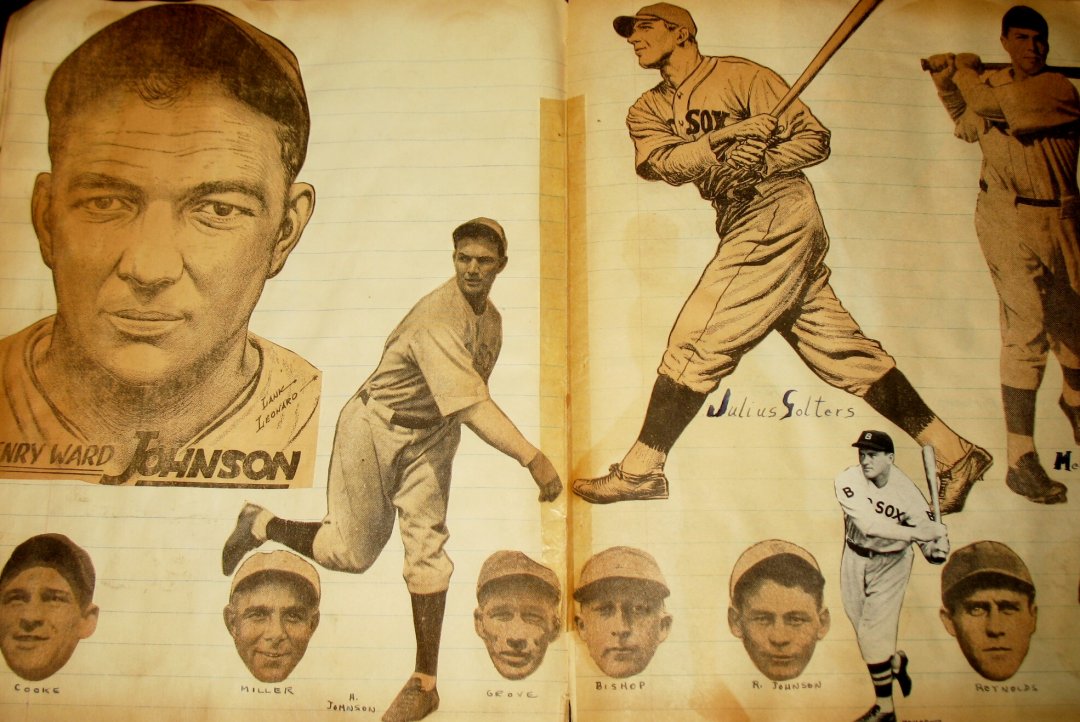
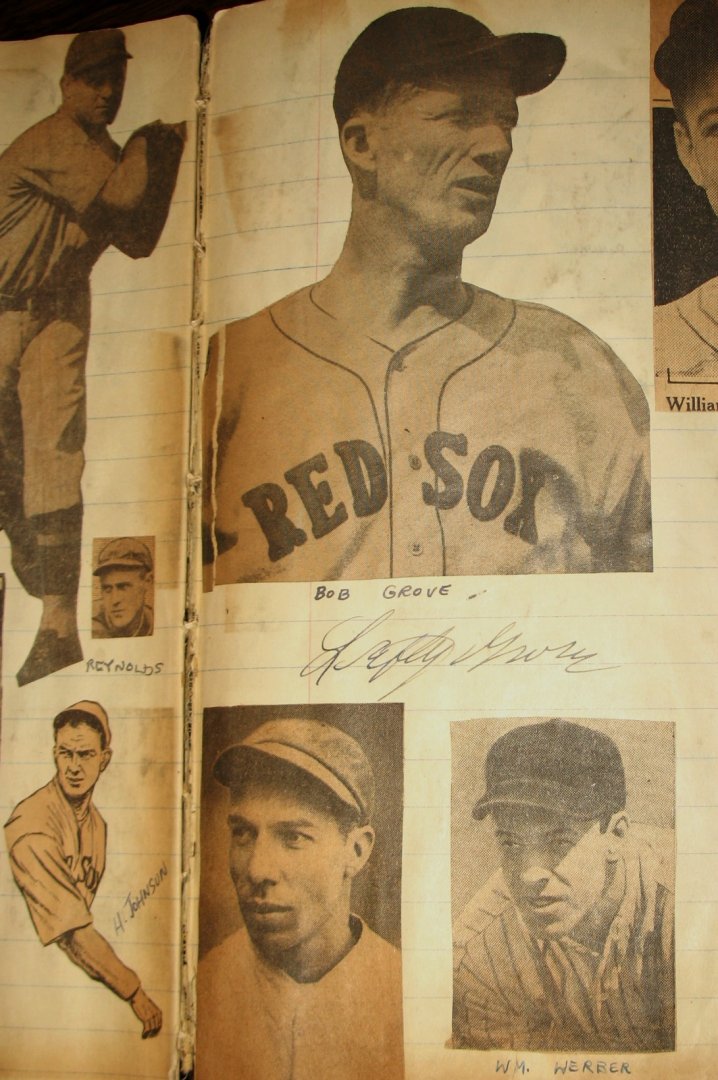
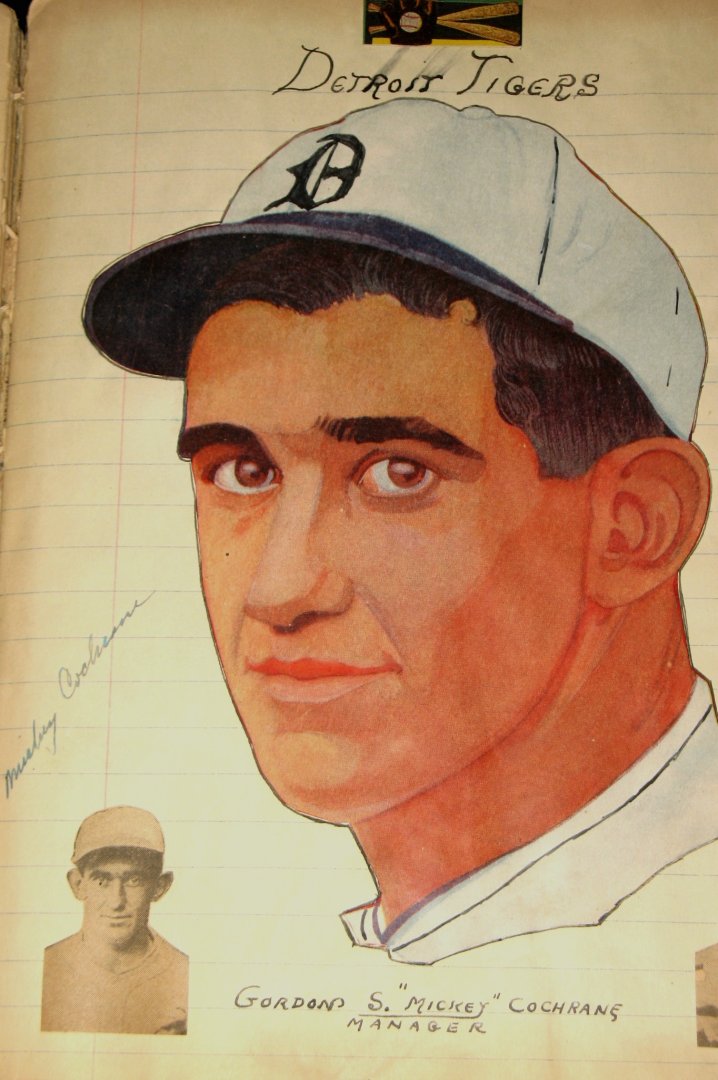
Ray picked-up a bright orange plastic bag from the bottom of the bookshelf, the kind you’d get from the local Chinese take out.  He pulled out two weathered books, practically falling apart, one dated 1932, the other, 1933.  They were filled with pictures of players from every team in baseball.  Ray cut-out images mostly from The New York Sun, The Saturday Evening Post, assorted baseball magazines as well as baseball cards.  Then, along with some friends, he’d scout the hotel lobbies where the out-of-town teams stayed, to get autographs.

Untitled

The books are lovingly, obsessively assembled, filled with small notations.  Ray expressed some embarrassment when I complemented him on how wonderful, how personal the books are. He dismissed his sketch of the Babe as being awful, but I liked it and his wife did too.

Ray asked if he should sell the books–after all, he’s got a couple of Lefty Groves in there, a Honus Wagner, Dizzy Dean.  Phyliss said that she didn’t think that was a good idea. I quickly agreed.

“You can’t sell these,” I said.  “They belong in a museum or for your grandkids.”

As I looked carefully through the two books, Ray kept wondering if he should sell them.  I said, “No way,” but when I left I felt foolish.  Who am I to say that he shouldn’t sell them?  There is probably some serious money in those two books.  Still, they feel too personal to part with.  They are not kept under a glass case, they are in a plastic bag on the shelf, a secret baseball treasure on the Upper East Side.

Yesterday, the New York Times featured a short essay by Ray Robinson about his scrapbooks.

Check it out and dig what I was able to see:
Untitled

Untitled

(more…)

Diggin in the Crates (Rain, Rain Stay Away)

One of the most exciting events of the spring has been the recent launching of the SI Vault. Talk about an embarassment of riches. Dag. To my dismay, the site does not offer anything close to a complete author index, making finding stuff a frustrating experience at best. I can only hope that this is a temporary problem, because it would be a real shame for something as rich and varied as the SI archives to be needlessly difficult to navigate.

Still, here are a couple of gems for you as we wait for today’s game. No telling if the rain will mess with things this afternoon. It’s warm and foggy this morning and the sun is even shinning here and there in the Bronx. I’m gunna throw up this game thread now cause I won’t be around for the start of the game. If they get it in, Andy Pettitte will make his first start of the year. If there is a delay, grab another bowl of soup, and consider the following bag o treats from the SI vault.

Come Down Selector:

A Diamond in the Ashes: Robert Lipsyte’s highly critical take on the rennovated Yankee Stadium (April, 1976).

This Old House: William Nack’s essay on the Stadium (June, 1999), and The Colossus, his piece on the Babe (August, 1998).

The Play that Beat the Bums: Ron Fimrite’s look back at the Mickey Owens game and the 1941 season (October, 1997).

Mickey Mantle: Richard Hoffer’s piece on the legacy of the last great player on the last great team (August, 1995).

A Real Rap Session: Peter Gammons talks hitting with Ted Williams, Don Mattingly and Wade Boggs from the Baseball Preivew issue (April, 1986).

Yogi: Roy Blount’s takeout piece on the Yankee legend (April, 1984).

Once He Was an Angel (March, 1972) and Tom Terrific and His Mystic Talent (July, ’72), two classic portraits (Bo Belinsky and Tom Seaver) by Pat Jordan.

No Place in the Shade: Mark Kram considered this portrait of Cool Papa Bell to be his finest work for SI (August, 1973). And while we’re on Kram, check out A Wink at a Homely Girl, his wonderful piece about his hometown Baltimore that appeared on the eve of the ’66 World Serious (October, 1966).

Laughing on the Outside: John Schulian’s fine appreciation of the great Josh Gibson (June, 2000).

And finally, He Does it By the Numbers: Dan Okrent’s landmark essay, you know, the one that “discovered” Bill James (March, 1981).

There, that should keep you busy for more than a minute.

The Last Five Minutes of Jose Canseco

Pat Jordan has a funny story about chasing Jose Canseco for a magazine profile over at Deadspin:

I have been pursuing Jose, like the Holy Grail, for three months now, trying to nail him down for a magazine profile he’d agreed to do in January, partly because, as his lawyer/agent had told me, “Jose’s on the balls on his ass,” and partly because Jose was trying to interest a publisher in his second steroids-tell-all book, which existed only as a two page proposal of typos that had yet to interest any publisher. This second book would be titled “Vindicated,” and it would “encompass approximately 300 pages and will require six months to complete.”

My pursuit of Jose began in January when I called him in California. His girlfriend, Heidi, answered the phone. I told her that I was writing a magazine story about Jose writing a book. “And a movie,” she said. “Jose is writing a book and a movie about himself.” I said, “You mean a screenplay?” She paused a beat, then said, “No, a movie.” I said, “Of course.”

Uh, and nice zinger to end the piece, right? One commentor on Deadspin said you could just skip the entire story and go right to the last line and that pretty much sums it up. Yow.

Yeah, I Gotta Rash, Man

Did anyone catch the segment on Lenny “Nails” Dykstra on the latest edition of HBO’s Real Sports? Ex-ballplayer-turned-shrewd-businessman. It’s worth watching for the highlight clip they show of Nails throwing bolos at Dodger catcher Rick Dempsey back when he was with the Phillies. It’s also interesting to see how Dykstra looks and sounds like a troll, almost as if he’s drugged. (And if you want to get good and steamed, wait around until the post-segment interview between reporter Bernie Goldberg and host Bryant Gumbel, and dig how Goldberg cops out of telling the truth about Dykstra’s alleged use of PEDS.) Pat Jordan wrote a piece on Dykstra for Fortune.com back in December of 2006. The published version concentrates mostly on the nuts-and-bolts of day trading, but Jordan’s original (“The Dude Abides”) focused more on what it was like to hang out with Dykstra.

(more…)

Losers

Mike Lupica and Allen Barra, an incongruous couple if I’ve ever heard of one, both mention W.C. Heinz this week. Barra has a tribute to Heinz in today’s Wall Street Journal:

Perhaps the lasting legacy of Bill Heinz is something he told me in a phone interview 15 years ago. What, I asked him, was the greatest lesson he had learned in nearly half a century of sportswriting? His answer was surprising. “In the end, all of us — fans, writers, coaches, athletes — have something in common: We’re all losers. Everybody is a loser, let’s face it. None of us wins all the time, in games or in life, not Joe DiMaggio, not Muhammad Ali. And none of us is going to live forever.”

Not even Roger Clemens…

This reminded me of what Roger Angell once said about failure, and why, when he started writing about baseball, he was drawn to the Mets and not the Yankees because, he contended, there is more Mets than Yankees in most of us. Most of us can generally relate more to failure than success. Pat Jordan was a failure as a pitcher and then made a career out of profiling so-called “failures” (though he writes just as convincingly about success stories). Check out Jordan’s latest, from last weekend’s Play magazine, on two young golfers.

Professionals

I saw my favorite bus driver this morning. I went to visit my brother and his family. I take the BX7 bus which picks me up on 236th street and Riverdale Avenue and lets me off on 207th street and Broadway, just a few blocks from their apartment. The trip takes between 15-25 minutes, depending on traffic.

The bus stops directly across the street from where I live so pretty much as soon as I walk out my door I know whether I can make a bus or not. I know exactly how much time it takes if I break out and haul ass in a sprint. Today, I started the sprint but didn’t have a chance and missed the bus by a wide margin. Buddy, a fit, old wise guy that lives in my building–he’s always out walking his little venomous dog–watched me sprint and then let up in defeat. I caught his eye and he laughed at me.

Took more than ten minutes for the next bus to show up. But when it did I saw that it was being driven by my man, Bobby Riggs. Bobby Riggs is a pale, lean man in his late fifites with glasses and pockmarked skin. He has a thick New York accent and a friendly disposition. Straight forward, open. But not soft. He’s been driving long enough to have seniority and he only likes to work the 7 line. The first time we met we got to talking sports, cause I brought it up, but he didn’t really care about sports. Somehow we got to tennis and the Billie Jean King celebrity match against…what was that guy’s name again? When I left the bus that day, neither of us could remember the stupid guy’s name.

Couple of hours after I left him that day, it hit me. And the next time I saw the guy, I was ready to pounce. He opens the door and points at me and goes, “Hey, Bobby Riggs.” So we’ve always called each other Bobby Riggs ever since. He’s a real good guy. Lives with his mother. She’s 91 and has alzheimer’s but he’ll never turn her over to a home or an institution.

He was actually getting off the bus himself at 215th street, a shift-change stop for drivers. Time for lunch-o. Before he got off he turned to me and said, “By the way, my name is Paul.”

(more…)

Soul on Ice

I tried to represent as many different sports as possible when I put together The Best Sports Writing of Pat Jordan. Funny thing is, while there may be more great writing about boxing than any other sport, including baseball, no boxing stories made the cut, though Pat’s done some decent ones, like this one about Amir Khan, the Great British-Pakistani-Muslim Hope:

At 10 p.m., Amir Khan walked into the arena amid the flash of cameras and TV lights and the Asian girls aiming their cellphone cameras at him. He was wearing his trademark silver trunks, but with a slight alteration: tartan trim had been sewn in. Steve Gethin stood in his corner, his blue eyes wide.

The bell rang for Round 1. Khan loped into the center of the ring and began to stalk Gethin. He moved gracefully, bent over at the waist, bobbing and weaving left and right, his hands dangling low to the canvas. Khan did not look so young now, nor so slight. He looked huge next to Gethin and dangerous in a primitive way. Suddenly he attacked Gethin, hitting him with three quick punches before Gethin could react. Khan did resemble Muhammad Ali in the ring. It’s almost sinuous, the way he moves. He’s a trained fighter, but an instinctive one too.

Khan pursued Gethin, who backpedaled, Khan weaving hypnotically, and then he sprang again, pummeling Gethin with so many quick punches it seemed as if they were all one long, continuous punch. Gethin wrapped his arms around Khan and waited for the referee to separate them.

The fight didn’t last very long. The referee stopped it in the third round, after Khan again battered Gethin’s head with so many quick blows in succession that Gethin could only cover his face with his gloves and forsake any thought of throwing a counterpunch.

Khan raised his arms in victory. Some cheered; others were upset the fight had been stopped early. The members of “Khan’s Barmy Army” poured out of their seats. They began to leave the arena, waving their Union Jack-Pakistani flag at the seated fans. The Scottish fans began to throw things at them. Bottles. Sharpened coins. Cups of beer. “Khan’s Barmy Army” covered their heads. Security appeared from the runways, surrounded Khan’s “army” and hustled them out of the arena. In the ring, Amir Khan, oblivious, was being interviewed on ITV with his father.

Pat did a handful of hockey pieces for Sports Illustraed in the ’70s including a good one on Derek Sanderson. We included a hockey story in our collection, one of his earliest pieces for Sport magazine, about the Bruins at the old Boston Garden. Here is a good little profile Jordan did on Mike Keenan for The Sporting News in 1994, just after coach Keenan left the Rangers for St. Louis.

Italian waiters at Gian-Peppe’s Restaurant in “The Hill” section of St. Louis are wearing tuxedos with frilly shirts. They hover around Keenan at his table as if he were the Mafia Don out of “A Bronx Tale.”

“I used to hang around with seven Italian brothers when I was a kid,” he says. “I was the only Irish kid. If they got a beating from their mother, I got a beating from her, too.” He laughs, and drains his beer. Keenan asks a waiter to bring him a phone. He has to call his daughter, who will visit him tomorrow, and he’s worried that she might not have gotten the airplane ticket he sent her.

“It causes me great pain to be away from her,” he says, as the waiter returns with the phone. “I’m proud of my accomplishments, but maybe my ambition was selfish. You pay a personal price. Loneliness. It’s the only thing that scares me.” He makes the call, but his daughter is not home. The other waiter returns with a beer. For a tough-guy hockey coach, Keenan talks a lot about pain and lone-liness and even fear. He had a fear of failure when he took over at Philadelphia.

“I was confident,” he says. “I felt ready. But there’s always that fear in hockey if you’re not successful you’ll never coach again. I felt I had to be firm with my players and then I’d back off after a while, you know, the way a teacher does. But the players didn’t think I let up as much as I should have. I like to think my relationship with players has improved. I’ve improved. After the separation, I learned to reflect on life. To be introspective, tolerant and understanding. It was an awakening.” He picks up the phone and dials his daughter again.

I’m not a hockey fan and I never have been. I don’t follow boxing but I liked it as a kid. Hagler, Hearns, Sugar Ray. The tail end of Ali. The Rocky movies (seeing Rocky III in the balcony of Loews 83rd street–a theater no longer with us–with the place literally shaking during the big fight at the end, was one of the more memorable movie experiences of my childhood). Larry Holmes v. Tim Witherspoon, vs. R. Tex Cobb, all the way through Iron Mike’s early days.

I want to read more boxing writing at some point–there’s so much good stuff out there. I’d at least like to give it a shot. It’s such an appealing sport for writers because, as Len Shapiro of the Washington Post says, “It’s the greatest sport in the world until they get in the ring.”

Lot of good boxing movies too, come to think of it: Body and Soul, Somebody Up There Likes Me, Fat City, Rocky, Raging Bull, When We Were Kings. And Slap Shot is arguably the greatest sports movie of them all.

The Gambler’s Son

Not so long ago, a good friend of mine encouraged me to feel comfortable promoting myself. While it doesn’t come naturally for me, I figured, what the hell, I can talk about Pat Jordan’s writing all day long. The Best Sports Writing of Pat Jordan is coming out just before Opening Day. Each week until then, I’m going to pick one of Pat’s stories that can be found on-line and feature it in a post. Leading off is a fun piece he did a few years ago for the New York Times magazine on Daniel Negreanu, the all-star poker player (the story was featured in The Best American Sports Writing 2006, edited by Michael Lewis).

Card Stud (Originally published, May, 2005.)

Negreanu claims not to have much interest in money, except as a means of keeping score. After he won that $1.8 million at the Bellagio, he bought six videos and put the rest of the money in poker chips in a lockbox at the casino as if it were a bus-station locker. The chips are still there. The $1.1 million Negreanu won in Atlantic City was converted into $300,000 in cash and an $800,000 check. Back home in Las Vegas, he discovered that he left the check in his hotel room; the maid threw it out, and Negreanu had to fly back for another check. “I don’t believe much in banks,” he says. “Although I do have one bank account with not much in it, just a couple hundred thousand.” He also doesn’t believe in credit cards, or buying anything he can’t afford to pay cash for, which is why he always travels with a wad of $100 bills held together with an elastic band.

Negreanu has two basic rules for playing poker. First, maximize your best hand and minimize a mediocre hand. Too many novices play too many mediocre hands when not bluffing, which increases their chances of losing. Great players only play hands when they have “the nuts,” or unbeatable cards; otherwise they fold hand after hand. Second, play hours, not results. Negreanu sets a time limit for his play and sticks to it, whether he’s winning or losing. If he goes beyond his time limit, he risks playing “tired hands” when he is not sharp. (Before a tournament, Negreanu gives up alcohol and caffeine. “I do nothing, to numb my brain,” he says, “except watch poker film — just like an N.F.L. team before the Super Bowl.”)

Negreanu says that most great players are geniuses, then lists the kinds of genius they must have: 1) a thorough knowledge of poker; 2) a mathematical understanding of the probabilities of a card being dealt, given the cards visible; 3) a psychological understanding of an opponent; 4) an understanding of an opponent’s betting patterns — that is, how he bets with the nuts and how he bets when bluffing; and 5) the ability to read “tells,” or a player’s physical reactions to the cards he is dealt. Negreanu is a master at reading tells, although he claims it is an overrated gift, since only mediocre players have obvious tells. The best players, of course, have poker faces.

Negreanu says he can break down opponents’ hands into a range of 20 possibilities after two cards are dealt. After the next three cards are dealt, he says, he can narrow the possible hands to five, and after the last two cards are dealt, to two. “It’s not an exact science,” he admits, “but I can reduce the possibilities based on the cards showing, his betting pattern, tells, his personality and my pure instinct.”

Shulman, Card Player’s co-publisher, connects Negreanu’s success to his personality: “Daniel controls a table by getting everyone to talk and forget they’re playing for millions,” he told me. “He makes every game seem like a home game — you know, guys drinking beer and eating chips. They forget what’s happening. Plus, Daniel is the best at reading an opponent’s hands, as if their cards were transparent. He gets guys to play against him when he has a winning hand and gets them to fold when he has nothing. He’s the King of Bluffing. You know some guys can beat bad players and not good players, and some vice versa. Daniel does both.”

Beyond Negreanu’s knowledge and considerable intelligence, what makes him truly great is his aggressiveness in a game — his ruthlessness, some might say. He once bluffed his own girlfriend, also a professional poker player, out of a large pot at a tournament. “I bet with nothing,” he says, “and she folded. To rub it in, I showed her my hand. She was furious. She stormed into the bathroom, and we could hear her kicking the door, screaming, smashing stuff. When she came out she kicked me in the shin and said, ‘Take your own cab home.'” She is no longer his girlfriend.

(more…)

Friends (How Many of us Have Them?)

The ones you can depend on.

Pat Jordan has a column on friendship, Mike Wallace, Roger Clemens, Brain McNamee, Tom Seaver, and, of course, himself, over at The Baseball Analysts today:

I had a chance to become friends with Mr. Clemens in 2001, when I interviewed him for a profile in the New York Times Sunday magazine. But, alas, our friendship did not take. Despite the fact that I, like Mr. Wallace, felt I too had been objective in my profile, Mr. Clemens did not concur. In fact, he called me up after the story appeared and berated me over the telephone. When I asked him what he didn’t like about the story, he said, “I didn’t read it.” I responded, “Then how do you know you don’t like it?” He said he was told by his “friend,” and the co-author of one of Mr. Clemens’ books, Peter Gammons, the ESPN-TV analyst, that he should hate it. In fact, Mr. Clemens hated my profile so fervently that he had me banned from the Yankees’ clubhouse during the years he remained with the team.

I would later learn that one of the many things Mr. Clemens hated about my profile of him was my description of his fawning relationship at the time with his friend Mr. McNamee, who lived in the pool house of Mr. Clemens’ Houston estate. On the first day I interviewed Mr. Clemens in Houston I had dinner with him and Mr. McNamee at the most exclusive steak house in Houston. The bill was for over $400, which I paid. Mr. Clemens said, “I’ll get you tomorrow.” The next day he bought me a taco at a Mexican Restaurant. But the point of my profile of Mr. Clemens was less about his parsimoniousness than it was his strange relationship with Mr. McNamee. During the dinner at the steakhouse Mr. Clemens asked Mr. McNamee for his permission to have a steak (McNamee nodded) and a baked potato (McNamee nodded again, but added a caveat, “Only dry.”). The same scenario played itself out at the Mexican Restaurant. Clemens pointed to an item on the menu and Mr. McNamee either nodded, or shook his head, no.

During the three days I followed Mr. Clemens around Houston, he seemed like a child beholden to the whims of the sour, suspicious, and taciturn McNamee. It seemed as if Mr. Clemens would not do anything to his body, or ingest anything into it that Mr. McNamee hadn’t approved. I found it strange that, at 38, Mr. Clemens still had to have someone dictate his diet and workout regimen down to the minutest detail at this late stage of his illustrious career. In fact, Mr. Clemens’ devotion to Mr. McNamee’s diet and workout routine seemed almost like a spiritual quest that must not be impeded. When Mr. Clemens and Mr. McNamee went on a long run one day and they came across another runner, lying on the ground, in the throes of a heart attack, they called for help. When Mr. Clemens related that story to me, he ended it by saying, “We were having a good run, too.”

I also found it strange that, at 38, Clemens had the energy of a teenager. Clemens’ workouts lasted 10 hours a day with only breaks for lunch and dinner. They began at 9 a.m. under McNamee’s watchful eyes, with light weight-lifting for an hour, then an hour run, then a trip into Clemens’ own personal gym, where he did a few hours of calisthenics, wind sprints, and throwing before going to lunch. After lunch, Clemens and McNamee went to an exclusive Houston men’s gym (Clemens told me that President Bush worked out there), where Clemens pedaled a stationary bike for an hour and then performed a heavy weight-lifting routine for another hour. Then after dinner at home, Clemens worked out again until 9 or 10 in the evening.

Just watching Clemens work out over a day exhausted me. I wondered where he found the energy to sustain such a maniacal pace when I, at a similar age 20 years before, had been unable to work out for more than a few hours a day without being drained. At the time I interviewed Clemens, I was training for an amateur body building contest and, like Clemens, I adhered to a strict diet and a strenuous weight-lifting and calisthenics routine. But nothing I did at 41 compared to the 10 hours-a-day routine McNamee put Clemens through.

Jordan’s New York Times magazine piece on Clemens, “Roger Clemens Refuses to Grow Up” is featured in The Best Sports Writing of Pat Jordan. The Mike Wallace-Clemens interview will appear tonight on “60 Minutes.”

feed Share on Facebook Share on Twitter Share via email
"This ain't football. We do this every day."
--Earl Weaver