"A New York Treasure" --Village Voice
Category: Writers

Duke in his Domain

Here’s Roger Angell on Duke Snider:

I still feel that I owe him. I saw him play plenty of times, but carry only a fragmented memory of him in action: rounded shoulders, and that thick face tilting while the finish of his big, left-side stroke starts him up the baseline, his gaze fixed on the rising (and often departing) ball. A first-class center fielder, who eagerly closed the angle on line drives. Great arm. Good guy, terrific smile. Hall of Famer. Something smug in me used to relish him, even while I rooted against him. Growing up in Manhattan, I was a Giants fan first of all, a huge Yankees booster in the other league, and caught the Dodgers pretty much only when they played at the Polo Grounds. Which is to say a Willie Mays fan first and always; an awestruck admirer of Mickey Mantle when he succeeded Joe DiMaggio in center for the Yankees, in 1952, and aware of Snider, of course, over there in Ebbets Field: the third-best, or—since he overlapped Joe D.’s tenure by three seasons—maybe the fourth-best fabulous center-field slugger in town but a guaranteed superstar as well. If Snider was great, how much better did that make my guys? I met the Duke once or twice, long after he’d left the game—he was gone before I started writing about baseball—and wanted to apologize for patronizing him in my fan’s heart. He didn’t mind; he was a self-punisher, not a self-aggrandizer, and I don’t think he worried about status.

And click below for and excellent profile on Snider by Dick Young from “Inside Sports.”

2500_001

The Power and Beauty of Restraint

Check out this fine post by Chris Jones at his blog, “Son of Bold Venture” (named after a horse in W.C. Heinz’s classic column, “Death of a Racehorse”).

Here’s Jones:

It’s probably the hardest lesson in writing: learning when you’ve already written enough.

We’re taught to believe that words have a value, a power, a weight. Logically, then, the more words, the better the sentence or paragraph or story. But writing isn’t always a logical exercise. Sometimes—most of the time—it’s about things that are harder to measure.

My editor, Peter—he will hate that I’m about to praise him in public—is one of the best in the business. He’s particularly good at carving the little excesses from a story that might either push it into sentimentality or turn the screw a little too hard. Because I’m often writing about emotional subjects, I’m especially dependent on Peter’s eye and knife. He just seems to know when even the smallest trim will serve the story. Peter understands restraint. He knows the value and power and weight of the words that aren’t there.

The older I get, the more I am drawn to restraint in cooking, moviemaking, music, and writing. It takes courage and discipline, not to mention confidence, to show restraint, to leave things out.

I e-mailed Glenn Stout, editor of the Best American Sports Writing series, about Jones’ post. He replied via e-mail:

Well, I’ve always thought it important to note that “In the beginning was the word…” Not “In the beginning was the words…” Although I wouldn’t necessarily say that more stories are ruined by underwriting rather than overwriting, because I see a lot of work in which the writer appears to have missed an opportunity, I will say that more ambitious stories could probably use more restraint. That’s one of the reasons I think that writers of any stripe should read poetry – it not only teaches tangible things like economy, sound and rhythm, but it also teaches that the negative space in writing – what’s not there, and the heartbeat of recognition that takes place over the empty space at the end of a line or a phrase – is as important as what is on the page. The way we connect with a piece of writing is how our brain fills in the blanks.

It’s like backing away from a painting rather than standing too close.

I understand negative space when it comes to painting, like in Giorgio Morandi’s wonderful still life pictures, but have only recently come to appreciate it in writing as well. Which is not to say that I don’t enjoy expressionists, just that I am more drawn to writers like Heinz and Pat Jordan, Elmore Leonard and Pete Dexter.

My pal John Schulian also sent the following e-mail:

The interesting thing about this is that Chris Jones writes with such restraint in the first place. For him to go public with a confession that even he needs an editor to keep his prose from going over the edge is truly remarkable. And instructive. Every writer caves in to his worst instincts sooner or later. Problem is, not every writer has an editor as sharp as Jones’s Peter (I assume he means Peter Griffin, Esquire’s deputy editor). Also, not every editor is working with a writer as wonderful as Chris Jones. Not that the wonderful-ness of a writer would stop some editors from screwing up their prose. But the trims that Peter made were as artful and restrained as what Jones wrote. They eliminated the unnecessary and, just as important, preserved the rhythm of Jones’ prose. Peter heard the music and left no fingerprints, and that, perhaps, is the ultimate proof of his artistry as a line editor. No wonder Jones saluted him.

It is not easy to find a good editor. Jones has it good and seems to know it. Perhaps the most instructive book I’ve read about editing is Susan Bell’s “The Artful Edit.” It’s an essential guide for me and rests next to “The Elements of Style” on my night table. Bell uses the relationship between F. Scott Fitzgerald and his editor Maxwell Perkins throughout her text.

Dig this one example from “The Great Gatsby.” First, from a rough draft:

They were both in white and their dresses were rippling and fluttering as if they had just blown in after a short flight around the house. I must have stood for a few moments on the threshold, dazzled by the alabaster light, listening to the whip and snap of the curtains and the groan of a picture on the wall.

And then revised for the the final version:

They were both in white, and their dresses were rippling and fluttering as if they had just been blown back in after a short flight around the house. I must have stood for a few moments listening to the whip and snap of the curtains and the groan of a picture on the wall.

Fitzgerald dropped “dazzled by the alabaster light…” a vivid, but ultimately, distracting flourish. Man, you’ve got to be ruthless to murder your darlings. It is nothing short of inspiring when the great talents have the conviction to do just that.

[Painting by Girogio Morandi]

Beat of the Day

The Boss is lost on me but that’s just a matter of taste. Still, I regard him as a great musician and songwriter and performer. For the many of you who dig Bruce, check out this post over at Pitchers and Poets.

This is one tune of his that I love:

And here is a 1975 newspaper article on the Boss by our pal John Schulian.

One Throw

Bronx Banter is proud to present “One Throw,” a classic piece of short baseball fiction by the great W.C. Heinz.

All thanks to Heinz’s daughter, Gayl, for making it happen. In a recent e-mail, Gayl wrote:

“One Throw” was first printed in a July 15, 1950 issue of Collier’s magazine. In 1959 Summer Time Scholastic magazine picked it up. I don’t know if it was printed anywhere in between, but it has been reprinted many times since in English textbooks as an instructional piece on how to build a plot, use dialogue, and so on. The most recent contract for a textbook reprint was this past summer. “One Throw” also appears in “The Third Fireside Book of Baseball,” 1968, edited by Charles Einstein….and who knows where else?! I know Dad was always pleased with its timelessness and longevity.

Here it is. Hope you enjoy.

“One Throw”

By W.C. Heinz

I checked into a hotel called the Olympia, which is right on the main street and the only hotel in the town. After lunch I was hanging around the lobby, and I got to talking to the guy at the desk. I asked him if this wasn’t the town where that kid named Maneri played ball.

“That’s right,” the guy said. “He’s a pretty good ballplayer.”

“He should be,” I said. “I read that he was the new Phil Rizzuto.”

“That’s what they said,” the guy said.

“What’s the matter with him?” I said. “I mean if he’s such a good ballplayer what’s he doing in this league?”

“I don’t know,” the guy said. “I guess the Yankees know what they’re doing.”

“What kind of kid is he?”

“He’s a nice kid,” the guy said. “He plays good ball, but I feel sorry for him. He thought he’d be playing for the Yankees soon, and here he is in this town. You can see it’s got him down.”

“He lives here in this hotel?”

“That’s right,” the guy said. “Most of the older ballplayers stay in rooming houses, but Pete and a couple other kids live here.”

He was leaning on the desk, talking to me and looking across the hotel lobby. He nodded his head. “This is a funny thing,” he said. “Here he comes now.”

(more…)

In Brief: Angell Blogs

Used to be that no baseball season felt complete until Roger Angell’s piece appeared in the New Yorker. Mr. Angell just turned 90 but he’s still writing. However, I don’t know if we’ll get the usual piece, as Angell was blogging for the New Yorker during the post-season. My favorite bit came his final post–because he dug up a quote from one of his old pieces that I’ve been looking for, unsuccessfully, for years now:

Players have little awareness of fan angst, but I’ve not forgotten an amazing late-summer conversation I had with the iconic, forty-year-old Willie McCovey at Candlestick Park, in 1978, at a time when his contending Giants had just dropped five out of six games and were beginning a customary September slide toward oblivion.

“The fans sitting up there are helpless,” he said. “They can’t pick up a bat and come down and do something. Their only involvement is in how well you do. If you strike out or mess up out there, they feel they’ve done something wrong. You’re all they’ve got. The professional athlete knows there’s always another game or another year coming up. If he loses he swallows that bitter pill and comes back. It’s much harder for the fans.”

The Art of Storytelling, Cont.

Roger Ebert gives us another loving tribute to his old friend, the great take-out writer, Bill Nack. If you’ve never read Nack’s book, “Secretariat: The Making of a Champion”, do yourself a favor–it’s a classic.

Two two chums got together recently and Nack told Ebert stories about perhaps the greatest champion of them all:

Here is Nack’s wonderful story, “Pure Heart,” on the death of Secretariat (Sports Illustrated, 1990):

Just before noon the horse was led haltingly into a van next to the stallion barn, and there a concentrated barbiturate was injected into his jugular. Forty-five seconds later there was a crash as the stallion collapsed. His body was trucked immediately to Lexington, Kentucky, where Dr. Thomas Swerczek, a professor of veterinary science at the University of Kentucky, performed the necropsy. All of the horse’s vital organs were normal in size except for the heart.

“We were all shocked,” Swerczek said. “I’ve seen and done thousands of autopsies on horses, and nothing I’d ever seen compared to it. The heart of the average horse weighs about nine pounds. This was almost twice the average size, and a third larger than any equine heart I’d ever seen. And it wasn’t pathologically enlarged. All the chambers and the valves were normal. It was just larger. I think it told us why he was able to do what he did.”

My Kind of Mental Case


From a John Lardner column for Newsweek, “The World’s Richest Problem Child”:

The St. Louis Browns have hired a professional pyschologist for the spring training season to currycomb their inferiority complex. The Boston Red Sox, on the other hand, have chosen a simpler way of treating their own pyschological problem, who goes by the name of Theodore S. Williams.

I am taking the word of certain experts for it that Williams has, or is, a psychological problem. Around the American League the pitchers tell you that if anything is wrong with Williams, they can only pray that it’s not catching. Give three or four other batsmen Theodore’s disease and the pitching profession will be totally wrecked.

However, as I say, many students of human mentality (most of them play the same instrument that I do, the typewriter, and have learned psychology by close observation of the bartender at the water hole around the corner from the office) have been saying for years that Mr. Williams has a complex. They watch him with honest pity as he gropes his way through the shadowland between .340 and .406. They agree with a sigh that he is the strongest left-hand-hitting neurotic they have ever seen.

A few weeks ago Thomas A. Yawkey, the Red Sox owner, took cognizance of Ted’s condition and tried the cure I spoke of above. It is a form of shock treatment. The subject is pelted softly but firmly with handfuls of green banknotes in large denominations. The size of the dose varies with the individual. Mr. Yawkey might still be showering his patient with engravings of General Grant had not Williams, rising from the couch when the total reached $125,000, remarked, by way of small talk, that he was satisfied.

The Man Who Wasn’t There

“John grew up in the shadow of a father who was a great writer,” said A. J. Liebling. “This is a handicap shared by only an infinitesimal portion of any given generation, but it did not intimidate him.”

When John Lardner was ten-years old, he wrote a short verse that appeared in a F.P.A column:

Babe Ruth and Jack Dempsey,
Both sultans of the swat.
One hits where other people are,
The other where they’re not.

John Lardner was born in Chicago but raised mostly on the east coast. He went to the Phillips Academy in Andover (his three brothers would follow), spent a year at Harvard and another at the Sorbonne, before he returned to New York and got a job at the New York Herald Tribune in 1931. He was nineteen-years-old. His father, Ring, who was already ill with the tuberculosis and heart diesee that would kill him a few years later, sent a note to Stanley Walker, a Texan who’d made the Tribune into the best writer’s paper in New York.

“You will find him a little reticent at times, but personally I never felt this was a handicap.” Walker later said that John “came close to being the perfect all-around journalist.”

John worked at the Tribune until 1933, the year his father died. The two men were close in Ring’s final years and the old man was proud of his son’s early achievements. “We are all swollen up like my ankles,” Ring wrote in a letter to his nephew, Richard Tobin. John was offered a syndicated sports column when he was twenty-one for the North American Newspaper Alliance. Carried locally by the N.Y. Post, Lardner wrote about sports, and then the war, for NANA until 1948.

(more…)

Grand Master

The New Yorker’s recent compilation, The Only Game in Town: Sportswriting from the New Yorker, is a fine and handsome collection but it is does not contain a single piece by John Lardner, which begs the question: Is Lardner the most neglected great sports writer of all-time?

Sure, Jimmy Cannon is  overlooked these days and he was a legend during his time; Joe H. Palmer was on his way to a PHD in English Literature when he became a full-time chronicler of horse racing–which he did as well as anyone ever has–but he died young and his name is lost; and Lenny Shecter was a funny, irascible talent, the patron saint of cynicism and snarki, and he’s sadly known as just the “co-writer” of “Ball Four.” Shecter also died young.

Over at SI.com, I’ve got an appreciation of a new collection of Lardner’s best sportswriting:

John Lardner was painting a prose portrait of a legendary con man when he wrote: “On a small scale, Titanic Thompson is an American legend. I say on a small scale, because an overpowering majority of the public has never heard of him. That is the way Titanic likes it. He is a professional gambler. He has sometimes been called the gambler’s gambler.”

Lardner might well have been writing about himself, although calling him a writer’s writer is too limiting, not to mention entirely inadequate. In a career that spanned three decades, the ’30s through the ’50s, he wrote for The New Yorker about everything from movies and TV, to the invasions of Normandy and Iwo Jima. But it was as a sports columnist for Newsweek that Lardner left his deepest footprint, and he underscored it with long, brilliant pieces for magazines like True and Sport. His trademark, as Stan Isaacs, the former Newsday sports columnist recently pointed out, was a “droll touch — precise, detached.”

“Time has a way of dimming the memory and achievements of writers who wrote, essentially, for the moment, as writers writing for journals must do,” Ira Berkow, the longtime columnist of the New York Times, told me recently. “But the best shouldn’t be lost in the haze of history and John Lardner was a brilliant writer — which means, in my view, that he was insightful, irreverent, wry and a master of English prose.”

Al Silverman, who ran Sport magazine in the Sixties, edited Lardner’s once-a-month sports column in True for a year-and-a-half in the early ’50s. “We never did meet but talked over the phone about his piece every month,” said Silverman. “I don’t remember ever saying, ‘You made a little grammatical error here, John.’ Always it was me saying, ‘Another great one, John.’ And they all were wonderful.”

In the epilogue to a posthumous collection “The World of John Lardner” (1961), his friend Roger Kahn wrote, “Although most perceptive sports writers accepted him as matchless, sports writing was not the craft of John Lardner. Nor was it profile writing, nor column writing. After the painstaking business of reportage, his craft was purely writing: writing the English sentence, fusing sound and meaning, matching the precision of the word with the rhythm of the phrase. It is a pursuit which is unfailing demanding, and Lardner met it with unfailing mastery.”

Do yourself a favor and pick up the new Lardner collection. You won’t be sorry.

[Drawings by Walt Kelly]

Sittin’ on the Dock of a Bay

Since we’s talkin literature and all that…Check this out, via Roger Ebert: Bill Nack recites the ending of “The Great Gatsby”:

Check out Susan Bell’s essential, “The Artful Edit” for a fascinating look at the relationship between F. Scott Fitzgerald and his editor, Maxwell Perkins. If you don’t have Bell’s helpful volume, please consider it. It sits on my shelf next to “The Elements of Style,” and has provided guidance and inspiration for me time and time again.

Bronx Banter Interview: Glenn Stout

To celebrate the publication of the 20th edition of The Best American Sports Writing, I sat down with series editor Glenn Stout. Dig our chat.

Bronx Banter: How many pieces do you read each year, and how do you find all the stuff?

Glenn Stout: I can’t answer this any more specifically than to say “many thousands.”  I don’t waste time counting. But understand, a lot of what I read I only read until I say to myself “This is not going to make the book,” so I stop. Suffice to say that I read enough of every submission, and enough of every significant story in every publication I receive, that I don’t stay up nights worrying if I read enough. Almost without even thinking about it anymore, I read a couple hours a day. It’s like feeding the dogs or working out – part of the fabric of the day.

I find things by looking and by being easy to find myself and by trying to make it clear to every writer that he or she is encouraged to submit material. Several hundred magazines and newspapers are sent requests for submissions and/or complimentary subscriptions.  I subscribe to a healthy number of publications myself, a few good friends, like yourself, and even readers, recommend stories to me, and I send out a mass e-mail request to a mailing list I’ve put together over the years. I also read some blogs and check some message boards to see if there are any stories people are talking about. But most importantly, I just keep my eyes open. A story like one by Pam Belluck in the New York Times a few years ago – “How to Catch Fish in Vermont,” wasn’t a submission, and didn’t appear in the sports section of the Times. I stumbled upon Belluck’s story while looking for something else. The same thing happened this year when I found Eric Nusbaum’s story “Death of Pitcher” from his blog, pitchersandpoets.com. I was looking for something for Fenway 1912, my book on the first season of Fenway Park which will come out next year, and I stumbled on his story. There are probably eight or ten stories each year that get sent to the Guest Editor that I “find” accidentally. But they are “on purpose accidental” because I leave myself open to finding them. I’ll steal a magazine from a doctor’s office if there is a story in it that might be good for the book.

BB: Has the process changed at all over the years?

GS: The biggest change is that 20 years ago all my browsing took place in hard copy. I worked at the Boston Public Library then and had access to where the past years’ magazines and newspapers were kept. I’d go in the occasional Saturday and spend the whole day reading. Now, with the internet, coupled with the fact I no longer have direct access to what, until recently, was one of the world’s greatest public libraries, means I spend much more time online. But I don’t think the flow rate of the word river has changed all that much.

BB: Are there certain kinds of stories that are more likely to make it? Magazine profiles, newspaper columns?

GS: I don’t think so, but other people do. I’ve gone back and checked and the stories I set aside each year for further reading break down about 60% – 40% between magazines and other long form formats and newspapers (which includes weeklies and the handful of Sunday supplements still published). Although these days, of course, with so many newspapers cutting space, cutting back, and/or closing, I’ve noticed a drop in submissions from newspapers and their writers, and there are clearly fewer “take-outs” being written. Since it is impossible to browse hundreds of daily newspapers, newspaper writing is probably more dependent on submissions than work from magazines that can send me subscriptions. And I have to say, newspapers and newspaper writers are, for some reason I’ve never been able to figure out, hesitant to make submissions. There are some major, major newspapers that have never responded to a request for material. I can’t consider what I don’t see. And even when papers do make submissions, there have been times we’ve picked a story that the writer submitted and the paper did not. What they submit is often very telling. One very well thought of sports editor at a major paper never sent me material from his staff – but submitted his own very pedestrian work every year.

I’ll admit that longer form pieces probably have a bit of an edge – extra space is a gift to a writer — but that’s also part of the media of putting a book together. Longer form stories hold together better in a book. Obviously, there are some kinds of stories that I personally don’t care for, but in every batch of material I send to the Guest Editor, I always include a few stories that I might not like at all, but understand that someone else might.

BB: There aren’t very many accounts of single games or events. Is that by design? Do you find that the art–and of necessity–of game recaps has been devalued with the rise of technology?

GS: Very few games stories and column – I find – provide the information needed to stand alone a year or more later when the book comes out. Often there just isn’t enough context in the story, and they often depend on a great deal of assumed knowledge. That may be understandable when the story was first written, but can no longer be assumed a year or more later. And some are just plain dated. This isn’t a contest for the writers, but a book for the readers, and if a story doesn’t give the reader enough, or is dated by changing events, it’s not going in the book no matter how well written it might be. And stylistically, few game stories or columns today are written with much real form – there is a lot of radio banter and one-liners masquerading as writing. I’m not sure that technology is the reason for that, but when considering game stories, I think that when the computer allowed writers the freedom to do constant updates and re-writes, and writers became accustomed to doing so, many stopped writing stories that actually told a story.

(more…)

Welcome to My Nightmare

Pat Jordan loves to trash the Yankees because he knows I’m so easy to wind up. He could not care less about the fortunes of any team in any sport other than his beloved Miami Hurricanes (and since I could not care less about college football, giving it back to him is less than fun). So we talk about the Yankees and he gets his digs in.

Last night he goes, “Hey Al, what are you going to do when Carl Pavano goes 2-0 in the playoffs against you guys? Hey, didn’t Pavano once pitch for the Yankees?”

Roars with laughter. “What? He win like three games in five years? Hey, Al isn’t he going for his 17th win tonight?” More laughter.

I tell him that Pavano winning two games agains the Yankees in the playoffs is my worst nightmare. Not even losing to the Twins–how can you be hard-on against the Twins?–just Pavano, who bilked the Yankees out of $40 million and is now pitching well while sporting the worst mustache of the decade.

“Tell you what, Al,” Pat said. “I’ll clean and polish my Glock 9mm and load the clip with hollow point bullets so you can come down here put it in your mouth and pull the fuggin trigger after Pavano beats the Yankees.”

More roaring.

[Photo Credit: Nam Y. Huh/AP]

Top of the Heap

The Best American Sports Writing turns 20 this year. Peter Gammons is the guest editor and the book will be available in a few weeks. As always, it’s a must-read for anyone who cares about good writing.

To celebrate, here’s an excerpt from the forward by series editor Glenn Stout (I’ll have a Q&A with Glenn up shortly).

Dig:

Twenty years ago, in the foreword to the inaugural edition of this book, I repeated an anecdote I heard Tim Horgan, long time sports columnist for The Boston Herald, tell at his retirement dinner. He said that when he was approached by aspiring students of sportswriting he always asked why he or she wanted to write about sports for a living. Invariably the students would respond to Horgan by saying, “Because I love sports.”

“Wrong,” Horgan would admonish. “You have to love the writing.”

I have never forgotten those words. They are the reason, as I explained in that first edition, why this book is called The Best American Sports Writing, two words, and not The Best American Sportswriting, the compound word, which would be a different collection entirely. First and foremost this is and has always been a book for those who love writing. That the writing is about sports is, of course, not insignificant, but my goal has always been to seek out stories that are so well written that the subject matter hardly matters, stories readers will enjoy, not simply because of the topic, but, just as a non-athlete can enjoy the artistry of an athlete, because of the artistry displayed by the writer,

A great deal has changed since I began the work of this book twenty years ago, both for me personally and in the field of sports writing. When I began serving this book as series editor, I had just turned thirty years old and lived in an apartment in Boston’s South End and freelanced while working as a librarian at the Boston Public Library. Over the ensuing twenty years BASW world headquarters have moved, first to a house in the suburbs and now to Vermont, hidden in the fields and woods alongside Lake Champlain near the Canadian border. I have married, buried both my parents and watched my daughter grow up amid the clutter of this book for each of her fourteen years. Eighteen years ago I quit my job and have been a full time writer ever since. I rehabbed an old rotator cuff tear, started playing baseball again, pitched in over-30 baseball leagues for ten years, and retired once more. I have coached girls softball and Little League, learned to ski and snorkel and kayak and skate, make my own beer, maple syrup and applesauce, given dozens of talks, visited scores of schools, written hundreds of columns and features, over forty juvenile books, a full dozen adult titles and edited several other anthologies. I’ve made some friends I’ll have for the rest of my life, and lost track of some because, quite frankly, the curse that every writer lives with is that every hour and minute we spend doing what we love are also hours and minutes we spend away from those who we care about. I easily spend six or eight hours almost every day writing (I usually have to ask my daughter, to her amusement, what day of the week it is), and hours more each day reading, usually for this book, sometimes while sitting on an exercise bike, or on the porch, or at the kitchen table eating, or in my chair watching a ballgame. The work of this book never ends, but has surrounded me for so long I sometimes barely notice.

In an earlier edition of the book I told the story about how I came to be selected to serve as Series Editor, something for which I am forever grateful and still a bit mystified, because, to be honest, I did not know how to do this when I started. I cannot imagine that anyone would know how to do this, really. Like the act of writing, this is a “learn by doing” experience.

My first editor, undoubtedly trying to impress me with the magnitude of my task, told me that the series editor for another Best American title kept file cards of publications and dutifully checked them off each time they arrived, notated the cards in regard to their contents, and that I should do the same. I bought a big box of file cards and dutifully began creating a similar card file system.

Then I looked at the pile of material waiting to be read and decided that anything that got in the way of reading should probably be ignored, and tossed the cards. I have kept things simple and never used any kind of grading or ranking system for the stories I read over beyond this: stories I want to read again go in one pile. Stories I don’t go into another, and when that much larger pile topples over, those stories either get recycled or go into my woodstove. As the deadline approaches I keep going over the “read again” pile until it gets small enough to send to the guest editor.

Of course, any changes in my life pale when compared with the changes that have taken place in writing and journalism. Twenty years ago – before anyone had ever called me “sir” – I had just made the transition from writing features and other freelance assignments in long-hand and then going into work early to type them out on an electric typewriter. I was beginning to work on a Magnavox Videowriter, a first generation word processor that, to a non-typist like myself (I use my thumb and two fingers on each hand and type at the speed of my mind, which is not very fast) seemed absolutely magical. When I was selected to edit this annual collection it came with the caveat that I had to buy a computer. It cost most of my advance and now my wristwatch probably contains more computing power.

Writers for newspapers and magazines were making – or had just made – a similar transition to computers, and there was, of course, no such thing as the online world which has changed almost everything everywhere, but few places more so than the commercial worlds of newspaper, magazine and book publishing. There is no point to hash over the obvious here, but anyone involved in any of these businesses knows that everything has changed, and in the last few years of economic recession, not for the better. There are, unquestionably, fewer print outlets for writing than there were twenty years ago, and space in those that remain has become more precious. The online universe, which did not even exist, now offers outlets to everyone, ranging from purely commercial platforms, to the virtually non commercial world of the blog. This is both a bad thing, because the best writing is generally done by professionals, and a good thing, because the best writing is not always done by professionals. Quality, not bylines, matter.

It has never been easy to earn a living as a writer, and it is particularly difficult now, but it probably never been easier to write. Resources are instantly accessible. In an hour I can research what used to take me weeks to do. But those same resources are now also at the fingertips of the reader, who does not always want or even appreciate the care and talent it takes to turn raw facts into fine writing.

In these pages we argue otherwise, because the only thing that has not changed over the last twenty years is the most important thing of all – the quality of the writing. I am amused that every three or four years some magazine (or, now, website) sees fit to run a story that bemoans the “death of sportswriting,” or some similar, “get off of my lawn” nonsense, and then sends it to me for consideration in next years’ edition.

Although I agree that a great deal has died over the last two decades, and perhaps a small portion of that compound word “sportswriting” has reached an end, I am something of a historian of both genres and believe that rumors of the demise of either are highly exaggerated. While I have yet to meet the writer who has become better at his or her craft by going on television or the radio, there always have been and continue to be great writers who value the written word above all others. But the notion of some kind of “Golden Age” of either sportswriting or sports writing is simply the kind of selective nostalgia that still prefers Mom’s meatloaf to any other.
From my chair sports writing seems to be doing quite well. The reason, of course, is the writer. Despite the conveyor belt of change, both in technology and the marketplace, that has been rocketing past, the writers who have appeared in this book and who I read each year have neither cowered in fear before the word and nor been frozen into silence.

Quite the opposite. Many of us who retain faith in the page probably write more and better than before. It’s in the blood, and despite all the logical arguments that can be made against pursuing writing of any kind as an avocation, at the end of each year I end up with a box of about two hundred stories that I want to read again, stories that I worry over as the pile gets smaller and the decisions more difficult, just as I did twenty years ago. At the end of the process, I still seem to find seventy stories or so that I feel are worthy of being sent to the guest editor. Unless they have collectively chosen to lie, each has had a difficult time selecting the twenty to twenty five stories that eventually appear in this book, not because they can’t find enough stories, but because they have a hard time paring the number of stories down to a manageable size.

Now I am the one who regularly gets phone calls or letters or emails from aspiring writers who call me “sir” and approach me in much the same way they approached Tim Horgan. I tell them the same thing he did; you have to love the writing. That, among all else, has not changed and I do not think it ever will.


Foreword” by Glenn Stout from THE BEST AMERICAN SPORTS WRITING 2010. Copyright © 2010 by Houghton Mifflin Harcourt Publishing Company. Used by permission of Houghton Mifflin Harcourt Publishing Company. All rights reserved.

For more on BASW, peep Glenn’s website.

“I. Have. Striven. For. Genius. All. My. Life. But I have known failure.”

Pat Jordan is 69 years old and still writing. He jokingly refers to himself as the “Last Knight of the Freelance,” and it’s true, he’s the last guy of his generation to still make a living as a freelance magazine writer. He writes for the dough but he also writes because that’s what he does, that’s who he is–he wouldn’t know what to do with himself if he wasn’t working.

Jordan takes on another old pro, William Shatner in a profile that appears in this week’s New York Times Magazine:

Shatner was interviewed once by a snarky British talk-show host, who showed scenes from Shatner’s TV cop show, “T. J. Hooker,” and asked, “What do you think about your acting?” Shatner replied: “Oh, I was terrible. How could I have played it that way?” Outside Starbucks, Shatner said to me: “If someone criticizes my acting, they may be right. Sometimes you shouldn’t work so hard” to entertain. Then, softly, he said: “I never thought of myself as a great actor, like Olivier. I was a working actor. I entertained people and always tried to be terrific at whatever it was.” His problem and his salvation. He played so many different roles that “people couldn’t define me like they could De Niro. I took whatever work came my way to pay the bills, even if it wasn’t a decent role.” His motto was “Work equals work,” which destroyed any hope he had of being taken seriously as an actor but also brought him longevity, wealth and fame. “I was always grubbing,” he said. “But I was saying the words somewhere.” He leaned toward me and said, with mock import, “I love to evoke the bones and meat and thoughts of characters.” He put his hand on my knee, squeezed gently, then said with breathless intimacy: “I said this one line for Priceline 20 times. I struggled to get the nuance. My silence reverberated in the ether.” His face was close to mine, as if imparting a great secret. “If you add a car and a hotel room, you will get an even better price from Priceline.com.” I nodded. “See! You got it!” Then, matter-of-factly, he straightened up and emphasized how much satisfaction that one line gave him. “A pro takes the job knowing it’s not a great role, just a paying job. But every word has music in it. My satisfaction is trying to reach that music.”

On the DL

Sorry about this folks, but the Banter is taking the day off on the count of I’m sick at home. I twisted my lower back over the weekend and am in no position to be doing much of anything.

To keep you busy with baseball news, don’t forget to check out these spots:

Baseball Think Factory, Hardball Talk, The Pinstriped Bible, River Ave Blues and Was Watching.

Oh yeah, and check out this piece by Glenn Stout on Josh Beckett’s historically bad season:

How bad has Josh Beckett been? Using ERA and a minimum of fourteen starts as a measure, every other pitcher in Red Sox history – with one notable exception – has been NABAB – Not As Bad As Beckett. Matt Young in 1991? Sixteen Starts and a 5.18 ERA, but Not As Bad As Beckett. Danny Darwin in 1994? Thirteen starts and 6.30 – NABAB. Frank Castillo in 2002? NABAB. Ramon Martinez in 2000, Jerry Casale in 1960, Gordon Rhodes in 1935, Frank Heimach in 1926? You can look ‘em up, NABABs all. Even the immortal Joe Harris, who went 2-21 for the 1906 Red Sox, was NABAB – his ERA was a sparkling 3.52, a number Josh Beckett and Theo Epstein would both kill for. And the list goes on and on and on and on.

Somehow this historic achievement has gone unnoticed. In a season best defined by the disabled list it has been easy to overlook Beckett’s expressionless appearances on the mound. Then again, they’ve often been so brief he’s been easy to miss. The fact is even with all the injuries, if Josh Beckett was pitching like an average starting pitcher, rather than a historically bad one, the Red Sox would be making plans for October.

We’ll have a game thread up tonight for the game…

[Picture by Bags]

In the Name of the Father

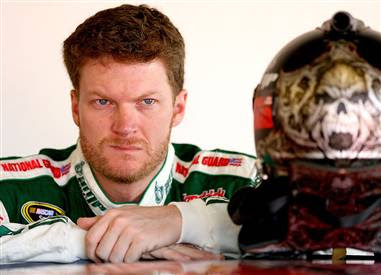
Good piece by Pat Jordan on Dale Earnhardt, Jr in the New York Times Magazine this week:

Earnhardt and I were sitting on the sofa talking; his publicist sat on another sofa. We talked for two hours, while his publicist fidgeted, casting expectant glances at us. Earnhardt said nobody calls him Junior or Little E anymore, except his fans. “That’s off my back,” he said. He looked down at his hands while he talked. When I asked him why he races, he said: “I didn’t want to work for a living. What the hell am I gonna do with my life as Dale Earnhardt’s son if I don’t race? I was a mechanic in Dad’s dealership at 18, and those were some of my happiest days. But my name was Dale Earnhardt Jr., man. Working as a mechanic would’ve been a real pain. People saying: ‘What happened to you? You’re Dale Earnhardt’s son.’ ”

…What has been the hardest thing for him to deal with in his career?

He stared at his hands and said: “All my life I’ve been the smaller measure of the man. When my Dad died, I wanted to honor him. But I wanted to distance myself from him too. I wanted to get out from under being Dale Earnhardt’s son.”

Bet a Million

Here’s Vic Ziegel, from the introduction to his collection Sunday Punch: Raspberries, Strawberries, Steinbrenner & Tysons–a Famed Sports Columnist Takes His Best Shot at Sports’ Big Shots:

Many of the pieces contained here were written in the press boxes, very close to deadline, with the stranger next to me typing a lot quicker. When sportswriters describe other sportswriters, good is high praise, quick is the ultimate. (The two words, quikc and good, make the work sound almost lewd. Me? I never got it for free and I never will.) The deadline is the problem, the enemy. It is there, at the same time, every night. You stand still and it comes closer. You can’t fake it out because it doesn’t move. It grows shorter and towers over you. It doesn’t understand that you want a better word than fast to describe a baserunner. Very fast is very bad. Fleet is out. Swift, nimble, speedy. No, no, no. Fast is starting to look better. There’s coffee spilled on my notes, you know in your heart that the press lounge has run out of beer, and now the stranger is on the telephone telling someone named Sweetie that he’s on the way.

On those days I write in the Daily News‘ sports department, and the ax of a deadline isn’t about to drop immediately, when you might think I have words enough and time, it suddenly becomes important to play chicken with the blade. So I shmooze with the guys in the office, go downstairs for another cup of cardboard coffee, call home, anybody’s home, until I have finally arrived at the moment I dread: the sports editor standing over me and saying, “Where is it?” (This is what you answer, kids. You say five minutes. And not to worry. If you miss once, nothing happens. If you miss too many times, they make you sports editor.)

And here’s John Schulian remembering his friend.

It was Vic Ziegel who once began a story with these immortal words: “The game is never over until the last man is out, the New York Post learned late last night.” If I had a nickel for every baseball writer who has paraphrased or just plain stolen that sentence, I might be able to afford a box seat at a Yankee game.

But those 19 words, no matter how often they appeared in one form or another under someone else’s byline, would always belong to Vic. He took a cliché and, with one deft addition, told his readers that he had written about a game, not the end of the world. Better still, he was setting the stage for a story filled with fun and whimsy. It would also be wise and free of self-importance, because those were trademarks of Vic’s work, too. Most of all, though, his story was going to make people laugh.

Making people laugh was what Vic did best until he died the other day, at 72, and turned my smile, and the smiles of everybody else that knew him, upside down. At the old Dorothy Schiff Post, he tickled funny bones by writing a sports advice column he called “Dear Flabby.” When Red Smith invited him to go to the horse races in some exotic, Ali-inspired locale -– oh, did Vic love the horses -– the next thing he knew, Red had written a column featuring a character named “Bet a Million” Ziegel.

And then there was a story that never made print, the one Vic told on himself about his turn as a hockey writer. The old one had left the Post, and when the new one couldn’t start for a couple of weeks, Vic volunteered the fill in even though hockey left him cold. Somehow he survived. He was such a team guy, in fact, that he even escorted the new man to the first game he covered. Soon after the puck was dropped, the new man began waxing rhapsodic about the action in the crease.

“The crease?” Vic Ziegel, hockey expert, said. “What’s the crease?”

As the story comes back to me, I can hear him laughing. Not loudly -– there was nothing loud about him -– but with the joy he got from telling a funny story well. And if he was the punch line, so what? We’re all punch lines at one point or another in our lives.

He and I might have qualified in that regard when we wrote for P.M. papers–Vic the Post, me the Chicago Daily News–and still struggled to make our deadlines. It was funny for everybody except us and the desk men who were waiting to slap headlines on our copy as dawn came creeping. For all I know, that was how our friendship was born: We were the last two guys in the pressroom. The only thing I can tell you for sure, though, is that we met at the Muhammad Ali-Alfredo Evangelista fight outside Washington, D.C., in 1977, and we became friends, just like that.

It was one more stunning development in the year and a half or so that saw me go from cityside reporter in Baltimore to sportswriter at the Washington Post to columnist in Chicago. Here was Vic, whose work in the New York Post had been making me laugh since the first time I picked up the paper, in 1968, and he was giving me his phone number and calling me “pal” and treating me as if I belonged in the kind of company he kept in Manhattan. He had worked with Leonard Shecter, Larry Merchant, Pete Hamill, and Murray Kempton, and I’d read in the Village Voice that he hung out at the ultimate writers’ bar, the Lion’s Head. Now he was my friend — how cool was that?

There was a grace and good-heartedness about Vic that never wavered throughout the 33 years I knew him. He took me to the Lion’s Head for my first visit, and made a point of introducing me to Hamill and Joel Oppenheimer and Joe Flaherty, towering figures in the pecking order in my head.

When I was married and my wife and I visited New York, Vic and his wife, the pluperfect Roberta, hosted a brunch in our honor at their apartment, and who should show up but Wilfred Sheed, another writing hero. Vic knew the Italian restaurants I should eat at, and the movies I should see (especially if they were film noir), and the old jazz I should be aware of, by Bix Beiderbecke and Jellyroll Morton. I’m partial to country music myself, but one rainy night Vic picked me up to go to dinner and then abruptly pulled his car to a stop on a side street so I could listen to what he thought was the perfect blending of our sensibilities: Jimmie Rodgers, the Singing Brakeman, backed by Louis Armstrong. If a goy from Salt Lake City may say such a thing, he was the ultimate mensch.

There are people who knew Vic longer than I did, and there are people who knew him better, but I consider myself lucky to have spent the time I did reading him and hanging out with him. The last time was after last year’s Breeders’ Cup at Santa Anita. He stayed for a couple of days in the room where I keep my crime novels and a jukebox that I’m ashamed to say has only one jazz CD on it, Miles Davis’ “Kind of Blue.” He had aged and he seemed less sure of himself physically, but if he had been diagnosed with the cancer that ultimately killed him, he never breathed a word of it. He wanted to talk, to laugh, to eat, and when I suggested that we watch The Friends of Eddie Coyle, he was up for that, too. He took the sofa, I took the easy chair, and we were both sound asleep before we got 20 minutes into the movie. It’s what old guys do. Then they say goodbye and hope they’ll see each other again.

When Vic was back in New York, he told me about the health problems that had begun to dog him, though still with no mention of cancer. But I’m not sure I ever told him about the anthology of boxing writing that George Kimball, another old friend, and I are putting together. I should have, because he’s in the book with a blissfully funny story he wrote for Inside Sports 30 years ago about the devoutly unfunny Roberto Duran. The story opens with Vic’s description of two chinchillas, Ralph and Steve, who live in a window cage in New York’s fur district. Now nobody will ever open another boxing story with chinchillas named Ralph and Steve, damn it.

[Photo Credit: NY Daily News, Corbis]

O Brother, Where Art Thou?

Here’s Pat Jordan at his best. A first-person essay on his relationship with his brother:

My brother doesn’t know where I live. He doesn’t know who my friends are. He doesn’t know I have two new puppies. He doesn’t know I am talking again to my daughter after 20 years. He doesn’t know if Susan is still well and free from cancer. He doesn’t know if I am well or sick, working or not, vigorous or an old man. I know nothing about him either. I have not talked to him in three years. I have not seen him in five. I have seen him only three times in the last 12 years, at my house in Florida in 2000, at our mother’s funeral in 2002, and at my father’s funeral in 2005. He doesn’t know what I look like now, at 69, whether I have gained or lost weight, whether I have lost my hair like Dad, or still have it like him. But I know what he looks like because he has never aged. He looked old when he was young, but when he got old he looked the same. He’s 83 now. With short hair like Brillo, a long horsey face, and small eyes (his friends called him “Moose”). A tall, sturdily built man with a vise-like handshake that made me wince, his reminder that he would always be stronger than me, like a solid oak unbending in the wind, while I would always be a sapling whipped by the wind until uprooted.

At my mother’s funeral in 2002, my father, my brother, and I greeted mourners in the back of the church in our hometown of Fairfield, Conn. My brother, 6’4″, wore his Ivy League suit from J. Press Clothiers in New Haven, and his wing-tipped cordovan shoes, as sturdy as Dutch clogs. My father, 5’6″, at 92, wore his navy blazer with brass buttons and his regimentally striped tie. I, 6’1″, wore my black leather sport jacket, jeans, and work boots. I had long gray hair and a white beard. My father looked at me and said, “You look like a bum.” My brother said, “Leave the kid alone, Dad. He came all this way.” My brother always defended me to my father. That’s why he always called me “the kid.” It was a sign of affection. To him, I would always be “the kid”; it was his way of excusing my behavior among adults. And whether my brother realized it or not, it was a way to diminish me. Which was the problem, one of them anyway, which is also why, at 69, I have reconciled myself to the possibility that I will never see my brother again.

Speed the Plow

With Father’s Day fast-approaching, consider Will Leitch’s smoothly-written memoir, Are We Winning? It’s a brisk and funny read. Will is really in his element here, flourishing. Ya heard?

And while we’re talking fathers and sons, do yourself a favor and check out this post by Glenn Stout:

Most of my memories of my father are somehow wrapped around a baseball – playing catch, him taking me to games or watching me pitch. It was the one way we really connected. But in high school I tore my rotator cuff and had to stop playing. We didn’t have as much to talk about after that.

Almost twenty years later my shoulder healed and I joined an adult league, one in Boston and later, another in Worcester County, where I then lived. For three or four years I was in both leagues and played fifty, sixty games each summer, usually pitching and playing first or third.

I’d call home every week and for the first time since I was a kid my conversations with my father were wrapped around baseball again. I sent him the ball after I won my first game since I was sixteen years old, and a t-shirt I got for making the league all-star team. I was as proud of each as of any book I’ve ever written, and so was he.

Fine work by Glenn, as usual.

Breaking the Wall

[Editor’s Note: Here’s another one from the Pat Jordan vaults, a short, cutting profile of Burt Reynolds, from the late Eighties. While Pat reserves his harshest criticism for himself, but he’s especially hard on jockish, so-called tough guy actors like Reynolds and Tom Selleck. He thought Reynolds wasted his talent and was willfully lazy for easy money and fame.

When this story was published Reyonlds’ publicist called Pat and called him the “evilest man in the world, the anti-christ.” Pat said, “Then I’ll see you in Hell.”

No business like show business. Enjoy.]

By Pat Jordan

It was just a wink. But it defined the rest of his career.

“They told me I couldn’t do it,” he says. “It would break down the wall between the actor and his audience. But the movie was just a cartoon. Smokey and the Bandit. Cotton Candy. I just wanted to say to the audience, I hope you’re having as much fun as I am. So I looked in the camera, and winked.”

Audiences loved it. That conspiratorial wink united them with the actor in his inside joke. This movie was just a lark. He didn’t take it seriously. He wasn’t really acting. He was just partying with friends in front of a camera, and he invited the audience to join in. His fans were so grateful they made his movie one of the biggest grosser of the year, 1977, and they made him a No 1 Box Office Attraction. A Star. But more than that. Their favorite actor. The actor they liked the most. Which was his problem.

“I thought acting was synonymous with being liked,” he says. “I courted my fans. I passionately wanted them to like me. I thought being liked meant I was a good actor.”

The critics weren’t so accepting as his fans. That wink didn’t play well with them. They read into it, not the actor’s good-spirits toward his fans, but his contempt for them, and his craft. It wasn’t an actor’s role to be liked by his fans. It was to entertain them. Just because he was having fun with his friends – Jackie Gleason, Dom DeLuise, Dean Martin, Sammy Davis, etc. – in a host of Sophomoric movies (Smokey and the Bandit, Iⅈ Cannonball Run, I&II) that actually did seem to be filmed parties of actors acting silly, that didn’t mean his audiences were having fun. They would have fun only as long as that wink deceived them into believing they were inside those parties. That they were getting drunk, cracking inside jokes, oogling beautiful girls, and crashing expensive cars with the actor and his friends. But the truth was, they weren’t and never would be. They were irrelevant to those parties, except that they made them possible by the vast sums of money they paid to see them on screen. When, and if, they woke to the deceit of that wink, how it made the actor rich at their expense, they’d stop paying to see such movies. Which they did. But not until after they made him a No 1 Box Office Attraction for five consecutive years.

(more…)

feed Share on Facebook Share on Twitter Share via email
"This ain't football. We do this every day."
--Earl Weaver