"A New York Treasure" --Village Voice
Category: Yankees

Coming Up Short

On Star Wars night at Comerica Park the Yankees and Tigers played a taut, tension-filled game. The Stakes seemed high for both teams–for the Yanks because Justin Verlander is pitching tomorrow, for the Tigers because they’ve been horrible lately.

Rick Porcello got Derek Jeter and Curtis Granderson out in the first on hard ground ball outs and after Alex Rodriguez and Robinson Cano singled, Mark Teixeira popped out to end the inning. Quintin Berry walked in the bottom of the inning, stole second, and was sacrificed to third. Then the rain came and the game was called for forty minutes. When it resumed, Hiroki Kuroda got out of trouble, retiring the demolition duo known as Cabrera and Fielder.

The game moved quickly. In the fourth, Don Kelly, a tall, thin left fielder, stretched out and robbed Teixeira of a homer. Bottom of the inning, however, there was no robbing Cabrera of anything as he hit an absolute bomb to center field. The Tigers added another run in the fifth and it stayed 2-0 when the Yanks led off the seventh with back-to-back singles (Chavez, Martin). Juaquin Benoit came in and Jeter sacrificed them over, as we all knew he would, and in spite of some of our hollering.

Would the Tigers walk Granderson to face Rodriguez? I thought they would. Instead they went right after Grandy. The first pitch, a change up, low and away was called a strike though it looked nowhere near the strike zone. Grandy popped the next pitch foul and out of play near the Yankee dugout and apparently Kevin Long said something to home plate umpire–and notorious crank–Bob Davidson because in not time he was thrown out of the game. Joe Girardi was heated, charged over to Davidson and he too was excused from the game. Then Grandy whiffed and Rodriguez hit a soft pop up to second and once again the Yanks couldn’t come through with the big hit.

In the bottom of the eighth, Cory Wade replaced Kuroda and got Berry to ground out to Cano for the first out. Cano moved to his left and fielded the ball on a short hop. He made the play look easy but it was anything but–second base always has odd plays that appear simple because the throw to first is short. Wade got a pop out to Cano and then had to deal with Cabrera.

But Cabrera dealt with him instead launching a 2-1 pitch to deep center right into the cameras.

“What a terrifying hitter he is,” said Tim McCarver on the Fox broadcast.

Enter the Jackass: Jose Valverde, who has added to his jackassedness with a blond billy goat beard since last we saw him (the tail of his hair is blond too).

First pitch he threw clipped Russell Martin in the left shoulder. Dwayne Wise pinch came in to run for Martin and he took off on the second pitch to Derek Jeter (and second ball) and made it to second safely. Three pitches later, Jeter drew a base on balls. Granderson took ball one and then hit a harmless fly ball to center for the first out.

Once again, Rodriguez was in a key spot. He took the first pitch for a strike while Wise and Jeter took off and successfully reached third and second respectively. The infield came in. And Rodriguez took a fastball, high and inside for a ball. The next pitch, another fastball, was outside. The next pitch summed up the season for Rodriguez. Right down the pipe, inside corner, 94 mph. Good swing, but futile, swung right through it for strike two. And then came a fastball that nailed Rodriguez on the left elbow, the funny bone. Rodriguez looked to be in considerable pain as the trainer Steve Donohue led him down to first base.

Leyland commenced to pacing as Valverde’s first pitch was so far outside that I was surprised that it wasn’t his last of the night. But he got the next pitch in on Cano’s hands and the second baseman hit a weak pop fly to short. All down to Teixeira.

The first pitch was way high for a ball. Next, another fastball outside, 2-0. The next pitch, again outside, and not even close, 3-0. How could the Tigers escape this? How could the Yanks find a way to screw it up? The crowd cheered when the following pitch was a strike down the middle. Would Teix take another one? He would not as he fouled a ball off.

Now the Tiger fans were shouting, trying to will their team to a win. Fastball inside, like the one that got Cano out, but Teix fouled it back. More screaming, fans standing, clapping. And ball four in the dirt. Game tied. Now, those same fans booed.

Raul Ibanez leaned back and took a 95 mph fastball inside for a ball.  A called strike. Another ball and then a pop up. The catcher Omir Santos came over near the Yankee dugout and he missed the ball. Flat missed it. More boos. Life for Ibanez as he tipped the next pitch–a good pitch to hit. Fouled off the next pitch too. Then grounded out weakly to Fielder.

David Phelps got the first man out in the ninth, gave up a single and then Jhonny Peralta sliced a ball to right. Nick Swisher, moving to the corner, fielded it on a hop with his bare hand. The ball was tailing to his left. It saved the game though runners were on the corners. Enter Boone Logan. Ramon Santiago, a right-handed hitter, pinch hit for Kelly. Took the first pitch in the dirt for a ball. Next pitch bounced too and Chris Stewart, the new catcher, blocked them both. Then Santiago was walked intentionally.

Bases loaded. Again. For Santos. The 9 hitter. And sunken stomachs in Yankee land, figuring this would just about figure. So Logan throws him a breaking ball for a strike. He lined the next pitch to right, good enough for a sac fly and good enough for the win.

Final Score: Tigers 4, Yanks 3.

Less than fourteen hours until Phil Hughes. Sleep well.

 

Keep On Truckin’

While the Mets remain the talk of the town the dullards from the Bronx look to win another game behind Hiroki Kuroda. Be a nice “w” what with Mr. Verlander vs. Phil Hughes tomorrow.

How ’bout some more runs, fellas?

Derek Jeter SS
Curtis Granderson CF
Alex Rodriguez 3B
Robinson Cano 2B
Mark Teixeira 1B
Raul Ibanez LF
Nick Swisher RF
Eric Chavez DH
Russell Martin C

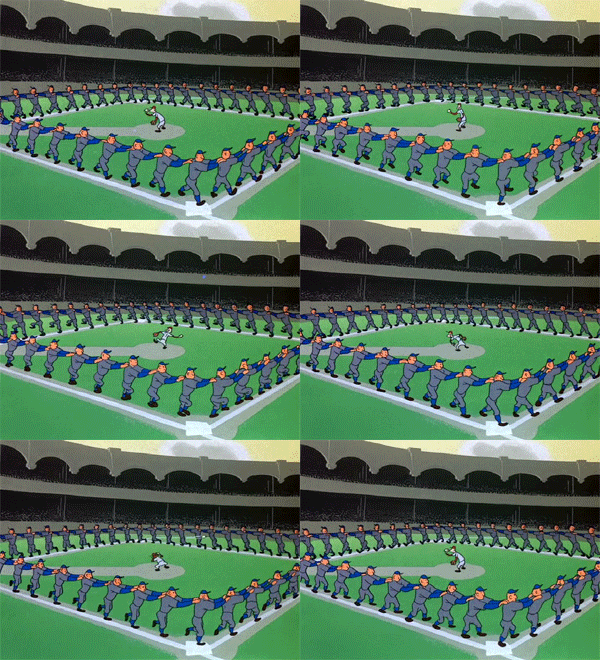
Never mind the storm troopers: Let’s Go Yank-ees!

[Photo Credit: Scarlet Pimp]

June 2, 1941: Game 19

The Yankees attempted to complete a sweep of their series against the Indians but were faced with the daunting task of hitting against one of the league’s hottest pitchers, Bob Feller. Coming into the game he hadn’t allowed a run in twenty-nine straight innings, and although the Yankees snapped that string in the second, Feller was still able to earn his eleventh win of the young season as the Indians came out on top, 7-5. DiMaggio had a single and a double on this day, and back in his hometown, the San Francisco Chronicle picked up on the streak for the first time. Soon enough, every paper in the country would be tracking DiMaggio’s progress.

Jo No (Oh, Yes)

Who says the Yanks can’t hit rookie pitchers they’ve never faced before? Who says they can’t get a big hit with the bases loaded? They had plenty fun tonight thanks to a grand slam by Curtis Granderson (2-0 pitch and son hit an absolute bomb) and a yeoman effort from C.C. Sabathia. It was a cold and rainy night in the Motor City but the Yanks got a lead and held it together. Grittsy n gutsy by C.C. who threw 39 pitches in the third inning but five in the sixth (after a bad call went against the Yanks, Robinson Cano was positioned just right to make an unassisted double play).

Alex Rodriguez whiffed three times but interrupted a rant by Michael Kay about how he hasn’t hit for power (which is, of course, true enough) to hit a two-run homer in the top of the ninth.

Rafael Soriano had to come in the game with the bases loaded, one out and Miguel Cabrera up in the bottom of the inning but got a ground ball double play to end it.

Final Score: Yanks 9, Tigers 4.

Course, the big news round these parts tonight was Johan Santana’s no-hitter for the Mets, the first no-hitter in franchise history. I only caught the final three outs and have never rooted so hard for the Mets. Good for them.

A good night for the locals indeed.

[Photo Credit: SNY]

Crouching Tiger Hidden Dragon

The Tigers have been bad. That’s gotta change, right?

Here’s hoping the Yanks take two of three this weekend.

Derek Jeter SS
Curtis Granderson CF
Mark Teixeira 1B
Alex Rodriguez 3B
Robinson Cano 2B
Nick Swisher RF
Andruw Jones DH
Jayson Nix LF
Chris Stewart C

Never mind the rookie: Let’s Go Yank-ees!

[Picture via Activity Village]

Book Banter

I’m going to be at the Warner Library in Tarrytown on Monday night talking to Rob Fleder about “Damn Yankees.”

Fall through if you are around that neck of the woods.

[Pictures via: It’s a Long Season]

It Was Twenty Years Ago Today

Happy Yankee anniversary to Derek Jeter. Joel Sherman and George King III have the skinny today in the Post.

June 1, 1941: Games 17 & 18

Playing their second doubleheader in three days, the Yankees continued their roadtrip by sweeping two games from the Cleveland Indians and moving to within a game and a half of the first place White Sox. DiMaggio had one single in each of the games to bring the streak to eighteen games. His hit in the second game came in his last at bat of the day. At this point, as a new paper each day seemed to pick up on the DiMaggio streak, he certainly must have been aware of what was at stake. He smashed a rocket that glanced off the glove of third baseman Ken Keltner. (The next time the Yankees came to Cleveland, DiMaggio would not be so lucky.) Elsewhere, Ted Williams was also continuing his torrid pace. He collected four hits in a doubleheader against the Tigers, raising his average to an obscene .430. His hitting streak was still intact a game beyond DiMaggio’s at nineteen straight, and he was even hotter than Joe D. Williams’s streak average was an even .500 (36 for 72) while DiMaggio was hitting a comparatively mild .362 (25 for 69).

Color by Numbers: Loaded Questions

What would the Yankees’ record be if their performance with runners in scoring position was on par with recent seasons? With a few key hits at the right moment, the Yankees could be resting comfortably in first place, but so far this season, the team hasn’t been able to land the big blow with the same amount frequency. And, in no situation has that been more evident…and costly…than when the Yankees have loaded the bases.

Yankees Offensive sOPS+ Rates, 1996-2012

Note: sOPS+ compares a team’s split to the adjusted average for the major leagues. A reading above 100 is considered above average for an offense.
Source: baseball-reference.com

Entering play on Wednesday, the Yankees ranked near the bottom of the major leagues in terms of batting average, on-base percentage, and slugging (.151/.222/.302) with the bases full. Based on OPS, not only does that performance rate fail to attain even 50% of the major league average, but it also ranks as the franchise’s third lowest output since 1948. Also, the differential between the team’s overall offensive production and its performance with the bases loaded is currently larger than at any point over the same timeframe.

Clearly, the Yankees have been laggards with the bases loaded, but is this really a bad harbinger? Based on correlation from 1996 to now, the Yankees’ performance with the bases loaded has only been moderately related to overall run production as a percentage of the league average (r=.62).  Meanwhile, the link between relative runs scored and OPS with men in scoring position has been more significant (r=.78). So, if anything, fans who are inclined to worry should focus their concerns on the more broad number.

Yankees’ Bases Loaded vs. Overall OPS, 1948-2012
 

Source: baseball-reference.com

It hasn’t been all bad news for the Yankees with the bases loaded. While the hitters have struggled in such situations, the pitching staff has done a good job wiggling out of trouble when the bags are jammed. In 42 plate appearances with the bases loaded, opposing hitters have produced at rates of .263/.262/.368 (sOPS+ of 76), including 13 strikeouts and only one walk. It might only be a small consolation, but at least Yankees’ pitchers have been able to offset some of the offense’s missed opportunities by imposing the same frustration on the opposition. Unfortunately, since 1996, there has been no correlation between the Yankees’ ability to limit the damage in bases loaded situations and prevent runs overall (r=.04), so there doesn’t seem to be much benefit from that guilty pleasure.

Yankees Pitching sOPS+ Rates, 1996-2012

Note: sOPS+ compares a team’s split to the adjusted average for the major leagues. A reading below 100 is considered above average for a pitching staff.
Source: baseball-reference.com

An optimist probably looks at the Yankees’ ability to hang around first place despite its offensive struggles with runners in scoring position as a positive sign. Meanwhile, the pessimist might consider the offense’s inefficiency to be a systemic problem that will prevent the team from outscoring the deficiencies of the starting rotation. Which side are you on? I take a little from both. The lineup’s track record suggests the Yankees’ offense will soon start making up ground on the past, but it won’t matter if they can’t stay ahead of the current opposition. A few more hits with the bases loaded would definitely be nice, but the real loaded question is whether the pitching staff can ensure that those runs will be meaningful when they finally cross the plate.

The Pleasure Pain Principle

Laz Diaz offers up some cruel and unusual punishment. Craig Calcaterra gathers the story over at Hardball Talk.

[Image Via: Von Trapper Keeper]

Escape from L.A.

Sometimes life can get in the way of baseball, and this was one of those nights. The good news, of course, is that I have a DVR, so I never really have to miss anything. I can coach volleyball practice, head directly to my daughter’s middle school band concert, then take the family out to a late dinner, confident that all the while my trusty DVR is dutifully recording the game.

The problem, of course, is that the game is also in my pocket the whole time. My phone buzzed at 7:05 to let me know that game had started, and I was tempted several times throughout the evening to check on the score. I resisted each time. During the lull between beginning band and beginning orchestra? Stand strong. After foolishly glancing at the restaurant television and seeing this on ESPN’s Bottom Line: Nova (NYY): 5 IP, 5 ER…? Stay calm and carry on. When my phone buzzed at 10:05, feeling suspiciously like an incoming text from a gloating Angel fan? Keep the faith.

And so I kept the faith, even as the Angels jumped on Ivan Nova for an early 1-0 lead in typically annoying Anaheim fashion. Mike Trout, heretofore referred to as the Most Exciting Player in Baseball, took a pitch to the shoulder to lead off the first, then galloped to third when a hit-and-run worked out and Alberto Callaspo singled where Derek Jeter had just been standing. Albert Pújols, suddenly fearsome again, walked to load the bases with none out, and disaster loomed. But Nova rebounded to strike out Kendrys Morales, yielded a sacrifice fly to Mark Trumbo, then got Howie Kendrick to fly out. Sure, it was 1-0, but it could’ve been much worse.

The Yankees answered back in the third when Russell Martin walked and later used the 3-2 head start to race to third on Derek Jeter’s single. Curtis Granderson followed that with home run to right, and the Yankees had their first lead since the first inning of the first game of the series. Ervin Santana was the victim of all that, and he responded by hitting Alex Rodríguez a few pitches later. If the Yankees were bothered by that — and I can’t imagine they were — Robinson Canó exacted revenge by powering a home run deep to right and they were up 5-1.

Nova, meanwhile, was looking good. I’m not sure how accurate it was, but according to the radar gun at Angels Stadium, Nova’s fastball was topping out at 97 MPH in the early going, and he cruised through the second and third innings on only eighteen pitches. But then came the fourth. I don’t have the energy to recap it completely, but believe me when I tell you it was just more Halo nonsense. Yet another home run from Mark Trumbo, a two-strike single, a bunt single, and a rocketed double off the bat of the Most Exciting Player in Baseball. In the blink of an eye, the game was tied at five. If you were watching live and felt confident at this point, you’re lying.

But Nova stuck around to cruise through the fifth and sixth and got back in position for a win when the Angels defense finally made a mistake. Raúl Ibáñez smoked a ball to the wall in right center, but Peter “Gorgeous” Bourjos foolishly chased it all the way to the warning track only to watch helplessly as the ball ricocheted over his head and bounded back towards center field, following the exact path Bourjos had just tread. Ibáñez actually looked like he had designs on an inside-the-parker before downshifting and coasting into third for his first triple in more than a year. Nick Swisher jumped on the first pitch he saw and produced a sacrifice fly to give the Yankees the 6-5 lead.

Nova was lifted after getting the first two outs of the seventh inning, then Boone Logan made things interesting by giving up consecutive singles to put runners on first and third with two out. With the game clearly in the balance, Cory Wade entered to face Kendrick and promptly fell behind 3-0. He was having trouble finding the feel of his curveball, but once he found it, the Angles hitters were at his mercy. He bounced back to strike out Kendrick, then K’d two of three in the eighth to hand the game to Rafael Soriano.

I won’t describe the ninth inning, except to mention that Pújols came to the plate as the winning run and I was dead certain that he was about to hit a walk-off. (Remember the suspiciously-timed text message from earlier?) He didn’t. Pretty or not, Soriano got the save. Yankees 6, Angels 5. And by the way, it isn’t just Mariano’s cold-hearted efficiency that I miss, it’s also his business-like reaction to the final out. Whenever Soriano gets a save, pulling his jersey out of his pants as he walks off the mound, I find myself completely distracted from the win and instead wishing he’d keep his clothes on. Classless. Someone should talk to him.

But things are looking up in Yankeeland. The teams heads off to Detroit, where two wins will make for a successful 6-3 road trip. Wouldn’t that be nice?

Oh, and that text message? Turns out it was just a push notification. It was my turn in Scrabble. If I had had the letters, I obviously would’ve played V-I-C-T-O-R-Y.

[Photo Credit: Chris Carlson/AP Photo]

Deja Vu All Over Again?

The Yanks look to escape Orange County with a win.

Derek Jeter SS
Curtis Granderson CF
Alex Rodriguez 3B
Robinson Cano 2B
Mark Teixeira 1B
Raul Ibanez LF
Nick Swisher RF
Eric Chavez DH
Russell Martin C

Never mind those brooms, fellas: Let’s Go Yank-ees!

[Photo Via: Where is the Cool?]

All Right Already

Chad Jennings breaks down the Yanks’ recent struggles with the bases loaded.

Freaky. It won’t last.

[Painting by Craig Robinson]

May 30, 1941: Games 15 & 16

The Yankees travelled to Boston for a Memorial Day doubleheader, one of six twinbills played during DiMaggio’s streak, another notable difference between baseball then and now. A sell-out crowd of 34,500 crammed into Fenway Park as the Yanks and Sox split the pair. In the opener, things looked bleak for the Yankees and DiMaggio as they came to bat in the top of the ninth trailing 3-1. Still without a hit, DiMaggio came up in the final inning with a runner on first. He singled to keep the rally (and the streak) alive, and New York eventually scored three times to take the one-run lead that would give them a 4-3 victory. In the nightcap, Boston hammered the Yankees, beating them 13-0, but DiMaggio was awarded a hit on a fly ball lofted high into the wind and sun that often plagued Fenway’s right field. Boston’s Pete Fox tried valiantly to make the catch, but the ball fell untouched at his feet, and DiMaggio scampered into second base with a double.

Aside from the two hits, DiMaggio’s day was utterly forgettable. Normally one of the best defensive outfielders in the game, DiMaggio earned his nickname, the Yankee Clipper, with the effortless way in which he sailed across the outfield grass in pursuit of flyballs. On this day, however, he was charged with an error in the opening game and three more in the second, making this perhaps his worst day in the field. None of this, however, affected the streak.

L.A. Confidential

I’ll tell you a secret. I hate the Angels. I hate them about a hundred times more than the Red Sox, a thousand more times than the Rays. I hate the way Mike Scioscia cocks his head and squints his eyes in confusion whenever a call goes against him. I hate the scrappiness, I hate the hustle, I hate the font of the numbers on the backs of their jerseys.

After a disappointing loss on Monday night, the Yankees returned to the scene of the crime on Tuesday and looked to bounce back into the win column. The problem, though, was that the Angels were sending Dan Haren to the mound. Haren has been unhittable recently, most notably in his last start against Seattle when he authored a 3-0 shutout that featured 14 strikeouts and zero walks, only the third time in the past dozen years that pitcher done that (a shutout with 14 Ks and zero walks). Opposing Haren would be the ageless wonder, Andy Pettitte.

I touched on this yesterday, but it cannot be understated. The Angels, as nauseating as they are, are an exciting team to watch, and it all starts with their youngest player, Mike Trout. On Monday night he flexed his muscles by bashing his fifth home run of the season, but on Tuesday he showed some of his other skills, namely speed and defense. With two outs and no one on in the bottom of the second inning, Nick Swisher launched a rocket to left center, but that’s Trout territory. He ran down the drive, leaping and snaring it just as it may or may not have left the park.

And how often does it happen? A guy makes a great player in the field, and two innings later he comes to the plate with a runner on second. Trout rifled a ball past third and down the line. The speedy Peter Bourjos coasted in easily on what seemed like a certain double from Trout. But Trout is probably in Brett Gardner’s class as a runner, and slid into third with a triple — on a ball hit into the left field corner. The whole world is crushing on Bryce Harper right now, and justifiably so, but check the numbers. Trout is outplaying the kid with the faux hawk.

The Angels push the envelope at all turns, so Trout went on contact and ran into an out at home on a grounder to Eric Chávez, but Albert Pújols erased that mistake seconds later when he smashed a no-doubter into the Yankee bullpen far beyond the left field fence for a 3-0 Angels lead. Pettitte would later call it “just a stupid pitch by me.” It seems the reports of Sir Albert’s demise were, indeed, highly exaggerated.

The Yankee hitters continued to struggle, and again they continued to fail with the bases loaded. In the half inning before the Angels scored those three runs, the Yanks had had a golden opportunity when they loaded the bases with two outs and Robinson Canó at the plate. A base hit there would’ve given Pettitte a cushion, pushed Haren a bit, and opened a lead, but instead Canó watched strike three dart across the outside corner. Fifteen minutes later it was the Angels who were giving the cushion, doing the pushing, and opening the lead.

Raúl Ibáñez doubled with one out in the fourth, and Nick Swisher quickly cashed him in with a hard single to right, bringing the Yankees to within two runs and breathing a little hope into the situation.

Following Swisher’s base hit, the next fifteen Yankees and Angels to come to the plate were all retired without the ball ever leaving the infield. Pettitte and Haren combined to gather nine groundouts, four strikeouts, a popup and a line out. The sixteenth hitter, however, was the Angels Mark Trumbo. Trumbo broke the string in the bottom of the sixth with a mammoth 433-foot blast into the rocks in center field, widening the Anaheim* lead to 4-1.

The Yankees put two runners on in the seventh, then two more in the eighth, but couldn’t make anything out of either opportunity. Then, more to taunt the Yankees than anything else, the Angels manufactured another run in the bottom of the eighth: single, ground out, single. It was all so easy, and in a game that had been close all night long, the Yankees were suddenly a grand slam behind.

The Yankees mounted a rally in the ninth as they often do, starting with a walks to Russell Martin and Derek Jeter. Granderson flicked a line drive to left, and it looked like a sure base hit, but again, left field is Trout territory, so it turned into an out. Angel reliever Ernesto Frieri plunked Alex Rodríguez, and suddenly the bases were loaded and Canó was walking to the plate as the potential tying run.

But if you’ve been paying attention lately, you know that the Yankees don’t get hits with the bases loaded. Canó struck out swinging. As the Angels announcer is fond of saying at the end of each victory, “Light that baby up.” Angels 5, Yankees 1. Lord help me.

*I know they’re not the Anaheim Angels, but they’re not the Los Angeles Angels, either. They don’t play in Los Angeles. They don’t play anywhere near Los Angeles.

[Photo Credit: Harry How/Getty Images]

Let’s Try This Again


C’mon Andy…

Derek Jeter SS
Curtis Granderson CF
Alex Rodriguez DH
Robinson Cano 2B
Mark Teixeira 1B
Raul Ibanez LF
Nick Swisher RF
Eric Chavez 3B
Russell Martin C

Never mind the late night nightmares in Cali:

Let’s Go Yank-ees!

[Photo Via It’s a Long a Season]

May 29, 1941: Game 14

A darkened sky threatening rain all afternoon and a stifling ninety-seven degree heat combined to keep attendance at a mere 1,500 in Washington as the Senators and Yankees tied 2-2 in a rain-shortened five-inning game. DiMaggio had been battling illness for a few days, but he was lucky enough to single and score in the fourth inning, extending his streak to fourteen games. Rookie Johnny Sturm, however, waited until the top of the sixth to record his basehit, only to see it washed away when the rains came before the Senators could hit in the home half of the inning. By rule, the score reverted to the last completed inning, and everything that happened in the Yankee half of the sixth was wiped out, including Sturm’s streak. Crosetti also singled in the fourth to keep his streak going at eleven. Though still unaware of DiMaggio’s streak, the New York Times reported one interesting note from the game. DiMaggio struck out for only the third time all season. He had struck out twice in the same game on April 25th, then waited 113 at bats before doing so again on this afternoon.

To Live and Die in L.A.

There aren’t too many games you can point to as “must wins,” especially in the closing days of May, especially when the team is in the middle of a west coast road trip, especially when the team is also riding a five-game winning streak. I’m not ready to say this game on Memorial Day night in Anaheim was a must-win, but it was certainly a game that should’ve been a victory.

Even though Phil Hughes had looked much better recently, the match-up didn’t look good on paper, as the Angels were sending their ace Jered Weaver out to start the series. Aside from Justin Verlander, Weaver has probably been the best pitcher in the American League for the past few years, and except for a bad start in Texas, Weaver has been dominant again this year. This was a game that looked like a Yankee loss before the first pitch was even thrown.

When the second pitch was thrown, however, Derek Jeter smoked a line drive into left field; five pitches later Curtis Granderson waited on a breaking ball and grounded it through the hole between short and third, and the Yankees suddenly had runners on first and second with no one out. Alex Rodríguez came up next and hit a hard grounder just to the right of shortstop Erick Aybar. It looked like a certain double play, but the ball skipped off of Aybar’s glove and somehow bounded over his shoulder into short center field, allowing Jeter to score easily and put runners on first and third.

Working to Robinson Canó, Weaver got a called strike to even the count at 1-1, but immediately started limping on his follow through, triggering a wave of discomfort in the stands and bringing Mike Scioscia and his support staff to the mound. Pitchers scare their managers all the time by catching a spike during a windup and coming up temporarily lame. They look into the dugout and say they’re fine, but the trainer still comes out to watch them throw a test pitch or two, but everything’s fine. Almost immediately it was clear that that wasn’t going to happen this time. Weaver slowly walked to the back of the mound, and when the cameras caught a glimpse of his face, it wasn’t pain that registered, but the frustration of an athlete whose body had betrayed him. Weaver knew this was serious even before he took his practice pitch and wasn’t able to complete it.

He walked off the mound, clenched his fist, and screamed “Fuuuuck!” at the top of his lungs, loud enough to be picked up by the crowd mikes and every ten-year-old in the lower tier. In case any of those ten-year-olds had missed it, he repeated himself just as he stepped into foul territory. Later the Angels would report he was suffering from a lower back injury.

It’s probably not appropriate to take pleasure in an opponent’s injury, but it’s perfectly fine to joyfully accept the opportunity that injury presents. The Yankees already had a 1-0 lead, there were runners at the corners with no outs, and the Angels were going to have to get 27 outs with their bullpen. Things looked good, about as good as they can look.

Bobby Cassevah came in for the Angels and struck out Canó, but then walked Mark Teixeira to load the bases, bringing up Raúl Ibáñez, who lofted a sacrifice fly to left field, scoring Granderson. Nick Swisher came up next and squirted a dribbler to the third base side of the mound. Cassevah fielded it in plenty of time, but rushed his throw, bouncing it past Albert Pújols for an error that allowed A-Rod to score the third unearned run of the inning. Scioscia decided to walk Eric Chávez intentionally, probably because his scouts had told him that the Yankees refuse to hit with the bases loaded. Russell Martin validated that decision by flying out to center field.

Handed this 3-0 lead and free of the pressure of facing an ace, Phil Hughes promptly gave everything back. It was the same infuriating rally the Angels have been cobbling together for years: Mike Trout two-strike single; Macier Izturis fly out, Pújols single, Kendry Morales two-strike RBI single, Mark Trumbo two-strike RBI ground-rule double, Howie “Yankee Killer” Kendrick RBI single.

It was finally over two batters later, but the Angels had sent eight men to the plate, scored four runs, and gotten right back into a game that should’ve been over.

Granderson homered to right in the top of the second to tie the game at four, but the Angels struck again in the fourth. Trumbo launched a towering fly ball to the gap in right center, but both Granderson and Swisher looked as if they had a shot at it. Just as the ball settled into Swisher’s glove, however, Granderson settled into Swisher’s chest. Both men fell in a heap on the warning track, the ball bounced free, and Trumbo ran like the wind. Well, Trumbo ran like a gentle breeze. He ended up on third with a triple. Kendrick took the first pitch he saw and floated it deep enough to right for Trumbo to score on the sacrifice fly. Angels 5, Yankees 4.

Hughes was clearly struggling, but not because of his control. His pitches were finding the strike zone (66 of 87, and through the first three innings that ratio was even higher), but he had no command. Pitches meant for the corners floated out over the plate and were hit hard. Seven times he put hitters into an 0-2 hole, but only once was he able to finish off that crippled hitter with a strikeout.

Hughes was touched again in the fourth, this time when Angel rookie Mike Trout hit a rocket over the wall in left center. There’s been some lamenting lately about the lack of exciting players on the Yankee roster, and some have suggested that Jesus Montero, a home-grown talent with All-Star potential, would’ve provided that. Montero was a player fans had been waiting for patiently, reading reports of his progress through the minors before his successful arrival in the Bronx last September. Trout followed that same flight path and created that same excitement, but he wasn’t traded. Forgive me if I’m bitter.

The suddenly resurgent Teixeira, hitting right-handed now against the left-handed Hisanori Takahashi, homered in the top of the fifth to cut the lead to 6-5. Over the past four games, Tex is 10 for 16 with three doubles, four home runs, and nine RBIs. There is hope.

Hughes made it into the sixth, but he wouldn’t make it out. It was all fairly innocent, which is typical of the Angels. The speedy Peter Bourjos reached on a perfectly placed dribbler to Hughes and was then sacrificed to second. Cody Eppley replaced Hughes, and Izturis hit a grounder up the middle; Canó was able to field it, but he couldn’t get the out. After Pújols walked to load the bases, David Phelps came in to face Morales, and his first pitch was hammered to the wall in left center, scoring two and giving the Halos an 8-6 lead.

Just as Yankee fans were starting to think dark thoughts about their heroes, the Bombers put together a rally in the top of the seventh. Canó hit a laser over Bourjos’s head in center field for a double, and Teixeira followed that with a walk, prompting Scioscia to bring in his fifth pitcher of the night, Jason Isringhausen. (I know what you’re thinking — it must’ve been Jason Isringhausen, Jr. No, it was really that Jason Isringhausen.) Ibáñez greeted him with a rifle shot to right field that looked like a run-scoring double. But Trumbo got a good jump on the ball, good enough that the runners had to be cautious. The ball ended up tipping off his glove, but Canó was fooled. Thinking Trumbo had actually caught the ball, he raced back to second to tag up, so he was only able to get to third.

Still, the bases were loaded with no outs. Swisher came to the plate with an opportunity to do some serious damage, but all he could muster was a sacrifice fly. One out later, though, Russell Martin laced a line drive down the left field line to score two and even the game at eight.

The Yankees would threaten again in the ninth, but again they’d be thwarted by bad luck and bad hitting with the bases loaded. Teixeira opened the inning with a single, then moved to second when Chávez walked two outs later. Martin punched a ground ball up the middle, and again it looked like the Yankees would surely score as the ball seemed ticketed for center field. But Izturis was able to keep it in the infield. He wasn’t able to make an out, but he saved a run. Jeter came up with the bases loaded and bounced the first pitch he saw to Pújols, who flipped to second for the out.

The Yankees had four at bats with the bases loaded and finished 0 for 2 with two sacrifice flies, but there wasn’t much time to dwell on that. Cory Wade came in to pitch the bottom of the ninth and Trumbo made his third pitch disappear into the night. Fuckin’ Angels.

Sons of Bitches 9, Yankees 8.

[Photo Credit: Jeff Gross/Getty Images]

Enjoy Your Stay: Welcome to L.A.

The Yanks are on a little roll but face a team that is perhaps better than its record in the Angels. At least they’ll be up against some formidable starting pitching as well as the hot-hitting Mr. Pujols. Two-of-three would be terrific.

Tonight gives Phil Hughes, he of the straight fastball, against Jared Weaver, a bona fide Ace.

Derek Jeter SS
Curtis Granderson CF
Alex Rodriguez 3B
Robinson Cano 2B
Mark Teixeira 1B
Raul Ibanez LF
Nick Swisher RF
Eric Chavez DH
Russell Martin C

Never mind the match-ups: Let’s Go Yank-ees!

[Photo Credit: Clarke Tolton]

May 28, 1941: Game 13

On a night when the Yankees and Washington Senators played the first ever night game in Washington’s Griffith Stadium, DiMaggio led his team to a 6-5 victory. Three interesting notes about the lights that night: One, Griffith Stadium was now one of only four American League parks to boast electric lights. Two, the lights were turned on for the first time by a Walter Johnson fastball. The retired Senator threw the ceremonial first pitch through an electric beam projected across home plate; his third attempt lit up the night. Three, Washington officials needed special permission to fly the flag after sundown for the playing of the national anthem.

Once the game was underway, the Yankees found themselves trailing 3-1 in the eighth inning as a hitless DiMaggio came to the plate. He tripled deep to right to extend his streak and trigger a five-run Pinstripe rally. In addition to DiMaggio, Johnny Sturm and Frank Crosetti also kept their streaks alive, and DiMaggio’s string was mentioned in the press for the first time in the New York World-Telegram: “Last night’s battle saw all three hitting streaks on the Yankees continued. DiMaggio hit in his thirteenth consecutive contest. Sturm in his eleventh and Crosetti in his tenth.” The fact that a player of DiMaggio’s stature could get almost two weeks into a hitting streak without being noticed underscores a major reason why this record will never be threatened. In this era of media saturation and round-the-clock sports highlights, nothing escapes the public’s unquenchable thirst for information. It isn’t uncommon to hear a television or radio announcer make mention of a three-game hitting streak, and any time a player gets a run up to twenty games, not even half way to DiMaggio, he becomes the lead story on SportsCenter. Even in 1941 DiMaggio endured scrutiny as an entire nation followed his exploits during the latter stages of his streak, but the media crush surrounding a player approaching that record today would be stifling. The physical accomplishment of fifty-six is amazing; the mental strength required to get there would be even more impressive. It’ll never happen.

feed Share on Facebook Share on Twitter Share via email
"This ain't football. We do this every day."
--Earl Weaver