
This is the 10th Opening Day we’ve covered here at Bronx Banter. We’re happy to have y’all back to enjoy another season.
Baseball is here.
Let’s Go Yank-ees!



This is the 10th Opening Day we’ve covered here at Bronx Banter. We’re happy to have y’all back to enjoy another season.
Baseball is here.
Let’s Go Yank-ees!

Photo: Peter Adams Photography
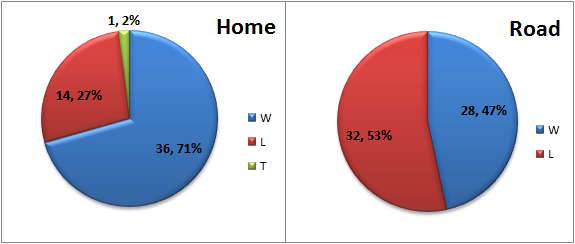
The Yankees open up their 112th season against the division rival Tampa Rays. Although the two teams previously faced off on Opening Day in 2004, those games were played in the Tokyo Dome, so this afternoon’s contests marks the first time the Yankees will begin a season at Tropicana Field. Entering the game, the Yankees are 64-46-1 (.577) on the season’s first day, but when opening up on the road, the team is below .500 and has lost seven of the last 10.
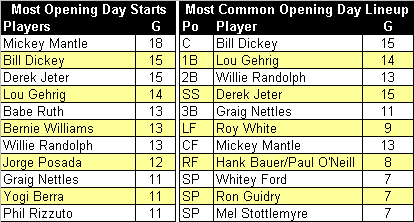
On an individual note, C.C. Sabathia is making his fourth consecutive Opening Day start, the most since Mel Stottlemyre did the same from 1967 to 1970 (the record is six, which was accomplished by Lefty Gomez from 1932 to 1937). With his 16th Opening Day start, Derek Jeter moves past Bill Dickey for sole possession of second place on the Yankees’ all-time list. If the Captain starts the opener in each of the final two years left on his current deal, he’d tie Mickey Mantle for the franchise lead. However, Jeter’s run of starts is not consecutive because a strained thigh muscle kept him out of the 2001 opening game.
Listed below is an assortment of team and player Opening Day facts and figures to keep you busy until the start of this afternoon’s game.
Yankees Opening Day Record, 1901-2011
Source: Baseball-reference.com
Yankees Opening Day Starters, 1918-2011
Source: Baseball-reference.com
Select Individual Player Opening Day Records, 1918-2011
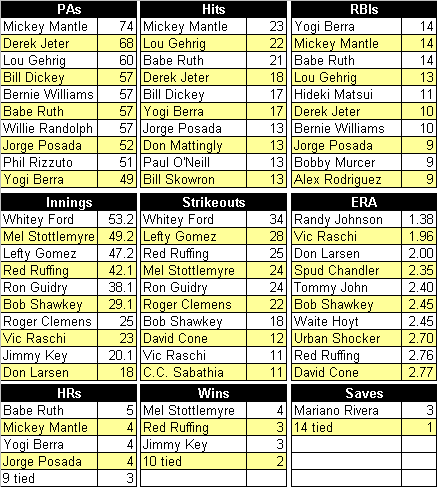
Note: ERA based on a minimum 10 innings pitched.
Source: Baseball-reference.com
Yankees Top Offensive Performers on Opening Day, 1918-2011
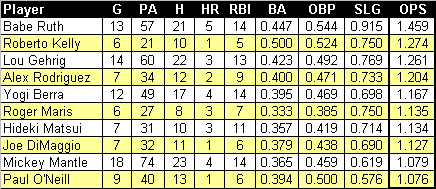
Note: Ranked by OPS; minimum 20 plate appearances.
Source: Baseball-reference.com
Yankees Top Pitching Performances on Opening Day, 1918-2011
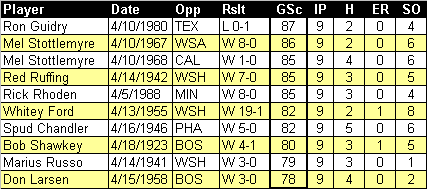
Note: Ranked by Game Score.
Source: Baseball-reference.com

If you follow one baseball site this year…

how about It’s a Long Season?

It’s killer diller…

don’t ya know?


The Why Time Begins on Opening Day thread. Have at it.
Play Ball!
[Photo Credit: Ralph Morse and George Silk, via It’s a Long Season]

Here’s a wonderful piece by our old pal, the late George Kimball. It’s about Opening Day at Fenway Park, 1971.
It appears in the fine collection, “Baseball I Gave You All The Best Years of My Life.”
Enjoy.
Opening Day at Fenway Park
By George Kimball
Years ago—only a few years ago, actually, but still years before the miracle year of 1967 and years before it became chic to root for the Red Sox—the centerfield bleachers at Fenway were traditionally the habitat of the most diehard of Sox aficionados. If the bleacherites weren’t the most knowledgeable fans, they were close to it, and they were certainly the most faithful. I suspect I was exposed to more genuine baseball lore, more understandings of the subtleties and stratagems of the game, and perhaps most importantly, more sheer love for the sport by sitting exclusively in the bleachers from boyhood through my early twenties than I’ve encountered in any reserved seat press box since.
This, of course, was back in the days when the Red Sox were drawing so poorly that they had to schedule night games around the Hatch Shell concerts in the summer and when a gate of 20,000 on Opening Day was considered spectacular. But from April through September the coterie in center field retained fidelity unmatched anywhere else in the American League. And while the businessmen who bought season tickets might sit next to someone in an adjacent box all season long and never exchange six words, there were people out there who’d been friends for twenty-five years yet never seen each other outside Fenway Park.
There were the beaten old men who looked like they’d just panhandled the 50 cent admission price, the retired gentlemen with their transistor radios and the truck drivers who took their shirts off on hot summer days. There were two old ladies from Dorchester, both named Mary, who attended the afternoon games as faithfully as they attended Mass. They left home early in the morning, bringing their Official Big League Scorebook along to Church, and after lunch in Kenmore Square, showed up at the park before batting practice started. They never went to night games, but the Boys from Chelsea did.
The Boys from Chelsea—three of them, Felix, Vinny, and Joe, all cab drivers, I believe, invariably turned up at night, and two or three of their friends often made it—were inveterate gamblers. They came to games weighted down with 50 cent rolls of pennies, and would wager with each other and anyone else on every conceivable facet of the game, from whether the next batter would get a hit (3 to 1 for Mantle or Willams; 6 to 1 for most pitchers) to an error on the next play (usually about 25 to 1, but you could always haggle) to the possibility of Casey Stengel being ejected during the course of the game. (If you got a bet down at the prevailing 7½ to 1 odds on Jackie Jensen hitting into a double play at every available opportunity, you usually made out over the course of a season.)
And there was Fat Howie. Fat Howie was on speaking terms with every centerfielder in the league. He’d sit right next to the rope (the section in straightaway center, directly in the batter’s line of vision, ALWAYS used to be roped off; since the space is needed now, the seats are painted green and the customers are allowed to sit there, provided they wear dark clothing) and carry on a running dialogue. Howie would lean over the wall between innings and yell out to Bob Allison: “Hey, Bob, what’s happening in Cleveland?” (The scoreboard on the left field wall can’t be seen from the bleachers in center.) And Allison would check the score and holler back: “4 to 2 Indians, Howie.” Howie was always there, day or night. I don’t know what he did for a living; maybe he took his summers off.
And, of course, there was the gang I hung out with in college. We’d usually catch about 20 or 30 games a year, always going in a group of four or five and always with a case of beer. Back then there was no hassle about bringing your own beer in to the bleachers; everyone did it, and probably would still be able to except for one particularly raucous occasion in the spring of 1964 when the bleachers were invaded by a few hundred Friday night beer drinkers posing as baseball fans.
Along about the sixth inning they were very drunk and very angry. The Red Sox were being humiliated by the lowly Kansas City Athletics (commonly referred to at the time as the “Kansas City Faggots,” since they wore bright gold suits with green trim, long before mod uniforms became fashionable), and someone heaved an empty beer can in the direction of Jose Tartabull, the A’s centerfielder. An umpire ran out to retrieve it, and was greeted by a fusillade of beer cans. This brought the park police out on the field, and the shelling exploded for real. One cop was cold-cocked by a beer can—a full one—and the barrage continued for about ten minutes, abating not because the park announcer warned that the umpires were threatening to forfeit the game, but only because the assholes ran out of ammunition. After that they started checking you out for beer when you came through the gate, and—at 55 cents a cup—the price of drinking went up considerably in center field.

Besides me, there were 34,516 other paying customers there last week. I hadn’t been to an opener at Fenway for seven years, though I caught a couple at Shea Stadium and K.C. Municipal. I looked around for Howie and the two Mary’s, but I didn’t see them. I suspect they’d be pretty uncomfortable out there these days anyway; the bleachers last Tuesday were packed with a crowd that would’ve been indistinguishable from the occupants of the cheap seats at the Fillmore East: freaks sporting Mao buttons, long-haired college kids, high school hippies, and even teenyboppers, with bells, beads, and blemishes.
Initially, anyway, that was relieving. For several years now I’ve found myself trembling whenever the National Anthem is played at sporting events, not out of patriotic sentiment but of fear that some flag-crazed lunatic sitting in back of me will be overcome by his emotions and seize the opportunity to bludgeon me from behind with his souvenir Louisville Slugger. Since the first ball on Opening Day was thrown out by a Vietnam veteran, a former POW, the new crowd did thus provide at least a reassuring measure of collective security during the pre-game ceremonies, helping to compensate for the nostalgic loss of old ambience.
On the very first play of the game, Yastrzemski made an incredible driving, sliding catch by the left field line off Horace Clarke’s bat, roller over and held the glove aloft. Now in the old days Jimmy Doyle from East Boston would’ve been yelling “Atta boy, Carl, Baby” in his booming foghorn voice, a voice so loud that even in the middle of 35.000 fans Yaz would’ve heard him. But the ovation from the bleachers was only polite applause by comparison. “That was a pretty nice, catch,” commented one of the kids behind me.

Ray Culp retired the Yankees 1-2-3 in the first, but despite two hits the Sox’ half of the first was scarcely more auspicious. Luis Aparicio led off with a smash over third base, which Jerry Kenney backhanded with a superb stab observed by everyone in Fenway Park except Aparicio and first base coach Dan Lenhardt, who waved Luis around toward second—directly into a rundown. Reggie Smith followed with another single but, after Yaz flied out, Reggie, the team’s top base thief, was thrown out trying to steal second.
The Yankees went down in order in each of the next two innings. As the Sox trotted off the field after the third, one of the kids behind me turned to his companion and breathlessly uttered: “He’s pitching a no-hitter!”
Now, according to every sacred tradition of the game’s etiquette, this is something which is never mentioned aloud—particularly after only three innings have been played. I was on the verge of turning around and instructing him on the point when his friend smugly added: “He’s pitching a perfect game.”
Fat Howie would have thrown them both over the wall.
I sat seething as the Red Sox went down 1-2-3 again, and then decided that it was time to make a beer run. “My turn,” I said, and after entrusting my scorecard to the guy sitting next to me, began making my way down the aisle. I paused at the top of the runway just in time to see Thurman Munson chop a slow-roller to the third-base side of the mound.
A pitcher fleeter afoot would have handled it with ease; Sox pitching coach Harvey Haddix, about 50 now, could still have eaten it alive. Culp himself could probably have made the play three times out of four, but as he lumbered off the mound he not only overran the ball but momentarily blocked out Petrocelli racing in from third. Rico barehanded the ball and whipped it to first in one motion, but too late to catch Munson. An infield single; the Yankees had their first hit, and I knew exactly where the blame lay. “Smart-ass punks!” I shook my fist at them as I descended the stairs.
I returned with the beer to find Reggie Smith on second with a double and Yastrzemski coming to bat. Taking my scorecard back, I matter-of-factly threw out “Here comes the first run of the season!”, which would’ve immediately been covered at 7 to 2 by Felix or Vinny. There was no response to the challenge here, though, and naturally Yaz responded with a run-scoring double.

Between innings the guy who’d been keeping my scorecard wanted to know what the funny little illegibly-scrawled notes in the margin were all about. I briefly considered a number of spectacular fabrications, but finally admitted that I wrote for the Phoenix and planned to do a story of some sort about Opening Day.
“Oh yeah?” He eyed me strangely. “If you’re a sportswriter why the fuck are you sittin’ here,” he gestured toward the press box. “Instead of up there?” The fact of the matter was that the Rex Sox had declined to provide the paper with press tickets, but for some reason I mumbled that I liked it better in the bleachers. At one time that would’ve been true; today it made me twice a liar.
The middle innings were largely uneventful, except for Duane Josephson knocking Kenney squarely on his ass while breaking up a double play, and the fact that somebody nearby produced a hash pipe. Since the hash was still being circulated when the time came, the people next to me remained sitting through the seventh inning stretch, yet another tradition shot to hell. We did come up with another run in the seventh anyway. Following two singles, a sacrifice, and an intentional walk to pinchhitter Joe Lahoud, Culp hit a sure double-play ball to short, but John Kennedy, running for Lahoud, bowled over Clarke at second, knocking the ball away and allowing the run to score.
New York led off the eighth with their second and third hits. After an error and two putouts, the bases were loaded, two out, when Clarke stroked a base hit to right apparently certain to score two runs, but Josephson perfectly blocked the plate long enough to get Smith’s throw to home and somehow the tying run was out at the plate. “Perfect throw,” approved one of the morons behind me. Of course it was not a perfect throw; it bounced three times and Scott almost cut it off and the runner had it beaten by at least ten feet had Josephson not had his body in the way.
The Sox scored their third run the way they are supposed to be scored: Yaz singled, went to third on a single by Rico, and came home on Scott’s sacrifice fly. Unspectacular, but it is the sort of thing that games are won by. Just as I’d called Josephson a “mediocre catcher” in print that morning—he came through with three hits and that key play at the plate that afternoon—I also picked the Sox to finish second behind Baltimore. One game does not a season make, but I’m looking forward to having reason to revise both assessments. I’m also looking for a new place to sit.

[This story appears with permission from the late George Kimball; it originally appeared in the Boston Phoenix. The photograph of George was taken by Hal Whalen.]

Yanks make a trade and Cervelli goes to the minors. Joe Pawlikowski doesn’t think it makes any sense.
The wife isn’t going to like this.
[Photo Credit: Alejandra Villa/Newsday]

Over at ESPN the Magazine, there is a long piece on Penn State by the acclaimed reporter Don Van Natta, Jr.:
Five months after that night and two-and-a-half months after Paterno’s death from lung cancer at age 85, the Penn State community’s anger at the coach’s dismissal might be less visible but is no less visceral. The story of how the Jerry Sandusky child sexual abuse case escalated into a Penn State scandal and a Joe Paterno scandal before a rapt national audience seems, in retrospect, a deceptively simple narrative: The alleged rape of a young boy, witnessed by a graduate assistant inside the Penn State locker room showers, was not thoroughly investigated by the university after the head coach told his superiors about it.
The untold story, though, is about bare-knuckle Pennsylvania politics, old grudges and perceived slights. It involves a stagnated child sexual abuse investigation that, to some, took a backseat to higher-profile cases and a gubernatorial campaign. It involves a head football coach who knew too little and, still, failed to do enough. It includes a passive school board of trustees that for months ignored a lurking controversy and then, under pressure to preserve Penn State’s reputation, quickly fired its legendary coach without ever talking with him.
Through it all, the central character was [governor Thomas W.] Corbett. “Something not very good happened,” he told reporters on Nov. 9, hours before he urged his fellow trustees to fire Paterno. “We have to … take the bull by the horns and fix it. Quickly.” Publicly, Corbett made it clear that he thought he was the most qualified person to fix Penn State.
A 62-year-old Republican, Corbett is a blunt-spoken former prosecutor whose political career has been built pursuing powerful people who, he has said, “believe they are beyond the law.” And his role in the Penn State scandal, fraught with potential conflicts, placed him in a remarkable position. As Pennsylvania’s attorney general, he investigated Sandusky for nearly two years but failed to make an arrest. But then, as governor, he blamed the university’s leaders for not doing more. One was Paterno, who some board members believed wielded too much power. The other was university president Graham B. Spanier, a 16-year veteran and Corbett rival who had become a vocal opponent of the governor’s efforts to slash higher education funding.
To some, Corbett relished the opportunity and had even planned to play a role in managing the crisis. Eight days before the Sandusky grand jury presentment was released this past November, Corbett’s staff booked hotel rooms in State College. Becoming governor had made Corbett a trustee, and he had decided to attend his first board meeting, after missing the first four. During those days of crisis in State College, he lobbied for the ouster of Paterno and Spanier, ending with that conference call on Nov. 9. And when he was on campus the next day, after Spanier’s resignation and Paterno’s firing, he celebrated the leadership changes. “Throughout this whole process, I felt he had some ulterior motive,” a trustee says of Corbett. “Most trustees felt uncomfortable
[Photo Credit: Washington Post]

Tomorrow night in the Village, Glenn Stout, Jay Jaffe, Steven Goldman and Dan Barry are the featured speakers at Gelf’s Varsity Letters reading series.
I’m so there.

Opening Day, Part II, is tonight. Then tomorrow and Friday gives the bulk of the season openers. Yanks go on Friday afternoon down in Tampa.
The intrepid Chad Jennings has the latest news and notes.
[Photo Credit: There is Beauty in Simplicity]

Reggie Miller was elected to the basketball Hall of Fame a few days ago. Knicks in Indy tonight.
Go sports.
Because some things are too cool not to share:
Laff of the Day:

Harry Crews passed away late last week. Check out his website.
Paul Iorio remembers his teacher at the Huff Post.
Here’s an NPR interview Crews did with Terry Gross in the 1980s and here is a recent one with Vice Magazine.
Rest in Peace.

Will Coach Cal get his first championship? No.

Here’s a good book for you: “Townie,” by Andre Dubus III.

And here is Jill Owens’s wonderful interview with the author over at Powell Books:
Jill: The way that writing seemed to teach you empathy, very directly, was impressive.
Dubus: I’m going to be on the road, and I’m going to have a three-minute interview on some morning TV show. The broadcaster probably won’t have time to read the book. They really want you to just pitch the book. They’ll ask, “What’s it about?” And I’ll end up saying, “I was bullied; I became a fighter, then I became a writer and writing saved my life.”
It sounds so reductive and horridly simplistic, like a TV movie of the week, when I describe it that way. I have disdain for that, but it’s the truth. [Laughter]
I love that line from Hemingway, “The job of the writer is not to judge, but to seek to understand.” We know he didn’t mean that writers aren’t judgmental in life. We can all be judgmental pricks like everybody else, and he certainly had his moments as a man. My father also wrote a beautiful essay about this in his own way, and I think what Hemingway was saying is that when you’re at the desk, the writing asks you to be larger than you may normally be. To be more patient, more merciful, more tolerant, a more disciplined listener, less judgmental, more compassionate.
What’s always drawn me to fiction as a reader is character-driven fiction — not the plot-driven stuff. I don’t like really wordy fiction. I’m not a metafiction fan. I don’t like a bunch of words just for the writer to show off the words. I really like them to be doing something around character and story.
I very quickly found that I couldn’t become my characters without just emptying myself of myself. And very, very soon after I began to write, I really couldn’t imagine punching someone in the face.I very quickly found that I couldn’t become my characters without just emptying myself of myself. And very, very soon after I began to write, I really couldn’t imagine punching someone in the face. You know that scene in the book with Donny C., when he was trying to stick the knife in his neck? I talked to him, and I realized, I would have fought this guy before. He’s obviously a bad-ass punk with a knife, but I’m going to talk him down.
It was writing. It was a combination of the daily practice of emptying myself of myself to receive these characters, combined with my spiritual distaste for the hangover that violence gives you.
One of the things that was confusing, and hopefully I was clear about this in the book, is that I had such mixed feelings. The little boy in me was so pleased at how tough I’d gotten, that I had the courage to step into any situation.
I didn’t go into any great detail about this, because it was really hard to write about without sounding like a blowhard. But in the fight with those Merrimack college kids… There were 11 of them, and I took on all 11 of them before my buddy showed up beside me. We kicked 11 guys out of the campus.
The little boy in me was so thrilled I’d become this kind of guy. The man in me was increasingly concerned. So, it was a combination of this spiritual distaste for violence, which I’d always hated and still do, with the daily practice of writing, that put me on a track that I haven’t gotten off of since.
I’m so full of shit in so many ways, you know. I always say I don’t believe in God, and I really don’t think I believe in a creator. I have a real hard time with that view that seems to me kind of childlike and simplistic. But I do believe in the divine, and I do believe in grace and mystery and spirits, probably, and maybe even angels. I don’t believe in the devil. I love Tom Waits’s line from “Heartattack and Vine”: “There is no devil, there’s just God when he’s drunk.”