
Nick Gerber has a great tumblr site stuffed with beautiful pictures of our city. Bookmark it.



Nick Gerber has a great tumblr site stuffed with beautiful pictures of our city. Bookmark it.
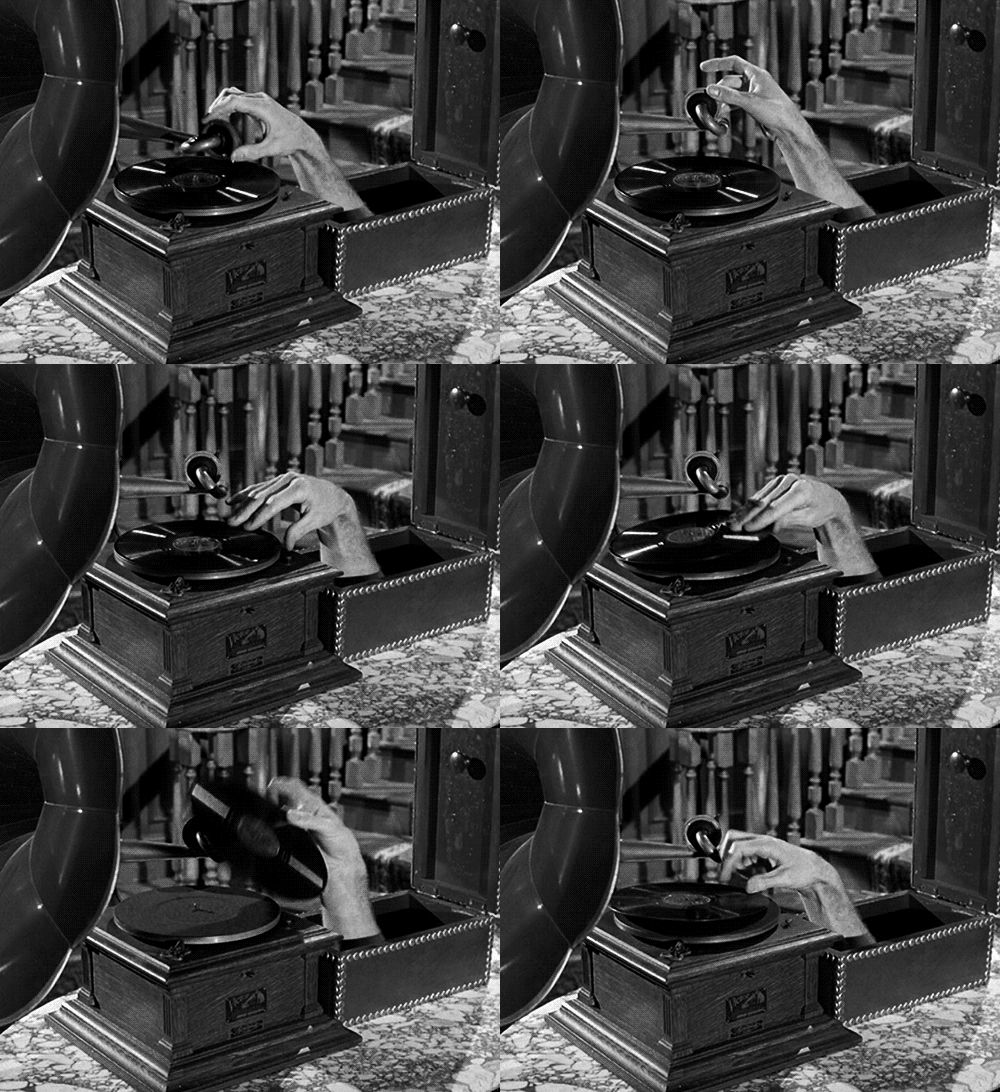
The B Side.

Ah One Two, ah One Two.

“Shakespeare at Dusk” by Edward Hopper (1935)

Because he’s not a guy who craves praise, I haven’t written about how much my pal Brad Lappin has done for the Banter. Let’s just say–in Damon Runyon terms–it’s more than somewhat. But now I’ve got a reason to share some news about Brad with you and there ain’t nuthin’ he can do about it.
This piece in the Denver Post says it all.
Well, almost all. You’ll want to watch this video, too. (And dig the recipe here.)
Needless to say if you find yourself in the Bolder-Denver area, check out the Bohemian Biergarten if you want to have a kick-ass soft pretzel.
I won’t lye.
(Follow Brad on Twitter.)
[Photo Credit: Cyrus McCrimmon/The Denver Post]

Spoon Fork Bacon gives Blistered Shishito Peppers. Grab some at your local farmer’s market and get to work.

“Two Men Walking in a Field,” by Georges Seurat (1882-84)

Saveur gives a bunch of tasty-looking recipes for spring peas.

“The Ballantine” by Franz Kline (1958-60)

Over at the Los Angeles Review of Books, David Wolpe reviews Greg Bellow’s memoir, Saul Bellow’s Heart:
After James Atlas’s 2002 biography, widely panned, with its portrayal of an altogether unappealing philanderer, is there balm in Gilead?
“Our father was always easily angered, prone to argument, acutely sensitive, and palpably vulnerable to criticism.” Reading this sentence in Greg Bellow’s new memoir, Saul Bellow’s Heart, one remembers the saying attributed to a French King, “I would rather be killed by my enemies than by my children.” Maybe we should have stuck with Atlas.
But Greg (permit me the first name, to distinguish from his father) has done something complicated and remarkable. He has spared none of the unsavory parts of his father’s character and still enabled us to understand why this man could generate, throughout his life, so much love. Greg expresses anger along the way — this book does not pull punches with the characters who moved through Bellow’s life — without the rancorous bitterness that suggests still unsettled reflections. Greg has opened his own heart. If there is any truth to the old adage that you judge a parent by the child, Greg is a testimonial.
[Photo Credit: Ann Street Studio]

Hard to imagine it’s been three years since Guru passed away. Now, he’s gone but still, it’s mostly the voice…

Dwight Garner profiles John Le Carre in the Times:
Yet John le Carré’s greatest invention is easily John le Carré himself. Born in 1931 in Poole, a sprawling coastal town in Dorset, he is a product of a childhood both unusual and enviable — if you happen to be a writer. It made him suspicious of charm of any sort and gave him a limitless fascination with humans and their secrets.
Le Carré, as most of his fans know, is a son of a great, debonair English con man. His father, Ronnie Cornwell, born into mundane middle-class life, remade himself into a funny, gracious man who found that he could talk anyone out of anything, and did so. He was friendly with the Kray twins, the notorious and photogenic London gangsters. He was jailed for insurance fraud. He always, le Carré said, had a scam or two in the works.
“In his high days, he had a racehorse at Maisons-Lafitte outside Paris, and dancing girls, and he’d go whizzing off to Monte Carlo with the former lord mayor of London to stay in grand style at the Hotel de Paris,” le Carré said. “His social rise was extraordinary.” When things went badly, le Carré recalls, “not only were the police looking for him, but the boys were. We had to put the cars behind the house, keep the lights out and so on.”
Le Carré likes to cite a passage from the autobiography of Colin Clark, the son of the art collector Lord Clark, who wrote about what it was like to be taken in by le Carré’s father: “He was your favorite uncle, your family doctor, Bob Boothby and Father Christmas rolled into one.” He could, Clark wrote, “fix anything” and did. “Ronnie invited me to Royal Ascot and gave me a few good dinners. Then he showed me a piece of derelict property, which he did not own, promised to double my money in three months and took the lot.”