This movie is just a whole lot of fun. One of the very best–if not the best–Elmore adaptation.
Saturday
October 24, 2026
Since 2002



Category: Arts and Culture
Taster’s Cherce

If I was at the game today this here’d be my beverage of cherce.

Beat of the Day
Baseball is back in the BX.
Afternoon Art

“Woman on a Porch” By Richard Diebenkorn (1958)
The Power and the Glory

Today is a good day.
Charles McGrath has a feature on the great Robert Caro for the New York Times Magazine:
Robert Caro probably knows more about power, political power especially, than anyone who has never had some. He has never run for any sort of office himself and would probably have lost if he had. He’s a shy, soft-spoken man with old–fashioned manners and an old-fashioned New York accent (he says “toime” instead of “time” and “foine” instead of fine), so self-conscious that talking about himself makes him squint a little. The idea of power, or of powerful people, seems to repel him as much as it fascinates. And yet Caro has spent virtually his whole adult life studying power and what can be done with it, first in the case of Robert Moses, the great developer and urban planner, and then in the case of Lyndon Johnson, whose biography he has been writing for close to 40 years. Caro can tell you exactly how Moses heedlessly rammed the Cross Bronx Expressway through a middle-class neighborhood, displacing thousands of families, and exactly how Johnson stole the Texas Senate election of 1948, winning by 87 spurious votes. These stories still fill him with outrage but also with something like wonder, the two emotions that sustain him in what amounts to a solitary, Dickensian occupation with long hours and few holidays.
…Caro is the last of the 19th-century biographers, the kind who believe that the life of a great or powerful man deserves not just a slim volume, or even a fat one, but a whole shelf full. He dresses every day in a jacket and tie and reports to a 22nd-floor office in a nondescript building near Columbus Circle, where his neighbors are lawyers or investment firms. His office looks as if it belongs to the kind of C.P.A. who still uses ledgers and a hand-cranked adding machine. There are an old wooden desk, wooden file cabinets and a maroon leather couch that never gets sat on. Here Caro writes the old-fashioned way: in longhand, on large legal pads.
While Chris Jones has a long profile on Caro in the latest issue of Esquire:
On the twenty-second floor of the Fisk Building in New York — an elegant brick giant built in 1921, stretching an entire block of West Fifty-seventh Street between Broadway and Eighth Avenue — the hallways are lined with doors bearing gold plaques. The plaques reveal the professions of the people at work behind them: lawyers, accountants, financial advisors. But one plaque displays only a name, with no mention of the man’s business: ROBERT A. CARO.
Behind that door on this February morning, as on most mornings for the twenty-two years he has occupied this office, Caro is hunched over his desk. His tie is still carefully knotted; his hair is slicked back. But his fingers are black with pencil. In front of him is a pile of white paper: the galleys for The Passage of Power, the fourth book in his enormous biography, The Years of Lyndon Johnson. The seventy-six-year-old Caro has worked on this project nearly every day since 1974; he has been working on this particular volume for ten years. In most cases, once a book reaches galleys — once it has been designed and typeset and a few preliminary copies printed, unbound — it is finished, or close to it. All that remains is one last pass. This is not true for Caro. For him, the galleys are simply another stage of construction. Less than three months before three hundred thousand copies of his book are due to be in stores on May 1, Caro has torn down and rebuilt the fifth paragraph on the 452nd page — and torn it down again. (It is, in fact, the fifth paragraph on the 2,672nd page of his work, factoring in the first three volumes of the series: The Path to Power, Means of Ascent, and Master of the Senate.) Now nearly every word of it sits dismantled in front of him like the pieces of a watch. He starts fresh. “The defeat had repercussions beyond the Court,” he writes.
This was meant to be the last of the Johnson books, but it is not. The Passage of Power spans barely four years in 605 pages. It picks up Johnson’s story with the 1960 Democratic nomination, won by a young senator from Massachusetts named John F. Kennedy, and it ends with President Lyndon Johnson passing the Civil Rights Act in 1964. There is an assassination in between. On two large rectangular bulletin boards, Caro has carefully pinned up his outline for his next volume, the fifth book, the rest of the story: Vietnam, resignation, defeat. The pages of that outline overlap the lighter rectangles where the outline for the fourth book had been pinned for so many years. “I don’t feel my age,” Caro says, “so it’s hard for me to believe so much time has passed.” He knows the last sentence of the fifth book, he says — the very last sentence. He knows what stands between him and those final few words, most immediately the fifth paragraph on page 2,672. He digs his pencil back into the paper.
This room is almost a temple to timelessness. Caro has worked with the same set of tools since 1966, when he began his first book, The Power Broker, his definitive 1,162-page biography of Robert Moses, the controversial New York planner and builder. For so many writers, for most of them, The Power Broker, which won a Pulitzer Prize in 1975, would represent their crowning achievement; for Caro, it was just the beginning. Back then, he and his wife, Ina, lived in a pretty little house in Roslyn, Long Island — he was a reporter at Newsday — and one of the great crumbling neighboring estates had a fire sale. Caro went. He bought a chess set, and he bought a lamp. The lamp was bronze and heavy and sculpted, a chariot rider pulled along by two rearing horses. “It cost seventy-five dollars,” Caro remembers. The chess set is hidden away under a couch in their apartment on Central Park West. The lamp is here on his desk, spilling light onto his galleys. Except for a brief period when he couldn’t afford an office, when Caro worked instead in the Allen Room at the New York Public Library, he has written every word of every one of his books in the same warm lamplight, millions of words under the watch of that chariot rider and his two horses.
“Nobody believes this, but I write very fast,” he says.
Check out this wonderful photo gallery of Caro at work.
[Photo Credit: Ethan Hill for Esquire]
Taster’s Cherce

When I was a kid my mother would make a homemade mayonnaise whenever she made french fries. Cause that’s how they roll in Belgium. That never made any sense to me because as an American kid I never imagined dipping a fry in anything but ketchup. I still prefer ketchup but also dig mayonnaise, or just salt, or salt and vinegar. Or any number of things.
What’s your favorite condiment for fries?
[Photo Credit: Nicole Franzen]

Afternoon Art

Two sculptures of Magritte by Marisol Escobar
Taster’s Cherce

A root beer float is a good thing. Cream soda float would work too.
[Photo Credit: The Improvised Life]

Afternoon Art

[Picture by Laurie Rollitt]
Taster’s Cherce

Serious Eats offers a list of 10 Italian cookbooks. I’m glad they included one from Diane Seed.
Beat of the Day

Djano.
[Photo Credit: Bags ]
Afternoon Art

“Large Figurative Sculpture” By William King (date unknown)

Beat of the Day
And I’m totally relaxed.
Sundazed Soul
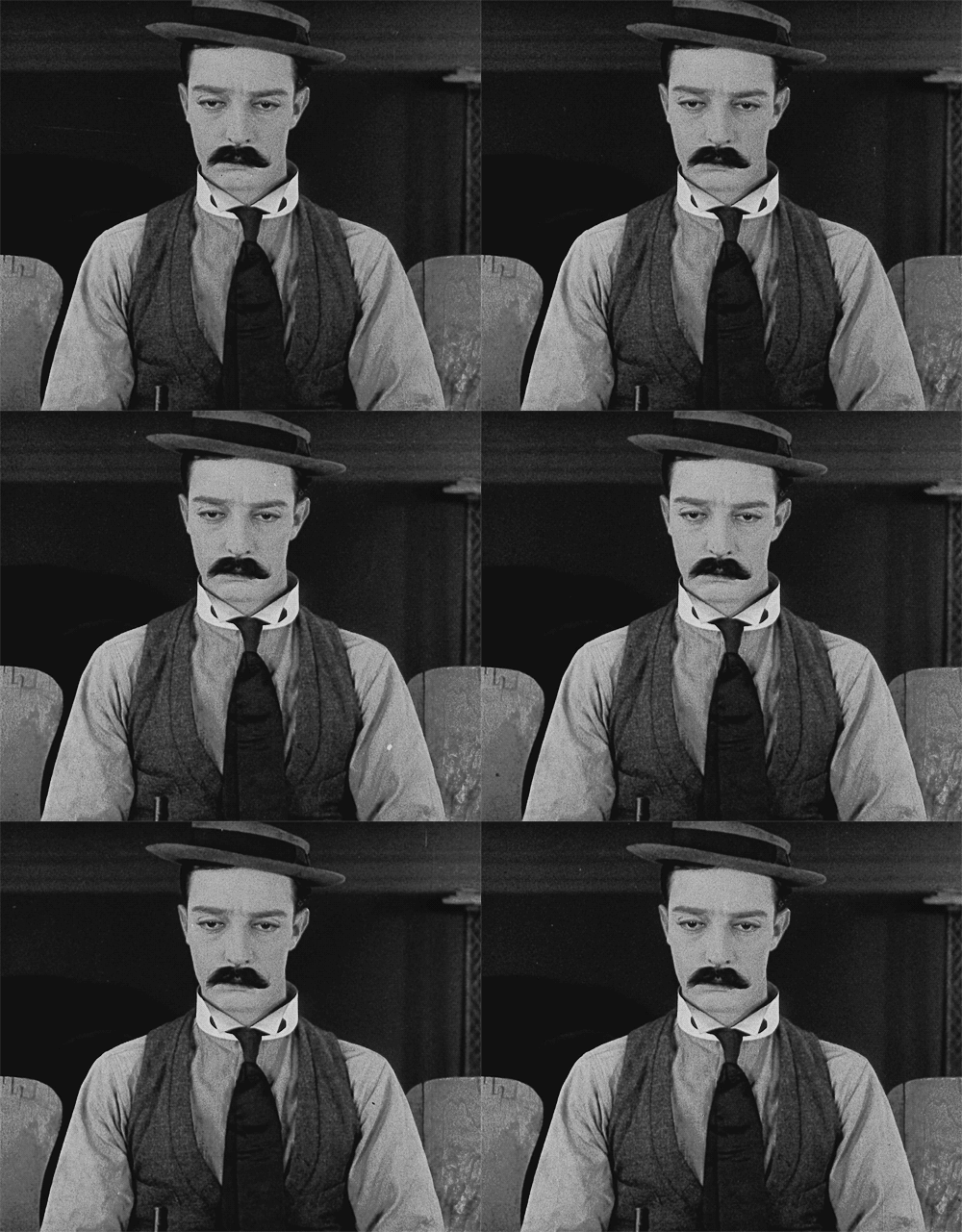
This here is how Yankee fans look (and presumably feel) after the first two games…
S’okay, they’s gunna win today.
Saturdazed Soul

[Photo Via: Daydreams]



"This ain't football. We do this every day."
--Earl Weaver
--Earl Weaver