
Beautiful sunny day in New York.
[Photo Via: Gruesometwosome ]



The opening minutes of David Lean’s great version of “Great Expectations”:
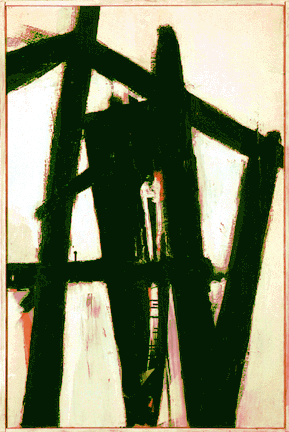
“Abstraction #1,” By Franz Kline (1951)

Check out this piece about the importance of authenticity by Sara Jenkins in the Atlantic:
I pride myself on having a profound understanding of what Italian food is and what makes it authentic…And yet, I ask myself, what is authenticity and does it really matter? Italians are, of course, passionate about their food culture and ready at all times to chastise a foreigner for not understanding that right combinations or sequences of flavors. Salad always comes after the entrée — never before. Pasta and soup fill the same slot in the meal, so you eat one or the other and not both. Plum tomatoes are for pasta sauce, globe tomatoes are for salad. And so it goes, a dizzying array of rules and regulations for how you eat. But still I wonder, what is the importance of authenticity?
Italian food and flavors changed dramatically after 1492 with the influx of the New World fruits and vegetables — tomatoes, corn, beans, peppers, potatoes — that were gradually integrated over four centuries of gardening and cooking and are at the core of today’s version of Italian food. If we wanted to be really authentic with Italian food, shouldn’t we do away with all the invasive species? Doesn’t that make tomato sauce and polenta inauthentic?
Food is not static. What we eat is constantly evolving and changing. New things become available. When I was a child in Rome, cilantro, limes, and yams were unknown and unavailable; today, thanks to immigration and the global produce trade, you can probably find all three at the corner vegetable stand. When I first started paying attention to my neighbors’ farm in Tuscany, they were extremely self-sufficient in terms of their food. They grew, raised, and foraged probably 90 percent of what they consumed. Their food and flavors were delicious and unvarying, and the dishes Mita cooked formed the basis of my understanding of Italian food.
Terrific stuff.
[Photo Credit: Quick Gardens]
Bitchin’.

“Dining Room in the Country,” By Pierre Bonnard (1913)

Thanks for the French food pern, Davey Dave.
Puttin’ the “unk” in Funk.

Serious Eats reviews Jin Ramen in Harlem and reports that it is worth the trip. Sounds like a plan.

As requested…

The animation in this movie looks wonderful.

Geoff Dyer goes all word nerd in the Times and I love it:
It started with the jacket copy for the British hardback of Richard Holmes’s wonderful “Age of Wonder.” We learn there of the astronomer William Herschel’s “tireless dedication to the stars” (the actual stars, that is, the ones out there in space, before they were superseded — and possibly even outnumbered — by those in the realm of film, pop and sport). This connection between an adjective and the stars made me curious about the extent to which a word can continue to shine after the life has gone out of it. Thereafter I started to notice that “tireless” and “tirelessly” were cropping up all over the place, often in works of considerable literary merit. In Jonathan Coe’s biography of the experimental novelist, for example, I read that B. S. Johnson “worked tirelessly for the trade union movement.” There was nothing particularly wrong with this particular instance, but the cumulative effect of encountering tirelesslys made me — taking my cue from Holmes again — wonder. Like a tired person trying to get to sleep who is kept awake by sounds from the street that he or she has for years scarcely noticed, I found that the word had become suddenly unignorable.
It intruded, if only in a pea-under-a-mattress way, on my enjoyment of two of the best books I read last year. Wade Davis’s “Into the Silence” is a brilliantly thorough narrative of the first attempts to conquer Everest, starting with the climbers who had fought in the First World War and climaxing with the disappearance of Mallory in 1924. It would be churlish when considering such a long book to make too much of the “tireless efforts” of one member of the team on behalf of the Everest project, or the description of another member as “tireless.” But one can, I think, question the accuracy of this shared appellation. I mean, were these people never tired? (Yes, yes, I understand, this is a context in which people are not just tired; they’re depleted beyond the limits of human comprehension — but keep going anyway.)
What words bother you? “Literally” is literally killing me these days because I literally hear people using it literally all the time.

R Crumb: The Paris Review Interview:
INTERVIEWER
The film about you, Crumb, was the pinnacle of being observed.
CRUMB
Devastating.
INTERVIEWER
But it was also a very sympathetic portrait.
CRUMB
Terry Zwigoff was my friend for twenty years already. Terry is sympathetic and shares some of my interests. Also, he is a 78 collector, a lover of old music and old comics. He is sharp and a good editor, and shares my vision and shares my negativity. He understood me and knew my world pretty well.
INTERVIEWER
Were you happy with how it came out?
CRUMB
Happy is not the right word. I thought he did a good job, but it’s excruciating to watch. It’s a very intimate movie, because I just opened up to him. Opened up my life to him, because he’s my friend. I never thought the film would be a big success. I thought maybe a few people would see it in art theaters. Who knew it would be so widely seen? Who knew that Aline’s mother would see it? Or my relatives in Minnesota? They all hated me after they saw that.
INTERVIEWER
The film showed some pretty graphic cartoon images of sex.
CRUMB
Very bizarre sexual fantasies. I had the compulsion to draw my sex fantasies and foist them on the public.
INTERVIEWER
That was just a working out of something?
CRUMB
Yeah, I guess. When I first started doing it in ’68 or ’69, the people who had loved my work before that, some of them were shocked and alienated by it—especially the women, of course. I lost all the women. I’m not antifeminist. I like strong, independent women, like the matriarchs of Genesis—they ordered the men around. The sex-fantasy thing was a whole other side of myself, and when that started coming out, I could no longer be America’s best-loved hippie cartoonist. Also the racial stuff: the racist images that I used. That also shut a lot of people off about my work. The feminists despised me. I had a couple of defenders among them whose defense of my work was: He’s just being totally honest about the male mentality. He’s revealing the thoughts that most men are walking around harboring about women all the time. I have to agree with that. I just revealed myself.


Over at Deadspin, Erik Malinowski has a long piece about the making of the “Homer at the Bat” episode of the The Simpsons. Worth checking out.

Yeah, I’d try this. Brought to you by Three to One.

Love the loop.