"A New York Treasure" --Village Voice
Category: Arts and Culture

The Exploitation Was The Genius

Duke-Ellington-Legacy-Recordings

Last month, Adam Gopnik wrote an absorbing review of Terry Teachout’s new Duke Ellington biography in the New Yorker. It’s only available to subscribers but I wanted to share this part:

…A residue of disappointment clings to go to these pages: Ellington was an elegant man but not a very nice one, Teachout concludes, exploiting the musicians he gathered and held so close. He used his musicians (not to mention his women) often quite coldly, and his romantic-seeming life was really one long cloud of shimmering misdirection. Teachout reveals that Ellington was rarely the sole composer of the music associated with his name. Nearly all of his hit songs, Teachout explains,”were collaborations with band members who did not always receive credit—or royalties—when the songs were recorded and published.” It’s long been known by fans that many of the most famous “Ellington” numbers are really the arranger Billy Strayhorn’s, including “Take the A Train” and “Chelsea Bridge,” and that the valve trombonist Juan Tizol wrote most of “Caravan.” But most of “Mood Indigo” was Barney Bigard’s, while “Never Know Lament” (which became the hit “Don’t Get Around Much Anymore”),”I’m Beginning to See the Light,” and” I Let a Song Go Out of My Heart” began as Johnny Hodges riffs and then became songs. “Sophisticated Lady,” “Prelude to a Kiss,” and “In a Sentimental Mood,” in turn, are melodies originally blown by, and rarely credited to, the alto-sax player Otto Hardwick.

None of these are obvious, all-purpose riffs, or simple blues phrases. They’re rich, melodic ideas, as complex as anything in Gershwin or Rodgers. Ellington owned them, but they didn’t start in his head, or take form under his fingers. Teachout says all the right things about how, without Ellington’s ear to hear them and his intelligence to fix and resolve them, these might have been butterflies that lived a day, fluttered, and died. But you sense that he’s shaken by the news. It seems like theft. It certainly bothered the musicians. Hodges used to make a sign of counting money when Ellington was playing the medley of his tunes.

One might be a touch more defiant on behalf of the Duke. Ellington really did take other men’s ideas and act as if they were his own. But he did this because because he took other men’s ideas and made them his own. There are artists whose genius lies in exploiting other people’s talent, and we can recognize the exploitation as the genius. It is the gift of such artists to be able to energize and paralyze other people and do both at the same time. It may be true that Herman Mankiewicz wrote most of “Citizen Kane,” scene by scene and even shot by shot. What is certainly true is that nothing else that survives of Mankiewicz’s is remotely as good as “Citizen Kane.” That’s because he was writing “Citizen Kane” for Orson Welles. Johnny Hodges spent many years on his own, with every chance to keep his tunes to himself. No other standard ever emerged. Suppose Billy Strayhorn had been liberated instead of “adopted” and infantilized. Would he have had the energy and mastery to form a band, sustain it, recruit the right musicians, survive their eccentricities and addictions, give them music they could play, record it, and keep enough of a popular audience alive to justify the expense of the rest? It is painful to read of Strayhorn desolate over having credit for his music stolen by the Duke; it is also the case that Ellington had the genius not to have to cry.

Ellington’s ear, his energy, his organizational abilities, the shortness of his decisions are a case study for management school.(Consider the way he fired Charles Mingus for fighting with Tizol, fondly but with no appeal: “I’m afraid, Charles—I’ve never fired anybody—you’ll have to quit my band. I don’t need any new problems. Juan’s an old problem…. I must ask you to be kind enough to give me your notice.”) These are not ordinary or secondary gifts. They were the essence of his genius. Ellington had an idea of a certain kind of jazz: tonal, atmospheric, blues-based but elegant. He took what he needed to realize the ideal he had invented. The tunes may have begun with his sidemen; the music was his. This is not a secondary form of originality, which needs a postmodern apologia, in which “curating” is another kind of “creating.” It is the original kind of originality.

There is a reason that Duke’s players mostly complained of being cheated only of the dough. Originality comes in two kinds: originality of ideas, and originality of labor, and although it is the first kind that we get agitated about, we should honor the second kind still more. There is wit, made by the head and spun out into life; and work, created mostly by fingers engaging tools as various as tenor saxes and computer keyboards. It is an oddity of our civilization, and has been since the Renaissance, to honor wit more than work, to think that the new idea “contributed” by the work matters more than the work itself.

What Johnny Hodges was doing in making those new melodies may have been more like copying errors in ceaseless cell fission then like premeditated decision: as he set to playing the same chord changes over and over, night after night, a lucky error in a note may, one night, have touched another and become an innovation. It was a happy accident produced by hard labor. But that it reflected effort as much as inspiration should only increase its value. No author really minds, too much, seeing his or her ideas “out there,” to be recycled, and even a conceptual artist has a slightly guilty conscience trading in that commodity alone. (That’s why Jasper Johns fans insist that it is the finish, the touch, that really matters.) What artists dislike is having their effort recirculated without we recompense. It is our sentences, not our sentiments, that we ought to protect. The Duke’s men grasped this. They were glad to concede to their self-made duke all of his preëminence—indeed, his royalty. They just wanted him to hand over their royalties first.

What mattered was the band. Duke Ellington was a great impresario and bandleader who created the most stylish sound, and brand, and American music, and kept the company of musicians going for half a century. That this description seem somehow less exalting than calling him a “major American composer” or a “radical music innovator” is a sign of how far we have to go in allowing art to tell us how to admire it, rather than trying to make it hold still in conventional poses in order to be admired.

Fascinating.

Taster’s Cherce

11087117823_f249c13584_c

Yes. And: Please.

Beat of the Day

888907JohnMidgley_1

Chopin: Nocturne #20 In C Sharp Minor, Bi 49

[Photo Credit: John Midgley via MPD]

Ornery

628x471

Need another reason to love Longform? How about this reprint of Bryan Di Salvatore’s massive 1990 profile of Merle Haggard?

Dig in:

In Hampton, Virginia, at five o’clock one drizzly, cool January morning, Theresa Lane, Merle’s girlfriend (no one addresses Merle as Mr. Haggard, though his friends often refer to him as Hag), summoned me by phone to Merle’s bus. As I walked across the parking lot of the Coliseum Sheraton a half hour later, the Strangers’ bus was the silent, dark one. Merle’s emitted a dim golden glow and rumbled on high idle. Theresa, a tall, slim, attractive woman in her late twenties, with tousled blond hair and muscular arms and shoulders, met me at the door and escorted me through the living room and down the narrow hallway, past a framed photograph of Hank Williams and another of Dolly Parton, into the kitchen, where Merle sat on the floor, his eyes closed and his bare legs stretched straight out under a small table. Naked except for a plaid flannel shirt and après-ski boots, he greeted me with a slight nod. I took a seat at the table, summoning faith in what one of the Strangers had told me months earlier at a Merle Haggard-Willie Nelson concert in Las Vegas—“Don’t knock on his door if he don’t tell you to. Don’t not knock on his door if he does tell you to”—and Theresa stood behind Merle to knead his shoulders, now and again pulling his head up hard, until his neck was stretched taut.

“Goddam, my head feels like it oughta be lifted right outa my skull,” Merle said. He reached for a pack of unfiltered cigarettes and a lighter on the table, where several packs were scattered among cigarette papers, sheets and scraps of notebook paper, cassette tapes, and empty cassette cases. On the counter were a few dirty dishes, glasses, and some silverware.

I asked Merle how they were biting back at Lake Shasta, near his home in Northern California. He has a houseboat there, and has sponsored several bass-fishing tournaments in recent years.

“I’ve hardly fished this last year or so,” he said, in a deep, barely audible monotone. “I been spending my time teaching her”—he motioned toward Theresa—“songwriting.”

I asked about the fortunes of the band’s softball team.

“We hardly play one game a year. The insurance company says there’s a lot of talent out there ready to break a leg.”

I asked to see some of his poems, which he had read on a recent television special. He thought Bonnie Owens, his backup vocal, longtime singing partner, and ex-wife (he has three, and is currently married to Debora Parret, who was in California at the time), had them at her house, near Lake Tahoe.

I asked about the plot of his unfinished novel, “The Sins of John Tom Mullen.”

“It’s about a teenager falsely accused of rape. They find out the rich boy in town done it, and they trace him by his tire tracks. I haven’t touched it in maybe fifteen years.”

I asked if he wanted me to come back later.

He looked up, as if surprised, and his voice rose slightly. “No, no, ask away.” He turned to Theresa. “That’s a lot better, baby,” he said. “You want to make us some breakfast?”

Theresa nodded and took two short steps to the refrigerator. She was shoe­less and wore a man’s long-sleeved white shirt and gartered black stockings. Merle folded his legs under him slowly, groaned, pushed himself to his feet like a stove-up yogi coming out of a trance, and walked down the hallway. He returned wearing gray sweatpants and slid into a narrow banquette behind the table. The room, snug as a ship’s cabin, grew hazy with smoke from frying potatoes and Merle’s cigarettes. The hum of an exhaust fan harmonized with the drone of the idling bus.

Merle coughed a deep, rasping cough—and looked at the cigarette in his hand. “I liked these things before I even started smoking,” he said. He speaks in a thick, nasal Southwestern drawl-twang, dropping most of his final “g”s, and turning “think” into “thank” and “thank” into “think.” The trip to put on his pants had seemed to wake him up. “But I believe myself and a lot of people will live to be a hundred years old. My blood pressure is one hundred eighteen over seventy-eight. I got the cholesterol of a twenty-one-year-old, and I can still run a hundred-yard dash and beat most people. I know that because last summer it was one hundred fifteen degrees, and I bought two ice creams and sprinted with ‘em back from the store to the grandkids. That was—oh, eighty, a hundred yards, and I didn’t even have to open my mouth to get air. My grandfather entered an old man’s race—you had to be a fifty or older to enter—and he waxed their ass. That’s when he was seventy-four.”

[Photo Credit: Michael Macor/ San Francisco Chronicle]

Taster’s Cherce

long-bean-cucumber-and-tomato-salad-ss

Here’s a step-by-step demonstration of how to make Andy Ricker’s Hot & Spicy Thai Salad. 

Million Dollar Movie

“We’re in a business where people perceive complexity as good. It’s not good. Complexity is not good. People don’t understand the elegance of simplicity. There are very few people left that do understand it. The whole idea is take a sophisticated idea and reduce it to the simplest possible terms so that it’s accessible to everybody — and don’t get simple mixed up with simplistic. It’s how you mount and present something that makes it engaging…Simplistic is doing it badly…simple is your choices.”

Gordon Willis on cinematography.

Morning Art

tumblr_mznruzYPAr1rpguofo1_500

“Spring Nude,” by Nathan Oliveira (1962)

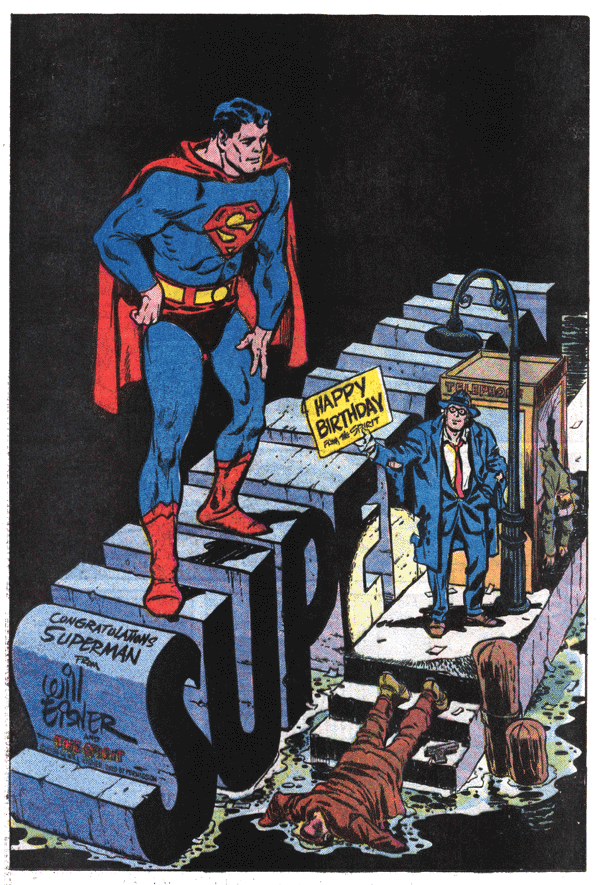
Superman Pin Ups

 tumblr_mphulb92TN1rom810o2_500

From the 400th issue of Superman

tumblr_mphuswct9F1rom810o4_500

tumblr_mphulb92TN1rom810o3_500

 tumblr_mphulb92TN1rom810o10_500

eisner-pinup

Moebius, Jack Davis, Jack Kirby, Berni Wrightson, Will Eisner.

Still Diggin’

 get-attachment.aspx

Don’t call it a comeback…

Million Dollar Movie

chinatown-nicholsonanddunway

And you can quote me on that.

Beat of the Day

tip

Van.

[Photo Via: This Isn’t Happiness]

Morning Art

tumblr_mzecwsuGrS1ru2qa4o1_500

“Nude in an Interior” by Pierre Bonnard (1912-14)

Taster’s Cherce

savuer

The Savuer 100. 


Beat of the Day

tumblr_mt3601nw8T1s6dotio1_500

Cool hand…

Morning Art

conversation

“Conversation” by Henri Matisse (1909)

Taster’s Cherce

lemon

Lemon and chocolate. Sure thing.

Beat of the Day

martha

Happy Birthday to a couple of Grandmasters.

Uncle L and Slick Rick.

[Photo Credit: Martha Cooper]

Morning Art

paul G

“Young Girl With Fan,” By Paul Gauguin (1912)

feed Share on Facebook Share on Twitter Share via email
"This ain't football. We do this every day."
--Earl Weaver