Dude, and I’m one lucky so-and-so. I’ve still got the original.
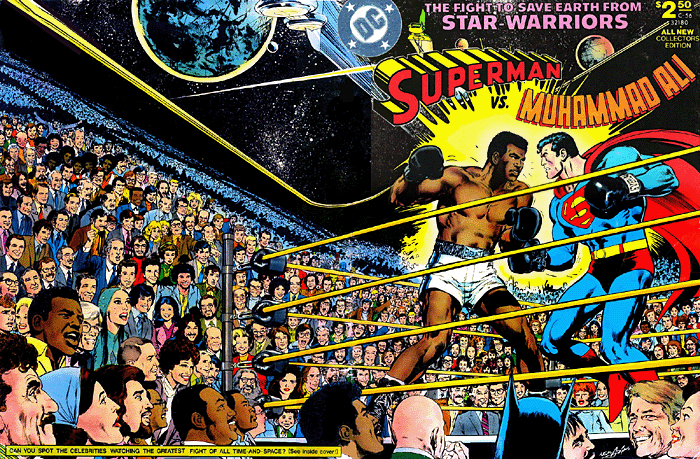



Dude, and I’m one lucky so-and-so. I’ve still got the original.
And here I thought I’d missed all the dramatic comebacks. I was away last weekend, bridesmaiding (and if that’s not an action verb, it should be), and for the first time in years was mostly without internet and TV – so I didn’t catch any of those three walk-off wins. I hasten to add, in case the lovely bride is reading this, that it was of course completely worth it. But fortunately the Yankees were willing to give me a little encore today, coming back from a two-run ninth inning deficit with another big homer from A-Rod, who continues to give the world the finger, and a Melky Cabrera single to beat the Phillies 5-4.
Regardless of the outcome, I’m loving this weekend’s baseball – I get a kick out of seeing Yankees fans pulling for the Mets, and vice versa. A rare moment of city-wide unity, even if it is based on a “the enemy of my enemy is my friend” sort of sentiment.
Andy Pettitte was the starter today, and he looked pretty good in the early going. In fact, he looked pretty good all afternoon if you just ignore a crucial five minute stretch in the middle there. In the second he allowed a solo shot to Raul Ibanez, which is the fashionable thing to do this spring, and then held things down ’til the fifth. Meanwhile the Yankees evened things up right away, when Cano doubled (or when Jayson Werth lost the ball, if you want to be less charitable) and Cabrera and Swisher got him the rest of the way home.
J.A. Happ was the Phillies starter, a classic URP situation. Mark Teixeira got two hits but other than that and Cano’s run in the second, New York didn’t put a dent in him. The game stayed tied at 1-1 until Pettitte slipped a bit in the fifth, with a base hit, walk, and home run from John Mayberry (Jr.), in his first Major League game.
(Mayberry doubled in the seventh, too. I was all ready to start seriously disliking this kid but then he looked so happy, I couldn’t hold it against him. His dad, who played for the Yanks at the very tail end of his career, though before my time, was in the stands – but FOX kept cutting to an entirely unrelated middle aged black Phillies fan, and misidentifying him as Mayberry, for more than an inning. Awkward. I was relieved when they announced their mistake, though, because I’d been wondering why the first guy they had onscreen didn’t seem all that proud.)
After that Pettitte buckled down and got through the seventh without further damage; and really, four runs in seven innings isn’t too bad against an offense like the Phillies’. This start pretty much encapsulated what I’ve come to expect from Pettitte these days: he doesn’t usually have the stuff to totally shut down a good-hitting team anymore, but he won’t let things get completely out of hand either.
Derek Jeter’s homer in the seventh made it 4-2, well within stirring comeback range. And so in the bottom of the ninth, Damon walked, Teixeira struck out on three hideously nasty Brad Lidge sliders, and A-Rod came to the plate. I have to say, given Teixeira’s AB, my hopes were not high at this point. But Rodriguez had a good at-bat, laid off a couple of low sliders, and waited out a fastball, which he then blasted into the seats — it wasn’t one of his tape-measure shots but he still knew right away it was out and took a little pause before breaking into his trot. I may never know what to make of that guy, but whatever else he is, he’s sure not boring.
After that Cano singled and stole second, and Melky worked out a nice careful at-bat and singled him home. There was a big happy celebratory knot of players on the field, and AJ Burnett marched off very businesslike and determined to fetch the whipped cream. This was the Yankees 17th come-from-behind win this season, and their 9th in their last at-bat, which if you want to be all glass-half-empty about it means they’re falling behind an awful lot, but still it’s fun to watch.
Meanwhile, up at Fenway, Omir Santos of all people just hit a game-winning two-run homer off of Papelbon. And Toronto lost, too. Can I get you anything else?
Up to Andy to stop the bleeding. One game losing streak sounds about right. Still want to win this series.

I expect the ball to continue jumping out today. Just hope the Yanks are the ones hitting the dingers.

A major Francis Bacon show has just opened at the MET. I can’t wait to see it. I remember seing a major Bacon retrospective at the Modern years ago and being blown away. I think his pictures are stunning and disturbing, sometimes scary and often beautiful. They are elegantly imagined nightmares. Something to peep if you can bear it.

Over at SI.com, Bill James and Joe Posnanski team-up for a column on the Big Unit, Randy Johnson:
Joe: That gets us to the larger point. Seems to me that Randy Johnson has in some ways been overshadowed in his own generation. It isn’t that people missed the point that the Unit has been a great pitcher — the guy has won five Cy Young Awards — it’s that I’m not sure people realize just HOW great he has been.
Why? It’s funny: I think it’s because while everyone will talk and talk about all the steroids and home runs during the Selig Era, and everyone will talk about how offense dominated the last 15 to 20 years, the truth is that the last 15 to 20 years have given us four of the best pitchers in the history of baseball.
And I just find that richly ironic: I don’t believe there has ever been an era in baseball history that gave us four pitchers as good as Roger Clemens, Greg Maddux, Pedro Martinez and Randy Johnson. So while Johnson has been Nolan Ryan with control (the Unit’s 10.7 strikeouts per nine innings is the best ever), while he had a longer Koufax-like peak, while he’s about to win his 300th game, he’s still widely viewed as the fourth-best pitcher of his time.

Why not more? Greed is good, haven’t you heard?
I’m starting to really love Joba as a pitcher. He was one thing as a set-up reliever, an overpowering guy–electric, exciting. But he’s far more complete as a starter; throws a change-up and a curve with confidence. He’s not as big or chunky or as plodding as Roger Clemens, but he’s still a power guy who is a bona fide pitcher. He’s walking too many guys but I like the progress he’s made. Each start is fun to watch. He’s thinking out there, and he’s got some courage.
Be interesting to see if he can keep building tonight in another go at the O’s.
Nine would be fine, sunshine.

Here’s an appealing bit of L.A. Noir fiction by our good pal John Schulian:
The first time I laid eyes on her, I’d just spent twelve hours waiting for an accountant who wasn’t the dognapper his ex-wife made him out to be. It was three in the morning and I was piling up some expenses at the counter of Norm’s, on La Cienega. Between bites of bacon and hard-fried eggs, I thought about all the other nights I’d wasted in a lonely car on a dreary street, waiting for bad news to show up. The memories would have ruined the romance of my life as a private eye if there’d been any romance left. Then she slid onto the stool next to mine the way hot fudge goes on ice cream.
Another Asian mascara junkie, I thought at first. But I changed my mind after taking in the eyes, the arms, the mouth of her, the east, west, north and south of her.
Somewhere in the middle of the tour, she caught me staring. She didn’t bat an eye. Maybe she couldn’t.“I see you tonight?” she asked.
“Would you remember if you had?” I said.
She laughed self-consciously. I took it as a no. But at least we had the start of something resembling a conversation. That’s how I learned she was a dancer at the Jewel Box, just down the street. “Naked body,” she said. “You better come see my show.”
But Ocho sure sounds sweet, don’t it?

Phil Hughes announced his presence with authority last night, working a 1-2-3 first inning that concluded with strikeouts of Adam Jones and Nick Markakis, both swinging through fastballs. He then stranded two runners in the second and got out of a runners-on-the-corners, no-out jam in the third by striking out Jones and Markakis again, the latter in conjunction with Kevin Cash throwing out Brian Roberts stealing.
Meanwhile, the Yankees built a 5-0 lead against Jeremy Guthrie on a Johnny Damon walk and a Mark Teixeira double in the first, consecutive solo homers by Nick Swisher (his first at the new stadium), Robinson Cano, and Melky Cabrera leading off the second, and a pair of walks and an RBI single by Cano in the third.
Hughes gave two of those runs back in the fourth on a Melvin Mora single and a Ty Wigginton homer and another in the fifth on a solo shot by Jones, but while he didn’t cure his recent gopheritis, he did set a career high with nine strikeouts—eight of them swinging, most of them on fastballs, but three on curveballs—while walking just one.
Hughes threw 89 pitches through five innings and Joe Girardi decided to hand the 5-3 lead to Alfrede Aceves at that point. Ace pitched around a pair of singles for two scoreless frames and Phil Coke and Mariano Rivera combined for a scoreless eighth. Then the Yankees dropped a six-spot on Danys Baez and Jamie Walker, blowing the game open late just as they had the night before. Since he was warm and had thrown just three pitches in the eighth, Girardi left Rivera in to mop up in the ninth, which he did, but not before giving up a solo homer to dead center by rookie Nolan Reimold. Final score: 11-4 Yankees.
That’s eight straight wins by the Yanks, who are now just 2.5 games behind the Blue Jays (who lost another to the Red Sox) in the East.
Girardi said the team would likely make a decision on Wang (and thus Hughes) tomorrow, but the skipper was pleased with the progess Hughes has made in his last two starts, which at least bodes well for Hughes chances at a return engagement should he find himself starting for Scranton in five days.
Your turn, Joba . . .
Take that Danny Kaye.
Funk Doc:

Biz Mark:

A good combination.
Here’s a vintage free style from 1990. Biz and Red rhyming over Impeach the President. The recording is bump but the rhymes are tons-o-fun. This was before Redman’s first record dropped. His diss of the Knicks at the end of his first verse is one of my favorite punchlines of all-time. And I like the Knicks.
Too good to be true or too much to take? I think Larry David is funny but I can’t watch him for more than a few minutes at a time. His comedy is just too intense and makes me too uncomfortable. I was never a fan of Seinfeld–though I came to appreciate it, especially the actors, when it went to syndication–and Curb Your Enthusiasm is far too astringent for my blood. Woody, I’m a fan. At least I used to be. Of his early funny movies. I was infatuated by his work when I was growing up, his writing, his stand-up and his movies, right up until Hannah and Her Sisters. Still, I am amazed at his productivity since. Even if I’m not wild about the movies themselves, it is impressive that the man keeps making movies, year-in, year-out.
Larry David is the star of Woody’s latest. Scott Raab thinks it could be a match made in Hebrew Heaven.

Forgive Gene Michael if he looks a little dazed in his 1969 Topps card. He’s shown as a member of the Yankees, even though he’s wearing the colors of the Pirates, a team that he hadn’t played for since 1966. Somehow Topps could not find a picture of Michael with either the Yankees or the Dodgers, the team that actually traded him to the Yankees.
Now that I’ve thoroughly confused you, I can tell you this without hesitation: Michael’s move to New York, which coincided with the start of the 1968 season, helped change his career for the better, more subtly in the short term and quite significantly over the long haul.
At one time traded for Maury Wills, Michael had fallen into disfavor with the Dodgers because of his lack of hitting. After the 1967 season, the Dodgers dealt him to the Yankees, where he would eventually replace Tom Tresh as the starting shortstop. Like many shortstops of the era, Michael couldn’t hit worth a damn, but he could field the position with a smooth alacrity that the Yankees hadn’t seen since the prime years of Tony Kubek.
It was during his Yankee years that Michael established a reputation as the master of the hidden ball trick. With the runner at second base thinking that the pitcher already had the ball, Michael would blithely move toward him and then place a tag on the unsuspecting victim before showing the ball to the umpire. It’s a play that major leaguers occasionally pull off in today’s game, but Michael did it with a stunning degree of frequency, at least five times that have been documented. Considering that the hidden ball trick relies on heavy doses of surprise and deception, it’s remarkable that Michael was able to execute it more than once or twice. He was that good at it.
The hidden ball trick epitomized Michael’s intelligence. He had little obvious talent, possessing no power, average speed, and an overall gawkiness that came with his rail-like frame of six feet, two inches, and a mere 180 pounds. Yet, he was surprisingly athletic, enough to have starred as a college basketball player at Kent State, where his lean look earned him the nickname of “Stick.” As a major league shortstop, he made up for his lack of footspeed and arm strength with good hands and quick feet, and by studying the tendencies of opposing hitters and baserunners. How good was Michael defensively? I’d call him a poor man’s Mark Belanger. Like Michael, Belanger was tall and thin, and overmatched at the plate. But Belanger was arguably the best defensive shortstop of his era, so it’s no insult to put Michael in a slightly lower class of fielders.
Michael served the Yankees well as their starting shortstop from 1969 to 1973, but age and injuries began to catch up with him in 1974. At the age of 36, Michael received his unconditional release. He eventually signed with the Tigers, where he played sparingly in 1975, before being returned to the unemployment line. In February of 1976, Stick signed with the dreaded Red Sox, but he could do no more than earn a minor league assignment. In May, the Red Sox released Michael, who never did appear in a game for Boston.
With his playing career over, Michael quickly embarked on his second life in baseball. George Steinbrenner, remembering him as one of the original Yankees from his first year as ownership, gave him a job as a coach. From there Stick became a front office executive and then a two-time Yankee manager, serving separate stints in 1981 and ’82. Like all Yankee managers of that era, Michael was fired. He left the organization to manage the Cubs, where he clashed with his new boss, Dallas Green.
After a brief respite from the reign of Steinbrenner, Michael eventually returned to the Bronx. In 1990, the Yankees, by now a struggling team and a near laughingstock, made one of the most important moves in franchise history. They hired Michael as general manager. I was working as a sports talk show host at the time; I remember being very critical of Michael, who seemed unwilling to pull the trigger on big trades. Well, Michael knew a lot more about constructing a ballclub than I did. He set out to rebuild the Yankees’ farm system, while resisting the temptation to trade what few prospects the organization had for quick-fix veterans.
Under Michael’s stewardship, the Yankees drafted or signed the following players: Jorge Posada, Derek Jeter, Andy Pettitte, and a fellow named Mariano Rivera. That’s probably enough of a testament to Michael, but let’s consider that he also signed Wade Boggs and Jimmy Key as free agents.
When Michael did decide to make a trade, he made a splash. In November of 1992, Michael executed one of the most pivotal moves for the franchise’s future. He sent Roberto Kelly, one of the team’s two young center fielders, to the Reds for Paul O’Neill. It was a controversial deal, to say the least. Kelly was two years younger than O’Neill, a good player certainly, but one who was already 30 and had appeared to reach his ceiling. Michael knew what he was doing. He realized that Kelly, who lacked patience at the plate and passion in the field, was not as good a player as Bernie Williams, the team’s other center fielder. He also sensed that the fiery O’Neill could blossom as a left-handed hitter at Yankee Stadium playing for Buck Showalter. Stick was right on both counts.
With those vital pieces in place—including a catcher, a shortstop, a right fielder, a starting pitcher, and a closer—Michael left a championship nucleus for Bob Watson and Brian Cashman when he stepped down as Yankee GM in 1995.
Dazed and rejected no more, Stick Michael proved himself to be a pretty smart guy.
Bruce Markusen can be reached at bmarkusen@stny.rr.com.

Federer’s breakdown just before Nadal received the ’09 Australian Open winner’s trophy was the most obvious sign of the shift, but there had been earlier indications. Asked the day before the final whether he relished another shot at his archrival, Federer said, “Honestly, I preferred the days when I didn’t have a rival.” Nadal had exhausted himself in a five-hour, 14-minute semifinal the day before, but as soon as the final began, Federer seemed out of sorts. Worse, unlike Nadal when he was No. 2, Federer didn’t commit himself to attacking his rival, to shaking him out of his comfort zone. Twice Federer ran around his backhand and staggered Nadal with forehand winners, but he never did that again. “Twice in 4½ hours?” Wilander asks. “Why not show Nadal something different?”
The answer lies in the regal language always used to describe Federer. Born to rule, he has never been interested in fighting for power; that’s why in his current exile he looks less like Napoleon plotting on Elba than like the puzzled Czar Nicholas II waiting for the world to right itself and restore his throne.
This attitude perplexes even Federer’s staunchest admirers. Former players, coaches, peers: They all accept that his talent is, as Wilander says, “crazy,” but his passive response to Nadal goes against what they’ve been taught a superstar does when he’s down. Muhammad Ali came up with rope-a-dope, an aging Michael Jordan perfected the fadeaway jumper: The great ones adjust, sending a signal not only to their rivals but also to all the newly emboldened. It’s no shock that following Nadal’s trail, No. 3 Andy Murray has won six of his last seven matches against Federer, and No. 4 Novak Djokovic has won three of their last five. “What makes me scratch my head,” Courier says, “is how Roger doesn’t shift.”
The remedy most often prescribed for Federer’s ailing game is hiring a coach such as Darren Cahill, who once counseled Agassi. Federer toyed with the idea in the off-season, but that he didn’t follow up seemed further proof that he’s not hearing alarm bells. Others suggest that he serve-and-volley more, or play more doubles to replicate the Olympic preparation that helped him win the gold medal in doubles in Beijing and the U.S. Open singles title last September. But if Federer insists on staying back and winning rallies from the baseline, the consensus is that he must shorten points to save energy for the decisive third and fifth sets he has lately been losing: He has to hit more low, short slices to throw off Nadal’s rhythm, and he must put more bite on his flatter strokes.
Federer did that in the Australian Open final, but only when desperate; the instant he felt he had gained the momentum, he went back to the game on which he built his empire—and that Nadal solved long ago. “Roger still feels he’s just better [than Nadal],” Courier says. “And, frankly, he’s not.”
I like Nadal but I root for Federer. It will be fascinating to see if he can recover and get those three more grand slams to set the all-time mark. What once seemed inevitable is very much in question now. Can you remember a champion, seemingly still in his prime, get taken out like this? Bjorg, maybe. But he just walked away from the game. I wonder if Federer has it in him to get back on top? It would be a dream if he could ever win the French. This is could become a great rivalry if Federer finds a way to respond.

CC Sabathia pitched another fine game and the Yankees scored seven runs in the seventh inning to win their seventh game in a row.
Final score: Yanks 9, Orioles 1.
It was a close game again until just after Kate Smith sung God Bless America.* Sabathia allowed a first-inning run but Alex Rodriguez crushed a two-run homer in the bottom of the inning to give the Yanks the lead for good. With a man on, Rodriguez quickly fell behind Brad Bergesen 0-2. He fouled off a couple of tough pitches, laid off a couple of breaking balls out-of-the-zone and worked the count full. Then a back-door fastball that darted across the plate but too high was struck for the homer.
It made that sound, that true, uncompromising sound of a ball being hit on the sweet spot. The kind of that makes you weak in the knees, the kind you dreamed about as a kid, the sound that makes you sit up like a dog bolting awake by a noise just outside the front door. (They never get the sound right in the movies, have you ever noticed that?)
Rodriguez took his textbook-fluid swing–the ball came to the bat as if drawn by a magnet, and then shot off deep into the night. Rodriguez just missed two more homers later in the game. Missed ’em by that much. But he didn’t miss the first one and it was a thing of beauty.
So was Sabathia, who nursed the one-run lead through seven. The Orioles didn’t stand a chance, collecting three hits and a walk against Poppa Large, who struck out seven and lowered his ERA to 3.43. The big man was brilliant. Bergesen, who also pitched well, getting a boat load of ground balls early on, left the game with a couple of runners on and one out in the bottom of the seventh. Chris Ray relieved him and got torched. Derek Jeter got the big hit, a three-run double with the bases loaded and Mark Teixeira hit his 11th of the season, a shot into the second deck in right field, to put the cherry on top of what turned out to be a laugher.
Brian Bruney, just activated off the DL, pitched a scoreless inning and the Yanks gained a game in the east as the Red Sox beat the Blue Jays, 2-1 in Boston.
*Do you know I ran into two Yankee fans today who complained that while yes, the Yankees are winning lately, they are only winning by the slimmest of margins, so…as if winning the close ones don’t count as much. I’m dead serious.

My nephew turned five last week. For his birthday he watched Star Wars for the first time. (Star Wars was the first movie I remember seeing in the movie theater as a kid; it was released a few days before I turned six.) There was a Jedi training session in Inwood Park and then there was the screening. My nephew has been talking about the movie for weeks. He even had a favorite character–Chewy. But his friends were more interested in his toys so they didn’t actually watch much of the movie. The real screening took place the next day and I arrived minutes before the Death Star was blown to smithereens.
A few days earlier, I stopped by the electric circus known as Toys R Us in Times Square to pick up a present. I headed to the Star Wars area and was dismayed; I could hardly find anything that had to do with the original movie (though I did eventually find one box that contained small figurines of Obi Wan, Luke and the two droids). When I got home and told my wife Emily how shocked I was at the lack of toys from the original movie, she turned to me, and in her best Alice Kramden said, “Sweetheart, that movie came out over thirty years ago.”
I looked at her blankly. Blinked. Then I unpacked the toys, took out my teeth, changed my diaper and went to bed. It was four in the afternoon.

From his blog, Baseball Nerd, Keith Olbermann on how Vin Scully almost became the Yankees’ announcer…According to Olbermann, here is Scully’s story (thanks to Baseball Think Factory for the link):
“When the Yankees let Mel Allen go in 1964, I got a phone call from the man who they had brought in to run their broadcasting operation, Craig Smith,” Vin began. “He had been in charge of the World Series broadcasts forever, so I’d known him about ten years by then. And he asked me if I’d like to come home to New York and become the lead announcer. He offered a very handsome salary, and a long contract.
“Well, I was amazed, as you can imagine. I’d found a wonderful home here in Los Angeles, but remember, this was only seven years after the Dodgers left Brooklyn. I was still a New Yorker through and through. Plus, here was a chance to work again with Red Barber. And recall, too, that this was just before the Yankee dynasty collapsed. As much as Mr. O’Malley had done here and in Brooklyn, the Yankees were still the marquee name in sports. If it had been 1958 or 1959, when I still missed New York so, I would’ve said yes before he hung up the phone.”
“So, I thought long and hard about that one. But I had a young family, and I think we had all just truly adjusted to living here – takes just about seven years, I think – and in the end I turned it down.”
Chien-Ming Wang and Brian Bruney both pitched in Triple A on Sunday. Chad Jennings reports:
Wang looked good on Sunday. His velocity was slightly lower than Tuesday — maxed out at 92 mph instead of 93 — but the movement on his sinker was better, and Wang said he was happier with his ability to get ahead in the count and locate his fastball down and in. He faced rehabbing Travis Hafner three times and got two routine groundouts before a bloop, broken-bat single.
“Performance-wise he was terrific,” Cashman said. “This was a much better hitting club. Columbus is a much better offensive club than the team he was facing last time, but his stuff was better last time, to be honest, although he performed great in both outings. He didn’t have the slider that he had last time. His changeup was better today than last time. His fastball velocity was a little bit lower this time than it was last time. At the same time, he handled the lineup and got a lot of groundballs. Facing guys like Hafner kind of tells you a little something you want to know. I think he had some groundouts and that broken-bat single to center. I know Hafner is on a rehab assignment and he’s a guy who can really do some damage if you’re making mistakes, not making some pitches, and (Wang) made his pitches. That tells you a lot.”
Jennings also has updates on Bruney, Ian Kennedy and Steven Jackson. Man, Jennings is good, isn’t he?


