What New Yorkers are reading on the train.

[Photo Credit: New York Magazine]



It’s cool and most cloudy here in the Bronx. Short week before Thanksgiving coming up. We should start to see some player movement around or just after the holiday.
In the meantime, hope you have a good one. And yo, remember: Do something nice for yourself…


I’m on the 1 train this morning when I see an old lady, bundled up for the cold, address a man who is leaning against the subway door, reading the New York Times.
“You’d better grab something to hold onto,” she said. “Otherwise, the doors might open, you’ll fall out and die and then we’ll all be late.”
The man folded his paper and looked down at the woman.
“Wow. That’s some scenario,” he said and returned to the paper.
“Yes,” she said, “Yes, it is.”
I smiled. She looked around and caught my eye and smiled. I was about to say something when I remembered an old family saying: “It’s not you, mind your own, sit down, shut-up.”
I stayed shut-up and let it pass.
Last night I was standing on a subway platform when a train whooshed into the station. I noticed that my car was almost empty before stepping inside. An empty car in the middle of the summer can mean one of two things: the AC is broken or someone smelly is inside (worse case scenerio brings both). Turns out the AC was busted. But I got in anyhow and enjoyed the space. The Russian Baths on the IRT, why not?
I’ve run into several mentally ill people on the trains lately. Last Friday night, on the Brooklyn-bound B train, a man walked through the car and said, “My man, my man, m-m-m-m-my man.” He held a cup in his hand and kept repeating these words in an insistent, almost pleading voice. I thought about the stuttering character in “Do The Right Thing.” The doors opened and closed but the dude didn’t get off the car. He just kept chanting. It was upsetting. A man sitting next to me looked up from his newspaper and muttered something derogatory about the guy. He’s a sick man, I thought.
Then on Saturday I saw a black woman standing on Broadway and 231st street. She was wearing powder blue shorts and a purple shirt. She had white facial hair under her nose and on her chin. She spoke with an English accent. “Would you kindly spare some change?”
I crossed the street and walked north. Sitting at the bottom of a flight of stairs was a wino I recognized from around the neighborhood. He looked like he could be fishing buddies with Thurman Munson and Dirt Tidrow.
“Hey, can you spare like $1,500?” he asked me.
I smiled and kept walking.
Joba on the hill tonight, weather permitting. Time to start another winning streak, don’t ya think?
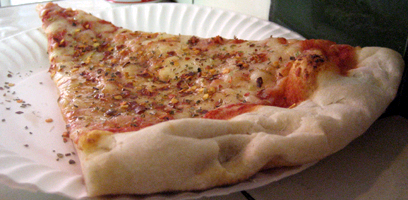
It is always the same, the sudden, stomach-dropping, jolt. Walking along a city block, looking up at a familiar store front or restaurant, a Closed sign hanging in the door way, or a vacant window. Something has happened. Change has come, like it or not.
I gasped last night as I walked past Sal and Carmine’s pizza shop on Broadway between 101st and 102nd (They make a salty but delicious slice.) The grate was up and a red rose was taped against the metal. Above it was a small xeroxed obiturary from a New Jersey paper.
Sal died late last week. I’ve been eating their pizza since I was a kid. Sal and Carmine. Two short, taciturn men in their seventies, though they look older. I never knew who was Sal and who was Carmine, just that one was slightly less cranky than the other. These are the kind of men that don’t retire but are retired.
The funeral was yesterday; the shop re-opens today.

As I read the obituary, people stopped and registered the news. They congregated for a few moments, some took pictures with their cell phones, and then slowly walked away, the neighbhorhood taking in the loss.
I got off work and headed downtown yesterday evening just as it started to pour. By the time I reached Union Square, the stairwell leading the street was crammed with people. Some were just waiting for the rain to let up, others were soaking wet. At the top of the stairs an African woman chanted, "Umbrella, umbrella, umbrella." I smiled at her and said, "How’s business?" She titled her head at me, paused and then went back to her mantra.
I braved the elements until I got to Fourth avenue and 12th street, where I stopped underneath an overhang, where several people were huddled. I sat and watched the traffic pass. It’s funny, the rain. Some people are completely unfazed by it. Others will wait it out cause they can’t stand getting wet. A kid in his early twenties passed me, no umbrella, drenched, his t-shirt sticking to his long torso. I remembered being in my early twenties seeing this kid and I smiled at his carefree manner as he strutted by.
Then a familiar face passed. As I thought about who it was, I said, "J?" The dude stopped and sure enough it was J-Live, the MC and record producer. Back in the summer of ’01, the year before I started Bronx Banter, I conducted a long interview with J in the basement of The Sound Library, an upscale record shop, when it used to be on Avenue A. This was just after J’s second full-length album, All of the Above was released. Although it took some time to pin him down once we spoke, J was insightful and a thoroughly decent guy.
I’ve drifted from the music scene in recent years though I did hear that J put out a new record earlier this summer. I congradulated him on the new joint (which I haven’t heard yet), told him what I’m up to, and then let him go. If it hadn’t been raining, I would have never run into him.

A few months ago I invited myself to Ray Robinson’s apartment, ostensibly to get his list of ten essential baseball books, but really so I could lay eyes on his library of sports books. Robinson, an author (Iron Horse) and longtime magazine editor, grew up on the Upper West Side, near Columbia. When he was a kid, Robinson got a delivery job at a local liquor store, and he found himself making stops over at Babe Ruth’s apartment at 110 Riverside Drive. He’d say, ‘Thanks keed,'” Ray told me. “He called everybody ‘keeed,’ because he couldn’t remember anyone’s name. And he would invariably honor me with a couple of dollar bills.”
Ray and his wife, Phyliss were wonderful with me. We chatted in the living room of their comfortable New York apartment for about an hour and Ray shared his selections of favorite baseball books with me. I poked my nose through his collection and as I was about to leave, Ray said, “Oh, would you like to see my scrapbooks?”
“Sure, I would.”
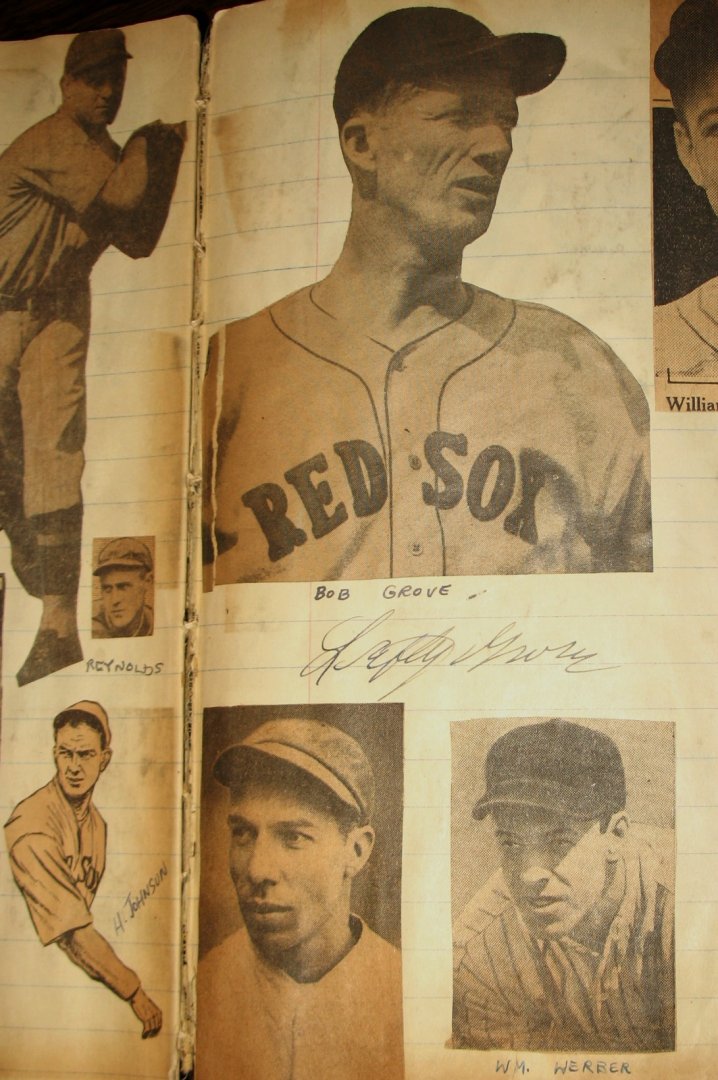
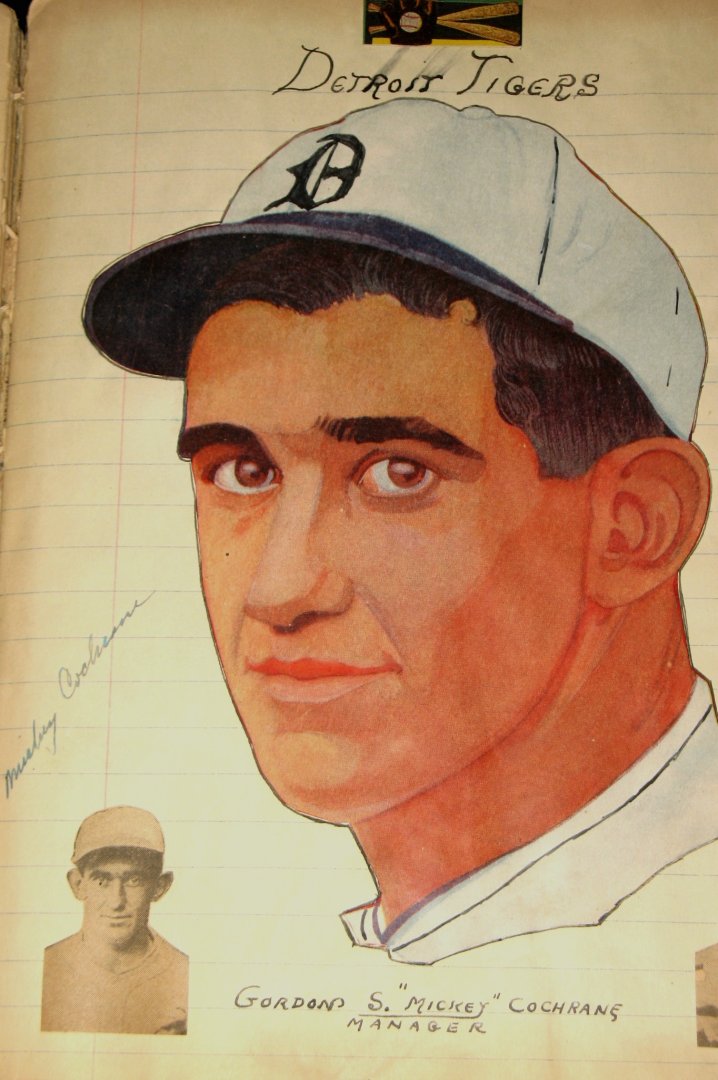
Ray picked-up a bright orange plastic bag from the bottom of the bookshelf, the kind you’d get from the local Chinese take out. He pulled out two weathered books, practically falling apart, one dated 1932, the other, 1933. They were filled with pictures of players from every team in baseball. Ray cut-out images mostly from The New York Sun, The Saturday Evening Post, assorted baseball magazines as well as baseball cards. Then, along with some friends, he’d scout the hotel lobbies where the out-of-town teams stayed, to get autographs.
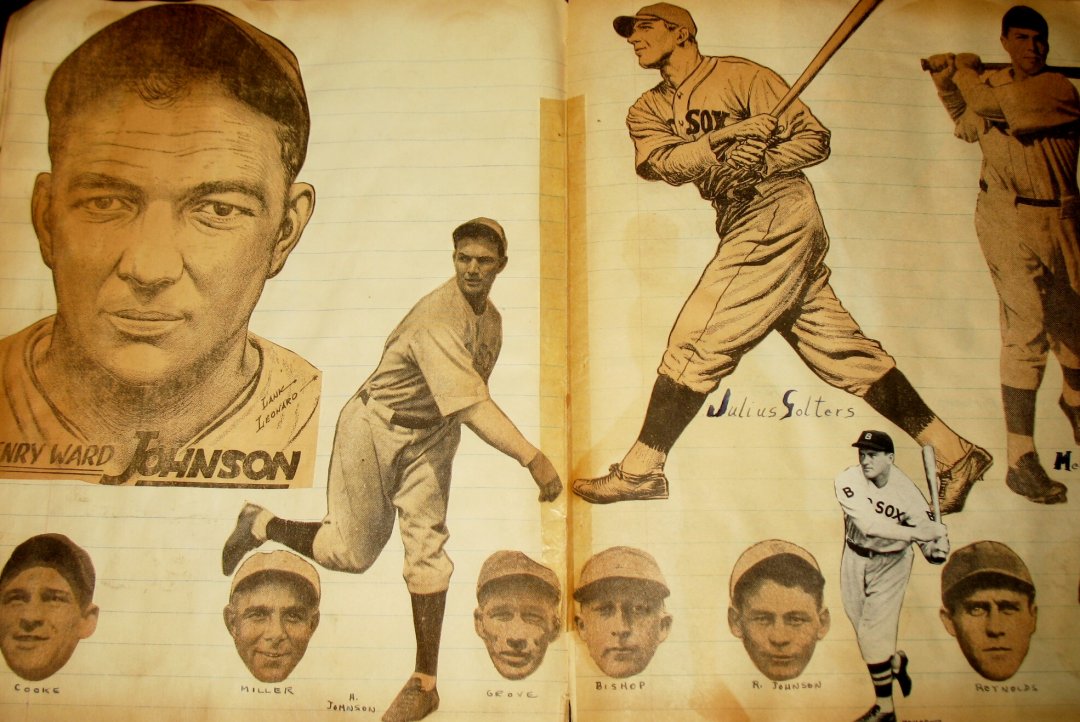
The books are lovingly, obsessively assembled, filled with small notations. Ray expressed some embarrassment when I complemented him on how wonderful, how personal the books are. He dismissed his sketch of the Babe as being awful, but I liked it and his wife did too.
Ray asked if he should sell the books–after all, he’s got a couple of Lefty Groves in there, a Honus Wagner, Dizzy Dean. Phyliss said that she didn’t think that was a good idea. I quickly agreed.
“You can’t sell these,” I said. “They belong in a museum or for your grandkids.”
As I looked carefully through the two books, Ray kept wondering if he should sell them. I said, “No way,” but when I left I felt foolish. Who am I to say that he shouldn’t sell them? There is probably some serious money in those two books. Still, they feel too personal to part with. They are not kept under a glass case, they are in a plastic bag on the shelf, a secret baseball treasure on the Upper East Side.
Yesterday, the New York Times featured a short essay by Ray Robinson about his scrapbooks.
Check it out and dig what I was able to see:

Every time I approach my barber’s shop on Smith Street in Brooklyn, I expect to be greeted by awful news. My barber is too old to work anymore, or worse, he’s dead. I lived in Carroll Gardens, Brooklyn from 1994 through 2000. One day I was looking for a barber shop, and I ran across Efrain. He came to Brooklyn from Puerto Rico in 1955. His father was a barber and his three older brothers were barbers too. He cut my hair with such care and patience that I have been a loyal customer ever since. It’s worth the two-plus hour roundtrip commute to the Bronx. Efrain, a silver-haired man with kind eyes and soft, smooth hands, no longer owns his own shop—he had to give his up five years ago, a victim of Smith Street’s rapid gentrification. He’s past retirement age but still works six days a week.
Now Efrain has a chair up the block from his old place, in a barber shop run by Ray, a self-absorbed Puerto Rican man in his mid-fifties. Ray’s shop is no longer cluttered mess it had been for years, as Ray’s daughter and her boyfriend use the space one a week to give dancing lessons. Three chairs stand in the middle of the space, and both walls are covered with mirrors. Ray has a trim mustache and likes to pontificate authoritatively about boxing, salsa music and women. When he is not holding court, he is sullen and removed as he works. Rays’ son Macho, a plump man in his early thirties with a thick scar on his left forearm, cuts heads too, his chair situated between Ray’s and Efrain’s.
It was overcast and muggy last Saturday morning when I arrived. Macho was walking out as I was walking in. I said my hellos and Efrain motioned to me, tilting his head forward and looking over his glasses, a pair of scissors in his raised right hand. Only three heads waiting in front of me, not bad for Saturday. I stuck my nose into my book. Old Salsa music played over the stereo. I didn’t recognize the tunes, but they were familiar anyhow. This was the music I heard up and down Amsterdam Avenue when I was a kid: Ray Barretto, Willie Bobo, Willie Colon, and Mongo Santamaria. Not ten minutes later, I was pleased to discover Efrain calling me to his chair.


