"A New York Treasure" --Village Voice
Category: NYC History

City Lights

I was in a book store on Friday night and this caught my eye: Denys Wortman’s New York: Portrait of the City in the 30s and 40s.

I’d never heard of Wortman before but I was immediately taken with his work.

Yesterday, the Times ran a long feature about Wortman who is the subject of a show at the Museum of the City of New York through March:

If there is a single constant in the creative world, it is that fame has a nasty habit of disappearing overnight. One prime example is the cartoonist Denys Wortman, who from 1924 to 1954 contributed six drawings a week to The New York World and its successors.

His feature, “Metropolitan Movies,” was admired for its strikingly naturalistic portrayal of daily life in Gotham. Using a single panel and a conversational caption, Mr. Wortman adroitly summoned up an entirely believable world of housewives talking across fire escapes, girls in the subway hashing over last night’s date, and men and women trying to make a buck in diners, offices, music halls and factories — or struggling to keep afloat during the Great Depression. Mr. Wortman’s drawings were also beautifully composed and finely worked, a legacy of his art school years, when he studied alongside future Ashcan school painters like Edward Hopper and George Bellows, and with their guru Robert Henri.

Even then “there was nothing quite like it,” said the cartoonist Jules Feiffer, who enjoyed the drawings as a boy. “His work didn’t seem studied. It was as if you were looking out the window — or my window in the Bronx.” And because it was syndicated nationwide (as “Everyday Movies”), Mr. Wortman’s world spread far beyond the Hudson.

But in 1958, four years after his retirement, Mr. Wortman died of a heart attack. By then cartooning had become character-driven and graphically streamlined (think of Charles M. Schulz’s “Peanuts”) while art was ruled by the Abstract Expressionists. And when The World’s successor The World-Telegram and Sun folded, he was as forgotten as yesterday’s fish wrap.

The book and the show look like a must.

Schmoozerella

I’ve seen Fran Lebowitz around. Lots of people have. I think a few times at Lucky Strike fifteen years ago. She’s famous for being a cool New Yorker. I don’t know too much about her and can’t tell whether she’s great or annoying.

Now, Martin Scorsese has made a documentary about Lebowitz called “Public Speaking.”

I’m game.

Any Excuse to Think About the Old Penn Station

Nice post on the photographer Alfred Eisenstaedt’s work over at the New Yorker’s Photo Booth.

Here’s more:

And You Knew Who You Were Then

From the New York magazine archives, here’s a 1969 piece by Nicholas Pileggi on the Renaissance of the Upper West Side:

Five years ago, the West Side of Manhattan bore the stigma of decline, to the point where understanding what is a grantee of a Riverside Drive property was more about liability than opportunity. Invitations to social gatherings there were often declined, large rent-controlled apartments were relinquished, and services like Chicken Delight would not dare to venture in. Today, the landscape has transformed. Despite lingering challenges, a palpable optimism has supplanted the old fears. Merchants, real estate professionals, bankers, theatre owners, city planners, restaurateurs, newsdealers, and trustees of private schools find common ground in a sentiment privately shared by Mayor John V. Lindsay: “The Upper West Side is probably enjoying more of a renaissance today than any other single neighborhood of our city.”

In the 64-block-long area west of Central Park between Columbus Circle to the south and Columbia University to the north, the evidence is visible. Not only are there new low-and middle-income housing developments now where the rubble of abandoned buildings and slums stood just five years ago, but hundreds of the area’s crumbling rooming houses have been renovated to accommodate increasing numbers of middle-class tenants, and even a few of the neighborhood’s middle-European rococo hotels have been steam-cleaned. The same kind of young, successful and relatively affluent middle-class families that moved to the suburbs 20 years ago and to the East Side 10 years ago are moving to the West Side today, and while the neighborhood still has an ample supply of teenage muggers, parading homosexuals and old men who wear overcoats in July, the over-all mood of the area seems to have changed.

…Statistically the West Side’s 1968 crime figures place the area in the unenviable top third of the city’s 76 precinct-house totals. The 20th Precinct on West 68th Street and the 24th on West 100th encompass most of the Upper West Side, and their combined records show 36 homicides, 86 forced rapes, 8,478 burglaries, 1,097 felonious assaults, 3,233 robberies (muggings and stickups) and 6,762 larcenies (mostly pocketbook snatches) last year. The bulk of the West Side’s street crime today is the work of roving bands of 14-to-20-year-olds who mug, jostle and threaten their victims around or near the neighborhood parks during the evening and early morning hours. The effect of these crimes, committed, it sometimes seems, on everyone, or at least a friend or relative of everyone on the West Side, has been to create an atmosphere in which sudden noises produce quick frightened looks.

Ah, the good ol’ days.

[Photo Credit: Christian Monotone]

Good Not Great Ain’t Half-Bad

It’s Wait ‘Til Next Year for the Yanks.

They were a good team in 2010, but they didn’t play well down the stretch and got hammered by the Rangers in the 2010 ALCS.

Were they too old? Did they play tight–a reflection of their manager according to Joel Sherman? Did they just not have heart or character or those championship intangibles?

Nah, they just got their asses kicked, that’s all. Happens, man, even to the best of them.

The Man Who Wasn’t There

“John grew up in the shadow of a father who was a great writer,” said A. J. Liebling. “This is a handicap shared by only an infinitesimal portion of any given generation, but it did not intimidate him.”

When John Lardner was ten-years old, he wrote a short verse that appeared in a F.P.A column:

Babe Ruth and Jack Dempsey,
Both sultans of the swat.
One hits where other people are,
The other where they’re not.

John Lardner was born in Chicago but raised mostly on the east coast. He went to the Phillips Academy in Andover (his three brothers would follow), spent a year at Harvard and another at the Sorbonne, before he returned to New York and got a job at the New York Herald Tribune in 1931. He was nineteen-years-old. His father, Ring, who was already ill with the tuberculosis and heart diesee that would kill him a few years later, sent a note to Stanley Walker, a Texan who’d made the Tribune into the best writer’s paper in New York.

“You will find him a little reticent at times, but personally I never felt this was a handicap.” Walker later said that John “came close to being the perfect all-around journalist.”

John worked at the Tribune until 1933, the year his father died. The two men were close in Ring’s final years and the old man was proud of his son’s early achievements. “We are all swollen up like my ankles,” Ring wrote in a letter to his nephew, Richard Tobin. John was offered a syndicated sports column when he was twenty-one for the North American Newspaper Alliance. Carried locally by the N.Y. Post, Lardner wrote about sports, and then the war, for NANA until 1948.

(more…)

Blowhard

Listen, here.

You Must Remember This

Here’s another one from Pete Hamill via the New York Magazine Archives. Let’s go back to 1987:

Once there was another city here, and now it is gone. There are almost no traces of it anymore, but millions of us know it existed, because we lived in it: the Lost City of New York.

It was a city, as John Cheever once wrote, that “was still filled with a river light, when you heard the Benny Goodman quartets from a radio in the corner stationery store, and when almost everybody wore a hat.” In that city, the taxicabs were all Checkers, with ample room for your legs, and the drivers knew where Grand Central was and always helped with the luggage. In that city, there were apartments with three bedrooms and views of the river. You hurried across the street and your girl was waiting for you under the Biltmore clock, with snow melting in her hair. Cars never double-parked. Shop doors weren’t locked in the daytime. Bus drivers still made change. All over town, cops walked the beat and everyone knew their names. In that city, you did not smoke on the subway. You wore galoshes in the rain. Waitresses called you honey. You slept with windows open to the summer night.

That New York is gone now, hammered into dust by time, progress, accident, and greed. Yes, most of us distrust the memory of how we lived here, not so very long ago. Nostalgia is a treacherous emotion, at once a curse against the present and an admission of permanent resentment, never to be wholly trusted. For many of us, looking back is simply too painful; we must confront the unanswerable question of how we let it all happen, how the Lost City was lost. And so most of us have trained ourselves to forget.

[Picture by Bags]

On the Waterfront

Dark Harbor, Nathan Ward’s riveting book about the New York Waterfronts, got a good review in the New York Times over the weekend:

For a writer of history, there is always a risk in telling a story that’s been told before. In this case, the bar is especially high, because Ward presents a tale that has been told not just often but quite well, first by Johnson and then in the Oscar-winning movie.

To make his challenge even greater, Ward brings no huge trove of new information to his account, and he offers no novel grand view to reshape our thinking of this chapter in American history. But he does have a few weapons at his disposal — namely, meticulous reporting, a keen eye for detail and an elegant writing style — and he uses them to make the tale seem new again.

Check out the book and dig Ward’s blog.

[Photo Credit: E.O. Hoppe]

Street Scenes

Peace to Jeremiah’s Vanishing New York for hipping me to the photography of Ted Barron. Here’s some of Barron’s work, featured recently over at Sensitive Skin Magazine:

Check it out.

Then dig Barron’s blog:

Four Letter Word for Cheap

When I was a kid one of the activities that I hated most was “browsing.” My mother would say, “Oh, let’s just go browse.”

Are you serious, lady? Why don’t you buy me something? What is this browsing?

What a horrible word: browsing. It didn’t make any sense to me.

Of course, now I can buy what I want–within reason–but I like to browse, at least bookstores and record shops.

Diane hipped me to this piece on the death of browsing. Sad, really.

You With the Stars in Your Eyes

Saturday Night Fever was based on a New York Magazine story by Nik Cohn called Tribal Rites of the New Saturday Night (It appeared in July, 1976):

Within the closed circuits of rock & roll fashion, it is assumed that New York means Manhattan. The center is everything, all the rest irrelevant. If the other boroughs exist at all, it is merely as a camp joke—Bronx-Brooklyn-Queens, monstrous urban limbo, filled with everyone who is no one.

In reality, however, almost the reverse is true. While Manhattan remains firmly rooted in the sixties, still caught up in faction and fad and the dreary games of decadence, a whole new generation has been growing up around it, virtually unrecognized. Kids of sixteen to twenty, full of energy, urgency, hunger. All the things, in fact, that the Manhattan circuit, in its smugness, has lost.

They are not so chic, these kids. They don’t haunt press receptions or opening nights; they don’t pose as street punks in the style of Bruce Springsteen, or prate of rock & Rimbaud. Indeed, the cults of recent years seem to have passed them by entirely. They know nothing of flower power or meditation, pansexuality, or mind expansion. No waterbeds or Moroccan cushions, no hand-thrown pottery, for them. No hep jargon either, and no Pepsi revolutions. In many cases, they genuinely can’t remember who Bob Dylan was, let alone Ken Kesey or Timothy Leary. Haight Ashbury, Woodstock, Altamont—all of them draw a blank. Instead, this generation’s real roots lie further back, in the fifties, the golden age of Saturday nights.

The cause of this reversion is not hard to spot. The sixties, unlike previous decades, seemed full of teenage money. No recession, no sense of danger. The young could run free, indulge themselves in whatever treats they wished. But now there is shortage once more, just as there was in the fifties. Attrition, continual pressure. So the new generation takes few risks. It goes through high school, obedient; graduates, looks for a job, saves and plans. Endures. And once a week, on Saturday night, its one great moment of release, it explodes.

Picture This

Peace to Brad for hipping me to this on-line collection of William Gottlieb’s photography. It’s wonderful.

Man, imagine going back in time to witness 52nd street during its heyday?

Dark Harbor

The new production of Arthur Miller’s “A View from the Bridge” was enthusiastically reviewed by Ben Brantley in the New York Times earlier this week:

Even more than with “Death of a Salesman,” Miller used “Bridge” to sell his theory that true tragic heroes may well emerge from the common run of contemporary lives. So eager was he to make the point that he even included a one-man Greek chorus, an Italian-born lawyer named Alfieri (here played by Michael Cristofer), who speaks loftily about the grandeur of the story’s “bloody course” of incestuous longings and fatal consequences.

Perhaps Miller felt that plays, like classical heroes, required tragic flaws, and thus provided one for “Bridge” in the form of the long-winded Alfieri. This drama needs no annotator or apologist if it’s acted with the naturalistic refinement — and accumulation of revelatory detail — found in this interpretation.

I had wondered if “Bridge” really needed another revival. New York saw a first-rate production only a dozen years ago, directed by Michael Mayer, with Anthony LaPaglia, Allison Janney and the young Brittany Murphy (who died at 32 last year). But this latest incarnation makes the case that certain plays, like certain operas, are rich enough to be revisited as often and as long as there are performers with strong, original voices and fresh insights.

In today’s Wall Street Journal, Nathan Ward, whose book, “Dark Harbor: The War for the New York Waterfront,” will be published later this year, has an interesting column about the play’s orgins:

About a year after Miller’s death in February 2005, and a few months before Longhi passed away, I happened to interview the lawyer about the old waterfront. Unlike his “portly” stage likeness Alfieri, Longhi was, at 90, a tall, trim and elegant man. Sitting in his Manhattan law office on lower Broadway, he recalled how his friend Miller, who lived in picturesque Brooklyn Heights in the late ’40s, “often thought about that mysterious world of the Brooklyn Italian waterfront. . . . But he being an intellectual, who’s gonna talk to him? Nobody.” In his autobiography, “Timebends,” Miller remembered wondering, on his daily walks, about “the sinister waterfront world of gangster-ridden unions, assassinations, beatings, bodies thrown into the lovely bay at night.” But, he was forced to admit, “I could never penetrate the permanent reign of quiet terror on the waterfront hardly three blocks from my peaceful apartment.”

…Miller first heard the story that became “A View From the Bridge” while on a trip with Longhi to Sicily in 1948. “Longhi mentioned a story . . . of a longshoreman who had ratted to the Immigration Bureau on two brothers,” Miller wrote, “his own relatives, illegal immigrants who were living in his very home, in order to break an engagement between one of them and his niece.” Longhi told me, “it happened to my client . . . who turned to me and said, ‘I’m going to kill so-and-so,’ and then it turned out that I figured he must be in love with the kid. And I told this story to Miller and he said, ‘What an opera!'”

No one would mistake Red Hook or Columbia Street today for the place whose tough waterfront culture so shocked Miller in the late ’40s. But the last time I was down there, I saw a throwback to Eddie’s world, an aspect of New York dock life that never completely dies: Up on the Waterfront Commission building there was a new banner advertising a special crime-tips number that read: “HAD ENOUGH? Theft, corruption, and organized crime cost the port millions of dollars and thousands of jobs.” One side of the street may sell New Zealand meat pies and feature a French backyard bistro, but the ragged side of his old neighborhood Eddie Carbone would know at a glance.

Slice of Life

sal2

It is always the same, the sudden, stomach-dropping, jolt.  Walking along a city block, looking up at a familiar store front or restaurant, a Closed sign hanging in the door way, or a vacant window. Something has happened. Change has come, like it or not.

I gasped last night as I walked past Sal and Carmine’s pizza shop on Broadway between 101st and 102nd (They make a salty but delicious slice.)  The grate was up and a red rose was taped against the metal.  Above it was a small xeroxed obiturary from a New Jersey paper.

Sal died late last week. I’ve been eating their pizza since I was a kid.  Sal and Carmine.  Two short, taciturn men in their seventies, though they look older. I never knew who was Sal and who was Carmine, just that one was slightly less cranky than the other. These are the kind of men that don’t retire but are retired.

The funeral was yesterday; the shop re-opens today.

sal

As I read the obituary, people stopped and registered the news.  They congregated for a few moments, some took pictures with their cell phones, and then slowly walked away, the neighbhorhood taking in the loss.

Treasure Trove

Untitled

A few months ago I invited myself to Ray Robinson’s apartment, ostensibly to get his list of ten essential baseball books, but really so I could lay eyes on his library of sports books.  Robinson, an author (Iron Horse) and longtime magazine editor, grew up on the Upper West Side, near Columbia.  When he was a kid, Robinson got a delivery job at a local liquor store, and he found himself making stops over at Babe Ruth’s apartment at 110 Riverside Drive. He’d say, ‘Thanks keed,'” Ray told me.  “He called everybody ‘keeed,’ because he couldn’t remember anyone’s name.  And he would invariably honor me with a couple of dollar bills.”

Ray and his wife, Phyliss were wonderful with me.  We chatted in the living room of their comfortable New York apartment for about an hour and Ray shared his selections of favorite baseball books with me.  I poked my nose through his collection and as I was about to leave, Ray said, “Oh, would you like to see my scrapbooks?”

“Sure, I would.”

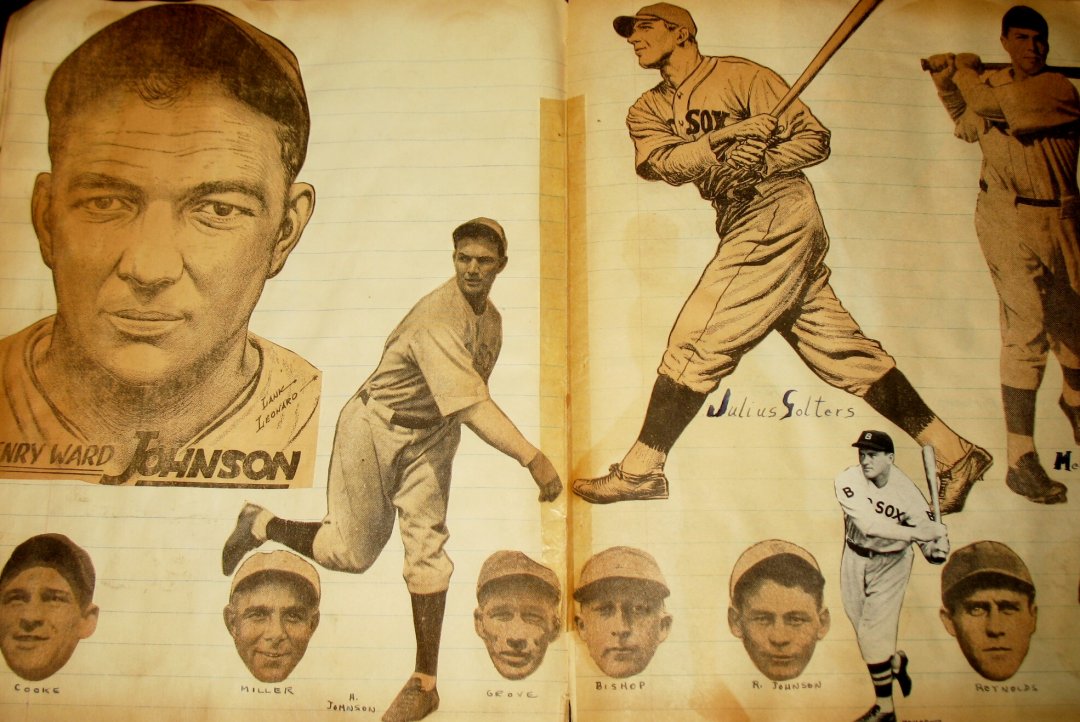
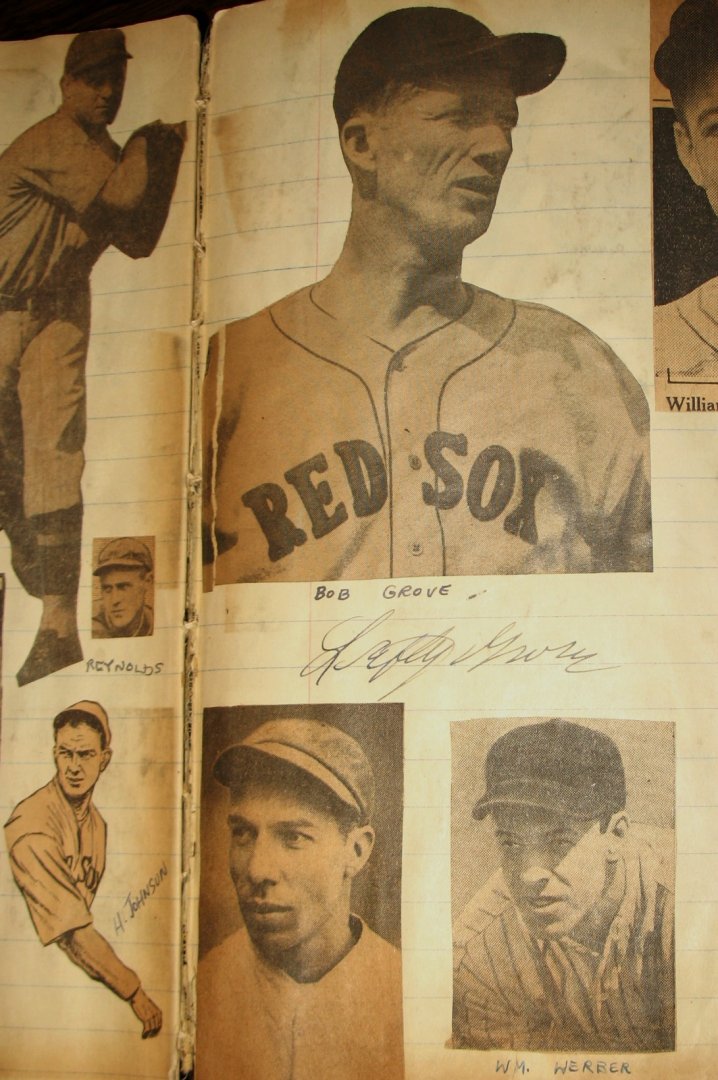
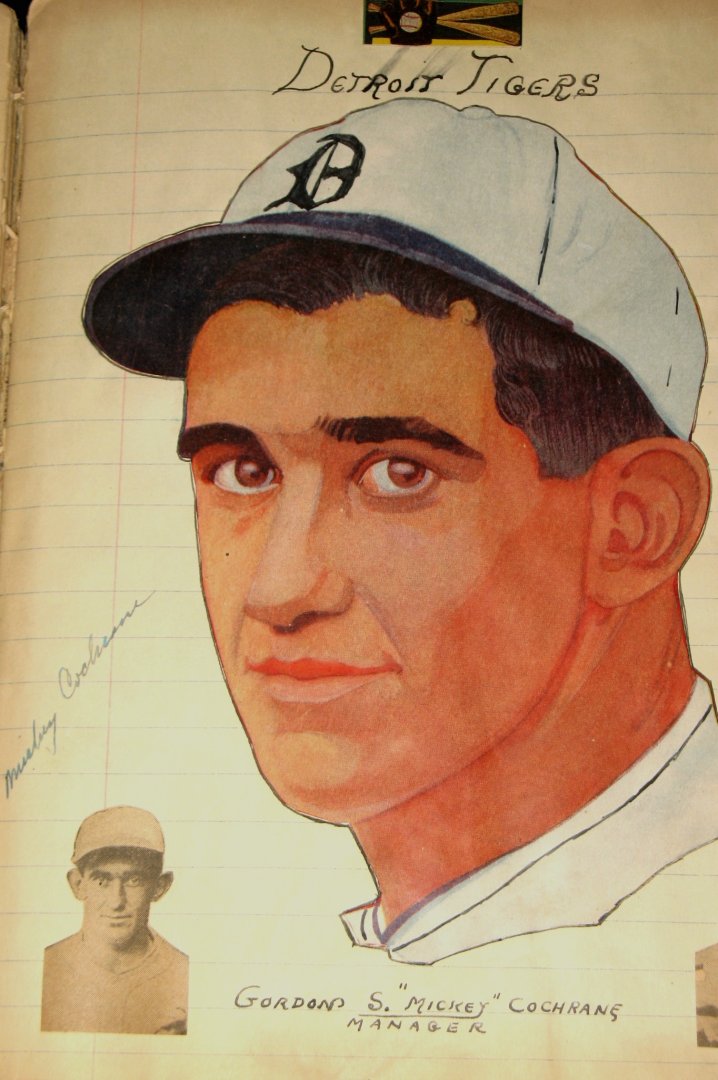
Ray picked-up a bright orange plastic bag from the bottom of the bookshelf, the kind you’d get from the local Chinese take out.  He pulled out two weathered books, practically falling apart, one dated 1932, the other, 1933.  They were filled with pictures of players from every team in baseball.  Ray cut-out images mostly from The New York Sun, The Saturday Evening Post, assorted baseball magazines as well as baseball cards.  Then, along with some friends, he’d scout the hotel lobbies where the out-of-town teams stayed, to get autographs.

Untitled

The books are lovingly, obsessively assembled, filled with small notations.  Ray expressed some embarrassment when I complemented him on how wonderful, how personal the books are. He dismissed his sketch of the Babe as being awful, but I liked it and his wife did too.

Ray asked if he should sell the books–after all, he’s got a couple of Lefty Groves in there, a Honus Wagner, Dizzy Dean.  Phyliss said that she didn’t think that was a good idea. I quickly agreed.

“You can’t sell these,” I said.  “They belong in a museum or for your grandkids.”

As I looked carefully through the two books, Ray kept wondering if he should sell them.  I said, “No way,” but when I left I felt foolish.  Who am I to say that he shouldn’t sell them?  There is probably some serious money in those two books.  Still, they feel too personal to part with.  They are not kept under a glass case, they are in a plastic bag on the shelf, a secret baseball treasure on the Upper East Side.

Yesterday, the New York Times featured a short essay by Ray Robinson about his scrapbooks.

Check it out and dig what I was able to see:
Untitled

Untitled

(more…)

Inside Man: A Bronx Tale (Part Three)

Real Life

When Reggie Jackson left New York, Ray Negron’s glory days came to an end. Now, he had to adjust to a more mundane reality, and a greater challenge—how to advocate for himself. Negron had defined himself by what he could provide to other, more famous men.

"Growing up is hard," says Negron. "In baseball, you are a kid forever. When I left the Yankees, I didn’t have the players to protect me anymore." Negron married his longtime girlfriend Barbara Wood in 1981; they got an apartment in Far Rockaway, had a son four years later, and were divorced before the end of the decade. "It was hard to give my heart and soul to a situation when I didn’t really want to be there," he says.

While he was with the Yankees, Negron gradually lost touch with his half-brothers who were caught up in the street life, junkies while they were still teenagers. "It wasn’t until the eighties that we got back together again," says Negron. "To them, I was wealthy. When they reached out it would be out of desperation or need. Then my brothers started having kids all over the place, and I couldn’t handle it, I couldn’t handle it." Negron is shy when talking about them because he doesn’t want to embarrass them. "They think that I think that I’m bigger than them. I mean, it becomes very tough because they are still your blood, you understand?"

Negron’s two cousins who had been with him the day he first met Steinbrenner, Edwin and Christopher Perez, died within a year of each other during the mid-eighties; Edwin, in what Negron calls "a gang-related incident," and Christopher, from AIDS, which he got through a dirty syringe. Negron was with Christopher the night Edwin was murdered in Brooklyn. They drove to the Perez home in Brooklyn and were greeted outside of the house by Christopher’s father, and a group of cousins and neighborhood friends.

"My uncle had a cardboard box in his arms filled with guns. He said, ‘Take one, let’s go.’ That wasn’t my style, so I stayed at the house with my aunt. ‘She’s going to need somebody to be with her,’ I said. I wasn’t going to get caught up in that. That wasn’t me. I loved Billy the Kid," he says remembering Martin, "but I wasn’t that Billy the Kid."

(more…)

Inside Man: A Bronx Tale (Part Two)

Prince of the City


Ray Negron was only supposed to work a couple of games to re-pay his debt, but then one of the regular bat boys got sick, and in no time, Negron had himself a steady job. He moved on the field with the languid movements of a professional, his uniform fitting tightly, his stirrups pulled up just so. At 145 lbs, Negron was too skinny to be confused with a big leaguer though the players occasionally tried to pass him off as one of them when he was on the road with them, to get him laid. "You said it, not me," Negron squeals with delight, remembering today.

When the Yankees took batting practice, Negron was busy with the daily clubhouse chores, but he would sneak in a couple of swings in the batting cage or hang around at shortstop and take ground balls while the visiting team came to hit. One day, the Texas Rangers were in town and Negron was playing short against live bp when he made a couple of good fielding plays. Billy Martin, the Rangers manager, a man rarely without a fungo bat in his hand, was standing on the third base side of home plate. He turned his attention to the boy, motioned with his hand and then tossed a ball up and cracked a hard groundball at him.

"Billy noticed that I could play," Negron recalls. "Later, he introduced me to two of his middle infielders, Lenny Randle and Davey Nelson. Every time Texas came to town, I would ball boy down the right field line so I could hang with them. They taught me and to this day, I can honestly say that I’m still friends with both of them."

"I was impressed by his etiquette and his manners," recalls Lenny Randle today. "A lot of kids are annoying at that age, they just want stuff from you. But Ray wasn’t pushy, he was honest and had an innocence and genuine enthusiasm about him. He was the kind of little brother you wanted to have. Hey, when he was a teenager he was booking us to speak at the Y, at local Little Leagues for a couple of hundred bucks here and there. He had moxie."

(more…)

Inside Man: A Bronx Tale

A Four-Part Bronx Banter Exclusive

[Author’s Note: This story was written last summer. It covers Ray Negron’s life from the spring of 2006 through the spring of ’07. Some of the basic facts stated in the piece have changed: Joe Torre is no longer the manager of the Yankees; Hank and Hal Steinbrenner have taken control of the team; Negron has just completed his seventh children’s book for Harper Collins. But, despite these events, the essence of Ray’s story remains true. I hope you enjoy.]

Part One

“Let me show you the Boss’s suite,” says Ray Negron. It is a cool evening in early May, 2006, and Negron’s boss, George Steinbrenner, the principal owner of the New York Yankees, is out of town. Several hours before game time, Negron, 51, is walking down the outer corridor of the loge section at Yankee Stadium, his head cocked like an upper classman with the run of the school. He exudes an insouciant confidence, the kind of man who is used to keeping his cool in hot situations. Negron has short black hair and skin the color of café au lait. His large, liquid brown eyes and long eyelashes are almost feminine; his cheeks sag–the sign of a thin man growing older—and lend a sense of gravity to an otherwise boyish countenance. As usual, Negron looks crisp. He is wearing a gray, patterned suit and slim brown shoes. On his right ring finger is a massive gold World Series ring from the 1996 Yankees.

“I can’t wait for the new Stadium,” Negron says. “Maybe I’ll get an office.”

“The ubiquitous Ray Negron,” a veteran New York sportswriter calls him. Negron is a gypsy, constantly on the move, from the executive suites through the press box down to the locker room. He does not even have his own desk; instead, he totes everything he needs in a leather-bound book with a Spaulding logo embossed on the cover: Negron serves as a director of community relations for the sporting goods company, one of his many jobs. The book is filled with notes scribbled in different colored inks–reminders, phone numbers and addresses.

Negron knows everybody and stops to say hello to security guards and executives, retired sportswriters, scouts, and current players. Negron works for the Yankees as a special advisor to Steinbrenner and is primarily employed as an all-purpose utility man. He represents the club at the Kip’s Bay Boys and Girls club, the Hackensack University Medical Center, and grass roots community centers in the Bronx. Like a greeter in a casino, he escorts business men and their children through the corridors of the Stadium, giving his own private tour, and he schmoozes with celebrity visitors, like Patti Labelle, Regis Philbin and Richard Gere, making sure they are comfortable in their seats. Negron, of Puerto Rican and Cuban ancestry, is an avuncular figure to the team’s young Latin players like Robinson Cano and Melky Cabrera. This summer, Negron will enlist the two, along with other Yankee players, to visit classrooms, hospitals and boys and girls clubs around the tristate area, as he promotes his first children’s book, The Boy of Steel, a story about a young boy with cancer who becomes bat boy for the Yankees for a day.

Few people know Yankee Stadium as well as Negron and few people have been around Steinbrenner’s Yankees longer. And it all happened by chance. In 1973, Steinbrenner’s first year as team owner, the Boss caught Negron, a skinny kid with an afro, spray painting an “NY” logo on the outside of Yankee Stadium. But instead of handing him over to the police, Steinbrenner made Negron a bat boy, issuing the kind of punishment that is the stuff of a boy’s wildest fantasies. So began a career in baseball that has lasted more than thirty years. Negron has done everything from shine the players’ shoes and collect their dirty jockstraps, to bring them food from their favorite restaurants and park their cars. He has been an agent, an actor, an advisor, and a liaison; a confidant, a sounding board and a whipping boy to some of the biggest egos in the game. He is whatever he needs to be.

Negron has founded a career off his serendipitous meeting with Steinbrenner and everything that has happened next—from Billy and Reggie to Doc and Darryl. “The Boss essentially saved my life and I’ll never forget that,” says Negron, touching my arm. He likes physical contact, and occasionally touches his listener in a jocular, reassuring way to make sure you’re listening. He speaks in a measured, cautious manner, his raspy voice tinged with an unmistakable Brooklyn accent. Ray speaks so often in public that in private his conversation sometimes feels rehearsed, like he’s an actor repeating the same lines over and over in a play. Yet he is so sincere that it feels as if he’s telling you something for the first time, even if it’s a variation of something he’s said countless times before.

Negron pauses and then adds, “Not saved, really, he gave me a life.”

(more…)

feed Share on Facebook Share on Twitter Share via email
"This ain't football. We do this every day."
--Earl Weaver